humanistic approach chapt 5
 Studied by 0 people
 Call Kai
 Learn
Learn Practice Test
 Spaced Repetition
 Match
Match Flashcards
 Knowt Play
1/11

There's no tags or description
Looks like no tags are added yet.
Name | Mastery | Learn | Test | Matching | Spaced | Call with Kai |
|---|
No analytics yet
Send a link to your students to track their progress
12 Terms
key assumptions
we have choices in how we act + behave (free will)
we are self-determining and free from casual influences of the past (biological/environmental)
reject scientific models
measure viewpoints + perspectives openly + subjectively as objective data does not give an in-depth understanding
study the whole person, not a part (holism)
look at unique cases rather than groups of people that cannot be replicated as they are subjective - person-centred approach
what are the 5 levels of Maslow’s hierarchy of needs
self actualisation
self-esteem
love and belonging
safety and security
physiological needs
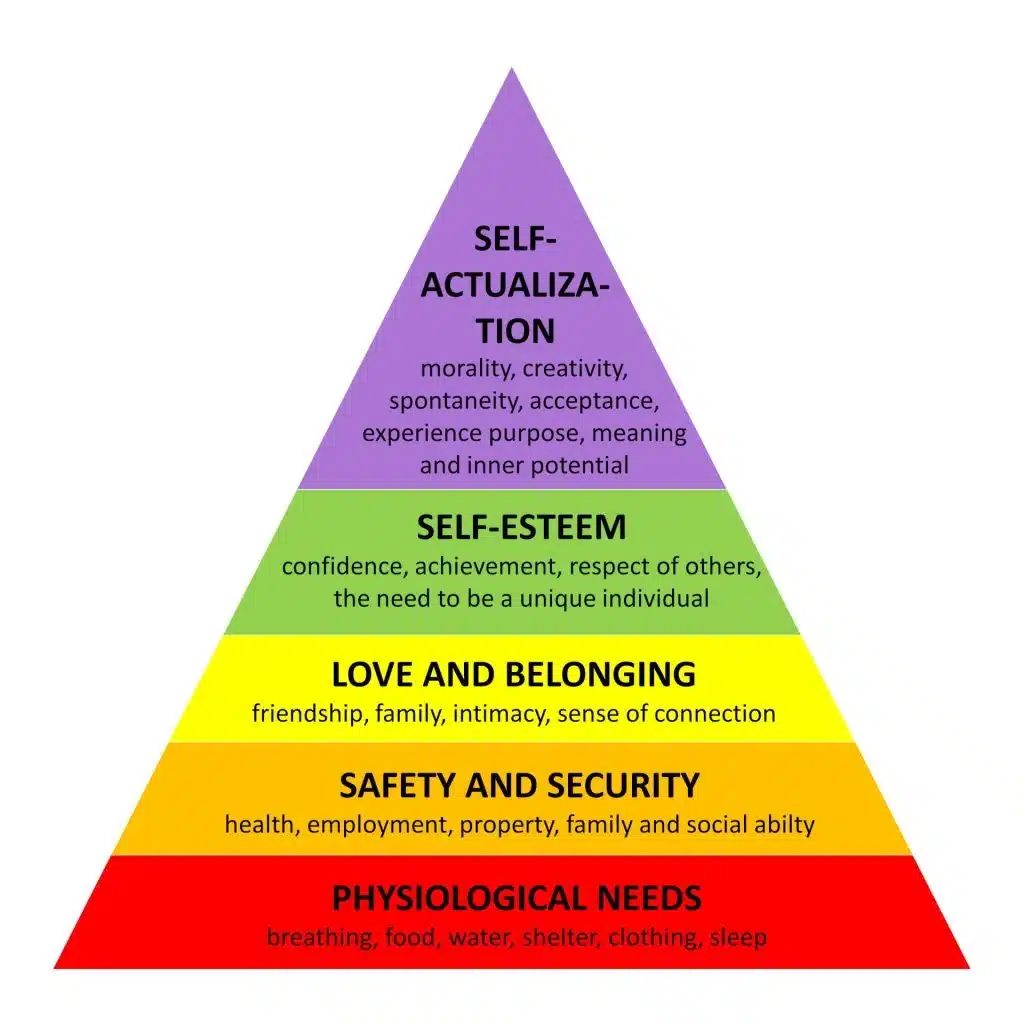
why is self-actualisation the goal?
Humanistic psychologists see personal growth as an essential part of what it is to be human - however not everyone can achieve this as it is difficult
Carl Rogers - congruence
describes the state in which a persons ideal self and self-concept (actual self) are consistent or very similar
Carl Rogers - incongruence + why can they not reach self -actualisation?
A large gap between a persons’ self-concept (perceived self) and ideal self which means that they cannot reach self-actualisation as incongruence leads to low self esteem.
what did Carl Rogers believe about issues we experience as adults e.g. anxiety or low self esteem
They are rooted in childhood - if parents don’t love their children unconditionally and set conditions of worth (parent places limits/boundaries on their love for their children) it will reduce the individuals sense of ‘worth’ leading to psychological problems
According to Carl Rogers, how do healthy personalities develop + what did he believe?
growth will only happen in an environment that provides genuineness, acceptance and empathy + everyone can achieve their goals in life
What did Carl rogers develop + what was it + what did it provide?
He developed client-centered therapy (counselling) to help people reduce the gab between their self-concept (perceived self) and their ideal self. Rogers wanted to provide his clients with unconditional positive regard that they had failed to receive as children
evaluation - cultural bias
limitation - many of the humanistic ideas (e.g. autonomy, individual freedom and personal growth) are associated with countries that have more individualist tendencies (e.g. US). countries with more collectivist tendencies emphasise the needs of the group and interdependence. This means that it is possible the humanistic approach does not apply universally and is a product of the cultural context within which it was developed
evaluation- it is optimistic
strength - humanistic psychologists see people and promote a positive image of human nature, unlike Freud who believed people are controlled by past experiences and lived between unhappiness and despair, humanistic psychologists believe people are basically good, have free will and can achieve their potential. this means that the humanistic approach brings a positive and refreshing alternative to other approaches.
evaluation- not reductionist
strength - rejects reductionism (attempts to break up behaviour and experience into smaller components) unlike behaviourist - explains behaviour using a stimulus-response links + cognitive- sees humans as information-processing machines + biological -reduces behaviour to physiological processes + psychodynamic- Freud explained personality as the conflict between the id, ego and superego. Humanistic approach support holism meaning that behaviour can only be understood by studying the whole person and their subjective experiences. This may increase validity because it considers behaviour in a real-world context
evaluation - not reductionist counterpoint
limitation - reductionist approaches may be more scientific as they include experiments. Experiments reduce behaviour into independent + dependant variables however humanistic psychology cannot do this because there are no concepts that can be broken down to a single measurement due to it holistic nature. This means that the humanistic approach is short on empirical evidence to support its claims
 Note
Note  Flashcards (132)