3.3: Transport in plants
 Studied by 0 people
 Call with Kai
 Learn
Learn Practice Test
 Spaced Repetition
 Match
Match Flashcards
 Knowt Play
1/120

There's no tags or description
Looks like no tags are added yet.
Name | Mastery | Learn | Test | Matching | Spaced | Call with Kai |
|---|
No study sessions yet.
121 Terms
Why do large multicellular plants need transport systems?
Because they are large (diffusion too slow), have small SA:V ratio, and high metabolic demands.
Why is diffusion alone insufficient in large plants?
The distance between cells and exchange surfaces is too great, making diffusion too slow
What are some of the substances that plants need?
mineral ions and sugars
What are dicotyledonous plants?
plants with two seed leave
What are the two main transport systems in plants?
Xylem (water & minerals) and phloem (sugars & assimilates)
What is a vascular bundle?
the general term for veins (xylem, phloem and cambium)
What is the xylem tissue?
consists of many dead, hollow vessels that carry water and dissolved mineral salts up from the roots
What is the phloem tissue?
tissue consisting of mainly tubular, living cells that carry dissolved organic substances e.g sucrose around the plant
What is the cambium?
a tissue usually found in between the xylem and phloem. They are meristem cells that can divide to form the xylem and the phloem
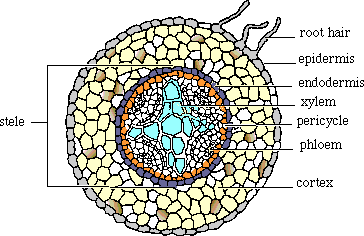
Where are the vascular bundles located in roots?
In the centre, with xylem forming an X shape and phloem between arms.
Draw a scientific drawing of the root and label it
Why are vascular bundles central in roots?
To withstand pulling forces as the root pushes through soil.
What tissue surrounds the vascular bundle in roots?
The endodermis, with the pericycle just inside it.
What is the pericycle?
a layer of meristem cells
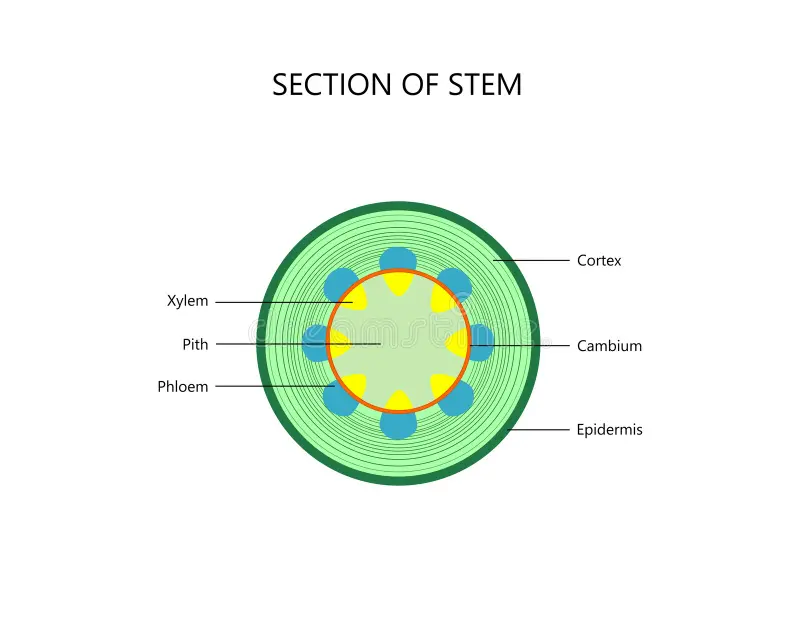
Where are vascular bundles found in herbaceous dicot stems?
Around the edge of the stem.
In a stem’s vascular bundle, which tissue is inside and which is outside?
Xylem is on the inside, phloem on the outside.
What lies between the xylem and phloem in a stem?
The cambium (a meristem producing new xylem & phloem).
Draw a scientific drawing of the stem and label it
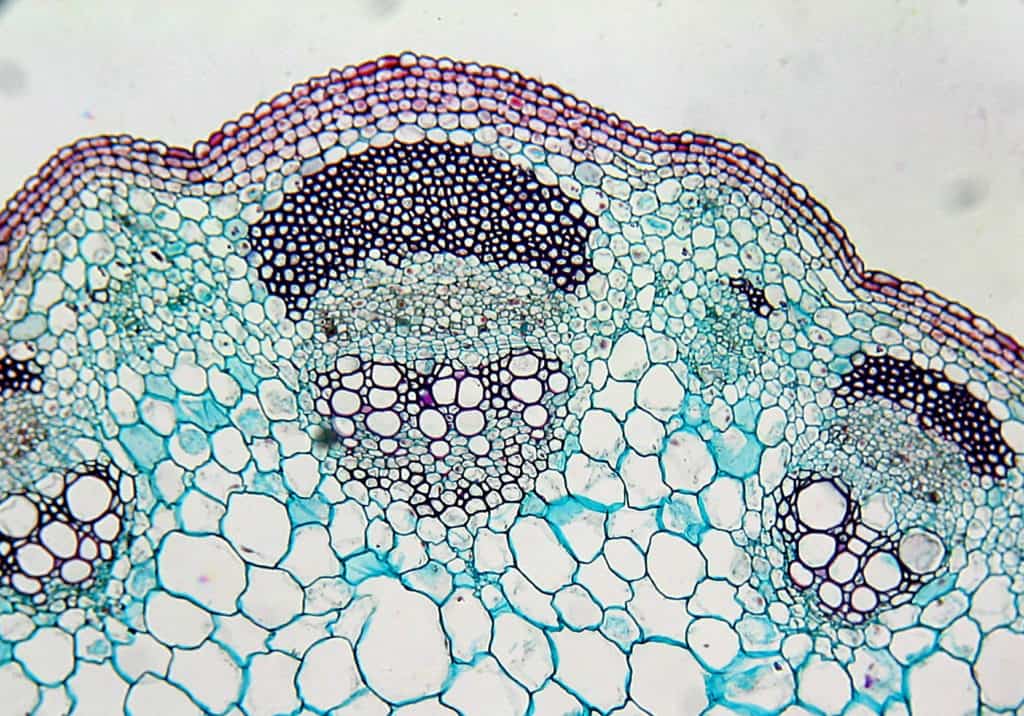
Label the 4 parts of this image of the stem
lignified fibres (provide support); functional phloem; cambium; xylem
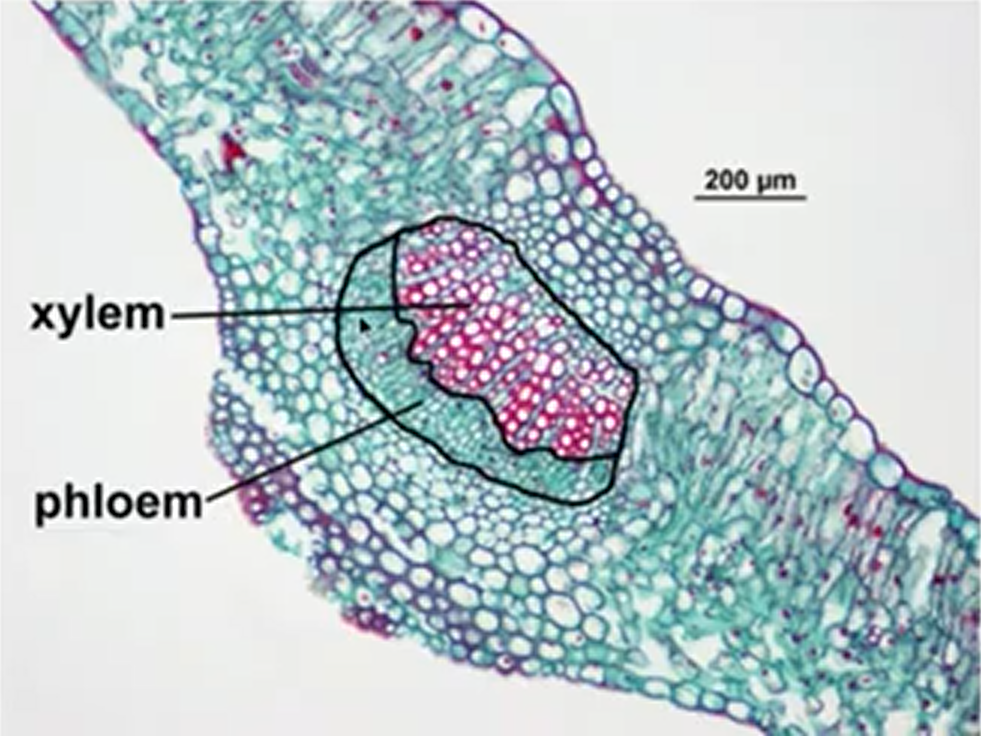
In leaves, which is positioned closer to the upper surface – xylem or phloem?
Xylem (upper side); phloem below.
Draw a labelled image of the leaf
including epidermis, palisade cells on top and mesophyll on the bottom
What does the xylem transport?
water and mineral ions UP from the roots to the leaves and other parts of the plant + supports the plant
Where in the xylem is lignin and what does it do?
the xylem’s cell walls are impregnated with lignin which is waterproof. It prevents the walls from collapsing and strengthens it
How can lignin be structured in the cell wall and what does it do?
spiral, annular or reticulate patterns allows the xylem to stretch as the plant grows, and enables the stem or branch to bend
What is the consequence of lignin?
it kills the cells
What type of cells make up the xylem?
dead cells end to end. It is a continuous tube from the root to the leaf with no end-walls
What are bordered pits?
areas in the xylem without lignin thickening that allow the lateral movement of water between vessels and into living tissues
Why is the flow of water not impeded?
there are no cross-walls
there are no cell contents, nucleus or cytoplasm
lignin thickening prevents the walls from collapsing
What does the phloem transport?
assimilates (mainly sucrose and amino acids) around the plant
How is the sucrose transported?
it is dissolved in water to form sap
What does the phloem tissue consist of?
sieve tube elements + companion cells
What do sieve tube elements line up end to end to form?
sieve tubes
What type of cells make up sieve tube elements?
living cells
Why do sieve tube elements have no nucleus and very little cytoplasm?
to leave space for mass flow of sap to occur, making it efficient
What are sieve plates?
perforated structures found at the end of sieve tube elements
What do the sieve plates allow?
the movement of the sap from one element to the next
What are companion cells?
small cells found in between the sieve tubes that help to load sucrose into the sieve tubes
What organelles do companion cells mainly contain?
large nucleus
dense cytoplasm
numerous mitochondria
Why do companion cells need many mitochondria?
to produce ATP need for the active loading of sugars into sieve tubes
What connects the companion cells to the sieve tubes?
the plasmodesmata
What is the overview of how water moves in a plant?
Soil → Root hair cells → Cortex → Xylem → Leaf mesophyll → Air (via stomata).
What are the three pathways that water moves through the root to reach the xylem?
apoplast pathway
symplast pathway
vacuolar pathway
What is the symplast pathway?
Water moves through the cytoplasm of cells, connected by plasmodesmata (tiny cytoplasmic connections).
This is a slower route, but allows more control over what passes through the plasma membrane.
Driven by osmosis — from cell to cell, down a water potential gradient.
What happens in the vacuolar pathway?
it is similar to the symplast pathway except that water also passes through the tonoplast into vacuoles
What happens in the appoplast pathway?
Water moves through cell walls and intercellular spaces, not through the cytoplasm.
It’s a passive, fast route because the cell walls are porous and offer little resistance.
Water moves by mass flow as mineral ions and salts can be carried with the water
By which process does water enter from the soil?
osmosis, as the water is going through a membrane
What is water potential?
the tendency of water molecules to move from one place to another
Why is the water potential in plant cells always negative?
as the cytoplasm contains mineral ions and sugars that will reduce the water potential
How does a plant cell become turgid?
when it is placed in water, water moves down the water-potential gradient into the cell. the cell does not burst due to the strong cellulose cell wall
How does a plant cell become flaccid?
when a plant cell is placed in a salt solution with a very negative water potential, water will move out. Eventually, cytoplasm and vacuole shrink - plasmolysis
What is transpiration?
the loss of water vapour from a plant’s surface, mainly through the stomata in the leaves.
What type of process is transpiration?
passive process - no ATP is directly used.
What is the transpiration stream?
the movement of water up the xylem
Outline the steps in transpiration
water enters the leaf through the xylem, and moves by osmosis into the cells of the spongy mesophyll
water evaporates from the cell walls of the spongy mesophyll into the leaf’s air spaces
water vapour moves by diffusion out of the leaf through the stomata down a water vapour potential gradient
How is transpiration a consequence of gaseous exchange?
Plants must open stomata to take in CO₂ for photosynthesis.
This allows water vapour to diffuse out (because water potential inside the leaf is higher than in the air).
So transpiration is an unavoidable side effect of gaseous exchange.
Why is transpiration essential?
transports useful mineral ions up the plant
maintains cell turgidity
provides water for photosynthesis
enables evaporative cooling (prevents overheating)
What are the environmental factors affecting the rate of transpiration?
light intensity
temperature
humidity
air movement (wind)
water availability
How does light intensity affect the rate of transpiration?
↑ light → stomata open → ↑ transpiration
Why does light intensity have this effect on the rate of transpiration?
in light, the stomata open to allow gaseous exchange for photosynthesis
How does temperature affect the rate of transpiration?
↑ temp → evaporation → ↑ diffusion rate → ↑ transpiration
Why does temperature have this effect on the rate of transpiration?
increases the kinetic energy of water molecules increasing the rate of evaporation of water vapour into the air spaces so that water vapour potential in the leaf increases
increases the concentration of water vapour that the surrounding air can hold before becoming saturated
How does humidity affect the rate of transpiration?
↑ humidity → ↓ transpiration
Why does humidity have this effect on the rate of transpiration?
as there will be a smaller water vapour potential gradient between the air spaces in the leaf and the air outside
How does air movement affect the rate of transpiration?
↑ wind → ↑ transpiration
Why does air movement have this effect on the rate of transpiration?
air moving outside the leaf will carry away water vapour that has just diffused out of the leaf. This will maintain a high water vapour potential gradient
How does water availability affect the rate of transpiration?
↓ water → stomata close → ↓ transpiration
Why does water availability have this effect on the rate of transpiration?
lack of water in the soil causes the plant to be in water stress. Closing the stomata, reducing the rate of transpiration. Plants want to minimise water loss
What is some of the evidence for root pressure?
poisons - they stop mitochondria and ATP production and so no ions are pumped meaning no root pressure
temperature - increasing temp increases root pressure as chemical reactions (Respiration and active transport) happen faster
oxygen - decreasing o2 levels decreases root pressure as ATP from respiration is needed
What is some of the evidence for cohesion-tension theory?
change in diameter - increased transpiration in the day increases pressure and tension so tree diameter decreases but at night, diameter is the largest as there is less pressure
cutting the xylem - breaks the continuous water column and water is no longer pulled upward and air is drawn into the xylem
radioactive tracer - plants given water containing radioactive oxygen confirming the pathway of water up the xylem
What is a potometer?
A potometer measures the rate of water uptake by a plant shoot, which is assumed to approximate the rate of transpiration.
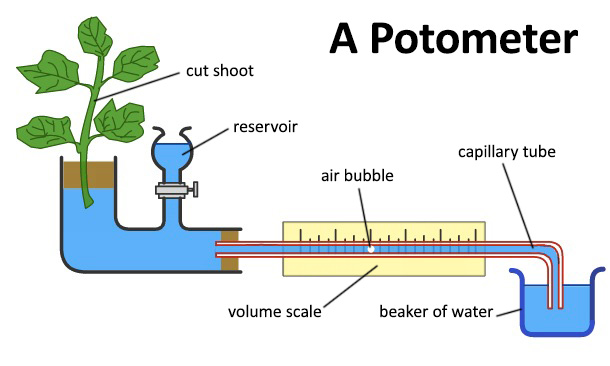
How do you set a potometer?
select a healthy plant to be investigated
cut the stem underwater at an angle (prevents bubbles and increases surface area)
keep the cutting beneath water level this ensures the column of water in the xylem is not broken
fill the potometer with water and introduce an air bubble into the capillary tube
place the whole potometer under water, and carefully insert the top of the cutting into the potometer - petroleum jelly can help seal the cutting in
dry the leaves, allow to settle. The plant can now be exposed to different environmental conditions and the rate of water uptake can how be measured
Why does the potometer not accurately measure the rate of water uptake?
as some of the water can be used in turgor pressure and some of the water may be used in photosynthesis
What is the equation of rate of water uptake?
Rate of water uptake=Distance bubble moved / time
Unit: cm s⁻¹ or mm min⁻¹
How can you calculate the volume of water uptake?
𝜋𝑟2ℎ - r-radius if the tube, h-distance moved by air bubble
What are some variables that should be controlled?
Leaf surface area (use the same plant type or measure area)
Light intensity
Temperature
Air movement
Humidity
How does water enter root hair cells by osmosis?
there is a lower water potential in root hair cells; due to a higher concentration of solutes
What is the casparan strip?
a strip located in the endodermis that blocks the apoplast pathway and forces water to travel through the symplast pathway
What is the casparian strip made of?
suberin (waxy, waterproof).
What does the casparian strip ensure?
ensures that water and dissolved mineral ions have to pass into the cell cytoplasm through the plasma membrane
How does the apoplast pathway converge with the symplast pathway?
plant actively pumps ions into the endodermal cell cytoplasm
this lowers the water potential inside the cell
water moves into the cell by osmosis
water enters the xylem converged
How does water move up the xylem?
by mass flow - a flow of water and mineral ions in the same direction
How does water get from the roots to the xylem to the leaves?
there is a high hydrostatic pressure in the roots due to water moving in by osmosis and there is low hydrostatic pressure in the leaves as water evaporates through the stomata. Water moves from a high hydrostatic pressure to a low hydrostatic pressure down its hydrostatic pressure gradient from the xylem to the leaves
Define cohesion.
Attraction between water molecules (hydrogen bonding) causing them to ‘stick together’
Define adhesion.
Attraction between water molecules and xylem vessel walls.
How does water move up the xylem?
it uses cohesion and adhesion together
What is the cohesion-tension theory?
that the cohesive forces in the xylem helps to maintain a continuous column of water in the xylem vessels, which transports water from the roots to the leaves
How does adhesion work?
it counters the force of gravity and assists in pulling the water column higher
What is the transpiration pull?
Evaporation of water at leaves creates the transpiration pull, and this tension is transmitted down the whole water column due to cohesion.
How are the leaves adapted to reduce water loss?
waxy cuticle helps to prevent evaporation
fewer stomata on their top surface
curled leaves to reduce the effects of wind
What are xerophytes?
Plants adapted to survive in very dry environments with limited water.
What are hydrophytes?
Plants adapted to live in or on water, where water is abundant
Why do xerophytes need special adaptations?
To reduce water loss and maintain water balance in dry conditions.
Why do hydrophytes need special adaptations?
To cope with excess water and low oxygen availability in flooded soils.
How does a thick waxy cuticle help xerophytes?
Reduces evaporation by making the leaf surface waterproof.
Why do some xerophytes have sunken stomata?
Traps humid air, lowering the water potential gradient, so less water is lost.
What is the advantage of rolled leaves in marram grass?
Traps moist air around stomata inside the rolled leaf, reducing transpiration.
How do hairs on marram grass leaves help conserve water?
Trap humid air, reducing air flow and water loss.
What are succulents? Give an example
A type of xerophytic plant adapted to arid environments by storing water in thick, fleshy tissues such as leaves or stems e.g cacti
Why do cacti have spines instead of leaves?
Reduces surface area for transpiration and deters herbivores.
What is the role of succulence in xerophytes?
Stores water in tissues to use during drought.
 Note
Note  Flashcards (38)