Microbiology
0.0(0)
 Studied by 5 people
 Call Kai
 Learn
Learn Practice Test
 Spaced Repetition
 Match
Match Flashcards
 Knowt Play
Card Sorting
1/100

Earn XP
Description and Tags
Last updated 5:19 PM on 2/8/23
Name | Mastery | Learn | Test | Matching | Spaced | Call with Kai |
|---|
No analytics yet
Send a link to your students to track their progress
101 Terms
1
New cards
Define the term microbiology
• Microbiology is the study of the biology of microscopic organisms such as viruses, bacteria, algae, fungi, slime molds, and protozoa
2
New cards
Explain Carl Woese’s contributions in establishing the three-domain system for classifying cellular life
Carl Woese’s discovery:
• Arranges them by biochemical traits, psychological traits, but most importantly arranges them based on rRNA. Seperated into the three domains
• Arranges them by biochemical traits, psychological traits, but most importantly arranges them based on rRNA. Seperated into the three domains
3
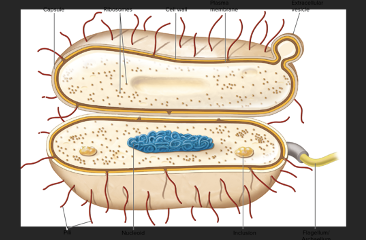
New cards
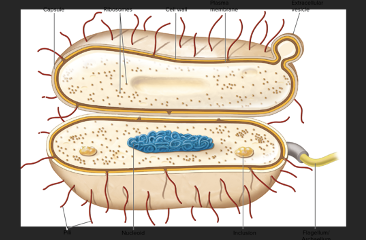
Know the differences/similarities between the three domains of life; Explain how the three domains determined?
• Bacteria: Single-celled organism, most have cell walls that contain the structural molc peptidoglycan. No membrane bound organelles.
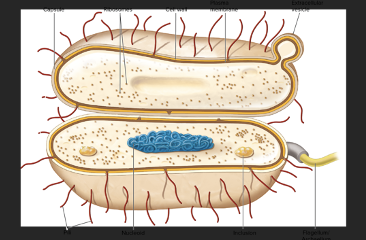
• Archaea: Distinguished from bacteria by many features, most notably their distinctive rRNA seq, cell walls, and membrane lipids. No membrane bound organelles. Mostly found in extreme environments
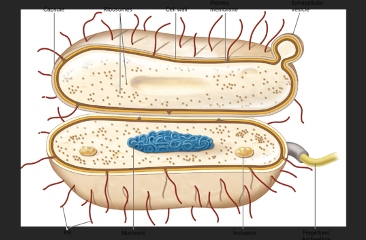
• Eukarya: Includes plants, animals, and microorganisms classified as protist or fungi. They are multicellular and contain membrane-bound organelles. They have a nucleus (unlike a nucleoid in bacteria)
• Archaea: Distinguished from bacteria by many features, most notably their distinctive rRNA seq, cell walls, and membrane lipids. No membrane bound organelles. Mostly found in extreme environments
• Eukarya: Includes plants, animals, and microorganisms classified as protist or fungi. They are multicellular and contain membrane-bound organelles. They have a nucleus (unlike a nucleoid in bacteria)
4
New cards
Explain how the RNA theory and how life began
• RNA World: Created by Gilbert to describe this precellular stage in the evolution of life because lipids, major structural components of the membranes of modern organism, spontaneously form liposomes.
• DNA evolved; it became the storage facility for genetic information because it provides a more chemically stable structure. Two pieces of evidence support the RNA theory; the fact that the energy currency of cells, ATP, is a ribonucleotide and the discovery that RNA can regulate gene expression.
• DNA evolved; it became the storage facility for genetic information because it provides a more chemically stable structure. Two pieces of evidence support the RNA theory; the fact that the energy currency of cells, ATP, is a ribonucleotide and the discovery that RNA can regulate gene expression.
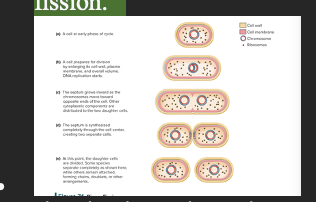
5
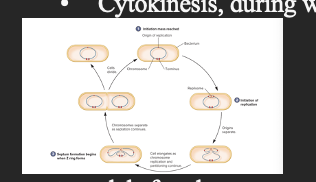
New cards
Describe the Miller-Urey experiment
and Explain what the first macromolecule to initiate life on earth was
and Explain what the first macromolecule to initiate life on earth was
• Miller and Urey: Suggested that the primordial soup or these conditions there were on earth could support the production of macromolecule (aka aa)
Prebiotic chemistry
\
How they did it:
They had two flask that were interconnected with a bunch of tubes. The flask on the left was the basis of this ‘primordial soup’ the flask was filled half way with water and the gases present in early earth's atmosphere (ammonia, methane, H2, N2, etc.). This flask also had electrodes running through it to stimulate lightning. The flask on the right was filled with water and then heated. This heated water was then condensed to stimulate rain and condensation. They kept this running until the first macromolc presented itself, which was amino acids.
Prebiotic chemistry
\
How they did it:
They had two flask that were interconnected with a bunch of tubes. The flask on the left was the basis of this ‘primordial soup’ the flask was filled half way with water and the gases present in early earth's atmosphere (ammonia, methane, H2, N2, etc.). This flask also had electrodes running through it to stimulate lightning. The flask on the right was filled with water and then heated. This heated water was then condensed to stimulate rain and condensation. They kept this running until the first macromolc presented itself, which was amino acids.
6
New cards
Explain the endosymbiotic hypothesis and list evidence to support this hypothesis.
• Endosymbiotic theory/hypo: Generally accepted as the origin of several euk organelles including mitochondria, chloroplast, and hydrogenases. Proposed that over time a bacterial endosymbiont of an ancestral cell in the euk lineage lost its ability to live independently.
• Endosymbiosis: An interaction between two organisms in which one organism lives inside the other
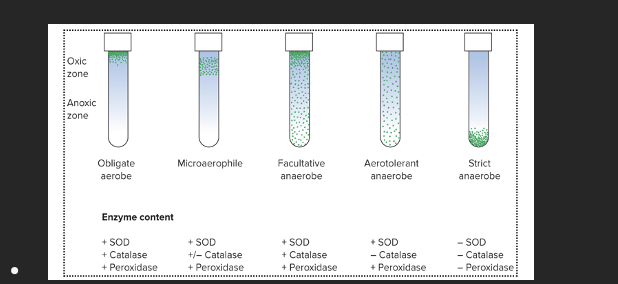
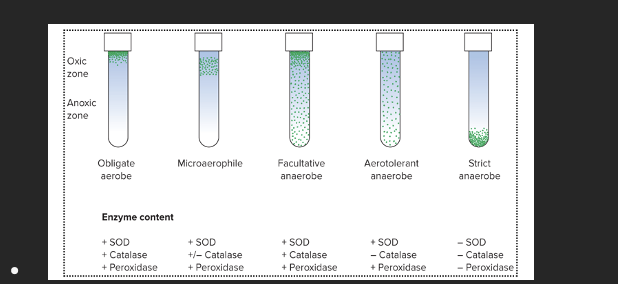
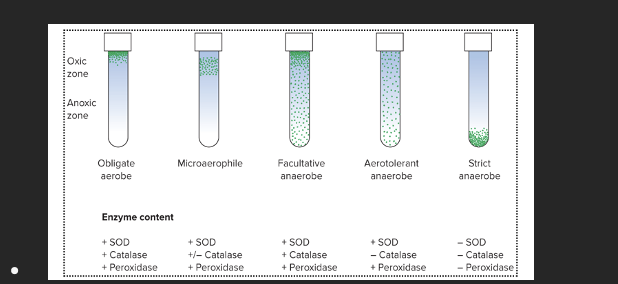
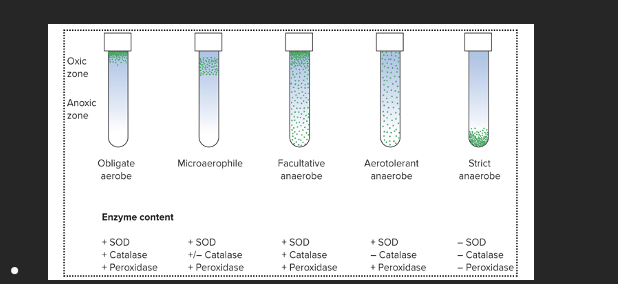
Evidence: Mitochondria and chloroplasts contain DNA and ribosome; both are like bacterial DNA and ribosomes.
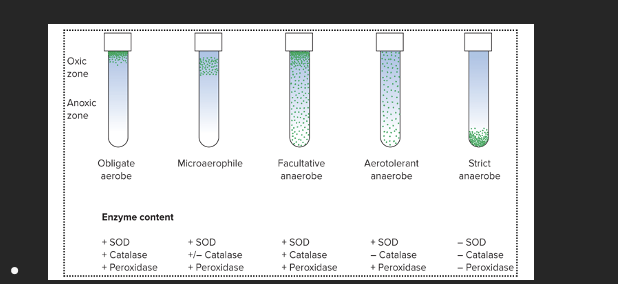
• Endosymbiosis: An interaction between two organisms in which one organism lives inside the other
Evidence: Mitochondria and chloroplasts contain DNA and ribosome; both are like bacterial DNA and ribosomes.
7
New cards
Identify the importance of the contributions made by Hooke
Hooke: First to observe ‘cells’ from cork; created compounds microscope and overserve 30x magnification
8
New cards
What did Leeuwenhoek create?
• Leeuwenhock: Ground a magnifying glass that allowed him to see 275x magnification
• Not a compound microscope and first to observe single cell microbes
• Not a compound microscope and first to observe single cell microbes
9
New cards
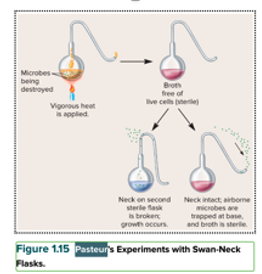
What did Pasteur do?
Swan Neck Flask experiment to stop spontaneous generation theory
\
• Also started the vaccination development: Aged culture of Cholera didn’t kill or infect the chicken. So he thought that maybe injecting the chicken with aged Cholera would give it immunity to Cholera this was true, they were immune
\
• Also started the vaccination development: Aged culture of Cholera didn’t kill or infect the chicken. So he thought that maybe injecting the chicken with aged Cholera would give it immunity to Cholera this was true, they were immune
10
New cards
Fleming
Discovered the first antibiotic that could successfully control bacterial infections
11
New cards
Koch Postulates
(1) Microbe is always present in a disease host. This was absent in health host. The problem with this is that some host can be healthy carriers.
(2) Microbe is grown in pure culture (isolated in lab). No other microbes were present. But the problem with that is that some are unculturable.
(3) Pure microbes are introduced into healthy host. Individual becomes sick form infections. But the problem with this is that it was unethical.
(4) Some microbe is re-isolated from now-sick individuals
(2) Microbe is grown in pure culture (isolated in lab). No other microbes were present. But the problem with that is that some are unculturable.
(3) Pure microbes are introduced into healthy host. Individual becomes sick form infections. But the problem with this is that it was unethical.
(4) Some microbe is re-isolated from now-sick individuals
12
New cards
Cocci
Roughly spherical cells
13
New cards
Diplocci
Streptococcus
Staphylococcus
Tetrads
Streptococcus
Staphylococcus
Tetrads
• Diplocci: Arise when cocci divide and remain together to form pairs.
• Streptococcus: Long chains of cocci results when cells adhere after repeating divisions in one plane.
• Staphylococcus: Divide in random planes to generate irregular, grapelike clusters.
Tetrads: Divide in two planes to form square groups of four cells
• Streptococcus: Long chains of cocci results when cells adhere after repeating divisions in one plane.
• Staphylococcus: Divide in random planes to generate irregular, grapelike clusters.
Tetrads: Divide in two planes to form square groups of four cells
14
New cards
Bacilli
rod like structures
15
New cards
Coccobacilli
Steptobacillus
Vibrious
Spirilla
Spirochetes
Pleomorphic
Steptobacillus
Vibrious
Spirilla
Spirochetes
Pleomorphic
• Coccobacilli: shorter and stalker rod shape structures
• Streptobacillus: Long and thinner chain of rods
• Vibrious: Comma shaped (curved)
• Spirilla: Rigid, spiral shaped cells
• Spirochetes: Flexible, spiral shaped bacteria (internal flagella)
Pleomorphic: Variable in shape and lacking in a single, characteristic form
• Streptobacillus: Long and thinner chain of rods
• Vibrious: Comma shaped (curved)
• Spirilla: Rigid, spiral shaped cells
• Spirochetes: Flexible, spiral shaped bacteria (internal flagella)
Pleomorphic: Variable in shape and lacking in a single, characteristic form
16
New cards
How does their shape (cocci or bacilli) effect a bacterial cell?
• The varying shapes can arise because of S/V ratio to increase nutrient uptake
Larger cells are less likely to be eaten by predatory protists
Larger cells are less likely to be eaten by predatory protists
17
New cards
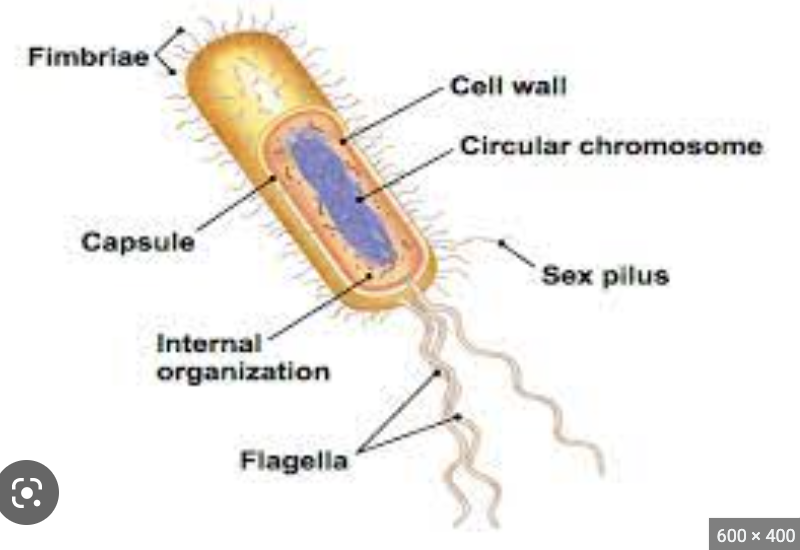
Distinguish a typical bacterial cell structure
* Cell Envelope: Consist of the plasma membrane, cell wall, and at least one additional layer (i.e. capsule or slime layer)
• Plasma membrane: Most important, encompasses the cytoplasm and defines the cell. Important the relationship between the cell and the outside world. Selectively permeable barrier.
* nucleoid: take up some of the space within a bacteria cell
* ribosomes
* Flagella: The tail of the bacteria use for locomotion
* Pillus: Used for attachment (sex pili) similar to fimbriae
* Fimbriae: The ‘hairs’ on a bacteria that help with an attachment used for
• Plasma membrane: Most important, encompasses the cytoplasm and defines the cell. Important the relationship between the cell and the outside world. Selectively permeable barrier.
* nucleoid: take up some of the space within a bacteria cell
* ribosomes
* Flagella: The tail of the bacteria use for locomotion
* Pillus: Used for attachment (sex pili) similar to fimbriae
* Fimbriae: The ‘hairs’ on a bacteria that help with an attachment used for
18
New cards
Describe the fluid mosaic model of membrane structure and identify the types of lipids typically found in bacterial membranes.
\
Hopaniods?
\
Hopaniods?
• Structure of plasma membrane:
* Bilayer formation of lipids, these lipids are typically amphipathic.
* Hopanoids: Similar to cholesterol their rigid structures make them more hydrophobic than phospholipids. Due to their hydrophobic natures, these lipids easily insert into membrane but because they are not amphipathic, they distory the regular bilayer structures
• Helps with fluidity or ridgity
* Bilayer formation of lipids, these lipids are typically amphipathic.
* Hopanoids: Similar to cholesterol their rigid structures make them more hydrophobic than phospholipids. Due to their hydrophobic natures, these lipids easily insert into membrane but because they are not amphipathic, they distory the regular bilayer structures
• Helps with fluidity or ridgity
19
New cards
• How is fluidity of membrane affected by saturation levels of phospholipids.
A more saturated (no db) have a more rigid structure because they have more van der waals
\
Longer chains allow for more saturation which causes a more rigid structure
\
Heat will cause membrane to become more fluid
\
Longer chains allow for more saturation which causes a more rigid structure
\
Heat will cause membrane to become more fluid
20
New cards
• How does the amphipathic nature of phospholipids help create the bilayer?
* Hydrophobic effect
• In aqueous environments, amphipathic lipids spontaneously interact to form a bilayer. The outer surface of the bilayer are hydrophilic, where hydrophobic ends are buried in the interior away form the surrounding water. Individual phospholipids molc associate through noncovalent interactions and are in continuous motion in a membrane.
* The lipid bilayers are not homogeneous (the proteins and hapoids amout is different in each bilayer)
• In aqueous environments, amphipathic lipids spontaneously interact to form a bilayer. The outer surface of the bilayer are hydrophilic, where hydrophobic ends are buried in the interior away form the surrounding water. Individual phospholipids molc associate through noncovalent interactions and are in continuous motion in a membrane.
* The lipid bilayers are not homogeneous (the proteins and hapoids amout is different in each bilayer)
21
New cards
• Describe the nature and function of proteins associated with the bilayer.
* Peripheral membrane proteins: Loosely connected ot the membrane and can be easily removed; soluble.
• Many are transport proteins used to more materials, others are involved in energy conserving processes, and the parts that are exposed to outside they interact with environment.
• Make up about 20-30% of the total membrane protein
Integral membrane proteins: Hydrophobic portions project from the membrane surface.
• These are not easily extracted from membranes and are insoluble in aqueous solutions when freed of lipids.
• Integral membrane proteins, like membrane lipids, are amphipathic.
\
• Many are transport proteins used to more materials, others are involved in energy conserving processes, and the parts that are exposed to outside they interact with environment.
• Make up about 20-30% of the total membrane protein
Integral membrane proteins: Hydrophobic portions project from the membrane surface.
• These are not easily extracted from membranes and are insoluble in aqueous solutions when freed of lipids.
• Integral membrane proteins, like membrane lipids, are amphipathic.
\
22
New cards
Passive diffusion
• Passive diffusion (simple diffusion): Process by which molc move from a region of higher to a lower concentration; down the concentration gradient.
* Usually, smaller nonpolar gases
* A large concentration gradient is required for adequate uptake by passive diffusion
* The rate of diffusion decreases as more nutrients accumulates in the cell; this occurs if the nutrients is not used immediately upon entry.
* Usually, smaller nonpolar gases
* A large concentration gradient is required for adequate uptake by passive diffusion
* The rate of diffusion decreases as more nutrients accumulates in the cell; this occurs if the nutrients is not used immediately upon entry.
23
New cards
Facilitated diffusion
• Facilitated Diffusion: Substances move across the plasma membrane with the assistance of transport proteins that are either channels or carriers.
* Channels: Pores in the membrane that allow substance to move. They show some specificity for the substances that pass through them, but this is considerably less than that shown by carriers, which is more substrate specific
* Carriers: Attach themselves to the membrane; the diffusion rate reaches a plateau above a specific gradient value because the carrier protein is saturated.
* Channels: Pores in the membrane that allow substance to move. They show some specificity for the substances that pass through them, but this is considerably less than that shown by carriers, which is more substrate specific
* Carriers: Attach themselves to the membrane; the diffusion rate reaches a plateau above a specific gradient value because the carrier protein is saturated.
24
New cards
Active Transport
What are the two types
What are the two types
The transport of solute molc to higher conc with the input of energy; uses carrier proteins
\
Primary and secondary
\
Primary and secondary
25
New cards
Primary active transport
\
What is it mediated by?
\
Are they uniporter, symporter, or antiporters
\
What is it mediated by?
\
Are they uniporter, symporter, or antiporters
\- Primary: Mediated by carriers call primary active transporters
• The transporters are uniporters (move one molc)
• ATP-Binding Cassette transporters (ABC transporters): Consist of two hydrophobic membrane-spanning regions with two ATP binding domains facing the cytoplasm. The membrane domains form a pore in the membrane, and the ATP binding domains bind and hydrolyze atp to drive uptake.
\
\
• The transporters are uniporters (move one molc)
• ATP-Binding Cassette transporters (ABC transporters): Consist of two hydrophobic membrane-spanning regions with two ATP binding domains facing the cytoplasm. The membrane domains form a pore in the membrane, and the ATP binding domains bind and hydrolyze atp to drive uptake.
\
\
26
New cards
Secondary active transport
\- Couples the potential energy of ion gradients to transport substances without modification.
• Cotransporters that move two substances, can be symport (same direction) or antiport (opposite direction)
\
• Cotransporters that move two substances, can be symport (same direction) or antiport (opposite direction)
\
27
New cards
Group translocation
\
What is it mediated by?
\
What is it mediated by?
\- That a molc is chemically modified as it is brought into the cell
• PTS (phosphoenolpyruvate: sugar phosphotransferase system); imports a varity of sugars while phosphorylating them, using PEP (phosphoenolpyruvate) as the phosphate donor.
• PTS (phosphoenolpyruvate: sugar phosphotransferase system); imports a varity of sugars while phosphorylating them, using PEP (phosphoenolpyruvate) as the phosphate donor.
28
New cards
Describe peptidoglycan structure.; explain the structure responsible for crosslinking
• Peptidoglycan: A single molc covering the entire plasma membrane that is composed of many identical subunits (subuntis contain two sugar derivatives, NAG and NAM)..
* Crosslinking:
• Direct: Connecting the carboxyl group of the aa in one stem peptide to the amino group of an aa in another stem peptide.
• Indirect: Use interpeptide bridge which is a short chain of aa linked the stem peptide of one peptidogly strand to another.
* Cross-linking results in a dense, interconnected network of peptidoglycan strands.
* Crosslinking:
• Direct: Connecting the carboxyl group of the aa in one stem peptide to the amino group of an aa in another stem peptide.
• Indirect: Use interpeptide bridge which is a short chain of aa linked the stem peptide of one peptidogly strand to another.
* Cross-linking results in a dense, interconnected network of peptidoglycan strands.
29
New cards
Gram positive bacterial cells
\
gram stain
\
How are the perplasmic space linked to membrane?
\
How thick is the plasma membrane?
\
gram stain
\
How are the perplasmic space linked to membrane?
\
How thick is the plasma membrane?
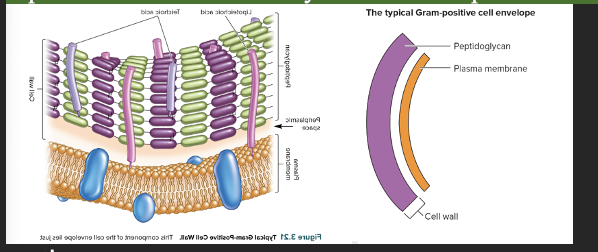
• Gram Positive:
* In a Gram stain gram positive will turn purple
* The bacteria consist of a single, 20 to 80 nm thick layer of peptidoglycan lying outside the plasma membrane.
* Lipoteichoic acids: Covalently connect to the plasma membrane
* In a Gram stain gram positive will turn purple
* The bacteria consist of a single, 20 to 80 nm thick layer of peptidoglycan lying outside the plasma membrane.
* Lipoteichoic acids: Covalently connect to the plasma membrane
30
New cards
Gram negative bacterial cells
\
Gram stain color?
\
How think are the cell walls? How think are the peptidoglycan layer?
\
How is it structured?
\
How are they linked between membrane and peptidoglycan?
\
Inner leaflet composition? What is the outer layer comprised of?
\
What are the function of LPS?
\
Gram stain color?
\
How think are the cell walls? How think are the peptidoglycan layer?
\
How is it structured?
\
How are they linked between membrane and peptidoglycan?
\
Inner leaflet composition? What is the outer layer comprised of?
\
What are the function of LPS?
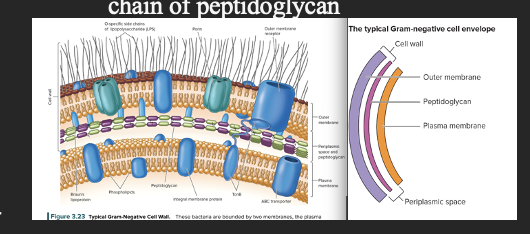
• Gram negative:
* In a Gram stan is will stain pink or red
* The cell walls of a Gram-negative bactieral have two distinct laters, a 2-7 nm thick peptidoglycan layer covered by a 12-14 nm thick outer membrane.
* Peptidoglycna layer is very thin (2-7 nm thick) and sits within the periplasmic space (30-70 nm wide)
* The outer membrane lies outside the thin peptidoglycan layer and it is linked to the cell by Braun’s lipoprotein the most adundant protein in the outer membrane.
• This protein covently links the outer membrane and the peptide chain of peptidoglycan
\- The inner leaflet is composed of phospholipids, but the external layer is comprised of LPS (lipopolysaccharides).
• Functions of LPS: (1) contribute the neg charge, (2) stabilizes the outer membrane structure, (3) creates a permeability barrier, and (4) protects pathogenic bacteria
* In a Gram stan is will stain pink or red
* The cell walls of a Gram-negative bactieral have two distinct laters, a 2-7 nm thick peptidoglycan layer covered by a 12-14 nm thick outer membrane.
* Peptidoglycna layer is very thin (2-7 nm thick) and sits within the periplasmic space (30-70 nm wide)
* The outer membrane lies outside the thin peptidoglycan layer and it is linked to the cell by Braun’s lipoprotein the most adundant protein in the outer membrane.
• This protein covently links the outer membrane and the peptide chain of peptidoglycan
\- The inner leaflet is composed of phospholipids, but the external layer is comprised of LPS (lipopolysaccharides).
• Functions of LPS: (1) contribute the neg charge, (2) stabilizes the outer membrane structure, (3) creates a permeability barrier, and (4) protects pathogenic bacteria
31
New cards
List the structures found in all the layers of bacterial cell envelopes
• Cell Envelope: Consist of the plasma membrane, cell wall, and at least one additional layer (i.e. capsule or slime layer)
32
New cards
identify the composition and function of capsules
\
What are they used for?
\
How can we see the capsules?
\
What are they used for?
\
How can we see the capsules?
\- Capsules: Well-organized layers that are most often composed of polysaccharides.
• Gram-neg: The polysaccarhides are bonded to outer membrame lipids and therefore are not easily washed away
• Used as protection against desiccation and resist phagocytosed by host phagocytes. They exclude viruses and most hydrophobic toxic materials such as detergents. but capsules are not require for growth and reproduction.
• Capsules are clearly visible in the light when negative stains or specific capsule stains are employed
• Gram-neg: The polysaccarhides are bonded to outer membrame lipids and therefore are not easily washed away
• Used as protection against desiccation and resist phagocytosed by host phagocytes. They exclude viruses and most hydrophobic toxic materials such as detergents. but capsules are not require for growth and reproduction.
• Capsules are clearly visible in the light when negative stains or specific capsule stains are employed
33
New cards
Slime layer
Also a polysaccharide layer, but it differns from a capsule in being more diffuse and unorganized and more easily removed from the cell.
34
New cards
Plasma/cell membrane
Most important, encompasses the cytoplasm and defines the cell. Important of the relationship between the cell and the outside world. Selectively permeable barrier.
35
New cards
Cell wall
\- Protection against osmotic stress (middle layer between capsule and plasma membrane)
36
New cards
identify the structure and function of S layers
Ordered surface covering that is composed of protein or glycoprotein.
* Makes many copies of a single protein form this 2D crystalline surface.
* In Gram-neg bacteria, the S-layer adheres noncovalently to the outer membrane. But it is associated with peptidoglycan surface in Gram-pos
* Function: Protecting the cell against ion and pH fluctuation, osmotic stress, enzymes, or predatory bacteria. Help maintain shape and rigidity of the envelope + promotes adhesion to other cells.
* Makes many copies of a single protein form this 2D crystalline surface.
* In Gram-neg bacteria, the S-layer adheres noncovalently to the outer membrane. But it is associated with peptidoglycan surface in Gram-pos
* Function: Protecting the cell against ion and pH fluctuation, osmotic stress, enzymes, or predatory bacteria. Help maintain shape and rigidity of the envelope + promotes adhesion to other cells.
37
New cards
Define the nucleoid
Nucleoid: Region that contains the cells choromosome and numerous proteins and occupies about 20% of the cell volume
38
New cards
\
\
39
New cards
List the composition of bacterial ribosomes and where we find them in the cell.
• Ribosomes: The site of protein synthesis, and large numbers are found in nearly all cells. The cytoplasm of rapidly growing bacterial cells is often packed with ribosomes, and additional ribosomes amy be loosely attached to the plasma membrane.
* They are called 70S and are constructed of 50S and 30S subunits
* They are mainly composed of rRNA molc
* They are called 70S and are constructed of 50S and 30S subunits
* They are mainly composed of rRNA molc
40
New cards
Differentiate the structure and function of bacterial chromosomes and plasmids.
• Chromosomes: Circular chromosomes with DNA.
\- These chromosomes are longer than the cell itself.
* Plasmids: The double-standed DNA molc that can exist independently of the chrosomsome.
\- Common is circular and contains few genes. But they do carry genes that confer a selective advantage to the bacteria.
\- These chromosomes are longer than the cell itself.
* Plasmids: The double-standed DNA molc that can exist independently of the chrosomsome.
\- Common is circular and contains few genes. But they do carry genes that confer a selective advantage to the bacteria.
41
New cards
Identify the general composition and function of pili (fimbriae) and flagella
• Pili: Many bacteria have fine, hairlike appendages that are thinner and typically shorter than flagells.
\- Grow by adding protein subunits to their base
\- Functions: There are some (type IV) are involved in motility and gene transfer mechanisms (transformation and conjugation).
\- Sex pili: The structure differ from other pili in the following ways, they are larger and are genetically encoded on plasmids and are required for conjugation.
\
* Flagella: Use these for locomotion, they are threadlike locomotor appendages extending outward from the plasma membrane and cell wall.
\- Other roles: they are involved in attachment to surfaces they are virulence factors; they contribute to the ability of the bacterium to cause disease.
\- They are slender, rigid structure.
\- Grow by adding protein subunits to their base
\- Functions: There are some (type IV) are involved in motility and gene transfer mechanisms (transformation and conjugation).
\- Sex pili: The structure differ from other pili in the following ways, they are larger and are genetically encoded on plasmids and are required for conjugation.
\
* Flagella: Use these for locomotion, they are threadlike locomotor appendages extending outward from the plasma membrane and cell wall.
\- Other roles: they are involved in attachment to surfaces they are virulence factors; they contribute to the ability of the bacterium to cause disease.
\- They are slender, rigid structure.
42
New cards
Describe in general terms the process of sporulation
Sporulation: Commences when growth slows due to nutrients limitation, it is a survival mechanism that allows the bacterium to produce a dorman cell that can persist until nutirents are available and vegetative growth can resume.
43
New cards
Describe those properties of endospores that are thought to contribute to its resistance to environmental stresses.
• Endorspores: Dormant cell formed within a so-called mother cell, are fascinating bacterial structure produced by certain bacterial
* This occurs when there is depletion in nutrients and the endospores represent a dormant stage of the organism
* They are very reistant to envirometnal stresses that damage living cells. They are also resistant to heat, UV, gamma radiation, chemical disinfectants, and desiccation.
* This occurs when there is depletion in nutrients and the endospores represent a dormant stage of the organism
* They are very reistant to envirometnal stresses that damage living cells. They are also resistant to heat, UV, gamma radiation, chemical disinfectants, and desiccation.
44
New cards
Describe binary fission as observed in bacteria and archaea.
• Binary fissions are a simply type of cell division. The cell elongated as new cell envelope material is synthesized. The nucleoid, which is present as a single entity must be replicated and partitioned into each half of the elongated cell during fission.
45
New cards
Summarize the three phases in a typical bacterial cell cycle
• Cell cycle: The complete seq of events extending from formation of a new cell through the next division.
• Three Phases:
• A period of growth after the cell is born, which is similar to the G1 phase of the euk cell cycle
• Chromosome replication and partitioned period, which functionally corresponds to the S and mitosis events of the M phase of the euk cycle
• Cytokinesis, during which a septum and daughter cells are formed
• Three Phases:
• A period of growth after the cell is born, which is similar to the G1 phase of the euk cell cycle
• Chromosome replication and partitioned period, which functionally corresponds to the S and mitosis events of the M phase of the euk cycle
• Cytokinesis, during which a septum and daughter cells are formed
46
New cards
• Summarize current models for chromosome partitioning; What proteins aid in chromosome partitioning and what is their function?
I don’t know if we need this :(
I don’t know if we need this :(
• Par A/Par B proteins in Caulobacter Crescentus. Par a polymerize to form filaments, Par B binds DNA at par S site near origin of replication
• Par B binds 2 copies of Par S site since DNA has been replication
Par A interaction with one of the two ParB/ParS complexes causes it to depolymerization pulling one copy of the DNA away
• Par B binds 2 copies of Par S site since DNA has been replication
Par A interaction with one of the two ParB/ParS complexes causes it to depolymerization pulling one copy of the DNA away
47
New cards
State the functions of cytoskeletal proteins during cytokinesis; What protein is involved in cytokinesis? What is the eukaryotic equivalent?
• Cytokinesis: The formation of two daughter cells following cell division, and septation is the process of forming a cross wall between those cells.
• Steps:
• Selection of the site where the septum will form
• Assembly of the Z-ring, which is a polymer of the cytoskeletal FtsZ
• Assembly of the machinery for synthesis of peptidoglycan and other cell wall constituents
• Constriction of the cell and septum formation
• Steps:
• Selection of the site where the septum will form
• Assembly of the Z-ring, which is a polymer of the cytoskeletal FtsZ
• Assembly of the machinery for synthesis of peptidoglycan and other cell wall constituents
• Constriction of the cell and septum formation
48
New cards
What is the first phase of batch culture? (log, lag, expotential, etc)
• Lag Phase: When microorganism is introduced into fresh culture medium, usually no immediate increase in cell number occurs.
• It is not a time for inactivity; rather cells are synthesizing new components.
• In this phase, the cells replicate their DNA, they increase in mass and divide. Gene expression also increases, and they adjust to the new environment
• It is not a time for inactivity; rather cells are synthesizing new components.
• In this phase, the cells replicate their DNA, they increase in mass and divide. Gene expression also increases, and they adjust to the new environment
49
New cards
What is the second phase to batch culture?
• Exponential Phase (Log Phase): Microorganism grow and divide at the maximal rate possible given their genetic potential, the nature of the medium, and the environmental conditions.
• Growth rate is constant during the exponential phase; they are completing the cell cycle and doubling in number at regular interval phases.
• During this time there is rapid growth and metabolic nutrients are consumed and produce
• Growth rate is constant during the exponential phase; they are completing the cell cycle and doubling in number at regular interval phases.
• During this time there is rapid growth and metabolic nutrients are consumed and produce
50
New cards
What is the third phase of a batch culture?
• Stationary phase: Attained by some bacteria at a population level
• The total number of viable microorganisms remains constant, resulting from a balance between cell division and cell death, or the population may simply cease to divide but remain metabolically active.
• Reduction in growth because of lack of nutrients and production of waste.
• The total number of viable microorganisms remains constant, resulting from a balance between cell division and cell death, or the population may simply cease to divide but remain metabolically active.
• Reduction in growth because of lack of nutrients and production of waste.
51
New cards
Four phase of batch culture?
• Death Phase: Cell growing in batch culture cannot remain in stationary phase indefinitely. The equilibrium between dying and reproducing cells shifts and the number of viable cells declines exponentially, with cells dying at a constant rate
There is a nutrient deprivation and the buildup of toxic waste cause harm to the cells
There is a nutrient deprivation and the buildup of toxic waste cause harm to the cells
52
New cards
Phase five of batch culture?
\
We didn’t talk about this in class so I am not sure we need to know this
\
We didn’t talk about this in class so I am not sure we need to know this
• Long-term stationary phase: During this time the bacterial population continually evolves so that actively reproducing cells are those best able to use the nutrients released by their dying brethren and best bale to tolerate the accumulated toxins.
• This can last months to years
• This can last months to years
53
New cards
• Correlate changes in nutrient concentrations in natural environments with the five phases of a microbial growth curve
• The bacterial will have the best growth within their optimal growth characteristics. This includes, but not limited to, temperature, pH, median, etc.
• As we get further from their optiumal growth phase the line will reduce down each time.
• As we get further from their optiumal growth phase the line will reduce down each time.
54
New cards
• Relate growth rate constant to generation (doubling) time and suggest how these values might be used by microbiologists doing basic research or working in industrial settings.
• Generational doubling time: During the exponential phase, each microorganism divides at a constant interval. Thus, the population double in number during a specific length of time.
55
New cards
What are factors that affect microbial growth?
\: water activity, pH, temperature, oxygen levels, pressure, and radiation.
56
New cards
How does water activity affect microbial growth
• If microorganism is placed in a hypotonic solution (one with a solute concentration that is lower outside the cell than inside) water will enter the cell and cause it to burst.
• If microorganism is placed hypertonic solutions (one with a higher osmolarity outside the cell than inside), water will flow out of the cell and it will shrink. Which dehydrates the cell and damage the membranes and the cell becomes inactive
• If microorganism is placed hypertonic solutions (one with a higher osmolarity outside the cell than inside), water will flow out of the cell and it will shrink. Which dehydrates the cell and damage the membranes and the cell becomes inactive
57
New cards
What is the effect of pH on microbial growth?
• Each species has a pH growth rang and pH growth optimum
• When is pH is low the concentrating of H+ is much greater outside than inside, and H+ will move into the cytoplasm and lower the cytoplasmic pH. Which changes of pH effect the membrane lipid and proteins.
• When is pH is low the concentrating of H+ is much greater outside than inside, and H+ will move into the cytoplasm and lower the cytoplasmic pH. Which changes of pH effect the membrane lipid and proteins.
58
New cards
Temperature affect on microbial growth?
\
Cardinal temperature definition?
\
Cardinal temperature definition?
• They are susceptible to external temp because they cannot regulate their internal temp. Beyond a certain point growth slows, proteins denature, and bilayer ‘melts’
• Cardinal temperatures: Due to these opposing influences, microbial growth has a characteristic temp dependence, ths is minimum, optimum, and maximum growth temperature.
• Cardinal temperatures: Due to these opposing influences, microbial growth has a characteristic temp dependence, ths is minimum, optimum, and maximum growth temperature.
59
New cards
Psychrophiles
\
Cardinal temperature growth?
\
Cardinal temperature growth?
Grow at 0 degrees Celsius or higher and typically have a maximum at about 15 degrees Celsius; the maximum is around 20 degrees Celsius
\
Psychrophiles like cold temperatures and have more fluid membrane structure (more unsaturated polysaccharides)
\
Psychrophiles like cold temperatures and have more fluid membrane structure (more unsaturated polysaccharides)
60
New cards
Mesophiles
\
Optimal growth temperature?
\
Optimal growth temperature?
Microorganism that grow in moderate temps, they have optima growth at around 20 to 45 degrees Celsius. There minimum temp is around 15-20 and their maximum is around 45
61
New cards
Thermophiles
\
Optimal growth temperature?
\
Proteins? Plasma membrane?
\
Optimal growth temperature?
\
Proteins? Plasma membrane?
• Thermophiles: Grow at high temp, usually around 45-85 degrees celcius. They have an optima between 55 go 65
\
Both thermophiles have proteins that function in high temperatures. They tend to be more saturated, more branches, and have a higher molc weight
\
Both thermophiles have proteins that function in high temperatures. They tend to be more saturated, more branches, and have a higher molc weight
62
New cards
Hyperthermophiles
\
Optimal growth temperature?
\
Proteins?
\
Optimal growth temperature?
\
Proteins?
• Grwoth ranges with optima temp around 85-100
• Both thermophiles have proteins that function in high temperatures. They tend to be more saturated, more branches, and have a higher molc weight.
• Both thermophiles have proteins that function in high temperatures. They tend to be more saturated, more branches, and have a higher molc weight.
63
New cards
O2 concentration on microbial growth: Obigate aerobe
• Almost all multicellular and many microbes are completely dependent on O2 for growth (will sit at the surface)
64
New cards
O2 concentration on microbial growth:
Microaerophiles
Microaerophiles
Are damaged by the O2 but require O2 levels in the range of 2-10% for growth. These will be found towards the top but completely submerged.
65
New cards
O2 concentration on microbial growth:
Facultative anaerobes
Facultative anaerobes
Can growth with or without O2, but grow faster in its presence where they perform aerobic respiration. They are found throughout the tube but there will be a denser cluster near the top
66
New cards
O2 concentration on microbial growth:
Aerotolerant anaerobes
Aerotolerant anaerobes
Grow eaully well whether O2 is present or not, they can tolerate O2, but they do not use it. These are usually found throughout the test tube with no cluster anywhere.
67
New cards
O2 concentration on microbial growth:
Strict anaerobes
Strict anaerobes
O2 is toxic and they are killed by exposure. These will cluster at the bottom of the test tube.
68
New cards
Describe enzymes observed in microbes that protect them against toxic O2 products; How do Superoxide dismutase and catalase affect their ability to handle toxic 02 products?
• Superoxide dismutase (SOD): Microorganism possess enzyme that neutralize toxic O2 product (reactive oxygen species), SOD catayzes the destruction of super-oxide radicals.
• Catalase and peroxidase use different mechanism but both detoxify hydrogen peroxides.
• Catalase and peroxidase use different mechanism but both detoxify hydrogen peroxides.
69
New cards
What is thioglycolate media/broth?
• Thioglycollate broth: The nature of bacterial O2 responses can be readily determined by growing the microbe in a medium such as thioglycolate broth, which contains a reducing agent that reduces O2 levels. Which the growth patterns are as follows (the word definitions are in the last question)
70
New cards
Define the terms sessile and planktonic.
• Sessile: Microbes in aquatic environments that are found at the surface of the water
• Planktonic: microbes in aquatic environments that are free-floating
• Planktonic: microbes in aquatic environments that are free-floating
71
New cards
Describe the formation of biofilms and summarize their importance in natural environments, industrial settings, and medicine
• Bioflims: These complex, slime-encased communities of microbes, they are ubiquitous in nature, and it is estimated that 40-80% of the bacterial and archael cells on the planet are in biofilms.
• These biofilms often cause serious illnesss and failure of the device, they can form within wounds and delay healing.
• They can form on virtually any living or nonliving surface. Cell recognize an interface for colonization, often through chemotaxis toward attractiants on the surface.
• Surface contact is typically through flagella or pilli
• These biofilms often cause serious illnesss and failure of the device, they can form within wounds and delay healing.
• They can form on virtually any living or nonliving surface. Cell recognize an interface for colonization, often through chemotaxis toward attractiants on the surface.
• Surface contact is typically through flagella or pilli
72
New cards
Define quorum sensing and provide examples of cellular processes regulated by quorum sensing
• Quorum sensing: A quorum usually refers to the minimum number of membranes in an organization needed to conduct business
• This is needed to be successful, a sufficient number of microbes must be present and participating, nad individual need a way to assess the size of their population
• This is needed to be successful, a sufficient number of microbes must be present and participating, nad individual need a way to assess the size of their population
73
New cards
What is AHL?
\
• N-acyl homoserine lactone (AHL)
• AHL is freely diffusible across the membrane, as the cell population increase the diffusion gradient is reversed to factor movement of AHL into the cell and due to the influx of AHL it enables the cells to assess population density.
• N-acyl homoserine lactone (AHL)
• AHL is freely diffusible across the membrane, as the cell population increase the diffusion gradient is reversed to factor movement of AHL into the cell and due to the influx of AHL it enables the cells to assess population density.
74
New cards
Defined (synthetic) media
• Defines (synthetic) medium: One in which each ingredient can be described with a chemical formula. It can be in a liquid form (broth) or solified by an agent such as agar.
• Many organism that use this reduce organic molc as carbon and energy sources can be grown in defined media.
• Many organism that use this reduce organic molc as carbon and energy sources can be grown in defined media.
75
New cards
Complex media
• Contains at least one ingredient of nonspecific chemical composition such as peptones, meat extract, or yeast extract.
• Peprontes are preaparted by patial digestion of protein sources. These serve as sources of carbon, energy, or nitrogen
Provides aa, peptides, nucleotides, organic acids, vitamins, and minerals
• Peprontes are preaparted by patial digestion of protein sources. These serve as sources of carbon, energy, or nitrogen
Provides aa, peptides, nucleotides, organic acids, vitamins, and minerals
76
New cards
Supportive media
Example
Example
• Supportive media: Medica such as soy broth/soy agar and they sustain the growth of many types of microorganisms
• Example: Chocolate agar
• Example: Chocolate agar
77
New cards
Enriched media
Example
Example
• Enriched media: Support multiple different types of microorganism fortified media that use blood and other nutrients (blood agar)
Example: Blood agar
Example: Blood agar
78
New cards
Selective media
Example
Example
• Selective media: Allow the growth of microorganism, while inhibiting the growth of others
• Example: Many gram neg bacteria grow on media contain bile salts or dyes such as crystal violet, however the growth of Gram-positive bacteria is inhibited
• Example: Many gram neg bacteria grow on media contain bile salts or dyes such as crystal violet, however the growth of Gram-positive bacteria is inhibited
79
New cards
Differential media
Example
Example
• Distinguish among different groups of microbes and even permit tentative identification of microorganism based on their biological characteristics.
• Example: Blood agar (can be differential and Enright media)
• Example: Blood agar (can be differential and Enright media)
80
New cards
Streak-plate
• Cells are transferred to the edge of an agar plate with an inoculating loop or swab and then streaked across the surface in one of several patterns. After the first sector is streaked, the inoculating loop is sterilized and an inoculum for the second sector is obtained from the first sector.
81
New cards
Spread plate
A small colume of diluted mixture is transferred to the center of the agar plate and spread evenly over the surface with a sterile bent rod. The dispersed cells develop into isolated colonies during incubation. The dilutions for a spread plate are usually made in the same way as for a pour plate.
82
New cards
Pour plate
Extensively used with bacteria, archaea, and fungi. It is particularly useful when sampling a heterogeneous population of microbes, some of which might produce colonies that overgrow an agar surface if to reduce the microbial population sufficiently to obtain separate colones when plating. Small volumes of several dilutes samples are mixed with liquid agae and the mixtures are poured into a sterile culture dishes.
83
New cards
Direct cell counts:
Determining microbial number by using a counting chamber. This is an easy, inexpensive, and relatively quick way of counting colonies. It gives information about the size and morphology of microorganism.
84
New cards
Viable counting methods
• they count only those cells able to reproduce when cultures, two commonly used procedures are the spread-plate and the pour-plate techniques.
85
New cards
How to measure cell mass
• Dermination of microbial dry weight, cell grow in lipid medium are collected by centrifugation, washed, dried, and weighed.
• A more rapid and sensitive method for measuring cell mass is spectrophotometry. This method depend ont eh face that microbial cells scatter light because the cells are roughly constant size, the amount of scattering is directly propotional to the biomass of cells present and indirectly related to cell number.
• The extenet of light scattering of the medum and the absorbance is almost linearly related ot cell concentration.
• A more rapid and sensitive method for measuring cell mass is spectrophotometry. This method depend ont eh face that microbial cells scatter light because the cells are roughly constant size, the amount of scattering is directly propotional to the biomass of cells present and indirectly related to cell number.
• The extenet of light scattering of the medum and the absorbance is almost linearly related ot cell concentration.
86
New cards
Sterilization
Is the process by which all living cells, spores, and acellular entites are either destroyed or removed form an object or habitat
87
New cards
Disinfectants
Agents, usually chemical, used to carry out dis infection and normally used only on inanimate objects. This doesn’t sterilize an object but few microbes may remain
88
New cards
Sanitization
The microbial population is reduced to levels that are considered safe by public health standards.
89
New cards
Antiseptics
Chemical agents applies to tissue to prevent infection by killing or inhibiting pathogen growth they also reduce the total microbial population.
90
New cards
What is chemotherapy (in terms of disinfectants)?
The generic term used to describe the application of chemicals to kill or inhibit the growth of microorganism.
91
New cards
Distinguish between “cidal” and “static” agents
• “-cide” or “cidal”; a cidal agent kills microbes but not necessarily endospores.
• A disinfectant or antiseptic can be particularly effective against a specific group, In which case it may be called.
“static”; other chemical do not kill but rather prevent growth, if the chemicals are removed, growth will resume
• A disinfectant or antiseptic can be particularly effective against a specific group, In which case it may be called.
“static”; other chemical do not kill but rather prevent growth, if the chemicals are removed, growth will resume
92
New cards
Depth filters
Consist of fibrous or granular materials that have been bonded into a thick layer filled with narrow, twisting chennels. The solution containing the microbes is sucked through this layer under vacuum, and microbial cells are removed by entrapment and by adsorption to the surface of the filter material
93
New cards
Membrane filters
• These filters are porous membranes. Although a wide pariety of pore sizes are avaibale membranes with pores about 0.2 micrometers in diameter are used to remove most cells, not viruses, from liquids.
• The liquid is forces through the filter and collected in sterilized containers. Membrane filers remove the microbes by screening them out much as a sieve separates large sand particles from small ones.
• The liquid is forces through the filter and collected in sterilized containers. Membrane filers remove the microbes by screening them out much as a sieve separates large sand particles from small ones.
94
New cards
High-efficiency air (HEPA) filters
• These let air move freely but restrict microbes, they are N95. They excluse 95% of particals 0.3 micrometers or larger.
• HEPA filters sterilize air by removing viruses that are 0.1 micrometer and smaller.
• HEPA filters sterilize air by removing viruses that are 0.1 micrometer and smaller.
95
New cards
Heat as a form of controlling microorganism
\
Moist vs dry heat
\
Autoclave
\
Moist vs dry heat
\
Autoclave
• Temperatures that exceed those damage structures and alter chemical reactions, moist and dry heat readiy destroy viruses, bacterial, and fungi
• Moist head destroys cells and viruses by degrading nucleic acids, denaturing proteins, and disrupting cell membranes. But this isn’t an effect way of killing endospores unless pressure is added
• Autoclave: Moist heat sterilization must be carried out at temperatures above 100 degrees celius that is present as staem and then adding steam.
• Moist head destroys cells and viruses by degrading nucleic acids, denaturing proteins, and disrupting cell membranes. But this isn’t an effect way of killing endospores unless pressure is added
• Autoclave: Moist heat sterilization must be carried out at temperatures above 100 degrees celius that is present as staem and then adding steam.
96
New cards
Radiation as a form of controlling microorganisms
• Causes thymine-thymine dimerization of DNA, preventing replication and transcription. UV radiation doesn’t penetrate glass, dirt fils, water, and other substance effectively.
97
New cards
Effects of population size and compositions
• Population size and composition:
• Size: A larger population requires a longer time to die than a smaller one does
• Composition: The effectiveness of an agent varies greatly with the nature of the organism being treated because microorganism differ markedly in susceptibility. Bacterial endospores are much more resistant to most agents than veg forms and younger cells are usually more readily destroyed than mature organism.
• Size: A larger population requires a longer time to die than a smaller one does
• Composition: The effectiveness of an agent varies greatly with the nature of the organism being treated because microorganism differ markedly in susceptibility. Bacterial endospores are much more resistant to most agents than veg forms and younger cells are usually more readily destroyed than mature organism.
98
New cards
Temperature as effect of microbial population
An increase in the temp at which chemical is used often enhances its activity. Frequently a lower concentration of disinfectant or sterilization agent can be used at a higher temperature.
99
New cards
Contact time as an effect of microbial populations
The longer a population is exposed to microbicidal agent, the more organism are killed. To achieve sterilization, contact time should be long enough to reduce the probability of revival.
100
New cards
Enviroments as affect of microbial populations
• The population to be controlled is not isolated but surrounded by environmental factors that may either offer protection or aid in its destruction.
• Organic matter, which can protect microorganism against physical and chemical disinfecting agents.
• Organic matter, which can protect microorganism against physical and chemical disinfecting agents.
 Note
Note  Flashcards (22)