Forensic Psychology and implicit measures
 Studied by 0 people
 Call with Kai
 Learn
Learn Practice Test
 Spaced Repetition
 Match
Match Flashcards
 Knowt Play
1/21

Earn XP
Description and Tags
Professor Robert Snowden
Name | Mastery | Learn | Test | Matching | Spaced | Call with Kai |
|---|
No study sessions yet.
22 Terms
What was the overall process of the research?
background in many psychological approaches to assessing abnormal criminal behaviour
trying to develop ways to determine the cause for these behaviours, using implicit measures (without having to ask directly)
attended a social psychology talk in 1998 where hears about a method called the AIT that could measure people’s racial attitudes at a more discrete level
developed the CSA-IAT specific to investigating offenders’ potential sexual preferences in children
visited HMP grendon in Oxfordshire, and managed to gain ppts to test
A bit of background of their research field…
How do we examine the serious risks (risk assessment) of violence and sexual violence, both to individuals and others, by understanding why this behaviour occurs through many different psychological approaches
developmental - looking at childhood
cognitive - looking at IQ and intelligence
biopsychological - potential damage to the brain
attitudes - what they think about different views in the world
social - how they interact with others
Can this person be in the public, raise a child, live alone, leave prison, etc
understanding why
What were the motivations for the study?
trying to get around the issues related to determining causes for these behaviours - e.g., offenders often don’t know why they have acted in this way, or deliberate dissimulation where offenders will not disclose their true reasoning
Current methods of measuring sexual deviancy are not effective
This can be overcome with implicit measures - methods of finding information without asking directly
What are the issues with the current tests for sexual deviancy?
Current tests of sexual deviancy are limited
self-report measures/interviews = can be faked easily, as the way we behave is not always in line with how we would want to behave
actuarial measures used to quantify risk; however, mean motives must be inferred
physiological measures, looking at how the body is responding to stimuli, are invasive, difficult to administer and can also be faked eg phallometry
need a simple test resistant to faking, sensitive to change in persons thoughhts feeling and beliefs and dynamic
Why is this an interesting problem?
Dealing with a highly sensitive research area that involves patients and the victims of those patients, so a large amount of risk is involved
But due to the complexity of the issues, it is very hard to assess the true internal causes for the behaviours
What are the hypotheses?
Those with sexual feelings towards children will perform faster in the incongruent condition (child and sex) than in the congruent condition (adult and sex), in comparison to those who do not have these attractions, who will perform in the opposite manor
How was this research translated into an experiment?
Whilst trying to develop a implicit method for measuring criminal attitudes, came across the AIT whilst in a lecture and set one up for myself for forensics by adapting it to look at different views of violence, sex, children, women etc
combining this with the new IAT developed their own form
used control IAT (C-IAT) to test on university students
What was the research design?
Prisoners were not willing to participate due to a new law - to make people comply approached the most dominant prisoner (psychopathic) use flattery - he ultimately agreed to take part, meaning others conformed
98% of prisoners then signed up
used both the control IAT (C-IAT) - tested on Cardiff University students, and the altered one, CSA-IAT
N=18 (paedophiles) and N=60 (other offenders) all male
blind study where ppts did not know the true aims
they complete the C-IAT as a control
then completed the CSA-IAT
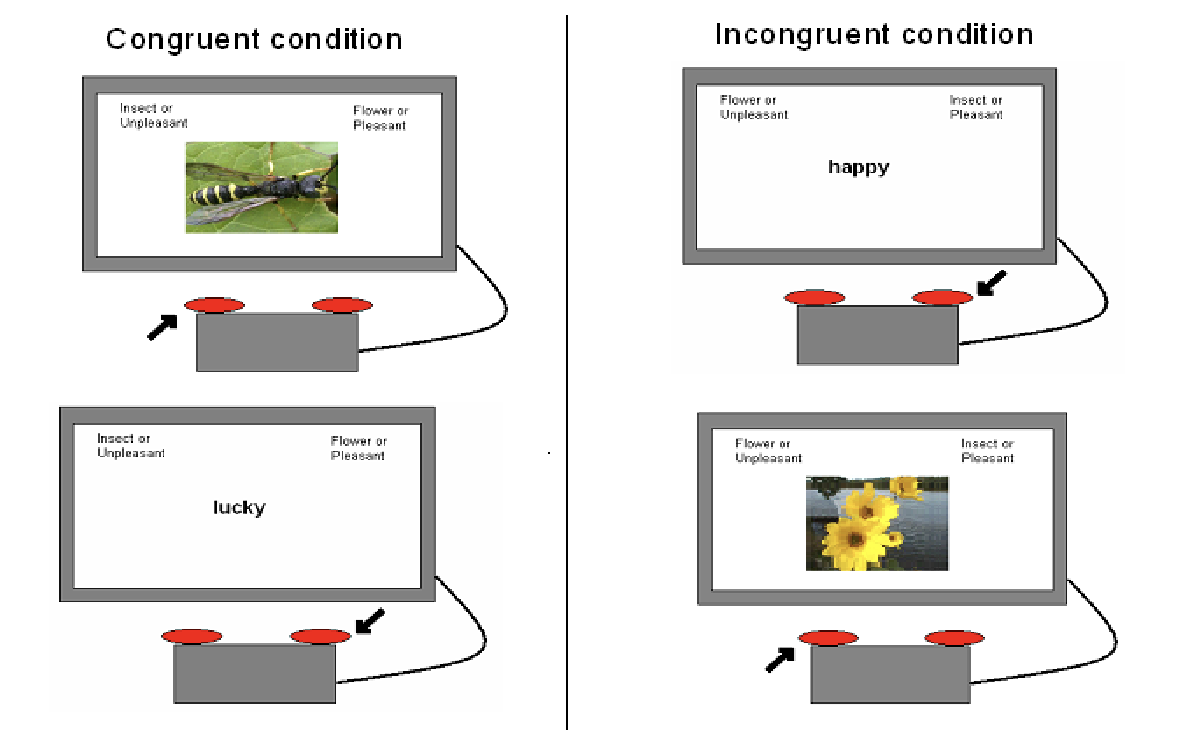
What is the AIT?
you have the thing that you are interested in
classic example is flowers (like) and insects (don’t like)
show pictures one at a time and classify the images as either a flower (by pressing one button) or an insect (by pressing another button)
also have words that come up (attribute dimensions) that are either good or bad and have to classify them aswell
two conditions - congruent and incongruent - within subject so all take part in both
congruent = insect or unpleasant as one button, flower or pleasant as the other
incongruent = insect or pleasant as on a button, flower and unpleasant as the other button
The incongruent condition is much harder due to interference
similar principle to the Stroop test
has a large effect size, is easy to use, reliable, lots of supporting evidence for the method (Greenwald et al, steffens and buchner etc)
How was the IAT adapted to be used on prisoners?
First used the control IAT and tested on Cardiff University students (N = 100<) and found every ppt to be significantly faster in the congruent condition
Then went on to aim to develop an IAT that looked at whether individuals had child preferances sexualy, aka the child-sex association IAT (CSA-IAT)
tried to obtain a set of child sex images through the police but were unsuccessful, but realised that if looking at preference, then you only need pictures of children, as you are not asking them if they regard child sex as food or bad
therefore, the stimuli did not need to be sexual to find out if offenders considered children as sexual (could use relevant words and images of children, overcoming the ethical issues)
for the attribute dimension, they used ‘sex’ or ‘non-sex
therefor target concepts were adults and children, and attribute dimension was sex or non-sex
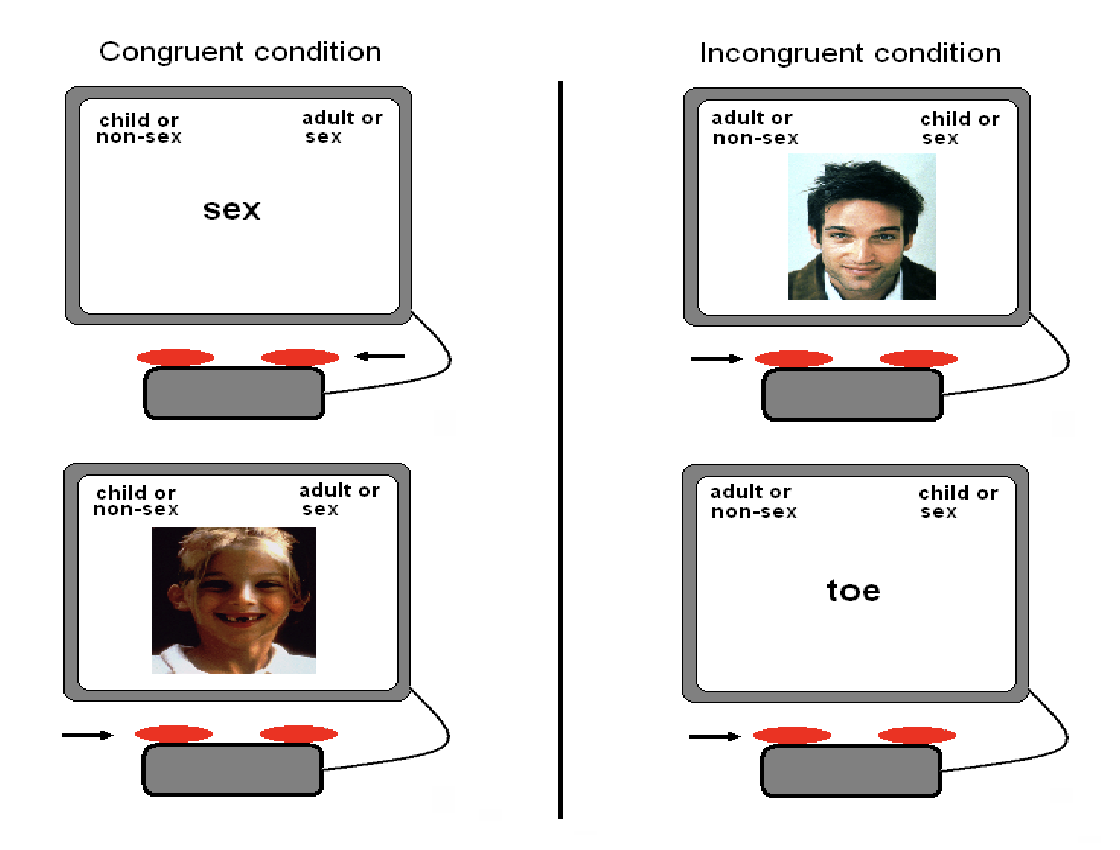
explain the CSA-IAT
congruent condition = adult and sex, child and non-sex
incongruent condition = child and sex, adult and non-sex
Images shown of either a child or an adult
words shown as either sexual or non-sexual
factor of interest (child or adult)
attribute (sexual or non-sexual)
What are the potential strengths and limitations of this research design?
strengths
overcomes the issues with the current methods of assessing sexual deviancy
easy to use, resource efficient, non-invasive, reliable, large effect sizes
Very strong effect sizes were presented from the IAT
looks into a very sensitive topic in a way that is ethically acceptable
used controls so can see the real effects
What were the results of the experiments?
control - to understand AIT
The two groups showed the same results as university students (fast in congruent, significantly slower in incongruent)
CSA-IAT
for most of the offenders, they were significantly faster in the congruent condition (adult and sex) and slow in the incongruent condition (child and sex)
for paedophiles, this pattern is reversed completely, and got the opposite
p<0.01 very significant interaction observed
How was the data analysed and why?
control university data analysed in a bar chart
Did the results support the hypothesis?
The results supported the hypothesis strongly with a p<0.01 significance
Was there a strong effect within the results?
Evidence from previous studies, as well as Snowden’s research, shows that the AIT produces large effect sizes and is reliable.
When control IAT is used on university students effect size = 1.72
What can be concluded from these results?
The control showed that the prisoners were just as capable as university students in completing IATs, removing variability
why are these findings interesting?
very large effect size, so extremely accurate in identifying these specific attitudes
only in men
potentially due to female offenders committing the crimes for reasons other than attraction, e.g., maternal reasons, company, or to serve a man, not due to sexual attraction - consistent with predictions
Are there any consequences/real life applications of these findings?
very sensitive area where safety of both individuals and the people they come into contact with are at risk
how were the findings received?
Based on the effectiveness of the findings were able to develop other IATs to investigate other criminal attitudes (rape, arson, violence etc)
2 more studies took place with larger numbers of people
refined the task to take only 5 mins
proved that IQ does not have an impact on it
differentiated between paedophiles (attracted to under 12s) and hebephiles (13 - 16s) 2009
hebephiles did not show this effect
works just as well for those who have admitted their offence and those who deny it
What further research could be conducted?
more research into how this can be applied in the real world as a preventative strategy
How did the study compare to later ones?
One of the first studies investigating these attitudes via these methods, however, since these research experiments have been replicated
gray et al 2005
Nunes et al 2007
The findings are identical to those found by snowden and brown
In the netherlands a test conducted on non-offending paedophiles found an even bigger effect than that found in offenders
 Note
Note  Flashcards (47)