3 - Kearns - Signal Transduction
 Call Kai
 Learn
Learn Practice Test
 Spaced Repetition
 Match
Match Flashcards
 Knowt Play
1/29

There's no tags or description
Looks like no tags are added yet.
Name | Mastery | Learn | Test | Matching | Spaced | Call with Kai | Chat |
|---|
No analytics yet
Send a link to your students to track their progress
30 Terms
Which are the following general steps in signal transduction? SATA
a. reception
b. transduction
c. translation
d. response
a, b, d (reception—> transduction—> response)
In tumor growth, what can happen to the general steps in the signal transduction pathway? SATA
a. the signaling molecule becomes deactivated
b. cell proliferation
c. increase in tumor suppressor genes
d. decrease in oncogene transcription
a, b (DECREASE in tumor suppressor genes, INCREASE in oncogenes)
What are some examples of signaling pathways that cancer uses to grow?
(don’t memorize just here for a summary)
transcription factor activation
angiogenesis
TF NF-kB
UPP
mTOR
tumor suppressor genes
How does activating transcription factors lead to cell growth/proliferation?
what is the signaling molecule?
what is the signal reception?
what is the signal transduction?
what is the cellular response?
signaling molecule | binding of a ligand |
signal reception | ligand binding domain |
signal transduction |
|
cellular response | CELL GROWTH/PROLIFERATION |
Summary—> ligand binds to binding domain —→ PHOSPHORYLATION OF TYROSINE KINASE—> activate intracellular TFs—> increase in cell growth
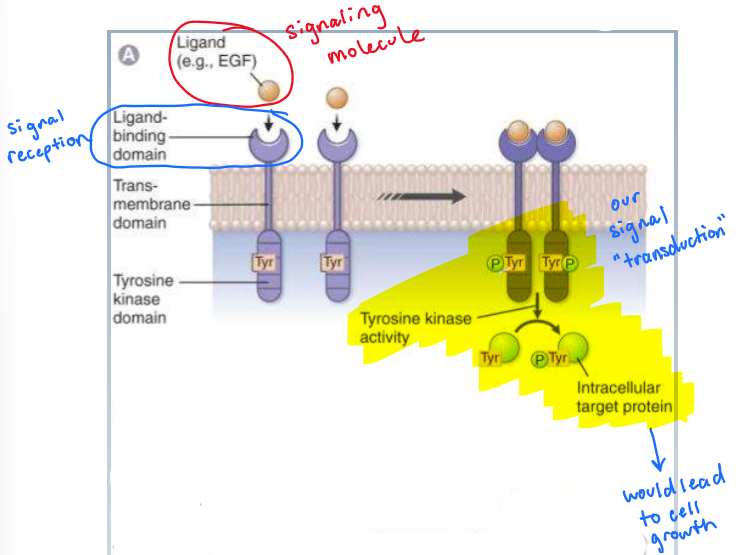
What do tyrosine kinase inhibitors do to cancer cells? What is their cytoplasmic and nuclear MOA?
tyrosine kinase inhibitors INHIBIT CELL GROWTH, proliferation, differentiation, and metabolic regulation
Cytoplasmic MOA- block phosphorylation of tyrosine kinase and other kinases
Nuclear MOA- inhibits gene transcription
Which of the following would a tyrosine kinase inhibitor inhibit?
a. DNA replication
b. protein synthesis
c. both
c
How does the process of angiogenesis work?
what is the signaling molecule?
what is the signal reception?
what is the signal transduction?
what is the cellular response?
signaling molecule | VGEF |
signal reception | VEGFRs dimerize (cell surface tyrosine kinase receptors) |
signal transduction |
|
cellular response | building new blood vessels increases cell growth, migration, and metastasize |
What does VEGF stand for?
vascular endothelial growth factor
oncogenes lead to ________ in cancer cells.
a. growth
b. death
c. angiogenesis
d. all of the above
a
What are 4 examples of oncogenes? (these are the ones kearns said to know)
EGFR
HER2
c-MYC
BCR-ABL
What is the following function of each oncogene:
EGFR
HER2
c-MYC
BCR-ABL
EGFR: genes for growth factors or their receptors -codes for epidermal growth factor receptor
HER2: genes for growth factors or their receptors- codes for growth factor receptor
c-MYC: genes for transcription factors that activate growth-promoting genes
BCR-ABL: genes for cytoplasmic kinases- codes for nonreceptor tyrosine kinase
The Philadelphia chromosome (a BCR-ABL oncogene) is an example of how an oncogene can become functional. Explain how this gene becomes functional. (not that important)
basically there are 2 genes on 2 normal chromosomes (ABL gene on chromosome 9 and BCR gene on chromosome 22)
during replication, epigenetic factor, etc. SOMETHING HAPPENS and the chromosomes break
when the chromosomes break off they don’t reattach to the same place and instead the 2 broken pieces come together
this makes the BCR-ABL oncogene ❤
think: BCR and ABL are protooncogenes and when they come together = oncogene
How does TF NF-kB cause cell proliferation in cancer?
What is the role of NF-kB?
What is the signal transduction pathway?
What is the cellular response?
role- protein that control many cell fxns (proliferation, metastasis, inflammation, angiogenesis, survival)
signal transduction
regulation of cyclin D1 and C-MYC
response- cell proliferation and promotes tumor growth
What are the pros and cons of NF-kB on TUMOR GROWTH?
pros
regulate expression of cyclin D1 and C-MYC
response- increase tumor cell proliferation, survival, and metastasis
cons
acts as tumor suppressor in keratinocytes—> rashes/dryness
response- increased risk of squamous cell carcinoma
What is the Ubiquitin Proteasome pathway responsible for?
intracellular protein degradation in all cells
Ubiquitin signals the protein for degradation by the _________________.
proteosome
Do cancer cells want to be ubiquinated?
no
How does the process of proteosome inhibition work?
what is the signaling molecule?
what is the signal reception?
what is the signal transduction?
what is the cellular response?
signaling molecule | cytokines |
signal reception | cytokine binding cell surface receptors |
signal transduction |
|
cellular response | decrease cell proliferation |
How does the process of the MTOR signaling pathway work?
what is the signaling molecule?
what is the signal reception?
what is the signal transduction?
what is the cellular response?
signaling molecule | cytokines |
signal reception | cytokine binding cell surface receptors |
signal transduction |
|
cellular response | decrease cell proliferation |
What are some examples of tumor suppresor genes? (the ones kearns wants us to know)
NF-1
NF-2
RB1
p53
BRCA1
BRCA2
What type of genes are NF-1 and NF-2 and what is their function?
type of gene- genes for proteins in the cytoplasm
function- codes for protein that inhibits stimulatory Ras protein
What type of genes are RB1 and p53 and what is their function?
type of gene- for proteins in the nucleus
function:
RB1- code for pRB protein, master brake of the cell cycle
p53- codes for p53 protein, which can halt cell division and induce apotosis
What type of genes are BRCA1 and BRCA2 and what is their function?
type of gene- genes for proteins whose cellular location is unclear
function- DNA repair and transcriptional regulation
How does a mutation in p53 lead to cell growth?
what is the signaling molecule?
what is the signal reception?
what is the signal transduction?
what is the cellular response?
signaling molecule | DNA damage, oncogene activation, hypoxia, telomere erosion |
signal reception | various cell surface receptors |
signal transduction |
|
cellular response | DNA repair, tumor suppressor activity, cell growth |
What are some ways a cancer cell can evade cell death? (don’t memorize just for summary)
TNF
PD-L1
CTLA4
Tumor Necrosis Factor is a cytokine that signals _______________ which signals ____________________.
Tumor Necrosis Factor is a cytokine that signals INFLAMMATION which signals the immune system to cause tumors to “die from the inside out” aka necrosis..
How does a mutation in TNFs cause the cancer cell to survive apoptosis?
what is the signaling molecule?
what is the signal reception?
what is the signal transduction?
what is the cellular response?
signaling molecule | TNF |
signal reception | TNF receptor |
signal transduction |
|
cellular response | cell survival |
How does a mutation in PD-L1 (an immune checkpoint) cause the cancer cell to survive apoptosis?
what is the signaling molecule?
what is the signal reception?
what is the signal transduction?
what is the cellular response?
signaling molecule | PD-1 receptor on the T cell |
signal reception | PD-L1 (receptor on target cell) |
signal transduction | t cell migration to the tumor |
cellular response |
|
How does a mutation in CTLA4 (an immune checkpoint) cause the cancer cell to survive apoptosis?
what is the signaling molecule?
what is the signal reception?
what is the signal transduction?
what is the cellular response?
signaling molecule | signals on antigen presenting cell |
signal reception | naive T cells |
signal transduction | antigen presenting cell—> migration to lymph node—> t cell recruitment—> t cell expresses CTLA4 receptor—> T cell migrates to tumor—> “turns on PD1” |
cellular response |
|
An important part of apoptosis is activating __________.
capsases