Class 10
 Call Kai
 Learn
Learn Practice Test
 Spaced Repetition
 Match
Match Flashcards
 Knowt Play
1/16

There's no tags or description
Looks like no tags are added yet.
Name | Mastery | Learn | Test | Matching | Spaced | Call with Kai |
|---|
No analytics yet
Send a link to your students to track their progress
17 Terms
Gas exchange in respiration and photosynthesis involve both CO2 and O2...you should know which produces / consumes which one of these two molecules...and where.
Photosynthesis = consumes CO2 and produces O2
Respiration = Consumes O2 and produces CO2
How to measure photosynthesis using gas exchange....and understand the units of carbon fixation.
Can use CO2 analyzer which detects decrease in CO2
Lights affect the photosynthesis
Rate of CO2 fixation = μmol CO2 consumed/min PER CELL
Basics of a light response curve...understand the shape of the curve: Linear portion (light-limited region) and Plateau (light-saturated region) in relation to actual photosynthetic processes.
Light response curve: How rate of photosyn. changes as light intensity increases
Rate of respiration starts negative (representing CO2 release when no light is present)
Light limited region (Linear region): At low light intensities, the rate of photosynthesis is directly proportional to the amount of light absorbed.
Light saturated region (Plateau region): : As light intensity increases, further increases in light do not increase the rate of photosynthesis.
How the light-saturated rate could be increased (e.g. more CO2).
elevating CO2 conc. and optimizing temp
From the light response curve....even when a chloroplast is present...how does one determine the rate of cellular respiration?
identifying the y-intercept
negative value = rate of respiration
Definition of Light Compensation Point...link it to concepts of Carbon Gain and Carbon loss (i.e your dorm room plant)
Def: specific light intensity at which a plant's rate of photosynthesis exactly matches its rate of cellular respiration
Below compensation point ( low light): Carbon Loss > Carbon Gain : Plant cannot grow because photosyn. is slow and less sugars are being made than consumed
At compensation point (break even): Carbon loss = Carbon gain, plant survives but does not grow
Above comp. point (high light): Carbon gain > Carbon loss: Plant has excess carbon to grow new leaves and stem
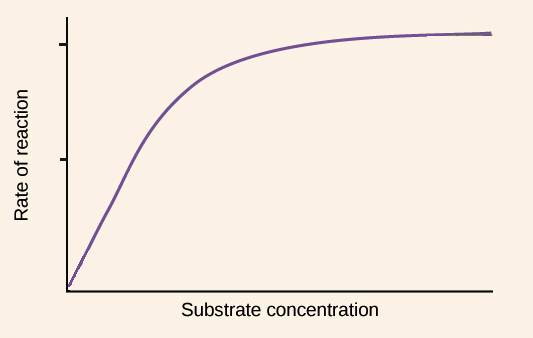
Whats limiting the rate
The ENZYME, not the substrate.
Understand why one adaptation to low temperature is to increase enzyme concentration.
counteracts reduced kinetic energy
causes slower molecular motion + fewer enzyme substrate collisions
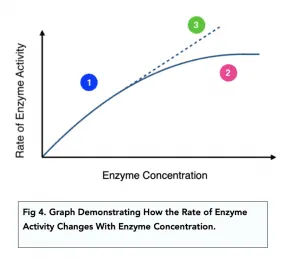
Understand the shape of the Rate of Reaction vs enzyme Concentration curve.
Straight linear line
Parameters Vmax and Km, what are they are how are they determined.
Vmax = Max reaction rate
Km = Measure of Affinity between enzyme and substrate
More enzyme ratio to substrate = lower affinity
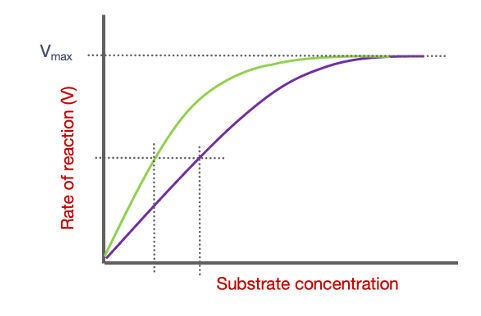
Definition of a competitive inhibitor (what does it do to Km, Vmax and why)....
molecule that structurally resembles a substrate and binds directly to an enzyme's active site, blocking substrate binding
How is inhibition overcome
overcome by high substrate conc.
high levels of substrate (more substrate = less chance of inhibition)
Differences in a V versus substrate concentration curve minus/plus competitive inhibitor
Vmax: w/o inhibitor = high , with inhibitor = unchanged
Km = w/o inhibitor = lower (higher infinity) , with inhibitor = higher (lower infinity)
Shape= reaches Vmax faster (w/o inhibitor) , reaches vmax slower (with inhibitor)
allosteric regulation of enzyme activity
molecules bind to a site other than the active site and alter enzyme activity
Advantage to regulating enzyme activity at the level of enzyme activity versus transcription/translation.
Quicker and efficient
Regulation of Phosphofructokinase (PFK)...do you understand why?
PFK activates w/ high levels of ADP (accelerates breakdown of glucose and generates ATP)
it initiates glycolysis when cellular energy is low
ATP citrate inhibits PFK (signal sufficient ATP availability and continuation of glycolysis is unnecessary)
Many enzymes of the Calvin Cycle, glycolysis, Citric Acid Cycle... are allosterically regulated. Thinking about the major metabolites (G3P, glucose, pyruvate, ATP, ADP, NADPH, NADP+, NADH...etc) which of these do you think would switch ON a particular enzyme and which do you think would switch OFF the same enzyme.
ADP, NADP+, and substrates act as activators, while ATP, NADH, and citrate generally act as inhibitors to ensure metabolic efficiency.

