ENGLISH LINGUISTICS II: Cohesion – Grammatical and Lexical
 Studied by 0 people
 Call with Kai
 Learn
Learn Practice Test
 Spaced Repetition
 Match
Match Flashcards
 Knowt Play
1/26

Earn XP
Description and Tags
A set of vocabulary-style flashcards covering key concepts and devices of grammatical and lexical cohesion, coherence, and related terminology from the notes.
Name | Mastery | Learn | Test | Matching | Spaced | Call with Kai |
|---|
No study sessions yet.
27 Terms
Cohesion
the mutual connectedness of words/phrases/clauses within a sequence, which is realized by grammatical dependencies.
The grammatical and lexical connections within a text that signal semantic unity and hold the text together.
Coherence
the mutual accessibility and relevance of concepts and the relations among them in the textual world.
Semantic continuity created by the reader’s interpretation and world knowledge; depends on context.
Grammatical cohesion
Cohesion realized through grammatical units or structures, including reference, substitution, ellipsis, parallelism, conjunction, and tense/aspect.
A REFERENCE
B SUBSTITUTION
C ELLIPSIS
D PARALLELISM
E CONJUNCTION
F TENSE/ASPECT
texture
the connectedness of a text. It involves cohesion (links within the text) and coherence (links made by the reader/listener using outside knowledge).
Pro-forms (reference) : definition +types
Short words that stand in for other lexical items and semantically refer to them;
1) EXOPHORIC: pro-‐form refers outside the text to the situation/context (I always thought...)
2) CATAPHORIC: pro-‐form refers ahead to a later item in the text (... it would be... an epic battle...)
3) ANAPHORIC: pro-‐form refers back to an earlier item in the text (This is how...)
Semantic Types of Reference
1. CO-REFERENCE
2. CO-CLASSIFICATION
3. CO-EXTENSION
Co-reference(Semantic Types of Reference)
Items linked by a cohesive link to the same extra-linguistic referent (referential identity).
Henry bought himself a new Jaguar. He practically lives in the car
Co-classification(Semantic Types of Reference)
Cohesion where A and B refer to members of the same identified class.
The kids were playing all kinds of games in that big hall. Some were into cards, there were plenty of chess boards, in one corner scrabble was set up.
Co-extension(Semantic Types of Reference)
Lexical items referring to related meanings within the same general field.
Congress complained about the president’s plans to rebuild White House.
Structural Types of Reference
1) PERSONAL REFERENCE: personal and possessive pronouns (Harry is a musician. He plays the oboe. His ...)
2) DEMONSTRATIVE REFERENCE: definite article, demonstrative pronouns (This is how it’s going to end.)
3) COMPARATIVE REFERENCE: reference items express comparison, e.g. same, equal, such, similar, other, different, comparative forms (... something a little more spectacular ... Getting hit by a car/not so distinctive)
Substitution: definition+ 3 types
Using pro-forms (like one, do, so) to replace a word or expression with the same grammatical function. anaphoric reference back to the earlier item.
1) NOMINAL SUBSTITUTION: pro-‐form replaces a noun phrase element (... all of them ... dedication, friendliness, responsiveness)
2) VERBAL SUBSTITUTION: ‘do’ replaces complete verb phrase (You wouldn’t drive a car without ABS. You’d be crazy if you did.)
3) CLAUSAL SUBSTITUTION: adverbs replace whole clauses (Is this the car you saw parked at the dealer the other day? Very likely so/Probably not.)
Ellipsis
parts of a sentence are left out because they can be recovered from the context (text or situation), ellipses shorten sentences and make texts denser
1) NOMINAL: core parts of a noun phrase are left out (We’ll park my car and take yours.)
2) VERBAL: parts of a verb phrase are left out (I have always supported you. Yes you have.)
3) CLAUSAL: a whole clause is left out (What are you going to have? I haven’t decided yet.)
Parallelism
sentences with similar grammatical or lexical structures create cohesion by showing a clear semantic connection.
You can‘t overnight dedication. Friendliness can’t be crated up for shipment. You can’t move responsiveness with a fork lift
Conjunction: definition + 3 types
Words that connect clauses or sentences and show the logical/semantic relationship between them. They do not replace or refer back but directly link ideas.
1) COORDINATORS: conjunctions coordinating clauses (cf. subordinators), e.g. and, but, or
2) ADVERBS: express broad spectrum of meaning and are syntactically flexible, e.g. then, however, besides
3) PREPOSITIONAL PHRASES: signal semantic relation between clauses, e.g. in spite of, as a result
Tense/Aspect
: belong to the repertoire of cohesive means as they express temporal relations across sentence boundaries and thus help to build formal and semantic connectedness
e.g. the simple past indicates completed actions, while the present perfect suggests ongoing relevance.

Lexical cohesion
Cohesion realized through link between the content words and their relations across segments, including repetition, synonymy, hyponymy, meronymy, paraphrase, and collocation.
A REITERATION
> repetition
> synonymy
> hypo-‐/eronymy
> meronymy
> antonymy
> paraphrase
B COLLOCATION
> lexical fields
> lexical se
Repetition (Lexical repetition)
the simplest way to built cohesive ties lexically is to repeat a word or expression (‘recurrence’); repetition promotes clarity but can also lead to redundancy
e.g. ‘Prime Minister Fukuda — Fukuda
SENSE RELATIONS
semantic relations between two or more words, e.g. synonymy, antonymy, hyponymy, meronymy
Synonymy
Two words with similar denotational meaning within the text.
e.g. parting shot/comeback/remark; outgoing/ parting
Antonymy
Words with opposite meanings that provide contrast.
Hyponymy
Word relationship of super-/subordinated meanings
“animal” is a hypernym of “dog.” - hyponym
Meronymy
Part–whole semantic relationship (e.g., T-shirt/designs).
e.g. pop culture/T-‐shirt, designs
A meronym is a part of a whole
holonym is the whole that contains the parts
Paraphrase
Expressing the same meaning in a different form;
expansion : Expressing the same idea using different words while retaining original meaning; it's often used to clarify or simplify complex information.
... I always thought it would be something a little more spectacular -‐ an epic battle with a hunter or a tiger. Or a territory war with another family. Or a forest fire.
condensation: Expressing a shortened version of the original text, retaining key ideas and meaning.
The floorboards creaked, the plumbing whined and throbbed, doorhinges squeaked and windows rattled in their frames. The noise was deafening.
Collocation
The regular co-occurrence of words or expressions that naturally go together and form meaning relations in a text.(e.g., make a decision).
Lexical Set: Words grouped by a shared theme or feature (e.g., red, blue, green = colors).same category (members of one group).
Lexical Field: Words linked by a shared subject or concept (e.g., doctor, nurse, hospital = medicine).Field = same topic/subject (different roles within one concept).
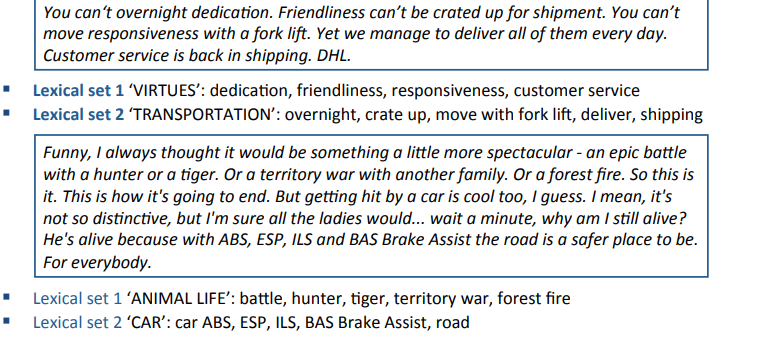
Lexical sets/fields
Lexical Set: Words grouped by a shared theme or feature (e.g., red, blue, green = colors).same category (members of one group).
Lexical Field: Words linked by a shared subject or concept (e.g., doctor, nurse, hospital = medicine).Field = same topic/subject (different roles within one concept).
Place relators
Spatial markers like this, that, here, there that orient the reader/listener.
Words or devices that give spatial orientation in a text, such as demonstratives (this, that) or demonstrative adverbs (here, there). They help create a sense of place in textual worlds.
Time relators
Tense and time words (e.g., yesterday, now, soon) that link events in time.

 Note
Note  Flashcards (88)