4. Principles of Inheritance and Variation
 Call Kai
 Learn
Learn Practice Test
 Spaced Repetition
 Match
Match Flashcards
 Knowt Play
1/247

Earn XP
Description and Tags
It is important you clear up your theory for this chapter before doing these flashcards because unfortunately I don't know how to teach this chapter through flashcards. Use this for revision since it has every fact-based sentence from NCERT but not the theory (seriously there's a lot). Anyway. Question type: Flashcards only. Answer type: Answer with Definition. Good luck!
Name | Mastery | Learn | Test | Matching | Spaced | Call with Kai | Chat |
|---|
No analytics yet
Send a link to your students to track their progress
248 Terms
What does “Like Begets Like” mean?
organisms of a species give rise to offsprings of the same species
What is genetics the study of?
Genetics is the study of inheritance and variation of characters in organisms, from parents to offspring.
What is the basis of heredity?
Inheritance
What is Inheritance?
Inheritance is the process by which characters are passed on from parent to progeny.
What is Variation?
Variation is the degree by which progeny differ from their parents.
What is one of the earliest examples of humans knowing that variation in organisms occurs through reproduction?
Artificial selection and domestication from ancestral wild cows, we have well-known Indian breeds, e.g., Sahiwal cows in Punjab.
Who conducted hybridisation experiments on garden peas for seven years?
Gregor Mendel
What experiments did Gregor Mendel do that led to him proposing laws of inheritance in living organisms?
hybridisation experiments on garden peas for seven years (1856-1863)
For how long did Mendel do his hybridisation experiments on garden peas?
seven years (1856-1863)
What are the two reasons that Mendel chose garden peas for his hybridisation experiments?
Peas don’t take too long to breed unlike humans, which can take many years. Peas grow and reproduce much faster, allowing for quicker data collection.
Peas produce many offspring, leading to greater sample size, which leads to greater credibility
(also peas are cheap)
According to Mendel’s Garden Pea experiments, what are the dominant and recessive traits regarding seed shape?
Dominant: round
Recessive: wrinkled
According to Mendel’s Garden Pea experiments, what are the dominant and recessive traits regarding seed colour?
Dominant: yellow
Recessive: green
According to Mendel’s Garden Pea experiments, what are the dominant and recessive traits regarding flower colour?
Dominant: violet
Recessive: white
According to Mendel’s Garden Pea experiments, what are the dominant and recessive traits regarding pod shape?
Dominant: Full
Recessive: constricted
According to Mendel’s Garden Pea experiments, what are the dominant and recessive traits regarding pod colour?
Dominant: green
Recessive: yellow
According to Mendel’s Garden Pea experiments, what are the dominant and recessive traits regarding flower position?
Dominant: axial
Recessive: terminal
According to Mendel’s Garden Pea experiments, what are the dominant and recessive traits regarding stem height?
Dominant: tall
Recessive: dwarf
Mendel conducted such artificial pollination/cross pollination experiments using several ____-________ pea lines.
Mendel conducted such artificial pollination/cross pollination experiments using several true-breeding pea lines.
What is a “true-breeding” line?
A true-breeding line is one that, having undergone continuous self-pollination, shows the stable trait inheritance and expression for several generations.
How many true-breeding pea lines did Mendel use for his hybridisation experiments?
14
How did Mendel select his 14 true-breeding pea lines for his hybridisation experiments? (what was he looking for?)
Mendel selected 14 true-breeding pea plant varieties, as pairs which were similar except for one character with contrasting traits.
What is the difference between characters and traits?
Characters are certain features, for example: eye colour, hair colour.
Traits are expressions of those features, for example: blue eyes, green eyes, black hair, brown hair.
What is a Filial1 or F1 generation?
Progeny made from cross breeding two true-breeding pea lines (first hybrid generation)
In Mendel’s hybridisation experiments on pea plants, what did he observe in the F1 generation?
F1 always resembled either one of the parents, and the trait of the other parent was not seen in them.
To study the inheritance of plant height in garden pea plants, which two types of plants did he cross-breed?
1 true-breed tall plant and 1 true-breed dwarf plant
What did Mendel do to obtain the F1 generation of pea plants in his hybridisation experiments?
He cross-bred two true-breed plants with opposing traits in the same trait.
What did Mendel do to obtain the F2 generation of pea plants in his hybridisation experiments?
He self-pollinated F1 plants.
What did Mendel observe in F2 generation of pea plants in his hybridisation experiments?
Some of the traits of the parent plants that were not present in F1 progeny are present in some of the F2 progeny.
What was the phenotypic ratio of F2 generation of pea plants in Mendel’s hybridisation experiments?
3:1
What was the genotypic ratio of F2 geenration of pea plants in Mendel’s hybridisation experiments?
1:2:1
What percentage of F2 generation of pea plants were dwarfs in Mendel’s hybridisation experiments?
25%
What percentage of F2 generation of pea plants were tall in Mendel’s hybridisation experiments?
75%
What is “selfing”?
self-pollination
Mendel proposed that something was being stably passed down, unchanged, from parent to offspring through the gametes, over successive generations. He called these things ________. Now we call them as ______.
Mendel proposed that something was being stably passed down, unchanged, from parent to offspring through the gametes, over successive generations. He called these things ‘factors’. Now we call them as genes.
What are the basic units of inheritance?
Genes
What are alleles?
Genes which code for a pair of contrasting traits are known as alleles.
What are the three possible pairs of alleles for plant height in pea plants?
TT
Tt
tt
What are homozygous genotypes?
Pairs of identical alleles
What are heterozygous genotypes?
Pairs of dissimilar alleles
What are genotypes?
Pairs of alleles that determine expression of a character
What are phenotypes?
Observable expressions of genotypes
What is the difference between genotype and phenotype?
TT and tt are called the genotype of the plant while the descriptive terms tall and dwarf are the phenotype.
What did Mendel conclude based on the F1 generation in his pea plant hybridisation experiments?
As Mendel found the phenotype of the F1 heterozygote Tt to be exactly like the TT parent in appearance, he proposed that in a pair of dissimilar factors, one dominates the other (as in the F1 ) and hence is called the dominant factor while the other factor is recessive . In this case T (for tallness) is dominant over t (for dwarfness), that is recessive.
How are dominant and recessive traits denoted when written?
It is convenient (and logical) to use the capital and lower case of an alphabetical symbol to remember this concept of dominance and recessiveness. (Do not use T for tall and d for dwarf because you will find it difficult to remember whether T and d are alleles of the same gene/character or not).
What is a monohybrid cross?
Cross-pollination of plants to observe the traits from one single character while other characters remain identical in both plants
From the observation that the recessive parental trait is expressed without any blending in the F2 generation in Mendels hybridisation experiments, what can we infer?
When the tall and dwarf plant produce gametes, by the process of meiosis, the alleles of the parental pair separate or segregate from each other and only one allele is transmitted to a gamete.
When the tall and dwarf plant produce gametes, by the process of meiosis, the alleles of the parental pair separate or segregate from each other and only one allele is transmitted to a gamete.
What is the percentage distribution of two alleles being present in the amount of gametes produced?
This segregation of alleles is a random process and so there is a 50 per cent chance of a gamete containing either allele.
What is a Punnett square?
It is a graphical representation to calculate the probability of all possible genotypes of offspring in a genetic cross.
The possible gametes are written on two sides, usually the top row and left columns. All possible combinations are represented in boxes below in the squares, which generates a square output form.
♂
what does this mean?
male
♀
what does this mean?
female
The 1/4 : 1/2 : 1/4 ratio of TT : Tt : tt is mathematically condensable
to the form of the binomial expression (ax +by)2. What are “a” and “b” here?
probabilities of x and y (alleles of a specific character in gametes) occuring in zygote
What is a test cross?
Whether a tall plant from F1 or F2 has TT or Tt composition, cannot be predicted. Therefore, to determine the genotype of a tall plant at F2, Mendel crossed the tall plant from F2 with a dwarf plant. This he called a test cross.
In a typical test cross an organism (pea plants here) showing a dominant phenotype (and whose genotype is to be determined) is crossed with the recessive parent instead of self-crossing. The progenies of such a cross can easily be analysed to predict the genotype of the test organism.
If a test cross is performed on a homozygous dominant plant, what is the nature of the offspring?
All show the dominant trait.
If a test cross is performed on a heterozygous dominant plant, what is the nature of the offspring?
50% show the dominant trait, and 50% show the recessive trait.
What are the first two principles of inheritance?
Law of Dominance
Law of Segregation
What are the three postulates of the Law of Dominance?
Characters are controlled by discrete units called factors.
Factors occur in pairs.
In a dissimilar pair of factors one member of the pair dominates (dominant) the other (recessive).
What is the Law of Segregation based on?
This law is based on the fact that the alleles do not show any blending and that both the characters are recovered as such in the F2 generation though one of these is not seen at the F1 stage.
What is the main postulate of the Law of Segregation?
Though the parents contain two alleles during gamete formation, the factors or alleles of a pair segregate from each other such that a gamete receives only one of the two factors.
What is the difference between the gametes produced by a homozygous parent and gametes produced by a heterozygous parent?
Of course, a homozygous parent produces all gametes that are similar while a heterozygous one produces two kinds of gametes each having one allele with equal proportion.
When experiments on peas were repeated using other traits in other plants, it was found that sometimes the F1 had a phenotype that did not resemble either of the two parents and was in between the two.
What is this phenomenon called?
Incomplete Dominance
Which organism is a good example of incomplete dominance?
Snapdragon (Antirrhinum majus)
What happens when you breed a true-breed white snapdragon plant with a true-breed red snapdragon plant?
In a cross between true-breeding red-flowered (RR) and true-breeding white-flowered plants (rr), the F1 (Rr) was pink! 🩷
In a cross between true-breeding red-flowered (RR) and true-breeding white-flowered plants (rr), the F1 (Rr) was pink.
What happened when the F1 generation was self-pollinated?
When the F1 was self-pollinated the F2 resulted in the following ratio 1 (RR) Red : 2 (Rr) Pink : 1 (rr) White.
What is the scientific name for Snapdragon?
Antirrhinum majus
When we cross a true-breed white snapdragon with a true-breed red snapdragon, why do we get a pink snapdragon?
What happened was that R was not completely dominant over r and this made it possible to distinguish Rr as pink from RR (red) and rr (white).
In a diploid organism, how many copies are there of each gene?
2
(a pair of alleles)
Let’s take an example of a gene that contains the information for producing an enzyme. There are two allelic forms. If the normal allele produces the normal enzyme that is needed for the transformation of a substrate S, what are the possible changes that a modified allele would cause? (there are three)
the normal/less efficient enzyme
a non-functional enzyme
no enzyme at all
Let’s take an example of a gene that contains the information for producing an enzyme. There are two allelic forms. Assuming the normal allele produces the normal enzyme that is needed for the transformation of a substrate S, and the modified allele produces
normal/less efficient enzyme
non-functional enzyme
no enzyme
then how is the phenotype due to this affected?
The phenotype/trait will only be dependent on the functioning of the unmodified allele.
Let’s take an example of a gene that contains the information for producing an enzyme. There are two allelic forms. Assuming the normal allele produces the normal enzyme that is needed for the transformation of a substrate S, and the modified allele produces
normal/less efficient enzyme
non-functional enzyme
no enzyme
then which is the dominant allele and which is the recessive allele?
The unmodified (functioning) allele, which represents the original phenotype is the dominant allele and the modified allele is generally the recessive allele.
What is the phenomenon of co-dominance?
In the case of co-dominance the F1 generation resembles both parents.
What is a good example of the phenomenon of co-dominance?
A good example is different types of red blood cells that determine ABO blood grouping in human beings.
An example of co-dominance is different types of red blood cells that determine ABO blood grouping in human beings.
What are the three alleles of the gene that controls which kind of sugar is present on blood cells?
IA, IB, and i
The plasma membrane of the red blood cells has sugar polymers that protrude from its surface and the kind of sugar is controlled by the gene. The gene (I) has three alleles IA, IB and i.
Which of these are dominant and which of these are recessive?
IA and IB are dominant, while i is recessive
The plasma membrane of the red blood cells has sugar polymers that protrude from its surface and the kind of sugar is controlled by the gene. The gene (I) has three alleles IA, IB and i.
How many genotypes of these alleles can be found in humans?
6
The plasma membrane of the red blood cells has sugar polymers that protrude from its surface and the kind of sugar is controlled by the gene. The gene (I) has three alleles IA, IB and i.
Depict a table of the different genotypes of these alleles that can be found in humans.
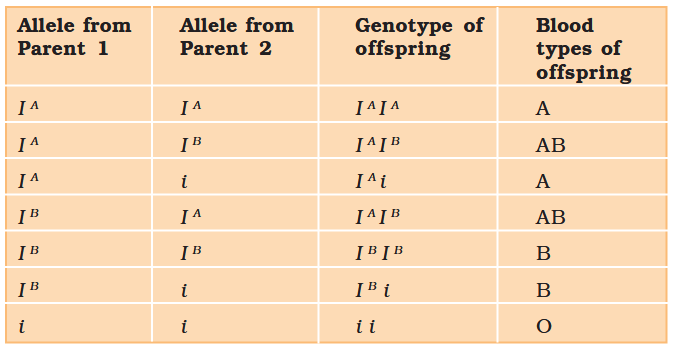
The plasma membrane of the red blood cells has sugar polymers that protrude from its surface and the kind of sugar is controlled by the gene. The gene (I) has three alleles IA, IB and i.
How many phenotypes of these alleles can be found in humans?
4
What is a notable example of a single gene producing more than one effect?
The gene that controls starch synthesis in pea plants also affects seed shape and size.
Starch synthesis in pea seeds is controlled by one gene. It has two alleles (B and b).
Discuss the effects observed in the pea plant when the genotype is BB.
Starch is produced effectively
Large starch grains
Round seeds
Starch synthesis in pea seeds is controlled by one gene. It has two alleles (B and b).
Discuss the effects observed in the pea plant when the genotype is Bb.
round seeds
intermediately sized starch grains (smaller than starch grains produced by BB genotype)
Starch synthesis in pea seeds is controlled by one gene. It has two alleles (B and b).
Discuss the effects observed in the pea plant when the genotype is bb.
lesser efficiency in starch synthesis
small starch grains
wrinkled seed
When Mendel crossed one pea plant with yellow and round seeds with one pea plant with green and wrinkled seeds, what phenotypes were observed in the F1 generation?
Mendel found that the seeds resulting from the crossing of the parents, had yellow coloured and round shaped seeds.
When Mendel crossed one pea plant with yellow and round seeds with one pea plant with green and wrinkled seeds, how can the genotypes of these parent plants be written as?
RRYY and rryy
When Mendel crossed one pea plant with yellow and round seeds (RRYY) with one pea plant with green and wrinkled seeds (rryy), what genotypes were observed in the F1 generation?
RrYy
When Mendel crossed one pea plant with yellow and round seeds with one pea plant with green and wrinkled seeds, what was the ratio of yellow and green seeds in F2 generation?
3:1
When Mendel crossed one pea plant with yellow and round seeds with one pea plant with green and wrinkled seeds, what was the ratio of round and wrinkled seeds in F2 generation?
3:1
When Mendel crossed one pea plant with yellow and round seeds with one pea plant with green and wrinkled seeds, what was the phenotypic ratio of F2 generation?

What is a trick for finding phenotypic ratios for dihybrid crosses when independent assortment is involved?
dihybrid cross phenotypic ratio = (monohybrid cross phenotypic ratio)2
What does the Law of Independent Assortment state?
The law states that ‘when two pairs of traits are combined in a hybrid, segregation of one pair of characters is independent of the other pair of characters’.
What is the Punnett square the F2 generation of a dihybrid cross involving yellow round pea plant seeds and green wrinkled pea plant seeds?
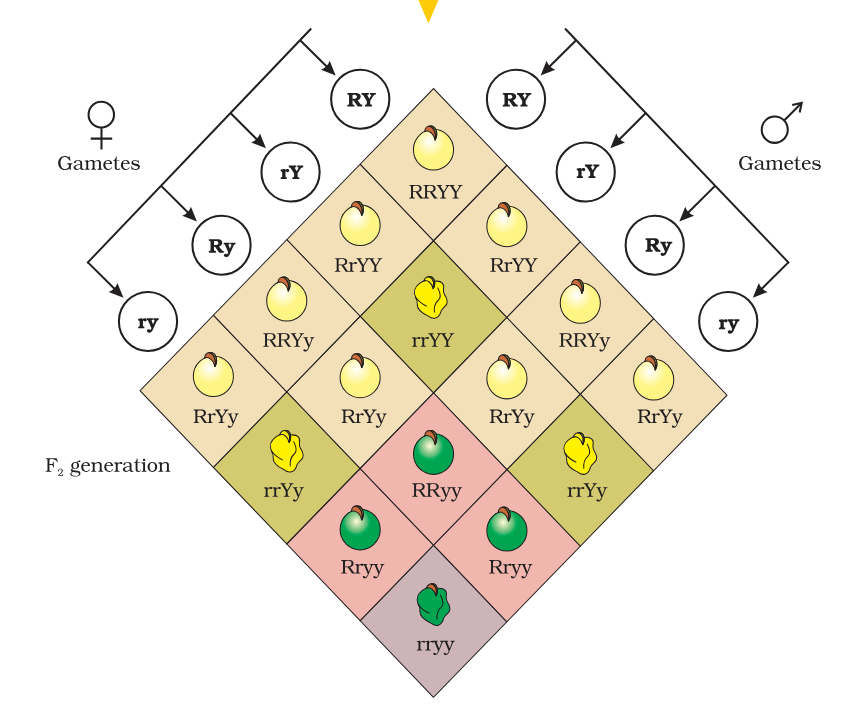
What is the Punnett square for the F2 geenration of a monohybrid cross between red and white snapdragons?
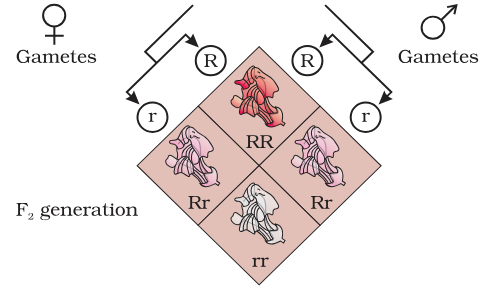
When Mendel crossed one pea plant with yellow and round seeds (RRYY) with one pea plant with green and wrinkled seeds (rryy), what were the four genotypes of gametes that combined to make F2 generation?
RY
Ry
rY
ry
What were the four reasons that Mendel’s work was published in 1865 but did not gain recognition until 1900?
communication was not easy (as it is now) in those days and his work could not be widely publicised.
his concept of genes (or factors, in Mendel’s words) as stable and discrete units that controlled the expression of traits and, of the pair of alleles which did not ‘blend’ with each other, was not accepted by his contemporaries as an explanation for the apparently continuous variation seen in nature.
Mendel’s approach of using mathematics to explain biological phenomena was totally new and unacceptable to many of the biologists of his time.
he could not provide any physical proof for the existence of factors or say what they were made of.
When Mendel crossed one pea plant with yellow and round seeds with one pea plant with green and wrinkled seeds, what was the genotypic ratio of F2 generation?
1:2:1:2:4:2:1:2:1
RRYY:RrYY:rrYY:RRYy:RrYy:rrYy:RR:yy:Rryy:rryy
When Mendel crossed one pea plant with yellow and round seeds with one pea plant with green and wrinkled seeds, how many genotypes were formed?
9
When Mendel crossed one pea plant with yellow and round seeds with one pea plant with green and wrinkled seeds, how many phenotypes were formed??
4
Which three scientists independently rediscovered Mendel’s discoveries? When?
de Vries, Correns and von Tschermak
1900
Which two scientists noted that the behaviour of chromosomes was parallel to the behaviour of genes and used chromosome movement to explain Mendel’s laws?
Walter Sutton and Theodore Boveri
The two alleles of a gene pair are located on homologous sites on homologous chromosomes.
Remember.
Okay.
Depict Meiosis briefly in your head.
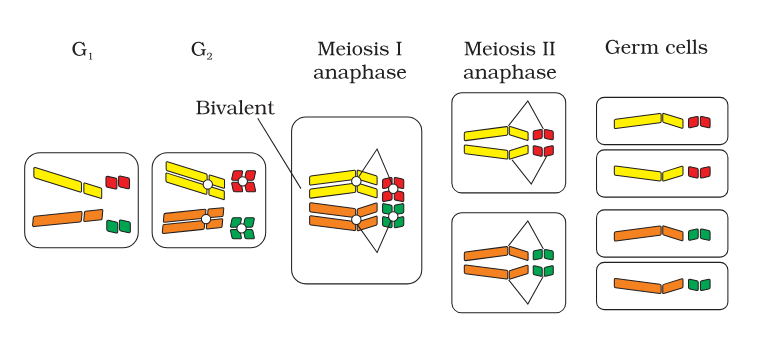
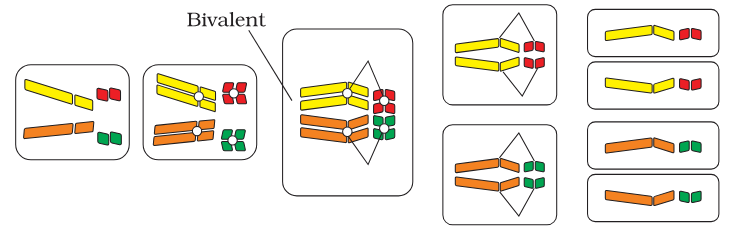
What is this process called?
Meiosis