Unit 3B: Learning
 Studied by 0 people
 Call Kai
 Learn
Learn Practice Test
 Spaced Repetition
 Match
Match Flashcards
 Knowt Play
1/10

There's no tags or description
Looks like no tags are added yet.
Name | Mastery | Learn | Test | Matching | Spaced | Call with Kai |
|---|
No study sessions yet.
11 Terms
learning
… is a relatively permanent change in behavior that occurs as a result of experience
behavioral psychology perspective
classical conditioning, pavlov, associative learning
… … is a type of learning in which an initially neutral stimulus when paired with a stimulus that elicits a reflex response results in a learned, or conditioned, response when the now conditioned stimulus is presented
Ivan … discovered this with dogs – the sound of a metronome (CS) was paired with meat powder (UCS)
Demonstrates principles of … … (connecting 2 distinct stimuli)
unconditioned stimulus, unconditioned response, neutral stimulus, conditioned stimulus, conditioned response
elements of classical conditioning
an … … is a stimulus that elicits an automatic or involuntary response – these don’t have to be taught to get a response to (ex: food – it makes a dog’s mouth water) – produces an unconditioned response
an … … is any original response that occurs naturally and in the absence of conditioning (ex: dog drooling)
a … … is a stimulus that initially does not elicit the reflex or automatic response being studied (ex: a bell ring does not initially make a dog drool)
a … … is a neutral stimulus that is repeatedly paired with an unconditioned stimulus until it acquires the ability to elicit a response that it previously did not – NS becomes conditioned once the pairing has happened (ex: when bell is paired with food, the bell is now the CS)
a … … is the learned or acquired response to a conditioned stimulus
acquisition, stronger, extinction, spontaneous recovery, stimulus generalization, stimulus discrimination, higher-order conditioning
procedures of classical conditioning
… refers to the first stages of learning when a conditioned response is established – involves repeated pairings of the CS and the UCS (the greater number of pairings, the … the CR, but the first few trials produce the greatest rate of learning which then levels off) – this occurs best when the interval between the presentation of the CS and the UCS is about half a second
… is the decrease or disappearance of a conditioned response (this involves repeatedly presenting the CS without pairing it with the UCS – ex: if a dog salivates to the sound of a can opener, then open the can without giving the dog food to eventually make the dog stop salivating to the sound)
… … is the reappearance of a conditioned response after a rest period or a period of lessened response – this can ONLY occur after extinction
… … is the elicitation of a CR by stimulation similar but not identical to the original stimulus (ex: ringing a similar sounding bell for the dog/it still drooling)
… … is the ability to distinguish between like stimuli and respond to specific stimuli only (ex: after getting bitten by a German Shephard, you may be scared of only big dogs and not small dogs)
…-… … is when the CS of one experiment acts as the UCS of another, for the purpose of conditioning a NS (ex: after pairing a tone with food and establishing the tone as a CS that elicits salivation, a light could be paired with the tone. The light alone would then come to elicit salivation, meaning it has become another CS)
learned, counterconditioning
john watson conditioned an infant named Little Albert to fear a white rat (CS) – the sight of the rat was paired with a loud noise (UCS) until the rat alone produced crying/other responses indicative of fear (CR). This fear generalized to stimuli similar to the CS including a dog, monkey, rabbit, and fur coat
This study shows that human emotional responses could develop as a result of classical conditioning and that most of our fears are … rather than innate
… is a behavioral therapy technique that replaces an UCR (like fear) with a desired, positive response by pairing the stimulus with something pleasant (ex: to take away Little Albert’s fear of the white rat, we could pair it with cookies to help him associate rats with the cookies instead)
taste aversion, one-trial conditioning, biological preparedness
… … is associating bad experiences with taste/food
…-… … is when you experience something traumatic only once, it makes an association/conditions you automatically
… … is the innate, evolutionary tendency for organisms to quickly learn associations that aid survival, like developing taste aversion
habituation
… is a decrease in response to a stimulus after being repeatedly exposed to it (ex: continuously slamming the psych textbook and me being less scared – a diminished response)
operant conditioning, reinforcement, primary reinforcement, secondary reinforcement, punishment, law of effect, shaping, instinctive drift
… … is the process in which behavioral change (ex: learning) occurs as a function of the consequences of behavior
B.F. Skinner trained rats and pigeons this way
… is any event that strengthens/increases the behavior it follows (… … fulfills basic drive/survival needs – like food/water, hugs, etc, while … …everything else – like money, stickers, etc)
a … is an event that tends to decrease the behavior that it follows
Edward Thorndike’s … … … states that behaviors with reinforcing consequences are more likely to be repeated while behaviors with punishing consequences are not as likely to be repeated
… is an operant conditioning procedure in which reinforcers guide behavior toward closer and closer approximations of the desired behavior
… … is the tendency of learned behavior to gradually revert to biologically predisposed patterns; when an animal’s instinctive behavior interfered with the process of conditioning
acquisition, exinction, spontaneous recovery, generalization, discrimination
comparisons between operant and classical conditioning
… – the initial stage of learning some pattern of responding (ex: dog learning to beg for food)
… – a procedure in which reinforcement is discontinued (the reinforcing stimulus is no longer presented) and there is a decline in the rate of the formerly reinforced response (ex: dog is no longer reinforced for begging, so it lays under the table instead)
… … – the reappearance of a conditioned response after it has been experimentally extinguished (ex: the dog once again begging for food after the behavior had been extinguished)
Stimulus … (ex: a child learning to say please to get candy from parents, then saying it to other adults to get what they want)
Stimulus … (ex: a dog learning to sit for a treat only when hearing “sit” and not “hit” or “kit”)
positive reinforcement, negative reinforcement
training techniques
… … adds a stimulus immediately after the behavior occurs, while … … removes a stimulus immediately after the behavior occurs
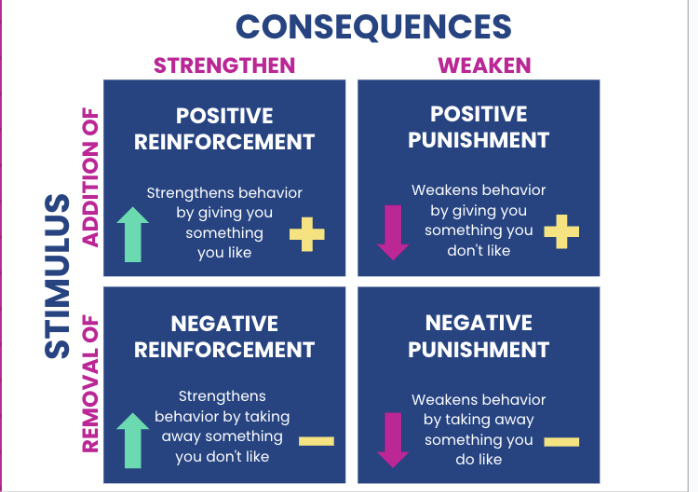
+ reinforcement ex: you pick up your sibling, they take you out to dinner at your favorite restaurant
+ punishment ex: if you come in late after your curfew, you’re given chores to do
– reinforcement ex: going for a run which reduces negative emotions like anxiety (increases athletic behavior)
– punishment ex: if you’re mean to your caregiver you get your phone taken away
superstitious, time, again, learned helplessness, decrease, depression
… behavior occurs when consequences reinforce unrelated behaviors – when the delivery of a reinforcer or punisher occurs close together in … with an independent behavior, making the behavior accidentally reinforced or punished, increasing the likelihood of that behavior occurring … (ex: you walk up a ladder and a minute later you trip and fall, so you attribute your accident to “bad luck” and the irrelevant ladder)
… … is the hopelessness and passive resignation humans and other animals learn when unable to avoid repeated aversive events; a … in an organism’s responding after its exposure to uncontrollable aversive events (ex: dogs subjected to uncontrollable electric shocks were later able to learn a routine avoidance task)
This may help explain … – if a person experiences uncontrollable events like the death of a loved one, the person may believe there is nothing they can do about it/give up
 Note
Note  Flashcards (31)