NUTR 3200 midterm
0.0(0)
 Studied by 3 people
 Call Kai
 Learn
Learn Practice Test
 Spaced Repetition
 Match
Match Flashcards
 Knowt Play
Card Sorting
1/233

Earn XP
Description and Tags
Last updated 10:06 PM on 2/3/23
Name | Mastery | Learn | Test | Matching | Spaced | Call with Kai |
|---|
No analytics yet
Send a link to your students to track their progress
234 Terms
1
New cards
Modern nutrition has changed from knowing how to prevent nutrient deficiencies to…..
understanding the effects of over nutrition,
goal = understand optimal levels of nutrients req for health
we dont eat nutrients, we eat \*food\*
focus on personalized nutrition
goal = understand optimal levels of nutrients req for health
we dont eat nutrients, we eat \*food\*
focus on personalized nutrition
2
New cards
1. what is an essential nutrient
2. what are the 2 reasons they are essential to the human diet
chemical that is req for metabolism
CANT be synthesized *or* not synthesized rapidly enough to meet needs
1. removing it causes deficiency and decline in heath
2. putting it back corrects problem, heath returns
CANT be synthesized *or* not synthesized rapidly enough to meet needs
1. removing it causes deficiency and decline in heath
2. putting it back corrects problem, heath returns
3
New cards
1. what is a nutritional deficiency
2. what are some examples and the diseases they cause?
person’s nutrient intake consistently falls *below* the recommended requirement
ex, iron = anemia (not enough red blood cells to transport o2)
thiamine = beri beri (abnormalities in nervous system, less energy production)
vitamin c = scurvy (no collagen= haemorrhaging)
vitamin d = rickets (bad bone growth)
ex, iron = anemia (not enough red blood cells to transport o2)
thiamine = beri beri (abnormalities in nervous system, less energy production)
vitamin c = scurvy (no collagen= haemorrhaging)
vitamin d = rickets (bad bone growth)
4
New cards
how does a fixing a deficiency differ from nutritional requirements
deficiency = prevention of disease *(bare minimum)*
nutritional requirement = ensure **optimal** health
nutritional requirement = ensure **optimal** health
5
New cards
nutritional requirements were prompted by WW1 and limited food rations… what are some of the limitations with their recommendations… what did they not consider
age, gender, body size, physical activity (soldier on the front line) were NOT considered but have a big effect
6
New cards
Daily values on a “Nutrition Facts” label is based on a 2000 calorie diet. They are made using ______________ which are established by the national academy of sciences
Dietary Reference Intakes
*these values are general and need to be adjusted for a specific person*
*these values are general and need to be adjusted for a specific person*
7
New cards
what is a dietary reference intake
set of reference values for nutrients
ex: 130 g of carbs a day for a female
ex: 130 g of carbs a day for a female
8
New cards
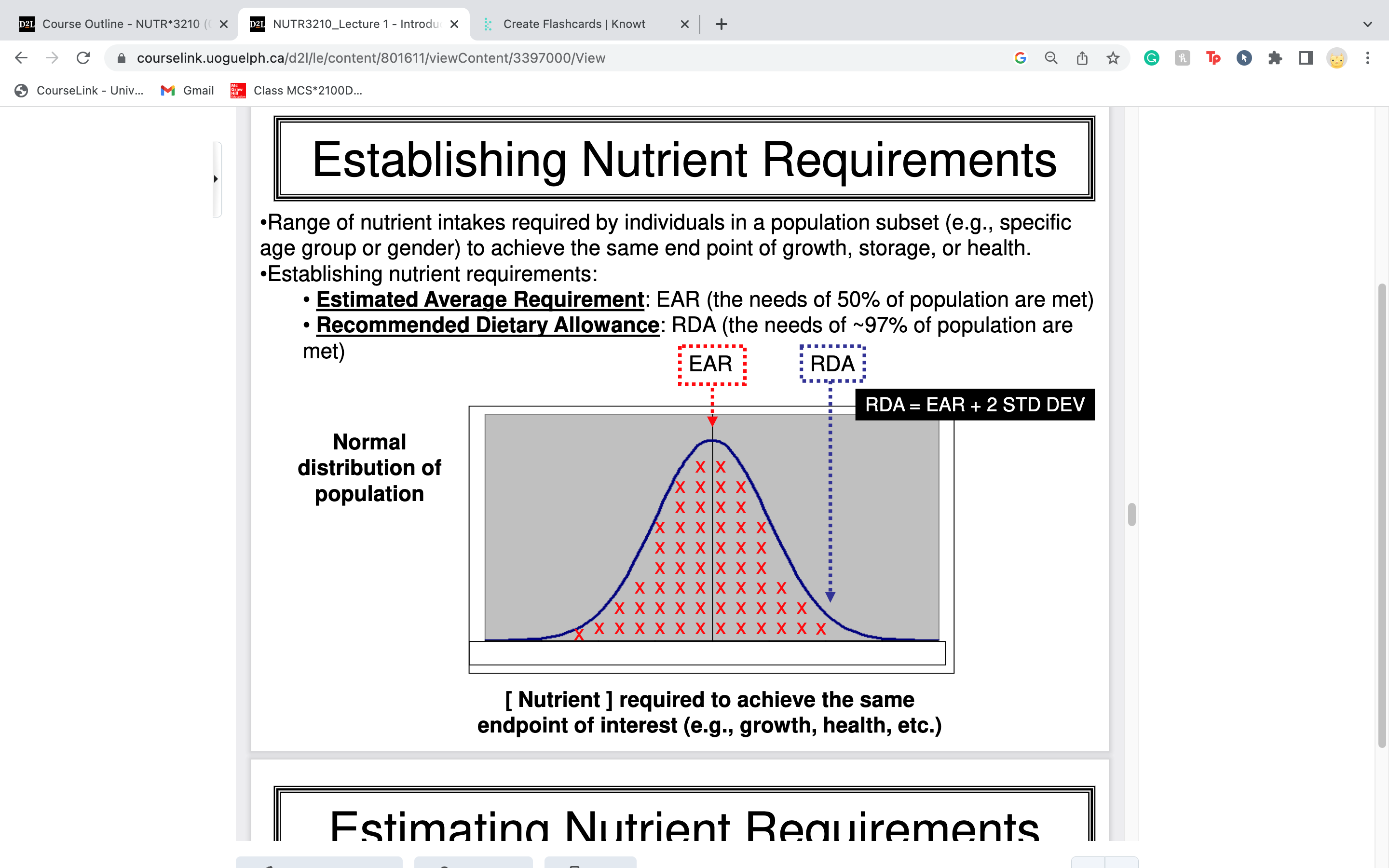
what is the EAR (estimated average requirement)
* needs of 50% of the population is met
9
New cards
what is RDA (recommended dietary allowance) and what is the formula for it
* needs of 97% of population is met
* RDA= EAR + 2 Std Dev
* RDA= EAR + 2 Std Dev
10
New cards
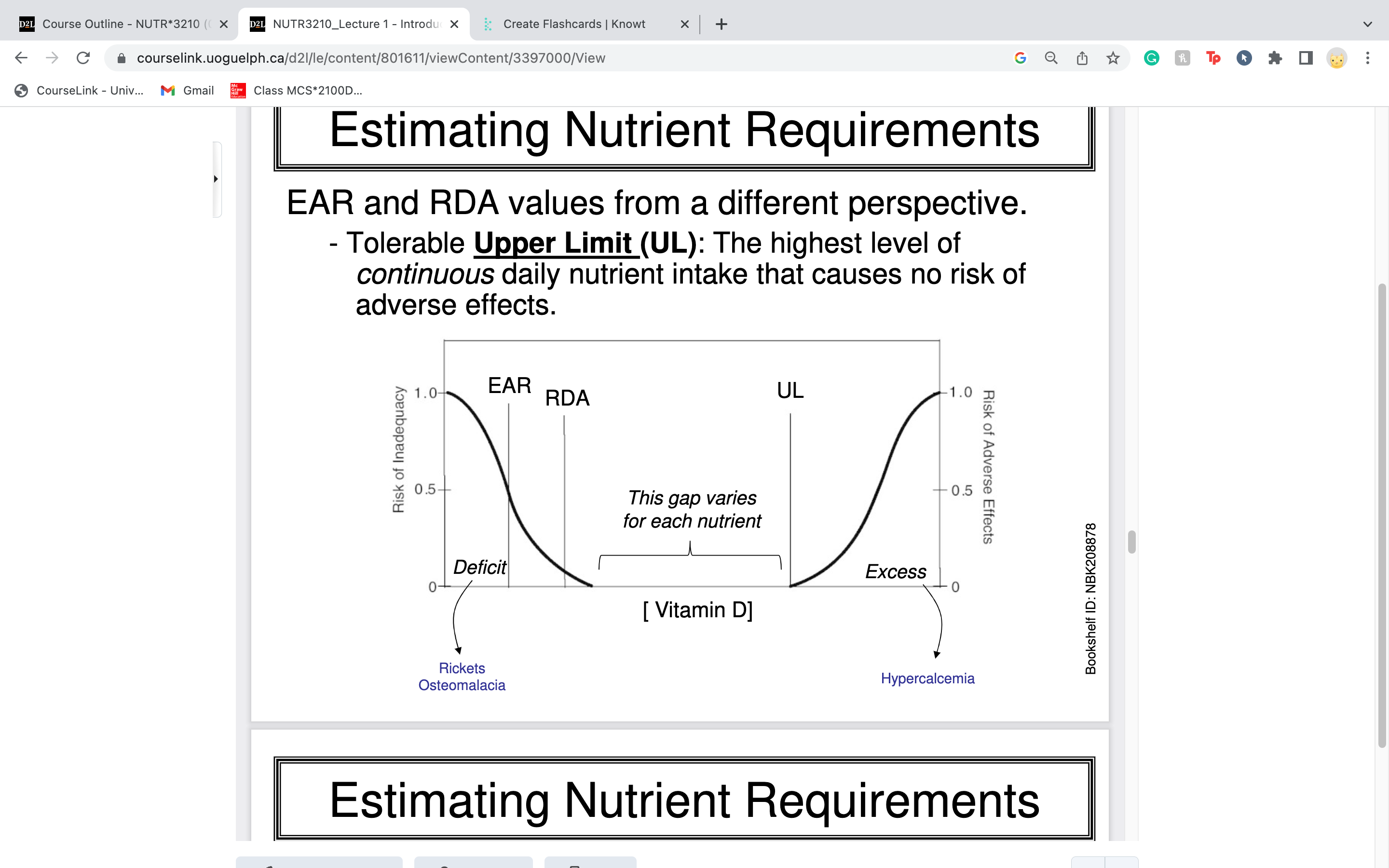
what is the tolerable upper limit (UL)
highest level of continuous daily nutrient intake that causes no risk of adverse effects
*amount right at the end of the sweet spot,*
*amount right at the end of the sweet spot,*
11
New cards
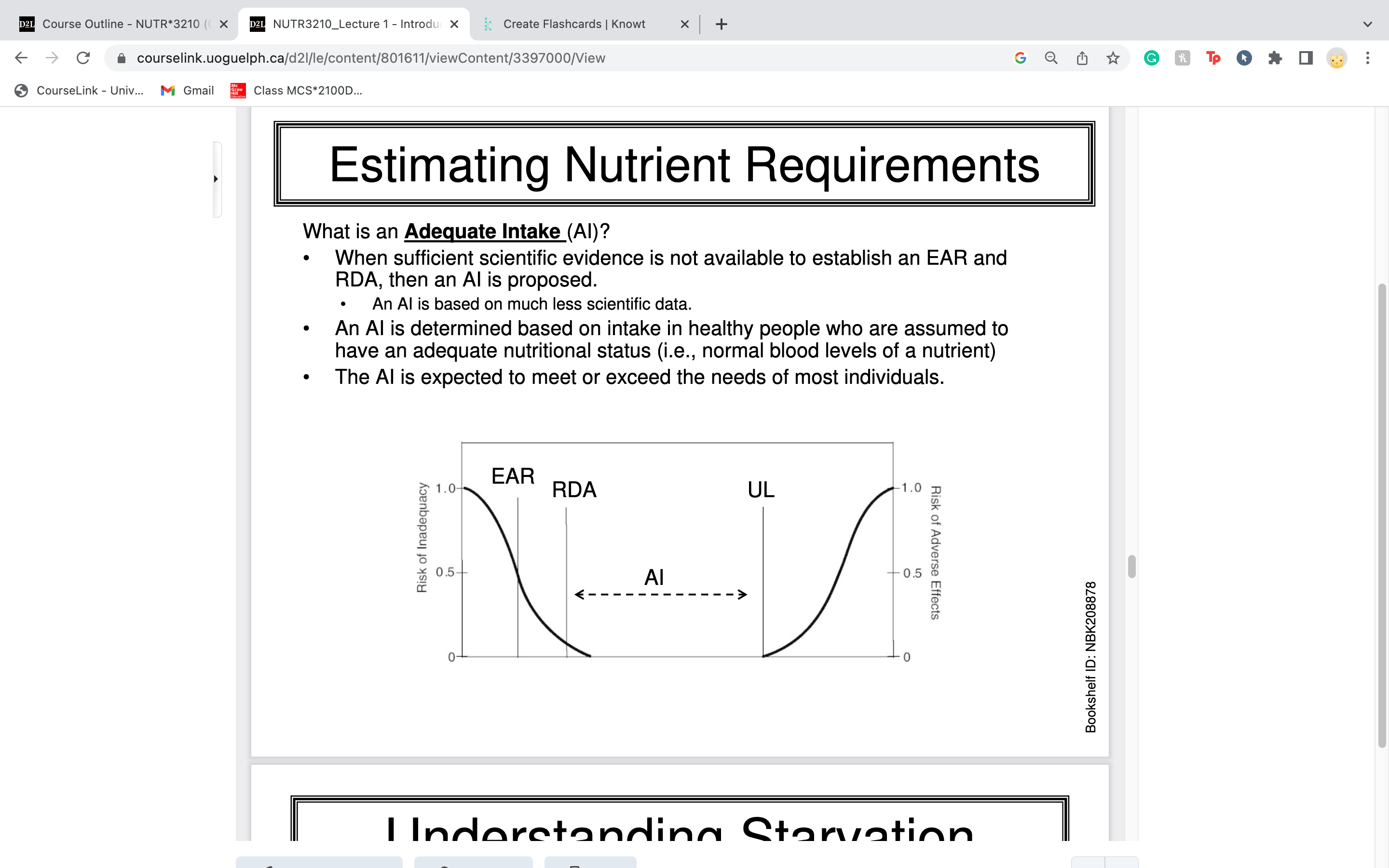
what is the adequate intake (AI)
**THE SWEET SPOT**
when u cant make up an EAR or RDA .. u do this
* determined based on intake in healthy people who are assumed to have an adequate nutritional status (i.e., normal blood levels of a nutrient)
* The AI is expected to __meet or exceed__ the needs of *most individuals.*
when u cant make up an EAR or RDA .. u do this
* determined based on intake in healthy people who are assumed to have an adequate nutritional status (i.e., normal blood levels of a nutrient)
* The AI is expected to __meet or exceed__ the needs of *most individuals.*
12
New cards
what were the outcomes of the Minnesota Starvation Experiment in 1944
obvi weight loss …. BUT also
irritability, dizziness, tiredness, hair loss, low libito, depression
took 2 years to overcome these effects in patients
irritability, dizziness, tiredness, hair loss, low libito, depression
took 2 years to overcome these effects in patients
13
New cards
1. what are the 4 characteristics of a nutritious diet
2. what are the ==meanings== of each
ADEQUATE- enough calories, essential nutrients, fibre to keep you healthy
MODERATE - dont consume excess calories of eat more of a food or food group than recommended
BALANCED - eat nutrient dense foods
VARIED - wide selection of foods to get necessary nutrients
MODERATE - dont consume excess calories of eat more of a food or food group than recommended
BALANCED - eat nutrient dense foods
VARIED - wide selection of foods to get necessary nutrients
14
New cards
cell culture, animal models and human studies are used to study genomics.
what are some challenges with human studies ?
what are some challenges with human studies ?
genetics, lifestyle, cultural habits
15
New cards
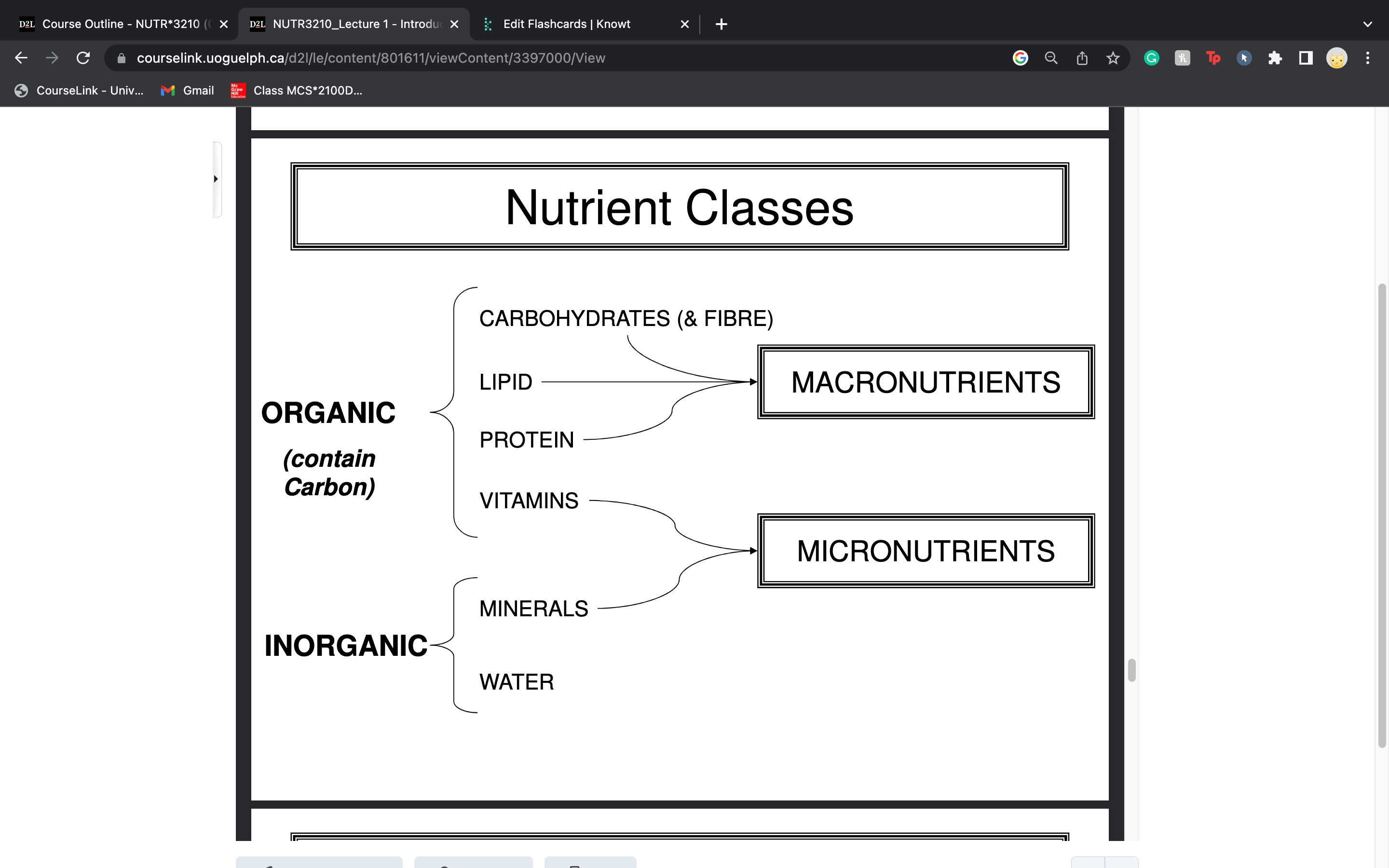
nutrients are classified into organic (carbon containing) and inorganic.
1. classify carbs, minerals, proteins, lipids, water, vitamins
1. classify them into macro nutrients and micro
1. classify carbs, minerals, proteins, lipids, water, vitamins
1. classify them into macro nutrients and micro
16
New cards
Say the major things that happened in nutrition in each era… slay
500 BC -
400 BC -
1614 AD -
17th century -
19th century -
20th century -
21st century -
500 BC -
400 BC -
1614 AD -
17th century -
19th century -
20th century -
21st century -
***500 BC -*** nutrients
***400 BC -*** medicine should focus on individual
***1614 AD -*** body uses food, metabolism
***17th century -*** dietary supplementation can improve the health w particular diseases \*nutrients are essential
***19th century -*** vitamins and prevention of disease
***20th century -*** how much of each nutrient is needed for optimal health
***21st century -*** nutritional genomics, diet and genes interact
***400 BC -*** medicine should focus on individual
***1614 AD -*** body uses food, metabolism
***17th century -*** dietary supplementation can improve the health w particular diseases \*nutrients are essential
***19th century -*** vitamins and prevention of disease
***20th century -*** how much of each nutrient is needed for optimal health
***21st century -*** nutritional genomics, diet and genes interact
17
New cards
anabolism is energy going into the body… what is an example of this ?
insulin, oversees ==building== things in the body
promotes the ==synthesis of protein and glycogen== and it inhibits the degradation of these compounds in muscle tissue.
promotes the ==synthesis of protein and glycogen== and it inhibits the degradation of these compounds in muscle tissue.
18
New cards
catabolism is energy out into the body… what is an example of this ?
glucagon
\
Stimulating the liver to break down glycogen to be released into the blood as glucose
Breaking down stored fat (triglycerides) into fatty acids for use as fuel by cells
\
Stimulating the liver to break down glycogen to be released into the blood as glucose
Breaking down stored fat (triglycerides) into fatty acids for use as fuel by cells
19
New cards
what is the average water intake of an adult?
2\.7L-3.7L
20% comes from foods
20% comes from foods
20
New cards
what are the 5 functions of water?
\-solvent in biochemical rxns
\-catabolism (hydrolysis) breakdown
\-maintains vascular volume
\-nutrient transport
\-temperature regulation
\-catabolism (hydrolysis) breakdown
\-maintains vascular volume
\-nutrient transport
\-temperature regulation
21
New cards
explain water toxicity
water intake is **greater** than the kidney’s ability to process water
22
New cards
1. what is hyponatremia
2. how can this occur, and how can it be avoided
3. what are the effects of it
1. too little sodium in blood ratio of water to sodium too big
2. occurs from excessive fluid intake, under replacement of sodium or BOTH. avoided by urination
1. central nervous system edema (swelling) and muscle weakness
23
New cards
food analysis gives us information about foods, and allows us to produce safe and nutritious foods so consumers can make *informed decisions*
\
how does food analysis have applications in the modern world?
\
how does food analysis have applications in the modern world?
government regulations - maintain quality of foods, ensure food industry makes safe foods w high quality, food allergies!
quality control - food composition doesn’t change
quality control - food composition doesn’t change
24
New cards
caloric content does not equate nutrient content in foods, as 1/2 cup of broccoli has many more nutrients than a cupcake that has more calories
25
New cards
a feed sample is left to air dry and becomes dry matter once the moisture leaves
\
why is determining water content in feed important? (4 reasons)… think moisture and its effects
\
why is determining water content in feed important? (4 reasons)… think moisture and its effects
* water contributes to weight aka price of feed and shipping costs
* storage conditions, too much = spoils fast, too little = less tasty
* moisture dilutes energy and nutrients in food
* moisture important for optimum intake and performance of animals
* storage conditions, too much = spoils fast, too little = less tasty
* moisture dilutes energy and nutrients in food
* moisture important for optimum intake and performance of animals
26
New cards
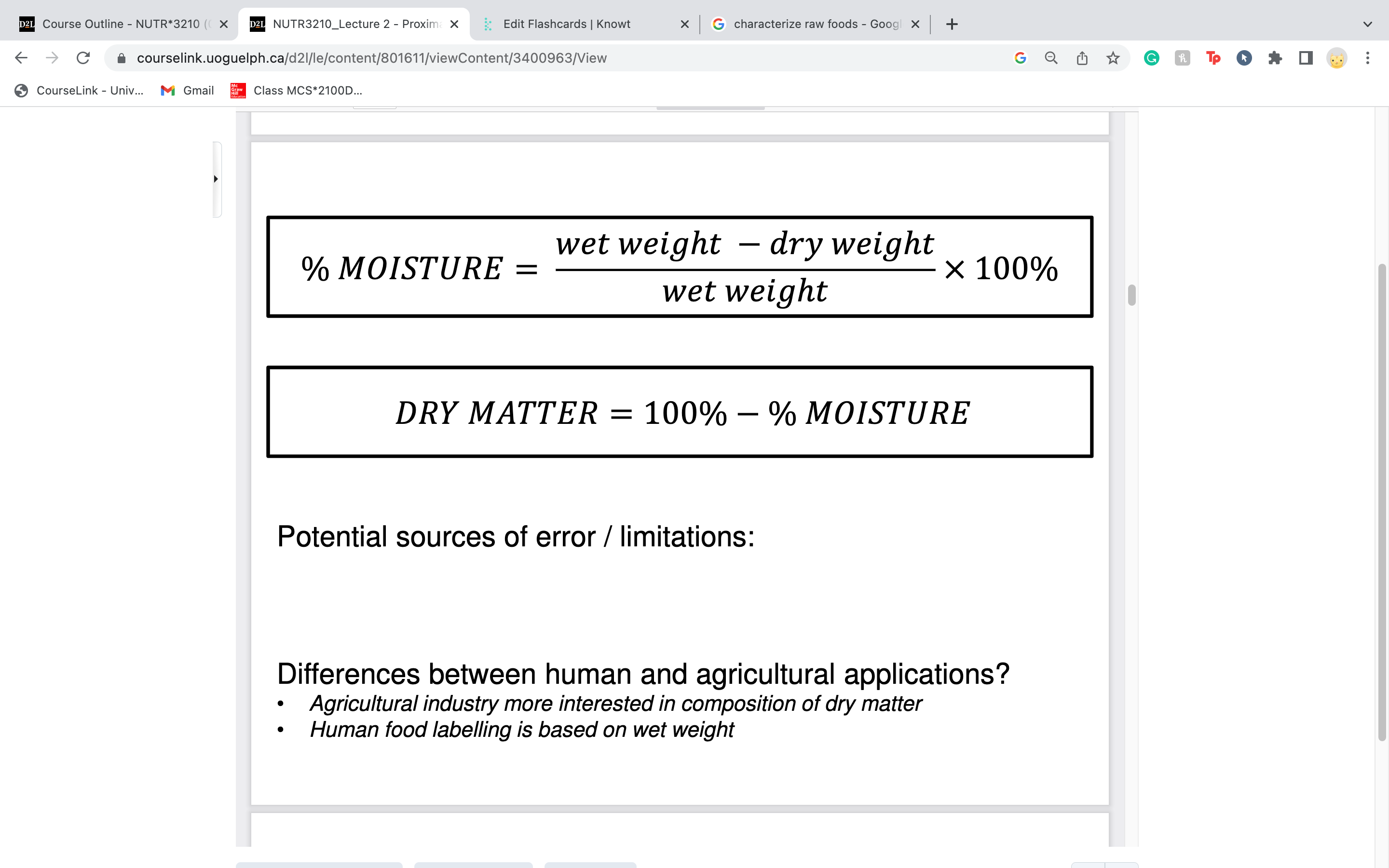
% moisture formula
\
27
New cards
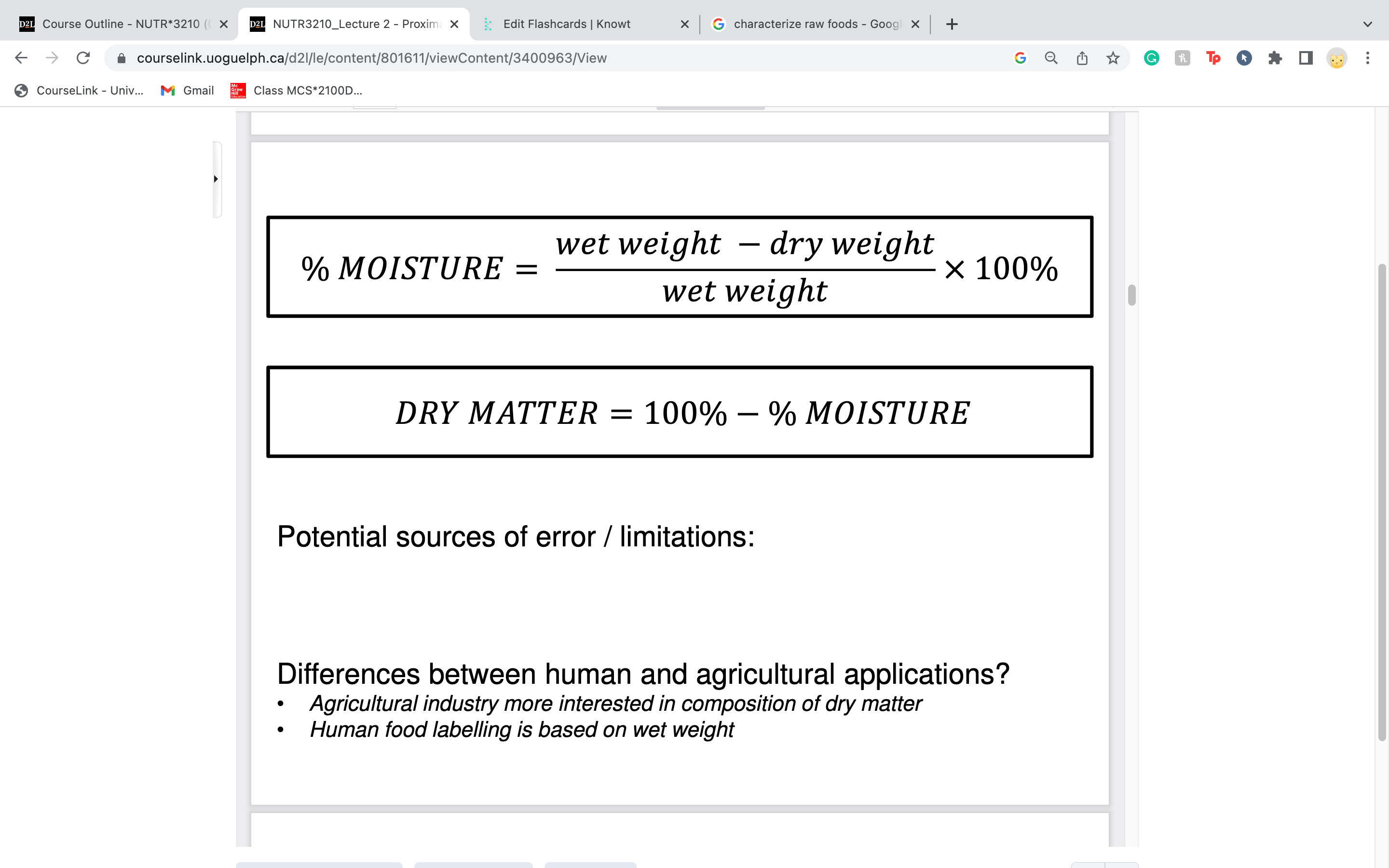
dry matter formula
28
New cards
what is the difference between human and agricultural applications of % moisture and dry matter
\-agricultural industry interested in dry composition
\-human food labelling based on wet weight
\-human food labelling based on wet weight
29
New cards
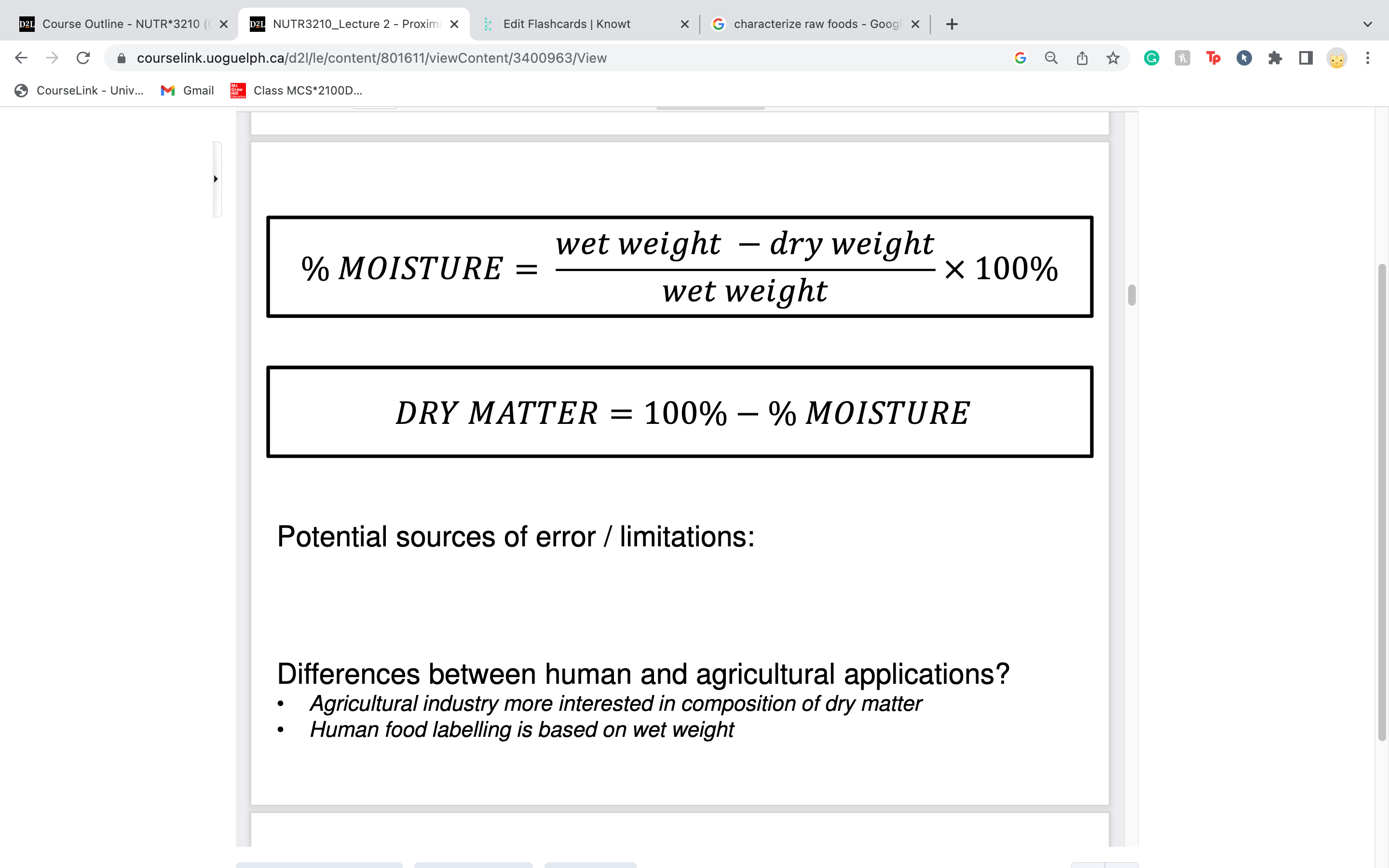
what are some potential sources of error/limitations when drying wet weigth
\-drying can remove volatile compounds such as short chain fatty acids and some minerals
\-this causes an under-estimation of dry weight
\-this causes an under-estimation of dry weight
30
New cards
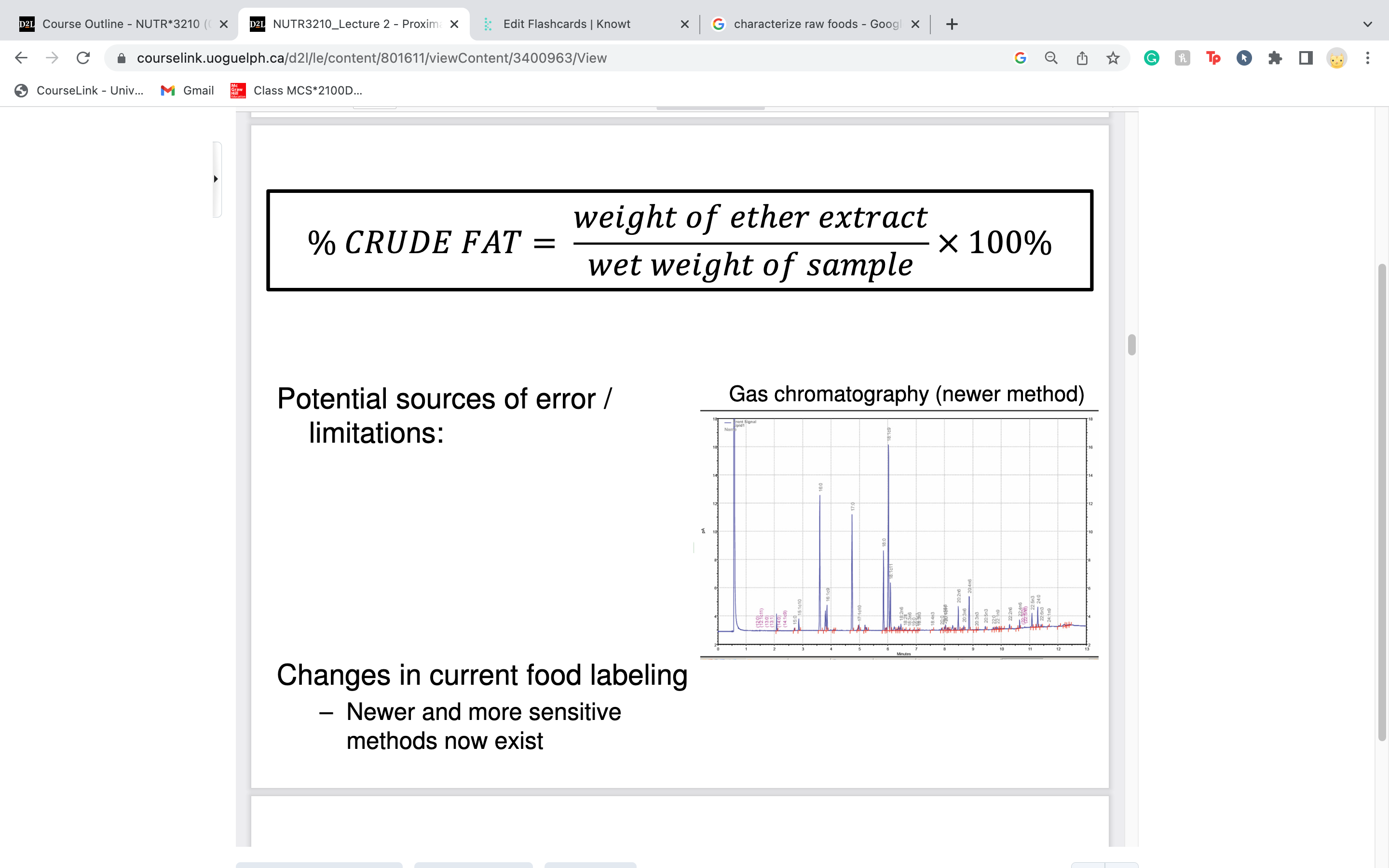
% crude fat formula
what are some limitations when extracting fats
what are some limitations when extracting fats
\-other non nutritious/non dietary fats (ex: chlorophyll, resins, waxes = used in structure etc) show up in the dried down solution and cause it to overestimate the crude fat determination
\
there is newer and more sensitive methods that exist to fix this
\
there is newer and more sensitive methods that exist to fix this
31
New cards
what do you need to do to dry matter to get it to ether extract
add organic solvent, this extracts the ether
anything thats not fat precipitates out
dry it down and measure the weight of the solid (fat) that is left
anything thats not fat precipitates out
dry it down and measure the weight of the solid (fat) that is left
32
New cards
1. how do you determine ash content from an ether extract (precipitate)
2. what is ash content
1. ignite it !!
2. mineral content
33
New cards
% ash formula
why is ash content aka mineral content important
why is ash content aka mineral content important
quality and taste of food
microbiological stability
nutritional requirements
manufacturer processing
microbiological stability
nutritional requirements
manufacturer processing
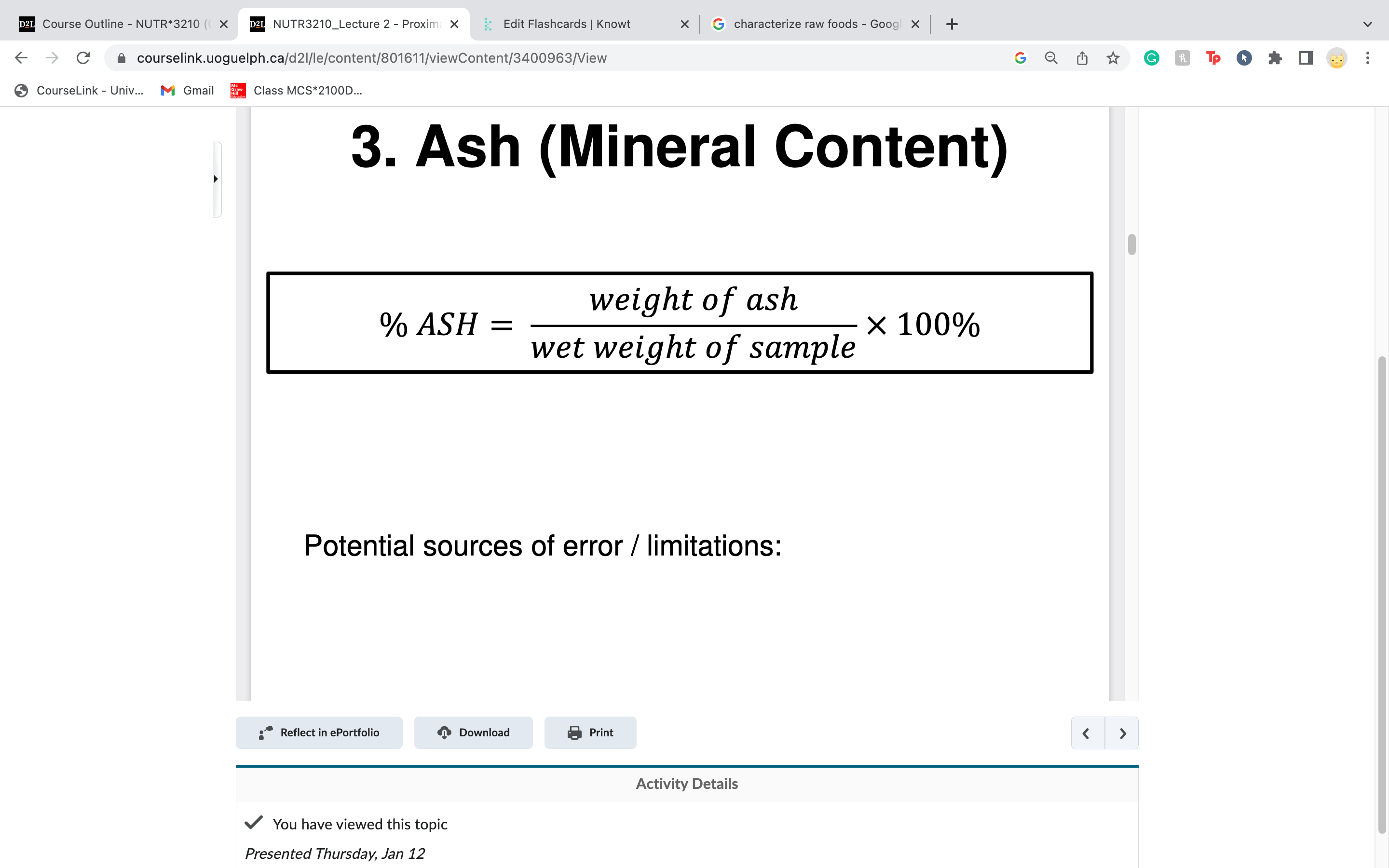
34
New cards
what are some limitations when determining ash/mineral content
\-volatile minerals can be lost
\-no info abt individual minerals
\-no info abt individual minerals
35
New cards
how do you get dry matter to nitrogen….
1. what are the two assumptions
2. what are the 3 steps
1. what are the two assumptions
2. what are the 3 steps
1. all nitrogen is in protein
2. all protein contains 16% nitrogen
\
1\. **digestion** - food sample mixed w sulfuric acid, converts nitrogen to ammonia
2\. **distillation** - separates the ammonia
3\. **titration** - quantifies the amount of ammonia
36
New cards
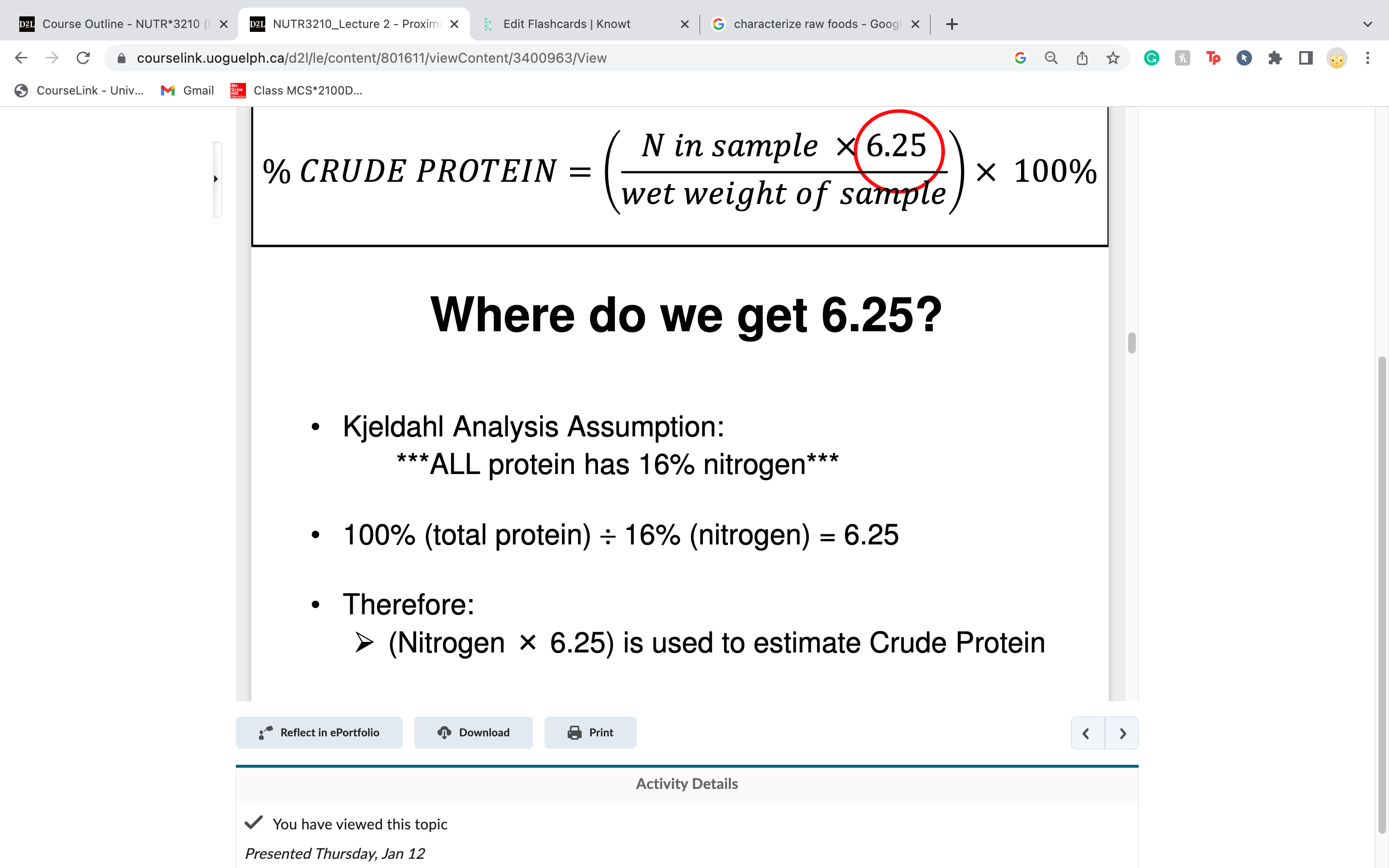
% crude protein formula
**conversion factor**=?
**conversion factor**=?
6\.25 used to estimate crude protein
37
New cards
what are some sources of error with the Kjedahl analysis (dry matter to nitrogen)
1) assumes all proteins have 16% nitrogen (actual range is 13-19%)
2) there are other sources of nitrogen (aka nitrates, nitrites, urea, nucleic acids, in food sample would be part of crude protein calculation… which would over estimate it )
2) there are other sources of nitrogen (aka nitrates, nitrites, urea, nucleic acids, in food sample would be part of crude protein calculation… which would over estimate it )
38
New cards
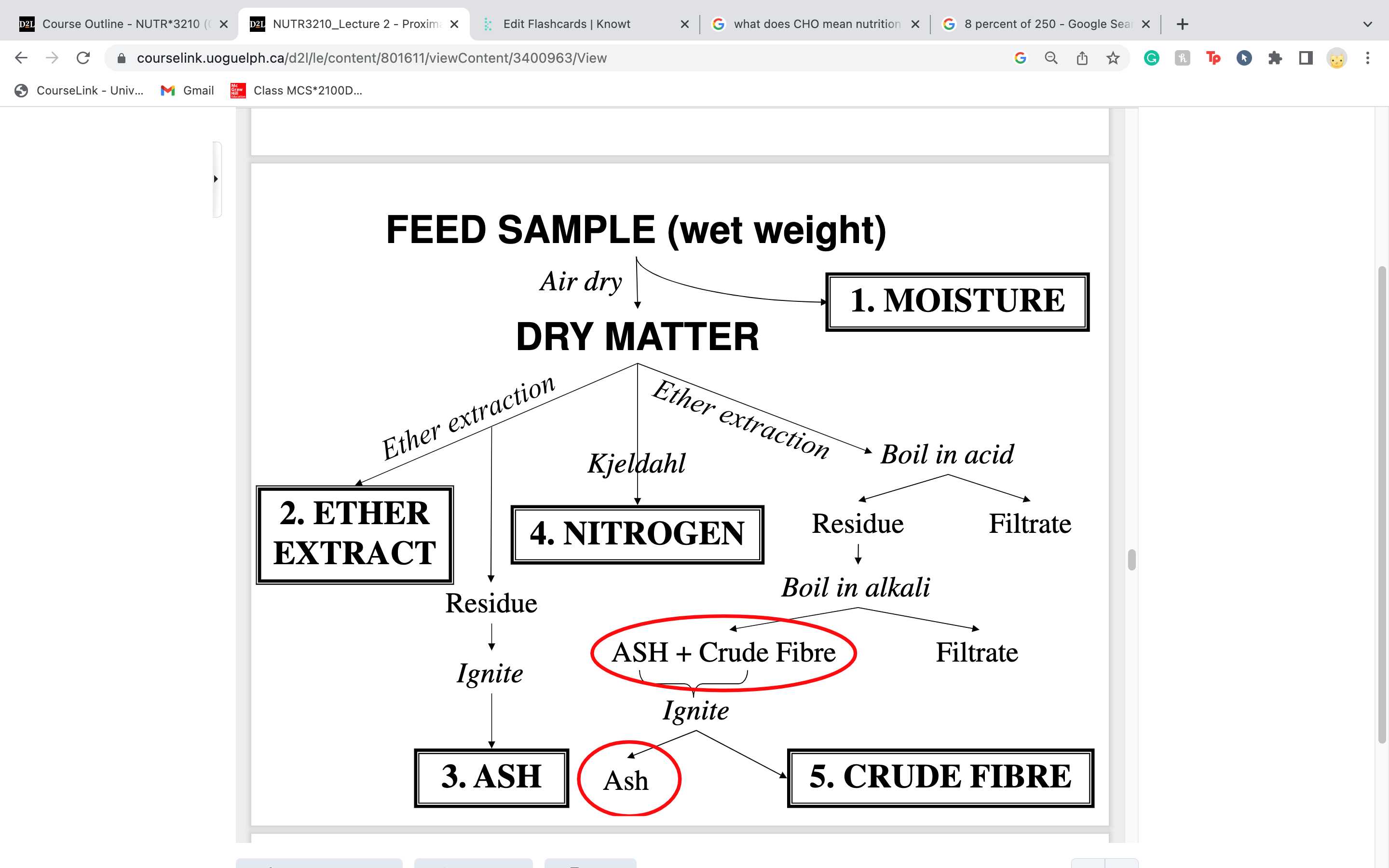
how do you get crude fibre from dry matter
*mimicked digestive system*
1. take ether extract and boil it in acid
2. filter it and take residue and boil it in alkali
3. filter that and you are left w ash and crude fibre
4. ignite that to eliminate ASH
5. left w crude fibre
1. take ether extract and boil it in acid
2. filter it and take residue and boil it in alkali
3. filter that and you are left w ash and crude fibre
4. ignite that to eliminate ASH
5. left w crude fibre
39
New cards
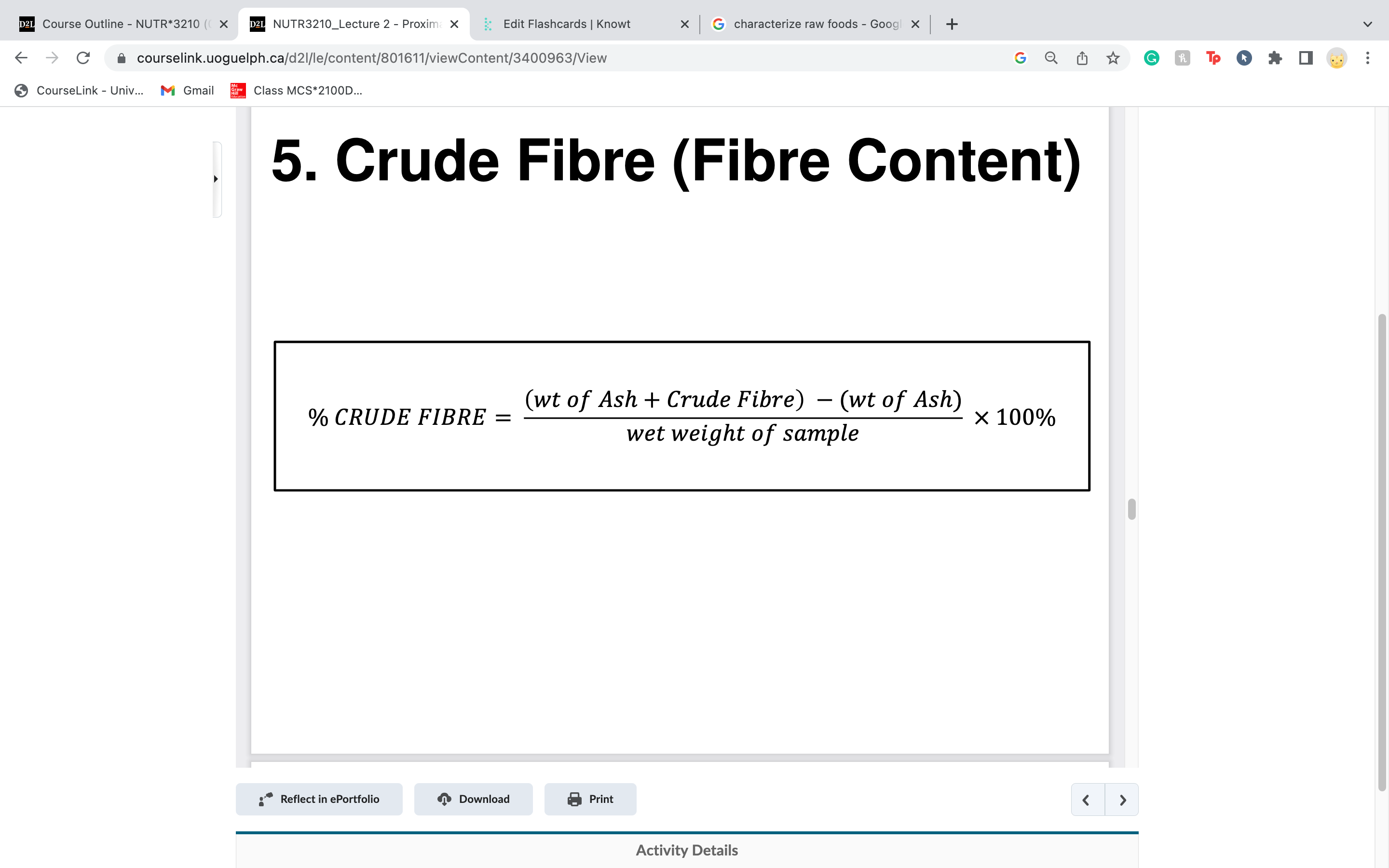
formula for % crude fibre
40
New cards
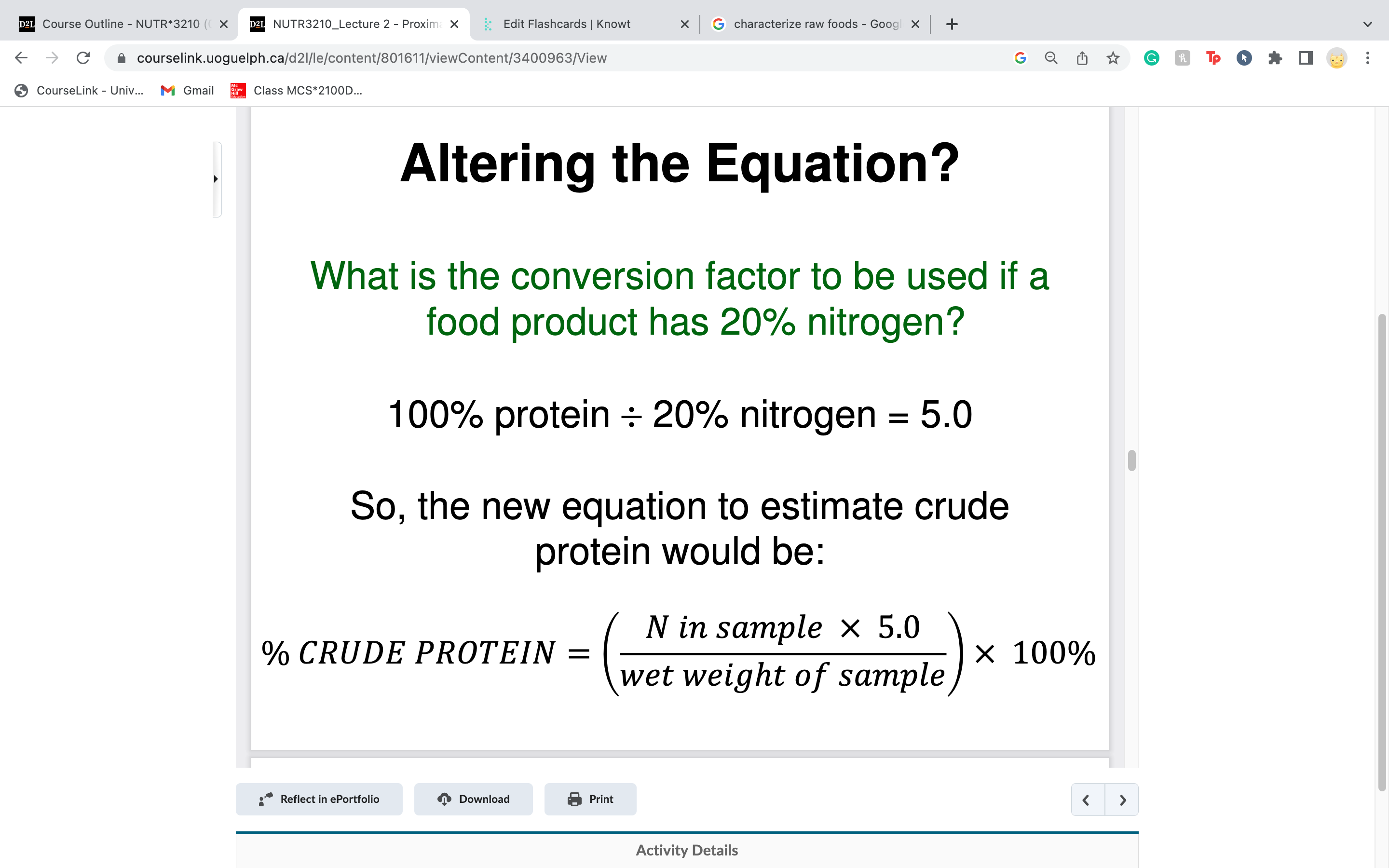
how would the conversion factor change is the % nitrogen in food was 20%
41
New cards
how does crude fibre vary from dietary fibre… how does this contribute to sources of error
crude fibre tels about the celluose and lignan content (insoluble fibres)
dietary fibers describe ALL fibres (both insoluble and soluble)
\
source of error = unable to distinguish fibre components… crude fibre understimates dietary fibre
dietary fibers describe ALL fibres (both insoluble and soluble)
\
source of error = unable to distinguish fibre components… crude fibre understimates dietary fibre
42
New cards
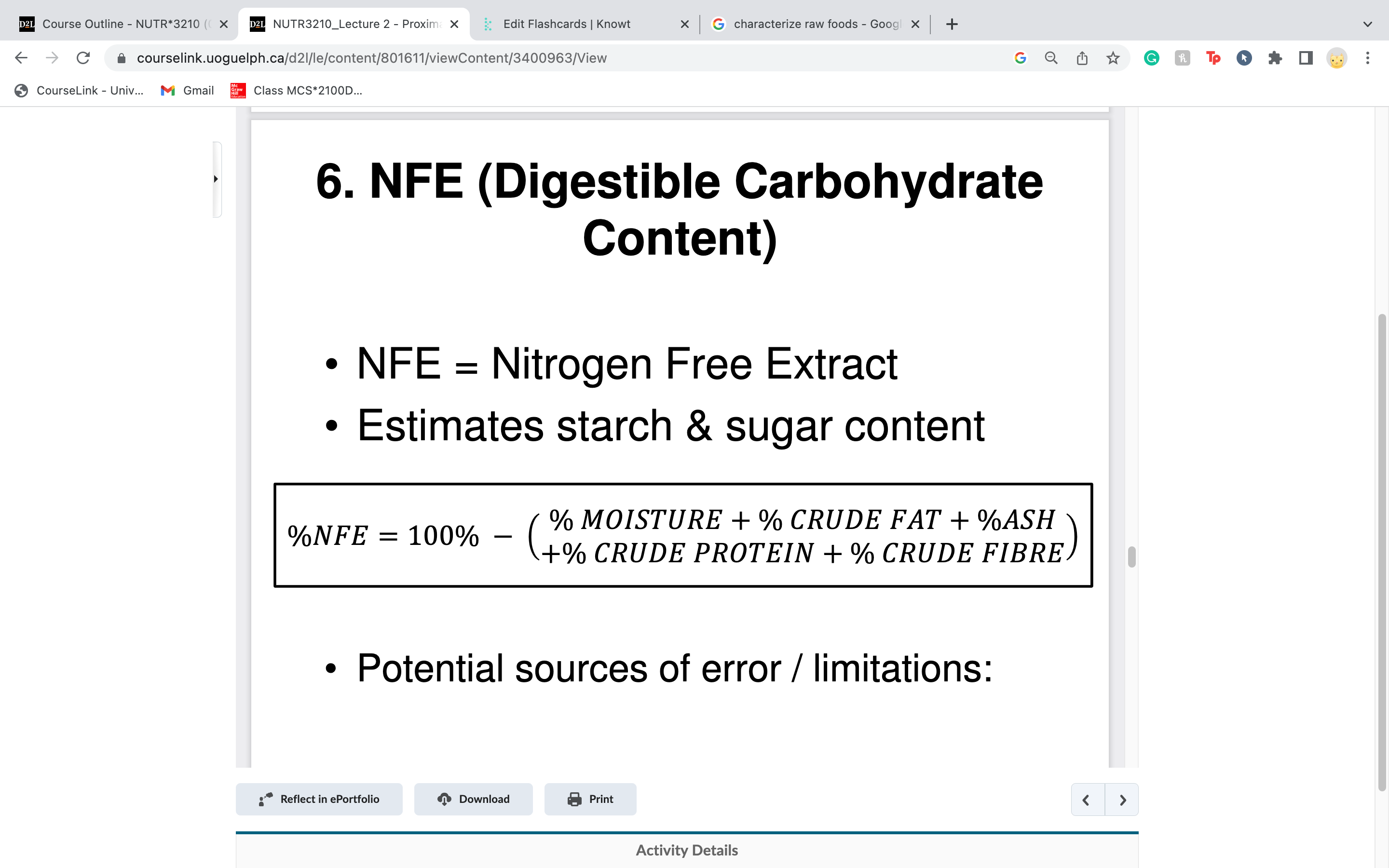
formula for NFE (nitrogen free extract)
what are some potential sources of error
what are some potential sources of error
accumulates all the errors that exist for the other components
43
New cards
what does NFE (nitrogen free extract estimate
starch and sugar content
44
New cards
proximate analysis is the basis of human food labelling but… whats wrong w it
\-no info on digestibility of food, we dont know what will be absorbed by organism
\-no info on specific AA’s minerals, lipids or carbs
\-no info on specific AA’s minerals, lipids or carbs
45
New cards
2 more accurate fibre analyses to complement the proximate analysis exist:
1) Van Soest method
2) Southgate method
\
explain both
1) Van Soest method
2) Southgate method
\
explain both
1) Van Soest method - differentiates insoluble fibres
(cellulose, hemicellulose, lignin)
\-determines fermentabe and non-fermentable carbs (has big time %%__*agricultural*__%% applications.. bc it doesn’t differentiate between sugars, starches and soluble fibres)
\
2) Southgate method - provides info about sugars starch and various fibres
\-useful for %%__*human nutrition*__%% and food labelling
\-does not differentiate sufficiently between various insoluble fibre components adequately.. therefore not good for agricultural applications
(cellulose, hemicellulose, lignin)
\-determines fermentabe and non-fermentable carbs (has big time %%__*agricultural*__%% applications.. bc it doesn’t differentiate between sugars, starches and soluble fibres)
\
2) Southgate method - provides info about sugars starch and various fibres
\-useful for %%__*human nutrition*__%% and food labelling
\-does not differentiate sufficiently between various insoluble fibre components adequately.. therefore not good for agricultural applications
46
New cards
dietary fibre- non digestible carbs - what are characteristics of insoluble fibre
cellulose, lignin, hemicellulose
\-remains %%intact%% through intestinal tract, ==does not dissolve in water==
\-remains %%intact%% through intestinal tract, ==does not dissolve in water==
47
New cards
dietary fibre - non digestible carb - what are characteristics of soluble fibre
pectins, gums, mucilages
\-forms gel, ==dissolves in water==
\-forms gel, ==dissolves in water==
48
New cards
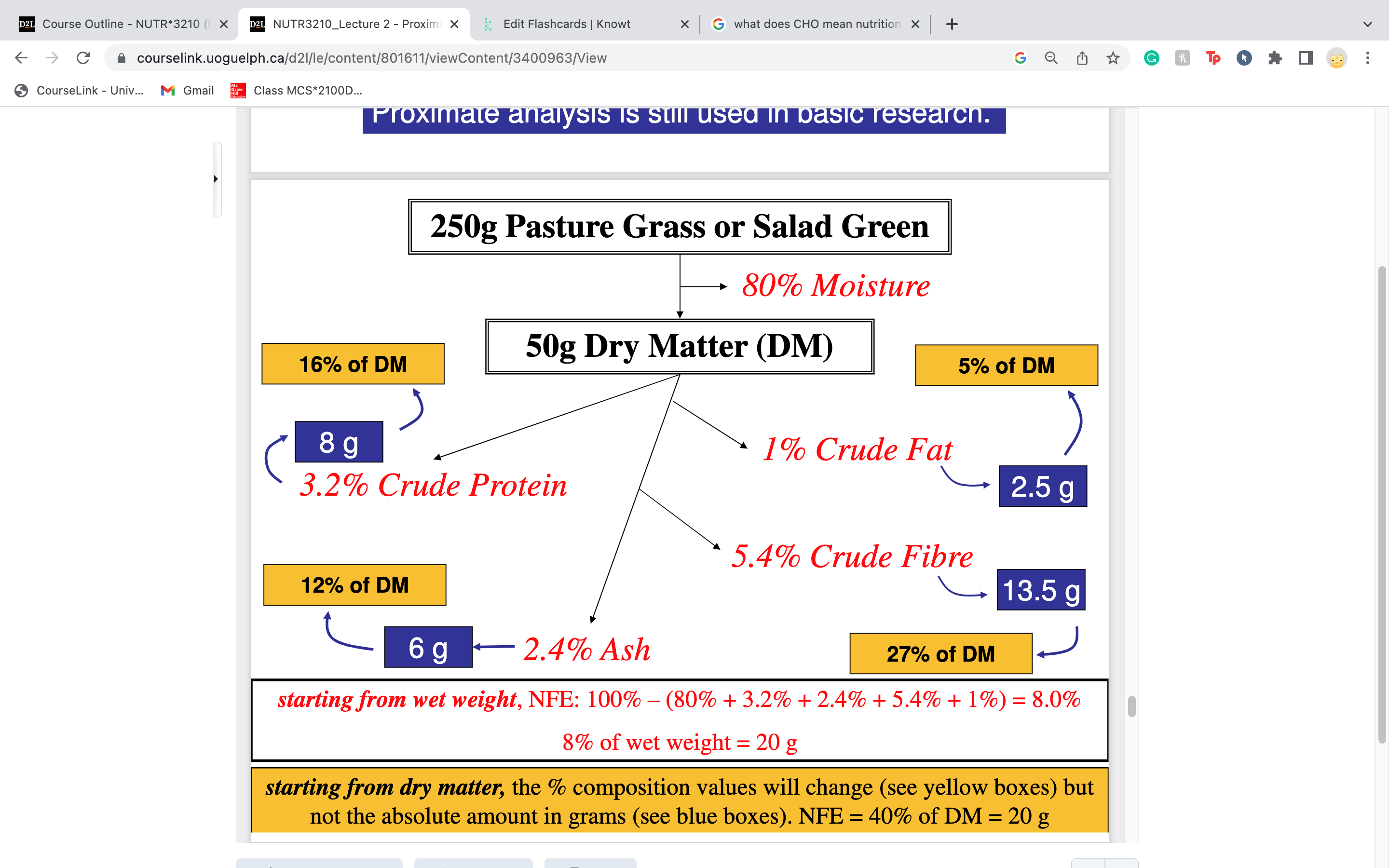
example problem for calculating NFE
49
New cards
GI tract is synonymous with digestive track… these are NOT the same as the __**digestive system…**__ what does the digestive system refer to
GI tract (mouth, esophagus, stomach, small and large intestine, caecum, rectum) and associated organs like liver, pancreas and gallbladder
50
New cards
what is the purpose of the caecum
hint 70% of total energy needed for host comes from: ___________
hint 70% of total energy needed for host comes from: ___________
has an abundance of gut bacteria bc its a huge hindgut
FERMENTATION AND PRODUCTION OF ==SCFA’s==
70% of total energy needed for host comes from SCFAs
site of %%production of vitamins%%
connection between small and large intestine
FERMENTATION AND PRODUCTION OF ==SCFA’s==
70% of total energy needed for host comes from SCFAs
site of %%production of vitamins%%
connection between small and large intestine
51
New cards
purpose of gall bladder and both intestines
stores and concentrates bile from the liver.
The small intestine is involved in the digestion of food and absorption of nutrients.
The large intestine is involved in the absorption of water and in the production of vitamins.
The small intestine is involved in the digestion of food and absorption of nutrients.
The large intestine is involved in the absorption of water and in the production of vitamins.
52
New cards
how is __solubility of carbohydrates__ determined by in the aqueous environment of the digestive environment
solubility determined by physiochemical properties of carbohydrates
ex: being small,polar and containing OH groups would make them hydrophilic
hydrophobic = insoluble
ex: being small,polar and containing OH groups would make them hydrophilic
hydrophobic = insoluble
53
New cards
how is the digestibility of carbohydrates in a organism determined
hin think fiber
hin think fiber
by the host’s digestive enzymes
ex: being able to digest cellulose bc you’re a cow
fibre is non-digestable carbs
ex: being able to digest cellulose bc you’re a cow
fibre is non-digestable carbs
54
New cards
what would it be called if an organism’s ==gut bacteria== has the enzymes to break down a carb
fermentable
55
New cards
SIMPLE DIGESTIVE SYSTEM w/o functional caecum
1. what are key features
2. what type of diet is ideal for this
3. whats some animal examples
1. what are key features
2. what type of diet is ideal for this
3. whats some animal examples
\-monogastric (simple stomach)
\-non-functional ceacum **no fermentation**
\*considered a hindgut fermenter
\-suited for a nutrient dense, low fibre diet
\
ex: human, pig, cat, dog
\-non-functional ceacum **no fermentation**
\*considered a hindgut fermenter
\-suited for a nutrient dense, low fibre diet
\
ex: human, pig, cat, dog
56
New cards
what happens in the oral cavity (what enzymes released)
mechanical breakdown bc food is chewed, mixed w saliva to form bolus
a-amylose and lingual lipase released
a-amylose and lingual lipase released
57
New cards
what happens in the stomach a) what does food become here
b)what is secreted
c)what are the sections
d)what is pH
b)what is secreted
c)what are the sections
d)what is pH
a) food becomes chyme
b) gastric glands secrete gastric juice (HCl, electrolytes, H2O, enzymes)
c) cardia, fundus, body, antrum
d) \~2
b) gastric glands secrete gastric juice (HCl, electrolytes, H2O, enzymes)
c) cardia, fundus, body, antrum
d) \~2
58
New cards
1. how long does gastric emptying take
2. what is the capacity of the stomach when empty and full
1. 2-6 hours
1. empty = 50mL, filled = 1-1.5 L
59
New cards
describe digestion in the small intestine:
a) 3 sections
b) what happens to chyme
c) what 2 things is food digested by
d) main site for _________ ___________
a) 3 sections
b) what happens to chyme
c) what 2 things is food digested by
d) main site for _________ ___________
a) duodenum, jejenum, ileum
b) chyme is neutralized by pancreatic juice which is basic
c) pancreatic juice and bile acids digest food
d) main site for nutrient digestion and absorption
\
notes: 30m^2 SA, and muscles move food along
b) chyme is neutralized by pancreatic juice which is basic
c) pancreatic juice and bile acids digest food
d) main site for nutrient digestion and absorption
\
notes: 30m^2 SA, and muscles move food along
60
New cards
large intestine aka colon:
a) site of ______________
b) production of ___________
c) what is absorbed here
a) site of ______________
b) production of ___________
c) what is absorbed here
a) fermentation
b) SCFAs (aka volatile fatty acids) are produced here by fermentation
c) water
b) SCFAs (aka volatile fatty acids) are produced here by fermentation
c) water
61
New cards
1. what do short chain fatty acids influence
2. how are they made
1. cholesterol metabolism
2. through fermentation of carbohydrates by bacteria in large intestine
62
New cards
what would fibre do to the transit time of food in the large intestine
decrease transit time
speeds everything along bc its insoluble
speeds everything along bc its insoluble
63
New cards
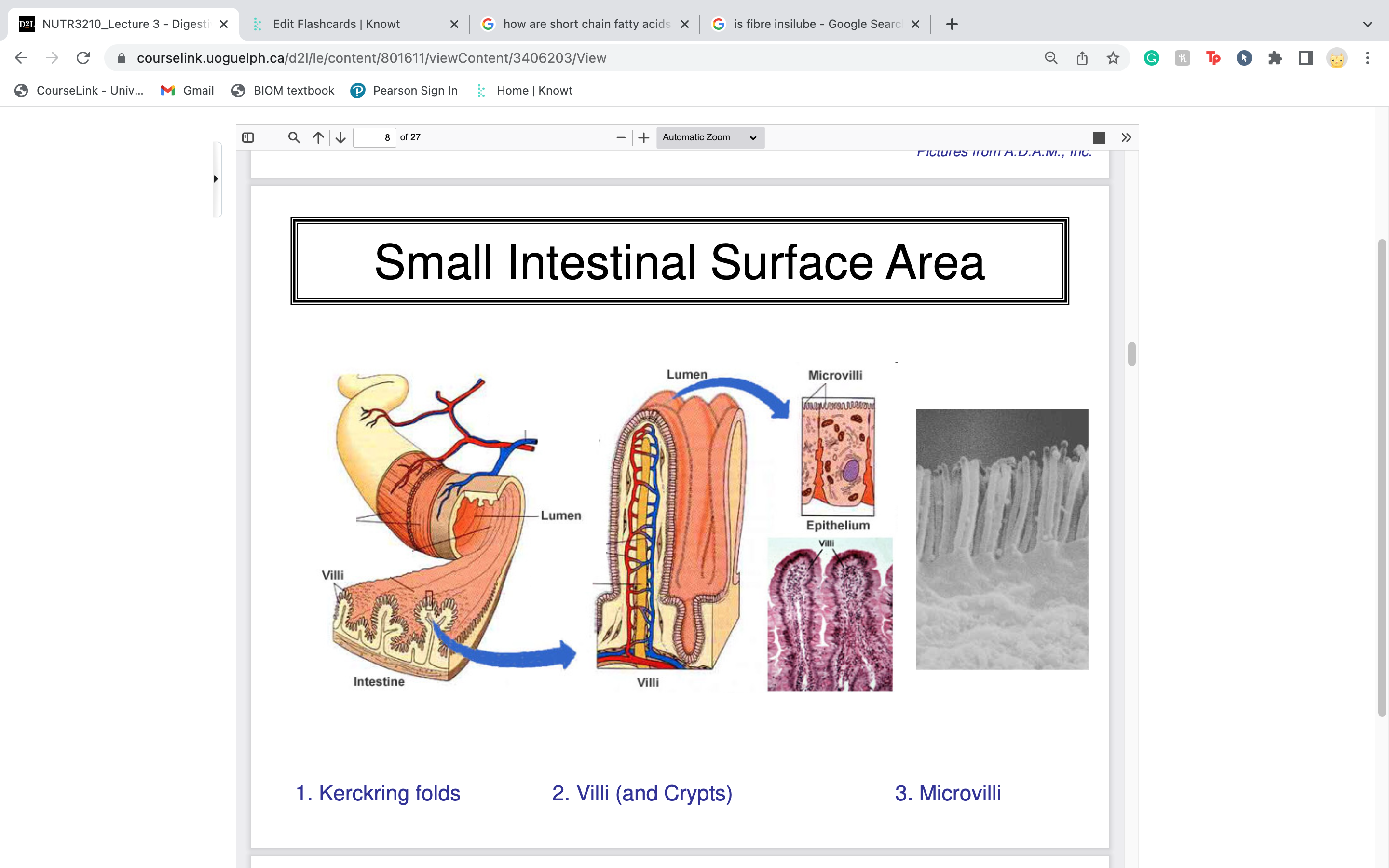
what are the three structures in the small intestine that increase its surface area
1. kerckring folds
2. villi (on the folds) and crypts (crypt is like an inverted villi)
3. microvilli (on outside of villi)
64
New cards
microvilli compose the ________________ in the small intestine
brush border enzyme
65
New cards
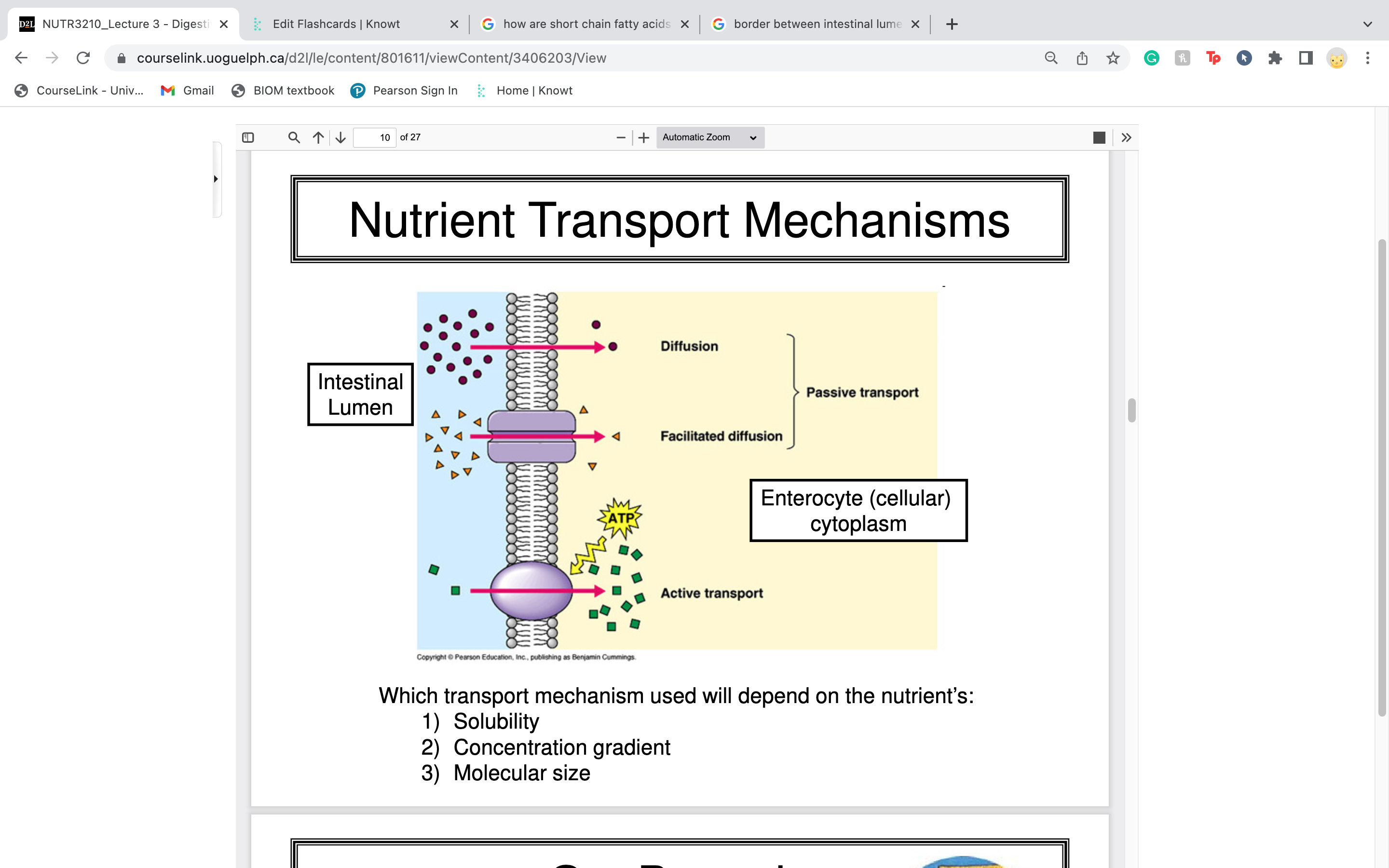
a nutrients transport across enterocyte membrane in intestine of either (1. passive diffusion a) simple diffusion b) facilitated diffusion or 2. active transport )
WILL depend on what 3 things?
WILL depend on what 3 things?
1. solubility
2. concentration gradient
3. molecular size
66
New cards
there is SOOO much bacteria in the gut aka GI tract… there aare 500-1000 species identified per person, w us having our own unique combo.
\
what factors are important for determining the # of bacteria in different regions? (6)
\
what factors are important for determining the # of bacteria in different regions? (6)
regional oxygen level
pH
bile acids
gut transit time
mucus
immune factors
pH
bile acids
gut transit time
mucus
immune factors
67
New cards
____ anaerobic: aerobic in the gut
1000: 1
this makes sense bc the GI tract is mostly anaerobic like the large intestine
this makes sense bc the GI tract is mostly anaerobic like the large intestine
68
New cards
where do you find the most bacteria in the digestive tract and why
large intestine/colon
bc bacteria are needed for fermentation of non-digestable carbs
bc bacteria are needed for fermentation of non-digestable carbs
69
New cards
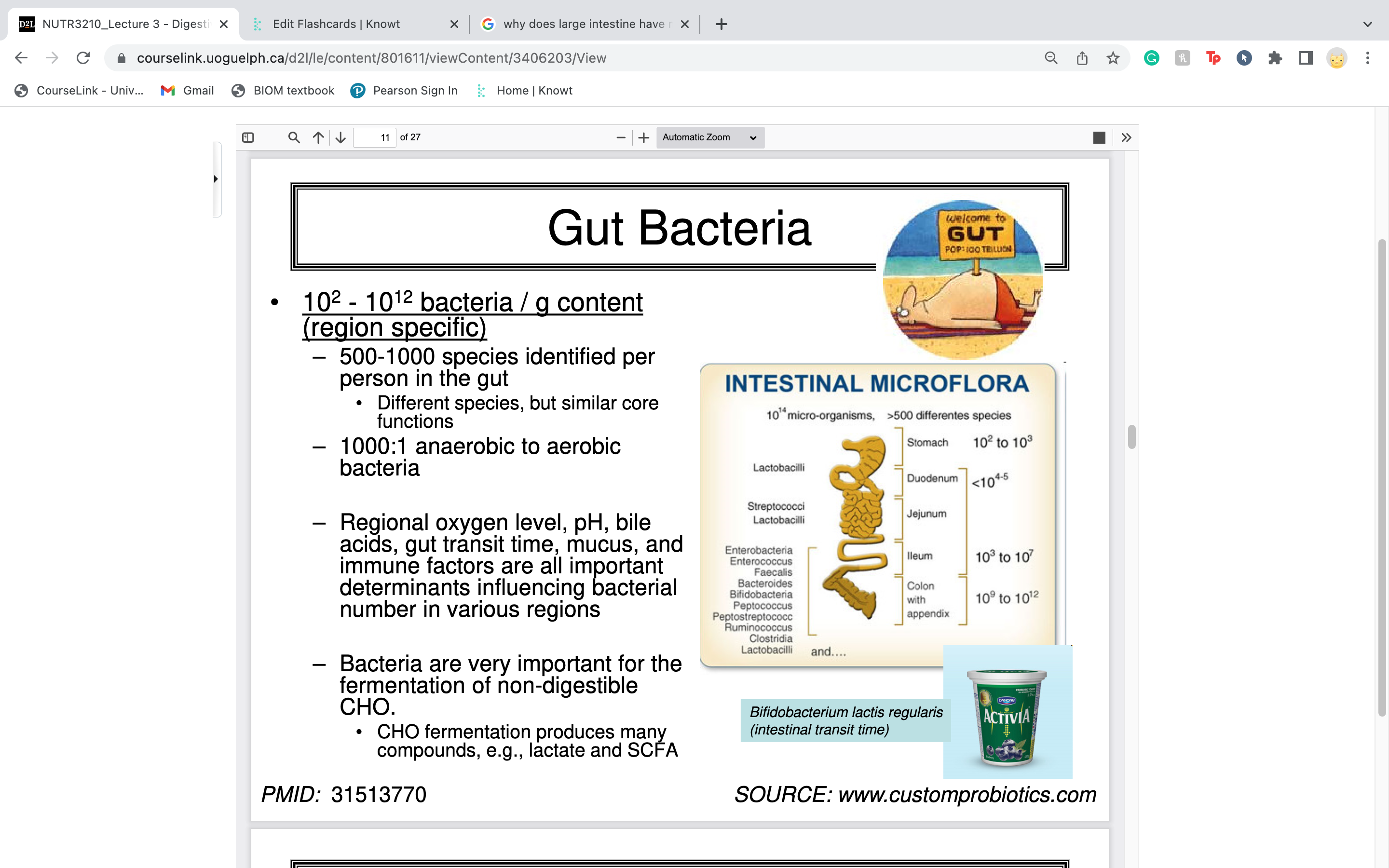
fun fact: gut microbes contribute to weight
\
also look at types of bacteria in diff sections of digestive track
\
also look at types of bacteria in diff sections of digestive track
70
New cards
SIMPLE DIGESTIVE SYSTEM w functional caecum
1. what are key features (what is a pseudo-ruminant)
2. what type of diet is ideal for this
3. whats some animal examples
1. what are key features (what is a pseudo-ruminant)
2. what type of diet is ideal for this
3. whats some animal examples
a) hindgut fermenter
%%pseudo-ruminant =%% an animal that eats large amounts of roughage but does not have a stomach with several compartments.
everything else functions like the monogastric system (humans)
2. high fibre diet with %%lots%% of fodder and foraging
3. horse, rabbit, hamster
%%pseudo-ruminant =%% an animal that eats large amounts of roughage but does not have a stomach with several compartments.
everything else functions like the monogastric system (humans)
2. high fibre diet with %%lots%% of fodder and foraging
3. horse, rabbit, hamster
71
New cards
what type of diet do hindgut fermenters like horses like
Hindgut fermenters are able to extract more nutrition out of %%small%% quantities of feed. The large hind-gut fermenters are bulk feeders: they ingest %%***large quantities of low-nutrient food***%%
\n \*\*only get 1 chance to digest
Hindgut fermenters have a shorter passage time than ruminants, and hence are less efficient in cellulose digestion, for which they compensate with a %%higher intake of food%%
\n \*\*only get 1 chance to digest
Hindgut fermenters have a shorter passage time than ruminants, and hence are less efficient in cellulose digestion, for which they compensate with a %%higher intake of food%%
72
New cards
signs of energy or nutrient deficiency in animal
coprophagy (eating poop)
\-purpose is to get more vitamins and colonize their guts w bacteria
\-purpose is to get more vitamins and colonize their guts w bacteria
73
New cards
where are the following absorbed in horses?
&
what are the following broken down/ absorbed as when digested?
a) indigestible fibre
b) fermentable fibre
c) fat
d) protein
e) sugar and starch
\
\
&
what are the following broken down/ absorbed as when digested?
a) indigestible fibre
b) fermentable fibre
c) fat
d) protein
e) sugar and starch
\
\
a) moves alllll the way through, never digested
b) large intestine & cecum // SCFAs
c) small intestine // fatty acids, any unused leaves
d) small intestine.. any unbroken down goes to large intestine to be broken down // amino acids in both
e) small intestine (fast transit time) // glucose in small intestine and lactic acid in large intestine
b) large intestine & cecum // SCFAs
c) small intestine // fatty acids, any unused leaves
d) small intestine.. any unbroken down goes to large intestine to be broken down // amino acids in both
e) small intestine (fast transit time) // glucose in small intestine and lactic acid in large intestine
74
New cards
why is it dangerous to feed horses a high carb diet
bc horses can’t vomit, so lactic acid from broken down carbs just sits there and causes ==colic==
75
New cards
MULTIPLE DIGESTIVE SYSTEM
1. what are key features
2. what type of diet is ideal for this
3. whats some animal examples
1. what are key features
2. what type of diet is ideal for this
3. whats some animal examples
1. RUMINANT
large stomach w 4 chambers : reticulum, rumen, omasum, abomasum
2. high amount of plant material, don’t need to each as much as hindgut formenters bc they can regurgitate to re-extraact nutrients
\-all other regions similar to monogastric
3. cow, sheep, goats
76
New cards
what are the four chambers of a ruminant’s stomach
rumen
reticulum
omasum
abomasum
reticulum
omasum
abomasum
77
New cards
what is unique about the reticulum
hint: think appearance..
hint: think appearance..
Honeycomb appearance; can capture \n nutrients and trap foreign materials (wire, \n nails, etc.) that are accidently swallowed \n “hardware disease” \n • Rich in bacteria (fermentation vat)
78
New cards
what is unique about the rumen
hint: think appearance..
also 60-80% of total energy produced here as ______
hint: think appearance..
also 60-80% of total energy produced here as ______
The largest section of the stomach \n • Rich in bacteria (fermentation vat) \n • Rumen papillae increases surface area for \n absorption (like microvilli in the human intestine) \n • Food is mixed & partially broken down, and stored \n temporarily \n • 60-80% of total energy produced here as SCFA
79
New cards
what is unique about the omasum
hint: think appearance..
hint: think appearance..
Resorption of water and some electrolytes \n • Filters large particles
\-book w leaflets
\-book w leaflets
80
New cards
what is unique about the abomasum
igestive enzymes secreted from gastric \n glands (HCl, mucin, pepsinogen, lipase, etc)
81
New cards
in ruminants… fermentation takes place before entering the intestine aka foregut digestion…
what does this mean for the nutrients produced
what does this mean for the nutrients produced
\-nutrients produced by bacteria then become available for digestion & absorption by the ruminant
82
New cards
what are some pros and cons about the ruminant digestive system?
PROS: - generates vitamins
\-non-protein nitrogen used for making protein
@@Ruminants have the ability to metabolize non protein nitrogen like urea into protein. The non-protein nitrogen's are a less expensive form of protein.@@
\
CONS: -carbs degraded into gases and lost through belching
\-heat production (heat stress, bad for body functions and homeostasis)
\-non-protein nitrogen used for making protein
@@Ruminants have the ability to metabolize non protein nitrogen like urea into protein. The non-protein nitrogen's are a less expensive form of protein.@@
\
CONS: -carbs degraded into gases and lost through belching
\-heat production (heat stress, bad for body functions and homeostasis)
83
New cards
AVIAN DIGESTIVE SYSTEM
1. what are key features
2. what type of diet is ideal for this
3. whats some animal examples
1. what are key features
2. what type of diet is ideal for this
3. whats some animal examples
1. beaks and claws are important for breaking up foods into smaller pieces that birds can swallow
2. rapid digestion - need constant grazing, they will starve if deprived of food for even a short time
3. chicken, turkey
\
84
New cards
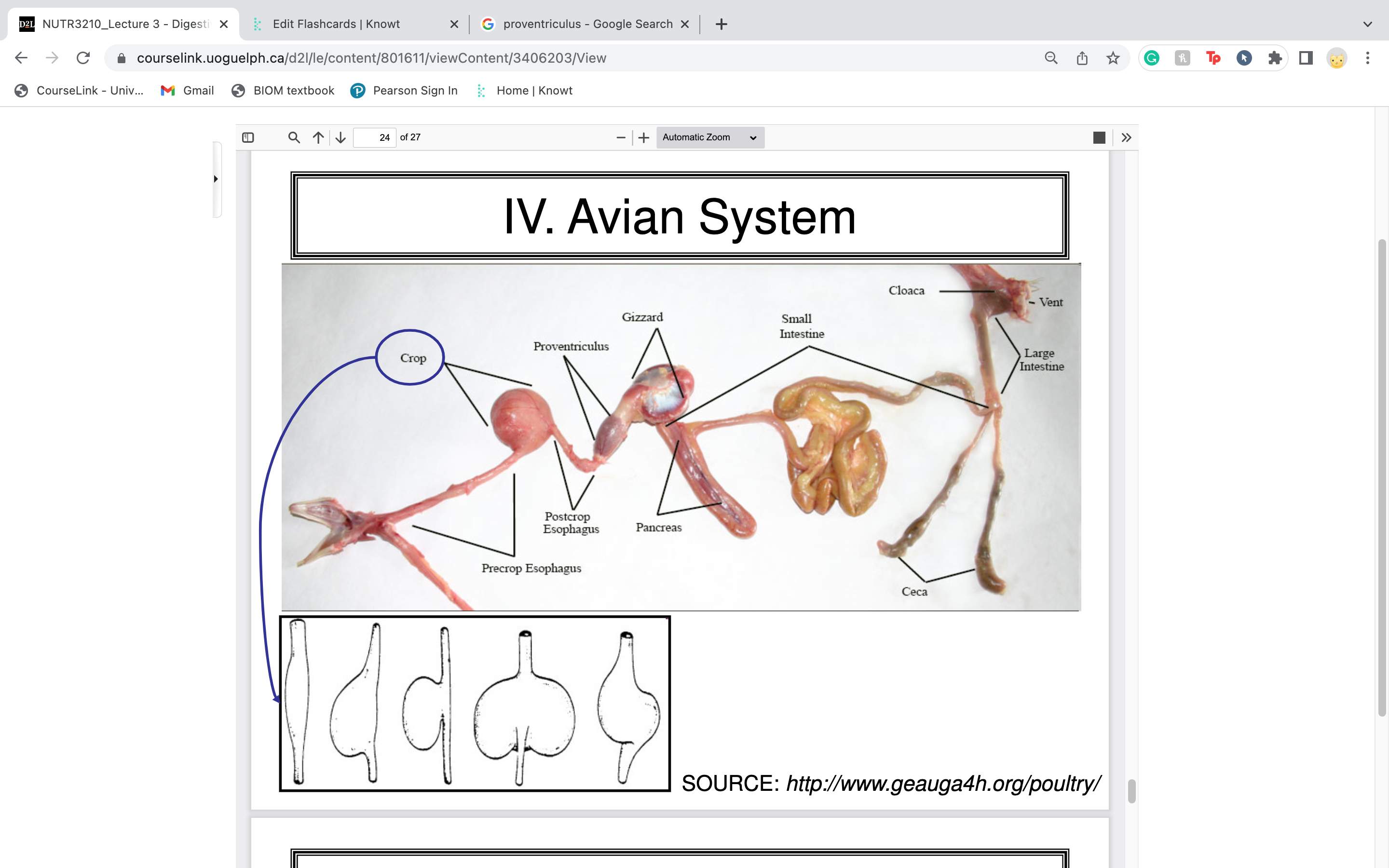
the crop is an enlarged part of the esophagus in avians, and it comes in many shapes and sizes, what is its purpose.. what happens here?
temporary storage location for food so the bird can eat and quickly fly away and not have to hold in mouth
\-food is softened here, and often regurgitated to feed babies \*\*\*there is no mechanical breakdown in mouth bc birds have no teeth
\-food is softened here, and often regurgitated to feed babies \*\*\*there is no mechanical breakdown in mouth bc birds have no teeth
85
New cards
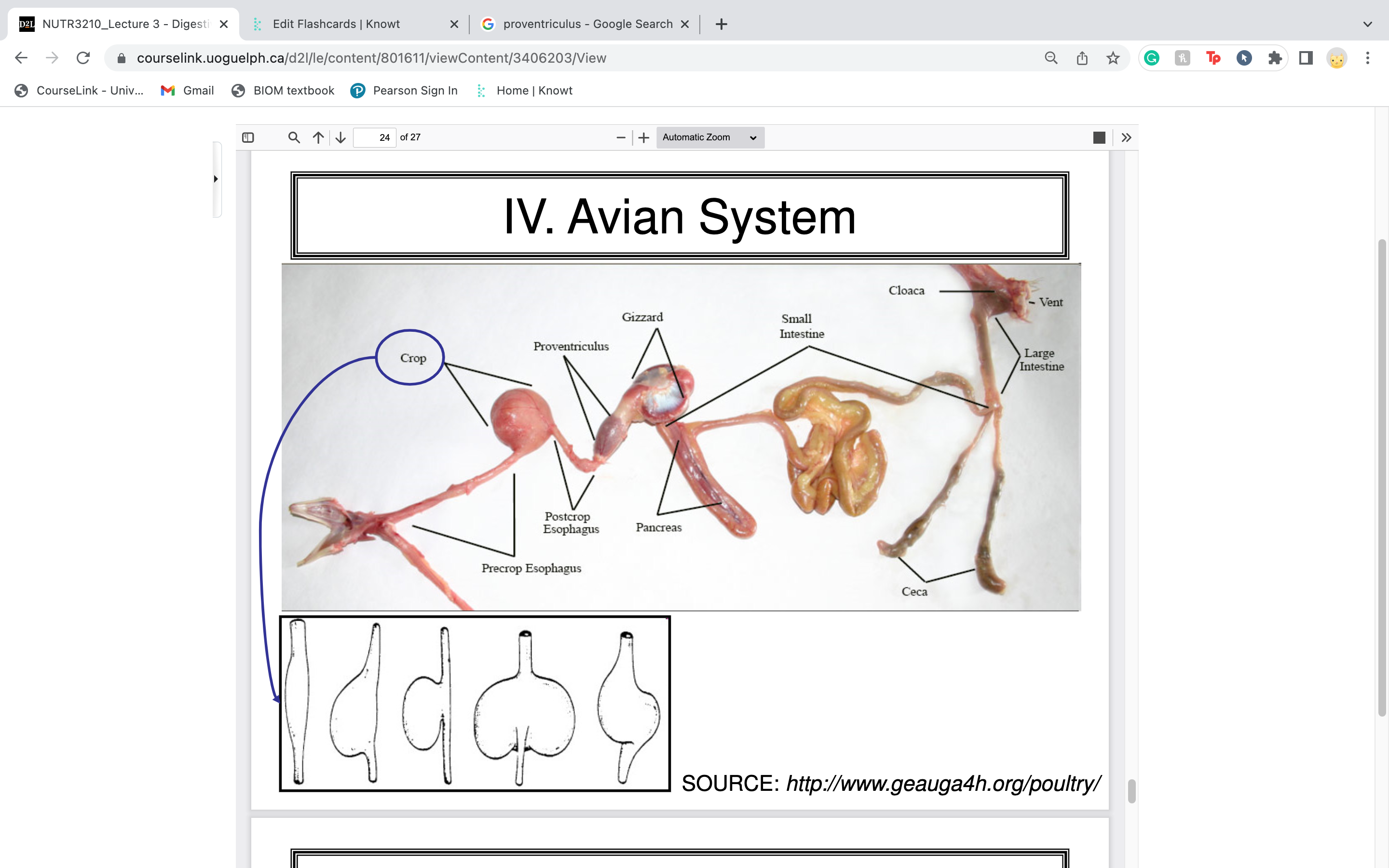
two chamber stomach in avians,
what are the two portions and
what are their purpose
what are the two portions and
what are their purpose
1st = glandular portion aka proventriculus - %%chemical%% breakdown, HCl and gastric enzymes secreted
2nd = muscular portion aka gizzard - grind and digest tough foods ==\*mechanical ==and sometimes even rocks here
2nd = muscular portion aka gizzard - grind and digest tough foods ==\*mechanical ==and sometimes even rocks here
86
New cards
True or False: the small intestine in avians is the nutrient gateway… and it functions the same as other systems
true
87
New cards
what goes on in the 2 ceca of avians
minor site of bacterial fermentation
(bc they dont eat lots of foods that need fermentation)
(bc they dont eat lots of foods that need fermentation)
88
New cards
what goes on in the large intestine of avians, what are key features about it
very short, serves predominantly to connect sml intestine and cloaca
\-bit of water absorption and storage of undigested material
\-bit of water absorption and storage of undigested material
89
New cards
what happens at the cloaca of avians
digestive, urinary and reproductive systems meet
90
New cards
1. what is digestibiity
2. how is it calculated
3. what does it represent
1. measure of the fraction of a specific nutrient (or of energy) that is extracted by the GI tract
2. from the amount of nutrient in diet vs amount in feces
3. represents a combo of nutrient release from the \*==food matrix\*==, microbial fermentation, and absorption
\
A ==food matrix==, as defined by USDA, is "the nutrient and non-nutrient components of foods and their molecular relationships, i.e., chemical bonds, to each other." The nutritional components are the vitamins, minerals and other health-influencing constituents in foods, such as antioxidants, while the non-nutrient components are the physical structures of the food, such as its form (solid, semi-solid, gel or liquid) and chemical bonds.
91
New cards
explain why digestibility is important for food science
prevents deficiencies by ensuring essential nutrients are available to the organism and being taken up
92
New cards
Explain the total collection method (5 steps)
what is the thing it measures
what is the thing it measures
\-allow animal to adapt to the diet over a 7-21 day period
\-isolate animal for quantitative analyses
\-measure intake over 3-10 day period
\-collect and weigh ==**all**== feces
\-analyze for nutrient of interest
\
measures the apparent digestibility coefficient
\-isolate animal for quantitative analyses
\-measure intake over 3-10 day period
\-collect and weigh ==**all**== feces
\-analyze for nutrient of interest
\
measures the apparent digestibility coefficient
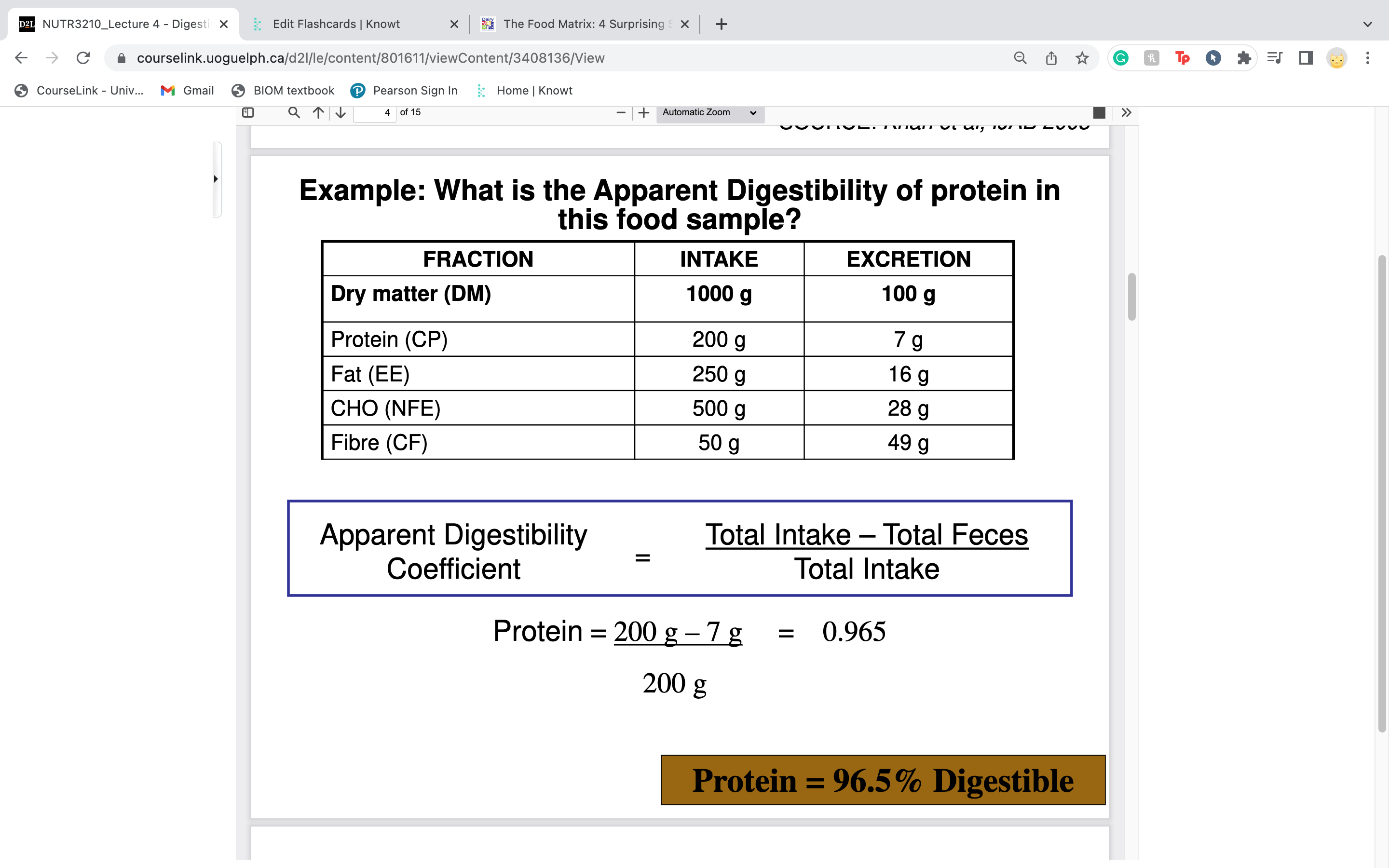
93
New cards
what is the formula for apparent digestibility coefficient
total intake - total feces / total intake
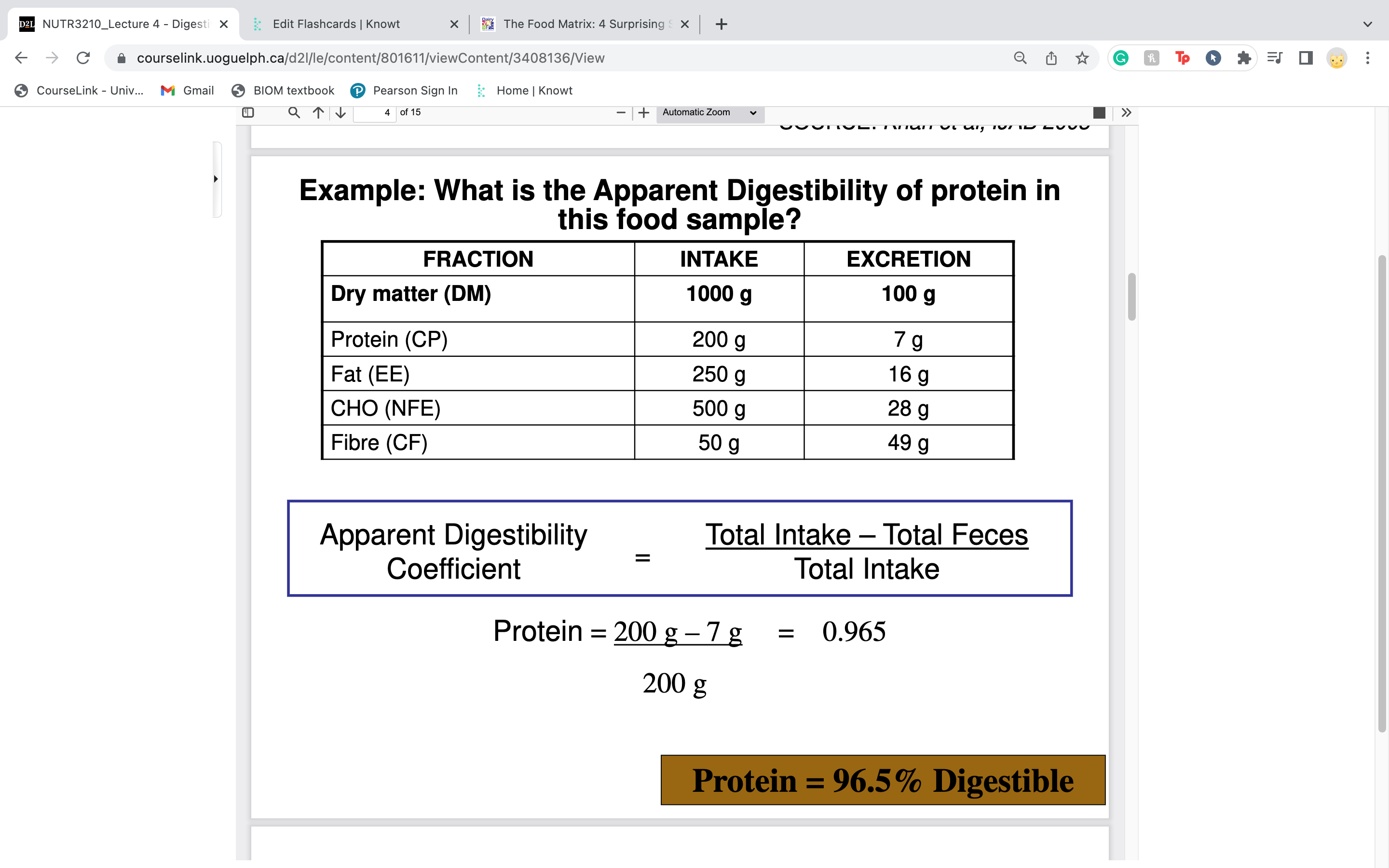
94
New cards
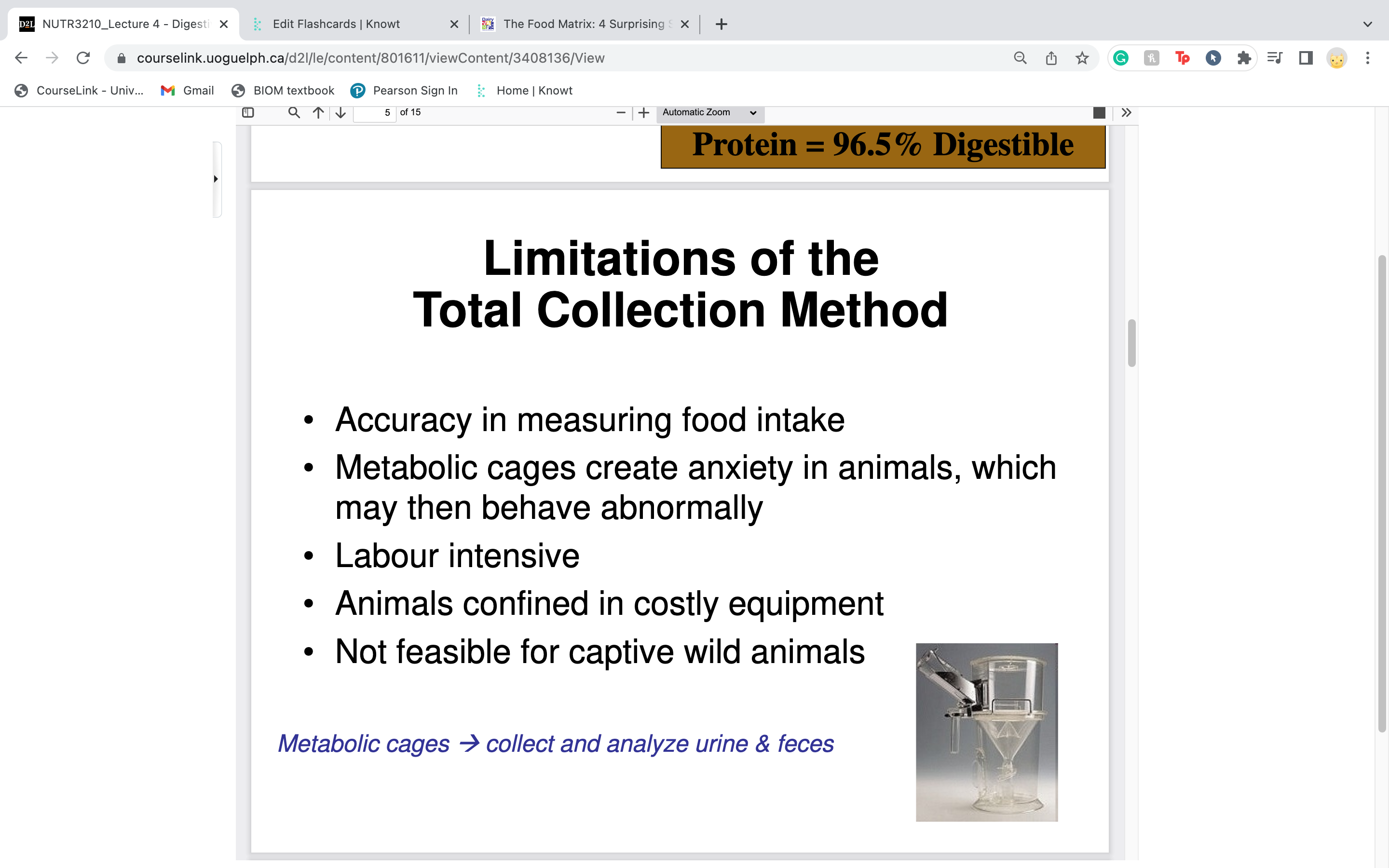
what are some limitations with the total collection method
hint: they use metabolic cages to capture urine and feces
hint: they use metabolic cages to capture urine and feces
\-accuracy in measuring food intake
\-the metabolic cages used cause anxiety in animals, which makes them behave abnormally
\-labour intensive
\-animals confined in costly environment
\-not feasible for captive wild animals
\-the metabolic cages used cause anxiety in animals, which makes them behave abnormally
\-labour intensive
\-animals confined in costly environment
\-not feasible for captive wild animals
95
New cards
we loveeee the indicator/marker method for measuring digestibility
1. it requires a marker, what are the 2 used
2. what are the steps
3. what are the advantages
4. whats the thing it measures
1. it requires a marker, what are the 2 used
2. what are the steps
3. what are the advantages
4. whats the thing it measures
1. internal (a natural component of the feed.. normally in food but we know it wont be absorbed ex: insoluble fibre)
external (a component added to the feed)
\
1. same as other, adapt animal to test diet w marker
2. collected a feed & fecal sample (**just a sample needed not everything)**
3. analyze each for marker and nutrient of interests relative to your indicate
\
\
3\.less labour intensive, good for ==WILD== animals
4. measures the apparent digestibility coefficient
96
New cards
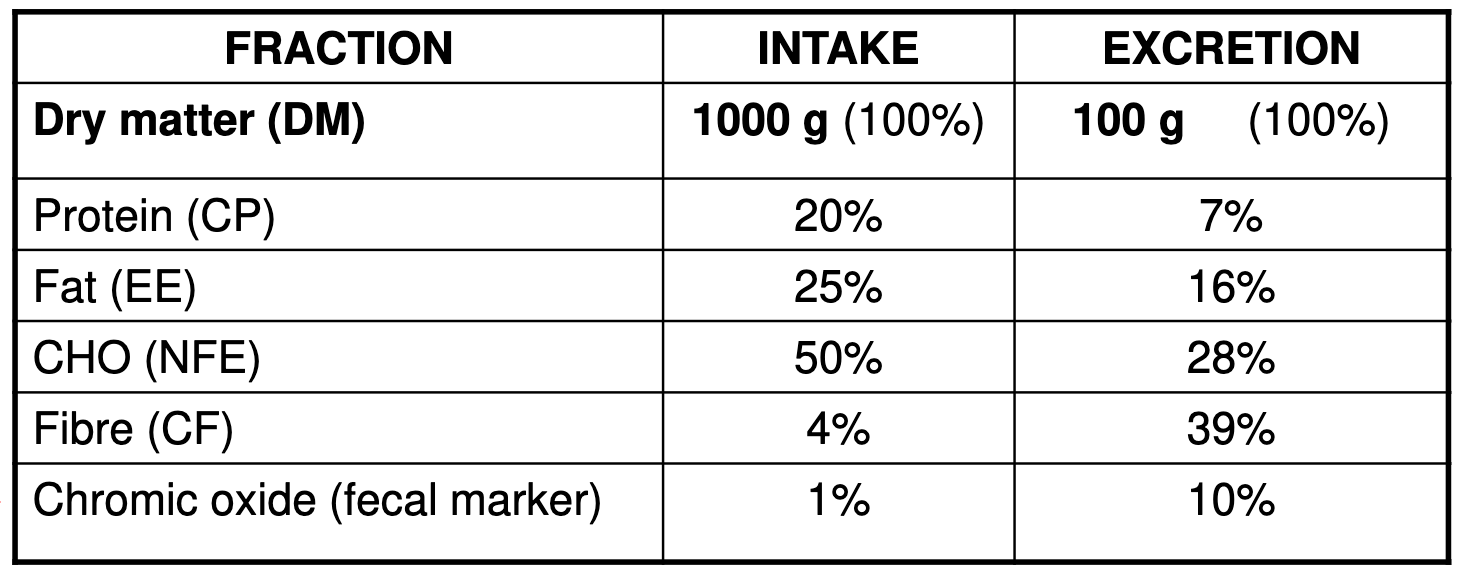
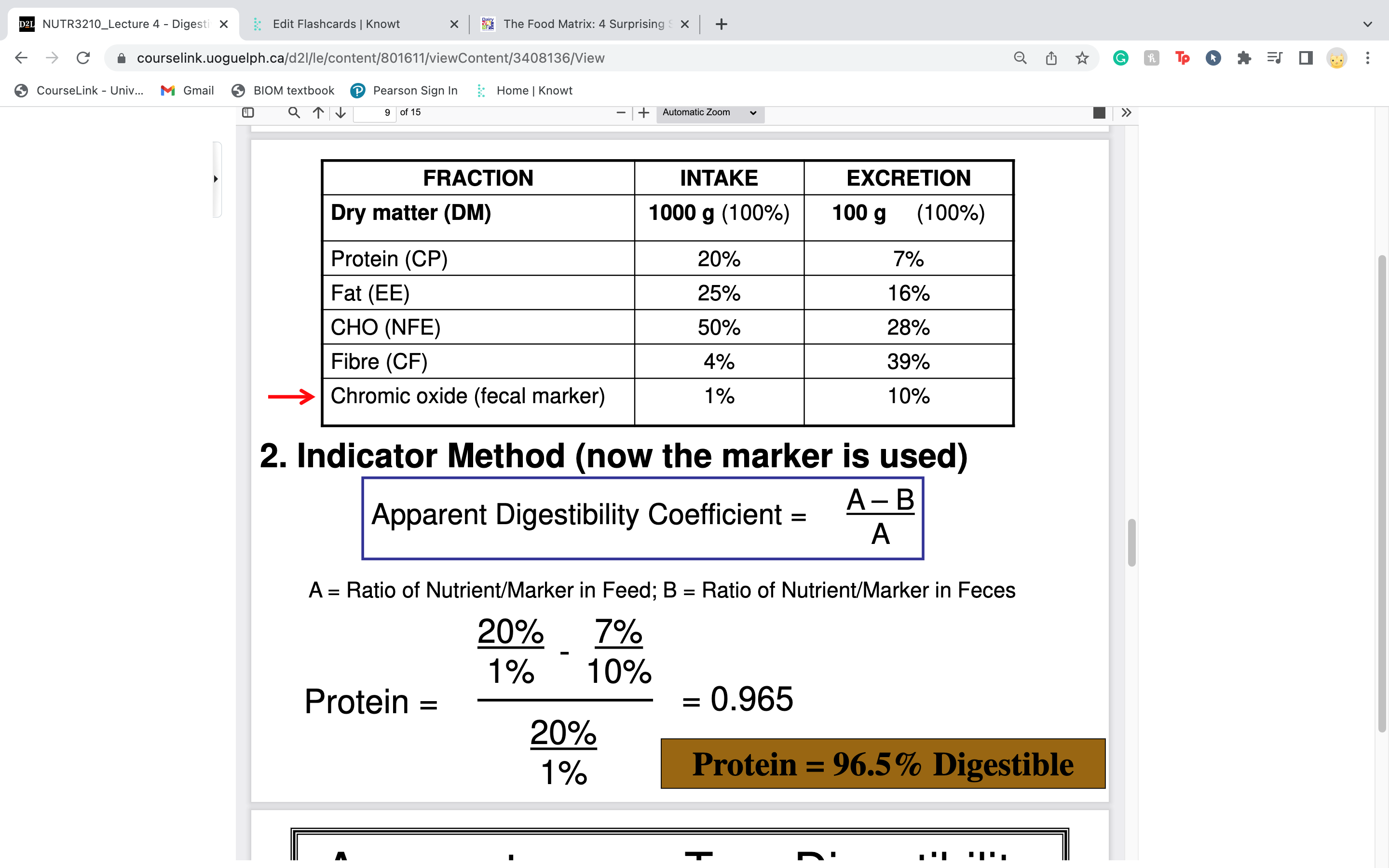
for the following chart. calculate the apparent digestibility coefficient of protein for:
1. total collection method
2. indicator/marker method
1. total collection method
2. indicator/marker method
1. 96.5 % digestible
2. 96.5 % digestible
\*to note that you should be able to use a chart that has grams or percentages
97
New cards
true or false, apparent digestibility overestimates true digestibility
false, it under estimates it
98
New cards
explain why apparent digestibility underestimates true digestibility (3)
the following things are not considered when calculating apparent digestibility
1. endogenous secretions
\-epithelial cells , ex fatty acids released from dying intestinal cells
2. bacterial growth in gut
\-nutrient synthesis, ex biotin produced by gut bacteria
3. digestive enzymes
-protein synthesis ex digestive enzymes released by cells (from pancreas)
\
SUMMARY - if we acknowledge the presence of these for true digestibility we can eliminate them from the presence of the nutrient we are isolating for like protein which actually makes the overall digestability higher.
1. endogenous secretions
\-epithelial cells , ex fatty acids released from dying intestinal cells
2. bacterial growth in gut
\-nutrient synthesis, ex biotin produced by gut bacteria
3. digestive enzymes
-protein synthesis ex digestive enzymes released by cells (from pancreas)
\
SUMMARY - if we acknowledge the presence of these for true digestibility we can eliminate them from the presence of the nutrient we are isolating for like protein which actually makes the overall digestability higher.
99
New cards
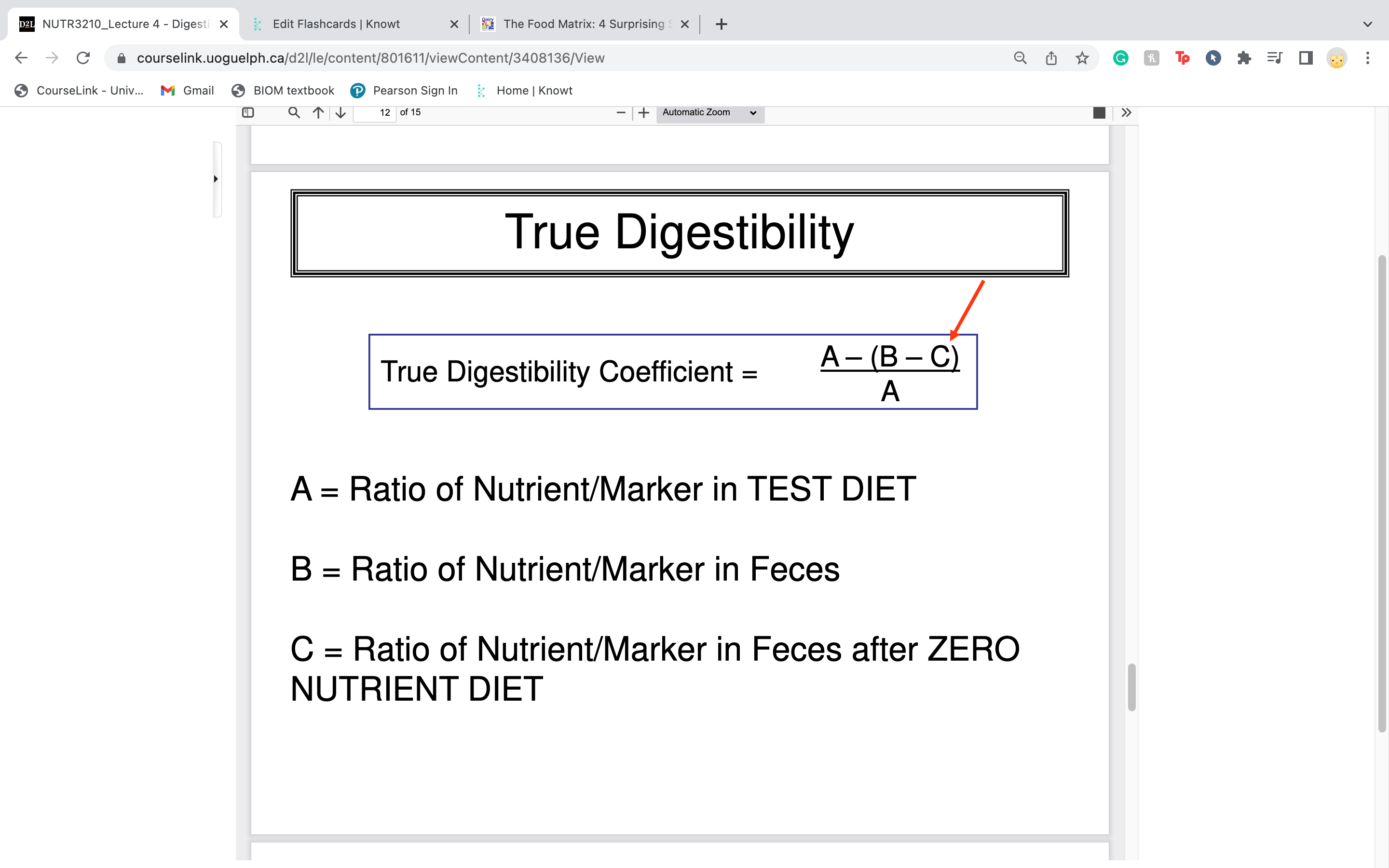
1. what are the 4 steps of calculating true digestibility
2. what is the formula for it
1. perform digestibility study using a TEST DIET (ex contains protein)
2. switch to diet containing none of the nutrient of interest/ ZERO NUTRIENT DIET (no protein)
3. analyze feces after TEST DIET is cleared, same w zero nutrient
1. subtract level of nutrient in feces of animals fed the zero nutrient diet from the test diet
100
New cards
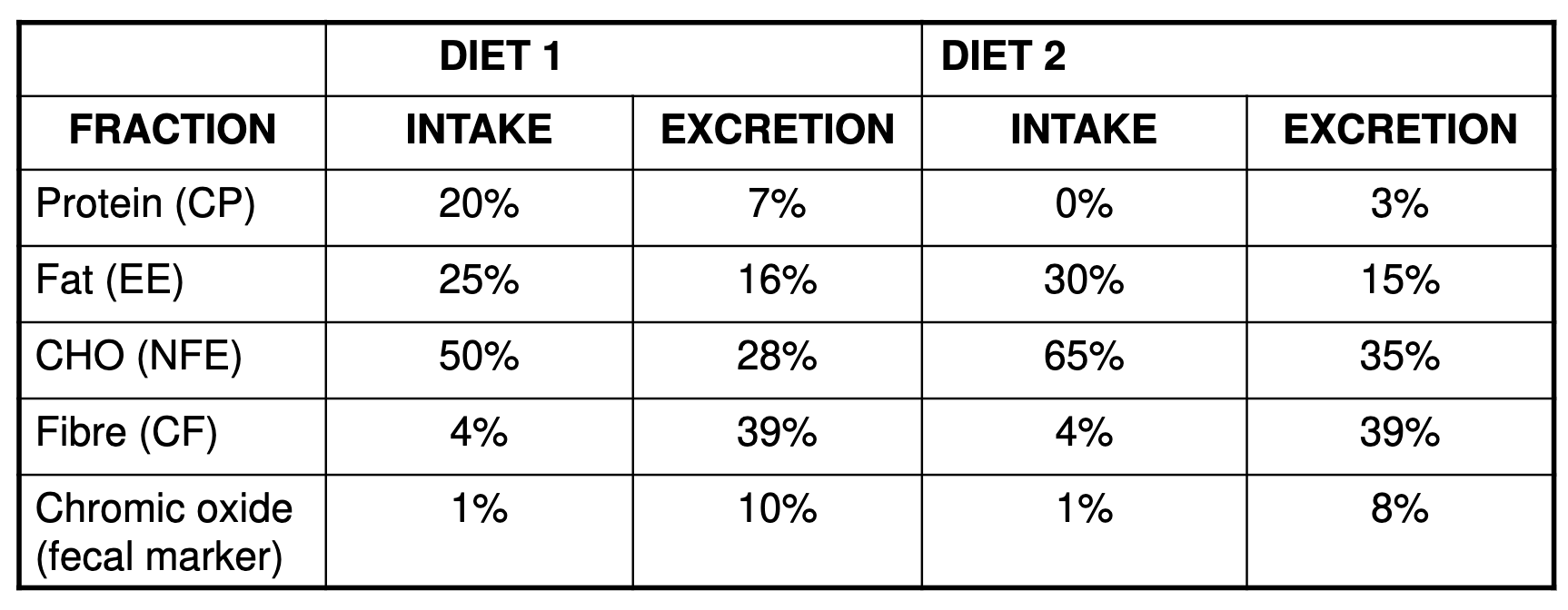
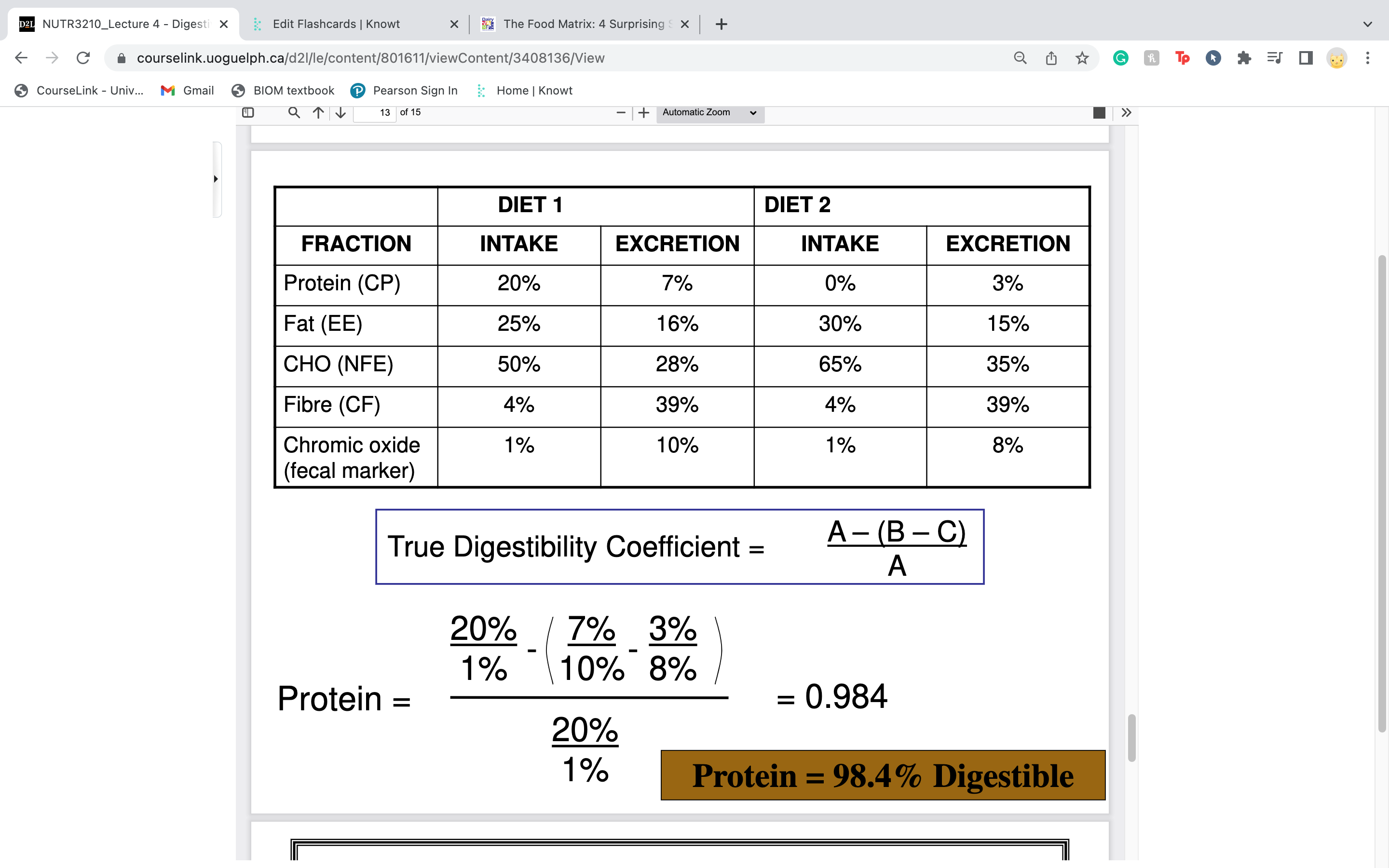
given the chart, calculate the true digestibility coefficient for protein
 Note
Note  Flashcards (64)