BA 355 Final Exam
0.0(0)
 Studied by 18 people
 Call Kai
 Learn
Learn Practice Test
 Spaced Repetition
 Match
Match Flashcards
 Knowt Play
Card Sorting
1/129

Earn XP
Description and Tags
Last updated 4:30 PM on 12/2/22
Name | Mastery | Learn | Test | Matching | Spaced | Call with Kai |
|---|
No analytics yet
Send a link to your students to track their progress
130 Terms
1
New cards
Goods
Have tangible attributes
-nondurable goods (ex. gum)
-durable goods (ex. coffee maker)
-nondurable goods (ex. gum)
-durable goods (ex. coffee maker)
2
New cards
Services
Intangible activities or benefits
3
New cards
Ideas
Thoughts that lead to products or action (e.g. concept for new invention or getting people out to vote)
4
New cards
Different types of 'newness' when considering types of new products
-Continuous (or Incremental) Innovation
-Dynamically Continuous Innovation - dramatic, but still the same business model
-Discontinuous Innovation - totally new business model
-Dynamically Continuous Innovation - dramatic, but still the same business model
-Discontinuous Innovation - totally new business model
5
New cards
Some reasons new products have challenges finding success -
-Difficult to produce a successful new product
-Consumers tend to be "creatures of habit"
-Consumers tend to be "creatures of habit"
6
New cards
Why some new products fail (9)
6 Market Reasons and 3 Organization Reasons...
6 Market Reasons and 3 Organization Reasons...
1. Insignificant Point of Difference
2. New product doesn't address a real consumer need
3. Bad Timing
4. Insufficient trade support
5. Poor Product Quality
6. Too little market attractiveness
7. Groupthink (ORGANIZATION REASON)
8. "Not Invented Here" (NIH) Syndrome (ORGANIZATION REASON)
9. Not learning from past failures (ORGANIZATION REASON)
2. New product doesn't address a real consumer need
3. Bad Timing
4. Insufficient trade support
5. Poor Product Quality
6. Too little market attractiveness
7. Groupthink (ORGANIZATION REASON)
8. "Not Invented Here" (NIH) Syndrome (ORGANIZATION REASON)
9. Not learning from past failures (ORGANIZATION REASON)
7
New cards
Insignificant Point of Difference
New product has to make a difference or else it won't be appealling to consumers
Microsoft Zune had no major benefits vs iPod
Microsoft Zune had no major benefits vs iPod
8
New cards
New product doesn't address a real consumer need
Self explanatory
ex. no one really wants a 'chewy starburst', the harder ones are successful as is
ex. no one really wants a 'chewy starburst', the harder ones are successful as is
9
New cards
Bad timing
Self explanatory
ex. technology not advanced enough in 1997 for Ask Jeeves search engine
ex. technology not advanced enough in 1997 for Ask Jeeves search engine
10
New cards
Insufficient Trade Support
Product is unable to get onto shelves
ex. side hershey products are usually placed on the very top or very bottom of shelves, and thus get less view and less sales
ex. side hershey products are usually placed on the very top or very bottom of shelves, and thus get less view and less sales
11
New cards
Poor Product Quality
Self explanatory
ex. Frito Lay Wow Chips were fat-free, but had laxative effect
ex. Frito Lay Wow Chips were fat-free, but had laxative effect
12
New cards
Too little market attractiveness
Market too small or competitive
ex. Car startups usually fail because car market is very very competitive and has strict barriers to entry (tesla rare exception)
ex. Car startups usually fail because car market is very very competitive and has strict barriers to entry (tesla rare exception)
13
New cards
Groupthink
Group becomes swayed to a false consensus because individuals don't think on their own or speak up
14
New cards
Not Invented Here (NIH) Syndrome
People don't accept an idea because it doesn't come from them or their area
15
New cards
Not learning from past failures
Self explanatory
16
New cards
7 Stage Cycle in the New Product Process (success)
1. New Product Strategy Development
2. Idea Generation
3. Screening and Evaluation
4. Business Analysis
5. Development
6. Market Testing
7. Commercialization
2. Idea Generation
3. Screening and Evaluation
4. Business Analysis
5. Development
6. Market Testing
7. Commercialization
17
New cards
What are the 4 Ps again? (review)
Product
Price
Place (Distribution)
Promotion (IMC)
Price
Place (Distribution)
Promotion (IMC)
18
New cards
Step 1: New Product Strategy
New Product Strategy Development
-Environmental Scanning
-SWOT analysis
-Define the STRATEGIC role of a new product
-Environmental Scanning
-SWOT analysis
-Define the STRATEGIC role of a new product
19
New cards
Step 2: Idea Generation
Idea generation sources
-internal BRAINSTORMING
-discussions with TRADE CUSTOMERS and END CONSUMERS (research)
-analysis of competition
-research and development laboratories
-CROWDSOURCING
-internal BRAINSTORMING
-discussions with TRADE CUSTOMERS and END CONSUMERS (research)
-analysis of competition
-research and development laboratories
-CROWDSOURCING
20
New cards
Step 3: Screening and Evaluation
Screening and Evaluation
INTERNAL APPROACH:
-Organization teams evaluate and select best ideas
EXTERNAL APPROACH: (consumers)
-Concept and Concept/Product Tests
-R&D labs create prototypes
INTERNAL APPROACH:
-Organization teams evaluate and select best ideas
EXTERNAL APPROACH: (consumers)
-Concept and Concept/Product Tests
-R&D labs create prototypes
21
New cards
Step 4: Business Analysis
Business Analysis
-New product fit with company's mission/objectives/strategies
-Financial Projections for new Product
-New product fit with company's mission/objectives/strategies
-Financial Projections for new Product
22
New cards
Step 5: Development
Development
-Advance from initial prototype to final product
-Run additional laboratory and consumer tests
-Advance from initial prototype to final product
-Run additional laboratory and consumer tests
23
New cards
Step 6: Market Testing
Market Testing
-SIMULATED TEST MARKETS (STMs) most popular since firms generally do not want to test in-market (gives competitors chance to steal product)
-In Simulated Test Markets, consumers take products home after initially surveys, so both TRIAL AND REPEAT purchase can be evaluated
-SIMULATED TEST MARKETS (STMs) most popular since firms generally do not want to test in-market (gives competitors chance to steal product)
-In Simulated Test Markets, consumers take products home after initially surveys, so both TRIAL AND REPEAT purchase can be evaluated
24
New cards
Step 7: Commercialization
Commercialization
-Bring a product into the market
-Development of packaging
-Development of pricing, distribution and integrated marketing communication strategies
-Bring a product into the market
-Development of packaging
-Development of pricing, distribution and integrated marketing communication strategies
25
New cards
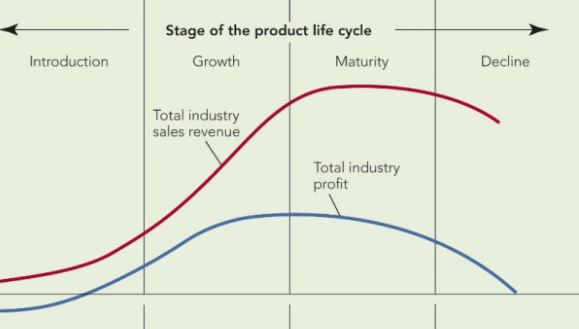
Stages of the Product Life Cycle
Introduction, Growth, Maturity, Decline
26
New cards
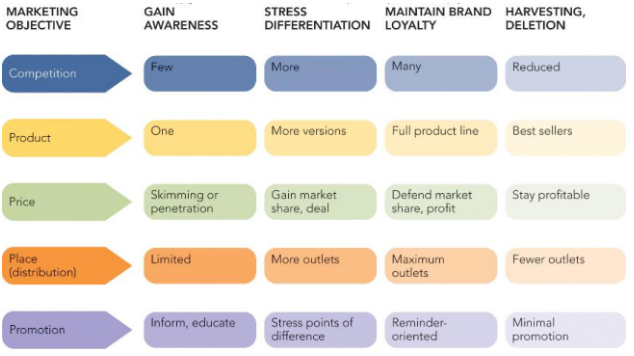
How Stages of the Product Life Cycle Relate to a Firm's Marketing Objectives
Just review it (memorize if have time)
Just review it (memorize if have time)
-
27
New cards
Introduction Stage
-Stimulate Trial
-First create PRIMARY DEMAND (for category) and then SELECTIVE DEMAND (for brand)
-First create PRIMARY DEMAND (for category) and then SELECTIVE DEMAND (for brand)
28
New cards
Growth Stage
-Rapid Sales Growth
-More Competitors
-Potential Strategies
- Achieve Broadest Possible Distribution
- Add new features to differentiate from competition
-More Competitors
-Potential Strategies
- Achieve Broadest Possible Distribution
- Add new features to differentiate from competition
29
New cards
Maturity Stage
-Industry/product sales slow
-Defending market share a key objective
-Differentiation a key strategy
-Defending market share a key objective
-Differentiation a key strategy
30
New cards
Decline Stage
-Industry/product sales drop
-Potential Strategies: Harvesting or Deletion (look at photo before)
-Potential Strategies: Harvesting or Deletion (look at photo before)
31
New cards
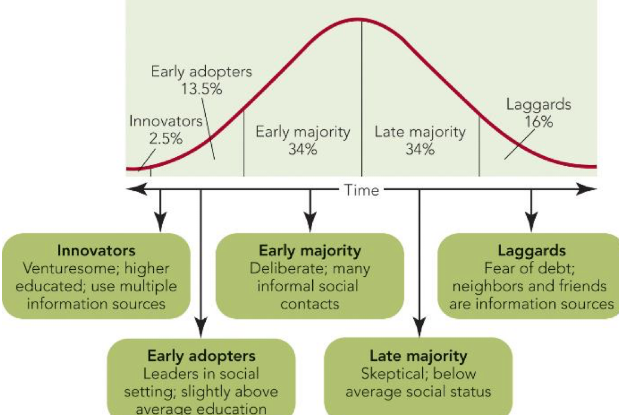
Charting the Product Life Cycle - Consumer Behavior (Diffusion of Innovation)
Just review it (memorize if have time)
Just review it (memorize if have time)
-
32
New cards
Modifying the Product
Product Modification
-Quality Improvements (ex. Better taste, longer shelf life, etc.)
-New Characteristics (ex. add DuraCeramic coating to grill)
-Quality Improvements (ex. Better taste, longer shelf life, etc.)
-New Characteristics (ex. add DuraCeramic coating to grill)
33
New cards
Modifying the Market
Market Modification
-Finding New Customers (ex. Facebook for Baby Boomers)
-Increasing a product's use (ex. drinking OJ all throughout day, not just breakfast)
-Creating a new use situation (ex. Hershey Bar in a S'More)
-Finding New Customers (ex. Facebook for Baby Boomers)
-Increasing a product's use (ex. drinking OJ all throughout day, not just breakfast)
-Creating a new use situation (ex. Hershey Bar in a S'More)
34
New cards
Branding
Use of a NAME, LOGO, or combination of these to identify a product and distinguish it from those of competition, creating a UNIQUE PROMISE OF VALUE
Brand names and logos need to be TRADEMARKED
Brand names and logos need to be TRADEMARKED
35
New cards
Brand Personality and Brand Equity
-Important to create BRAND PERSONALITY
-Goal is to build BRAND EQUITY
- the added value a brand name gives to a product beyond the functional benefits provided
-Goal is to build BRAND EQUITY
- the added value a brand name gives to a product beyond the functional benefits provided
36
New cards
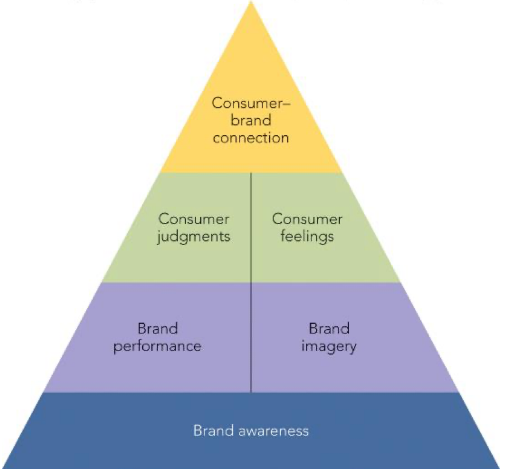
Customer-Based Brand Equity Pyramid
-
37
New cards
Creating Brand Equity
-Build AUTHENTICITY
- Develop trust with consumers
- Has become increasingly important in today's world
- Develop trust with consumers
- Has become increasingly important in today's world
38
New cards
Creating Value and Competitive Advantage
Packaging and Labeling Products
- Functional Benefits
- Needs to protect product
- Offers opportunities for displaying product
- Communication Benefits
- Brand Equity
- Key Features
- Other uses of product (ex. in recipes)
- Functional Benefits
- Needs to protect product
- Offers opportunities for displaying product
- Communication Benefits
- Brand Equity
- Key Features
- Other uses of product (ex. in recipes)
39
New cards
Challenges with Packaging Products
-Making Product User-Friendly
- Resealability
-Environmental Concerns
- Recyclability
-Health, Safety, and Security Issues
- Maintaining Shelf Life
- BPA - free plastic
-Cost Issues
- Can't be overly expensive
- Resealability
-Environmental Concerns
- Recyclability
-Health, Safety, and Security Issues
- Maintaining Shelf Life
- BPA - free plastic
-Cost Issues
- Can't be overly expensive
40
New cards
What is Price?
Price - money or other consideration (including other products and services) exchanged for ownership or use of a product or service
41
New cards
Nature and Importance of Price - Price as an Indicator of Value
Value - what all consumers want
Value = Perceived Benefits / Price
Value = Perceived Benefits / Price
42
New cards
Profit Equations
-Profit = Total Revenue - Total Cost
-Total Revenue = Unit Price x Quantity Sold
-Total Cost = Fixed Cost + (Variable Unit Cost X Quantity Sold)
-Fixed Cost - Cost does not vary with volume (e.g. office rent)
-Variable Cost - Cost varies with volume (e.g. packaging material)
-Total Revenue = Unit Price x Quantity Sold
-Total Cost = Fixed Cost + (Variable Unit Cost X Quantity Sold)
-Fixed Cost - Cost does not vary with volume (e.g. office rent)
-Variable Cost - Cost varies with volume (e.g. packaging material)
43
New cards
Six Steps in Setting Price:
1. Identify Pricing Objectives and Constraints
2. Estimate Demand and Revenue
3. Determine Cost, Volume, and Profit Relationships
4. Select an Appropriate Price Level
5. Set the List or Quoted Price
6. Make Special Adjustments to the List or Quoted Price
2. Estimate Demand and Revenue
3. Determine Cost, Volume, and Profit Relationships
4. Select an Appropriate Price Level
5. Set the List or Quoted Price
6. Make Special Adjustments to the List or Quoted Price
44
New cards
Step 1. Identify Pricing Objectives and Constraints
Pricing objectives can be based on maximizing...
-Profit
-Revenue
-Market Share
- Company Sales / Market Sales (ex. Chobani has $40M sales and the yogurt category is
$100M in sales: Chobani has $ market share of 40%)
- Unit Market Share = Firm Units / Category Units (ex. Chobani sells 200M units and the
yogurt category is 600M units in total: Chobani has unit market share of 33.3%)
-Profit
-Revenue
-Market Share
- Company Sales / Market Sales (ex. Chobani has $40M sales and the yogurt category is
$100M in sales: Chobani has $ market share of 40%)
- Unit Market Share = Firm Units / Category Units (ex. Chobani sells 200M units and the
yogurt category is 600M units in total: Chobani has unit market share of 33.3%)
45
New cards
Pricing Constraints
Consumer Demand for the product or service
Cost of producing and marketing the product
Types of Competitive Markets
Cost of producing and marketing the product
Types of Competitive Markets
46
New cards
4 types of competitive market
Pure Competition
Monopolistic Competition
Oligopoly
Pure Monopoly
Monopolistic Competition
Oligopoly
Pure Monopoly
47
New cards
Step 2. Estimate Demand and Revenue
Demand Curve - relates quantity sold to price
Price Elasticity of Demand
Price Elasticity of Demand (E) = Percentage Change in Quantity Demanded / Percentage Change in Price
KNOW WHAT ELASTIC AND INELASTIC IS
Price Elasticity of Demand
Price Elasticity of Demand (E) = Percentage Change in Quantity Demanded / Percentage Change in Price
KNOW WHAT ELASTIC AND INELASTIC IS
48
New cards
Elastic Demand
when a 1% decrease in price produces more than 1% increase in quantity demanded (or a 1% increase in price produces more than a 1% decrease in quantity demanded)
49
New cards
Inelastic Demand
when a 1% decrease in price produces less than a 1% increase in quantity demanded (or when a 1% increase in price produces less than a 1% decrease in quantity demanded)
50
New cards
Step 3. Determine Cost, Volume, and Profit Relationships
Break Even Analysis
Breakeven Point – unit quantity at which Total Revenue and Total Cost (fixed plus variable) are equal
DO PRACTICE PROBLEM IN COURSES
Breakeven Point – unit quantity at which Total Revenue and Total Cost (fixed plus variable) are equal
DO PRACTICE PROBLEM IN COURSES
51
New cards
Step 4. Select an Appropriate Price Level
Demand Oriented Pricing Approaches:
Skimming Pricing
Penetration Pricing
Prestige Pricing
Cost Oriented Pricing Approach:
Standup Markup % pricing
Cost-Plus Pricing (Cost plus percentage of cost or cost plus fixed extra amt.)
Profit Oriented Pricing Approaches
Target Profit Pricing
Target Return-on-Sales pricing
Target Return-on-Investment Pricing
Competition Oriented Pricing Approaches
Customary Pricing
Above or Below-Market Pricing
Loss-Leader Pricing
Skimming Pricing
Penetration Pricing
Prestige Pricing
Cost Oriented Pricing Approach:
Standup Markup % pricing
Cost-Plus Pricing (Cost plus percentage of cost or cost plus fixed extra amt.)
Profit Oriented Pricing Approaches
Target Profit Pricing
Target Return-on-Sales pricing
Target Return-on-Investment Pricing
Competition Oriented Pricing Approaches
Customary Pricing
Above or Below-Market Pricing
Loss-Leader Pricing
52
New cards
Explain the 3 types of demand oriented pricing approaches
Skimming Pricing - setting the highest price consumers are willing to pay to maximize profit
Penetration Pricing - setting a low price to appeal to mass market and maximize volume
Prestige Pricing - setting a high price so that status-conscious consumers will buy product
Penetration Pricing - setting a low price to appeal to mass market and maximize volume
Prestige Pricing - setting a high price so that status-conscious consumers will buy product
53
New cards
Explain the 3 types of competition oriented pricing approaches
Customary Pricing - all players price about the same (ex. candy bars)
Above or Below Market Pricing - based on company estimate (ex. Apple brand above market, Suave brand below market)
Loss-Leader Pricing - Deliberately pricing a product low to attract people to store
Above or Below Market Pricing - based on company estimate (ex. Apple brand above market, Suave brand below market)
Loss-Leader Pricing - Deliberately pricing a product low to attract people to store
54
New cards
Step 5. Set the List or Quoted Price
Choose a Price Policy
-Fixed Price policy - one price for all buyer of a product or service
-Dynamic Pricing policy - sets different prices in real time in response to demand and supply conditions
Consider Effects on Pricing
Company effects:
- Price of one product affects price of others in product line
Customer effects:
- Final check to make sure prices are acceptable to trade customers and consumers
Marginal Analysis (next flashcard)
-Fixed Price policy - one price for all buyer of a product or service
-Dynamic Pricing policy - sets different prices in real time in response to demand and supply conditions
Consider Effects on Pricing
Company effects:
- Price of one product affects price of others in product line
Customer effects:
- Final check to make sure prices are acceptable to trade customers and consumers
Marginal Analysis (next flashcard)
55
New cards
Marginal Analysis
Balance Incremental Costs and Revenues
Expected incremental revenue from pricing and other marketing actions must more than offset incremental costs to achieve incremental profit
Expected incremental revenue from pricing and other marketing actions must more than offset incremental costs to achieve incremental profit
56
New cards
Step 6: Make Special Adjustments to the List or Quoted Price
What are the three special adjustments?
What are the three special adjustments?
Three special adjustments to list or quoted price includes discounts, allowances, and geographical adjustments
57
New cards
Deceptive Pricing
Pricing which misleads consumers
58
New cards
Predatory Pricing
Practice of charging very low price with intent of driving competitors out of business
59
New cards
Services
Intangible activities or benefits that an organization provides to satisfy consumers’ needs
60
New cards
Four I's of Services
Intangibility
Inconsistency (referring to quality of service)
Inseparability (between deliverer of service and service itself)
Inventory (unused capacity a problem)
Inconsistency (referring to quality of service)
Inseparability (between deliverer of service and service itself)
Inventory (unused capacity a problem)
61
New cards
5 Dimensions of Service Quality
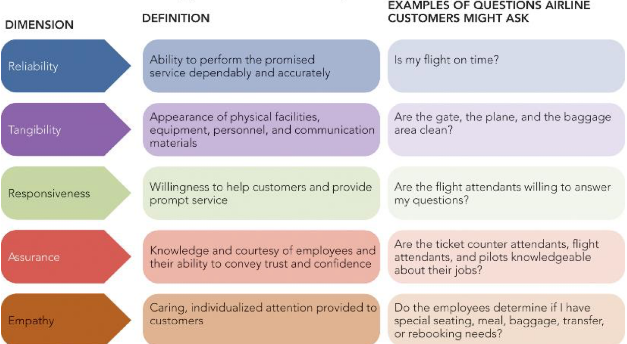
62
New cards
Seven P's of Service
Product Concept
- Segmentation
- Positioning
Pricing
- Price often perceived by consumer as indicator of quality
- Off-season pricing a common technique
Place (Distribution)
- How the consumer can book the service
Promotion (Integrated Marketing Communications)
- Includes advertising, public relations and consumer promotion
- Social media critical due to people sharing service experiences
People
- Internal Marketing - focus on employees
- Customer Experience Management (CEM) - outstanding service at each contact point with
customers
Physical Environment
-
Process - flow of activities by which service delivered
- Customer Contact Audit
- Inventory Management important
- Segmentation
- Positioning
Pricing
- Price often perceived by consumer as indicator of quality
- Off-season pricing a common technique
Place (Distribution)
- How the consumer can book the service
Promotion (Integrated Marketing Communications)
- Includes advertising, public relations and consumer promotion
- Social media critical due to people sharing service experiences
People
- Internal Marketing - focus on employees
- Customer Experience Management (CEM) - outstanding service at each contact point with
customers
Physical Environment
-
Process - flow of activities by which service delivered
- Customer Contact Audit
- Inventory Management important
63
New cards
Managing Distribution Channels & Supply Chains
Common distribution channels for consumer products and services by the kind and number of intermediaries
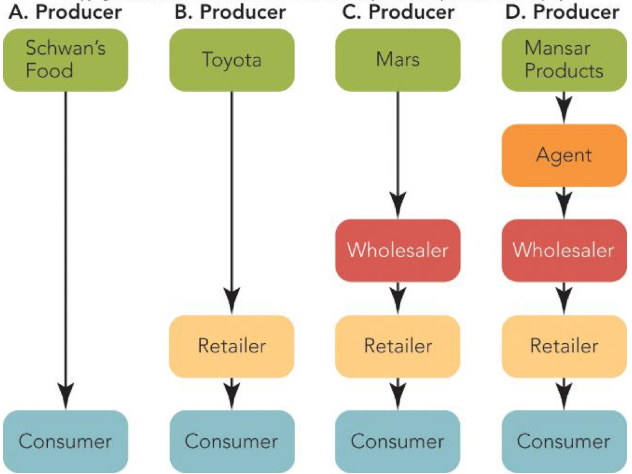
64
New cards
Omnichannel Marketing
Blending of different delivery channels for consumers who shop and buy in brick and mortar outlets and online
Same chain has brick and mortar outlets and online presence
Same chain has brick and mortar outlets and online presence
65
New cards
Factors Affecting Distribution Channel Choice
Coverage - Need to determine channels which will provide best coverage for target market
- Intensive distribution (many outlets)
- Exclusive distribution (one or a few outlets in a geographic area)
- Intensive distribution (many outlets)
- Exclusive distribution (one or a few outlets in a geographic area)
66
New cards
Types of Channel Conflict
Vertical Conflict - Conflict between Manufacturer and Retailer
Horizontal Conflict - Conflict between Retailers
Disintermediation (bypassing a channel) (ex. Hershey sells directly to 7/11 instead of going through candy/tobacco distributor)
Horizontal Conflict - Conflict between Retailers
Disintermediation (bypassing a channel) (ex. Hershey sells directly to 7/11 instead of going through candy/tobacco distributor)
67
New cards
Channel Captain
A channel member that coordinates, directs and supports other channel members
- Can be a manufacturer, wholesaler or retailer
- Channel captains decide how shelf will be organized
- Can be a manufacturer, wholesaler or retailer
- Channel captains decide how shelf will be organized
68
New cards
Logistics
refers to activities that get the right amount of the right products to the right place at the right time at the lowest possible cost
69
New cards
Supply Chains
refers to the firms involved in creating or delivering a product to intermediaries, consumers or industrial buyers
- firm must drive down supply chain costs but deliver outstanding customer service
- firm must drive down supply chain costs but deliver outstanding customer service
70
New cards
Types of Merchandise Lines
Specialty Outlets have low breadth but High depth
(ex. best buy, staples, barnes and nobles)
(ex. best buy, staples, barnes and nobles)
71
New cards
Breadth
Number of different product lines
72
New cards
Depth
Number of items within each product line
73
New cards
Types of Merchandise Lines
General merchandize stores have high breadth but low depth
(ex. supermarket)
(ex. supermarket)
74
New cards
Retail Pricing
Retailer Markup % is the amount by which one multiplies the retailer cost to get the retailer selling price (retailer cost is $.60, Retailer Markup % is 50%, so $.60 X 1.50 = retailer selling price of $.90)
- Formula for retailer markup % is: [(retailer selling price-retailer cost)/retailer cost] X 100,
or [($.90-$.60)/$.60] X 100 = 50%
Retailer Margin is retailer selling price minus cost to the retailer ($.90 - $.60 = $.30 in above example)
Retailer Margin % is retailer margin over retailer selling price
- Formula for retailer margin % is: [(retailer selling price-retailer cost)/retailer price] X 100,
or [($.90-$.60)/$.90] X 100 = 33%
Don’t mix up Retail Markup %, Retailer Margin and Retailer Margin %!
- Formula for retailer markup % is: [(retailer selling price-retailer cost)/retailer cost] X 100,
or [($.90-$.60)/$.60] X 100 = 50%
Retailer Margin is retailer selling price minus cost to the retailer ($.90 - $.60 = $.30 in above example)
Retailer Margin % is retailer margin over retailer selling price
- Formula for retailer margin % is: [(retailer selling price-retailer cost)/retailer price] X 100,
or [($.90-$.60)/$.90] X 100 = 33%
Don’t mix up Retail Markup %, Retailer Margin and Retailer Margin %!
75
New cards
Off-Price Retailing
Retail practice selling brand-name merchandise at lower than regular prices
Variants:
Warehouse clubs
Outlet stores
Single price/extreme value retailers
Variants:
Warehouse clubs
Outlet stores
Single price/extreme value retailers
76
New cards
All Retailing Strategy Subtitles
Off Price Retailing
Location
Experience
Merchandising
The Future
Location
Experience
Merchandising
The Future
77
New cards
Location
-The main rule of real estate also applies to retailing
-Best Place in a mall to locate is near an Apple Store
-Sephora planning to open stores in more than 75 cities, focusing on “local neighborhoods and community centers” (away from malls)
-Best Place in a mall to locate is near an Apple Store
-Sephora planning to open stores in more than 75 cities, focusing on “local neighborhoods and community centers” (away from malls)
78
New cards
Retail Experience
Store’s image, atmosphere, ambience critical
79
New cards
Retail Merchandising
Category Management - an approach to assortment management in which a whole category is organized on shelf for optimal sales/profits
Best selling items in ideal spots to attract consumers
Best selling items in ideal spots to attract consumers
80
New cards
The Future
Retailers need to take customer service to a new level to compete with the online world
Best Buy an example of this trend
-Sales people steeped in product knowledge to help consumers
-Introduced in-home advisory service to explain how to connect all products in homes with each other
-Post Covid-19, transitioning half the square footage at some stores to online order fulfillment
-Testing digital first, smaller retail store in Monroe, North Carolina
Best Buy an example of this trend
-Sales people steeped in product knowledge to help consumers
-Introduced in-home advisory service to explain how to connect all products in homes with each other
-Post Covid-19, transitioning half the square footage at some stores to online order fulfillment
-Testing digital first, smaller retail store in Monroe, North Carolina
81
New cards
Target Audience
-Must be aligned with target market specified in the positioning
-Need to understand the demographics, media use, and shopping behavior of the target audience
-Create a “Buyer Persona”
-Need to understand the demographics, media use, and shopping behavior of the target audience
-Create a “Buyer Persona”
82
New cards
Selecting the Tools - IMC
Tools available are Advertising, Personal Selling, Public Relations, Consumer/Trade Promotion, and Direct Marketing
Use Traditional and/or Social Media for advertising, PR and consumer promotion
All the tools need to work together to create a consistent message
Use Traditional and/or Social Media for advertising, PR and consumer promotion
All the tools need to work together to create a consistent message
83
New cards
Three types of Advertisments
Pioneering (informational)
Competitive (or persuasive)
Reminder
Competitive (or persuasive)
Reminder
84
New cards
Developing the Advertising Program
Creative Strategy
Coming up with an Advertising Campaign
Selecting the Right Media
Coming up with an Advertising Campaign
Selecting the Right Media
85
New cards
Creative Strategy
Key Prospects
Key Benefit Promised
Support for Promise
Tone
Key Benefit Promised
Support for Promise
Tone
86
New cards
Key Prospects
The target audience against which the brand’s advertising will be directed
87
New cards
Key Benefit Promised
the product benefit considered to be the most meaningful/motivating to the brand’s target audience
88
New cards
Support for Promise
the means by which believability/persuasion is brought to the brand’s promise
89
New cards
Tone
the personality which the advertising will have
90
New cards
Ex. of Creative Strategy (Kisses)
Key Prospects - Females between ages of 18-39
Key Benefit Promised - the simple, yet special, way to connect with others
Support for Promise - 1. Kisses are special due to their size, shape, foil and plume, and 2. The Kisses name is synonymous with affection
Tone - affectionate, charming, magical
Key Benefit Promised - the simple, yet special, way to connect with others
Support for Promise - 1. Kisses are special due to their size, shape, foil and plume, and 2. The Kisses name is synonymous with affection
Tone - affectionate, charming, magical
91
New cards
Coming Up with an Advertising Campaign
Once you have a solid creative strategy, you then need a BIG IDEA for an advertising campaign
The idea should be translatable to a large array of advertising executions in traditional and digital media
The idea should be translatable to a large array of advertising executions in traditional and digital media
92
New cards
Selecting the Right Media
Media planning goals
Evaluate traditional and digital media
Business Analytics optimization techniques on media data can lead to best media mix
Evaluate traditional and digital media
Business Analytics optimization techniques on media data can lead to best media mix
93
New cards
Selecting the Right Media (cont.)
Reach - the number of different people or households exposed to an advertisement
Frequency - the average number of times a person in the target audience is exposed to an advertisement
Rating - the percentage of households in a market that are tuned to a particular show
Gross Rating Points (GRPs) - Reach % x Frequency
Example: 80% reach X Frequency of 3 = 240 GRPs
Cost per Thousand (CPM) - Cost of reaching 1,000 individuals or households with an ad in particular medium
Frequency - the average number of times a person in the target audience is exposed to an advertisement
Rating - the percentage of households in a market that are tuned to a particular show
Gross Rating Points (GRPs) - Reach % x Frequency
Example: 80% reach X Frequency of 3 = 240 GRPs
Cost per Thousand (CPM) - Cost of reaching 1,000 individuals or households with an ad in particular medium
94
New cards
Different media alternatives
TV
Radio
Magazines
Outdoor
Social Media
Radio
Magazines
Outdoor
Social Media
95
New cards
Social Media
The wave of the future and evolving rapidly
Will discuss in detail in upcoming class
Will discuss in detail in upcoming class
96
New cards
Consumer Oriented Promotion Examples
Coupons - valuable tool for trial or repeat purchase
Samples - excellent tool when objective is trial purchase
Premiums (ex. merchandise) - merchandise may be free or reduced-price, build repeat purchase among current consumers
Contests - encourage consumers to apply skills or creative thinking to win a prize, build repeat purchase among current consumers
Sweepstakes - no skill needed (vs. contest) - just luck of the draw, build repeat purchase among current consumers
Loyalty Programs - encourage and reward repeat purchases
Product Placement - can build trial or repeat purchases
Samples - excellent tool when objective is trial purchase
Premiums (ex. merchandise) - merchandise may be free or reduced-price, build repeat purchase among current consumers
Contests - encourage consumers to apply skills or creative thinking to win a prize, build repeat purchase among current consumers
Sweepstakes - no skill needed (vs. contest) - just luck of the draw, build repeat purchase among current consumers
Loyalty Programs - encourage and reward repeat purchases
Product Placement - can build trial or repeat purchases
97
New cards
Trade Oriented Promotion
Discounts and allowances extensively used by manufacturers to gain reduced prices, displays and other types of promotions
98
New cards
Public Relations
A form of communications management that seeks to influence the image of an organization and its products/services without payment to media
-News releases and conferences
-Special Events
-Crisis control if there are quality or other controversial issues
-News releases and conferences
-Special Events
-Crisis control if there are quality or other controversial issues
99
New cards
How to Build Great Campaigns
A good advertisement is one which SELLS THE PRODUCT, not the advertisement
What you say is more important than how you say it (CONTENT IS KING)
Unless your campaign is built around a big idea, it will flop (no mediocrity)
Give the Facts (don't stretch the truth)
You can not bore people into buying (evoke excitement into your ads)
Make advertising CONTEMPORTARY (contemporary changes in current society)
Never write an advertisement that you wouldn’t want your own family to read
Good products can be sold by honest advertising
If you don’t think the product is good, you have no business to be advertising it
It’s all about trust
Every advertisement should communicate the BRAND IMAGE
-develops from the positioning and the creative strategy
Dont be a copy cat, do something new
What you say is more important than how you say it (CONTENT IS KING)
Unless your campaign is built around a big idea, it will flop (no mediocrity)
Give the Facts (don't stretch the truth)
You can not bore people into buying (evoke excitement into your ads)
Make advertising CONTEMPORTARY (contemporary changes in current society)
Never write an advertisement that you wouldn’t want your own family to read
Good products can be sold by honest advertising
If you don’t think the product is good, you have no business to be advertising it
It’s all about trust
Every advertisement should communicate the BRAND IMAGE
-develops from the positioning and the creative strategy
Dont be a copy cat, do something new
100
New cards
How to Write Powerful Copy
The headline is the “ticket on the meat”: use it to flag down readers
-Do not say anything in it which will exclude parts of your target audience
-It should include your benefit/selling promise
-Try to incorporate news in it
-Include the brand name in the headline
Body copy should:
-Go straight to the point
-Be specific, factual and informative
-Include testimonials, if possible
-Give the reader helpful advice (e.g. recipes for a food product)
-Write in a style of everyday conversation
-Do not say anything in it which will exclude parts of your target audience
-It should include your benefit/selling promise
-Try to incorporate news in it
-Include the brand name in the headline
Body copy should:
-Go straight to the point
-Be specific, factual and informative
-Include testimonials, if possible
-Give the reader helpful advice (e.g. recipes for a food product)
-Write in a style of everyday conversation
 Note
Note  Flashcards (108)