Decision Making
 Studied by 0 people
 Call Kai
 Learn
Learn Practice Test
 Spaced Repetition
 Match
Match Flashcards
 Knowt Play
1/18

There's no tags or description
Looks like no tags are added yet.
Name | Mastery | Learn | Test | Matching | Spaced |
|---|
No study sessions yet.
19 Terms
Expected Utility Theory
We make decisions based on the expected utility of the outcomes & their respective probabilities
Utility
Whatever end a person may want to achieve
System 1 Thinking
Heuristic Mode, Fast, Efficient, Based on Previous Experiences & Beliefs, Intuition
System 2 Thinking
Analytic Mode, Slow, Deliberate, Controlled, More Cognitively Demanding
Normative Model
Describes how we ought to think in a given situation
Descriptive Approach
Describes how we actually think; we show bounded rationality
Availability Heuristic
Events that are more easily remembered are judged as more probable
Illusionary Correlation
Strong correlation between two events appears to exist but doesn't
Representativeness Heuristic
Probability that A is a member of class B is determined by how well properties of A resemble properties usually associated with B
Base Rate
Relative proportions of classes in the population
Conjunction Rule
Probability of conjunction of two events cannot be higher than the probability of single constituents
Law of Large Numbers
The larger the number of individuals drawn from a population, the more representative the group will be of the entire population
Myside Bias
The tendency for people to generate & evaluate evidence& test their hypothesis in a way that is biased towards their own opinions and attitudes
Confirmation Bias
Selectively looking for information that conforms to a hypothesis & overlooking information that argues against it
Backfire Effect
People's support for a particular viewpoint becomes stronger when presented with facts opposing their viewpoint
Framing Effect
Decisions are influenced by how the choices are stated
Losses
They are more worth avoiding because they are stronger
Prospect Theory
Assessing the way people evaluate information in a descriptive approach instead of a normative approach
Prospect Theory Curve
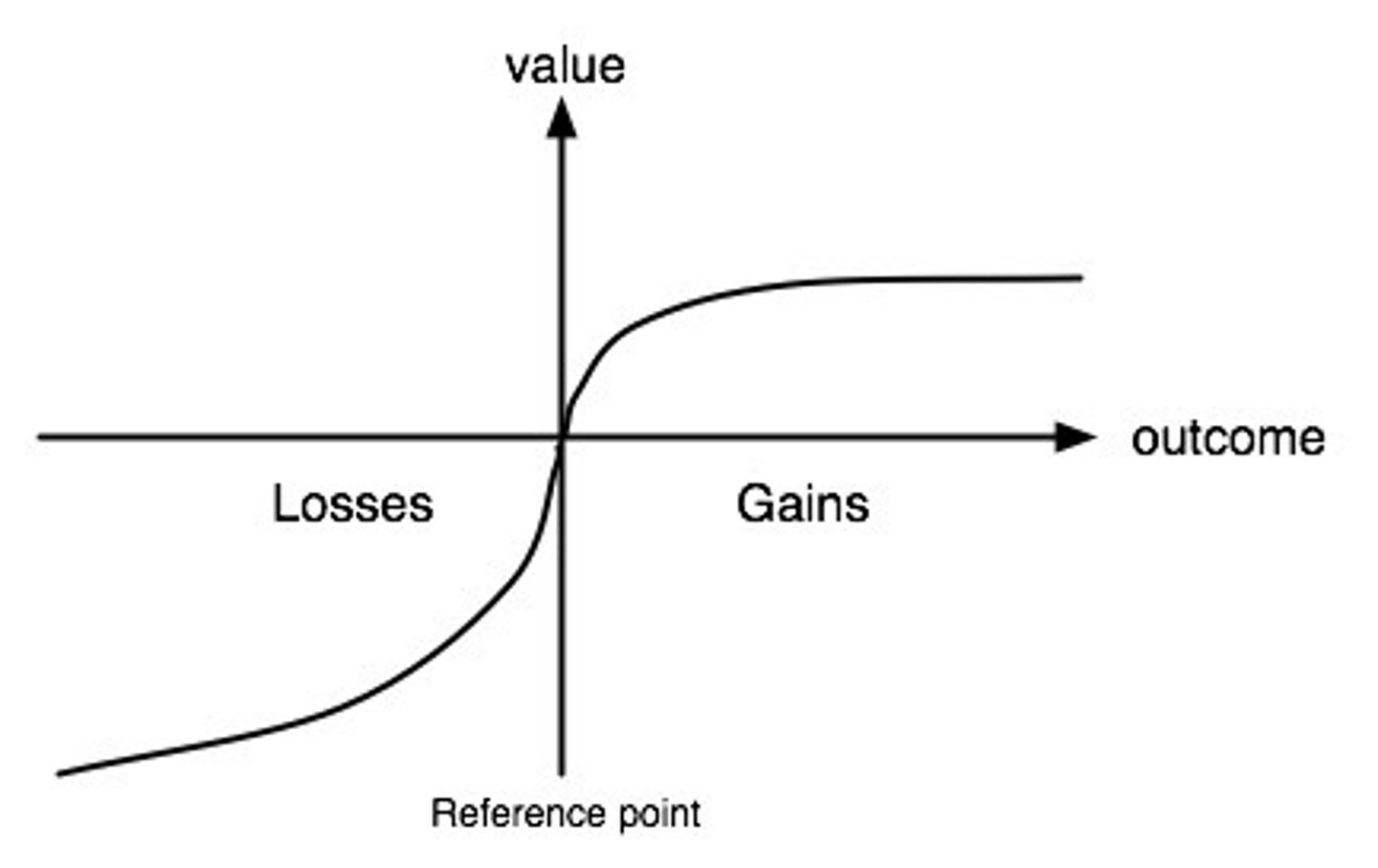
 Note
Note  Flashcards (20)