Bio Unit 2 - Genetic Material
 Call Kai
 Learn
Learn Practice Test
 Spaced Repetition
 Match
Match Flashcards
 Knowt Play
1/15

There's no tags or description
Looks like no tags are added yet.
Name | Mastery | Learn | Test | Matching | Spaced | Call with Kai |
|---|
No analytics yet
Send a link to your students to track their progress
16 Terms
What is the circumstantial evidence for DNA?
It is present in the nucleus of a cell and in chromosomes, doubles during the S phase of the cell cycle, and diploid cells have twice as much as haploid cells.
How was the evidence of DNA discovered?
Nuclei were isolated from white blood cells of wounded soldiers, which contained DNA.
What technique confirmed the presence of DNA in chromosomes?
DNA-binding dyes were developed using light microscopy to confirm that DNA is in chromosomes.
What did flow cytometry reveal about DNA content in different cell phases?
Flow cytometry showed that cells in the S, G2, and M had twice as much DNA as haploid cells
What was the transformation experiment?
Transformation is that bacteria can incorporate environmental DNA into their own DNA. In the experiment, there were two bacterial strains: R strain and S strain (deadly). The heat-killed S strain + living R strain = death of the mouse. They tested three enzymes and found that adding the DNA-degrading enzyme stopped transformation from occurring, allowing the mouse to live.
What did the Hershey-Chase experiment reveal?
Showed that bacteriophages inject DNA, not protein, into bacteria. They labeled viral DNA and protein with radioactive isotopes, then infected bacteria, blended to separate them, and centrifuged. The viral DNA was found in the bacteria, proving that DNA is the genetic material.
What pieces of evidence helped discover the structure of DNA?
The chemical composition of DNA, the ratio of bases (Purines = Pyrimidines), Photograph 51, and 3D structure models.
What is Photograph 51?
In 1952, Rosalind Franklin used X-ray crystallography to create an image showing the positions of the atoms within DNA. Suggested DNA was a helical molecule.
Who are Francis Crick and James Watson?
In 1953, they combined all the knowledge of DNA to determine its structure. They created models and found that DNA strands must be antiparallel.
What are the 3 DNA replication hypotheses?
Semiconservative (each parental strand is a template for a new strand), conservative (both strands act as a single template and produce one double-stranded daughter molecule), and dispersive (parent molecule is dispersed among two daughter molecules)
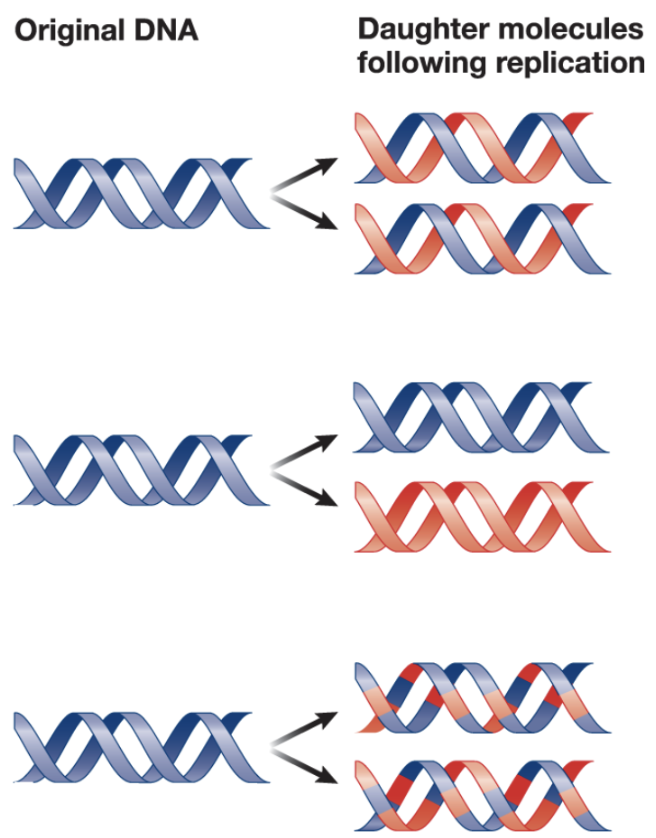
What was the Meselson-Stahl experiment?
Found that DNA replication was semiconservative. Grew E. coli in heavy 15N, then switched to light 14N. After one division, DNA was intermediate weight (one old strand, one new). After two, both intermediate and light bands appeared. Therefore, each new DNA molecule consists of one original strand and one newly synthesized strand.
What are the steps of DNA replication?
Initiation (unwinding and synthesizing RNA primers), elongation (synthesizing new strands of DNA), termination (DNA synthesis ends).
What is initiation?
The pre-replication complex binds to sites of origin. Replication bubble forms at ori with replication forks at each end. DNA helicase moves away from the ori, separating the strands and widening the replication bubble with the help of topoisomerase. Primase synthesizes RNA primers on each strand to DNA.
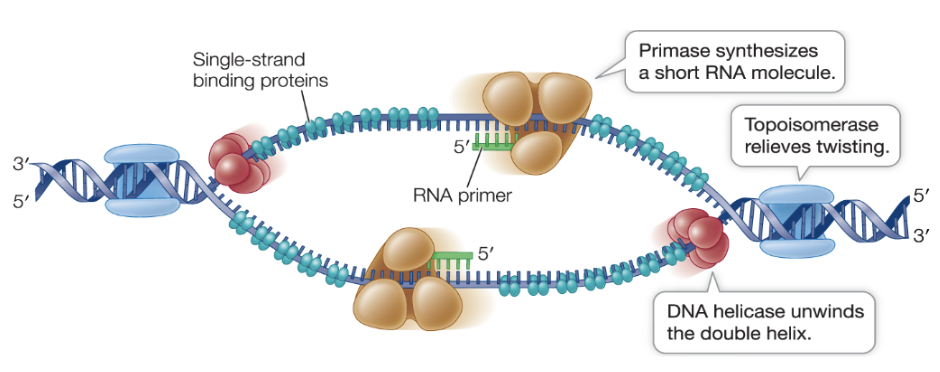
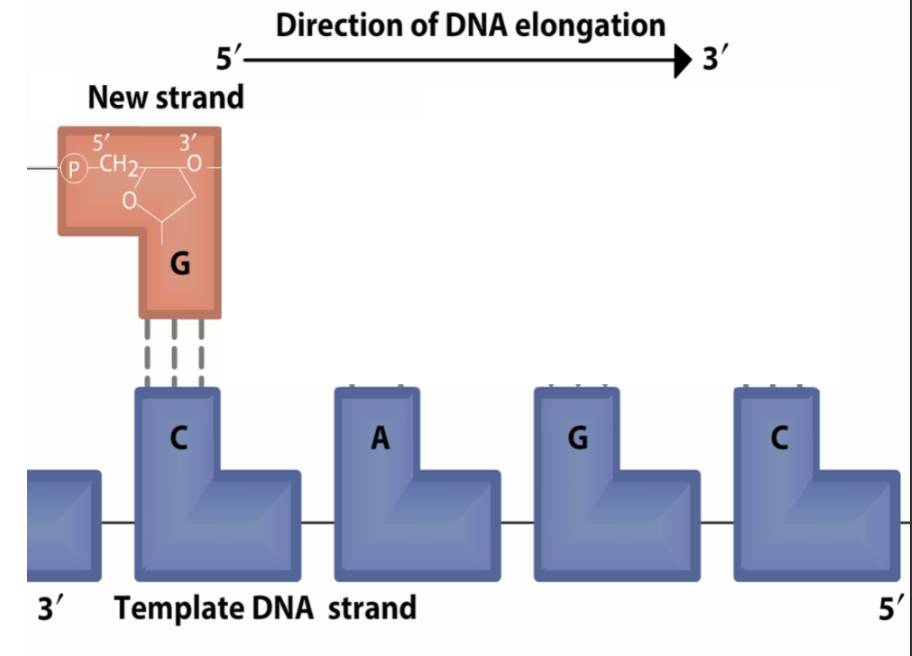
What is elongation?
DNA polymerase attaches to primers and adds nucleotides to the 3’ end of the template strand to build a new strand. Helicase unwinds a replication fork. The leading strand is built continuously, while the lagging strand is built in Okazaki fragments. Another DNA polymerase replaces RNA primers with DNA. DNA ligase joins Okazaki fragments.
What is termination?
The process where replication forks meet or reach the chromosome end. Proteins halt the machinery, and the leading strand completes. However, the lagging strand loses its final primer, leaving a single-stranded end that is removed, resulting in a slightly shorter chromosome.
What are telomeres?
Repetitive non-coding DNA “caps” at chromosome ends. They protect coding regions because the lagging strand cannot be replicated to the very end. Instead of losing vital genes, the cell loses a portion of the telomere during each division.

