Action Potential
 Call Kai
 Learn
Learn Practice Test
 Spaced Repetition
 Match
Match Flashcards
 Knowt Play
1/11

There's no tags or description
Looks like no tags are added yet.
Name | Mastery | Learn | Test | Matching | Spaced | Call with Kai |
|---|
No analytics yet
Send a link to your students to track their progress
12 Terms
Summary of an action potential
Graded potentials (IPSPs and EPSPs) enter trigger zone (axon hillock)
If the sum of these graded potentials depolarizes the membrane potential greater than threshold voltage (-55mV) then…
Voltage-gated Na+ channels open and Na+ enters neuron
A wave of positive charge (an action potential) spreads along adjacent sections of axon by local current flow
An action potential at one section of the axon causes voltage-gated channels at adjacent sections to depolarize to threshold, and so on
→ this is an example of positive feedback
→ Propagation is conduction of action potential along a non-myelinated axons
→ Saltatory conduction is conduction of action potential along myelinated axons (is faster than propagation)
Efflux of K+ repolarized the membrane at each section
The refractory period prevented backward conduction
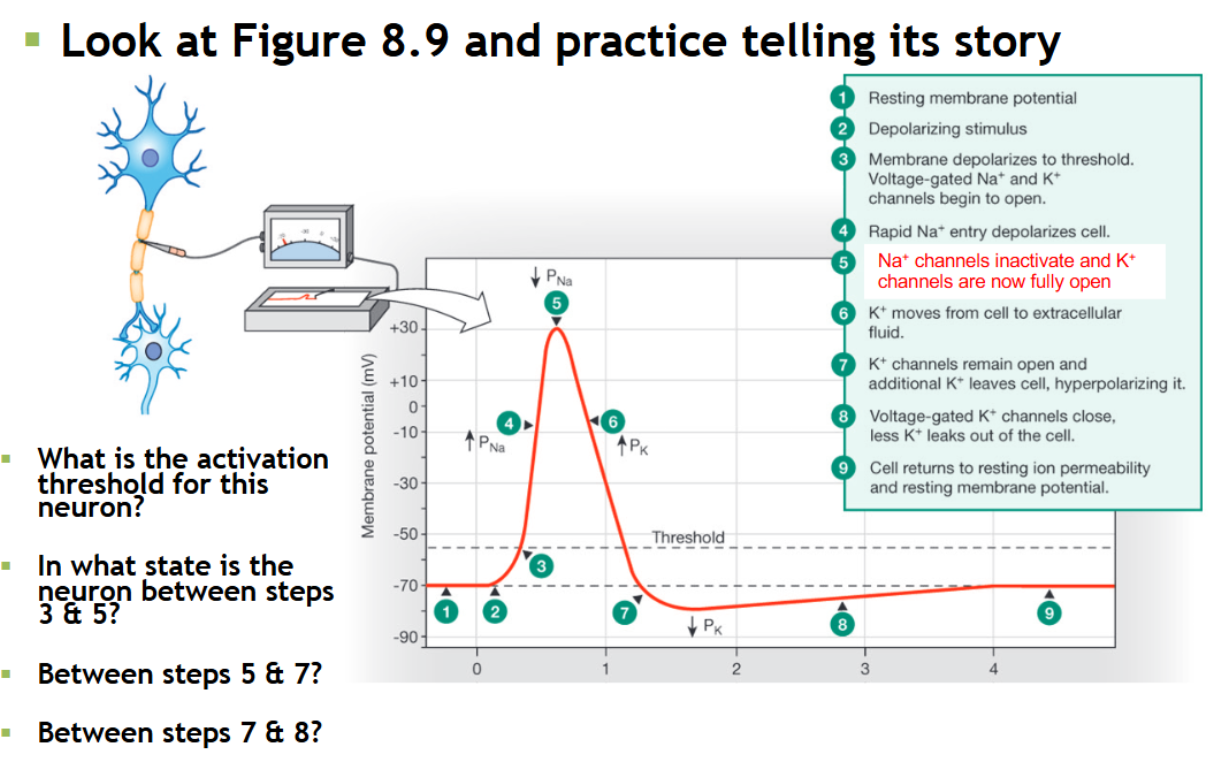
Action Potentials: The all-or-none signals generated by neurons
that
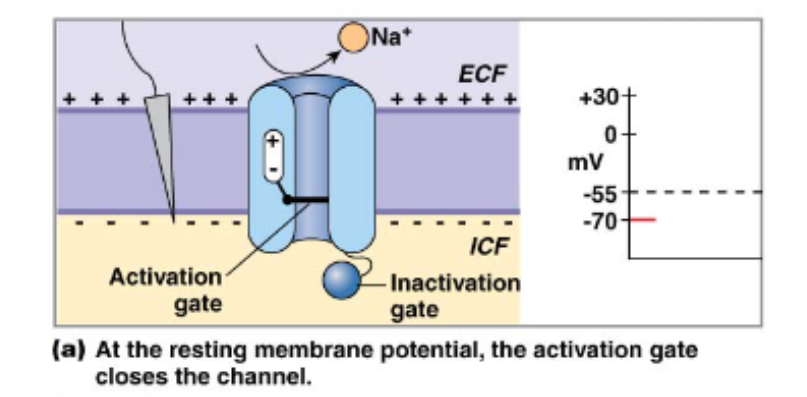
Voltage gated Na+ channels have 3 states and 2 gates
At resting membrane potential, the channel is voltage sensitive because the activation gate is CLOSED and inactivation gate is open
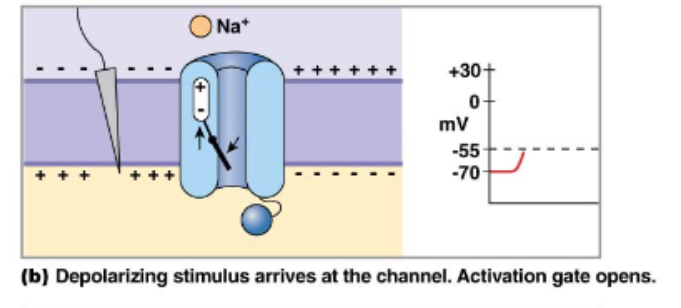
Voltage gated Na+ channels have 3 states and 2 gates
When the neuron is stimulated past threshold, the activation gate OPENS
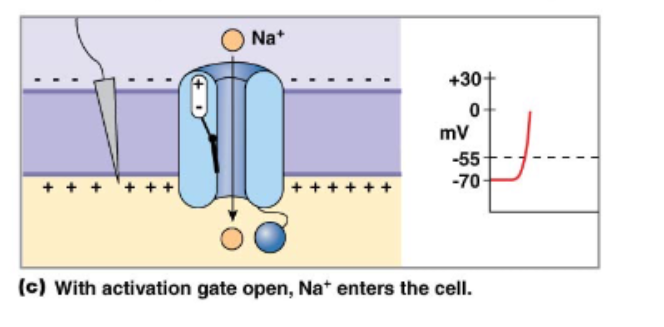
Voltage gated Na+ channels have 3 states and 2 gates
Small amount of Na+ influxes through channel and the neuron starts to depolarize
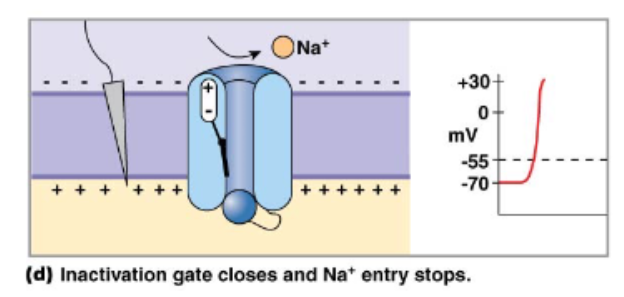
Voltage gated Na+ channels have 3 states and 2 gates
Intermediate step: inactivation gate closes (channel INACTIVATED) after ~0.5 msec
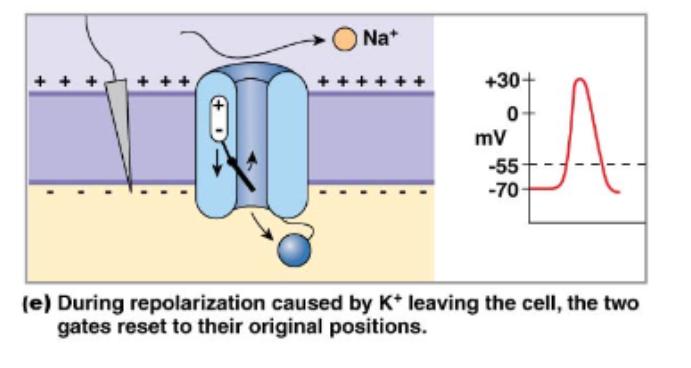
Voltage gated Na+ channels have 3 states and 2 gates
Then both gates return to their original positions (as seen in step 1) after a few milliseconds
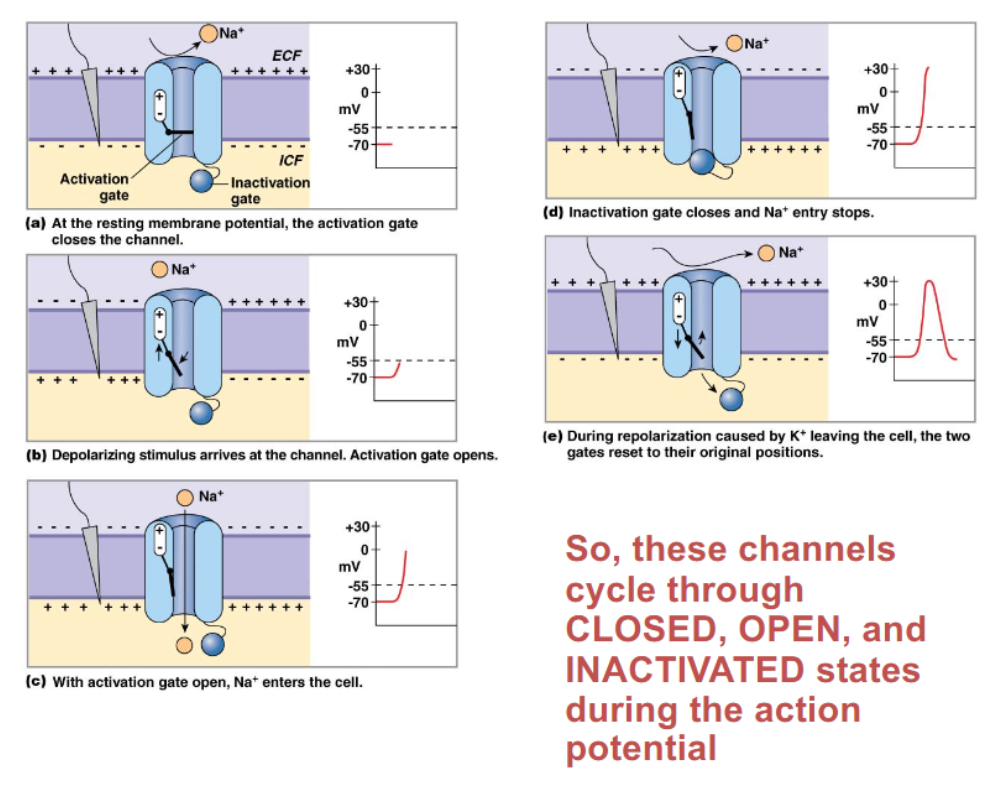
So, these channels cycle through CLOSED, OPEN, and INACTIVATED states during the action potential
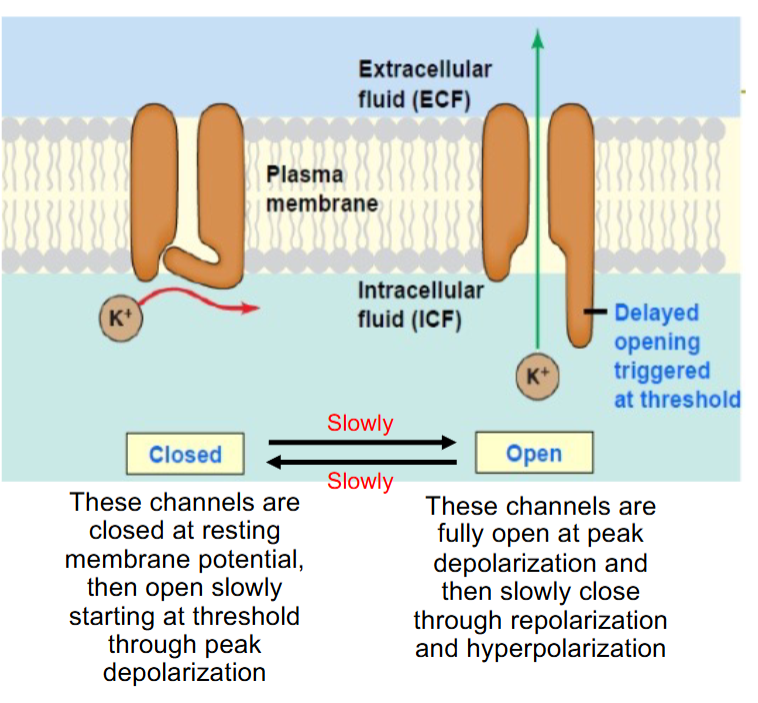
Voltage gated K+ channels have only ONE gate
At resting membrane potential, their gate is closed
When threshold is met, their gate starts to SLOWLY OPEN
These channels are NOT FULLY OPEN until peak depolarization is reached (and Na+ channels are inactive)
K+ channels then SLOWLY CLOSE during the repolarization and hyperpolarization phases
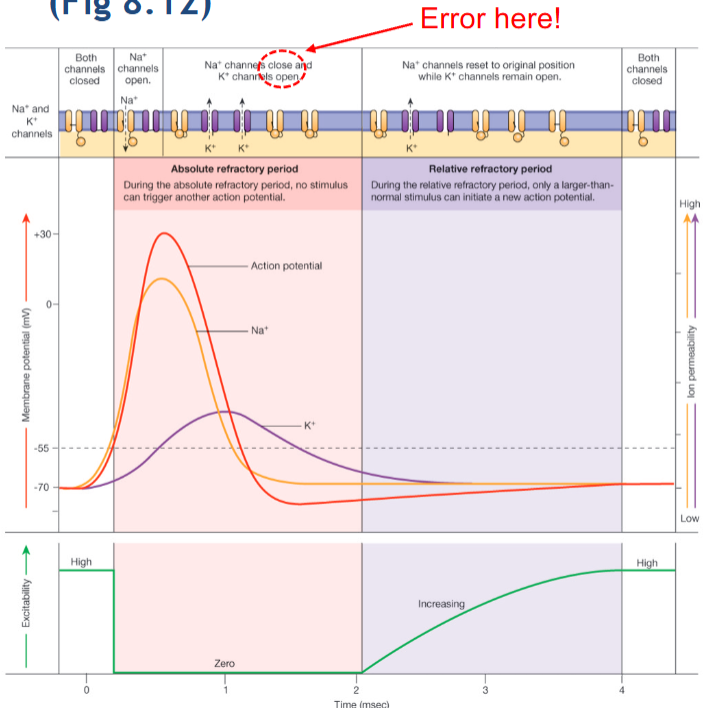
The second action potential will not fire during the absolute refractory period
Na+ channels still inactivated, but not completely closed
They must be completely re-set (closed) to be opened again
K+ channels are slow to close, resulting in brief hyperpolarization
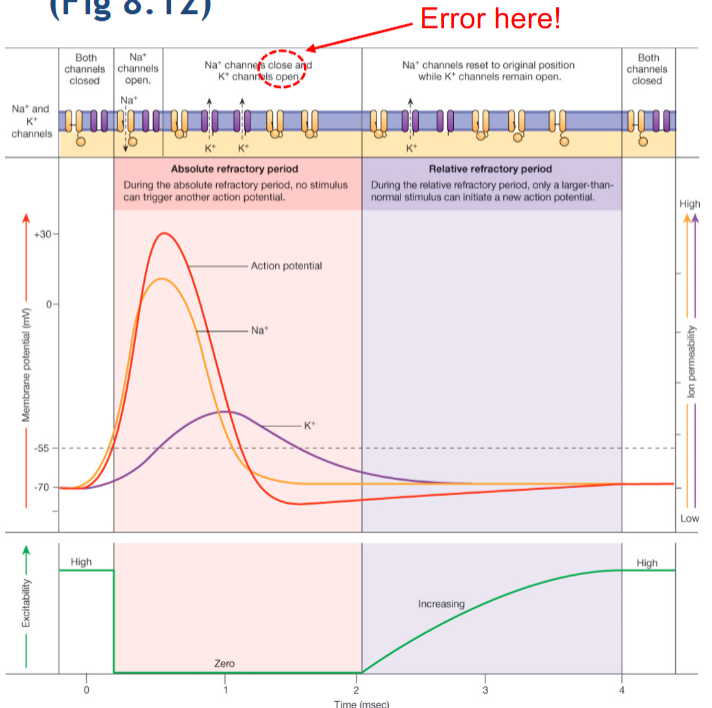
However, a second action potential CAN fire during the relative refractory period
But only if the EPSP is higher than normal
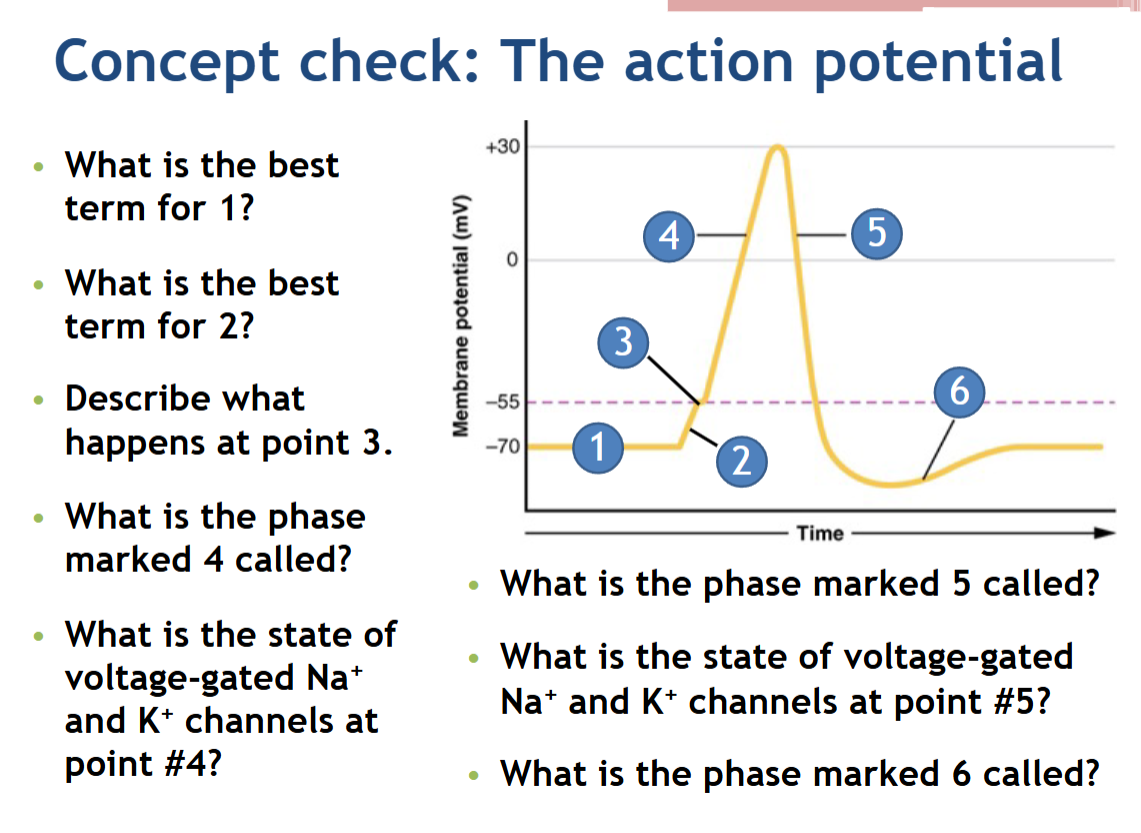
The action potential!

