Home work 4 every question
 Studied by 0 people
 Call Kai
 Learn
Learn Practice Test
 Spaced Repetition
 Match
Match Flashcards
 Knowt Play
1/44

There's no tags or description
Looks like no tags are added yet.
Name | Mastery | Learn | Test | Matching | Spaced | Call with Kai |
|---|
No analytics yet
Send a link to your students to track their progress
45 Terms
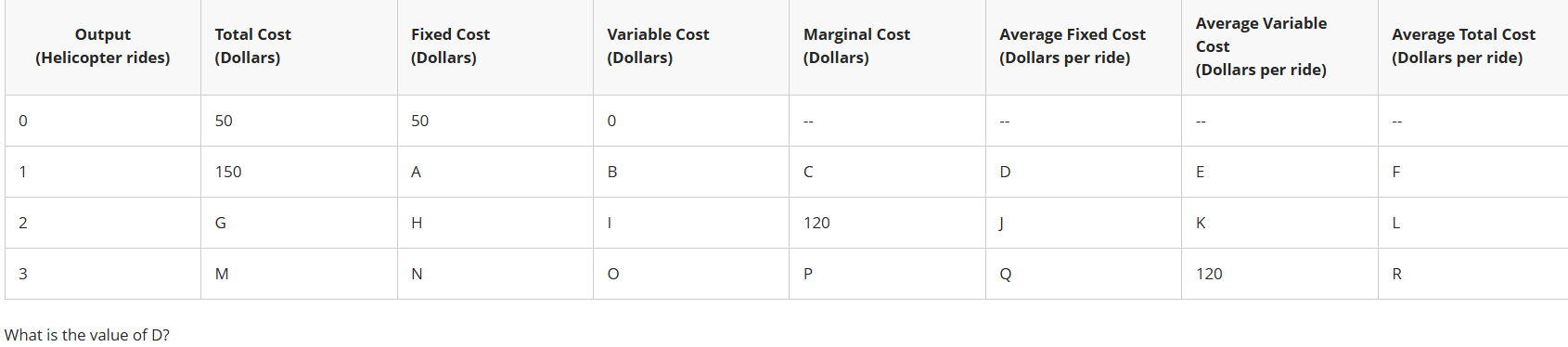
What is D
$50
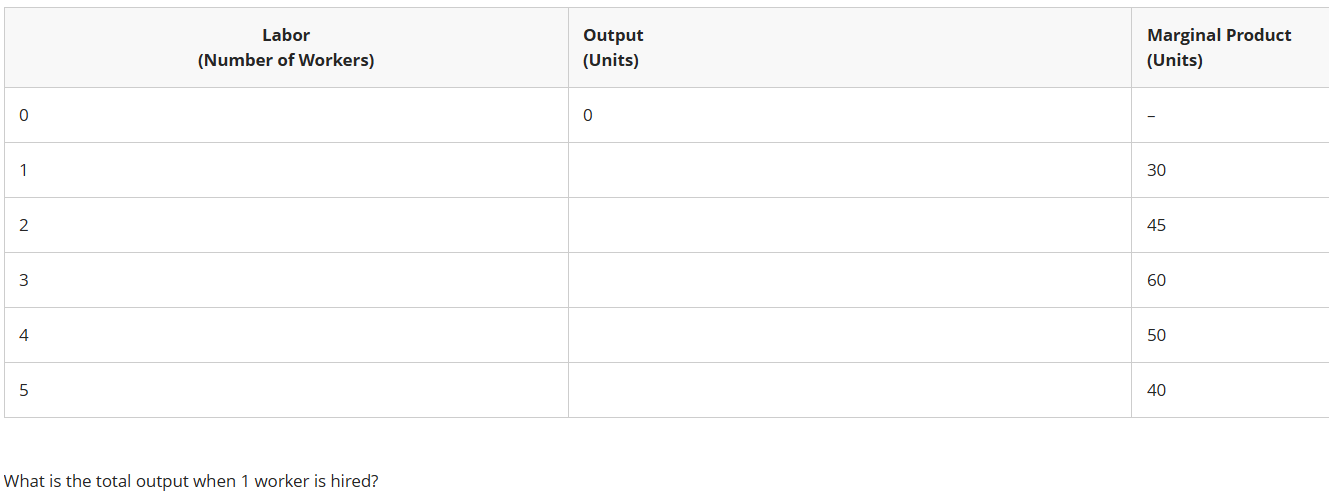
What is the total output when 1 worker is hired?
30
A difference between explicit and implicit costs is that
explicit costs must be greater than implicit costs.
explicit costs do not require a direct monetary outlay by the firm, whereas implicit costs do.
implicit costs do not require a direct monetary outlay by the firm, whereas explicit costs do.
implicit costs must be greater than explicit costs.
implicit costs do not require a direct monetary outlay by the firm, whereas explicit costs do.
If Marginal cost = average total cost, then
average variable cost is decreasing.
average fixed cost is increasing.
marginal cost is at its minimum.
average total cost is at its minimum.
average total cost is at its minimum.
A firm produces 300 units of output at a total cost of $1,000. If fixed costs are $100
average fixed cost is $10.
average variable cost is $3.
average total cost is $4.
average total cost is $5.
average variable cost is $3.
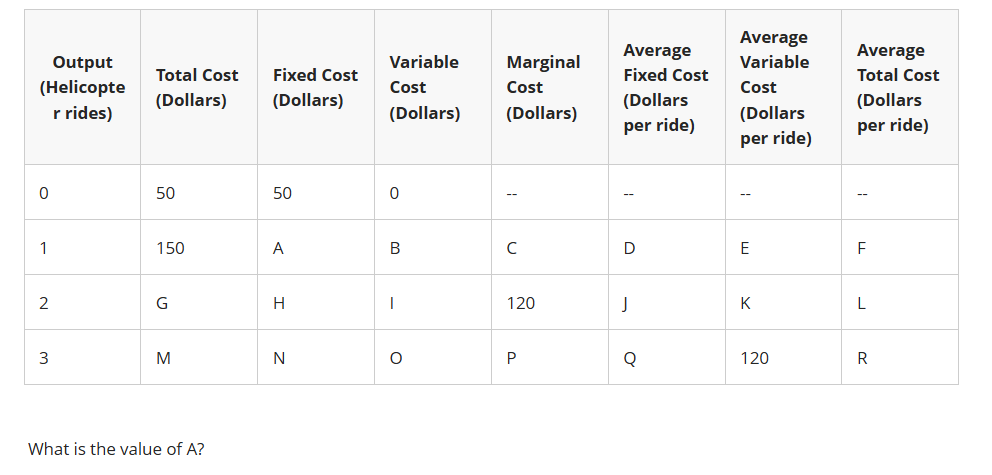
What is the value of A
$50
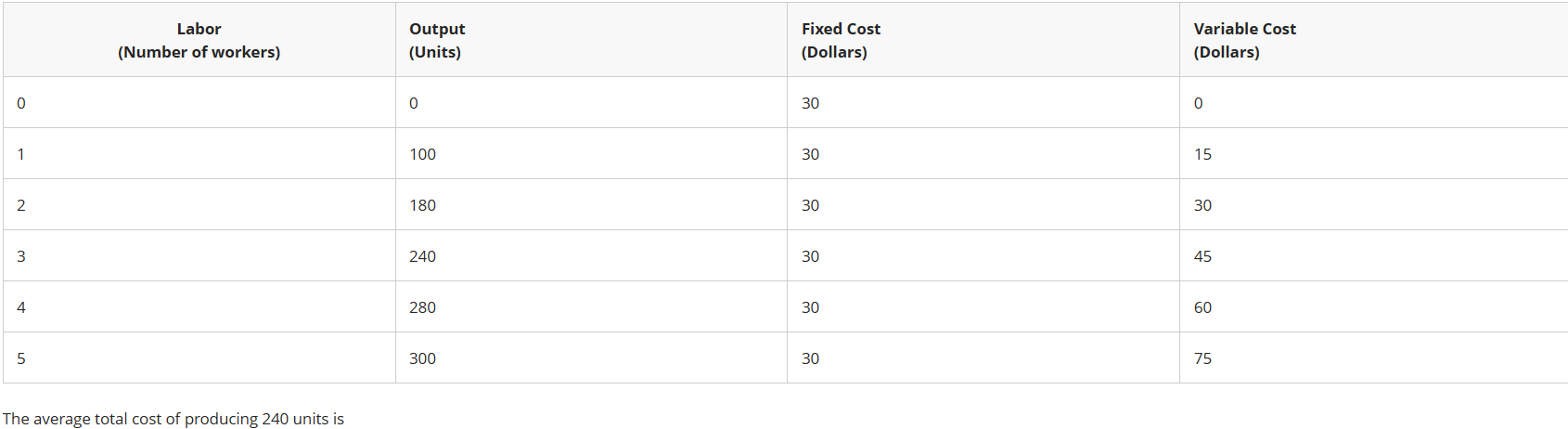
The average total cost of producing 240 units is
$0.32
The average fixed cost curve
always goes down if output decreases
always rises with increased levels of output.
always goes up if output decrease
always decrease with increased levels of output.
always goes up if output decrease
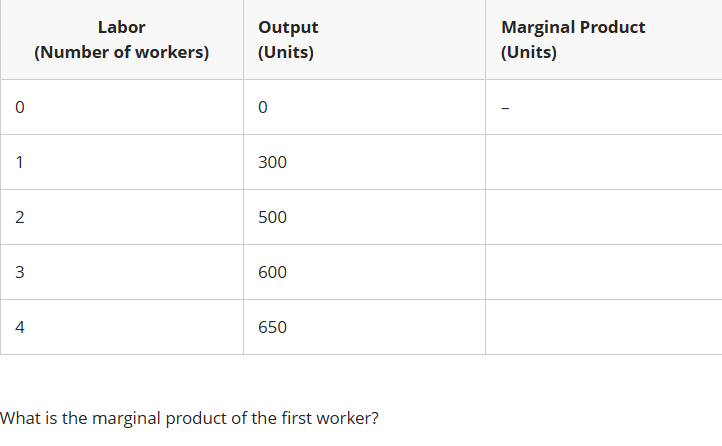
What is the marginal product of the first worker?
300 units
Cindy's Car Wash has average variable costs of $2 and average fixed costs of $3 when it produces 100 units of output (car washes). The firm's total cost is
$500
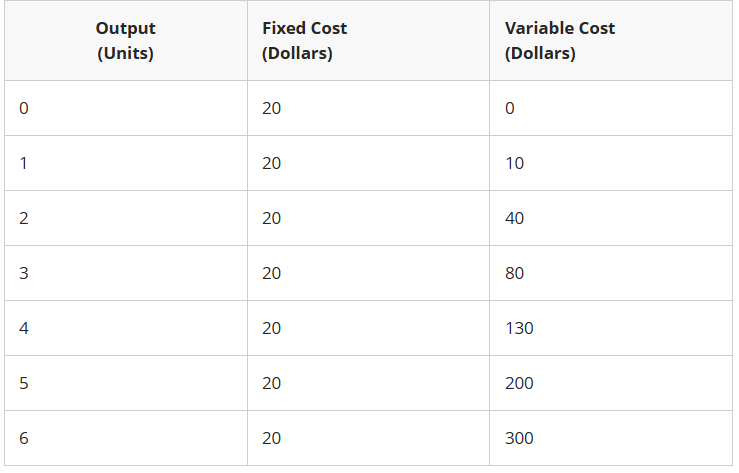
What is the average variable cost of producing 5 units of output
$40
For a large firm that produces and sells cars, which of the following costs would be a variable cost?
The $10 million payment that the firm pays each year for accounting services
The cost of the engines that is used in producing automobiles
The rent that the firm pays for office space in Laredo.
The cost of internet advertising incurred each year.
The cost of the engines that is used in producing automobiles
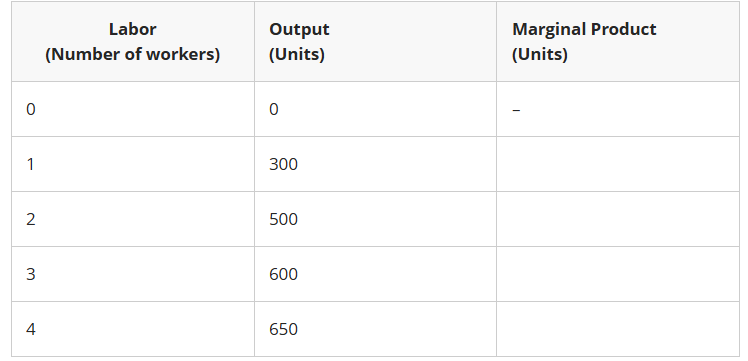
At which number of workers does diminishing marginal product begin?
2
In the short run, a firm that produces and sells house paint can adjust
where to produce along its long-run average-total-cost curve.
the size of its factories.
how many workers to hire.
the location of its factory.
how many workers to hire.
On a 100-acre farm, a farmer is able to produce 3,000 bushels of wheat when he hires 2 workers. He is able to produce 4,400 bushels of wheat when he hires 3 workers. Which of the following possibilities is consistent with the property of diminishing marginal product?
The farmer is able to produce 5,600 bushels of wheat when he hires 4 workers.
The farmer is able to produce 5,800 bushels of wheat when he hires 4 workers.
The farmer is able to produce 6,000 bushels of wheat when he hires 4 workers.
The farmer is able to produce 6,200 bushels of wheat when he hires 4 workers.
The farmer is able to produce 5,600 bushels of wheat when he hires 4 workers.
Kate is a florist. Kate can arrange 20 bouquets per day. She is considering hiring her husband William to work for her. William can arrange 18 bouquets per day. What would be the total daily output of Kate's firm if she hired her husband?
18 bouquets
19 bouquets
20 bouquets
38 bouquets
38 bouquets
Suppose that for a particular firm the only variable input into the production process is labor and that output equals zero when no workers are hired. In addition, suppose that when four units of output are produced, the total cost is $175, and the average variable cost is $33.75. What would the average fixed cost be if ten units were produced?
$4
$10
$40
$135
$4
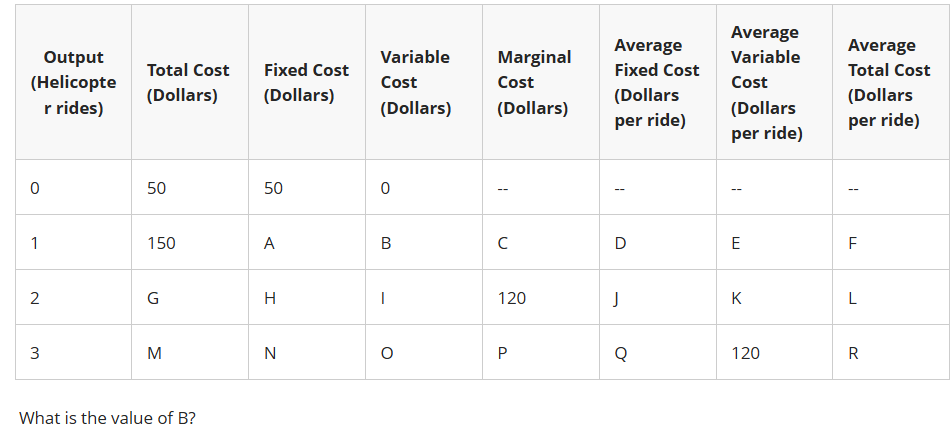
What is the value of B
$25
$50
$100
$200
$100
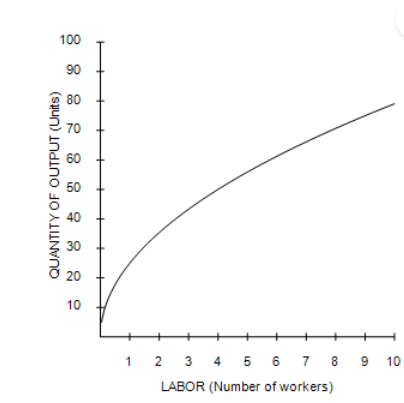
The graph illustrates
total-cost curve.
production function.
production possibilities frontier.
marginal product of labor curve.
production functions
Which of the following expressions is correct?
accounting profit = economic profit + implicit costs
accounting profit = total revenue − implicit costs
economic profit = accounting profit + explicit costs
economic profit = total revenue − implicit costs
accounting profit = economic profit + implicit costs
Profit equals total revenue minus total cost. true or false
true
The average-fixed-cost curve is constant. true or false
false
Variable costs usually change as the firm alters the quantity of output produced.
True
Diminishing marginal productivity implies decreasing total product. true or false
false
If the average-total-cost curve is falling, then the marginal-cost curve must also be falling. true or false
false
The average-total-cost curve reflects the shape of both the average-fixed-cost and average-variable-cost curves. true or false
true
Diminishing marginal product exists when the production function becomes flatter as inputs increase. true or false
true
Anna borrows $5,000 from a bank and withdraws $1,000 from her personal savings to start a coffee shop. The interest rate is 5 percent for both the bank loan and her personal savings. Her opportunity cost of capital is $250. true or false
false
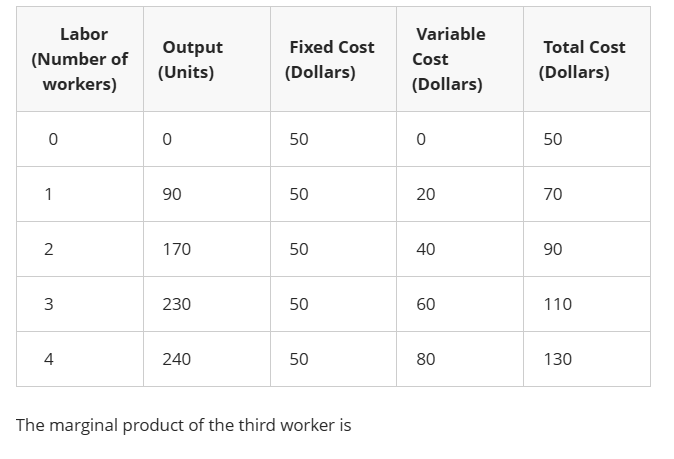
The marginal product of the third worker is
60 units
Carol Anne makes candles. If she charges $20 for each candle, her total revenue will be
$1,000 if she sells 100 candles.
$500 if she sells 25 candles.
$20 regardless of how many candles she sells
$200 if she sells 5 candles
$20 regardless of how many candles she sells
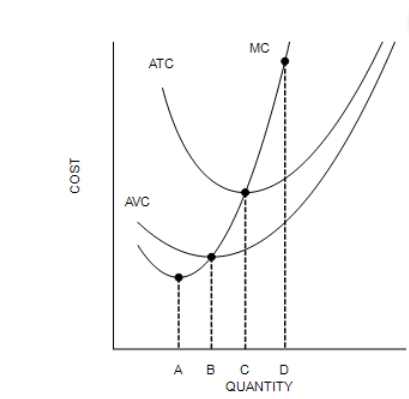
Which of the following statements is correct
Marginal cost is rising for quantities higher than D because marginal cost is higher than average total cost.
Average variable cost is declining for quantities less than B because marginal cost is lower than average variable cost.
Marginal cost is minimized at B because at that quantity, marginal cost equals average variable cost.
Average total cost is declining for quantities less than C because average variable cost is less than average total cost.
Average variable cost is declining for quantities less than B because marginal cost is lower than average variable cost.
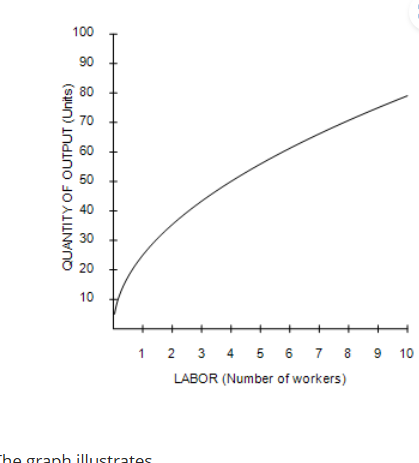
The graph illustrates
total-cost curve.
production function.
production possibilities frontier.
marginal product of labor curve.
production function.
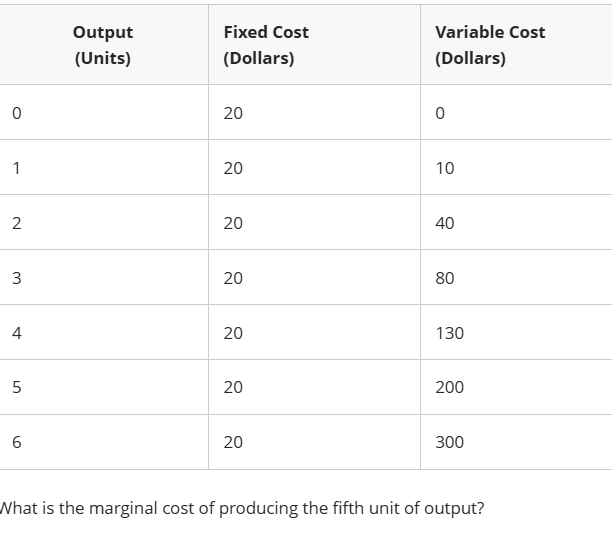
What is the marginal cost of producing the fifth unit of output?
$70
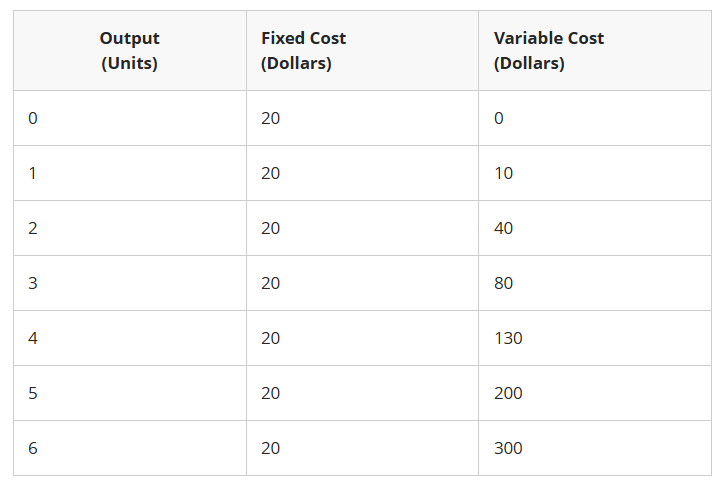
What is the shape of the marginal cost curve for this firm
Constant
upward-sloping
downward-sloping
u-shaped
upward-sloping
For a large firm that produces and sells cars, which of the following costs would be a variable cost?
For a large firm that produces and sells cars, which of the following costs would be a variable cost?
The cost of the engines that is used in producing automobiles
The rent that the firm pays for office space in Laredo.
The cost of internet advertising incurred each year.
The cost of the engines that is used in producing automobiles
Accounting profit is greater than or equal to economic profit. True or false
True
A firm produces 60 units of output with 5 workers, 65 units with 6 workers, and 68 units with 7 workers. The firm's production function exhibits diminishing marginal productivity between 5 and 7 workers. True or false
true
The average-total-cost curve reflects the shape of both the average-fixed-cost and average-variable-cost curves. True or false
True
An example of an explicit cost would be the wages that a business owner pays their employees. True or false
True
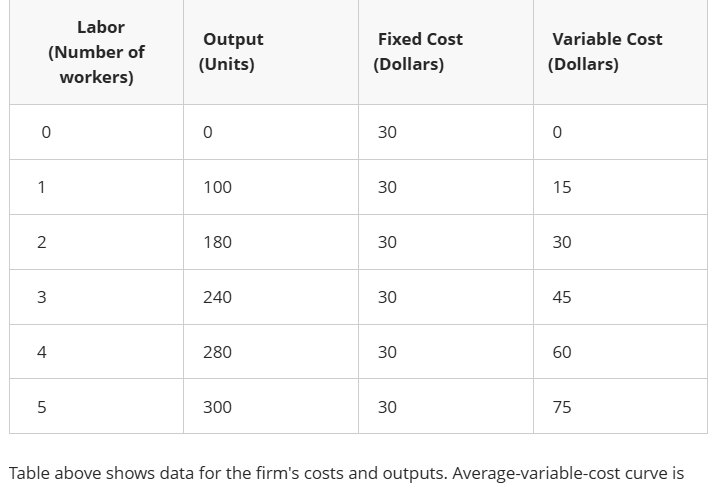
Table above shows data for the firm's costs and outputs. Average-variable-cost curve is
constant.
decreasing
increasing.
U-shaped.
increasing
In the short run, a firm that produces and sells house paint can adjust
where to produce along its long-run average-total-cost curve.
the size of its factories.
how many workers to hire
the location of its factory
how many workers to hire
If the average-total-cost curve is falling, then the marginal-cost curve must also be falling. True or false
False
The average-total-cost curve reflects the shape of both the average-fixed-cost and average-variable-cost curves. True or false
True
Economists include both explicit and implicit costs while accountants include only implicit costs. True or false
False
 Note
Note  Flashcards (66)