BIOB51: Final Review
0.0(0)
 Studied by 1 person
 Call Kai
 Learn
Learn Practice Test
 Spaced Repetition
 Match
Match Flashcards
 Knowt Play
Card Sorting
1/260

Last updated 3:43 AM on 4/20/23
Name | Mastery | Learn | Test | Matching | Spaced | Call with Kai |
|---|
No analytics yet
Send a link to your students to track their progress
261 Terms
1
New cards
What are the similarities and differences between qualitative and quantitative traits?
Qualitative traits are traits that can be observed and categorized into discrete groups, while quantitative traits are traits that can be measured and expressed numerically. Both types of traits are inherited from parents and can be influenced by environmental factors. However, quantitative traits are typically controlled by multiple genes and are subject to continuous variation, while qualitative traits are often controlled by a single gene or a small number of genes and exhibit distinct phenotypic categories.
2
New cards
What is quantitative genetics?
Quantitative genetics is a branch of genetics that deals with the inheritance of continuous traits, such as height or weight, that are influenced by multiple genes and environmental factors. It involves the use of statistical methods to study the genetic basis of these traits and to predict their inheritance patterns in future generations.
3
New cards
How does Hardy-Weinberg extend to quantitative traits
The Hardy-Weinberg theorem can be extended to situations where traits are influenced by multiple genetic loci. As loci are added, the number of possible genotypes increases, and the number of phenotypes increases as well.
4
New cards
What is variance?
a statistical measure of the dispersion of trait values about their mean
5
New cards
What does *V*P = *V*G + *V*E represent?
The total variance in a phenotypic trait in a population (known as VP) is actually the sum of several different kinds of variances*.* One important source of this variance is the genetic difference among individuals, VG. Another is the difference arising from the environmental conditions in which the individuals developed, VE.
6
New cards
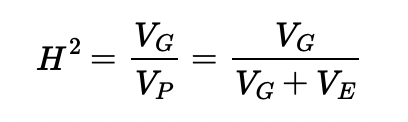
What is broad sense heritability (*H*2)? How is it measured? What are its shortcomings?
The proportion of the total phenotypic variance of a trait is attributable to genetic variance, where genetic variance is represented as a single value (that is, genetic variance is not broken down into different components).
The problem with broad sense heritability is that it represents all genetic variance as a single value. Real genetic variance is far more complicated. In sexually reproducing organisms, for example, not all of an individual’s genotype is transmitted to offspring. Some genetic effects are lost. Combinations of alleles change during meiosis when each pair of chromosomes separates and the associations between alleles break down. As a result, only some genetic variation contributes to the phenotypic resemblance between offspring and their parents. Only this portion of the variance enables a population to evolve in response to selection.
The problem with broad sense heritability is that it represents all genetic variance as a single value. Real genetic variance is far more complicated. In sexually reproducing organisms, for example, not all of an individual’s genotype is transmitted to offspring. Some genetic effects are lost. Combinations of alleles change during meiosis when each pair of chromosomes separates and the associations between alleles break down. As a result, only some genetic variation contributes to the phenotypic resemblance between offspring and their parents. Only this portion of the variance enables a population to evolve in response to selection.
7
New cards
What is narrow sense heritability (*h*2)? How is it measured? What are it’s shortcomings?
is the proportion of the total phenotypic variance of a trait attributable to the *additive effects of alleles* (the additive genetic variance). This component of variance causes offspring to resemble their parents, and it causes populations to evolve predictably in response to selection.
\
\

8
New cards
What is additive genetic variance? Why is it important to studies of quantitative genetics?
\
VA, Additive genetic variance refers to the portion of the total genetic variance in a population that is due to the additive effects of individual genes. These effects are independent of each other and add up to determine the overall phenotype. Additive genetic variance is important in studies of quantitative genetics because it contributes to the heritability of a trait, which is the proportion of the total phenotypic variance that is due to genetic factors. Understanding the additive genetic variance of a trait can help researchers predict how it will be inherited and how it will respond to selection.
VA, Additive genetic variance refers to the portion of the total genetic variance in a population that is due to the additive effects of individual genes. These effects are independent of each other and add up to determine the overall phenotype. Additive genetic variance is important in studies of quantitative genetics because it contributes to the heritability of a trait, which is the proportion of the total phenotypic variance that is due to genetic factors. Understanding the additive genetic variance of a trait can help researchers predict how it will be inherited and how it will respond to selection.
9
New cards
How can we estimate heritability from a parent-offspring regression?
Heritability can be estimated from a parent-offspring regression by calculating the slope of the regression line, which represents the degree of resemblance between parents and offspring. The slope is then multiplied by 2 to obtain the heritability estimate, as heritability is defined as the proportion of phenotypic variation that is due to genetic variation.
If there is a significant positive relationship (that is, the slope is greater than zero), then parents with unusually large trait values tend to produce offspring who also have unusually large trait values (and vice versa for parents with smaller trait values)
If there is a significant positive relationship (that is, the slope is greater than zero), then parents with unusually large trait values tend to produce offspring who also have unusually large trait values (and vice versa for parents with smaller trait values)
10
New cards
What is directional selection? Stabilizing selection? Disruptive selection? Know how to
describe and discern between them
describe and discern between them
**Directional selection** is a type of natural selection where one extreme phenotype is favored over the other, leading to a shift in the population's genetic makeup. **Stabilizing selection** is a type of natural selection where the intermediate phenotype is favored over the extremes, leading to a reduction in genetic variation. **Disruptive selection** is a type of natural selection where both extreme phenotypes are favored over the intermediate, leading to an increase in genetic variation. These three types of selection can be discerned by observing changes in the frequency of different phenotypes in a population over time.
11
New cards
What is the selection differential (*S*)? How is it measured?
A measure of the strength of phenotypic selection. The selection differential describes the difference between the mean of the reproducing members of the population that contribute offspring to the next generation and the mean of all members of a population. Directional selection occurs whenever the mean phenotype of breeding individuals
Directional selection occurs whenever the mean phenotype of breeding individuals (X¯B) differs from the mean phenotype of all the individuals in the parents’ generation (X¯P). If the difference is large, the selection is strong.
\
Directional selection occurs whenever the mean phenotype of breeding individuals (X¯B) differs from the mean phenotype of all the individuals in the parents’ generation (X¯P). If the difference is large, the selection is strong.
\
12
New cards
What is the response to selection (*R*)?
The response to selection (R) is the amount of change in a trait that is expected to occur in a population due to natural or artificial selection. It is calculated as the difference between the mean of the trait in the selected individuals and the mean of the trait in the entire population.
\
\
13
New cards
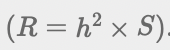
What is meant by the equation *R* = *h*2*S*? Be able to describe, calculate, and identify how
all these three terms are interrelated
all these three terms are interrelated
* breeder’s equation
The phenotypic variation that influences fitness (S) and the ability to transmit those phenotypic characteristics to offspring (h^2)
If selection is strong, a population can respond even if a trait is only weakly heritable. And even weak selection can lead to significant evolutionary change if a trait’s heritability is high. But the most rapid evolutionary responses occur when both selection and heritability are large
The phenotypic variation that influences fitness (S) and the ability to transmit those phenotypic characteristics to offspring (h^2)
If selection is strong, a population can respond even if a trait is only weakly heritable. And even weak selection can lead to significant evolutionary change if a trait’s heritability is high. But the most rapid evolutionary responses occur when both selection and heritability are large
14
New cards
What is linkage? What factors influence the degree of linkage between alleles at multiple
loci?
loci?
Linkage refers to the tendency of alleles at different loci to be inherited together due to their physical proximity on the same chromosome. The degree of linkage between alleles at multiple loci is influenced by the distance between the loci on the chromosome, with closer loci exhibiting stronger linkage. Recombination events during meiosis can also break up linkage between alleles. Additionally, the frequency of recombination events can be influenced by factors such as genetic variation, environmental factors, and the presence of other genes or regulatory elements.
15
New cards
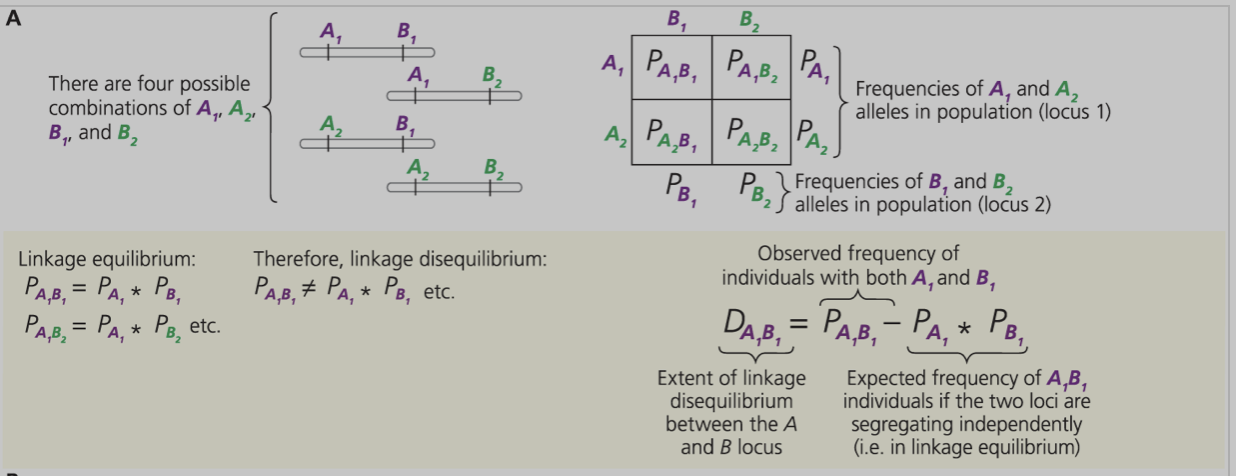
What is the difference between linkage equilibrium (LE) and linkage disequilibrium (LD)?
Linkage equilibrium (LE) refers to the random association of alleles at different loci in a population, where the frequency of each allele is independent of the other. In contrast, linkage disequilibrium (LD) refers to the non-random association of alleles at different loci, where the frequency of each allele is dependent on the other. LD can arise due to genetic drift, selection, mutation, migration, or recombination.
16
New cards
How do we detect LD? What is meant by 𝑫𝑨𝟏𝑩𝟏 = 𝑷𝑨𝟏𝑩𝟏 − 𝑷𝑨𝟏 ∗ 𝑷𝑩𝟏 ?
LD stands for Linkage Disequilibrium, which is the non-random association of alleles at two or more loci. LD can be detected by measuring the degree of association between alleles at different loci.
𝑫𝑨𝟏𝑩𝟏 = 𝑷𝑨𝟏𝑩𝟏 − 𝑷𝑨𝟏 ∗ 𝑷𝑩𝟏 is the formula for calculating the difference between the observed frequency of a particular haplotype (allele combination) and the expected frequency of that haplotype if the alleles were randomly associated. This is used to measure the degree of LD between two loci.
𝑫𝑨𝟏𝑩𝟏 = 𝑷𝑨𝟏𝑩𝟏 − 𝑷𝑨𝟏 ∗ 𝑷𝑩𝟏 is the formula for calculating the difference between the observed frequency of a particular haplotype (allele combination) and the expected frequency of that haplotype if the alleles were randomly associated. This is used to measure the degree of LD between two loci.
17
New cards
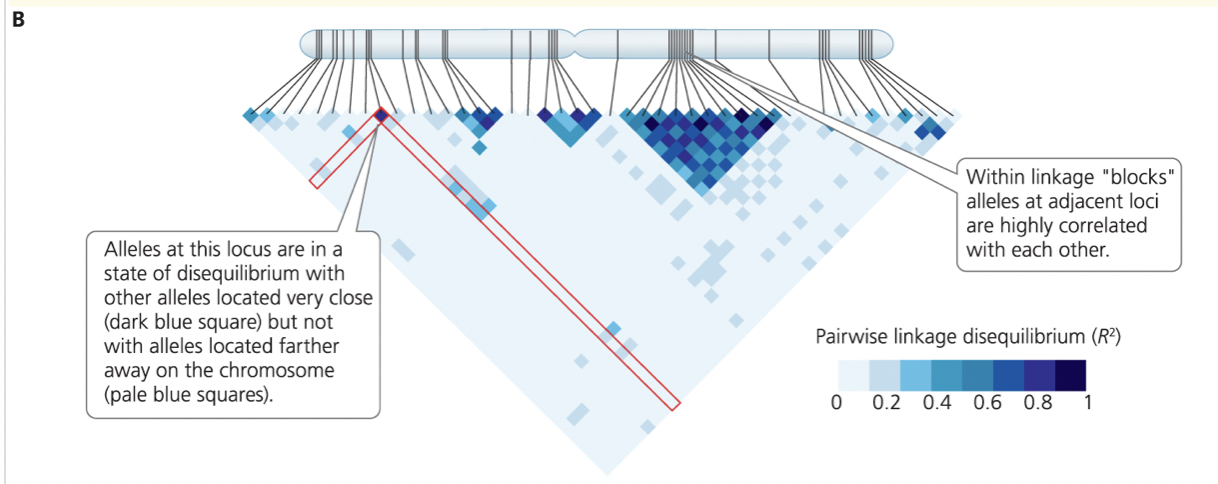
Know how to read and interpret an LD map
18
New cards
What is a supergene?
A **supergene** is a group of functionally related genes located close enough together that they segregate as a single unit.
19
New cards
What is the purpose of selected lines? Why might a researcher conduct a selection
experiment?
experiment?
The purpose of selected lines is to create populations with specific traits of interest. Researchers conduct selection experiments to study the genetic basis of traits, to improve the performance of organisms in agriculture or industry, or to understand the process of evolution. The response to selection (R) is a measure of how much a trait changes in response to selection.
20
New cards
What are recombinant inbred lines (RIL)? What are they used for?
Recombinant inbred lines (RIL) are a set of genetically identical plants that are created by self-fertilizing hybrid plants for several generations. They are used to study the inheritance of traits and to create stable genetic lines for plant breeding. RILs are also useful for mapping genes and identifying quantitative trait loci (QTLs) associated with complex traits.
21
New cards
What is a quantitative trait locus (QTL)? What is QTL mapping? Be familiar with the
general process and the interpretation of the results.
general process and the interpretation of the results.
**Quantitative trait locus (QTL)** is a stretch of DNA that is correlated with variation in a phenotypic trait. These regions contain genes, or are linked to genes, that contribute to population differences in a phenotype.
Markers that have a statistically significant association with the expression of a phenotypic trait are called quantitative trait loci (QTLs).
QTL mapping studies require a tremendous amount of work. Scientists first raise hundreds of F2 offspring and measure their phenotypes. Then they carry out large-scale comparisons of huge numbers of genetic markers to find significant associations. But such effort has been amply rewarded: QTL mapping has helped scientists to uncover regions of the genome responsible for the evolution of complex phenotypes
Markers that have a statistically significant association with the expression of a phenotypic trait are called quantitative trait loci (QTLs).
QTL mapping studies require a tremendous amount of work. Scientists first raise hundreds of F2 offspring and measure their phenotypes. Then they carry out large-scale comparisons of huge numbers of genetic markers to find significant associations. But such effort has been amply rewarded: QTL mapping has helped scientists to uncover regions of the genome responsible for the evolution of complex phenotypes
22
New cards
How was QTL analysis used to understand the evolution of coat colour in mice? What are
the relative roles of *Agouti* and *Mc1r?*
the relative roles of *Agouti* and *Mc1r?*
Hoekstra and her colleagues found that each of the QTL regions contained a known coat-colour gene. Together, the allelic variation in these two genes—called *Agouti* and *Mc1r (*for melanocortin-1 receptor) *—* could explain most of the variation in coat colour in the F2 mice
They found that *Agouti* and *Mc1r* produce proteins that are critical elements of the pathway for synthesizing the dark pigment, melanin, in growing hair. The lighter coat colour of Gulf Coast beach mice resulted from a mutation that changes a single amino acid in the *Mc1r*protein. The mutation decreases the activity of the receptor (**Figure 7.18**). A second mutation increases the expression of a gene, known as *Agouti*, that interferes with the expression of *Mc1r.* Combined, these two genetic changes reduce levels of melanin synthesis and result in lighter-coloured mice.
These researchers found that *Agouti* and *Mc1r* do not act additively to produce pale colour. Instead, the *Agouti* allele found in beach mice interacts epistatically with the other gene: it must be present for the *Mc1r*allele to have a measurable effect on pigmentation.
They found that *Agouti* and *Mc1r* produce proteins that are critical elements of the pathway for synthesizing the dark pigment, melanin, in growing hair. The lighter coat colour of Gulf Coast beach mice resulted from a mutation that changes a single amino acid in the *Mc1r*protein. The mutation decreases the activity of the receptor (**Figure 7.18**). A second mutation increases the expression of a gene, known as *Agouti*, that interferes with the expression of *Mc1r.* Combined, these two genetic changes reduce levels of melanin synthesis and result in lighter-coloured mice.
These researchers found that *Agouti* and *Mc1r* do not act additively to produce pale colour. Instead, the *Agouti* allele found in beach mice interacts epistatically with the other gene: it must be present for the *Mc1r*allele to have a measurable effect on pigmentation.
23
New cards
What is genome-wide association studies (GWAS)? How are they similar and how are
they different from QTL analysis? What are the pros and cons of each approach?
they different from QTL analysis? What are the pros and cons of each approach?
**Genome-wide association studies (GWAS)** are a type of study that looks for genetic variations across the entire genome that are associated with a particular trait or disease. GWAS and QTL analysis are similar in that they both aim to identify genetic variants associated with a trait. However, QTL analysis typically focuses on a specific region of the genome, while GWAS scans the entire genome. The pros of GWAS include its ability to identify genetic variants associated with a trait across the entire genome, while the cons include the potential for false positives and the need for large sample sizes. The pros of QTL analysis include its ability to identify genetic variants associated with a trait in a specific region of the genome, while the cons include its limited scope and potential for missing important genetic variants outside of the targeted region.
24
New cards
What is phenotypic plasticity? What are the differences and similarities between
phenotypic plasticity and polyphenism?
phenotypic plasticity and polyphenism?
Phenotypic plasticity refers to the ability of an organism to change its phenotype in response to environmental cues. Polyphenism is a type of phenotypic plasticity where discrete, alternative phenotypes are produced in response to different environmental conditions. The main difference between the two is that phenotypic plasticity can result in a continuous range of phenotypes, while polyphenism produces distinct, discrete phenotypes. However, both involve changes in phenotype in response to environmental cues.
25
New cards
What is a reaction norm? What is meant by the term GxE? How is GxE measured?
**Reaction norm** refers to the pattern of phenotypic expression of a single genotype across a range of environments. In a sense, reaction norms depict how development maps the genotype into the phenotype as a function of the environment.
GxE refers to the interaction between genotype and environment in determining phenotype. GxE can be measured by analyzing the variation in the phenotypic expression of different genotypes across different environments.
GxE refers to the interaction between genotype and environment in determining phenotype. GxE can be measured by analyzing the variation in the phenotypic expression of different genotypes across different environments.
26
New cards
What is meant by *V*P = *V*G + *V*E + *V*GxE?
VP = VG + VE + VGxE is the formula for the analysis of variance (ANOVA) which is used to determine the total variation in a set of data. VP represents the total variation, VG represents the variation between groups, VE represents the variation within groups, and VGxE represents the interaction between groups and within groups.
27
New cards
How can phylogenies be studied at the level of the gene, and alleles within genes?
Phylogenies can be studied at the level of the gene by comparing the DNA sequences of homologous genes from different species. Alleles within genes can also be compared to construct phylogenies by analyzing the frequency and distribution of different alleles in different populations or species.
28
New cards
What is coalescence?
To coalesce means to grow together, to join, or to fuse. When two copies of a gene are descended from a common ancestor which gave rise to them in some past generation, looking back we say that they coalesce in that generation.
29
New cards
What does the coalescent time vary for different genes?
The coalescent time can vary for different genes due to factors such as mutation rate, population size, and selection pressure.
\
\
30
New cards
Why don’t gene trees always match species trees?
Because each gene copy has a single ancestral copy, barring recombination, all gene trees would be identical. Recombination, however, breaks up the genomic history into a series of partially independent stories, that is into gene trees along the genomes of species.
31
New cards
What is incomplete lineage sorting?
**Incomplete lineage sorting** occurs when a genetic polymorphism persists through several speciation events. When fixation of alternative alleles eventually occurs in the descendent species, the pattern of retention of alleles may yield a gene tree that differs from the true phylogeny of the species.
32
New cards
What is maximum parsimony?
**Maximum parsimony** is a statistical method for reconstructing phylogenies that identifies the tree topology that minimizes the total amount of change, or the number of steps, required to fit the data to the tree.
33
New cards
What are distances matrices? How is a distance matrix approach like neighbour-joining used to construct a phylogeny?
A **distance-matrix method** is a procedure for constructing phylogenetic trees by clustering taxa based on the proximity (or distance) between their DNA or protein sequences. These methods place closely related sequences under the same internal branch, and they estimate branch lengths from the observed distances between sequences.
**neighbor joining** is a distance-matrix method in which scientists pair together the two least-distant species by joining their branches at a node. They then join this node to the next-closest sequence, and so on. By joining neighboring species in round after round of this procedure, scientists can find the tree with the smallest possible distances—and the shortest possible branch lengths—between species
**neighbor joining** is a distance-matrix method in which scientists pair together the two least-distant species by joining their branches at a node. They then join this node to the next-closest sequence, and so on. By joining neighboring species in round after round of this procedure, scientists can find the tree with the smallest possible distances—and the shortest possible branch lengths—between species
34
New cards
Why do researchers often employ multiple methods to construct phylogenies?
Researchers often employ multiple methods to construct phylogenies because different methods can produce different results due to variations in assumptions and limitations. By using multiple methods, researchers can compare and contrast the results to identify areas of agreement and disagreement, which can help to increase the accuracy and reliability of the phylogenetic tree. Additionally, using multiple methods can help to account for uncertainties and biases that may be present in any single method.
35
New cards
What is the Out of Africa model for the origin of humans? What is the evidence that
supports this notion?
supports this notion?
The Out of Africa model suggests that modern humans originated in Africa and then migrated to other parts of the world. The evidence supporting this includes genetic studies showing greater genetic diversity in African populations, as well as the discovery of the oldest known human fossils in Africa. Additionally, archaeological evidence shows that early human tools and artifacts are found exclusively in Africa until around 60,000 years ago, when they begin to appear in other parts of the world.
36
New cards
What is the difference between a synonymous and a nonsynonymous mutation?
A synonymous mutation is a change in DNA sequence that does not result in a change in the amino acid sequence of the protein. A nonsynonymous mutation, on the other hand, is a change in DNA sequence that results in a change in the amino acid sequence of the protein.
37
New cards
What is the neutral theory of molecular evolution?
The neutral theory of molecular evolution proposes that most genetic variation within populations is due to random genetic drift of neutral mutations that do not affect the fitness of an organism, rather than natural selection. This theory suggests that the rate of molecular evolution is determined primarily by the rate of mutation and genetic drift, rather than by natural selection.
38
New cards
What is the molecular clock?
A **molecular clock** is a method used to determine time based on base pair substitutions. Molecular clocks use the rates of molecular change to deduce the divergence time between lineages in a phylogeny, for example. They work best when they can be “calibrated” with other markers of time, such as fossils with known ages and placements.
39
New cards
What is the relationship between the rates of evolution for nonsynonymous sites, synonymous sites, introns, and pseudogenes?
The rates of evolution for nonsynonymous sites are generally higher than those for synonymous sites, as nonsynonymous mutations are more likely to affect protein function. Introns and pseudogenes generally evolve at slower rates than coding regions, as they are under less selective pressure. However, the specific rates of evolution can vary depending on the organism and the specific genes being studied.
40
New cards
What is a pseudogene?
A pseudogene is a non-functional or inactive gene that has lost its ability to produce a functional protein due to mutations or other factors. It is considered an evolutionary relic of a functional gene that has accumulated mutations over time.
41
New cards
What is a selective sweep?
**Selective sweep** describes the situation in which strong selection can “sweep” a favorable allele to fixation within a population so fast that there is little opportunity for recombination. In the absence of recombination, alleles in large stretches of DNA flanking the favorable allele will also reach high frequency.
42
New cards
What is genetic hitchhiking?
**Genetic hitchhiking** occurs when an allele increases in frequency because it is physically linked to a positively selected allele at a nearby locus.
43
New cards
What is positive selection?
Positive selection is a process in which advantageous genetic variations increase in frequency in a population due to natural selection. This occurs when individuals with these variations have a higher chance of survival and reproduction, passing on their advantageous traits to their offspring.
44
New cards
What is introgression? How can we use *F*ST to identify introgression?
Introgression is the movement of genes from one species or population into another through hybridization and backcrossing. FST is a measure of genetic differentiation between populations. By comparing FST values between putative donor and recipient populations, we can identify regions of the genome that have experienced introgression. Elevated FST values in these regions suggest that they have been under selection and may contain introgressed genes.
45
New cards
What is meant by dN/dS? How is it used to detect selection on DNA sequences?
dN/dS is the ratio of the number of non-synonymous substitutions per non-synonymous site (dN) to the number of synonymous substitutions per synonymous site (dS) in a DNA sequence. It is used to detect selection on DNA sequences by comparing the rates of non-synonymous and synonymous substitutions. If dN/dS is greater than 1, it suggests positive selection, meaning that non-synonymous mutations are being favored. If dN/dS is less than 1, it suggests negative selection, meaning that synonymous mutations are being favored. If dN/dS is equal to 1, it suggests neutral evolution, meaning that both types of mutations are equally likely to occur.
46
New cards
How does neutral drift, positive selection, and purifying selection look within DNA
sequences and genealogies?
sequences and genealogies?
Neutral drift, positive selection, and purifying selection can be observed in DNA sequences and genealogies through changes in allele frequencies over time. Neutral drift results in random fluctuations in allele frequencies, while positive selection leads to an increase in the frequency of advantageous alleles. Purifying selection, on the other hand, removes deleterious alleles from the population. Genealogies can also reveal the relationships between different alleles and their origins, providing insight into the evolutionary history of a population.
47
New cards
What is a gene regulatory network?
A gene regulatory network is a collection of genes and their regulatory interactions that control the level of gene expression in a cell or organism. It describes the complex web of interactions between transcription factors, signaling molecules, and other regulatory proteins that work together to control gene expression.
48
New cards
What is a gene control region? repressor? transcription factor? complex adaptation?
**Gene control region** refers to an upstream section of DNA that includes the promoter region as well as other regulatory sequences that influence the transcription of DNA
A **repressor** is a protein that binds to a sequence of DNA or RNA and inhibits the expression of one or more genes.
A **transcription factor** is a protein that regulates the expression of a gene by binding to a specific DNA sequence in association with the gene sequence. A single transcription factor can regulate many genes if they share the same regulatory sequence.
A **complex adaptation** is a suite of coexpressed traits that together experience selection for a common function. Phenotypes are considered complex when they are influenced by many environmental and genetic factors and when multiple components must be expressed together for the trait to function.
A **repressor** is a protein that binds to a sequence of DNA or RNA and inhibits the expression of one or more genes.
A **transcription factor** is a protein that regulates the expression of a gene by binding to a specific DNA sequence in association with the gene sequence. A single transcription factor can regulate many genes if they share the same regulatory sequence.
A **complex adaptation** is a suite of coexpressed traits that together experience selection for a common function. Phenotypes are considered complex when they are influenced by many environmental and genetic factors and when multiple components must be expressed together for the trait to function.
49
New cards
What is the hierarchical gene regulatory network that controls the development of animal
embryos? What happens when genes at the top of the hierarchy are disrupted?
embryos? What happens when genes at the top of the hierarchy are disrupted?
The hierarchical gene regulatory network that controls the development of animal embryos is a complex system of gene interactions that determine cell fate and differentiation. Genes at the top of the hierarchy, known as master regulators, control the expression of downstream genes and ultimately determine the developmental fate of the embryo. When these master regulator genes are disrupted, it can lead to significant developmental defects or even embryonic lethality.
50
New cards
How can gene duplication facilitate the evolution of novel function?
Gene duplication can facilitate the evolution of novel function by providing a copy of the original gene that can undergo mutations without affecting the function of the original gene. These mutations can lead to the development of new functions or alterations in the original function, which can be beneficial for the organism's survival and reproduction. Additionally, the duplicated gene can also undergo subfunctionalization or neofunctionalization, where it acquires a new function or divides the original function with the original gene, respectively.
51
New cards
What is a paralog?
A **paralog** is a homologous gene that arises by gene duplication. Paralogs together form a gene family.
52
New cards
What is gene recruitment?
**Gene recruitment** refers to the co-option of a particular gene or network for a totally different function as a result of a mutation. The reorganization of a preexisting regulatory network can be a major evolutionary event.
53
New cards
What is a pleiotropic gene?
A pleiotropic gene is a gene that can affect multiple traits or characteristics of an organism.
54
New cards
How did one of Lenski’s LTEE lines evolve the ability to metabolize citrate during aerobic
conditions?
conditions?
One of Lenski's LTEE lines evolved the ability to metabolize citrate during aerobic conditions through a rare mutation that occurred in the citrate transporter gene, allowing it to transport citrate into the cell. This mutation provided a new energy source for the bacteria, leading to the evolution of citrate metabolism.
55
New cards
How did snake venoms evolve? Understand how this story involved numerous instances
of co-option and gene duplication.
of co-option and gene duplication.
Snake venoms evolved through a process of co-option and gene duplication. This involved the recruitment of genes from various body tissues, such as digestive enzymes and blood-clotting factors, and their subsequent modification to produce venom. Gene duplication events also played a role in the evolution of venom, allowing for the creation of new toxin variants. Overall, the evolution of snake venoms is a complex process that involves multiple genetic mechanisms.
56
New cards
What are the Hox genes? Why is it considered a “genetic toolkit”?
The Hox genes are a group of genes that play a crucial role in the development of the body plan in animals. They are considered a "genetic toolkit" because they provide the instructions for the formation of body segments and the differentiation of body parts. These genes are highly conserved across different animal species and are responsible for the diversity of body plans observed in the animal kingdom.
57
New cards
What is dorso-ventral patterning? How is it similar and different when comparing
protostomes and deuterstomes?
protostomes and deuterstomes?
Dorso-ventral patterning is the process by which the dorsal and ventral sides of an organism are differentiated during embryonic development. In both protostomes and deuterostomes, this process involves the formation of a dorsal ectodermal ridge and a ventral mesodermal ridge. However, the orientation of the process is different between the two groups. In protostomes, the mouth develops from the blastopore, which forms on the ventral side, while in deuterostomes, the anus develops from the blastopore, which forms on the dorsal side.
58
New cards
What is the relationship between *Dll* and *FGFs* in the evolution of appendages?
In the evolution of appendages, Dll (Distal-less) and FGFs (Fibroblast Growth Factors) have a complementary relationship. Dll is responsible for the development of the distal part of the appendage, while FGFs are responsible for the growth and patterning of the proximal part. Together, they play a crucial role in the formation and diversification of appendages in various organisms.
59
New cards
How has the regulation of *Hoxd13* expression influenced the transition between find
development and limb development?
development and limb development?
The regulation of Hoxd13 expression has been shown to play a crucial role in the transition between fin development and limb development. Studies have demonstrated that changes in the regulation of Hoxd13 expression can lead to alterations in limb morphology, suggesting that this gene plays a key role in the evolution of limbs. Additionally, the expression of Hoxd13 is regulated by a number of other genes and signaling pathways, which further highlights its importance in the development of limbs.
60
New cards
What is the relationship between opsins and the evolution of vision?
Opsins are proteins found in photoreceptor cells that are responsible for detecting light and initiating the process of vision. The evolution of different types of opsins has played a crucial role in the development of vision in various organisms. For example, the evolution of multiple types of opsins allowed for the development of color vision in primates. Additionally, the evolution of opsins in different parts of the eye has allowed for the detection of different types of light, such as UV light in birds and insects.
61
New cards
What is the role of crystallins in vision?
Lenses are made of remarkable molecules called crystallins, which are among the most specialized proteins in the body. Different clades of animals produce different types of crystallins (vertebrate eyes, for example, produce one form known as *α*-crystallins). But all types of crystallins have many things in common. They are transparent, to begin with. As light passes through crystallins, the proteins alter the path of incoming light, making it possible to focus an image on the retina. All crystallins are incredibly rugged. They are among the most stable proteins in the body and keep their structure for decades. (Cataracts are caused by crystallins clumping late in life.)
62
New cards
What is anatagonistic pleiotropy?
**Antagonistic pleiotropy** is the condition that occurs when a mutation with beneficial effects for one trait also causes detrimental effects on other traits.
63
New cards
Why might the necks of giraffe’s represent antagonistic pleiotropy?
Almost all mammals have only seven cervical vertebrae in their neck. This rule applies even to species with long necks, such as giraffes. This pattern may be the result of evolutionary constraint. Mutations that would lead to more or fewer cervical vertebrae may have deleterious effects as well.
64
New cards
How does the recurrent vagus nerve/laryngeal nerve in giraffe’s represent a relic of
evolutionary history?
evolutionary history?
The recurrent laryngeal nerve in giraffes represents a relic of evolutionary history because it takes a longer route than necessary, looping down from the brain, around the aorta, and back up to the larynx. This is because in the ancestors of giraffes, the distance between the brain and the larynx was shorter, and as the giraffe's neck elongated over time, the nerve was stretched along with it. This is an example of a vestigial structure, which is a structure that has lost its original function over the course of evolution.
65
New cards
How can convergent evolution help us to interpret and understand of the evolution of the
genetic and development of similar adaptations?
genetic and development of similar adaptations?
Convergent evolution can help us understand the evolution of genetic and developmental similarities between different species that have evolved similar adaptations independently. By studying the similarities and differences in the genetic and developmental mechanisms that underlie these adaptations, we can gain insights into the evolutionary processes that have led to their emergence.
66
New cards
What is artificial selection? What are some examples of artificial selection? How did
artificial selection influence Darwin’s deduction of the process of natural selection?
artificial selection influence Darwin’s deduction of the process of natural selection?
Artificial selection is the process of intentionally breeding plants or animals for specific traits. Examples include breeding dogs for certain physical characteristics or crops for higher yields. Darwin observed that artificial selection could produce significant changes in a short amount of time, leading him to deduce that natural selection could also produce significant changes over long periods of time. This helped him develop his theory of evolution through natural selection.
67
New cards
What was so special about the Galápagos Islands? How did (and do) the studies of
organisms and their diversity on the islands inform us about natural selection and
adaptation?
organisms and their diversity on the islands inform us about natural selection and
adaptation?
The Galápagos Islands are special because they are home to a diverse array of unique species that are not found anywhere else in the world. The studies of organisms on the islands, particularly by Charles Darwin, informed us about natural selection and adaptation through observations of how different species adapted to their specific environments. For example, Darwin observed that finches on different islands had different beak shapes depending on the type of food available, which led to his theory of natural selection.
68
New cards
Who are Peter and Rosemary Grant? What is the significance of 40+ years of studying
Darwin’s finches on Daphne Major?
Darwin’s finches on Daphne Major?
Peter and Rosemary Grant are evolutionary biologists who have been studying Darwin's finches on the Galapagos island of Daphne Major for over 40 years. Their research has provided valuable insights into the process of natural selection and how it can lead to the formation of new species. By observing changes in the beak size and shape of finches in response to environmental pressures such as drought and food availability, the Grants have been able to document the evolution of these birds in real time. Their work has also demonstrated the important role that hybridization and gene flow can play in the evolution of populations. Overall, the Grants' long-term study of Darwin's finches has greatly contributed to our understanding of evolutionary processes and the mechanisms that drive them.
69
New cards
What is the significance of the relationship between *Geospiza fortis* and *Geospiza*
*magnirostris*?
*magnirostris*?
Geospiza fortis and Geospiza magnirostris are two species of finches that were studied by Charles Darwin during his visit to the Galapagos Islands. The significance of their relationship lies in the observation that they have different beak sizes and shapes, which allows them to exploit different food sources on the islands. This observation helped Darwin develop his theory of natural selection, which states that organisms with advantageous traits are more likely to survive and reproduce. The finches' relationship thus provided evidence for the role of natural selection in driving evolution.
70
New cards
What happened in 1977 on Daphne Major? How did it affect *G. fortis*?
In 1977, a severe drought occurred on Daphne Major, causing a sharp reduction in the number of small and medium-sized seeds available for consumption by finches. This led to a strong selective pressure for larger beak size in G. fortis, as individuals with larger beaks were better able to crack the remaining large and hard seeds. As a result, the average beak size of the population increased significantly over the course of the drought.
71
New cards
What is *Tribulus* (caltrop)? What was its role in the finch story?
Tribulus (caltrop) is a plant that produces spiky fruits and is known for its medicinal properties. In the finch story, researchers found that the size of the beaks of finches on the Galapagos Islands was influenced by the availability of seeds from the Tribulus plant. When there were more seeds available, the beaks of the finches tended to be larger, and when there were fewer seeds available, the beaks tended to be smaller. This demonstrated the process of natural selection in action.
72
New cards
What is the significance of coat colour and fitness in oldfield mice?
Hopi Hoekstra and her colleagues set up an experiment to measure natural selection on coat color in oldfield mice. Clay models of mice were painted to resemble beach or mainland forms and placed in either mainland or beach habitat in Florida. Blending into the background effectively reduced predation rate in both the beach and mainland habitats. Predation rates of dark clay models in beach habitats (left) were much higher relative to white models, and predation rates of light models in mainland habitats (right) were much higher relative to dark models
73
New cards
What is the nature of the light coat colouration in Gulf coast vs. Atlantic coast mice?
On the Gulf Coast, it turns out, these lighter coats were the results of mutations to several genes involved in the pathway for pigmentation. One mutation changed a single amino acid in the melanocortin-1 receptor (*Mc1r*), decreasing the sensitivity of the receptor to signals that would otherwise lead to the production of dark pigmentation. A second mutation increased expression of a gene known as *Agouti,* which interferes with the signaling of *Mc1r.* Combined, these two genetic changes resulted in reduced levels of melanin synthesis and lighter overall coat color
On Florida’s Atlantic Coast, they exist as well. It’s unlikely that one population descended from the other because that would have required white mice traveling across 300 kilometers of dark soils. Instead, it’s much more likely that the two populations evolved from mainland mice independently. Hoekstra and her colleagues compared the genetic basis of coat color in the two coastal populations and got an intriguing result: the light-colored mice on the Atlantic Coast lacked the Gulf Coast alleles of *Mc1r.*
On Florida’s Atlantic Coast, they exist as well. It’s unlikely that one population descended from the other because that would have required white mice traveling across 300 kilometers of dark soils. Instead, it’s much more likely that the two populations evolved from mainland mice independently. Hoekstra and her colleagues compared the genetic basis of coat color in the two coastal populations and got an intriguing result: the light-colored mice on the Atlantic Coast lacked the Gulf Coast alleles of *Mc1r.*
74
New cards
Why are some snowshoe hairs no longer alternating between light and dark pelage?
Like the oldfield mice, snowshoe hares in the Pacific Northwest live in habitats with different background colors. The inland environments are cold enough to have snow fall on the ground each winter. Closer to the coast, the climate is too warm. In those snow-free environments, turning white in the winter makes it easier for the hares to be spotted by predators. Jones and his colleagues have found that the color polymorphism tracks this climate gradient. Winter-brown snowshoe hares are more common in places with less snow. This pattern strongly suggests that natural selection is responsible
75
New cards
Why might there be a geographic relationship between those that are winter-white vs.
those that are winter-brown?
those that are winter-brown?
The best explanation for this pattern is that snowshoe hares in the Pacific Northwest were originally winter-white. During the last ice age, glaciers covered part of the region. Thanks to the cold climate of the time, the parts that were ice-free were covered each winter by snow. Natural selection strongly favored hares that could match that white background.
76
New cards
What do we know about how the genetic underpinnings of the winter-brown snowshoe
hares? What does this have to do with jackrabbits?
hares? What does this have to do with jackrabbits?
Across most of their range, snowshoe hares produce a white coat after their fall molt. But in some places, they remain brown. B: The probability that snowshoe hares will turn white is close to 100% across most of their range. But at the warm fringes of their range, they are more likely to remain brown. C: Winter-brown and winter-white snowshoe hares in Washington state have little genetic divergence, except in a tiny region of their genome that includes the *Agouti* gene. D: Genome-wide analysis of rabbit DNA (left) shows that winter-brown snowshoe hares in Washington state are most closely related to winter-white snowshoe hares from other parts of North America. But the winter-brown *Agouti* allele has a different evolutionary history (right). This pattern suggests that the winter-brown allele was introgressed into the snowshoe hare genome when hares hybridized with black-tailed jackrabbits, and the allele spread rapidly in the Pacific Northwest due to natural selection.
77
New cards
What are the three components of natural selection?
The three components of natural selection are variation, heritability, and differential reproductive success.
78
New cards
What is the role of predators and parasites on gall size and goldenrod gall flies?
Predators and parasites play a significant role in regulating the population size of goldenrod gall flies, which in turn affects the size of galls. Parasitoids lay their eggs inside the larvae of the goldenrod gall fly, which reduces the number of flies that survive to adulthood. Predators such as birds and wasps also feed on the larvae and pupae of the goldenrod gall fly. This natural control helps to maintain a balance in the ecosystem and prevent overpopulation of the goldenrod gall fly.
79
New cards
Why are there differences between marine and freshwater three-spined sticklebacks?
Marine and freshwater three-spined sticklebacks differ in their morphology, physiology, and behavior. Morphological differences include body size, shape, and armor plates. Physiological differences include osmoregulation and ion regulation. Behavioral differences include mating behaviors and predator avoidance strategies. These differences exist because the two environments have different physical and chemical properties, and the sticklebacks have adapted to these differences through natural selection.
80
New cards
What role does the *Ectodysplasin (Eda)* gene play? What is the relative importance of the
high and low alleles of *Eda*?
high and low alleles of *Eda*?
The Ectodysplasin (Eda) gene plays a crucial role in the development of ectodermal tissues, including hair, teeth, and sweat glands. The high and low alleles of Eda refer to variations in the gene that affect its activity. The high allele is associated with more robust development of ectodermal structures, while the low allele is associated with less robust development. The relative importance of these alleles depends on the specific context and the traits being considered.
81
New cards
What role does Loberg Lake play in the stickleback story?
Loberg Lake is the location where the stickleback fish underwent rapid evolution in response to changes in their environment. This evolution was studied by scientists to understand the mechanisms of evolution and adaptation.
82
New cards
What did Rowan Barrett find in his four experimental ponds?
Rowan Barrett found that the number of species and the overall biomass of organisms increased as the size of the pond increased in his four experimental ponds.
83
New cards
What is the nature of the impact of humans on natural selection? Give examples using
our use of pesticides and herbicides?
our use of pesticides and herbicides?
The impact of humans on natural selection is significant. Our use of pesticides and herbicides has led to the selection of resistant pests and weeds. For example, the use of herbicides has led to the selection of herbicide-resistant weeds such as pigweed and horseweed. Similarly, the use of pesticides has led to the selection of pesticide-resistant insects such as the Colorado potato beetle.
84
New cards
What is Bt toxin? What is the important of Bt-free “refuges”?
**What is Bt toxin?**
Bt toxin is a protein produced by the bacterium Bacillus thuringiensis. It is toxic to certain insects and acts as a natural pesticide.
**What is the importance of Bt-free "refuges"?**
Bt-free "refuges" are areas where crops that do not contain Bt toxin are grown. These refuges are important because they provide a habitat for insects that are not resistant to Bt toxin. This helps to prevent the evolution of Bt-resistant insects, which could render Bt toxin ineffective as a pesticide.
Bt toxin is a protein produced by the bacterium Bacillus thuringiensis. It is toxic to certain insects and acts as a natural pesticide.
**What is the importance of Bt-free "refuges"?**
Bt-free "refuges" are areas where crops that do not contain Bt toxin are grown. These refuges are important because they provide a habitat for insects that are not resistant to Bt toxin. This helps to prevent the evolution of Bt-resistant insects, which could render Bt toxin ineffective as a pesticide.
85
New cards
Why are cane toads a problem in Australia?
Cane toads are a problem in Australia because they were introduced in 1935 as a means of controlling the cane beetle, but they have since become an invasive species. They have no natural predators in Australia and their toxic skin secretions can kill native predators that try to eat them. Additionally, they compete with native species for resources and can disrupt ecosystems.
86
New cards
What adaptations have black snakes acquired to allow them to feed on cane toads?
Black snakes have developed a resistance to the toxins produced by cane toads, allowing them to prey on them without being affected. They also have a specialized jaw structure that enables them to swallow the toads whole, avoiding contact with the toxic skin.
87
New cards
What was the effect of trophy hunting on bighorn sheep?
Trophy hunting has had a negative impact on bighorn sheep populations. It has led to a decrease in the number of mature males, which has disrupted social structures and breeding patterns. Additionally, trophy hunting has selected for smaller horn size, which has reduced the genetic quality of the population.
88
New cards
What was the effect of intensive fishing on Atlantic cod?
The effect of intensive fishing on Atlantic cod led to a significant decline in their population, which has had a major impact on the fishing industry and the ecosystem of the North Atlantic.
89
New cards
What did John Maynard Smith mean by the two-fold cost of sex?
John Maynard Smith proposed the idea that sexual reproduction has a "two-fold cost" compared to asexual reproduction. This cost refers to the fact that in sexual reproduction, only half of an individual's genes are passed on to each offspring, while in asexual reproduction, all of an individual's genes are passed on. Additionally, sexual reproduction requires the investment of time and energy in finding a mate and producing offspring, while asexual reproduction can be done alone. Therefore, the "two-fold cost" of sex refers to the reduced genetic transmission and increased investment required in sexual reproduction.
90
New cards
What is Muller’s ratchet? What is the relationship between the ratchet analolgy and
genetic load?
genetic load?
Muller's ratchet is a process in which the genomes of an asexual population accumulate deleterious mutations over time, leading to a decrease in fitness. The ratchet analogy refers to the idea that, like a ratchet, the process is irreversible and can only move in one direction. Genetic load refers to the burden of deleterious mutations in a population, and Muller's ratchet is one mechanism that can increase genetic load over time. Therefore, the relationship between Muller's ratchet and genetic load is that the former can contribute to the accumulation of the latter in a population.
91
New cards
What is the Red Queen effect? How does it apply to predator-prey relationships?
The Red Queen effect is a phenomenon in evolutionary biology where organisms must constantly adapt and evolve in order to survive in a changing environment. In predator-prey relationships, the Red Queen effect suggests that predators and prey are in a constant evolutionary arms race, where each must evolve new adaptations in order to gain an advantage over the other. This can lead to a co-evolutionary "arms race" where both predator and prey are constantly evolving to outcompete each other.
92
New cards
How did Curt Lively’s work on snails in New Zealand demonstrate a Red Queen effect?
Curt Lively's work on snails in New Zealand demonstrated a Red Queen effect by showing that the prevalence of parasitic infection in snails increased over time, leading to a coevolutionary arms race between the snails and their parasites. As the snails evolved to become more resistant to the parasites, the parasites also evolved to become more virulent, resulting in a constant struggle for survival between the two species.
93
New cards
What is sexual selection? What is the relationship between sexual selection and natural selection?
Sexual selection is a type of natural selection that occurs when certain traits increase an individual's ability to attract mates and reproduce. It can lead to the evolution of exaggerated physical or behavioral traits that enhance an individual's reproductive success. Sexual selection is a subset of natural selection, as it operates on traits that affect an individual's ability to reproduce and pass on their genes to the next generation. Therefore, sexual selection and natural selection are interrelated and work together to shape the evolution of species.
94
New cards
What were the five main topics gleaned from Darwin’s “Descent of Man” book from 1871?
Darwin's "Descent of Man" book from 1871 covered five main topics: the evolution of humans, sexual selection, the differences between humans and animals, the role of emotions in human behavior, and the origins of morality.
95
New cards
What is anisogamy?
Anisogamy is the biological phenomenon where males and females produce gametes (reproductive cells) of different sizes.
96
New cards
Explain how the limitations on reproductive success generally differ between the sexes?
In most species, females have a limited number of eggs, which limits their reproductive success. On the other hand, males can produce a large number of sperm, which increases their chances of fertilizing multiple females and thus increases their reproductive success. Additionally, females often have a greater investment in offspring due to pregnancy and lactation, which further limits their reproductive output. Males, on the other hand, can potentially mate with multiple partners and spread their genes more widely.
97
New cards
What is parental investment / parental care?
Parental investment or parental care refers to the time, energy, and resources that a parent provides to ensure the survival and well-being of their offspring. This can include activities such as feeding, protecting, and teaching their young. The level of parental investment can vary greatly between species and can be influenced by factors such as the number of offspring produced and the level of parental certainty.
98
New cards
What is meant by uncertain paternity?
**What is meant by uncertain paternity?**
Uncertain paternity refers to situations where the biological father of a child is unknown or cannot be confidently determined.
Uncertain paternity refers to situations where the biological father of a child is unknown or cannot be confidently determined.
99
New cards
What is the operational sex ratio (OSR)? How is it different from the sex-ratio? Why is
looking at the OSR important for studies of sexual selection?
looking at the OSR important for studies of sexual selection?
**Operational sex ratio (OSR)** is the ratio of male to female individuals who are available for reproducing at any given time.
The operational sex ratio (OSR) is the ratio of sexually active males to females in a population at a given time. It differs from the sex ratio, which is the ratio of males to females in a population regardless of their sexual activity. Looking at the OSR is important for studies of sexual selection because it can affect the intensity and direction of sexual selection. When there are more males than females, competition among males for access to females can be intense, leading to stronger sexual selection. Conversely, when there are more females than males, males may be more selective in their choice of mates, leading to stronger sexual selection on females.
The operational sex ratio (OSR) is the ratio of sexually active males to females in a population at a given time. It differs from the sex ratio, which is the ratio of males to females in a population regardless of their sexual activity. Looking at the OSR is important for studies of sexual selection because it can affect the intensity and direction of sexual selection. When there are more males than females, competition among males for access to females can be intense, leading to stronger sexual selection. Conversely, when there are more females than males, males may be more selective in their choice of mates, leading to stronger sexual selection on females.
100
New cards
What is intrasexual selection?
**Intrasexual selection** occurs when members of the less limiting sex (generally males) compete with each other over reproductive access to the limiting sex (generally females). Often called male–male competition.
 Note
Note  Flashcards (20)