Week 4 - Muscle excitation & contraction coupling

0.0(0)
Studied by 0 people
call kaiCall Kai
learnLearn
examPractice Test
spaced repetitionSpaced Repetition
heart puzzleMatch
flashcardsFlashcards
GameKnowt Play
Card Sorting

1/10

encourage image

There's no tags or description

Looks like no tags are added yet.

Last updated 2:36 AM on 4/2/26
Name
Mastery
Learn
Test
Matching
Spaced
Call with Kai

No analytics yet

Send a link to your students to track their progress

11 Terms

1
New cards

Skeletal muscles overview

Function: Maintain body temp (heat production), movement & metabolism

All skeletal muscles are connected to bones via tendons.

  • under voluntary control

    • Can only be stimulated by an action potential arriving from a somatic motor neuron

2
New cards

Skeletal muscles, subdivisions

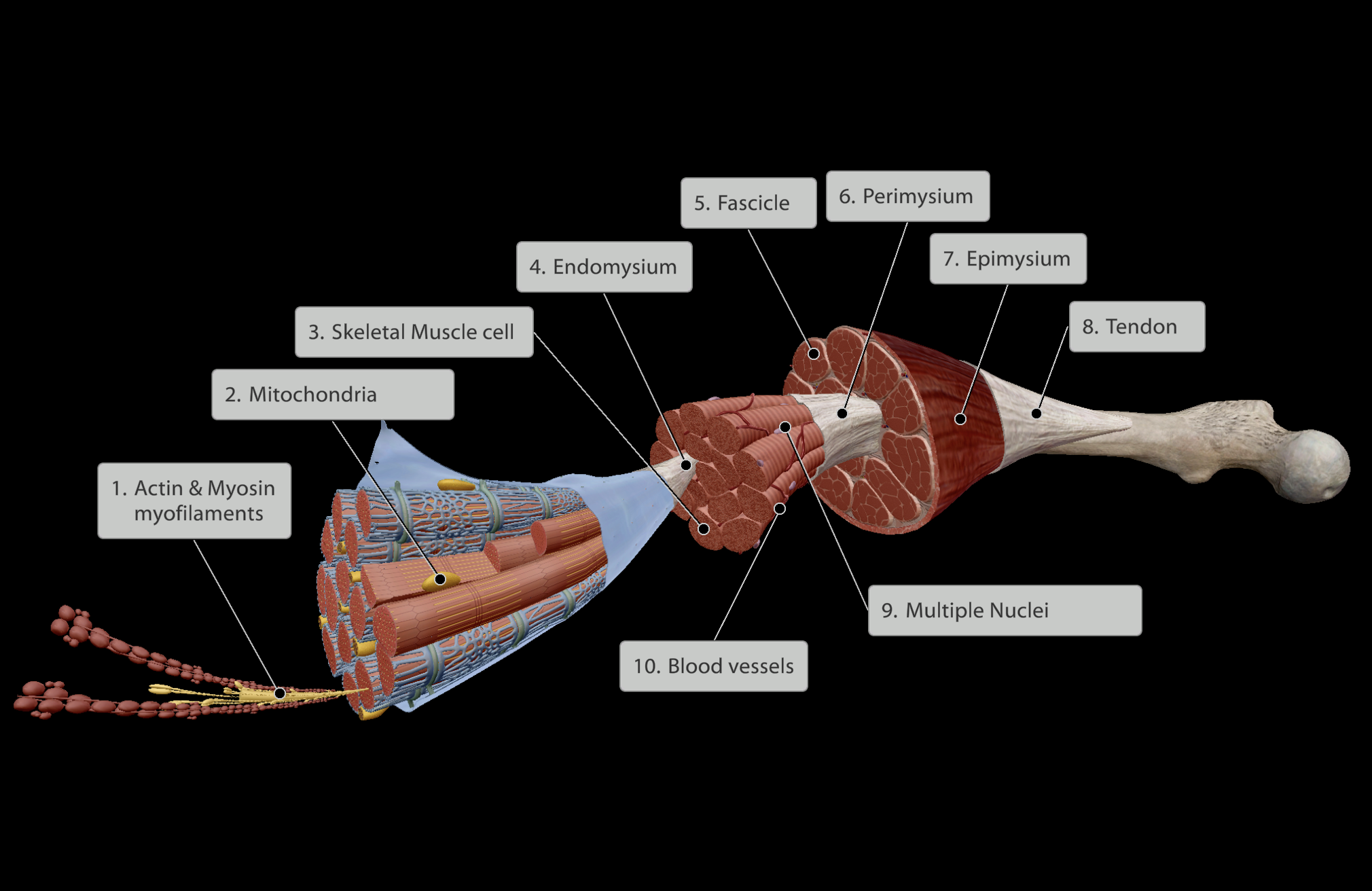
Levels of the Muscle Belly (Inner to Outer):

  1. Actin & Myosin myofilaments within skeletal muscle cell

  2. Skeletal Muscle cell/skeletal muscle fibre

  3. Endomysium - Connective tissue surrounding skeletal muscle cell

  4. Fascicle - Groups of skeletal muscle cells each wrapped in endomysium

  5. Perimysium - Connective tissue surrounding each fascicle

  6. Epimysium - Connective tissue surrounding all fascicles in muscle belly

  7. Tendon - Joining point of all inner connective tissue (endomysium, perimysium, epimysium) that links muscle to bone.

    a. Dense fibrous regular connective tissue.

    b. Links muscle directly into bone

All muscle is highly vascularised, however the tendons at the end of muscles have less blood supply.
<p>Levels of the Muscle Belly (Inner to Outer):</p><ol><li><p><strong><em>Actin &amp; Myosin myofilaments</em></strong> within skeletal muscle cell</p></li><li><p><strong><em>Skeletal Muscle cell/skeletal muscle fibre</em></strong></p></li><li><p><strong><em>Endomysium</em></strong> - Connective tissue surrounding skeletal muscle cell</p></li><li><p><strong><em>Fascicle</em></strong> - Groups of skeletal muscle cells each wrapped in endomysium</p></li><li><p><strong><em>Perimysium</em></strong> - Connective tissue surrounding each fascicle</p></li><li><p><strong><em>Epimysium</em></strong> - Connective tissue surrounding all fascicles in muscle belly</p></li><li><p><strong><em>Tendon</em></strong> - Joining point of all inner connective tissue (endomysium, perimysium, epimysium) that links muscle to bone.</p><p>a. Dense fibrous regular connective tissue.</p><p>b. Links muscle directly into bone</p></li></ol><p></p><p><strong><em><u><mark data-color="blue" style="background-color: blue; color: inherit;">All muscle is highly vascularised, however the tendons at the end of muscles have less blood supply.</mark></u></em></strong></p>
3
New cards

Why are skeletal muscles striated?

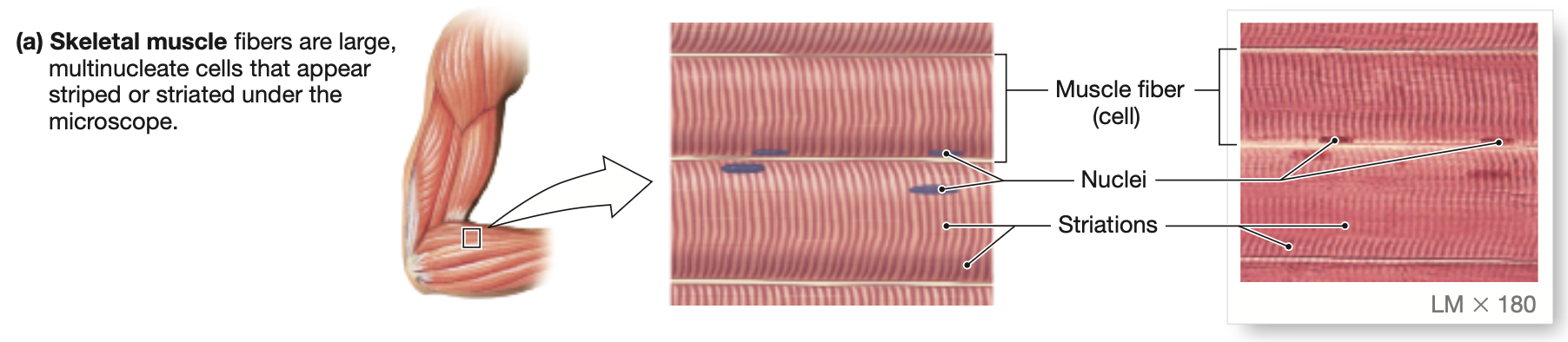
All skeletal muscles are striated. Each skeletal muscle cell has alternating dark and light bands.

  • Each muscle cell is multinucleated, and spans the length of the ENTIRE muscle.

    • Hence, can be the largest cells in the body
<p>All skeletal muscles are <strong>striated</strong>. Each skeletal muscle cell has alternating dark and light bands.</p><ul><li><p>Each muscle cell is multinucleated, and spans the length of the ENTIRE muscle.</p><ul><li><p>Hence, can be the largest cells in the body</p></li></ul></li></ul><p></p>
4
New cards

Skeletal muscle CONTRACTION process: Somatic motor neuron

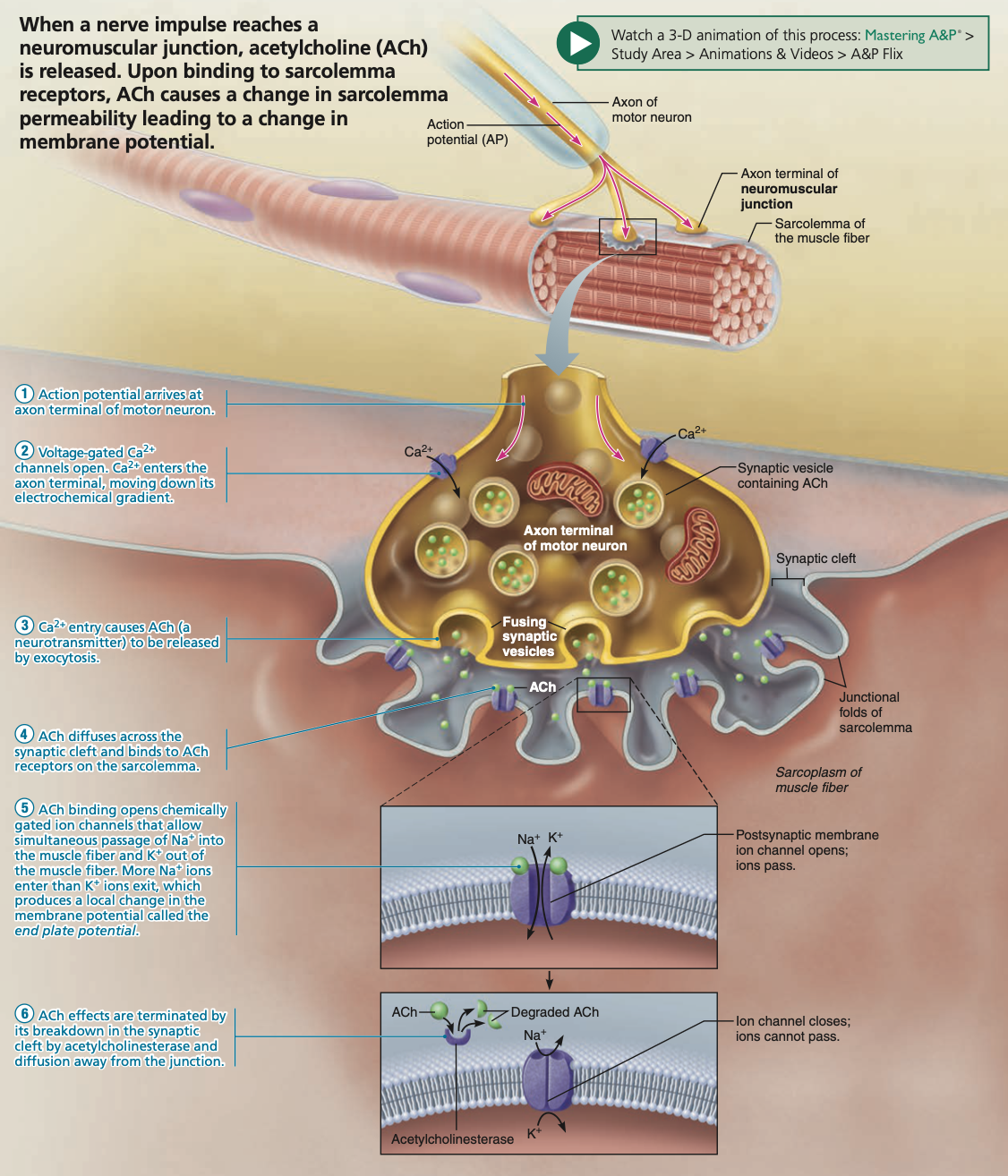
  1. Action potential travels down to axon terminal of somatic motor neuron

  2. Due to processed (refer to previous notes), Ca2+ voltage-gated ion channels open, allowing Ca2+ to rush into the neuron’s axon terminal

  3. Ca2+ sensing protein “synaptotagmin” found on the surface of vesicles within the axon terminal activate

  4. These vesicles containing neurotransmitters (in muscle contractions, Ach), fuse with the axon terminal’s cell membrane

  5. Ach is released into the neuromuscular junction via exocytosis.

  6. Ach binds to receptors on the chemically-gated/ligand-gated Na+ channels on skeletal muscle cells.
<ol><li><p>Action potential travels down to axon terminal of <strong><em><u><mark data-color="yellow" style="background-color: yellow; color: inherit;">somatic motor neuron</mark></u></em></strong></p></li><li><p>Due to processed (refer to previous notes), Ca2+ voltage-gated ion channels open, allowing Ca2+ to rush into the neuron’s axon terminal</p></li><li><p><em>Ca2+ sensing protein “synaptotagmin</em>” found on the surface of vesicles within the axon terminal activate</p></li><li><p>These vesicles containing neurotransmitters (in muscle contractions, <strong><em><u><mark data-color="purple" style="background-color: purple; color: inherit;">Ach</mark></u></em></strong>), fuse with the axon terminal’s cell membrane</p></li><li><p><strong><em><u><mark data-color="purple" style="background-color: purple; color: inherit;">Ach</mark></u></em></strong> is released into the <strong><em>neuromuscular junction via exocytosis.</em></strong></p></li><li><p><strong><em><u><mark data-color="purple" style="background-color: purple; color: inherit;">Ach</mark></u></em></strong> binds to receptors on the <mark data-color="green" style="background-color: green; color: inherit;">chemically-gated/ligand-gated Na+ channels</mark> on skeletal muscle cells.</p></li></ol><p></p>
5
New cards

Skeletal muscle CONTRACTION process: Sarcolemma

  1. Opening these chemically-gated/ligand Na+ channels (activated by Ach) allows Na+ to flow down the concentration gradient, into the muscle cell.

  2. Depolarisation of the skeletal muscle cell membrane/surface (called ‘sarcolemma’) occurs.

  3. Moving away from the motor end-plate/neuromuscular junction, chemically-gated Na+ channels, activated by Ach, become voltage-gated Na+ channels, enabling depolarisation to occur.

  4. Action potentials propagate in all directions from the neuromuscular junction

  5. Action potentials travel down into ridges/tunnels on the sarcolemma, called T-tubules.
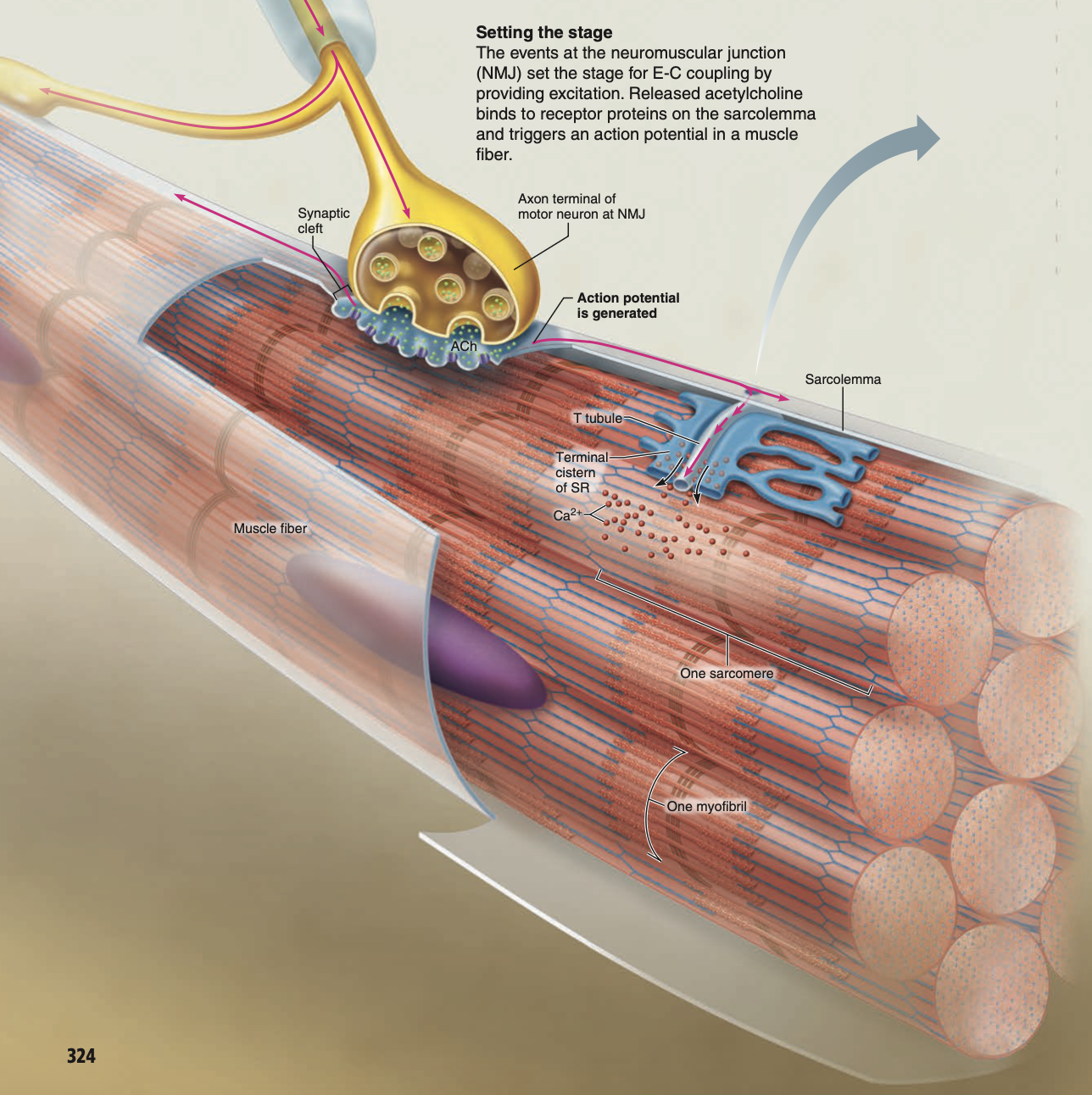
<ol start="7"><li><p>Opening these <mark data-color="green" style="background-color: green; color: inherit;">chemically-gated/ligand Na+ channels</mark> (activated by <strong><em><u><mark data-color="purple" style="background-color: purple; color: inherit;">Ach</mark></u></em></strong>) allows Na+ to flow down the concentration gradient, into the muscle cell.</p></li><li><p><strong><mark data-color="blue" style="background-color: blue; color: inherit;">Depolarisation</mark></strong> of the <mark data-color="yellow" style="background-color: yellow; color: inherit;">skeletal muscle cell membrane/surface </mark><strong><mark data-color="yellow" style="background-color: yellow; color: inherit;">(called ‘sarcolemma’)</mark></strong>  occurs.</p></li><li><p>Moving away from the motor end-plate/neuromuscular junction, chemically-gated Na+ channels, activated by <strong><em><u>Ach</u></em></strong>, become voltage-gated Na+ channels, enabling depolarisation to occur.</p></li><li><p>Action potentials propagate in all directions from the neuromuscular junction</p></li><li><p>Action potentials travel down into ridges/tunnels on the <mark data-color="yellow" style="background-color: yellow; color: inherit;">sarcolemma</mark>, called <strong><mark data-color="yellow" style="background-color: yellow; color: inherit;">T-tubules</mark></strong>.</p></li></ol><p></p>
6
New cards

Skeletal muscle CONTRACTION process: T-tubules

  1. At the base of T-tubules, are complexes called DHP (dihydropyridine L-type

    calcium channel). DHPs are voltage receptors, hence respond to the depolarisation of the sarcolemma.

  2. DHPs are physically connected to RyR channels (ryanodine receptor-channel). Hence, when DHPs are activated, RyR channels follow suit.

  3. RyR channels are found gating the sarcoplasmic reticulum found within the muscle cell.
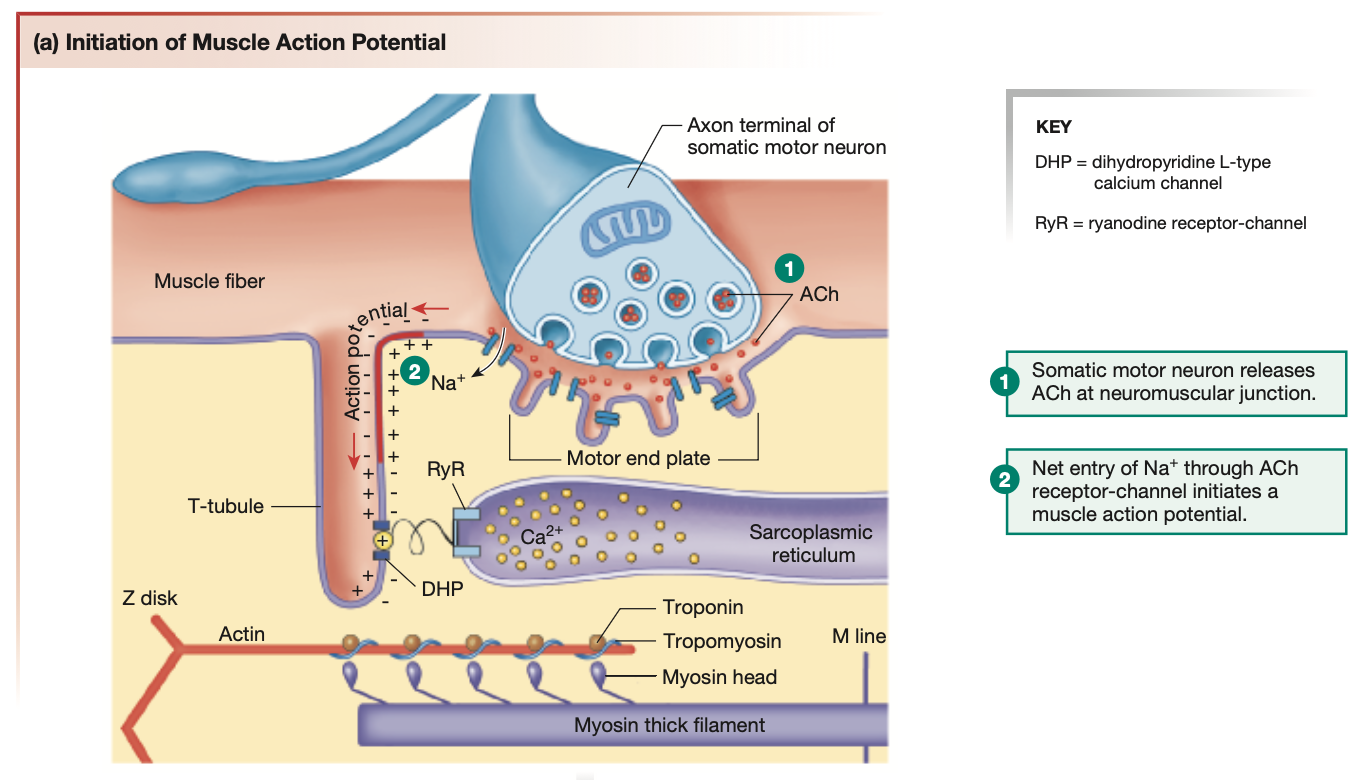
<ol start="12"><li><p>At the base of T-tubules, are complexes called <strong><em><u><mark data-color="green" style="background-color: green; color: inherit;">DHP</mark></u></em></strong> (dihydropyridine L-type</p><p class="p1"><strong><em><mark data-color="green" style="background-color: green; color: inherit;">calcium channel</mark></em></strong>). DHPs are <strong><mark data-color="green" style="background-color: green; color: inherit;">voltage receptors</mark></strong>, hence respond to the depolarisation of the sarcolemma.</p></li><li><p class="p1">DHPs are physically connected to <strong><em><u><mark data-color="green" style="background-color: green; color: inherit;">RyR channels</mark></u></em></strong> (ryanodine <mark data-color="green" style="background-color: green; color: inherit;">receptor-channel</mark>). Hence, when DHPs are activated, RyR channels follow suit.</p></li><li><p class="p1">RyR channels are found gating the <mark data-color="yellow" style="background-color: yellow; color: inherit;">sarcoplasmic reticulum</mark> found within the muscle cell.</p></li></ol><p></p>
7
New cards

Skeletal muscle CONTRACTION process: Sarcoplasmic reticulum

  1. RyR channels are physically pryed open, letting the contents of the sarcoplasmic reticulum flow into the skeletal muscle cell. (RyR channels are mechanically-gated ion channels)

  2. The sarcoplasmic reticulum contains Ca2+ stores.

  3. Hence, when RyR channels open, Ca2+ rushes into the skeletal muscle cell.

  4. The more Ca2+ released by the sarcoplasmic reticulum, the more force produced in a movement

  5. Ca2+ that floods the skeletal muscle cell binds to troponin on actin myofilaments
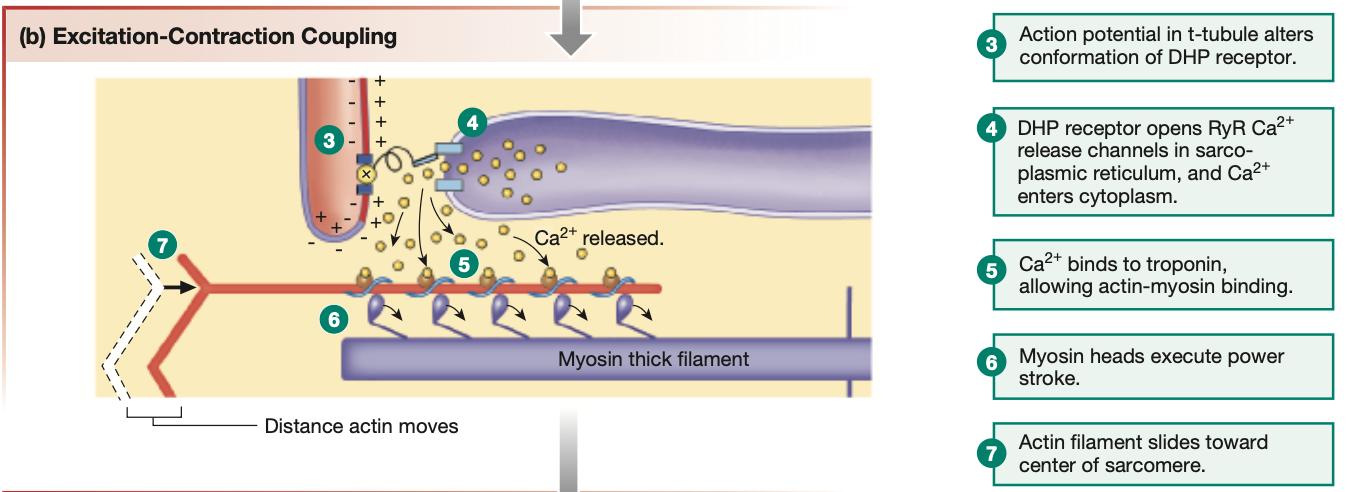
<ol start="15"><li><p><strong><em><mark data-color="green" style="background-color: green; color: inherit;">RyR channels</mark></em></strong> are physically pryed open, letting the contents of the <mark data-color="yellow" style="background-color: yellow; color: inherit;">sarcoplasmic reticulum</mark> flow into the skeletal muscle cell. (RyR channels are mechanically-gated ion channels)</p></li><li><p>The <mark data-color="yellow" style="background-color: yellow; color: inherit;">sarcoplasmic reticulum</mark> contains <mark data-color="green" style="background-color: green; color: inherit;">Ca2+</mark> stores.</p></li><li><p>Hence, when <strong><em><mark data-color="green" style="background-color: green; color: inherit;">RyR channels</mark></em></strong> open, <mark data-color="green" style="background-color: green; color: inherit;">Ca2+</mark> rushes into the skeletal muscle cell.</p></li><li><p>The more <mark data-color="green" style="background-color: green; color: inherit;">Ca2+</mark> released by the sarcoplasmic reticulum, the more force produced in a movement</p></li><li><p><mark data-color="green" style="background-color: green; color: inherit;">Ca2+</mark> that floods the skeletal muscle cell binds to <mark data-color="red" style="background-color: red; color: inherit;">troponin</mark> on <strong><em><u><mark data-color="red" style="background-color: red; color: inherit;">actin myofilaments</mark></u></em></strong></p></li></ol><p></p>
8
New cards

Skeletal muscle RELAXATION process

  1. Action potentials stop being send down the somatic motor neuron

  2. Ach is no longer released as a neurotransmitter, and Ach is removed from chemically-gated/ligand-gated Na+ channels on the sarcolemma.

  3. Sarcolemma repolarises, voltage-gated Na+ channels close.

  4. T-tubules repolarises

  5. DHP no longer senses a voltage change in the T-tubule, hence DHP inactivated & RyR channel physically closes.

  6. Sarcoplasmic reticulum is closed, Ca2+ stops flooding the skeletal muscle cell

  7. Ca2+ already bound to troponin on actin myofilaments is released

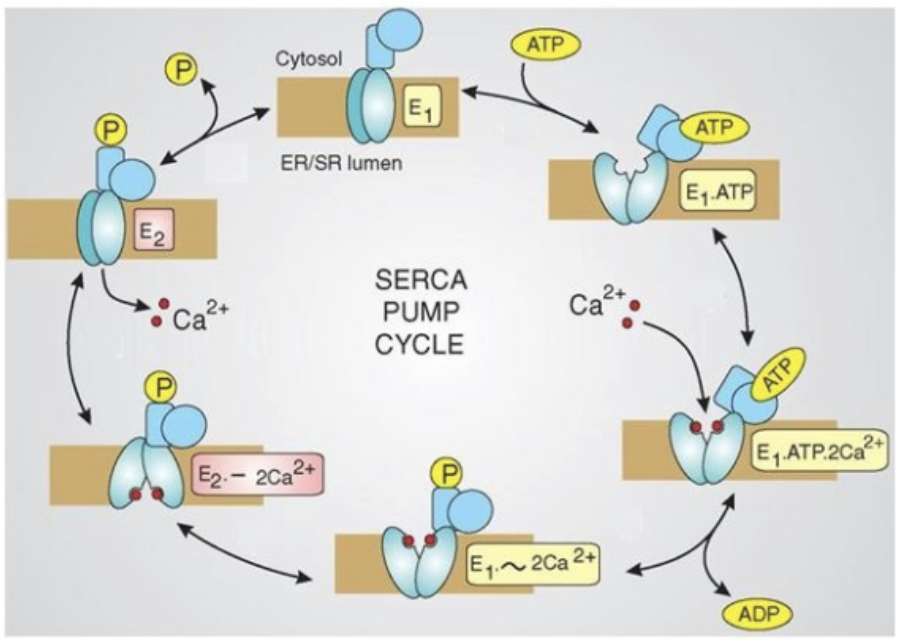
  8. SERCA pumps (Sarcoplasmic/Endoplasmic Reticulum—Calcium ATP pump) reintakes Ca2+ into the sarcoplasmic reticulum at the cost of ATP.
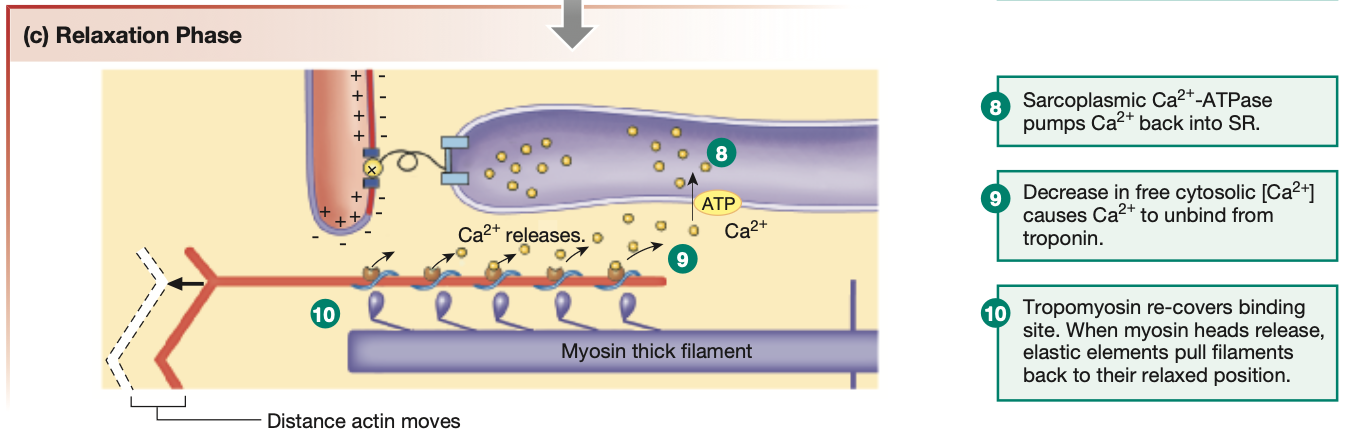
<ol><li><p><mark data-color="yellow" style="background-color: yellow; color: inherit;">Action potentials stop</mark> being send down the <strong><mark data-color="yellow" style="background-color: yellow; color: inherit;">somatic motor neuron</mark></strong></p></li><li><p><strong><mark data-color="purple" style="background-color: purple; color: inherit;">Ach</mark></strong><mark data-color="purple" style="background-color: purple; color: inherit;"> is no longer released</mark> as a neurotransmitter, and <mark data-color="purple" style="background-color: purple; color: inherit;">Ach is removed</mark> from <mark data-color="green" style="background-color: green; color: inherit;">chemically-gated/ligand-gated Na+ channels</mark> on the <mark data-color="yellow" style="background-color: yellow; color: inherit;">sarcolemma</mark>.</p></li><li><p>Sarcolemma repolarises, <mark data-color="green" style="background-color: green; color: inherit;">voltage-gated Na+ channels close</mark>.</p></li><li><p><mark data-color="yellow" style="background-color: yellow; color: inherit;">T-tubules repolarises</mark></p></li><li><p>DHP no longer senses a voltage change in the T-tubule, hence <mark data-color="green" style="background-color: green; color: inherit;">DHP inactivated &amp; RyR channel physically closes</mark>.</p></li><li><p><mark data-color="yellow" style="background-color: yellow; color: inherit;">Sarcoplasmic reticulum is closed</mark>, <mark data-color="green" style="background-color: green; color: inherit;">Ca2+ stops flooding</mark> the skeletal muscle cell</p></li><li><p><mark data-color="green" style="background-color: green; color: inherit;">Ca2+ already bound to troponin</mark> on actin myofilaments is <mark data-color="green" style="background-color: green; color: inherit;">released</mark></p></li><li><p><strong><em><u><mark data-color="red" style="background-color: red; color: inherit;">SERCA pumps</mark></u></em></strong> (Sarcoplasmic/Endoplasmic Reticulum—Calcium ATP pump) <mark data-color="red" style="background-color: red; color: inherit;">reintakes Ca2+ into the sarcoplasmic reticulum</mark> at the cost of ATP.</p></li></ol><p></p>
9
New cards

Muscle cramps

Occurs when somatic motor neurons continuously send action potentials, leading to continuous propagation of Ach neurotransmitters, leading to muscles continuously staying contracted.

  • Can lead to permenant muscle damage

10
New cards

EXTRA KNOWLEDGE: SERCA pumps & Enzyme function
<p></p>
11
New cards
<p><strong><em><u>EXTRA KNOWLEDGE</u></em></strong>: Malignant Hyperthermia</p>

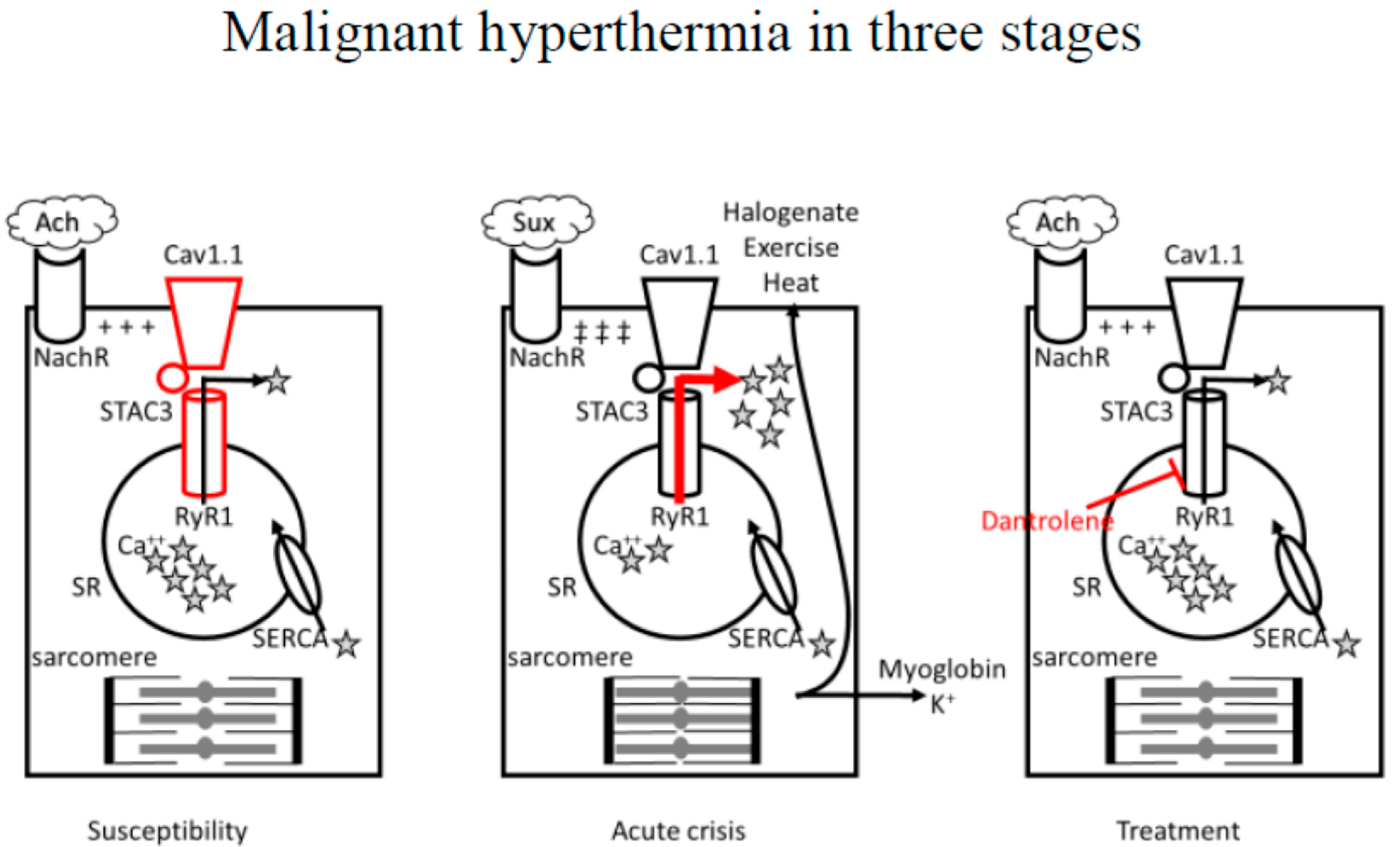
EXTRA KNOWLEDGE: Malignant Hyperthermia

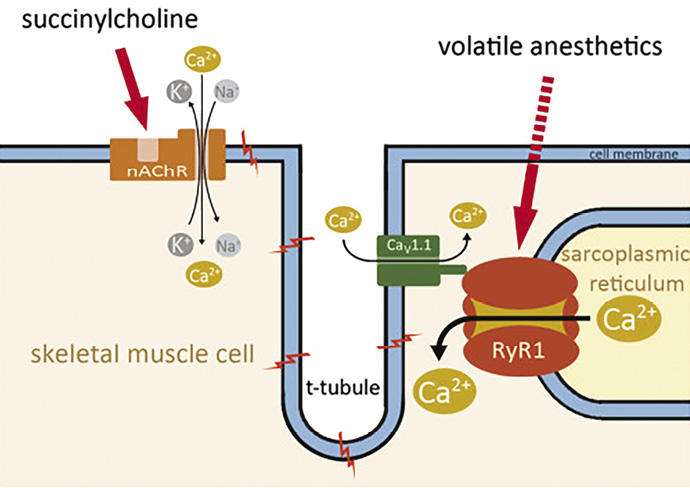
Malignant Hyperthermia - Genetic condition where abnormal RyR receptors remain open longer than normal, allowing excess Ca2+ to be released from the sarcoplasmic reticulum.

  • Excess Ca2+ in the cytoplasm, turnover by SERCA pumps cannot catch up, leading to Ca2+ remaining bound to troponin for longer than necessary.

  • Thus, myosin heads remain clamped onto actin filaments for long periods of time

  • Muscle remains contracted for an extended period of time - ensuing muscle cramps

  • SERCA pumps work overtime (consuming lots of ATP → ADP + Pi), releasing heat in the catabolic reaction

  • Muscle cells/fibres can melt from the heat

    • Also excess Ca2+ triggers enzymes that cause muscle-breakdown (rhabdomyolysis) - resulting in dark/red urine

      • If left untreated, can lead to kidney failure or even death

    • Often found during surgery, as certain anaesthetics can trigger the RyR channels directly

    • Muscle relaxant Succinylcholine can also trigger MH
<p><em><u>Malignant Hyperthermia</u></em> - Genetic condition where abnormal <strong><em><mark data-color="green" style="background-color: green; color: inherit;">RyR receptors</mark></em></strong> remain open <strong><em><mark data-color="red" style="background-color: red; color: inherit;">longer than normal</mark></em></strong>, allowing excess Ca2+ to be released from the sarcoplasmic reticulum.</p><ul><li><p>Excess Ca2+ in the cytoplasm, turnover by SERCA pumps cannot catch up, leading to Ca2+ remaining bound to troponin for longer than necessary.</p></li></ul><ul><li><p>Thus, myosin heads remain clamped onto actin filaments for long periods of time</p></li><li><p>Muscle remains contracted for an extended period of time - ensuing <strong>muscle cramps</strong></p></li><li><p>SERCA pumps work overtime (consuming lots of ATP → ADP + Pi), releasing heat in the catabolic reaction</p></li><li><p>Muscle cells/fibres can <strong><em><mark data-color="red" style="background-color: red; color: inherit;">melt</mark></em></strong> from the heat</p><ul><li><p>Also excess Ca2+ triggers enzymes that cause muscle-breakdown (rhabdomyolysis) - resulting in dark/red urine</p><ul><li><p>If left untreated, can lead to kidney failure or even death</p></li></ul></li><li><p>Often found during surgery, as <mark data-color="blue" style="background-color: blue; color: inherit;">certain anaesthetics</mark> can trigger the RyR channels <strong>directly</strong></p></li><li><p><mark data-color="blue" style="background-color: blue; color: inherit;">Muscle relaxant Succinylcholine</mark> can also trigger MH</p></li></ul></li></ul><p></p>

Explore top notes

note
Radioactive Elements:
Updated 1170d ago
0.0(0)
note
Genshin Impact Artifacts Guide
Updated 484d ago
0.0(0)
note
4.1b: Phone usage
Updated 671d ago
0.0(0)
note
Breathing and Exchange of Gases
Updated 905d ago
0.0(0)
note
APUSH REVIEW
Updated 1064d ago
0.0(0)
note
Radioactive Elements:
Updated 1170d ago
0.0(0)
note
Genshin Impact Artifacts Guide
Updated 484d ago
0.0(0)
note
4.1b: Phone usage
Updated 671d ago
0.0(0)
note
Breathing and Exchange of Gases
Updated 905d ago
0.0(0)
note
APUSH REVIEW
Updated 1064d ago
0.0(0)

Explore top flashcards

flashcards
Gopo chapter 3
24
Updated 1182d ago
0.0(0)
flashcards
Transfusion Acquired Infection
32
Updated 532d ago
0.0(0)
flashcards
Bio AT2 2023
181
Updated 1112d ago
0.0(0)
flashcards
Nervous System
140
Updated 1063d ago
0.0(0)
flashcards
Correlation and functions
20
Updated 1232d ago
0.0(0)
flashcards
Elimination and Renal Disorders
58
Updated 479d ago
0.0(0)
flashcards
Rhetorical Terms List #1
20
Updated 549d ago
0.0(0)
flashcards
Gopo chapter 3
24
Updated 1182d ago
0.0(0)
flashcards
Transfusion Acquired Infection
32
Updated 532d ago
0.0(0)
flashcards
Bio AT2 2023
181
Updated 1112d ago
0.0(0)
flashcards
Nervous System
140
Updated 1063d ago
0.0(0)
flashcards
Correlation and functions
20
Updated 1232d ago
0.0(0)
flashcards
Elimination and Renal Disorders
58
Updated 479d ago
0.0(0)
flashcards
Rhetorical Terms List #1
20
Updated 549d ago
0.0(0)