Ion Channels - Exam 1
 Studied by 0 people
 Call Kai
 Learn
Learn Practice Test
 Spaced Repetition
 Match
Match Flashcards
 Knowt Play
1/92

There's no tags or description
Looks like no tags are added yet.
Name | Mastery | Learn | Test | Matching | Spaced |
|---|
No study sessions yet.
93 Terms
neural signals
Just as neurons are considered the basic functional unit of the nervous system (Neuron Doctrine), ion channels may be considered the basic functional unit of ________________
channelopathies
Disorders that stem from ion channel mutations are termed _______________. Those involving ion channels in neurons include various forms of epilepsy, some types of ataxia (uncoordinated movement) and deafness.
gain of function
Mutations in one subtype of Na+ channel (Nav1.7) underlies erythromelalgia (IEM), where mild warmth is perceived as burning pain. IEM is a so-called “__________________” mutation, where the Na+ channels in the sensory neurons that express them are more easily activated than normal.
They occur whenever there are changes in the flow of ions across the cell membrane. The flow of ions per unit time is an ionic current
What causes local and action potentials to occur in a neuron?
The combination of two forces, a chemical “force” (concentration gradient) and an electrical force. The summed combination of these two forces is termed the net electrochemical force.
what causes ions to flow?
Where do these currents occur?
Rapid currents occur through specialized membrane proteins called ion channels. These large, integral membrane proteins span the lipid bilayer and form a physical pore through which ions diffuse. A reminder that diffusion is a passive process, requiring no direct input of cellular energy. However, energy is required indirectly (to maintain the concentration gradients mentioned above).
Ion channels are often selectively permeable
Ion channels conduct ions at high rates.
Key Properties of Ion Channels
enzymatic
Movement of ions through channels is amazingly rapid, several orders of magnitude faster than the turnover rate for typical ______________ reactions.
10^6 to 10^8
In a typical channel, ions move through at a rate of __________ per second.
free diffusion
The transport of ions across the membrane at such rates essentially matches the speed of _______________ and is diagnostic for the presence of an ion channel.
much slower
Ions may also cross membranes via protein exchangers or pumps [see later slides]. These transport processes are _____________ but are nevertheless quite important and can affect neuronal signaling on longer time scales.
size; charge
Most ion channels recognize and select among different ions based on the ion's _______ and electrical ___________
single
Some ion channels are highly selective, essentially allowing only a _________ type of ion to pass (e.g. a K+ channel). Others, which likely have selectivity filter regions of larger diameter, allow several types of ions to pass - e.g. cation channels (Na+/K+ or Na+/K+/Ca2+).
The phospholipid bilayer of the cell membrane is impermeable to ions.
Why do cells require ion channels to generate rapid ionic currents?
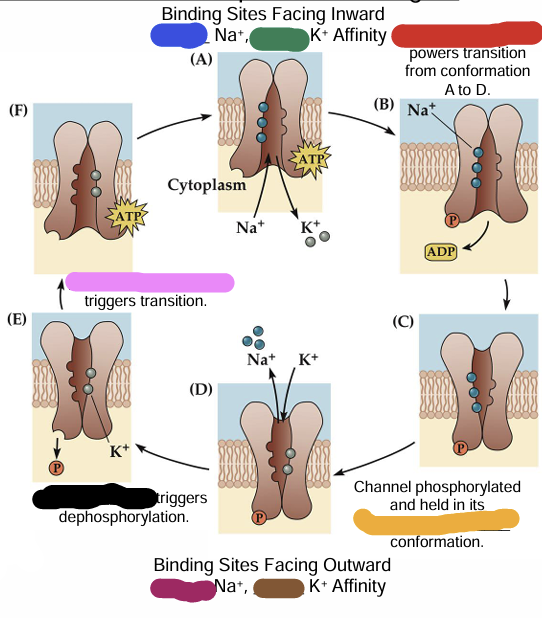
Na-K Pump (Na-K ATPase)
Maintains stable concentration gradients for these ions across the plasma membrane.
electrogenic
_____________ - can contribute to the resting membrane potential of the neuron.
ouabain
the sodium potassium channel can be Blocked by ____________ and other drugs
High; Low
what is represented by the blue and green boxes respectively
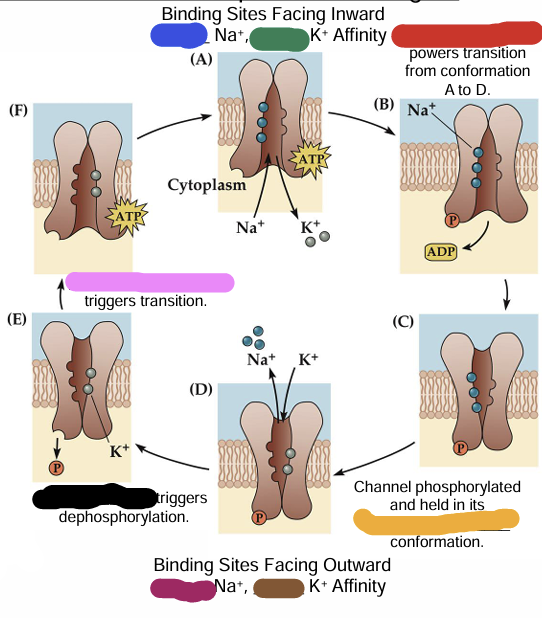
ATP hydrolysis
what is represented by the red box
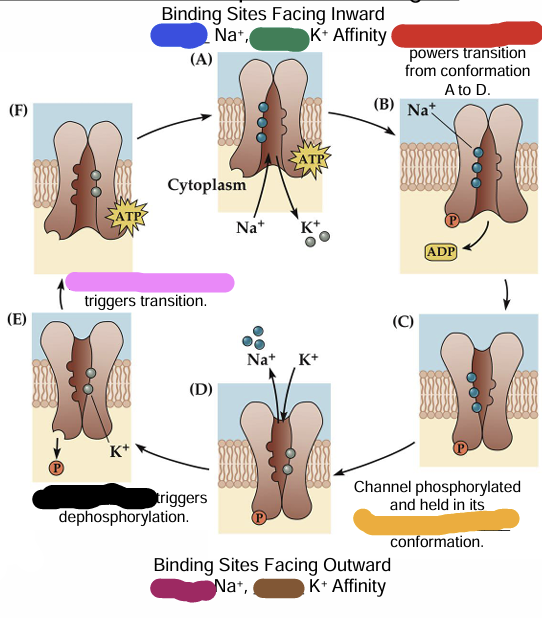
high energy
what is represented by the yellow box?
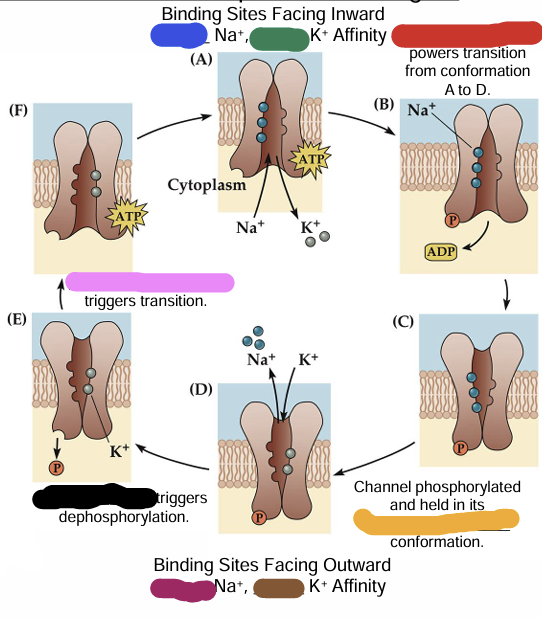
low; high
what is represented by the purplish red box and brown box?
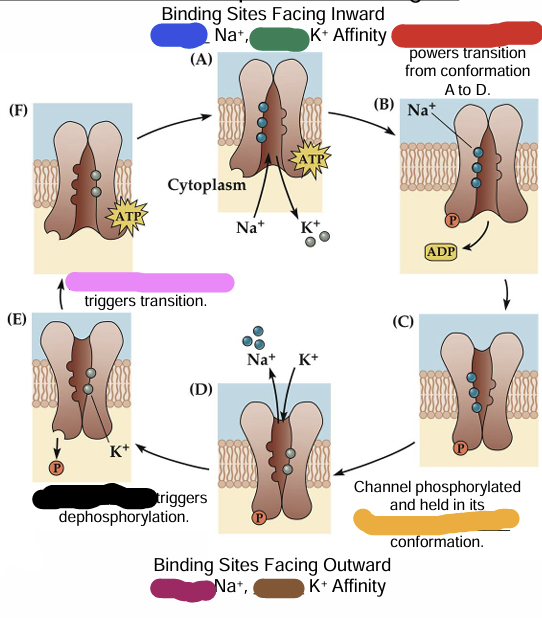
Potassium binding
what is represented by the black box
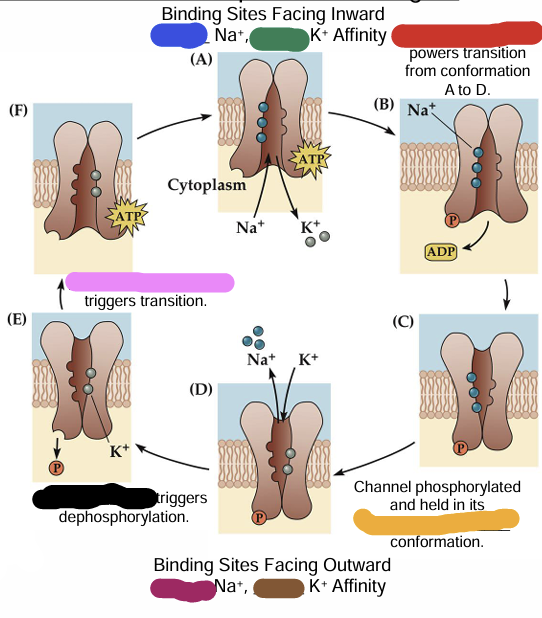
dephosphorylation
what is represented by the pink box
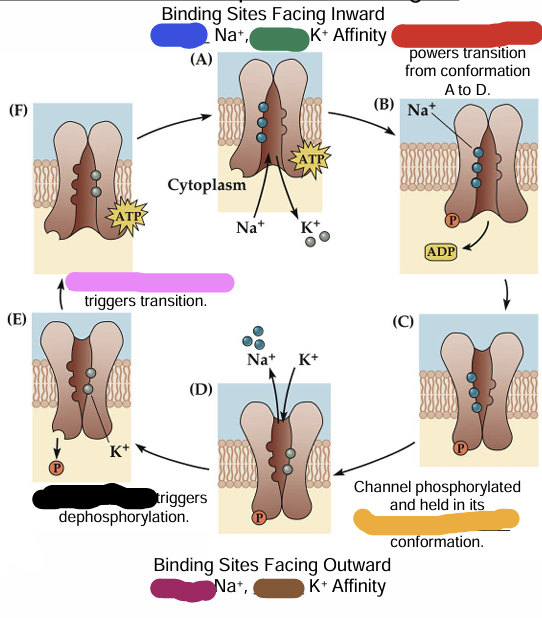
low energy
No cellular energy is required for the return to the ____________ conformation (panels D → A)
10-100nM
Resting [Ca2+]i = ___________
Ca Pumps (Calcium ATPase)
Na-CA exchanger (NCX)
Calcium Pumps and Exchangers
cocaine; fluoxetine
There are other transport proteins for chloride ions and neurotransmitters. The latter are important targets of psychoactive compounds such as _____________ or ______________
“Non-Gated” (Leak) channel type
“always” open and has low density in the membrane. It is responsible for the resting membrane potential.
Gated channel type
May be open or closed and is high density in the membrane. its function is underlie signals (may also contribute to the resting membrane potential if open)
population
Thus, as a ______________ they provide a constant pathway (conductance) for ion flow through the membrane
Activation
closed to open conformation
deactivation
open to closed conformation
Physical changes in the membrane
Voltage
Mechanical
Temperature
chemicals (ligands)
External
Internal
Gating is a stochastic process. The probability that a channel is in one state or the other is modified by specific gating triggers. Triggers include:
inactivation
open to refractory closed conformation
Deinactivation
refractory closed to resting closed conformation
membrane
what is represented by the black box
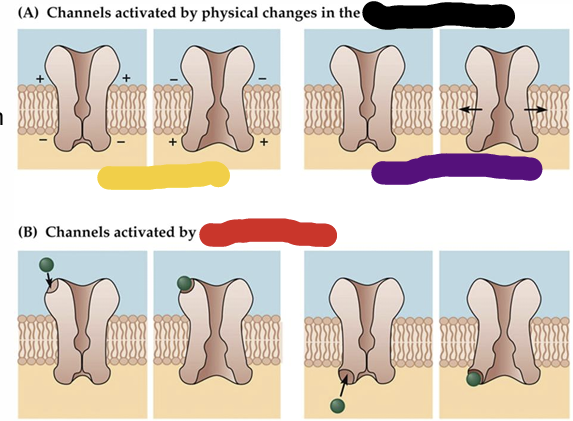
ligands
what is represented by the red box
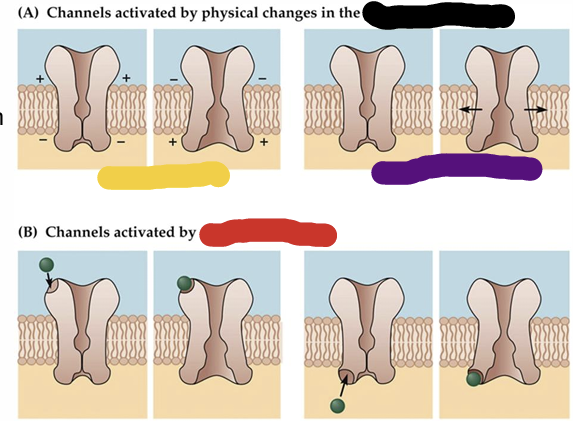
Voltage-gated
what is represented by the yellow box
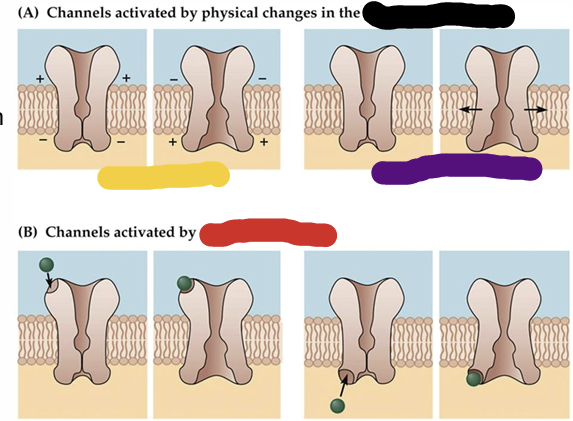
Mechanically Gated
what is represented by the purple box
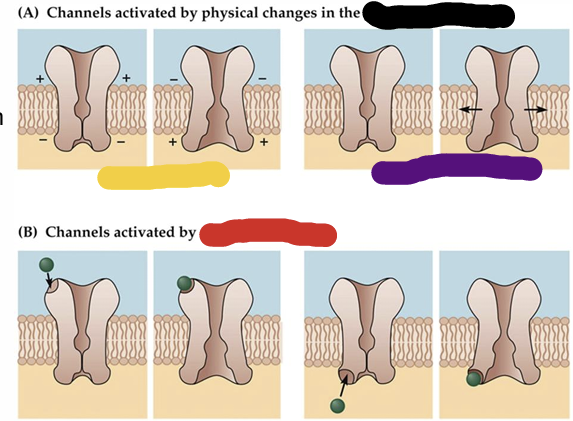
• Ligand-Gated (Cys-loop) Channels
• Glutamate Receptor Channels
• Chloride Channels
• Gap Junction Channels
• Pore-Loop Channels
Ion Channel Structural Families
Ligand-Gated (Cys-loop)
Has 5 polypeptide subunits and 4 (TM) helices per subunit.
Nicotinic AChR
5-HT3 Receptor
Glycine Receptor
GABAA and GABAC Receptors
Members of the Cys-loop superfamily receptor/channels:
Cations
Nicotinic AChR is permeable to
Cations
5-HT3 Receptor is preamble to
anions
Glycine Receptor is permeable to
anions
GABAA and GABAC Receptors is permeable to
Gap Junction
HAs 6 polypeptide subunits and 4 TM helices per subunit
electrical
Gap junction channels are found at ___________synapses.
2 hemichannels
how many hemichannels are needed to form a functional Gap Junction ion channrl
Pore Loop
This channel can have 1, 2, or 4 polypeptide subunits with varying numbers of the TM helices per Subunit. The P loop or P domain is a structural feature unique to this superfamily (which includes most voltage-gated channels). The fully intact channel always possesses 4 P loops. Also referred to as the voltage-gated ion channel superfamily, even though it includes several types of non-gated or cyclic nucleotide-gated channels. However, all members share a common evolutionary origin as revealed by their DNA sequences.
selectivity filter
One of 4 polypeptide subunits found in a voltage-gated K+ channel. Each contains 6 transmembrane TM helices and one P loop located between TM helices 5 and 6. The P loop enters the membrane but does \not span the bilayer. Part of the P loop consists of a pore helix (see image below right). In the intact channel, the four subunits are arranged in a ring with the P-loops pointing towards each other and nearly touching. This creates a tiny opening that functions as the channel’s ___________________.
single
Voltage-gated NA+ (shown below) and Ca2+ channels evolved later and consist of a _________ large polypeptide with four repeating domains (I to IV in diagram). [This likely resulted from fusion and subsequent evolution of potassium subunits.]
“Non-Gated or Leak K+ Channels
Shown above are two polypeptide subunits, each containing four TM helices and two P-loops.
linker
The -subunit ankyrin repeat (AR) domains are hypothesized to connect the channel to microtubules in the cytoskeleton such that deformation of the membrane pushes or pulls on the AR repeats and, via ___________sequences, translates that force to the channel core, gating the channel open or closed. The channel is permeable to Na+, K+, and Ca2+
Multiple AR domains form a series of helices and loops that, collectively, function as a molecular spring
what is the highlighted region
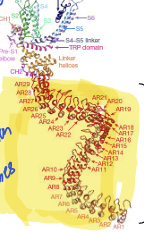
interact; slow
Pre 1998 – the great paradox of ion channels. Many are highly selective and yet pass ions at extremely high rates. To be selective, a channel must ___________ with ions to control which ones will pass. However, such events would be expected to ______ the ion’s passage through the channel pore
X-Ray Crystallography
A clear answer to this apparent paradox, along with many other mysteries of ion channel structure, began to emerge in 1998 with the first detailed look at ion channel structure . This was accomplished using ____________________ in the laboratory of Roderick MacKinnon.
eukaryotic
The initial work was carried out on a bacterial K+ channel. We now know that this channel, including the selectivity filter region, is essentially identical to the core of _____________ K+ channels in regards to the study of the three-dimensional sturcture of the ion channel.
2 transmembrane helices; S5 and S6
The bacterial channel is formed from four subunits, each with a P loop. However, instead of 6 TM regions, each subunit has only ________________ (corresponding to TM helices _____________ in eukaryotes)
GYGV sequence
Two P-loops with their highly conserved ____________________ form the selectivity filter near the extracellular mouth of the channel.
central cavity
A pore helix extends part way into the channel starting near the external surface and ends near a relatively large ________________ at the center of the membrane
inner helices
The channel was crystallized in its closed configuration – note the close proximity of the _________________ at the cytoplasmic end of the channel. These move apart in the open configuration
Rapid conduction is promoted by ensuring that K+ ions are always near the channel pore. The figure shows a color-coded view of the channel, with red indicating regions that are relatively electronegative. Such regions will attract cations to the internal and external mouths of the channel, thus ensuring that K+ ions are always near the channel, and thus available to diffuse through as soon as the channel is open.
Five Channel Features Permit Rapid Conduction: Feature 1
To be selected for passage, ions must interact electrostatically with the channel walls. However, rapid conduction requires that K+ ions do not stop or slow down as they permeate the channel. The interactions must therefore be minimized and those that do occur must be weak and/or unstable. Otherwise, the ion will linger too long inside the pore. To minimize interactions, most of the channel wall lining the conducting pore is nonpolar. The entire pore is about 3.5 nm long, but the only electrostatically hydrophilic region is the selectivity filter, which is a mere 1.2 nm in length. This minimizes interactions with the channel wall that could slow conduction.
Five Channel Features Permit Rapid Conduction: Feature 2
The nonpolar nature of the channel creates a problem, however. Why would a K+ ion enter an electrostatically neutral region of the channel, i.e. the region embedded in the center of the nonpolar lipid bilayer? This problem is solved by the pore helices. Any alpha-helix has a natural electrical polarity, with one end slightly positive (bluish) and the other slightly more negative (reddish in diagram). Note how the pore helices point toward water-filled cavity at the center of the channel. This slightly negative helps entice K+ ions to enter the cavity from the cytoplasmic side.
Five Channel Features Permit Rapid Conduction: Feature 3
Another factor is that the central cavity is filled with water. K+ ions can therefore remain in solution (interacting with 8 water molecule oxygen atoms ) on the internal side of the selectivity filter. Thus, only the slight negativity of the pore helices is needed to create the conditions needed to ensure that, on average, there always is at least one K+ ion present in the cavity
Five Channel Features Permit Rapid Conduction: Feature 4
The data indicated that at least two K+ ions were located within the channel’s selectivity filter (dashed box to right) at any moment in time. Electrostatic Repulsion between these ions creates instability, preventing an ion from associating with any one binding site for more than a brief instant (average time spent at a binding site is about 1 uS)
Five Channel Features Permit Rapid Conduction: Feature 5
Multiple rings of oxygen atoms formed (mostly) by the P-loops. Surprisingly, the majority of these oxygen atoms were not part of amino acid side dehydrated chains. Instead, they were oxygens of the main carbonyl chain of the protein. Each ring consists of 4 oxygen atoms. There are 5 rings in the selectivity filter formed by the P loops plus a 6th ring at the extracellular end of the filter. These rings serve as a series of oxygen cages (or “binding” sites), each cage thus consisting of 8 oxygen atoms (4 from one ring and 4 from an adjacent ring).
Features that Explain the Channel’s Selectivity for K+ ions: Feature 1
in solution!
K+ ion (green dot) completely _____________ but near the mouth of the channel (7th “binding” site).
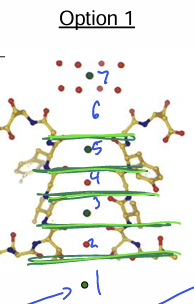
never
Two K+ ions in the filter at any one time, but _____ in adjacent “binding” sites.

A third K+ ion is always present in the water filled cavity (considered the 1st “binding” site).
Where is the third K+ ion
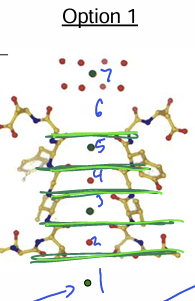
Partially dehydrated
__________________ K+ ion in a 6th binding site as it enters (or leaves) the selectivity filter.
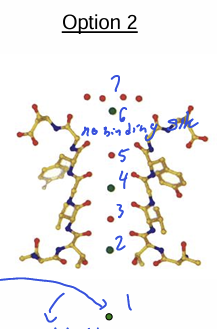
alternative pair
Two K+ ions in the filter, but at the____________ of sites
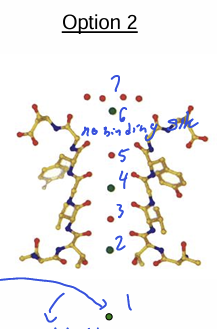
outward or inward
Note that the probability that a given K+ ion moves ________________ through the channel is determined by chemical and electrical forces to be discussed later. The ability permeation are the issues here, and not to permeate and the mechanism the net direction of diffusion. of rapid
The key structural feature of this area is the diameter of the pore. In the selectivity filter, the oxygen atoms in these rings are held at a precise distance apart, the exact distance required for a large naked K+ ion to “perceive” that it still is interacting with water (in solution). K+ (0.133nm)
Why is the filter permeable to K+
In contrast, a Na+ ion entering this region is too small. That is, if the Na+ ion were to shed all its water and become a naked ion, the oxygen atoms of the protein would be too far away to precisely mimic the favorable electrostatic interactions with water. On the other hand, the combination of a Na+ ion (0.095nm) plus even one associated water molecule (0.27nm) is too large to fit through!
Why is the filter not permeable to Na+
This is where the amino acid side chains of the filter region play an important role. The side chains of the selectivity filter amino acids interact electrostatically with side chains of the inner transmembrane helices. Conserved tyrosine’s of GYGV sequence. The result is a planar or sheet-like structure that acts like a set of radial springs, holding the selectivity filter oxygen atoms in place and precisely controlling the distance between them.
OK, but what prevents the oxygen atoms of the protein from collapsing inward slightly as they are attracted to the powerful charge of the Na+ ion, thus creating a more favorable electrostatic interaction?
T1 domains play a role in assembling the 4 subunits. In addition, their amino terminus region forms a ball shaped structure that is responsible for rapid (N-type) voltage-dependent inactivation. the T1 domain form each subunit extends from the S1 helix. This occurs when the ball enters, and then plugs, the open channel pore.
The bacterial channel forms the core of the larger eukaryotic channel, which has additional TM helices and various “bells and whistles” attached on the intracellular side. Explain this.

voltage sensors
S1-S4 helices function as _______________
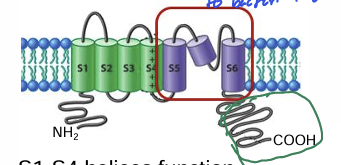
arginine; positive; probability
Each paddle is formed by the S1-S4 helices on a given subunit. Each S4 helix has four _____________ residues, thus providing four ________ charges. Helix and thus paddle move all the time, but Vm strongly affects the _______________ that these structures are in a given location.
closed conformation. Vm must be hyperpolarized and the paddle will be down and tipped CCW. S4 helix shifted down (toward cytoplasm). Paddle separates from channel core
what does this show
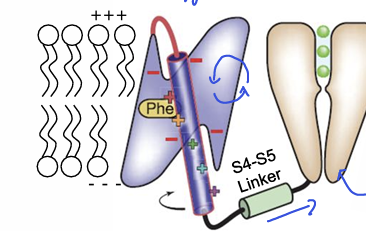
open conformation: Vm is depolarized so the paddle is up and tipped CM allowing for water to enter the cavity, further preventing the closer of the inner helices. S4 helix shifted up (away from cytoplasm) Paddle linked to channel core
what does this show?

Hydrophobic collapse; dehydration
The key step in channel closure for the eukaryotic cell is ______________ and _____________________ of the inner helices and water filled cavity. Conversely, an outward shift of the S4 helix dehydration the inner helices and allows water to open the channel and reenter the pore
Ion Channel Protein Auxiliary (Beta) Subunits
Separate polypeptides that attach to main subunits and affect channel kinetics, voltage -dependence, and localizations.
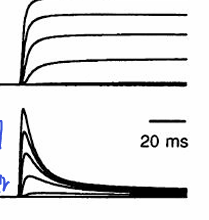
noninactivating K+ current (Delayed Rectifier)
what type of current is this

transient where alpha subunit does activation and inactivation
what type of current is this
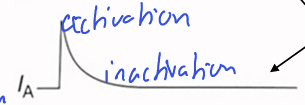
the beta subunit inactivates the protein when present
what does this illustrate
CELL ATTACHED: electrode attached to surface of the electrode tip
what does this show
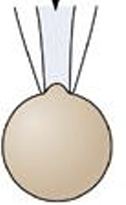
Inside-Out patch: extracellular end of the channel is in contact with the pipette solution.
what does this show?
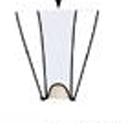
whole-cell recording: Permits recording of entire cell via a low resistance pathway.
what is this
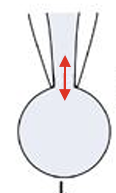
Outside-out patch: Patch of membrane adheres to pipette. Extracellular side of channel remains in contact with the extracellular fluid
what is this?
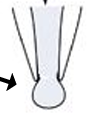
single channel (microscopic) current
Cell Attached
inside-out
outside-out
macroscopic currents
whole cell patch has ________
 Note
Note  Flashcards (30)