Day 15 - Community Structure
 Call Kai
 Learn
Learn Practice Test
 Spaced Repetition
 Match
Match Flashcards
 Knowt Play
1/22

There's no tags or description
Looks like no tags are added yet.
Name | Mastery | Learn | Test | Matching | Spaced | Call with Kai |
|---|
No analytics yet
Send a link to your students to track their progress
23 Terms
What is a community?
All organisms in a defined area or habitat, irrespective of taxonomic identity, that interact either directly or indirectly
Include other taxa (EX: invertebrates) interacting with fishes
What is an assemblage?
All [fish] species in a defined area (‘locality’) irrespective of whether they interact
Looser term = fish found in this area
Just fish
What is richness?
The raw number of species in a community
What is evenness?
The evenness of abundance between species in a community
Is one species dominant over the others?
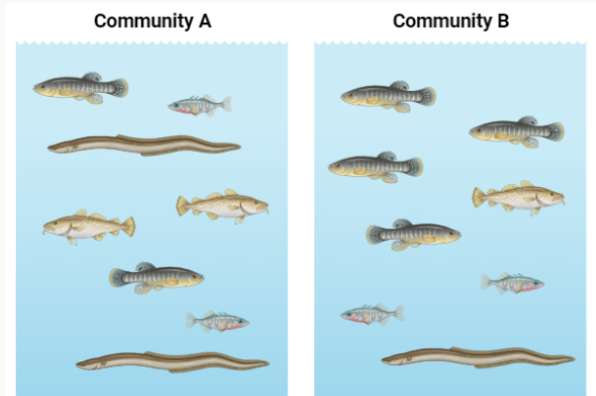
What community has more richness?
Both have the same number of richness
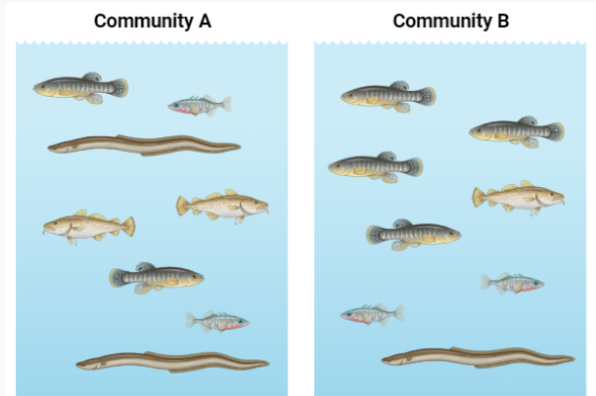
What community has more evenness?
Community A is more even than community B
How are communities and assemblages often named (2 ways)?
Based on ecological or numerical dominance of a species or group of species that are of value to people
By prominent guilds: a group of species (populations) in the community or assemblage which exploit the same resource in a similar war (EX: may be thermal habitat, feeding, reproductive, etc.)
What are some of the major trophic guilds in teleost fish?
Detritivores
Scavengers
Herbivores (Grazers, Browsers, Phytoplanktivores)
Omnivores
Carnivores (Benthivores, Zooplanktivores, Aerial feeders, Piscivores)
What are ecoregions?
Some spatial distinct area or land
What are ecotones?
A transitional area between communities/ecoregions that blur the lines
EX: riparian buffer zone
What does community/assemblage structure include?
Number of species or other diversity indices
Number of families
Species richness within families
Number of prey versus piscivore species
Composition by guilds and ‘functional groups’
Distribution of species abundance at a locality
Distribution of age classes within species
Body-size patterns for the whole assemblage
Distribution of trophic potential (EX: mouth size) within the assemblage
What are the 2 theories that are used to determinant the assemblage structure?
Niche theory
Neutral theory
What is niche theory?
Community composition reflects the niches and interactions of its species
EX: biotic coupling, saturated, competition, resource limitation, density dependence, specialization, few stochastic effects, tight patterns
What is neutral theory?
Community composition is random and due to chance/luck of its species
Whoever gets there first is the one in your community (think coral larvae fish)
EX: biotic decoupling, unsaturated, species independence, abiotic limitation, density independence, opportunism, large stochastic effects, loose patterns
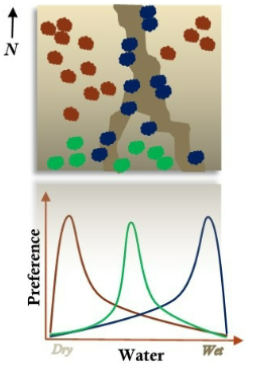
What do these sets of graphs show?
Niche theory
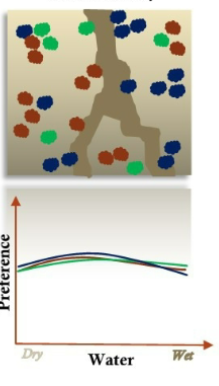
What do these sets of graphs show?
Neutral theory
Does history matter?
IT DEPENDS!
No = one environment leads to one community
Yes = the colonization and extinction history can lead to multiple stable equilibria
When would history matter?
When there is a big species pool (new species can adapt after every disturbance)
When there is low dispersal, high productivity, and low disturbance (also means the ecosystem is for everyone! —> more species available))
What are the characteristics of a habitat for specialists?
Low productivity and high disturbance
What did the Chase (2003) paper look at?
Looked at different ponds and their distance from each other and how much disturbance was at every pond
Observation study (I found this but many things can cause this)
What did the Chase (2003) paper find?
The further away the ponds where from one another the more dissimilar (different) the communities were
Ponds with lower disturbance (permanent/stable) had more dissimilarity (difference)
Ponds with more primary productivity had more dissimilarity (difference(
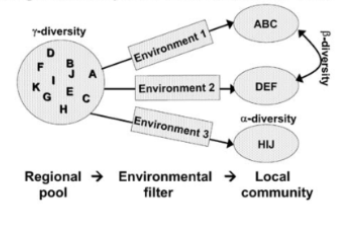
What does this graph show?
A single stable equilibrium: environments differ
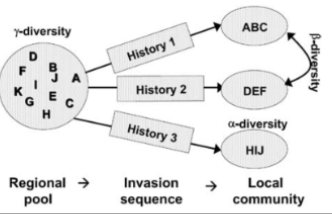
What does this graph show?
Multiple stable equilibria: histories differ

