1. Modelling in Engineering
 Studied by 0 people
 Call Kai
 Learn
Learn Practice Test
 Spaced Repetition
 Match
Match Flashcards
 Knowt Play
1/18

Earn XP
Description and Tags
LO: 1. Model classification 2. Complexity 3.System Identification in Modelling
Name | Mastery | Learn | Test | Matching | Spaced | Call with Kai |
|---|
No analytics yet
Send a link to your students to track their progress
19 Terms
Compare deterministic models to probabilistic / stochastic models
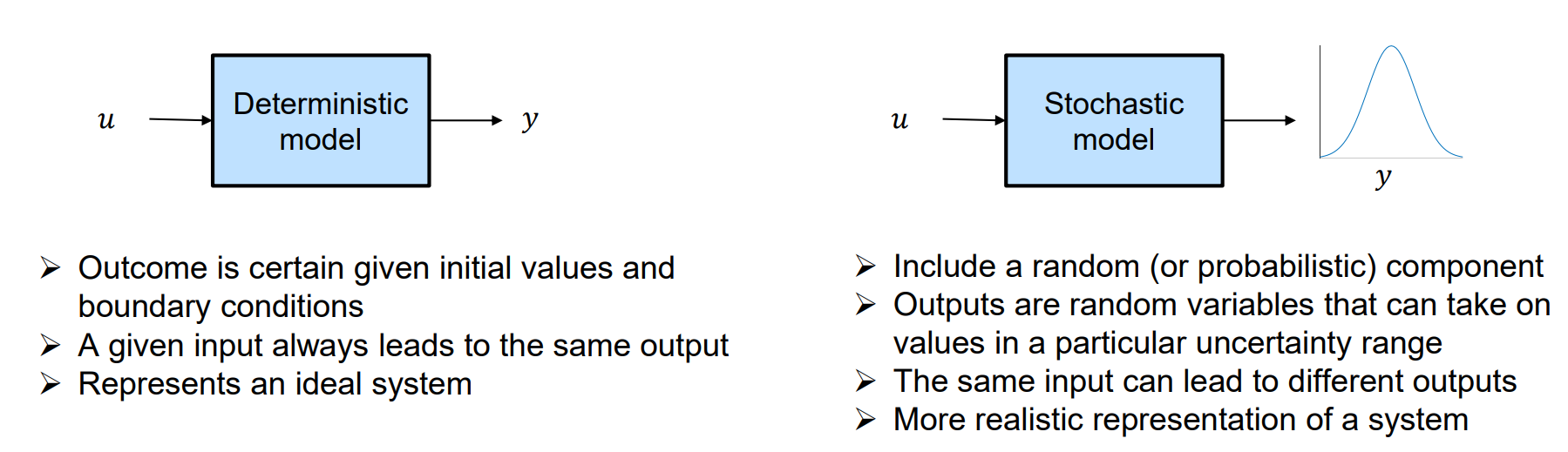
We can classify models into deterministic models vs. probabilistic / stochastic models. Whats their key differences ?
Unlike deterministic models that produce the same exact results for a particular set of inputs, stochastic models predict outcomes that account for unpredictability or randomness.
Stochastic models produce an output distribution for any given deterministic input.
A stochastic model can be obtained by associating a probability distribution to several uncertain model parameters and by propagating the parametric input uncertainty through the deterministic model.
Is Statistical data-driven modelling a deterministic or a non-deterministic model ? Elaborate what this model is based on and what its goal is ?
It’s a non-deterministic model. The variables are random (not specific) with probability distribution.
It is based on data. (→ data-generating process)
Its goal is to infer statements about a real-world process (generate knowledge, e.g. make predictions; validate assumptions etc.)
Statistical modeling is the use of mathematical models and statistical assumptions to generate sample data and make predictions about the real world. A statistical model is a collection of probability distributions on a set of all possible outcomes of an experiment.
What is a training data set, what is a test data set?
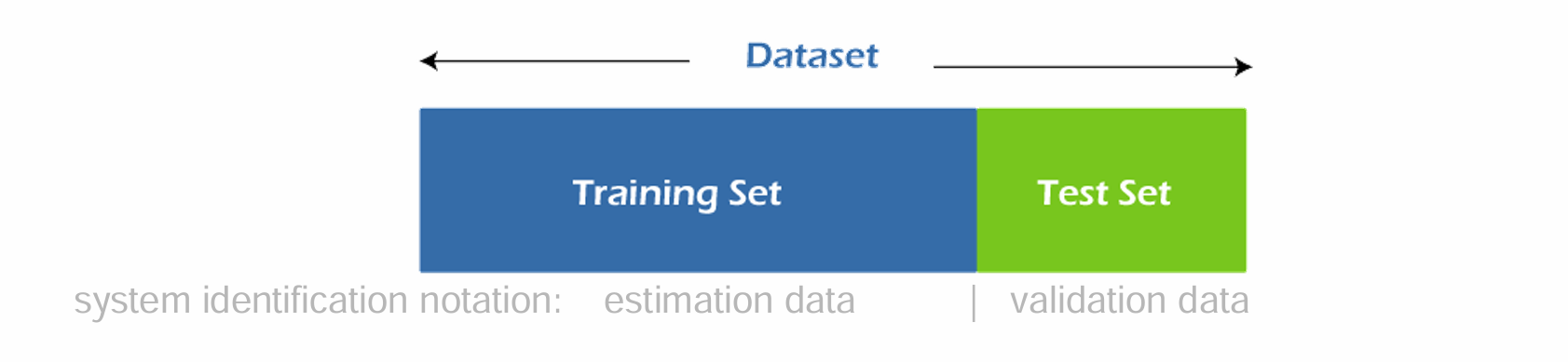
Data can be divided into training and test data sets.
Our task becomes then to learn the statistical model from the training set such that it can make correct predictions on a new set of data. We test this ability on the test data set.
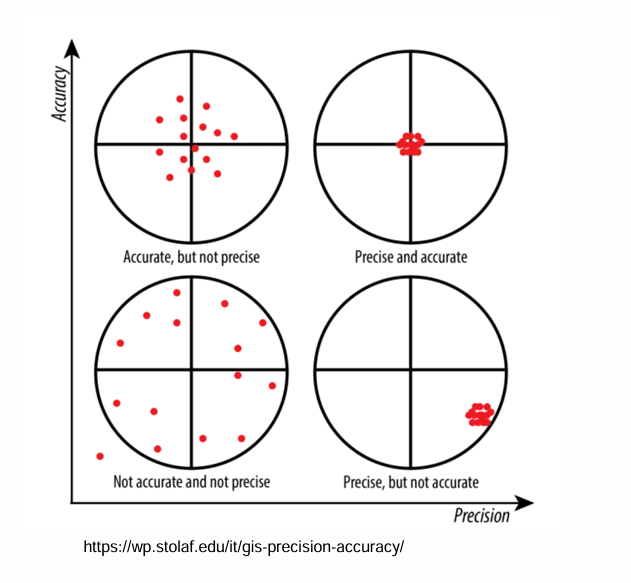
What is the difference between Accuracy and Precision ?
Accuracy: How close are the model results to the actual value of the real system?
Precision: How close are the model results to each other?
What are the different model fidelity levels ? What do they tell about the real system ?
→ They answer the following question: “How accurately does the model need to approximate reality? “
L0: Based on empirical knowledge / rough estimations
L1: Simplified physics principles – limited number of effects considered
L2: Physical behaviour represented by more accurate relationships & equations
L3: Very high computational costs – only local, distinct effects, high precision, high number of features captured
How do we define the complexity of a model ?
Computational complexity or algorithm-sided complexity:
Computational time requirement
Computational memory storage requirement
often expressed through “Big-O-Notation”: Used to classify algorithms according to how their run time or space requirements grow as the input size grows => measure of computational complexity
Problem-sided (model) complexity
How complex is the model structure?
Number of parameters / degree of polynomial / independent variables / features / predictors used
System-model complexity
Amount of fundamental (physical) insight about real system
“reciprocal” of degree of abstraction: higher level of abstraction → lower system-model
What is “Underfitting” in the context of Problem-sided complexity ?
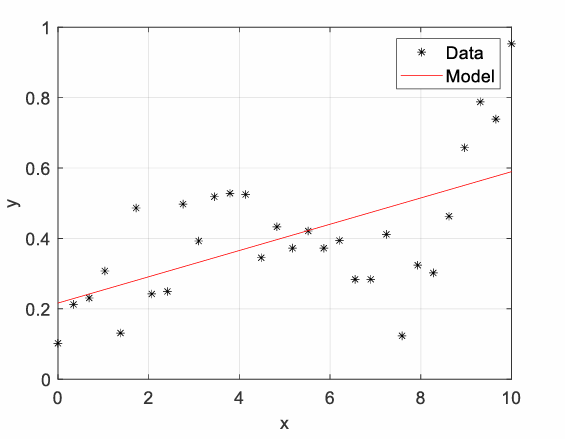
Model cannot capture the relevant effects with sufficient accuracy (e.g., nonlinearities)
E.g. important physical effects have been neglected; polynomial degree is too low; insufficient training in data-driven models
What is “Overfitting” in the context of Problem-sided complexity ?
Model captures irrelevant info, e.g. noise
Typical problem of data-driven models!
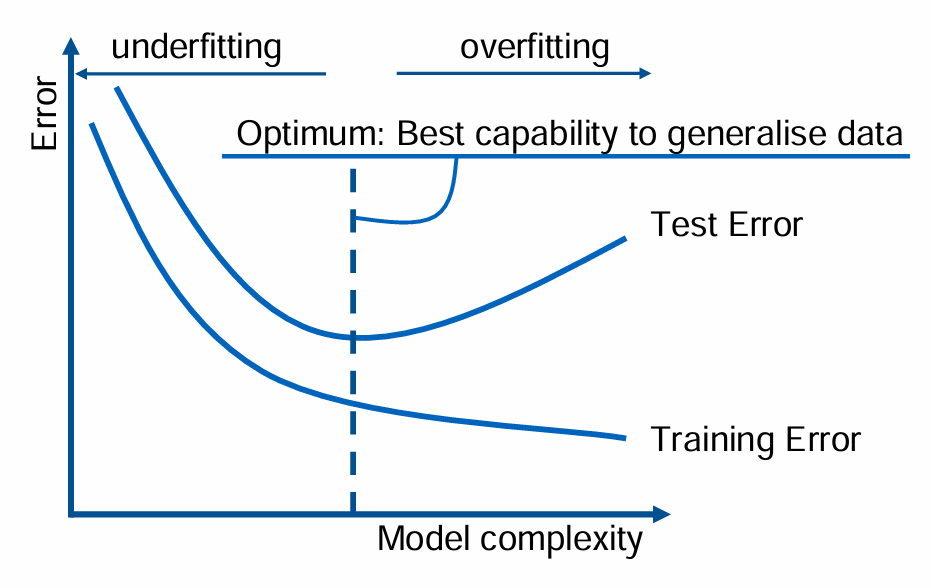
Model may be over-trained and cannot generalise from training to test dataset
Model degree is too high
How do we correct “Underfitting” and “Overfitting” to generalise data ?
How to correct/avoid underfitting:
→ Increase order of polynomial
→ Switch to nonlinear model
How to correct/avoid overfitting:
→ Decrease order of polynomial
→ Decrease ranges of factors
→ Increase number of training sets
Define “ Cross-Validation Error” and how do we obtain it?
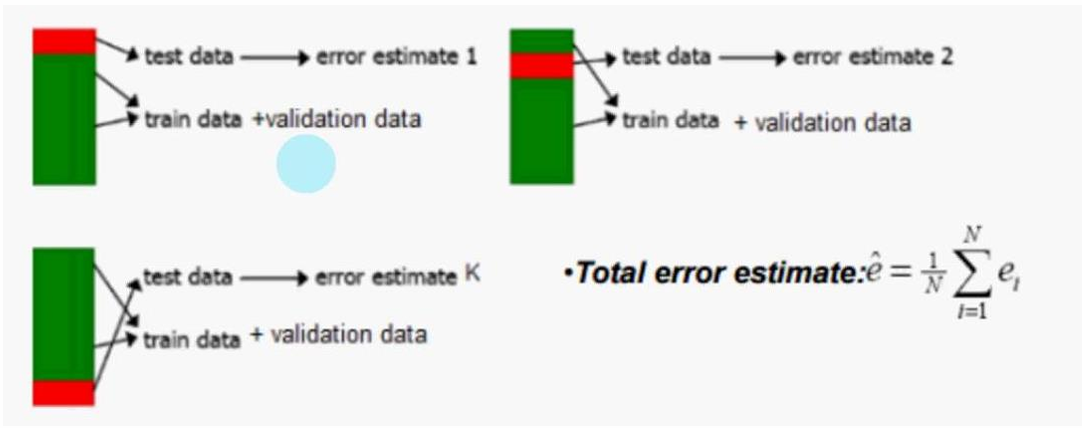
Cross-Validation Error = Wow well does the model generalize?
Procedure:
Randomly split training data into 𝑞 equal subsets
Remove first subset & fit model to remaining data
Predict removed subset using model fitted to remaining data
Remove second subset from data set & fit model to remaining data
Predict removed subset using model fitted to remaining data
Iterate till there are no subsets left
What is the definition of “Degree of abstraction” ?
Refers how far a physics-based model distances itself from reality in terms of physical insight. The higher the degree of abstraction, the lower the model complexity
! Important: Low degree of abstraction ≠ Correctness !
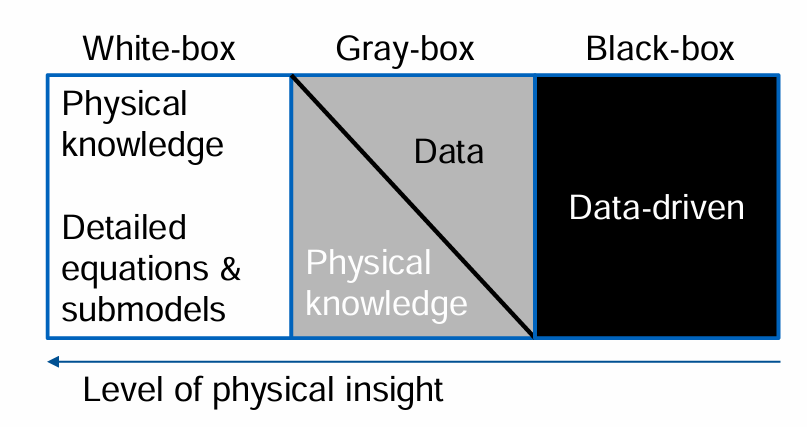
What do “White-boxes”, “Grey-boxes”, and “Black-boxes” model ? What are they useful for ?
→ They model the degree of abstraction of a system and how much physical insight is used for the system
White-box modelling:
Complete understanding of inner system structure, system boundary & interaction with its environment
Physical law-driven
Can be difficult or impossible to obtain
→ suitable when system is simple & well-understood
Gray-box modelling:
Limited knowledge of inner system structure, system boundary & interaction with its environment
Captures essential system information
Partly data-driven
→ suitable when system is partially understood & has complex components
Black-box modelling:
No knowledge of inner system structure
Only IO-behaviour
Statistics/Machine Learning used to build model
Can capture complex behaviours that are hard to model physically
Fully data-driven
→ suitable when system is highly complex, not well understood & experimental
What are “Parametric-” and “Non-Parametric” model types ? What are their differences ?
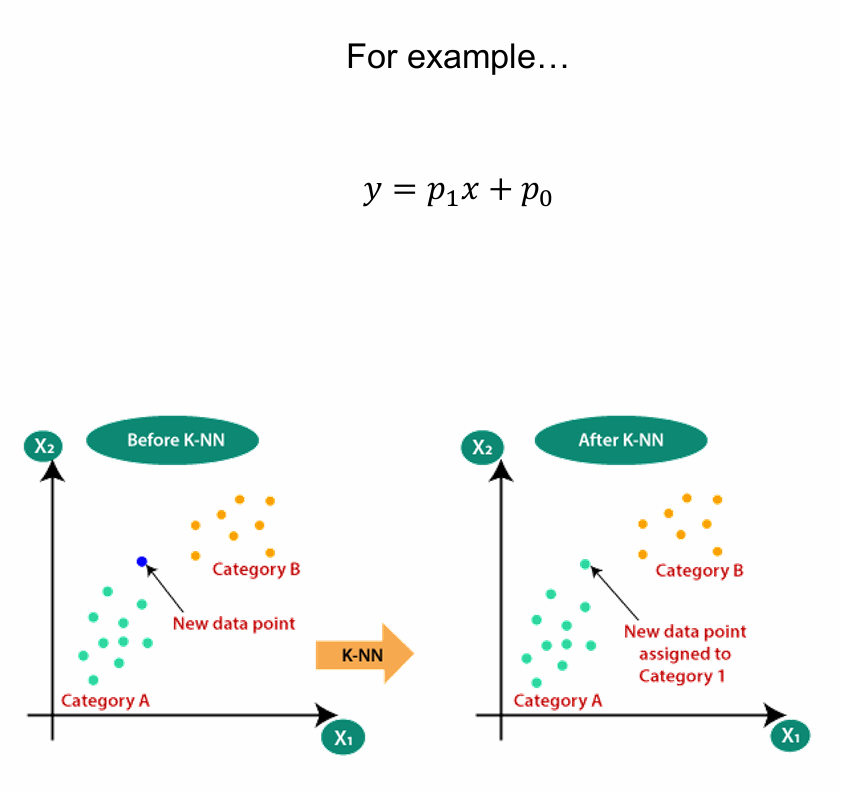
Parametric Models:
Based on finite set of parameters
Response is a functiono of input variables and parameters
→ e.g. polynomial structures
Non-Parametric Models:
Parameter space is infinite-dimensional
No assumptions on distribution of the data
Number of parameters can grow with amount of data considered
→ e.g. clustering
How do we classify models into Continuous- vs. Discrete Models?
Continuous models:
output changes continuously over time
assumed behaviour of many physical models
e.g. set of ordinary differential equation
Discrete models:
Output changes only at discrete points in time
Computer-based models are discrete
e.g. state machine
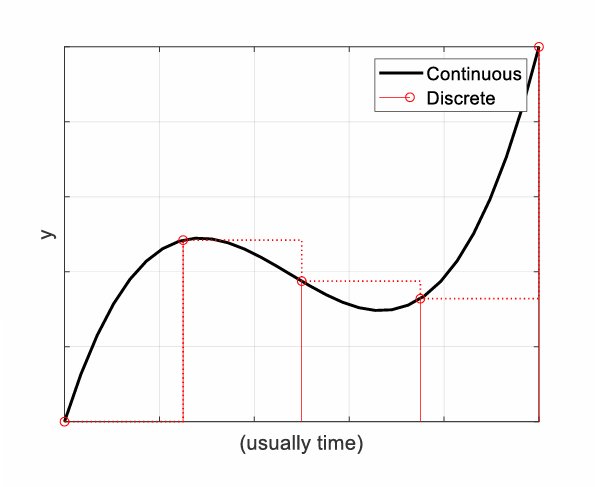
In addition to classifying models according to “Continous-” and “Discrete-” Models, how else can we classify models accordingly?
→ Classify models according to domains they cover
(e.g. aerospace, propulsion, structure, gravity, flight dynamics etc. … )
Where do we start when modelling a system? Whats the general high-level approach ?
Identify & formulate problem
Specify key questions & define objectives: what information and what accuracy are desired?
Identify potential modelling approaches
Evaluate modelling options (consider degree of abstraction, level of fidelity, (computational) complexity, uncertainty, etc.)
Choose the most suitable modelling technique (expected gain and the “effort” required to achieve this gain → trade-off
Clarify model architecture, consider system boundaries, define final assumptions (How do model elements interact with each other ? How does the system interact with its environment? )
Implement model
Inspect model quality: is it realistic enough? Does it meet the requirements?
Use the model to solve the initial problem
What is System Identification and Why is this beneficial/crucial especially for Aersoapce ?
System Identification = Derive a model of a dynamic system from (experimental) data
by essentially caputing Input-Output Behavior.
Pros:
Does not require a priori knowledge
Potentially both computationally efficient and accurate models
Intrinsic validation possibility
Can be used to simplify complex model structures
Cons:
Less or no physical insight
Models tied to tested system: hard to generalise
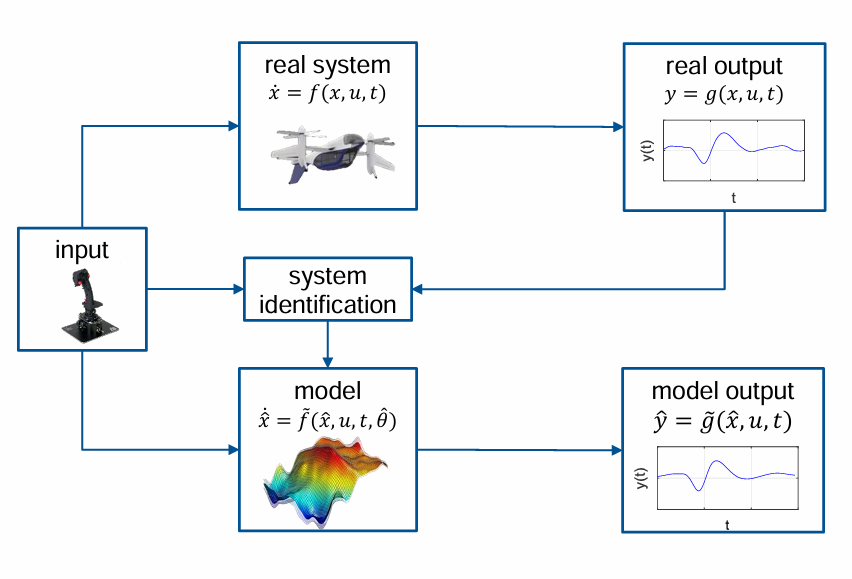
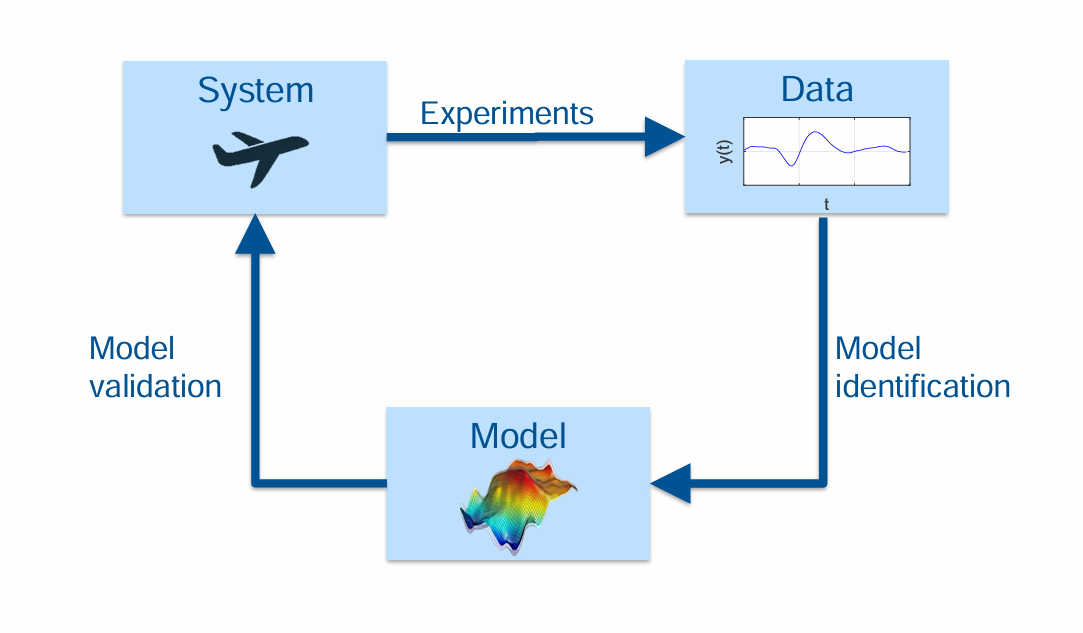
What are the main steps in identifyiing a system?
Main steps:
Design & perform experiments
Define model structure
Estimate parameters
Validate model
 Note
Note  Flashcards (193)