astronomy: unit 8, chapter 9
 Studied by 0 people
 Call with Kai
 Learn
Learn Practice Test
 Spaced Repetition
 Match
Match Flashcards
 Knowt Play
1/53

Earn XP
Description and Tags
the sun
Name | Mastery | Learn | Test | Matching | Spaced | Call with Kai |
|---|
No study sessions yet.
54 Terms
What is the definition of a star?
a glowing ball of gas held together by its own gravity and powered by nuclear fusion in its core
How do the radius and mass of the sun compare to the Earth?
the radius is larger than 100 Earth radii; mass greater than 300,000 Earth masses
How is the region named the photosphere defined?
the visible surface of the sun, lying just above the uppermost layer of the sun’s interior and just below the chromosphere
List the seven zones of the sun given in the section and identify them as belonging to the atmosphere or interior of the Sun
core (interior), radioactive (interior), convection (interior), photosphere (atmosphere), chromosphere (atmosphere), transition region (atmosphere), corona (atmosphere)
What is the rotation rate at the equator of the sun? What is the rotation rate at the poles of the sun?
24.5-25.5 days; 35-38 days
What is the definition of luminosity?
total amount of energy emitted by a star, including the sun, per unit of time
What is hydrostatic equilibrium?
condition in a star or other fluid body in which gravity’s inward pull is exactly balanced by internal forces due to pressure
What is the density in the core of the sun? How does this compare to the density of the iron?
the variation in density is large, ranging from a core value of about 150,000 kg/m3, 20 times the density of iron
What is the temperature in the center of the sun? What is the temperature at the photosphere?
the temperature is about 15 million K at the center and decreases steadily, reaching the observed value of 5800 K at the photosphere
What feature on the surface of the sun is direct evidence for convection? Describe the size and lifetime of these features
granulation on the sun’s surface is the direct and visible evidence of convection; it appears as a patchwork of bright, boiling, cell-like patterns due to hot plasma rising from the interior, cooling, and sinking back down
What is the most abundant element in the sun? What is the second most abundant element?
Hydrogen is by far the most abundant element, followed by helium
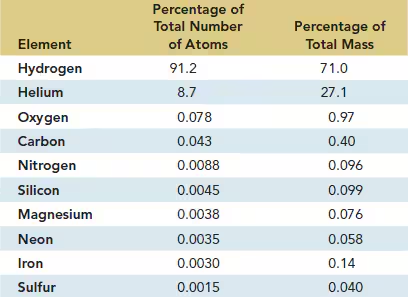
From Table 9.2, what are the four next most common elements in the Sun?
oxygen, carbon, nitrogen, and silicone
Spicules are the most common feature of the chromosphere. Describe them
short-lived, narrow jets of gas that typically last mere minutes can be seen sprouting up from the chromosphere in this ultraviolet image of the Sun
What is the temperature of the solar corona?
1 million kelvins
What is the solar wind? What causes it?
outward flow of fast-moving charged particles from the sun; coronal heating, magnetic field escape, coronal holes, and active regions
How much of the sun's mass has been lost to the solar wind since the sun formed?
over the past 4.5 billion years, the sun has lost roughly .05% of its total mass through a combination of solar wind and nuclear fusion
Describe the temperature and size of sunspots. Why do sunspots appear dark?
the temperature of the umbra is about 4500 K, that of the penumbra 5500 K, and typically measure about 10,000km across; because they appear against an even brighter background (the 5800 K photosphere)
How are sunspots related to the magnetic field of the sun? How does the magnetic field in sunspots compared to the area around it in strength?
they are intense, localized concentrations of the sun’s magnetic field that emerge through the photosphere; their magnetic field is roughly 1,000-2,500 times stronger than the surrounding quiet, undisturbed solar surface
How does the Sun’s rotation affect the solar magnetic field?
it twists, stretches, and tangles the solar magnetic field lines
What happens when the magnetic field becomes so strong that it overwhelms the Sun's gravity?
it triggers violent solar activity, including massive coronal mass ejections (CMEs), intense solar flares, and complex, tangled field structures
Describe the sunspot cycle. What significance do the time intervals “11 years” and “22 years” have in the solar cycle?
fairly regular pattern that the number and distribution of sunspots follows, in which the average number of spots reaches a maximum every 11 or so years, then falls off to almost zero; In fact, the 11-year sunspot cycle is only half of a 22-year solar cycle—the period needed for both the average number of spots and the Sun’s overall magnetic polarity to repeat themselves (the polarities reverse for the next 11 years)
What was the Maunder Minimum?
a prolonged period from roughly 1645-1715 when the sun experienced an unusual scarcity of sunspots, indicating very low solar activity, coinciding with colder temperatures during the little ice age in europe and north america
What is a solar prominence? Describe their behavior.
a large, bright gaseous feature extending outward from the sun’s surface, often in a loop shape, consisting of relatively cool, dense plasma suspended in the hot corona; generally form over a day, consist of many spine legs anchored to the photosphere, and are stable, long-lived structures that can last for months
What is a solar flare? How are they different from prominences?
an intense, rapid explosion of electromagnetic radiation and high-energy particles from the sun’s atmosphere; flares are bright, explosive, and shoot energy into space while prominences are cooler, stable loops of plasma anchored to the sun’s surface
What is a coronal mass ejection?
massive eruption of plasma and magnetic fields from the sun’s outer atmosphere into space, releasing huge amounts of energy and billions of tons of solar material at high speeds
What effect can coronal mass ejections have on the Earth?
they can trigger significant geomagnetic storms, as well as power grid failures, satellite disruptions, communication and navigation issues, auroras, and pipeline corrosion
How are coronal holes related to the solar wind?
they act as primary sources of the fast solar wind, featuring open and unipolar magnetic field lines that extend into interplanetary space, allowing plasma to escape freely, creating “magnetic highways”
What is the general definition for nuclear fusion?
mechanism of energy generation in the core of the sun, in which light nuclei are combined, or fused, into heavier ones, releasing energy in the process
The proton-proton chain describes a certain type of nuclear fusion. What type of light nuclei are used in the process? What heavier type of nuclei are produced?
light nuclei- hydrogen
heavier nuclei- helium, uranium, plutonium
How many tons of hydrogen are fused in the core of the sun every second?
600 million tons
Why are neutrinos especially important in studying the interior of the Sun?
they are the only particles that escape the solar core immediately, providing real-time data on nuclear fusion
active region
region of the photosphere of the sun surrounding a sunspot group, which can erupt violently and unpredictably. during sunspot maximum, the number of active regions is also a maximum
convection zone
region of the sun’s interior, lying just below the surface, where the material of the sun is in constant convection motion. this region extends into the solar interior to a depth of about 20,000km
corona
one of numerous large, roughly circular regions on the surface of venus, thought to have been caused by upwelling mantle material, causing the planet’s crust to bulge outward. the tenuous outer atmosphere of the sun, which lies just above the chromosphere at great distances, turns into the solar wind
coronal hole
vast regions of the sun’s atmosphere where the density of matter is about 10 times lower than average. the gas there streams freely into space at high speeds, escaping the sun completely
photosphere
visible surface of the sun, lying just above the uppermost layer of the sun’s interior and just below the chromosphere
positron
atomic particles with properties identical to those of a negatively charged electron, except for its positive charge. this positron is the antiparticle of the electron. positrons and electrons annihilate one another when they meet, producing pure energy in the form of gamma rays
solar activity
unpredictable, often violent events on or near the solar surface, associated with magnetic phenomena on the sun
standard solar model
a self-consistent picture of the sun, developed by incorporating the important physical processes that are believed to be important in determining the sun’s internal structure into a computer program. the results of the program are then compared with observations of the sun, and modifications are made to the model. the standard solar model, which enjoys widespread acceptance, is the result of this process
transition zone
the region of rapid temperature increases that separates the sun’s chromosphere from the corona
chromosphere
the sun’s lower atmosphere, lying just above the visible atmosphere
deuteron
isotope of hydrogen in which a neutron is bound to the proton in the nucleus. often called heavy hydrogen because of the extra mass of the neutron
granulation
mottled appearance of the solar surface, caused by rising (hot) and falling (cool) material in convective cells just below the photosphere
helioseismology
study of conditions far below the sun’s surface through the analysis of internal waves that repeatedly cross the solar interior
law of conservation of mass and energy
fundamental law of modern physics that states that the sum of mass and energy must always remain constant in any physical process. in fusion reactions, the lost mass is convicted into energy, primarily in the form of electromagnetic radiation
neutrino
virtually massless and chargeless particle that is one of the products of fusion reactions in the sun. neutrinos move at closer to the speed of light and interact with matter hardly at all
neutrino oscillations
possible solution to the solar neutrino problem, in which the neutrino has a very tiny mass. in this case, the correct number of neutrinos can be produced in the solar core, but on their way to earth some can oscillate, or become transformed into other particles, and thus go undetected
polarity
measure of the direction of the solar magnetic field in a sunspot. conventionally, lines coming out of the surface are labeled S, while those going into the surface are labeled N
proton-proton chain
chain of fusion reactions, leading from hydrogen to helium, that powers main-sequence stars
radiation zone
region of the sun’s interior where extremely high temperatures guarantee that the gas is completely ionized. photons only occasionally interact with electrons and travel through the region with relative ease
sunspot
an earth-sized dark blemish on the surface of the sun. the dark color of the sunspot indicates that it is a region of lower temperature than its surroundings
supergranulation
large-scale flow pattern on the surface of the sun, consisting of cells measuring up to 30,000km across, believed to be the imprint, of large convective cells deep in the solar interior
what is the solar constant?
about 1400 watts per square mile
convection zone
region extending down some 200,000 km below the photosphere where the material of the sun is in constant convective motion
 Note
Note  Flashcards (36)