insect physiology
 Call Kai
 Learn
Learn Practice Test
 Spaced Repetition
 Match
Match Flashcards
 Knowt Play
1/47

There's no tags or description
Looks like no tags are added yet.
Name | Mastery | Learn | Test | Matching | Spaced | Call with Kai |
|---|
No analytics yet
Send a link to your students to track their progress
48 Terms
Vitrification Hypothesis
Hypothesis for how cells survive dehydration:
Cell contents form a glass-like state
Molecular movement stops
Cellular structures are stabilized
Water Replacement Hypothesis
Hypothesis for how cells survive dehydration:
Molecules (mainly trehalose) replace water
Maintains structure of:
membranes
proteins
macromolecules
Cryptobias
an extreme dormant state where organisms appear almost dead but can revive when conditions improve.
Characteristics:
Metabolism becomes nearly undetectable
Organisms survive otherwise unsurvivable conditions
Pros of Dormancy
avoidance of inclement conditions
synchronizing (food source/same species)
difference between diapause & quiesence
diapause is programed, quiescence is not.
In addition, quiesence starts after conditions become unfavorable & ends when conditions improve.
In temperate insects, diapause is cued by..
changes in the photoperiod
Stage specific diapause
some examples
Egg: Asian tiger mosquito
Larvae: pitcher plant mosquito / eurytoma gigantea
Pupae: flesh fly / eurytoma obtusiventris
Adult: house mosquito / paper wasps
Types of Diapause
Facultative Diapause
Occurs only under certain environmental cues
Common in temperate insects.
Obligate Diapause
Happens every generation
Required for development.
Phases of Diapause
Induction → Preparation & Entry → Maintenance → Termination → Post-diapause Quiescence
What two forces control ion movement across membranes?
→ Chemical force (diffusion)
→ Electrical force (voltage)
Why is the inside of a neuron negative at rest?
K⁺ leaks out of the cell, leaving excess negative charge inside.
What is chemical force?
Movement of ions down their concentration gradient
What is electrical force?
Movement of ions due to membrane potential
Eion < Va
Electrical force dominates & drives Na+ out of the cell
Eion > Va
Chemical force dominates & drives Na+ into the cell, even against a positive chemical force
What is a graded potential?
A voltage change that decreases with distance
What is an action potential?
A rapid, all-or-none electrical signal that travels along the axon.
Why do some insect neurons not need action potentials?
due to how small insects are, some neurons are able to send signals w/only passive signal propigation
What channels generate action potentials?
Voltage-gated Na⁺ and K⁺ channels
What is light detected by?
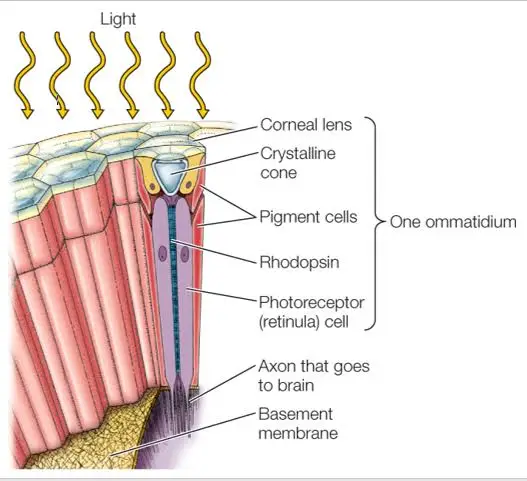
Light is detected by rhodopsin, a G-protein coupled receptor (GPCR)
What is rhodopsin made of?
Opsin (protein)
Retinal (chromophore derived from vitamin A).
Key Themes Insect Vision:
Insect compound eyes are made of thousands of ommatidia.
Visual acuity is low but varies across the eye.
Light detection uses rhodopsin GPCR phototransduction.
Most insects have trichromatic color vision (UV, blue, green).
Many insects detect polarized light for navigation and finding water.
What is the basic visual unit of an insect compound eye?
Ommatidium (one of the MANY light detecting units which compose a compound eye)
What are the main parts of an ommatidium?
→ Corneal lens
→ Crystalline cone
→ Photoreceptor cells
→ Rhabdom
→ Screening pigment cells
What determines spatial resolution in compound eyes?
Interommatidial angle
What does a smaller interommatidial angle between adjacent ommatida yield?
Higher visual acuity
What is an acute zone?
A region of the eye with denser ommatidia and higher visual acuity
What type of receptor is opsin?
G-protein coupled receptor (GPCR)
What structural change occurs when rhodopsin absorbs light?
Retinal changes from 11-cis to all-trans
What type of signaling pathway is activated after rhodopsin changes shape?
Second messenger cascade
What ion channel ultimately opens during phototransduction?
TRP channel
What happens when the TRP channel opens?
Cations enter the cell, leading to depolarization
What are the three main photoreceptor types in most insects?
Blue, Green & UV
What is an ‘e-vector’?
A plane in which lightwaves vibrate
What natural source produces polarized skylight patterns?
The atmospheric scattering of light
About how many ommatidia are in the DRA?
~ 60
Which specialized eye region detects polarized light?
The Dorsal Rim Area (DRA)
Name the types of Insect Mechanosensors
Mechanosensory hairs, capaniform sensilla, & tympanic ears
What’s up with mechanosensory hairs?
These hairs ben when stimulated by touch/air movements, which activates a sensory neuron at the base of the hair
Elaborate on the role of campaniform sensilla
These are dome shaped sensor in the cuticle which detect strain and deformation in the cuticle. They help insects sense the forces acting on them
Tympanic Ears
Thin cuticle, sense sound pressure waves and vibrations caused by sound
Information from sensory hairs is integrated to the neuron system and directed to…
fourteen giant interneruoms
What are the characteristics of the Giant Internuerons?
receive input from many sensory hairs
located in the terminal abdominal ganglion
have large axons
rapidly transmit information to the thorax.
What triggers the ‘escape behavior’ response in cockroaches?
Wind detected by cercal hairs → sends signal to giant interneurons → GI’s transmit signals to cockroach legs → triggers 180º movement from source detection
What are EPSP’s?
excitatory post synaptic potentials
What are the characteristics of EPSP’s? What response can EPSP’s trigger?
weighted (based on distance/length constant)
summed across dendrites
If total excitation exceeds threshold → action potential fires
How does ‘Descending Inhibition’ apply to insect neural activity?
Inhibitory signals from a higher neural center (e.g., the brain) suppress neural activity in some circuit
The brain sends signals down the ventral nerve cord which can suppress certain behaviours. (eg, male mantis s ex)

