Cell communication
 Studied by 0 people
 Call Kai
 Learn
Learn Practice Test
 Spaced Repetition
 Match
Match Flashcards
 Knowt Play
1/39

There's no tags or description
Looks like no tags are added yet.
Name | Mastery | Learn | Test | Matching | Spaced | Call with Kai |
|---|
No analytics yet
Send a link to your students to track their progress
40 Terms
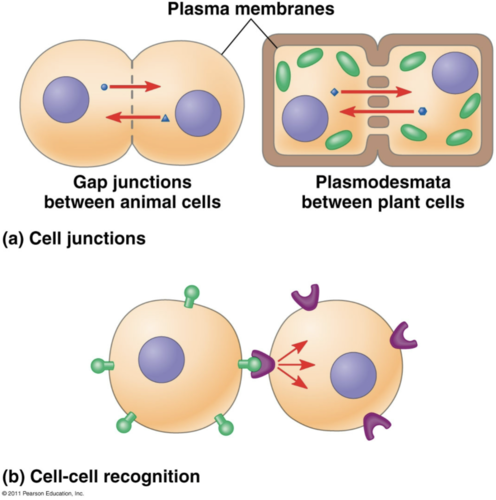
direct communication
direct exchange of materials and interaction of cell surface molecules
indirect communication
two non contacting cells using signals
paracrine
release of chemical signal from one cell, detected by another closely located cell
autocrine
release of chemical signal from one cell, detected by the same cell
neural
release of neurotransmitters across a synapse between two closely located neurons
endocrine
long distance, hormonal signaling
signal molecules
AA and its derivatives, steroids, proteins, peptides
Glutamic acid
AA excitatory transmitter
GABA
AA derivative inhibitory transmitter
epinephrine
AA derivative increases blood glucose
Ligands
signals- dont change anything unless bonded to a receptor
AA and its derivatives interact with
polar + hydrophilic (water soluble), signals that cannot cross the membrane
Steroids interact with
non-polar + hydrophobic (lipid soluble) signals that can cross the membrane
step 1 signaling process
reception, signal molecule binds
step 2 signaling process
transduction pathway in cell
step 3 signaling process
response
1) alteration of enzyme function
2) alteration of gene expression
transduction cascade
consists of kinase enzymes that catalyzes phosphate group, changes it shape, activates
phosphotase
enzymes that remove phosphate groups/reduce enzyme activity
advantages to transduction cascades
amplified signal
divergence of multiple cellular processes
various signals can control the cascade
second messenger
act to trigger the transduction cascade, intermediaries between receptor and cascade
3 principal second messengers
cyclic AMP
calcium ions Ca2+
IP3
cyclic amp cycle
ATP looses 2 phosphate groups w/ adenylyl cyclase, cyclizes ribose-phosphate=cyclic AMP, phosphodiesterase adds H20 and linearizes the ribose-phosphate into AMP
Types of transmembrane receptors
g-protein-linked (epinephrine)
tyrosine-kinase (insulin)
ligand-gated ion channels (calcium)
g-protein receptors
linked to relay proteins and bind guanosine di/tri-phosphate
g-protein receptors ligand binds and…
g-protein can now bind and GDP → GTP, activate/inhibit an adj. enzyme to create cAMP, once hydrolyzed cycle reverses
kinase component of tyrosine kinase receptor
part of the receptor
target protein component of tyrosine kinase receptor
separate from receptor
Dimerization
connection of two separated parts (kinases) when ligand binds
once dimerized kinase…
moves a phosphate from ATP to an AA (tyropsine)
autophosphorylation
kinase receptor phosphorylates itself
ATP → ADP in tyrosine kinase
phosphorylates dimer and therefore activates relay proteins
kinase signaling and gene expression
reception (signal attaches), transduction (phosphorylation cascade), activates transcription factors in nucleus, creates mRNA
calcium second messenger
binds to calmodulin, kinase triggers kinase cascade
increase intracellular calcium by
facilitated diffusion through ion channels
release of calcium from intracellular stores
release of calcium from intracellular stores
regulated by signal cascade using IP3- activated by g-protein or protein-kinase
phospholipase C
breaks down PIP2 → DAG + IP3 (second messenger)
termination of Ca2+ signaling
removed from cytosol by pumps into outside, mitochondria, SER, w/ use of ATP
variations of signaling
single response
branch point, two responses
cross-talk btwn two pathways
same signal, diff response on diff receptor
steroid hormones control
gene expression
intracellular signaling/cross-talk
steroid hormones pathway
diffusion into cell
binds to receptor, change in conformation
moves into nucleus aided by protein
controls gene expression

