3: Chemical Interactions + Agonist/ Antagonists + Partial/ Inverse Agonist
 Studied by 0 people
 Call Kai
 Learn
Learn Practice Test
 Spaced Repetition
 Match
Match Flashcards
 Knowt Play
1/75

There's no tags or description
Looks like no tags are added yet.
Name | Mastery | Learn | Test | Matching | Spaced | Call with Kai |
|---|
No analytics yet
Send a link to your students to track their progress
76 Terms
What are the four different types of chemical interactions?
additive
synergistic
potentiation
antagonism
the combined effect of two chemicals is equal to the sum of the effects of each agent alone (2+3=5) ?
additive
two organophosphate insecticides when given together will inhibit an insect’s acetylcholinesterase enzyme as a sum of both of their parts
this is an example of which chemical interaction?
additive
the combined effect of two chemicals are much greater than the sum of the effects of each given alone (2+2=20)
synergistic
two hepatotoxic chemicals (carbon tetrachloride and ethanol) produce more than additive toxicity when given together
synergism
when one chemical does not have an effect on an organ or system but when added to another chemical makes that chemical much more effective (0+2=10)
potentiation
isopropanol is NOT hepatotoxic BUT when administered with carbon tetrachloride, the hepatotoxicity of carbon tetrachloride is much greater that then given alone
this is an example of which interaction between chemicals?
potentiation
when two chemicals administrated together interfere with each other’s actions or one interferes with the action of the other
(4+6)= 8
(4)+(-4) = 0
4 + 0 = 4
antagonism
repeated administration of the same dose of a drug results in a progressively reduced effect of the drug over time
higher doses may be needed to achieve the same pharmacological response
tolerance
is it possible to have tolerance to one effect of the drug and not to another?
if so, what is an example?
Yes!
opiods: can build a tolerance to analgesia effects but NOT respiratory depression
so higher opioid will cause high respiratory depression (BAD) but not desired analgesia effects
in terms of tolerance how would you interpret a change in ED50 but not TD50 ?
tolerance to therapeutic effect( need higher [L] to reach ED50)
BUT not to toxic effect (need same amount to get toxic so higher = higher toxicity)
what are three causes of tolerance?
metabolism or transport
mediators
receptor systems
how can metabolism and transport lead to tolerance?
list an example?
increased degradation or removal of the drug causes you require more of the drug to achieve the same effect as you getting less than the amount you are expecting
ex. drug efflux pumps in cancer cells
what is an example of decreased mediators leading to tolerance?
reduced neurotransmitters available to stimulate receptors
______ or _________ receptors can lead to increased drug tolerance
list an example
less changed
Clonal expansion of mutated receptors on cancer cells develop resistance against cancer drugs (imatinib resistance in EGF receptors)
complete tolerance that develops rapidly after (repetitive) administration of a pharmacologically active chemical
tachyphylaxis
Tachyphylaxis usually occurs following the ______ doseS of drugs
can increasing the dose overcome tachyphylaxis?
initial
NO, once you develop tachyphylaxis no amount of the drug will cause you to have a response
when taking a nitrovasodilator to treat angina you must take an 18-hour break before taking another dose to prevent ___________________ (if not, no matter how much you take, you will not get relief from angina)
tachyphylaxis
property of a molecule to activate the receptor
agonist
do agonists and antagonists have both affinity and intrinsic activity?
NO
agonists have affinity AND intrinsic activity
antagonists ONLY have affinity has no effect unless a agonist is present
property of a molecule to prevent the binding of agonists and block their biological function
antagonist
do antagonists have affinity for the receptor?
do they have intrinsic activity? what exactly is meant by intrinsic activity?
YES
NO, intrinsic activity is the ability to perform a function independently. Antagonists do not decrease efficacy unless there is an agonist that they are actively blocking whether it be noncompetitive or competitive
are agonists solely drugs?
NO an internal ligand can also be an agonist
binding of an agonist to a receptor stabilizes the receptor in an active ___________
conformation
D + R ⇌ DR*
the following suggests that AGONIST binding is proportional to _________ ________
receptor activation
D + R ⇌ D + R*
↕
DR ⇌ DR*
explain the following equation
what part of this equation is unstable?
a drug and receptor may come together to form an inactive complex (DR) or a drug may simply activate a receptor (R*) both of which are unstable
OR it could form a stable ACTIVE drug-receptor complex (DR*)
D + R ⇌ DR ⇌ DR*
what does the ⇌ between D+R and DR represent
what does the ⇌ between DR and DR* represent
—> = Kon
←— = Koff
—> = Ka = rate of receptor ACTIVATION
←— = Kb = rate of receptor DEACTIVATION
which type of antagonist
inactivates the agonist by modifying or sequestering it so that the agonist is no longer capable of binding to and activating the receptor WITHOUT interacting with the receptor
chemical
Protamine binds to acidic heparin to reverse excessive bleeding without interacting with its receptor
what type of agonist/antagonist is protamine?
chemical ANTAGONIST
what type of antagonist
activates or blocks the receptor that mediates a response physiologically OPPOSITE to that of the receptor for the agonist
doesn’t interfere with the receptor target of the agonist but instead with the receptor of a separate process that will counteract the response of the agonist
physiological/function
which antagonists inhibit the function of the agonist without binding the the target receptor of the agonist?
chemical
physiological/functional
dispositional
what type of antagonist
alters ADME so that the concentration and/or duration of the agonist at the target organ are diminished
dispositional
_____________ _______________ inccreases the metabolism of many drugs by inducing hepatic microsomal enzymes which reduces the concentrations and pharmacologic responses of administered drugs
this drug acts as a _________ antagonist/agonist
anticonvulsant phenobarbital
dispositional ANTAGONIST
what are some differences between competitive and noncompetitive antagonism in terms of
where it binds
reversibility
potency of agonist
efficacy of agonist
competitive bind onto the active site, noncompetitive binds to an allosteric site
competitive bind REVERSIBLY so it can be overcome with a larger number of agonists (potency decreased) non-competitive bind IRREVERSIBLY once it binds it changes the conformation of the receptor which can no longer be bound to
Potenceny: noncompetitive= no change in potenency competitive = decreased potency
efficacy: NC= decreased Competitive= unchanged
Compeititve Antagonim
reversible or irreversibly bound?
effect on efficacy
effect on potency
shift in the graph
can inhibition be overcome? if so, how?
reversibly
no change bc/ reversible
decreased potency (right shift)— need more agonist to compete against antagonist
right shift
yes with increased agonist
Noncompetitive Antagonism:
irriversible or reversible?
effect on agonist efficacy
effect on agonist potency
can inhibition be overcome?
irreversible — once it binds allosterically, the receptor can no longer be activated by agonist
decreased efficacy — won’t be able to reach max effect of having all agonistic receptors filled
no effect on potency (it will take the same amount of drug to get to 50% effectiveness— but effectiveness will be half)
inhibition CANNOT be overcome since increasing the concentration won’t change the fact that there are antagonists irreversibly bound
Asprin works as a blood thinner by binding irreversibly to COX enzyme preventing the formation of thromboxane
Asprin acts as a competitive/noncompetitive antagonist or agonist?
noncompetitive ANTAGONIST bc/ binds irreversibly
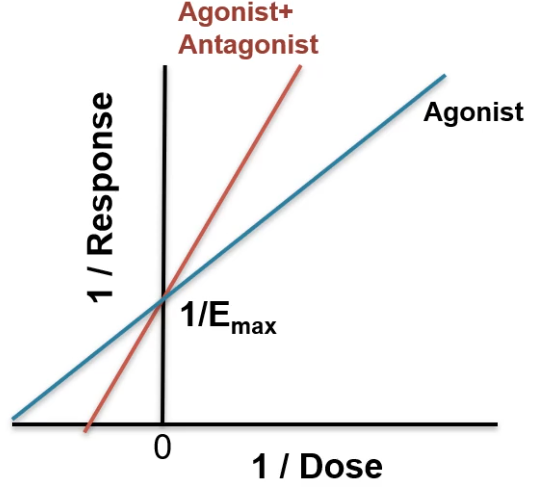
does the following dose-response reciprocal plot show a competitive antagonistic relationship or noncompeitive antagonistic relationship between the agonist ?
how can you tell?
The intersection at Y-axis (E-max) shows that efficacy remains the same meaning we have a COMPETITIVE inhibitor (if we have enough agonist we can outcompetethe inhibitor and reach max effectiveness)
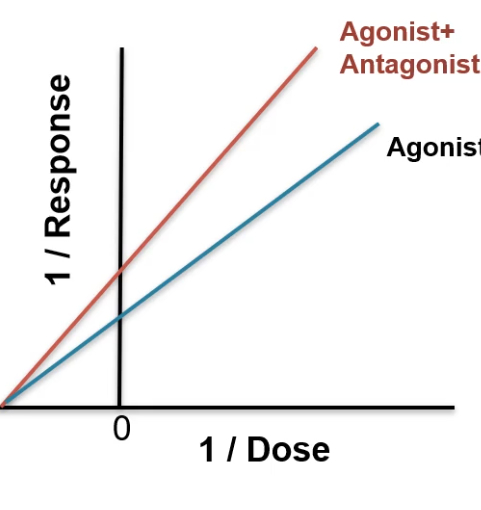
does the following dose-response reciprocal plot show a competitive antagonistic relationship or noncompetitive antagonistic relationship between the agonist ?
how can you tell?
noncompetitive bc/ intersection at x axis shows that [ligand]— dose— remains the same
the effectiveness (y-axis) decreases but the amount of drug it takes to reach the new max activity remains the same
which type of antagonism is altered in the presence of spare receptors?
noncompetitive
Noncompetitive Antagonism with Spares:
LOW antagonist concentration
bind to receptors not needed for maximal response SO no change in ___________
reduction in the number of receptors available INCREASING the fraction of receptors that must be occupied to produce a 50% response SO DECREASED ____________
HIGH antagonist concentration
binds to spare AND needed receptors SO _______ in potency and ________ in efficacy
efficacy
potency
decrease in potency AND efficacy
In noncompetitive antagonism involving spare receptors
what happens to the max efficiency of the agonist in LOW concentrations
what happens to max efficiency and potency in HIGH concentrations
HIGH
unchanged efficacy= antagonist takes up receptors that aren’t needed anyway for max effect
decreased potency = you need more agonist to reach 50% max effect since some of the spots needed are being taken away
LOW
decreased efficacy = antagonists begin to take the place of receptors needed to reach max effect (all are used up)
decreased potency = need more agonist to reach 50% of max since now even more receptors are taken up by antagonist
Noncompetitive Spare Antagonism
HIGH concentration of antagonist:
_______ efficacy
________potency
LOW concentration of antagonist
________efficacy
________potency
HIGH
UNCHANGED efficacy
decreased potency
LOW
decreased efficacy
decreased potency
a ______ agonist produces complete activation of a receptor at high drug concentration
full
a ________ agonist binding results in less than 100% activation even at very high concentrations
partial
________ agonists produce a response below the base line response measured in the absence of the drug
inverse
receptors can have________ activity such that a certain percentage of the response is achievable without the receptor being stimulated by a drug/ligand
CONSTITUTIVE
partial agonists are sometimes also referred to as
partial antagonists
mixed-agonist- antagonist
since partial and full agonists bind to ______ receptor site partial agonists can ______ the response produced by a full agonist
same
REDUCE

derivatives of trimethylammonium stimulate muscarinic acetylcholine (Ach) receptors to cause muscle contraction in the gut
the ligand is acetylcholine which is not shown on the graph
Which types of agonists are butyl, hexyl, heptyl, and octyl?
full agoninst = butyl and hexyl = reach max effect
partial agonist = heptyl and octyl = DONT reach max effect
are partial agonists lest potent than agonists?
not always
can also be more potent
ex. it takes less buprenorphine (0.3mg/kg) to get to half of its efficiency and more morphine (1mg/kg) to get to half of its efficiency but morphine has a higher max response
the stabilization of DR as well as DR* is hypothesized to to explain the mechanism of which type of agonist?
partial agonist
why it doesn’t reach max because the receptors that it does bind to aren’t activated once it becomes a complex
receptors with multiple DR* confirmations all with different intrinsic activity is thought to explain the mechanism of which type of agonist?
partial agonist
partial agonist binds to make DR* but not all DR* responds the same way, making it unable to to reach max efficiency
decreased efficiency in inducing primed conformation of receptor may explain the mechanism behind which agonist?
partial agonist
if the receptor is not primed by a partial agonist it may not be activated leading to less than max effeciency
as the number of receptors occupied by the partial agonist increases, the number of receptors that can be bound by full agonist _________ causing a decrease in ___________
decreases
Emax
not all bound to full agonist which would have provided 100% efficiency
_____________ inhibits overactive dopamine pathways and stimulates underactive pathways
which type of agonist is this drug?
Aripiprazole
partial agonists
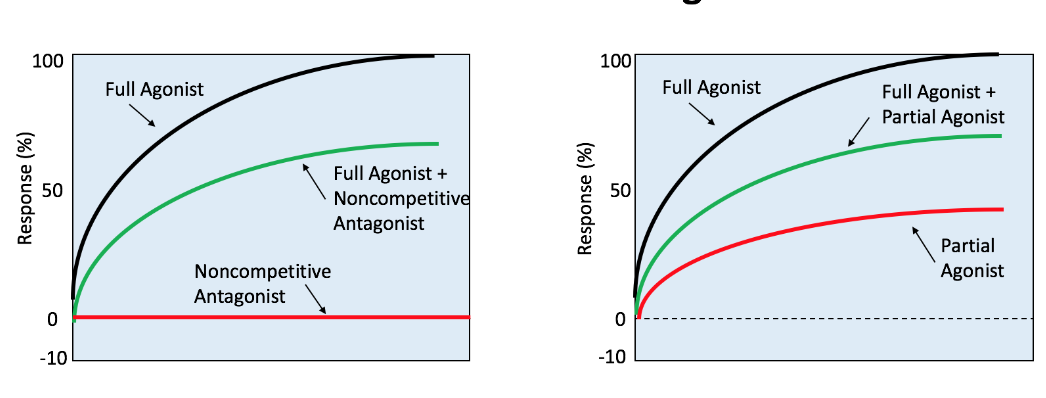
what are the similarities vs differences between the noncompetitive antagonists vs the partial agonist curves?
SIMILARITIES:
noncompetitive antagonists and partial agonists BOTH decrease max effectiveness —- if there is a non-competitive antagonist present then not all of the receptors are bound to the agonist causing a decrease in EC50. if partial agonists are present and bind to receptor instead of full agonists then Emax is not going to be achieved
DIFFERENCES:
noncompetitive antagonists have no intrinsic activity without an agonist present however partial agonists can decrease Max Effectiveness even without agonists present
molecule that binds to the same binding site on a receptor as an agonist and reverses the intrinsic constitutive activity of the receptor
inverse agonist
why is an inverse agonist considered an agonist if it reduces the activity of its receptor?
agonist does not always mean enhance it can also block a response as does the inverse agonist
the main point is the inverse agonists can elicit a response without an agonist present (whether it is increase or decrease a response)
inverse agonists can decrease the intrinsic activity of receptors unbound to drug without any agonists involved causing it to be an INVERSE AGONIST
what are examples of receptors with CONSTITUITIVE activity that are active WITHOUT having to be bound by an internal ligand or external drug?
GABA
Canaboid
benzodiazepine
Histamine
Opiod
Bradykinin
Adenosine receptors
Hypothesis: __________ agonists may keep receptor in bound, inactive complex that prevents baseline R* activity
inverse
R* unable to act on its own because it is trapped as DR
in systems that are NOT constitutively active OR in the presence of a full agonist, inverse agonists will behave like _____________ ____________
competitive antagonists
will bind to and inhibit receptor from attaching to drug
Full agonists stabilize ___
Partial agonists stabilize ____
Inverse agonists stabilize _____
competitive antagonists stabilize _____
WITH EXPLANATIONS
DR* (activated complex— full response)
DR* and DR (stabilize inactive as well which is why they can’t get full activity— alternate activity of DR* — primed DR)
DR (stabilize DR prevent R* from working intrinsically)
R (don’t allow R to bind with drug becoming DR)
Full agonists stabilize ___
Partial agonists stabilize ____
Inverse agonists stabilize _____
competitive antagonists stabilize _____
without explanation
DR*
DR and DR*
DR
R
How to Partial Agonists Work— Hypotheses
stabilize ____ form so there is a mixture of _____ and _____ form
receptor may have multiple DR* confirmations each wtih a different ________ _______
receptor may require a ________ change before activation. Partial agonists may be less efficient at inducing __________ conformations
DR DR and DR*
intrinsic activity
priming primed
How do Inverse Agonists Work: Hypothesis
inverse agonists may keep receptor in _______ inactive _______ preventing baseline R* activity
bound DR
The following illustrates the effect of a ____________ ____________ on the efficacy of a full agonist
How can you tell?
Competitive Antagonist
Can still reach Emax since antagonist is bound irreversibly and can be replaced by full agonist but potency is decreased since it will take a lot more of the agonist to be able to outnumber the competitive antagonist
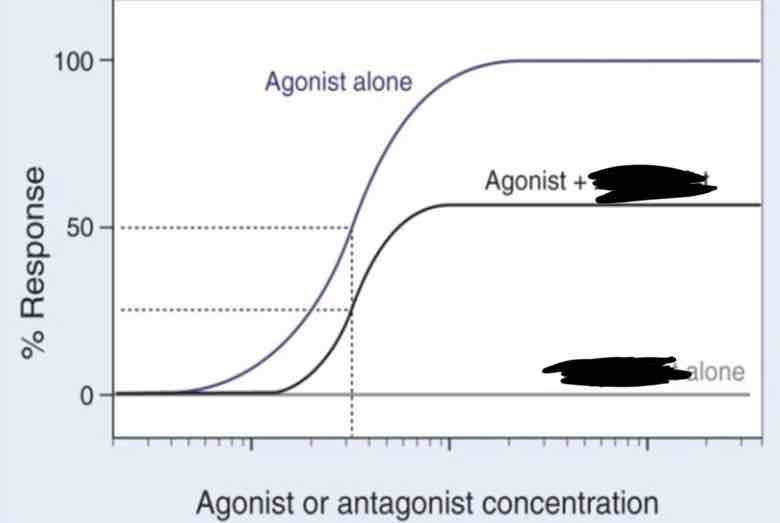
The following illustrates the effect of a ____________ ____________ on the efficacy of a full agonist
Noncompetitive Inhibitor
Decreased Emax and unchanged potency
Can’t get to Emax because noncompetitive inhibitors are irreversibly bound, BUT 50% of the agonist will still lead to 50% max effect (new max effect) the same amount of the drug that achieved 50% efficacy will still give 50% efficacy, but it is a lot smaller than it was before

The following illustrates the effect of a ____________ ____________ on the efficacy of a full agonist
Noncompetitive antagonist (WITH SPARE RECEPTORS)
THE MORE ANTAGONISTS YOU HAVE THE MORE YOU ARE TAKING UP RECEPTORS THAT MATTER AND DECREASING EFFICACY AND POTENCY
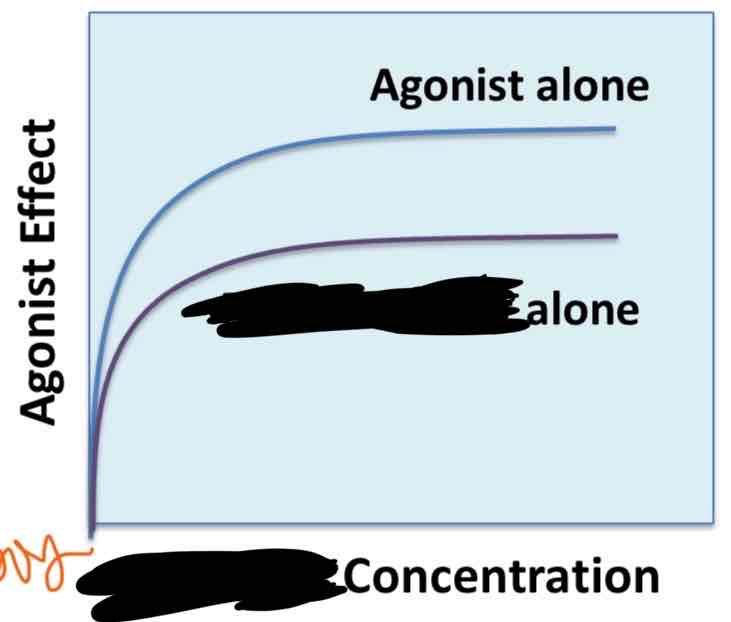
The following illustrates the effect of a ____________ ____________ on the efficacy of a full agonist
partial agonist
Different from Noncompetitive antagonist because agonist can work on its OWN has intrinsic activity (watch out for the alone line!)
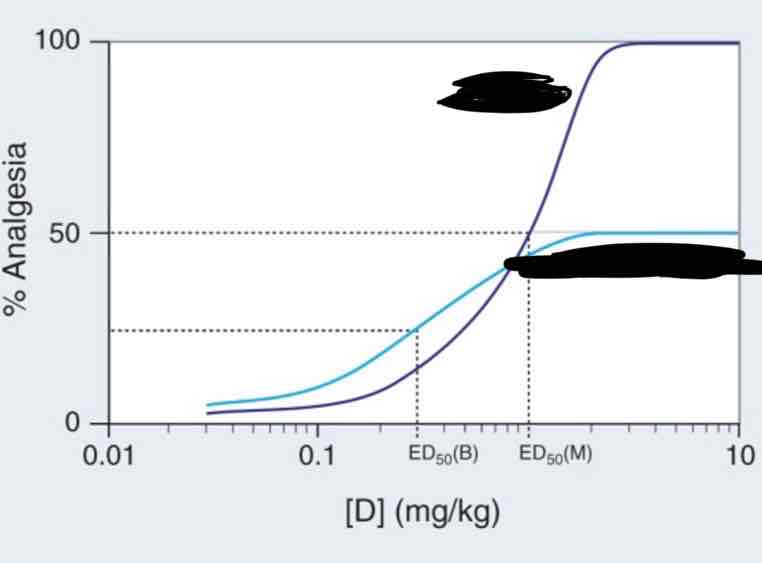
The following illustrates the effect of a ____________ ____________ on the efficacy of a full agonist
Partial agonist
You can see that efficacy has gone down but potency has gone UP which is not the case for Noncompetitive agonists whose potency remains unchanged
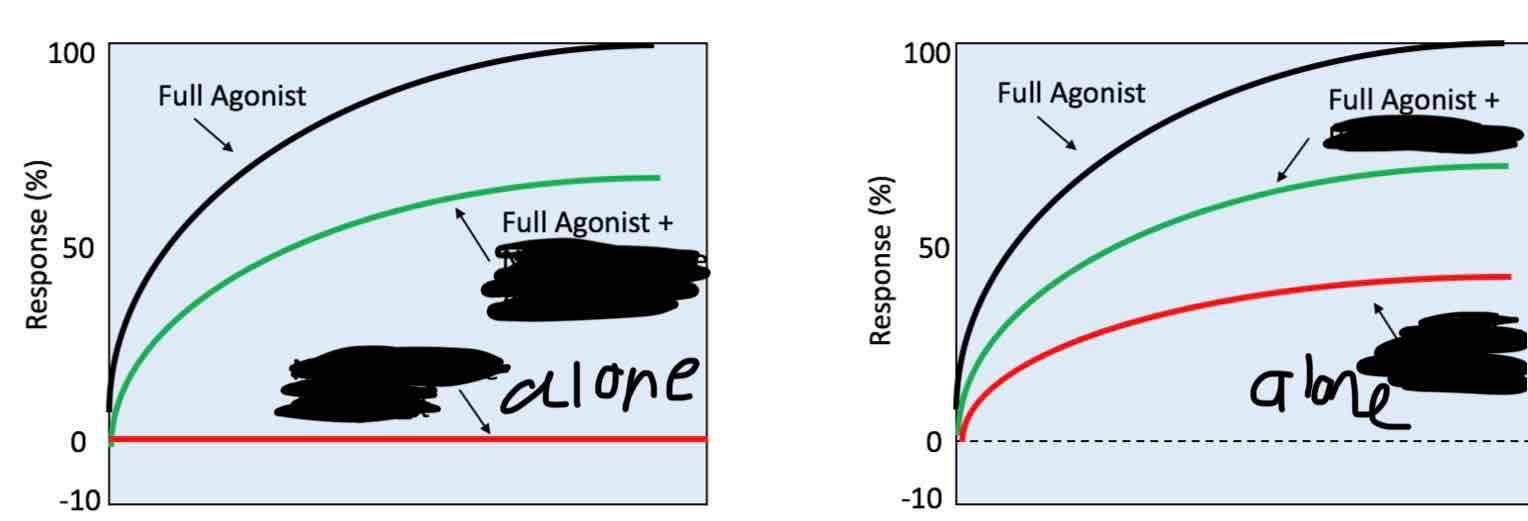
The following illustrates the effect of a ____________ ____________ on the efficacy of a full agonist (which is left vs right)
Left = Noncompetitive antagonist (efficacy decreased but no intrinsic effect alone)
Right = potential agonsit (efficacy decreased but you can see that alone it has instrinsic effect)
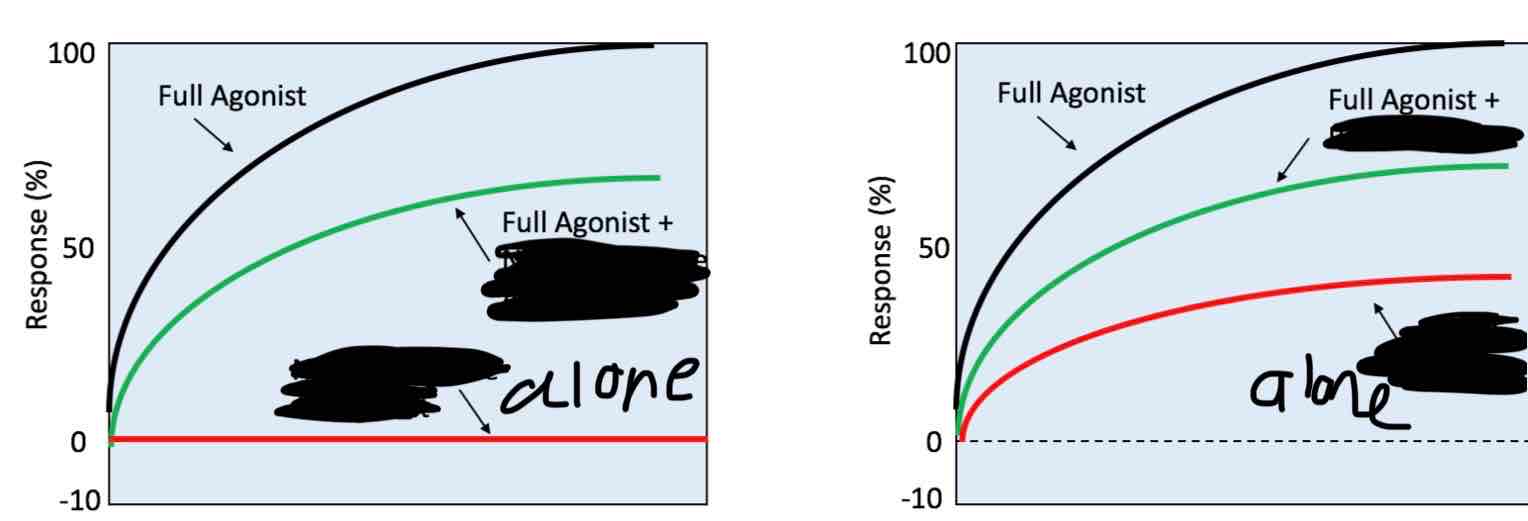
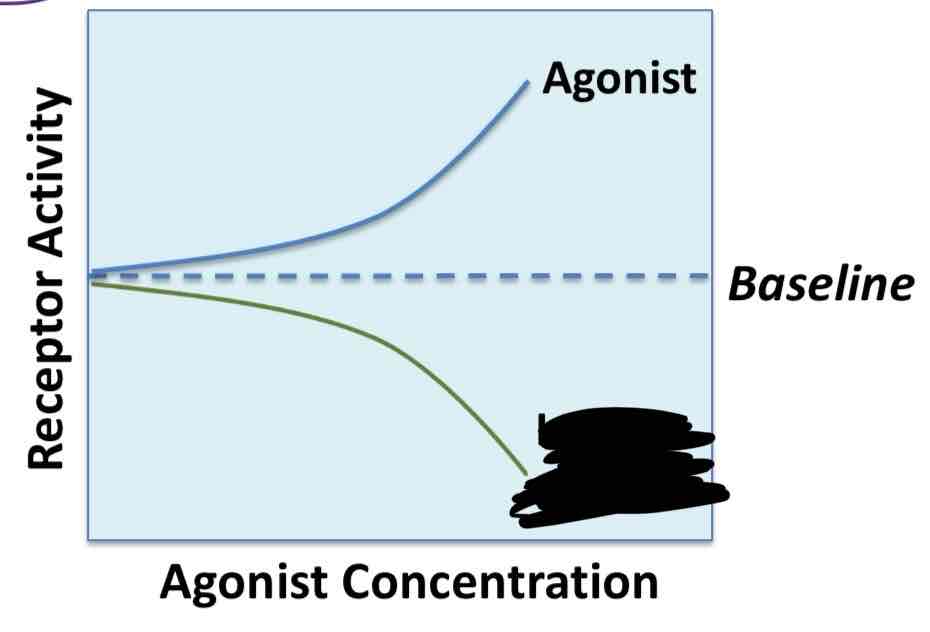
The following illustrates the effect of a ____________ ____________ on the efficacy of a full agonist
Inverse agonist
Binds to receptor active site and decreases receptors instirnsic activity WORKS WITHOUT AGONIST PRESENT WHICH IS WHY IT IS NOT AS ANTAGONIST. if the receptor had no intrinsic activity then it would act as a competitive antagonist

explain why pentazocine is selective for KOR over MOR and DOR
the dissasociation constant (Kd) for MOR and DOR are HUGE meaning there is more independent ligand and drug then [LR]
KOR has a low Kd meaning there is a higher affinity towards KOR receptor
Kd= [L][R] /[LR]
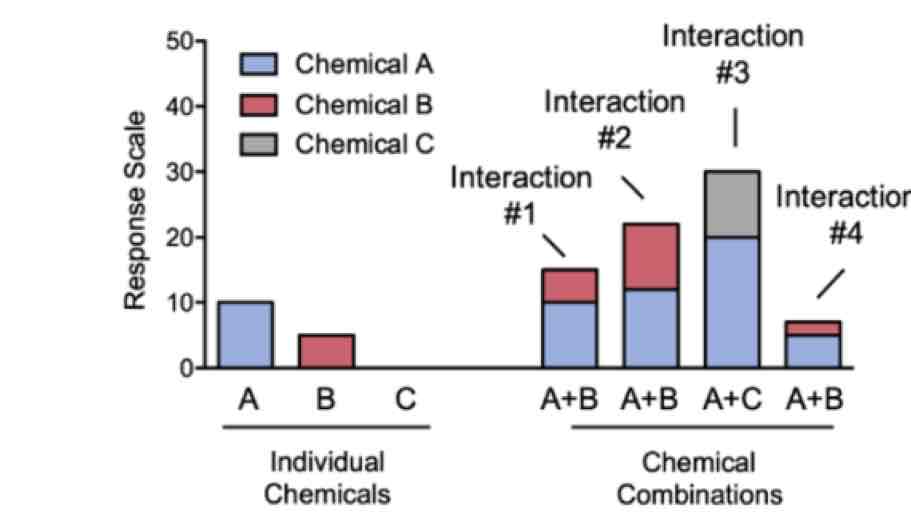
identify the chemical interactions that are taking place
additive
synergism
potentiation
antagonism
 Note
Note  Flashcards (106)