BSC 2011 Exam 2 - Animals
 Call Kai
 Learn
Learn Practice Test
 Spaced Repetition
 Match
Match Flashcards
 Knowt Play
1/146

There's no tags or description
Looks like no tags are added yet.
Name | Mastery | Learn | Test | Matching | Spaced | Call with Kai |
|---|
No analytics yet
Send a link to your students to track their progress
147 Terms
Animal commonalities
All share a common ancestor = monophyletic group
all are heterotrophic and multicellular
most have internal digestion and movement via a nervous system (at some point in life)
Monoblastic and diploblastic animals
one or two tissues
cnidarians
placozoans
ctenophores
sponges
triploblastic animals/ bilaterians
three tissue layers: ectoderm (epidermal skin and nervous system) , mesoderm (muscle, connective tissue, bone blood, heart, kidney), and endoderm (lungs, digestive tract)
bilateral symmetry
protostomes and deuterostomes
Protostomes
blastospore develops into mouth, then anus forms
dorsal digestive trace
ventral nerve chord
arrow worms
lophotrochozoans (mollusks, worms)
ecdysozoa (arthropods, nematodes)
Deuterostomes
blastospore develops into the anus, then the mouth forms
ventral digestive tract
dorsal nerve chord
echinoderms
hemichordates
chordates
Animal body plan characteristics
symmetry
body cavity structure
segmentation
appendages
nervous system
Symmetry
asymmetrical: no symmetry (sponges + placozoans)
radial symmetry: symmetry around a central axis (independent in jellyfish + starfish)
bilateral symmetry: can be divided along only one axis (humans, frogs, insects)
Body cavities/ coeloms
acoelomates: no true body cavity (flatworms)
pseudocoelomates: body cavity partially lined with mesoderm- only surround pseudocoel (roundworms)
coelomates: body cavity fully lined with mesoderm (earthworms)
Segmentation
allows for specialization of body regions (alter body shape + precise movement)
some animals are unsegmented (nematodes)
some animals highly segmented (arthropod radiation due to segmentation —> highly successful))
Appendages
external appendages enhance ability of movement
e.g. antennae, claws, mouthparts and reproductive organs
Nervous system
most organism have nervous systems to control parts of the body
nerve nets: diffuse nervous systems in animals (cnidarians, ctenophores)
vertebrates have organized peripheral and central nervous systems
arthropods have groups of neurons (ganglia) in body segments
Early animal branches
cells in colonies began specializing for diff functions, leading to larger, more complex animals
sponges: cells that function together, bodies of pores and channels for water circulation, choanocytes, some carnivorous (spicules)
ctenophores: diploblastic, eight combe plates (ctenes) with beating cillia for locomotion
placozoans: diploblastic, asymmetric, 4 cell types, no mouth/gut/nerves
cnidarians: specialized stinging cells, nematocysts (harpoon-like structures) capture prey, gastrovascular cavity
Lophotrochozoans
lophophore: crown of ciliated tentacles for feeding/respiration
trocophore: distinct larval stage, ring of cilia for swimming/feeding
Annelids: segmented worms, each segment has isolated coelom, permeable skin
Mollusks: mantle covers internal organs (modified coelom), muscular foot, most have open circulatory system
Flatworms lost coelom
Ecdysozoans
rigid outer cuticle secreted by epidermis - have to molt exoskeleton
Nematodes: unsegmented worms
Arthropods: paired appendages, very rigid exoskeleton (form monophyletic group with tardigrades + velvet worms)
Chelicerates: heads with two modified mouthparts (chelicerae): e.g. arachnids, seaspider, horseshoe crab
Mandibulates: mouthparts used for biting and chewing (mandibles) - Myriapods: segmented trunks, many paired legs (centipedes, millipedes) - Crustaceans: mainly aquatic arthropods, body divided into head, thorax, abdomen (shrimp, lobsters, crabs, barnacles) - Hexapods: six legs, body divided into head, thorax, abdomen, + gas exchange uses tracheae and spiracles (beetles, flies, bees, ants)
Echinoderms
sea star, sea urchins, sea cucumbers
system of calcified internal plates forming internal skeleton
system of water filled cannels connected to tube feet (used for gas exchange, locomotion, and feeding)
bilateral symmetry —> changes to radial symmetry
Hemichordates
acorn worms, pterobranchs (secreted tubes)
worm-like marine creatures
three body parts: proboscis, collar, trunk
Chordates
all have three derived structures at some stage
dorsal hollow nerve cord
dorsal supporting rod (notochord)
post-anal tail
tunicates: have all characteristics
lancelets: lose notochord during metamorphosis to adult
vertebrates: dorsal notochord develops into dorsal vertebral column, anterior skull with brain, well-developed circulatory system
Vertebrate Phylogeny
hagfish are the closest relative to vertebrates
evolution of jaws and teeth improved feeding efficiency - derived from anterior gill arches
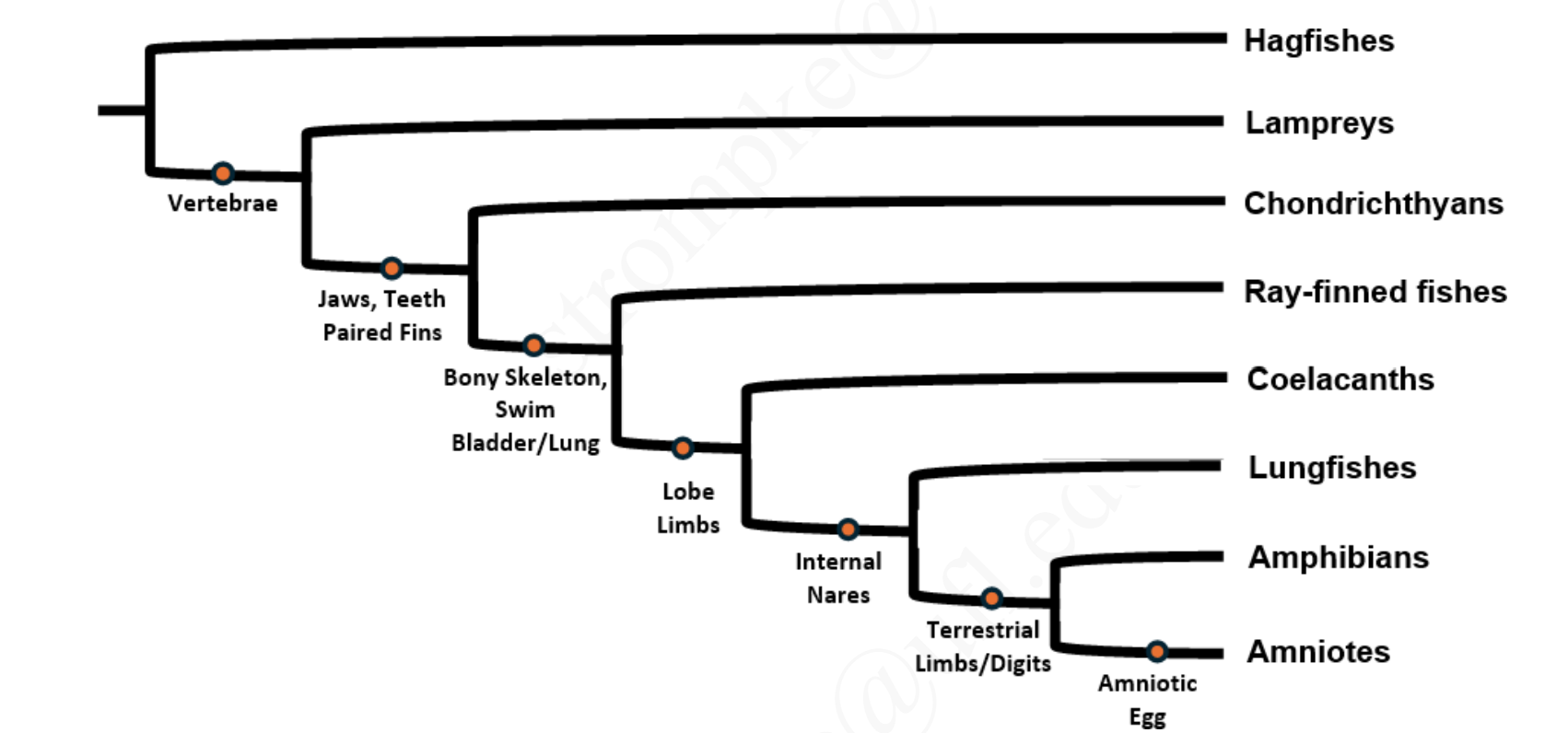
Chondrichthyans
jawed fish
skeletons primarily composed of cartilage
lack fins with supportive rays
Ray-finned fishes
fins with supportive rays
swim bladder (gas filled sacs supplementing gas exchange + improving buoyancy)
Lobe-limbed vertebrates
jointed appendages (paired) by single large bone
Coelacanths: deep sea fish
Lungfishes: both gills and lungs
Tetrapods: four limbs (Amphibians + Amniotes)
Amphibians
caecilians, anurans (frogs + toads), salamanders
live in moist environments (semi-permeable skin and eggs need water)
direct developers: some amphibians can bypass tadpole stage
Amniotes
the amniote egg: key innovation of terrestrially adapted egg (protective aquatic environment)
Reptiles: keratinized skin, scales
Mammals: mammary glands, sweat glands, hair, four chambered heart, endothermy
Reptile clades
Lepidosaurs: Squamates (lizards, snakes), Tautaras
Turtles
Archosaurs: Crocodilians (crocodilians, caimans, gators, gharials), Pterosaurs (extinct), Dinosaurs (extinct besides Aves)
Mammal clades
Prototherians: produce milk without nipples, lay eggs
Therians: milk with nipples, viviparous
Mass extinction effect on mammals
Mammals coexisted with dinosaurs for millions of years and were able to diversify after extinction of non-avian dinosaurs
Evolution of homeothermy, hair, and feather across the phylogeny of amniotes
homeothermy developed independently in aves and mammals
aves developed feathers from dinosaurs that had protofeathers
mammals developed hair from skin glands
Relationship between bigger brains, smaller jaws, and neoteny
Humans retained juvenile features of apes like a globular skull, flat face, and small jaw into adulthood
reduction in size of jaw muscles and supporting bones increased space for brain expansion
Animals are heterotrophs
animals require preformed organic molecules to obtain energy, build tissues, replace/grow cells
Essential nutrients
amino acids
fatty acids
minerals
vitamins (required in small quantities, cannot synthesize)
Metabolic rate defintion + measuring
the amount of chemical bond energy consumed and converted to heat per day
measured by determining rate of oxygen consumption (1:1 ratio with production of heat)
Cellular respiration defintion and formula
process by which food is converted into energy
Food + O2 —> CO2 + H2O + Heat
Total vs Basal metabolic rates
Basal metabolic rate: energy needed to do basic functions at rest, in comfortable environment, with no food consumed
Total metabolic rate: basal + energy required for activity
humans-linear, fish-exponential, birds-u shaped
Scaling relationship
larger animals require more energy overall, but less per unit of body weight compared to smaller animals
Temperature conformity vs regulation
Temperature conformity: animal’s internal environment permitted to vary with/match external environment
Temperature regulation: animal’s internal environment stays constant while environment fluctuates
tradeoffs: regulation more energy intensive but allows for survival in larger range, conformity less energy intensive, but narrower range of survival
Interstitial fluids
cells in an animal’s body are bathed with tissue fluids, constituting their internal environment
Homeostasis
the process by which animals maintain a stable internal environment
Poikilotherms (ectotherms) vs homeotherms (endotherms)
both engage in behavioral thermoregulation
Poikilotherms: variable body temps determined by environment
e.g. fish, reptiles, insects
Homeotherms: maintain constant internal body temp
e.g. mammals, birds
Thermo-neutral zone
when metabolic rate is minimal, or leveled-off, when animals fall below or above this zone they have to increase metabolic rates to regulate temp
Homeothermic mechanisms
Cold
shivering thermogenesis: skeletal muscles contract converting ATP to heat
non-shivering thermogenesis: use brown adipose fat that uncouples oxidative phosphorylation to produce heat instead of ATP
insulation: maintains body temp
counter-current heat exchange: direct warm blood to body’s core
Hot
evaporative cooling (sweating/panting) water absorbs heat energy to change state
Regulatory control systems
set point, feedback info, error signal
stimulus
sensors
control mechanism
effectors
negative feedback ex. thermoregulation (hypothalamus control, shivering effector)
positive feedback ex. oxytocin and uterine contractions during birth
Adaptations to cold extremes
small animals use behavioral methods- make burrows or find caves to escape the cold
larger animals use physiological defenses to prevent heat loss- good insulation (fat or hair), regional hypothermia keeps core constant temp but allows appendages to be colder (e.g. counter current heat exchange)
both may hibernate- state of metabolic depression and thermal conformity
Adaptations to heat extremes
small animals use behavioral methods- nocturnal lifestyle, burrow into ground, tuck in limbs (reduce SA exposed), shuttling between sunny and shady areas
large animals use physiological defenses- high heat tolerance, no sweating to reduce water needs, countercurrent heat exchange to keep brain cool
freshwater fish osmoregulation
have greater concentration of ions in tissue than surrounding water (hyper-osmotic)
gain water via osmosis through gills and skin (semipermeable)
osmotic flooding must be checked to stop internal drowning
kidney excretes excess water through dilute urine (and soluble salts replaced by food and absorption through chloride cells in gills)
saltwater fish osmoregulation
concentration of ions in the tissues is lower than that of surrounding water (hypo-osmotic)
lose water through osmosis in gills and skin
water loss compensated by drinking seawater
remove excess salts using chloride cells in gills and by feces and urine
Osmotic conformers (iso-osmotic)
most marine invertebrates
osmotic pressure of body fluids always same as surrounding water
only survive in a narrow range of salinities
Marine air breathing vertebrates regulate salt by
extrarenal salt glands where salt is actively excreted using ATP
Phenotypic plasticity
an individual’s ability to display diff phenotypes in diff environments
i.e. one genotype produces two or more phenotypes
Acclimation/acclimitization
phenotype changes from long-term exposure to a particular environment
Example of phenotypic plasticity (organs and biochemistry)
Organs: Daphnia (water fleas) grow helmets and defensive swords in areas where predators are present
Biochemistry: fish exposed to pollutants develop high levels of Cytochrome P450 enzymes to detoxify
Exogenous vs Endogenous timing
Exogenous timing is mechanized by external environmental cues
Endogenous timing is a self-contained metabolic mechanism to keep track of time
Circadian biological clock
entrained to light-to-dark cycle: starts running at the same time each day, with a 24hr rest-activity cycle
free-running: rest-activity cycle less than 24 hrs, activity will begin earlier each day
Benefits of an endogenous circadian clock
adaptive by allowing animals to anticipate future events without external cues
helps maintain a sun compass to compare perceived time of day with the sun’s position to determine directions
Bulk flow and Diffusion
Only two mechanisms for O2 movement, as there are no active transport mechanisms
Diffusion: small-scale random movement of particles towards a state of equilibrium
Bulk flow: large scale flow of matter from one place to another
incredibly important in delivering oxygen to cells quickly as diffusion is very slow
Process of mammalian respiration
Bulk flow- air is drawn through the mouth or nostrils to the lungs
Diffusion- air diffuses across to simple epithelium (alveolus and capillary) into the bloodstream
Bulk flow- heart pumps oxygenated blood through the body
Diffusion- oxygen diffuses from blood cells across two epithelium layers to target cells and through cytoplasm to mitochondria
Air vs. water as respiratory environments
diffusion much faster through air
in water, oxygen decreases with temp increase
air has a much higher oxygen content than water
higher energy expenditure to move water over respiratory surfaces
Gills vs lungs
Gills evaginated (folded outward), surround environmental medium, unidirectional ventilation
Lungs invaginated (folded inward), contain environmental medium, tidal ventilation
Animals without specialized breathing structures
some animals just use simple diffusion with low metabolic rates and cells close to body surface
Fish gills
each gill arch has two rows of gill filaments
fish pump/ram water unidirectionally through mouth, over gills, and out the opercular flaps
blood and water flows through each lamella in a countercurrent system
Bird breathing system
rigid lungs
unidirectional ventilation via air sacs- don’t participate in gas exchange (parabronchi do)
inhale: posterior air sacs expand with fresh air, exhale: air moves to parabronchi, inhale: stale air moves to anterior air sacs, exhale: air moves out the trachea
Insect tracheal breathing system
spiracles in the abdomen open into tubules (tracheae)
gas exchanged directly with atmosphere so circulatory system doesn’t play a role
system limits size
Mammalian breathing system
air enters lungs through two primary bronchi, then secondary bronchi, then bronchioles, and finally alveolar sacs (gas exchange occurs in alveoli)
cell walls extremely thin to minimize diffusion distance
circulatory and respiratory systems work together: lungs take in O2 and pass it to blood to deliver it to tissues, and returns CO2 to be exhaled
Inhale as active and exhale as passive in humans
inhalation: contraction of diaphragm expands thoracic cavity, pulling on and expanding the lungs to suck in air
exhalation: diaphragm and muscles relax, allowing elastic recoil of lungs and thoracic activity to push air out
Negative feedback of CO2 levels
when CO2 levels increase, breathing rate increases to deliver more O2 to tissues and remove CO2
carotid and aortic bodies in blood vessels are monitors for O2 + CO2 partial pressure —> send signals to brain to increase breathing
Ventilation def
actively moving the respiratory medium over the respiratory surface
Open circulatory system
blood exits the vessels as it flows through the body
uses fluid hemolymph to directly bathe tissue cells in blood (no distinction between blood and interstitial fluid
plays a larger role in oxygen transport for larger organisms than smaller (arthropods and mollusks)
creates hydrostatic pressure
Closed circulatory system
blood always remains in the blood vessels
found in annelids, cephalopods, and vertebrates
more rapid and effective
heart pumps blood into arteries that branch out to microscopic capillaries
blood leaving tissues/organs flows into larger vessels until back to veins and heart
Arteries
carry blood away from heart
operate under high pressure (elastic tissue and smooth muscle for stretch)
branch to arterioles
pulmonary artery exception- carries deoxygenated blood from heart to lungs
Veins
carry blood towards heart
operate under low pressure
one-way valves prevent backflow of blood
pulmonary vein exception- carries oxygenated blood from lungs to heart
Capillaries
tiny vessels, primary sites of exchange between blood and body cells
extremely thin walls with pores/gaps (efficient diffusion)
capillary beds increase SA
Atrium vs. ventricle chambers
atrium chamber receives blood
ventricle chamber pumps blood
Microcirculation + vasomotor control
smooth muscles adjust arteriole diameter (allows redirection of blood from unneeded areas to needed areas)
contraction causes vasoconstriction
relaxation causes vasodilation
vasomotor mechanism: cuts blood flow to body and drops heart rate
Blood plasma
blood solution free of cells
water and solutes (glucose, ions, waste, hormones, oxygen)
Blood cell types and platelets
red (erythrocytes): hemoglobin and oxygen
white (leukocytes): immune cells
platelets: pinched off fragments of cell that aid blood clotting
Respiratory pigments
proteins greatly increasing the amount of oxygen that can be carried in the blood
combines reversibly with oxygen
Red pigments
hemoglobin
in most vertebrates
Blue pigments
hemocyanin
spiders, crustaceans, mollusks, octopi, squid
horseshoe crab blood clots when toxins are detected
Evolution of the vertebrate heart
vertebrate hearts are multi-chambered
pre-vertebrates: tube heart with closed vascular system
two-chambered heart: fish (single circulatory circuit)
three-chambered heart: amphibians (two atria one ventricle, pulmonary and systemic circuit)
partial separation: reptiles (partial septum in ventricle)
four-chambered heart: mammals, birds (pulmonary and systemic circuit)
Cardiac cycle phases
Diastole (relaxation phase): ventricles relax and heart fills with blood, atria contracts completing ventricle filling
Systole (contraction phase): ventricles contract and atrioventricular valves close, pressure builds in ventricles until aortic and pulmonary valves open and blood is is pumped out into the aorta and pulmonary circuits
Oxygen equilibrium curve
relationship between oxygen partial pressure and hemoglobin binding
during rest, oxygen binding drops (unloading increases)
during exercise, oxygen binding drops even more (unloading increases more)
total cross sectional area relation to blood velocity
as total cross sectional area of blood flow decreases, blood flow velocity increases
cross sectional area relative to blood velocity
as cross-sectional area increases (e.g. capillary beds) velocity falls due to increased flow resistance
allows circulatory system to maximize exchange effectiveness
Sensory vs Motor neurons
sensory neurons: carry signals from sense organs to CNS
motor neurons: carry signals to muscle cells, stimulating contraction
CNS vs PNS
Central nervous system: brain and spinal cord
ventral for arthropods
dorsal for vertebrates
interprets and processes perceived information
Peripheral nervous system: all other parts of the system
neurons organized into nerves
perceives information
Autonomic vs Somatic nervous system
both part of the peripheral
Autonomic regulates involuntary physiological processes
Somatic causes voluntary contraction of skeletal muscles
Centralization vs Cephalization
Centralization: grouping of nerve cells into a CNS
faster, better communication and coordination across the body
Cephalization: nervous tissue highly concentrated in the anterior region
favors forward movement
types of nervous systems
no nervous system: some simple organisms lack a nervous system
nerve nets: simplest neural network (cnidarians and ctenophores)
ganglia: neurons organized into clusters that process info
brains: primary info processing center in sophisticated organisms
Neuron structure
synapse: cell-to-cell contact point specialized for signal transmission (one-way)
presynaptic cell: conducts signals into the synapse
postsynaptic cell: conducts signals away from the synapse
dendrites: carry signals to cell body
cell body/soma: contains nucleus and organelles; integrates incoming signals
axon: conducts action potentials away from the cell body
presynaptic axon terminals: make synaptic contact with cells
Action potential
temporary depolarization of the cell membrane due to changes in ion distributions
generated at one point and propagates over the whole membrane
Creation of neural signals
stimulus cause voltage-gated sodium channels to open and depolarize the membrane (sodium rushes in)
if the stimulus reaches the threshold potential an action potential is fired
membrane repolarizes as sodium-gated channels close and potassium-gated channels open (potassium leaks out)
resting membrane potential caused by open potassium channels
Chemical synapses
communication between cells via chemicals instead of direct contact (synaptic cleft); most common
neuromuscular junction (comm between neurons and muscles)
action potential stimulates influx of Calcium
neuron’s axon terminal releases neurotransmitter Acetylcholine
ACh crosses synaptic cleft to muscle cell
muscle cell’s receptors detect ACh and trigger action potential (chemical either reuptake or degraded)
Electric synapses
transmit signals directly between cells through gap junctions (extremely fast)
Reflexes
rapid, automatic motor response to stimulus
reflex arc consist of the simple chain of neurons that give rise to reflexes (doesn’t require the brain)
Knee-jerk reflex
tap stretches tendon and stretch receptors activate
sensory neuron sends signal to spinal cord
sensory neuron directly activates motor neuron in the quad
quads contract and opposing muscle is inhibited causing the lower leg to jerk forward
Endocrine system
a system of ductless glands that produce endocrine secretions
development, growth, reproduction, metabolism, stress responses
Evolution of chemical signaling
Unicellular eukaryotes: pheromones and quorum sensing
Cnidarians: early peptides and diffuse nerve nets
Bilaterians: compartmentalized endocrine tissues
Vertebrates: hormone axes
Hormone
chemical substance secreted into the bloodstream that influences other cell functions
bind covalently to target cell receptors, trigger signal transduction
Three types of hormones
Peptide and protein hormones
Steroid hormones
Amine hormones
Peptide and protein hormones
water soluble, easily transported in the blood
packaged in vesicles and released via exocytosis
polar so can’t cross cell membrane —> receptors on exterior of target cell
e.g. insulin, growth hormones
Steroid hormones
synthesized from cholesterol
lipid-soluble, pass through cell membrane —> intracellular receptors
don’t absorb well in plasma —> require carrier proteins in the blood
e.g. testosterone, estrogen, cortisol

