Chapter 5 Key Terms/Equations: Forces and Motion I
 Call Kai
 Learn
Learn Practice Test
 Spaced Repetition
 Match
Match Flashcards
 Knowt Play
1/11

There's no tags or description
Looks like no tags are added yet.
Name | Mastery | Learn | Test | Matching | Spaced | Call with Kai |
|---|
No analytics yet
Send a link to your students to track their progress
12 Terms
Newtonian Mechanics
Newtonian Mechanics is a branch of physics that deals with the analysis of forces and the motion of objects based on Newton's laws of motion.
Force
A vector quantity that causes an object to accelerate, change direction, or deform. The unit of force is defined as (kg*m)/s²; this unit comes from Newton’s Second Law which states that F = ma, hence mass is multiplied by acceleration, so the units combine accordingly. Force is measured in newtons (N) and can result from interactions such as gravity, friction, and tension.
Newton’s First Law of Motion
An object at rest will remain at rest and an object in motion will continue in motion at a constant velocity unless acted upon by a net external force. This law is often summarized as the principle of inertia, which states that objects resist changes to their state of motion.
Inertial Reference Frames
Frames of reference in which Newton's first law holds true, meaning objects not subjected to external forces maintain their state of motion.
Mass
An intrinsic property that does not change, no matter the change of conditions of the environment. Mass relates the body’s acceleration to the net force that causes the acceleration via the formula F = ma.
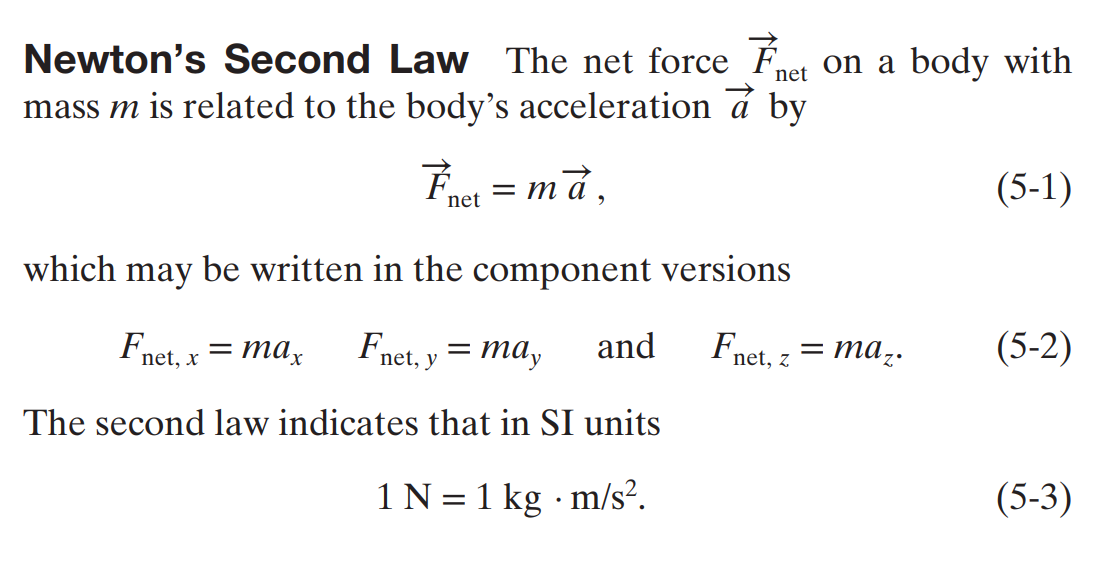
Newton’s Second Law
The net force FNet on a body with mass m is related to the body’s acceleration via the fundamental formula: F = ma.
In particular, the individual forces acting on each of the system’s axes would have to be considered; regardless, each dimension’s equations are all of the form F = ma, just with respect to the necessary axis.
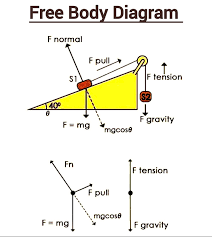
A Free-Body Diagram
A simplified diagram in which a body is drawn such that all of the external forces acting on the body are considered for the purpose of analyzing the effects of each force.
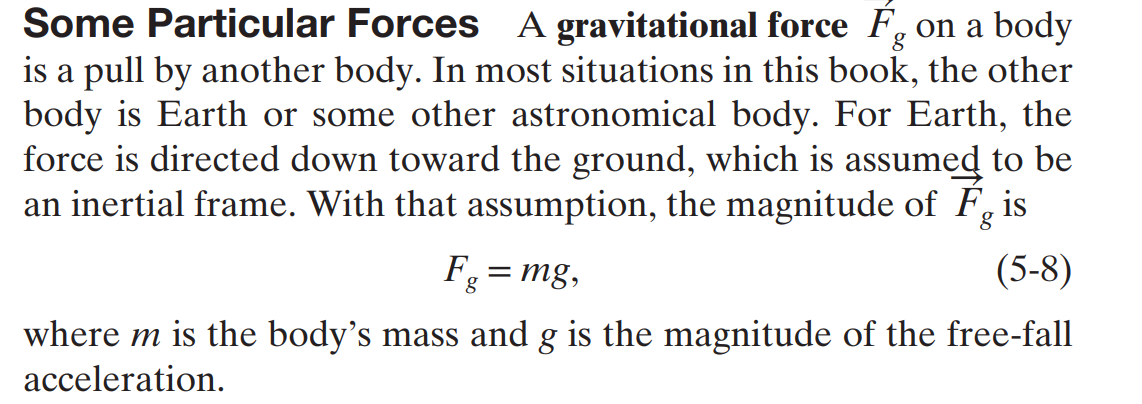
Force Due to Gravity
The force due to gravity is a particular case of the formula F = ma, whereby the a component is set equivalent to g since the only downward acceleration is Earth’s own acceleration.
The Weight Force
Weight is the effect of the acceleration due to gravity on an object’s mass; mass remains constant whereas weight changes based on the magnitude of the acceleration due to gravity of a given planet/system.

The Normal Force
The normal force is the force that a surface exerts on an object in order to oppose its presence; typically, the normal force is equal in magnitude but opposite in direction to the force due to gravity. The normal force is what ensures that objects, such as a box on a table, do not go through other surfaces.

Tension Force
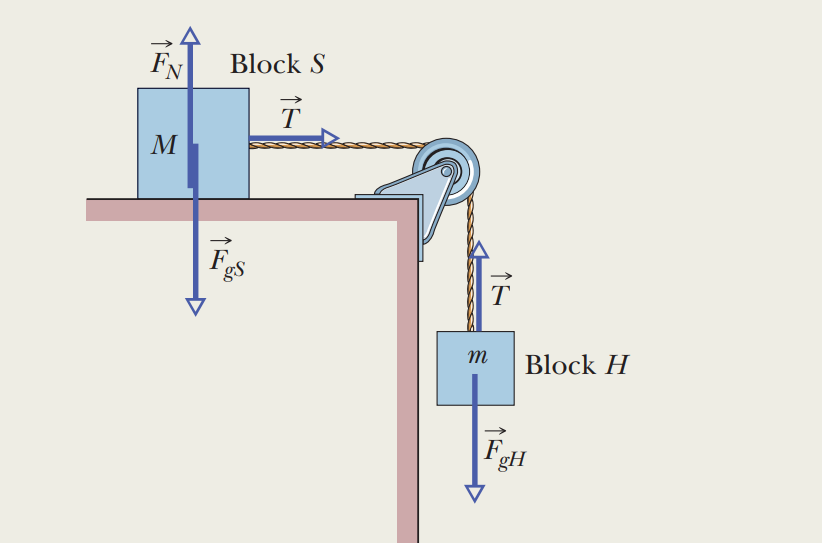
The Tension Force is the force that an object endures while attached to a cord; tension runs ALONG a cord and away from the object to which it is attached.
In the attached picture, each of the tension forces are of the same magnitude and point AWAY from the block at which the strings are attached; furthermore, notice how tension runs ALONG the string as well.
Newton’s Third Law


