unit 9: chapter 10, measuring the stars
 Studied by 0 people
 Call with Kai
 Learn
Learn Practice Test
 Spaced Repetition
 Match
Match Flashcards
 Knowt Play
1/44

Earn XP
Description and Tags
astronomy
Name | Mastery | Learn | Test | Matching | Spaced | Call with Kai |
|---|
No analytics yet
Send a link to your students to track their progress
45 Terms
parallax
the apparent motion of a relatively close object with respect to a more distant background as the location of the observer changes
parsec
the distance at which a star must lie in order for its measured parallax to be exactly 1 arc second; 1 parsec equals 206,000 AU; equal to about 3.3 light years
luminosity
one of the basic properties used to characterize stars, luminosity is defined as the total energy radiated by a star each second, at all wavelengths
what is the difference between luminosity and apparent brightness?
luminosity is the total energy radiated by a star each second, while apparent brightness is how a star appears from on observer on earth
do bright stars have positive or negative magnitude?
they have lower or negative apparent/absolute magnitudes
what is the difference between apparent and absolute magnitude?
apparent magnitude measures a celestial object's brightness as seen from Earth, influenced by its distance; absolute magnitude measures true brightness (defined as how bright it would appear at a standard distance of 10 parsecs)
how do astronomers use the blackbody curve to measure the temperature of a star?
by measuring their brightnesses through two or more optical filters, then fitting a blackbody curve to the results
what features are present in the spectra of stars having temperatures over 25,000 kelvin?
show strong absorption lines of singly ionized helium (i.e., helium atoms that have lost one orbiting electron) and multiply ionized heavier elements, such as oxygen, nitrogen, and silicon (the latter lines are not shown in the figure). These strong lines are not seen in the spectra of cooler stars because only very hot stars can excite and ionize such tightly bound atoms
what features are most prominent in the spectra of stars with temperatures below 4000
kelvins?
molecular absorption bands, neutral atomic lines, weak/absent hydrogen lines, Ha emission, and pressure broadening
spectral class
classification scheme, based on the strength of stellar spectral lines, which is an indication of the temperature of a star
list the spectral classes in order from lowest to highest temperature:
M K G F A B O
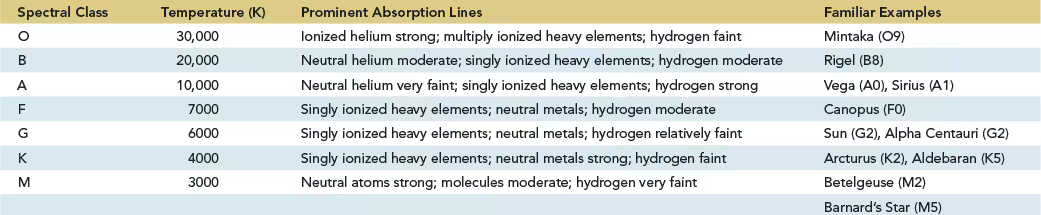
in table 10.2 what is the temperature of an M star? What is the temperature of an O star?
3,000 K; 30,000 K
astronomers do not measure the radius of a star directly. what two quantities are used to
determine radius?
their luminosity and temperature
what two things are true of a star called a red giant? how are supergiants different than
giants?
radius between 10 and 100 times that of the sun, has a surface temperature relatively low to make it glow red; supergiants have a radius between 100 and 1000 times that of the Sun and giants have a radius between 10 and 100 times that of the Sun
when is a star described as a dwarf star?
any star of radius comparable to or smaller than the radius of the Sun (including the Sun itself)
what is the main sequence and how does it appear on a Hertzprung-Russell diagram?
well-defined band on the Hertzsprung–Russell diagram on which most stars are found, running from the top left of the diagram to the bottom right
what increases from right to left on a Hertzprung-Russell diagram?
the spectral classes, surface temperature, peak frequency, and color (getting bluer)
what increases from bottom to top on a Hertzprung-Russell diagram?
luminosity (intrinsic brightness) and the radius size
what increases from the lower left to the upper right of a Hertzprung-Russell diagram?
stellar size, evolutionary stage (going from white dwarfs to red giants/supergiants), and luminosity, while temperature decreases
what is the luminosity class of a star? How is the luminosity class listed as part of the
spectral class when written?
a classification scheme that groups stars according to the width of their spectral lines. for a group of stars with the same temperature, luminosity class differentiates between supergiants, giants, main-sequence stars, and subdwarfs; written as a roman numeral (I-VII)
what is the order of the standard luminosity classes?
I: supergiants (Ia+ or 0 for hypergiants, Ia, Ib); II: bright giants; III: giants; IV: subgiants; V: main-sequence stars (dwarfs); VI (or sd): subdwarfs; VII (or D): white dwarfs
what is a binary system? Are they common in the Universe?
a system that consists of two stars in orbit about their common center of mass, held together by their mutual gravitational attraction'; yes, most stars are found in binary-star systems
what quantity is easy to determine when a star is a member of a binary system?
the individual stellar masses
how can the mass of the star be determined from its position on the Hertzsprung-Russell
diagram?
through the mass-luminosity relationship, which dictate4s that higher luminosity and hotter temperatures correlate with higher mass, while lower luminosity and cooler temperatures indicate lower mass
what percentage of stars are red dwarfs?
~75%
what percentage of stars are dwarfs or red dwarfs?
over 90%
what percentage of stars are less than or equal to one solar mass?
over 90%
what percentage of stars are greater than or equal to eight solar masses?
less than 1%
blue giant
large, hot, and bright star at the upper left end of the main sequence on the HR diagram; its name comes from its color and size
blue supergiant
very largest of the large, hot, and bright stars at the uppermost left end of the main sequence on the HR diagram
eclipsing binary
rare binary star system that is aligned in such a way that from earth we observe one star pass in front of the other, eclipsing the other star
light curve
variation in brightness of a star with time
proper motion
angular movement of a star across the sky, as seen from earth, measured in seconds of arc per year. this movement is a result of the star’s actual motion through space
radius-luminosity-temperature relationship
mathematical proportionality, arising from stefan’s law, that allows astronomers to indirectly determine the radius of a star once its luminosity and temperature are known
red dwarf
small, cool, and faint stars at the lower right end of the main sequence on the HR diagram
red giant region
upper right corner of the HR diagram where red giant stars are found
red supergiant
extremely luminous red star, which is often found on the asymptotic giant branch of the HR diagram
spectroscopic binary
binary star system that appears as a single star from earth, but whose spectral lines show back and forth doppler shifts as two stars orbit one another
spectroscopic parallax
method of determining the distance by measuring its temperature and then determining its absolute brightness by comparing with a standard HR diagram; the absolute and apparent brightness of the star give the star’s distance from earth
visual binary
binary star system in which both members are resolvable from earth
white dwarf
dwarf star with sufficiently high surface temperature that it glows white
white dwarf region
bottom left corner of the HR diagram, where white dwarf stars are found
stellar mass
amount of matter contained in a star, which influences its other properties
what is the mnemonic that helps us remember the order of spectral classes?
Oh, Be A Fine Guy, Kiss Me
inverse-square law
the law used to determine a star’s distance if its luminosity and apparent brightness are known
 Note
Note  Flashcards (101)