Biol 325
 Studied by 0 people
 Call Kai
 Learn
Learn Practice Test
 Spaced Repetition
 Match
Match Flashcards
 Knowt Play
1/395

There's no tags or description
Looks like no tags are added yet.
Name | Mastery | Learn | Test | Matching | Spaced | Call with Kai |
|---|
No analytics yet
Send a link to your students to track their progress
396 Terms
What is the symbol, dimensions and units of Area
Symbol = S
Dimensions = L2
Units: m2
What is the symbol, dimensions and units of Volume
Symbol = V
Dimension = L3
Units: m3
What is the symbol, dimensions, equation, units of Velocity
Symbol = v
Dimensions LT-1
equation = length/time
units = meter/second
What is the symbol, dimensions, equation, units of Acceleration
Symbol = a
Dimensions = LT-2
equation = velocity change / time
units = m/s2)
What is the symbol, dimensions, equation, units of Force
Symbol = F
Dimensions = MLT-2
equation = mass x acceleration
Unit = Newton (N)
What is scalar
A physical quantity that has magnitude
What are examples of scalar
Mass
length
area
volume
speed
density
pressure
energy
work
What is vector
Has both magnitube and direction
What is an example of Vector
- Acceleration
- velocity
- momentum
- force
- displacement
- lift
- drag
- thrust
- weight
What are newton's three laws
Body stays at rest or in uniform motion in a straight line unless a force is applied to it
acceleration is proportional to applied force and is in the same direction as the force
two forces are equal in magnitude, oppsite in direction, and act along the same line (action/reaction)
What is work
Work is done on a body when force applied to the body causes a displacement in the direction of the force
force applied x displacement caused by force in the direction of the force
J joules = N x m
What is power
Power is the rate at which work is being done
Power = Work/time
W = J/s
What is a lever
Lever is a ridgid oject that can pivot around an axis
amplify either force or distance
What is mechanical advantage
"Mechanical advantage is used on a lever, defined at the amplification of force
M.A = 1/DA
M.A is the reciprocal of DA
"
What is distance advantage
"Distance advantage is defined as amplication of distance
D.A = 1/M.A
D.A is the reciprocal of MA
"
What does all lever have?
A fulcrum (pivot or axis of rotation)
A load moment arm (with a length of dL)
A effort moment arm (with a length of dE)
What is 1st class lever
"First class is where dL is equal or larger or smaller to dE"
What is 2nd class lever
"Where dL is smaller then dE
in this case, the force is amplified by the lever M.A is larger than 1"
What is 3rd class lever
"where dL is larger than dE
M.A: in this cause the force is reduced by the lever, M.A is smaller than 1"
What is a lever's speed advantage
The speed advantage is the same as distance advantage
What would the D.A and M.A of burrowing animal be?
"
- Digging requires high force at the end of the limb = slow high force limbs
- M.A would be higher than cursorial animal but still lower then D.A
"
What would the M.A and D.A be in cursorial animals
"
- Running requires high speed at the end of the limb, fast, low force limbs
- M.A very low but D.A is very high
- D.A is high because D.A is same and speed advantage, and in this case they need to have high speed
"
What is type 1 fiber
low contraction force
low contraction speed
long time to fatigue
low atpase activity
What is type 2 fiber
Medium contraction force
high contraction speed
short time to fatigue
high atpase activity
Claw differentiation of lobster
the crusher has
slow high force fibers
long sarcomeres and low atpase activity
the cutter has
fast low force fibers
short sarcomeres and high ATPase activity
What does the unipennate muscle look like
""
What does Bipennate muscle look like
""
What does multipennate muscle look like?
"
"
what is the relationship between pennation angle and muscle force
"
- angle between the muscle fibers and the tendon/line of action
- pennation angle increase, decrease of muscle force
- force is only generated from the component that is aligned with the tendon or the muscle
- in the picture below is the Fmuscle force that is decreasing as pennation angle is increasing
What is isometry
two variables scale in direct proportion with one another (scale with a factor of 1)
What is allometry
non equal scaling (an object scales with a factor of more or less than 1)
one unit of change in X is less or more than one unit change in Y
- Positive allometry is Y cahnges radpidly to relative to X
- negative allometry is Y changes slowly to X
What is the formula for scaling
"
Y = changes in proportion with mass to the power b
M = mass (body mass usually)
a = variable-specific coefficient
b = scaling factor (power)"
What are the scaling factor (b) on a graph
""
How is the difference between a log transformed graph VS not transformed
"the graph lines are striaght (now to base of 10)and not to a curve
the formula changed to
"
What is the relationship between the log transformed formula to the graph and to the original formula
""
What is uniform scaling
Uniform scaling: objects increase in all linear dimensions by the same factor
What is uniform (isotropic) scaling
All linear dimensions have increased by the same factor
Dimensions increase with M0.33 and areas increase with M0.67
What is non-uniform (anisotropic) scaling
Some linear dimensions have increased by different factors
no longer scale with 0.67 and 0.33
What is part of the Allometric equation and how to plot it on the graph
"1. Body mass is always on the x-axis
2. Whatever variable of interest is on the y-axis
3. Arithmetic axes produce curves: Y = aMb
4. Logarithmic axes produce straight lines: log(Y) = log(a) + b·log(M)"
What are the uses of allometry
how does the variable (y) change with body size
Compare Y from a single species to the overall trend seen in a group.
Compare two different groups for differences in slope and elevation (b and a, respectively)
Make an estimate of Y for an unmeasurable species (e.g., extinct)
"What are the two hypothesis of ""How does a skeleton scale with body mass?"""
Hypothesis 1: The mass of the skeleton increases uniformly with body mass (Isometric scaling b = 1 for skeleton mass), to maintain constant shape
Hypothesis 2: The skeleton scales in some other allometric fashion (b>1, 0<b<1) to maintain functional equivalence
What is Hypothesis 1: isometric scaling
Isometric scaling means the skeletal mass is b=1, bone length b=0.33, bone CS b=0.67
- Stress on the skeleton = force/CSA
- force acting on skeleton ∝ animal’s mass × gravity = M^1 × M^0
- thus the compressive force ∝ M^1
- gravity is M^0 because it is constant
- C.S. area of skeleton = M^0.67
- Stress = force / CSA
- Mx = M1/M0.67 = M0.33
- Thus stress increases with M^0.33, this being bad news for big animals
What is Hypothesis 2: Allometric scaling
"
- If skeleton scaled so that the stress on it remained constant (stress is proportional to M^0)
- Force ∝ M1 (just like hypothese 1)
- stress remain constant with increasing mass, stress must scale independently of mass = M0
- Stress = Force/CSA -> M0 = M1 /M?
- Stress = M0
- Force = M1
- CSA =?
- CSA = (M0=M1- M?) -> M? = M1 -> CSA = M1
- As animal’s body mass increases, the skeleton’s CSA must grow linearly with mass to prevent the stress on the bones from increasing
- we know skeletal mass proportional to bone volume = length x area
- length = M^0.33 and CS is M^1
- so the skeletal mass would be M^1.33.
- This also being impossible example: elephant would have 78% skeleton if this is the case
"
What is the equation to calculate mass of a skeleton
Skeleton mass = aM^1.08
M=mass of animal
we are looking for a
How does Metabolic rate and what equation is this
- Metabolic rate scale with allometric
- equation = BMR = aMb
What is Rubner's measurement of RMR
determined that b is 0.67, so scaling with dog surface area as he only tested on dogs. argued this was due to heat loss, where for body temp to be constant,
metabolic rate = heat flux out
Heat flux = conductance
Conductance proportional to surface area
What is Kleiber's measurement of RMR
Determined that b is 0.75 could not explain the origins but it is not based on geometric principles
Measured 13 animals of 8 species all animals are basal (animal is adult, resting, non-reproductive, post-absorptive, and at a thermo-neutral temperature)
What is the universal scaling of MR
no single scaling exponent can describe the relationship between basal MR and body mass for all life, most likely being inbetween 0.67 and 0.75
What is the symbol, dimensions, equation, units of Momentum
Symbol = mv
dimensions = MLT-1
equation = mass x velecity
Unit = Kg-m/s
What is the symbol, dimensions, equation, units of stress
symbol = o- (sigma)
Dimensions = ML-1T-2
Equation = force / area
units: newton/meters2 / pascal
What is the symbol, dimensions, equation, units of pressure
symbol = p
dimensions = ML-1T-2
equation = Force/ area
units = mewton/meters2 / pascal
What is the symbol, dimensions, equation, units of work
symbol: W
dimensions: ML2T-2
equation: Force x Length
units: Joule (J)
What is the symbol, dimensions, equation, units of Power
symbol: P
dimensions: ML2T-3
equation: Work/Time
units: watt (W)
What is the symbol, dimensions, equation, units of Density
symbol: p (different from pressure)
dimensions: ML-3
equation: mass/volume
units: kg/m3
what are the properties of gas
- Assumes the shape and the volume of its container (spread out across)
- Compressible (free space between particules)
- flows easily (when we push in, it will resist, but push out will flow easily)
- resist compression
What are the properties of liquid
Assume the shape of the part of the container it occupies
Not easily compressible (little free space between particules)
flows easily
ressits compression and tension
What are the properties of Solid
- Retains a fixed volume
- not easily compressible (little free space between particules)
- doesnt flow
- resist compression tension and shear
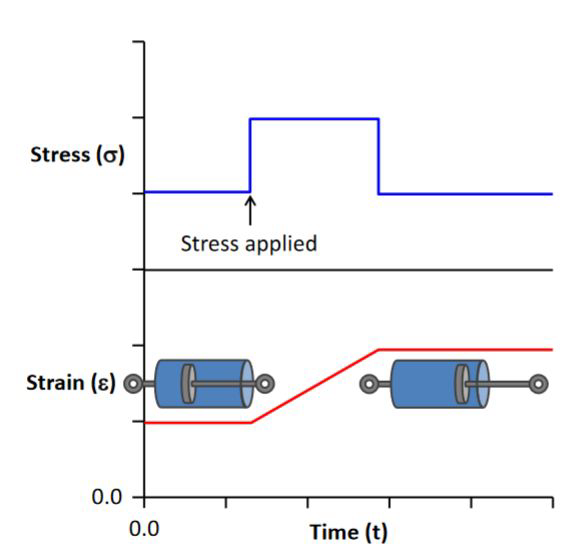
How to interpret this graph
on top we have normal elastic material, where stress applied and stress go up and after time the elastic will relax and fall back down
but on the bottom, is a viscous material, we apply stress (force) to pull the piston out and strain increase over time, once it gets to the max strain, it does not relax but just holds there until the stress is removed.
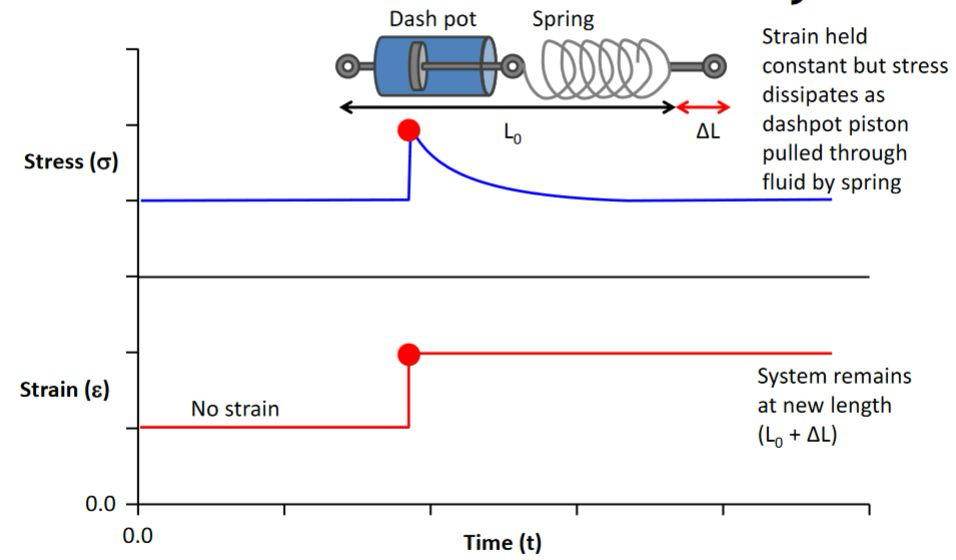
Interpret this graph
stress and strain remain constant
increase in stress and strain meaning the spring is pulled (this is the peak)
dropping off of the peak = spring releases stress overtime by contraction. and the rate of pulling the piston decreases over time
the speed of realxation/contraction depends on the viscousity of the liquid, if high then slow pull if low then fast pull
the strain remain the same, because althu spring contracted and relax, the piston will hold strain caused by the spring and thus increasing the length of the system
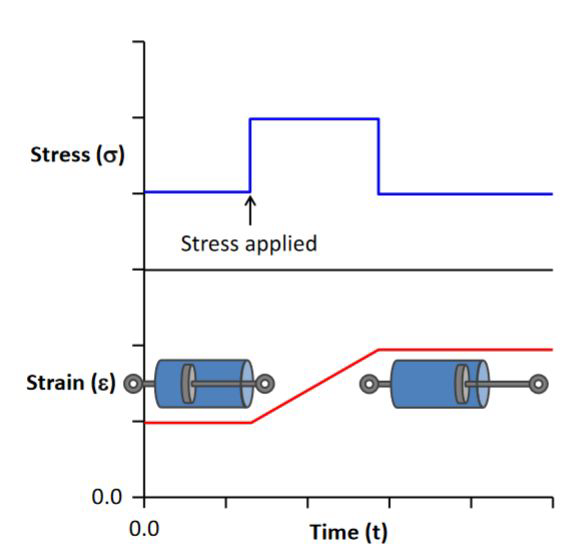
How harmonic analysis can reveal the properties of a material sample
"1. when in phase the material act as an elastic (hookean) solid described by younh's modulus of elasticity (linear line)
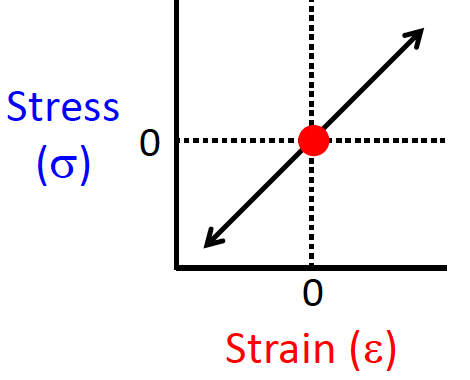
2. when 90 degree out, the material is acting as a newonian fluid described by the sample's dynamic viscousity, make a circle
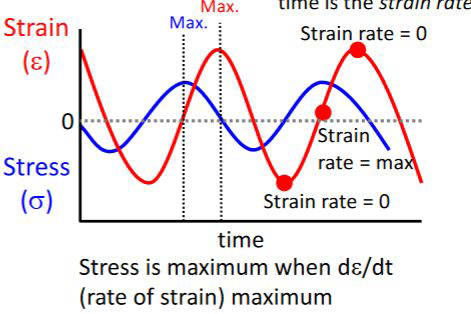
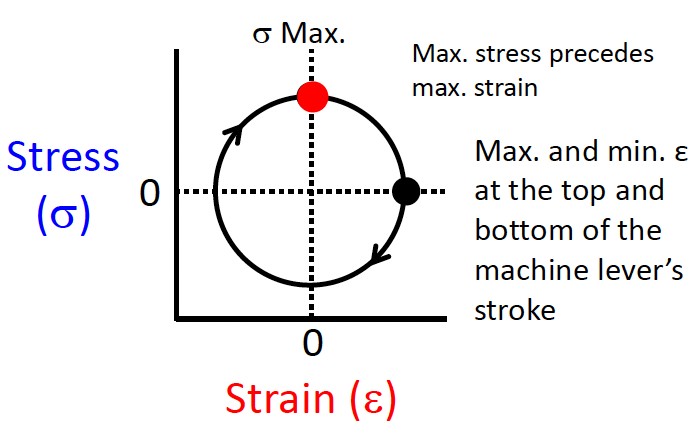
3. when somewhere inbetween is the viscoelastic material, make a ring (ring on jupiter)
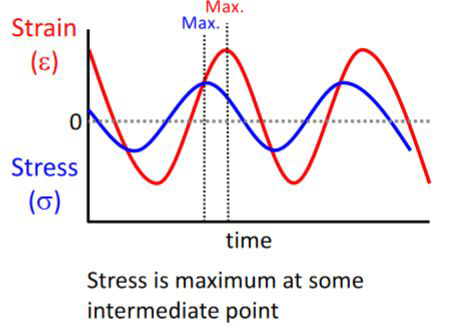
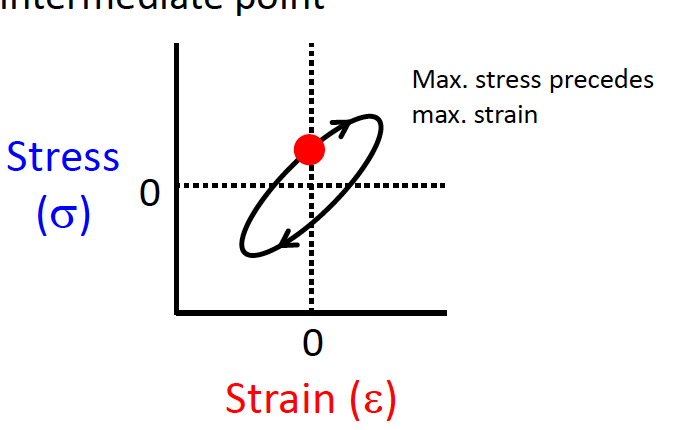
What is density
Density is used when describing the energy present in fluid.
p (rho) = mass/Volume)
if we divde the 3 types of fluid energy by volume will give their energy density (energy per unit volume)
What is the bernoulli's theorem?
total energy of moving fluid is equal to the sum of pressure, potential and kinetic energies.
we can use Bernoulli to determine how different components of fluid energy must change to satisfy the law of conservation of energy in a moving fluid.
However for this to work we assume the
fluid is inviscid (move w/o drag/friction)
flow is incompressible (low velocity)
flow is constant (volume/time)
flow is laminar (no turbulence)
How does Law of continuity apply when water is flowing from the top to down
"
since S1V1=S2V2
The water flowing from the tap is at constant rate, as the water falls down the volume of water per unit time must be the same and as water the is falling down its accerlation must increase due to gravity. meaning volume/time is constant
As the water falls towards the bottom, the velocity is going up so the water's CS area will decreases because of the law of continuity so the volume/time is constant
The static pressure is constant because the column is falling in free air, it is in free fall
The potential energy is changing since the water is falling down, dyamic pressure increases as a result because the fluid is travelling faster, 1/2pv2 (the square meaning more value is on the velocity)
"
What is inviscid Flow in a pipe
"Pressure in the pipe is constant
By looking at the system below, we see there is pipes coming up, that is use to tell us static pressure. "
What is Inviscid flow in real life under a pipe situation
"
- There will be a no slip condition causing the water to be stuck on the wall
- velocity gradient becomes the largest in the middle of the pipe as no slip condition causes a decrease of momentum from the wall to the middle
- water is getting stuck onto the wall, which results in friction and energy lost, this causes the water to decrease in height in the static ports
- Fluid flows down a energy gradient
What is the Hagen-Poiseuille equation
Relates rate of laminar flow through a pipe to the pressure gradient diving the flow, viscousity of the fluid, radius and length of the pipe
the unit is m3 / s
if we double
length= 1/2 Q
viscousity = 1/2 Q
pressure gradient = 2Q
radius = 16Q (strong emphasis)
What does Hagen-Poiseuille equation tells us about radius and its connection to blood vessel
Use radius to regulate flow of blood
we can use smaller vessels to provide the most resistance to flood flow
Blood is regulated by vasodilation (r increase) and Vasoconstriction (r decrease)
What is a Manometer
"
- Uses mercury to measure because of Mercuries density
- When pressure is applied to one side, the fluid inside will flow, changing the height (h) until the pressure exerted by the rasied column of fluid is equal to the applied presure
What is the Patm and Pgauge and its relationship to the Manometer?
"
- Patm: atomsphere pressure and it is always absolute (positive) and using a vaccum to measure, because no atmosphere pressing down on it
- Pgauge: Can be positive or negative, relative to Patm
- Focuses on how much higher/lower the pressure in a system is compared to the surrounding atmospheric pressure.
- Above atmospheric pressure (positive gauge pressure)
- Below atmospheric pressure (negative gauge pressure, also called a vacuum).
How to calculate pressure using the Manometer
"
- The pressure applied to one arm of the manometer can be calculated using the relationship between the density (rho), gravity (g) and height (h) of the fluid column
- there is no kinetic energy
- P1 has raised the fluid by height h
- P1 must be greater than P0 (atmospheric)
"
"How does the Venturi meter work and its relationship to a real life example (length answer)?"
"We can see that
- S(diameter/Cross sectional area) increase = pressure increase = velocity decrease
- S(diameter/Cross sectional area) decrease = pressure decrease = velocity increase
- follows the rule of continuity that pressure decrease result in increase of velocity to match the constant flow rate
- The air wants to move from high pressure to low pressure, and the opening on the ""ground"" has a reduction of S/D/CS (meaning a decrease in pressure)
- this causes the air to move into the region with low pressure.
- With air moving into the hole on the ""ground"", this area is now high pressure, so air would continue to move and exists the tunnel.
- the exit would be at the ""ground"" of an area that has low S/D/CS as compared to the enterance, this result in a low pressure area
- now the air from the hole at high pressure will flow out from the hole into a region of low pressure
- this includes the ventilation of the system
What is a Pitot Tube without a static port
"We meausre the total pressure energy = dynamic + static
velocity by converting the kinetic energy of the moving fluid into pressure energy (pressure energy = dynamic + static)"
"How does a Pitot Tube work with a static port attached "
"
- stagnation point is a combination of static and dynamic pressure, but we only want to measure the dynamic pressure
- adding a second Pitot tube with holes oriented perpendicular to the direction of flow and allows the static pressure to be measured
- since the opening is not directly against the fluid
- the flow does not enter the tube, it flows above or underneath it
- meaning it only measures the pressure exerted by the air on the surface of the tube, it only senses the static pressure
What is the importance of a perpendicular second pitot tube instead of parallel
Importance is that being perpendiular
- it will not measure dynamic energy since the flow of air is not flowing into it
- the air flows around it, either above or underneath
- now the air flows above or around it, meaning the port can only sense the static pressure as the air flows pass it.
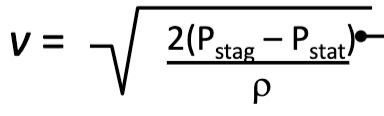
Explain the relationship where the dot is pointed to, to the pitot tube
- In the Bracket is what we get from h
- with 2 port, the pitot tube can automatically subtract Pstat from Pstag
"Combining pitot tube with pipe and explain this picture "
We see many points and how it relates to the units
- the Pitot tube with a stagnation point measure the combine pressure, dynamic and static pressure
- static port allows the port to only measure static pressure because
- it is perpendicular to the Pitot tube, only measure the static pressure it senses as fluid moves pass it
- the pipe S/D/CS reduces in the middle, meaning Velocity increase, pressure decrease,
- this is due to law of continuity, inorder to maintain the constant flow,
- we see decrease in pressure, shown by pitot tube
- increase in velocity, shown by a low static pressure by the static port which means a larger dynamic pressure is experienced
- the S/C/CS increases to the original in the end, meaning velocity decrease and pressure increase
- just like the explanation above, this is due to the law of continuity
- we see increase in pressure, shown by pitot tube
- decrease in velocity, shown by a high static pressure by the static port which means a low dynamic pressure is experienced
- This shows that the fluid flows down an energy gradient
- since pressure does not change (pitot tube proved)
- the only thing that changes is energy lost due to friction as the fluid moves fast a no slip condition, requiring more energy to push fluid down the pipe the deeper the fluid goes down the pipe
How is a Pitot tubes used in nature
Birds have dynamic soaring: use differences in wind speed above the waves to power their flight
Tube-shaped nostrils may function as a pitot tube to detect pressure change and detect air speed they are travelling at
What is Laminar flow?
"Need to be true for bernoulli's principle
- ordered flow
- like sheets of fluid siding over other sheets of fluid
- flows in uniform
- wall has a no-slip conditions and there will be a even velocity gradient starting from the wall, which is the slowest, all the way to them middle being the fastest
- reversible and reproducible
- like a pendulum, easy to predict
- reverse can unmix the fluid since the fluid is moving in sheets
- Cannot mix (like mixing coffee)
What is Turbulent Flow
"
- Disordered flow
- swirling and mixing, unpredictable
- velocity gradient is unpredictable
- Irreproducible and non-reversible
- because fluid can finish at unpredictable places
- efficient mixing
- distributing the ceam, more uniform, cannot be unmixed/unstirred
- dye added will be mixed
- Vorticity
- swirl at different scales, big swirl or little
- chaos
What is Reynolds Numbers?
Conditions in which fluid flowing through pipe
under what condition do we see laminar or turbulent
how to change in between and calculate what condition we see
this relationship is defined empirically
What is Viscous forces
"
- tend to dominate laminar flow since it is at low velocity
- high viscosity results in the velocity gradient from no-slip condition to be transferred further out
- Contains shear stress since we can think of movement of liquid being plates of liquid moving past each other
- each plate rubs against each other and reducing velocity transfer per plate
What is Inertial forces
"
- Dominates turbulent flow because its high velocity
- determined by how fast fluid is flowing and how dense the fluid is
- Fluid collides with the plate area (S) which exerts a force proportional to density, velocity of the fluid and the surface area of the plate
"
"What is the equation for Re # and what does the equation tells us tell us?"
"
- dimensionless unit
- top increases then more turbulent flow
- bottom increases then more Laminar flow
- Re is the ratio of inertial force (Fi ∝ rhov2S) to the viscous force (Fv ∝ dynamic viscousity∙(v/l)∙S)
"
How does changing velocity effect both Inertial forces and viscous forces?`
increasing velocity = promoting laminar to turbulent
low velocity = low shear strain rate = laminar flow
Low shear strain rate: fluid move in parallel layers,meaning less interaction and mixing between layers because the velocity gradient between layers is gentle.
Shear strain rate: measure of how much the fluid layers deform relative to each other as they flow.
high velocity = higher shear rate = higher shear strain rate = inertial forces
higher velocity = increase instability of flow
high shear strain rate: cause rapid change in velocity between the particles and layers of the fluid
higher shear stress: since the strain rate is higher this leads to an increase in shear stress (reflected by the equation also).
Fluctuating motion and mixing in turbulence create large velocity gradients, especially near walls, contributing to higher shear stresses.
"
How does changing density effect inertial forces and viscous forces
Increasing density = increase fluid not going to move tgt
- Cars moving along the road, low mass = turn the corner nicer = no spin out
- Increasing mass = more likely to spin out
- Higher density = if object want to move in a straight line, it makes it harder to conform
- like truck has a harder time to drive when compared to cars
- The higher the fluid’s density (rho) = more velocity to generate inertia forces
- like the velocity relationship to inertial forces, this increases turbulent forces
- which causes it to be more likely to separate from the surface (thus generate turbulence)
how does changing the length (l) effect inertial forces and viscous forces
"
- described the scale of the system
- I increases longer flow path means longer CS area the fluid need to flow over
- increase chance of turbulent
What are the properties to promoto turbulent flow?
Increasing fluid density (rph) kg/m3
Increasing velocity (v) m/s
Increasing characteristic length (l) m
What is the difference between kinematic viscousity and dynamic viscousity
KV: measure of fluid resistance to flow under influence of gravity
How easily fluid spread or flow under its own weight
DV: measure of fluid internal resistance to flow
describes how thick or viscous a fluid is
how easily or diffcult fluid flows under force
how much force is needed to make it flow
What is the relationship of air and water with Kinetic Viscousity and Dynamic Viscousity
"
- Air
- KV: High when compared to water
- because have low dynamic viscousity and low density
- althu air has lower dynamic viscousity, so it should in theory have low KV
- but because the density is lower, so KV is lower
- smaller denom
- DV: Low when compare to water
- Because its a gas, more molecule is spread out
- Water
- KV: Low when compare to air
- because is not viscous
- higher dense, so larger denom
- DV: High when compare to air
- water is thicker and has more resistance to flow compare to air
- more friction because more water is packed together then air
"
what is the Tangetal velocity and how does a solid spin on a disc
On the disc, tangental velocity to the AoR is lower then further out on the disc
increase in velocity at a linear relationship
since the surface of the object is completes on the flat disc while rotating
so the object will rotate around the AoR
What is tangental velocity and fluid during a vortex
"
- Closer to the AoR, fluid tangental velocity at its greatest
- movement of solid at this position is the same as the object moving on a disc
- However too close to the AoR then velocity drops
- also requries to apply more shear stress thus using more force
- Shear stress in a fluid is proportional to velocity gradient between adjacent layers of fluid (the shear rate).
- At center, velocity gradient is close to zero because less fluid = ittle radial movement relative to one another = less slipping to increase speed
- not much difference in velocity between layers in the center, the shear rate is minimal, leading to very low shear stress.
- solid is no longer rotating with the vortex, but ""translating"" towards the outside of the vortex
- Translating meaning: part of the leaf closet to the centre will be faster then the part further out
- this causes the solid to turn in oppsite direction
What is angular momentum
"
- Universal rule: angular momentum must be conserved!
- If r decreases, then an-mom must increase Velocity varies inversely with radius
- Each bit of fluid mass has the same angular momentum
"
What is the relationship between vortex and viscousity
Vortices involve the shearing of concentric rings of fluid
At low Re = large viscous force meaning vortices can have large rotational cores
To shear steams of viscous fluid past one-another requires energy
In the absence of energy being added, this viscous shearing will cause the vortex to grind to a stop and dissipate
How does Bristles function at low Re
"
- Mainly used by smaller animals
- when at low Re #, large amount of viscous forces
- there exist a thick layrer of semi stagnant fluid adheres to the hair
- viscous force are about fluid sticking meaning the fluid will stick on and between bristles to act like a solid paddle
- which causes the fluid to flow around it
- When at high Re #
- inertial force is more important then viscous forces
- without length and viscosity force changing but velocity changes
- change in velocity is able to push thru the stagnant fluid to allow the fluid to flow between the hair
What is leakiness equation
"
- volume per time of fluid passing between the hair / volume per time without hair
How does leakiness relate to paddle and sieve
"
- Paddle
- the lower the Re the more ""paddle like""
- less leakage = less inertia force and more viscous force
- Sieve
- the higher the Re the more ""sieve like""
- more leakage = more inertial force and less viscous force
"What does the graph tell u about the x and y axis "
Y: Measure of fluid bypassing or leaking through the gaps between hairs.
A higher value means more fluid is leaking through the gaps.
X: Shows the ratio of the gap between hairs relative to the diameter of the hairs.
Low value represents fine mesh (closely packed hairs)
while a high value represents a coarse mesh (larger gaps).
"how can you interpret leakiness with Re # from this graph"
"
- leakiness increases when gap width between the hairs grows relative to hair diameter.
- Means that structure becomes ""coarser,"" more fluid passes through the gaps.
- Effect of Reynolds number (Re): high inertial force = high velocity
- At higher Reynolds numbers (Re = 1.5, Re = 0.8),
- Leakiness rises steeply with increasing gap width
- means faster flows cause more fluid to bypass the hairs in a coarser structure.
- At lower Reynolds numbers (Re = 0.01, Re = 0.05), high viscouse force = low velocity
- leakiness increases more gradually = slower flows result in less leakage through the gaps even in coarse mesh.
How does antennae function as sieves for odour molecules?
they contain antennas
will act as a solid when at low velocity = visousity high = low Re
When wanting to function as a sieve the antenna will
twitching of the antenna causes an increase of velocity = changing from solid into sieve = hormone flow thru the antenna
How does the moth use the principle of continuity to sample a larger area of air?
flapping of wing creates air currents that draw more air toward its body. this increases the air velocity
To maintain continuity of airflow as velocity increases, the moth pull air from a larger area,
therefore increasing the probability of detecting the pheromones.
Law of continuity hows that as the wing flap thus increases air velocity near the antennae,
more distant air is drawn in to compensate, expanding the effective sampling zone.
 Note
Note  Flashcards (31)