BI 927 - Lecture 1
 Studied by 0 people
 Call with Kai
 Learn
Learn Practice Test
 Spaced Repetition
 Match
Match Flashcards
 Knowt Play
1/18

Earn XP
Description and Tags
Lecture 1 - The Media of Plant Tissue Culture
Name | Mastery | Learn | Test | Matching | Spaced | Call with Kai |
|---|
No study sessions yet.
19 Terms
Explant
It’s the piece of tissue, cell, or organ that is used to regenerate or regrow the whole plant under an artificial environment.
Callus---
An unorganized, proliferate mass of differentiated plant cells, a wound response.
(wound healing)
Plant Tissue Culture 101
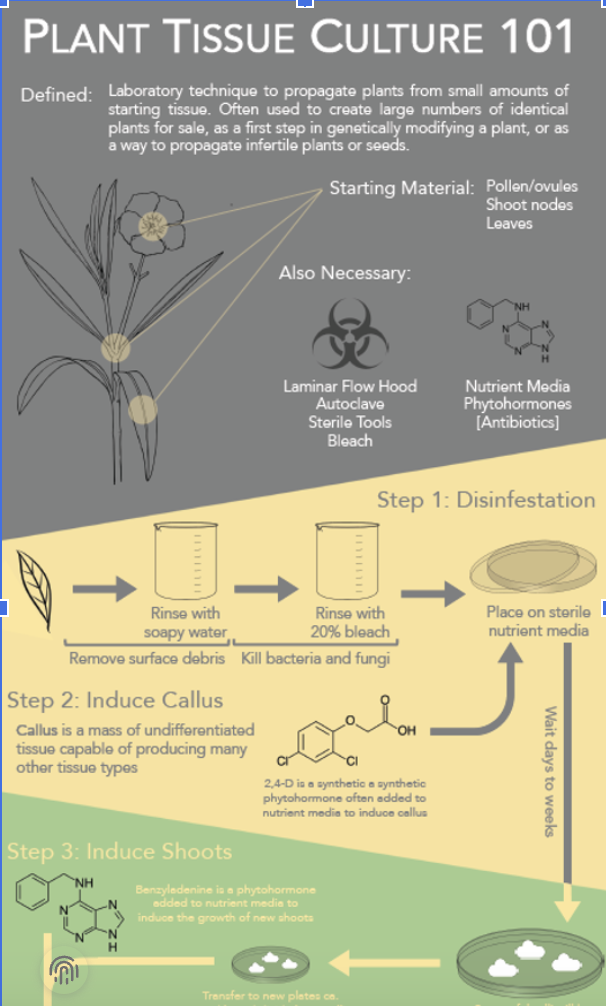
Each plant tissue culture medium must contain the following essential components
Macro inorganic nutrients.
Micro inorganic nutrients
Iron (as chelating agent)
Vitamins
Carbon sources
Organic nitrogen
Plant growth regulators
Agar (as gelling substance)
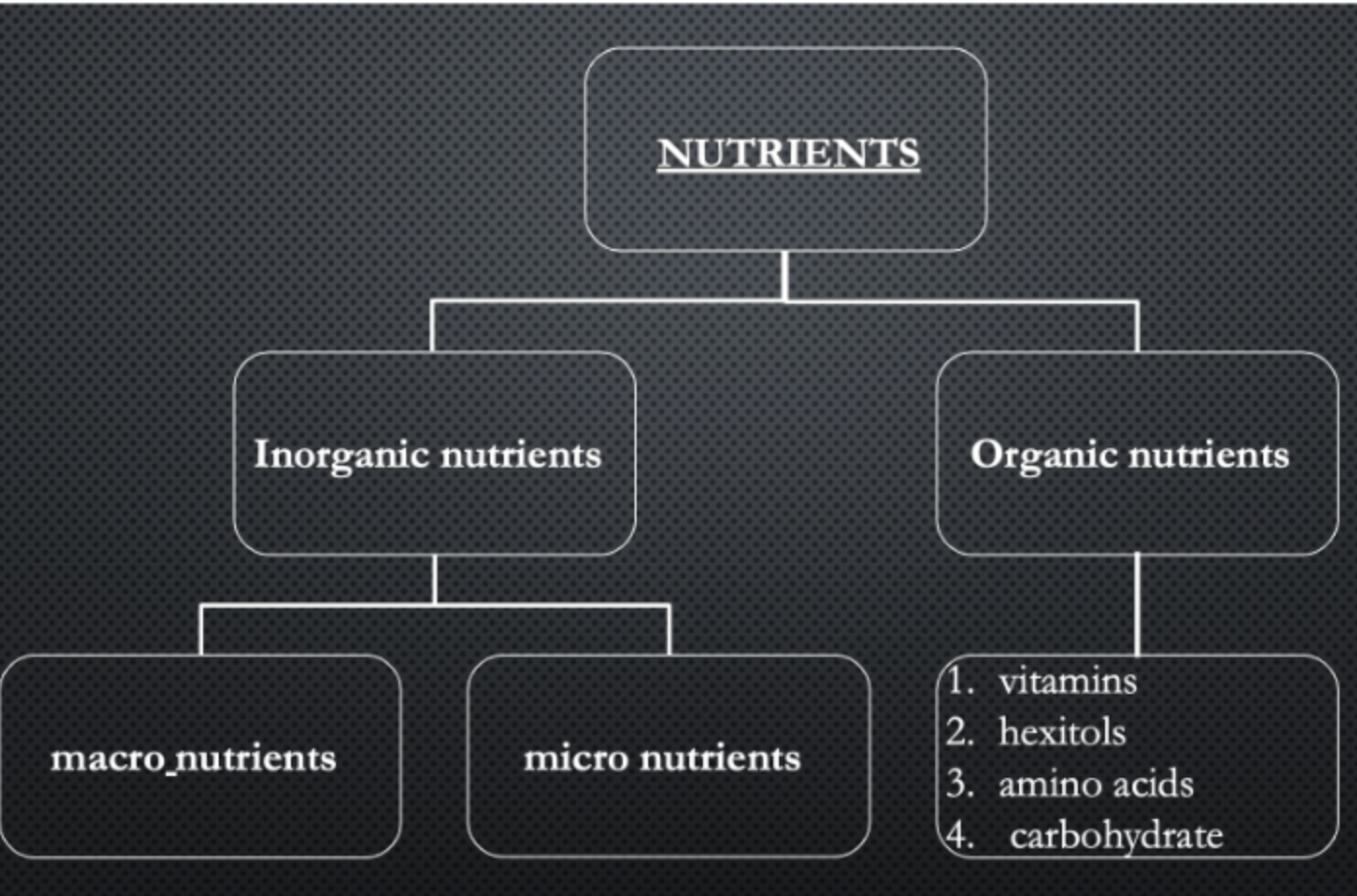
1. Macro nutrients
It is present in milli molar (mM) quantities (more than 30 mg/L)
provide both anions and cations for the plant cells.
nitrogen (as NO3 NH4) and, phosphorus(PO4), potassium(K),Sulphur(SO4),magnesium(Mg),and calcium(Ca).
structural and functional role in protein synthesis, cell wall synthesis enzyme Co-factors and membrane integrity.
2. Micro Nutrients
Boron(B),Manganese(Mn),Zinc(Zn),Molybdenum(Mo),C opper(Cu),Cobalt(Co).
Used in less amount less than (1mg/L). Concentration is always in uM.
Play important roles in enzymatic activities
iron
Important Enzyme Co-factor
Supplied in uM quantities.
It is supplemented with chelators and Complex compounds due to its solubility problem.
Supplied as Na2FeEDTA
Iron deficiency have severe effects on the growth and development plant cells.
Organic Nutrients
Vitamins
Plant synthesis required vitamins
Essential for many biochemical reactions.
Cultured cells are capable to produle vitamins at some level.
They require an exogenous supply of different vitamins for optimum growth.
Most usable vitamins are Thiamine, Pyridoxine nicotinic acid Vitamin B Complex.
Carbohydrate
Supplied by adding sucrose (after autoclave!)
Concentration is 20-30mg/L
Gelling agent
Agar
a natural product of seaweeds.
With water it melts at 100ºC and solidify at 45ºC
Agarose
Highly purified agar
Melt and gel at temperatures below 30ºC and dissolve through boiling
Gelrite or Phytagel
Gelrite is a naturally derived polymer
produced by the microbial fermentation of the bacterium Pseudomonas elodea.
low-cost gelling agent.
0.1-0.2 % concentration per liter required
PLANT GROWTH REGULATORS (PGR)
A plant hormone can be defined as a small organic molecule that elicits a physiological response at very low conc.
PGR plays an important role in the phenotype.
Act as a messenger between environment and the genome.
AUXINS
• Essential for cell division, cell elongation, cell differentiation, organogenesis and embryogenesis, callus formation
• Natural form auxins
➢ [indole-3-acetic acid (IAA), phenylacetic acid (PAA), indole-3-butyric acid (IBA)
• Synthetic form of auxins
➢ 2,4-dichlorophenoxyacetic acid (2,4-D) and 1-naphthaleneacetic acid (NAA)
Auxins are a vital class of plant hormones (or plant growth regulators) that promote cell elongation, division, and differentiation, primarily governing growth processes like rooting, stem elongation, and tropical responses to light and gravity.
CYTOKININS
• promote cell division, shoot proliferation and influence the cell cycle.
• inhibit root formation.
• Synthetic form is 2-ip which is most active cytokines.
• Natural forms are BAP and kinetin.
Cytokinins (not to be confused with immune system cytokines) are a class of plant hormones (phytohormones) that act as essential plant growth regulators.
PH OF TISSUE CULTURE MEDIA
pH is adjusted between 5.3 & 5.8 before gelling and sterilization with the help of dilute NaOH, KOH or HCL.
pH below 4.5 or above 7 will lead to growth and development inhibition
Last step before adding and dissolving agar
Gamborg's B5 powder
Gamborg's B5 powder is a widely used, nutrient-rich basal salt mixture designed for plant tissue culture, developed by O.L. Gamborg in 1968. It provides essential macronutrients (like potassium nitrate and ammonium sulfate) and micronutrients to support callus induction, suspension cultures, and plant regeneration, particularly for soybean and Eucalyptus species.
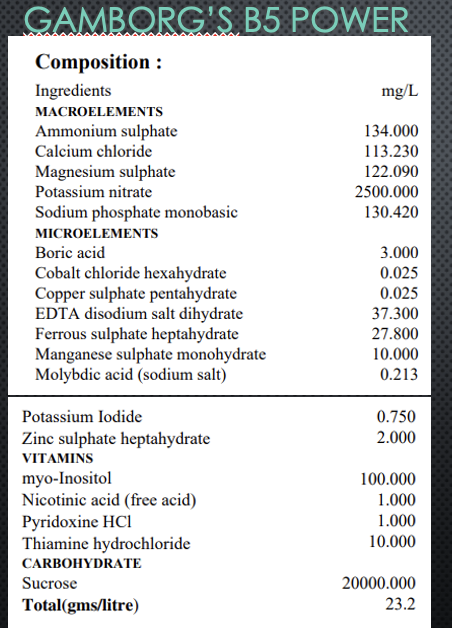
To prepare Gamborg’s B5-#
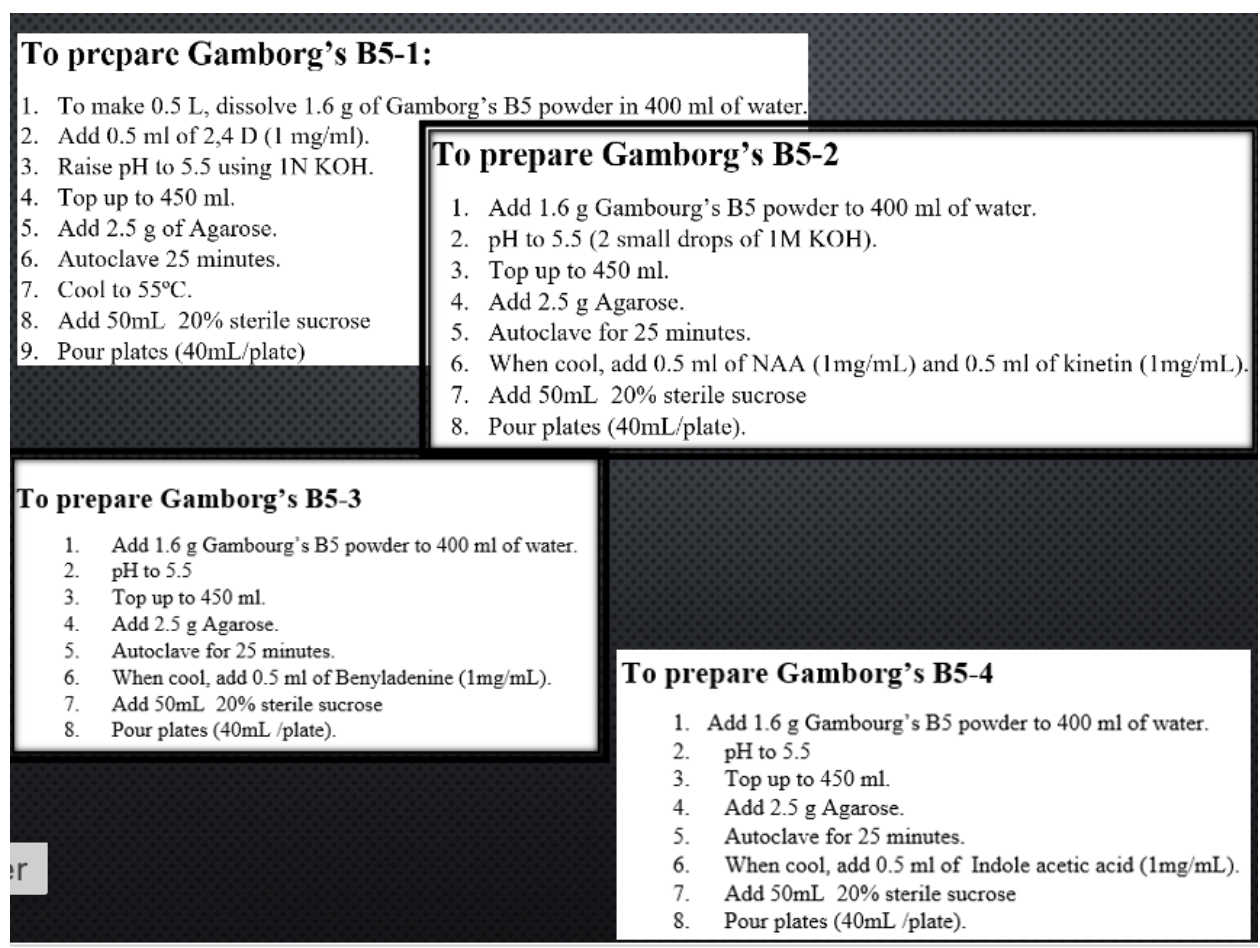
 Note
Note  Flashcards (45)