PSYC 310 Exam I
 Studied by 0 people
 Call Kai
 Learn
Learn Practice Test
 Spaced Repetition
 Match
Match Flashcards
 Knowt Play
1/134

Earn XP
Description and Tags
cognitive development with Dr. Stella Lourenco
Name | Mastery | Learn | Test | Matching | Spaced | Call with Kai |
|---|
No analytics yet
Send a link to your students to track their progress
135 Terms
what is cognition?
thinking
reasoning
planning
knowledge
mental processing
what is knowledge?
(access to) the content of what we know
having information in our head
ACTIVE RETRIEVAL of info
what does mental processing allow us to do?
make a distinction between what’s automatoc vs. effortful and conscious vs. unconscious
ex: tying shoes is just as cognitive as solving a math problem, it was once just more effortful
ex: driving is an act of cognition, no matter how conscious we may be
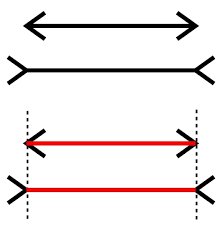
what is the muller-lyer illusion?
visual illusion where two lines of equal length appear to be different due to the addition of arrow-like tails or fins at the ends of the lines.
how does the process of mental processing look like?
stimulus/input
sensation
perception
cognition
what is stimulus/input?
the stimulus itself
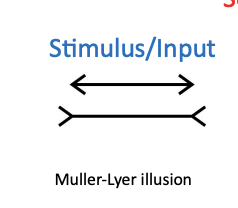
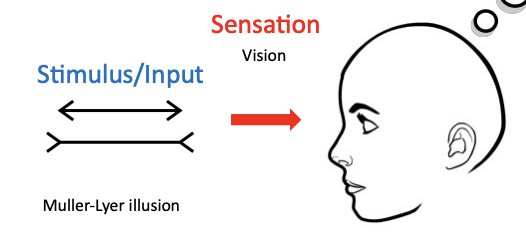
how does stage 2: sensation work in mental processing?
visual stimulus makes contact with our sensory organs (eyes)
ex: we see the muller-lyer illusion
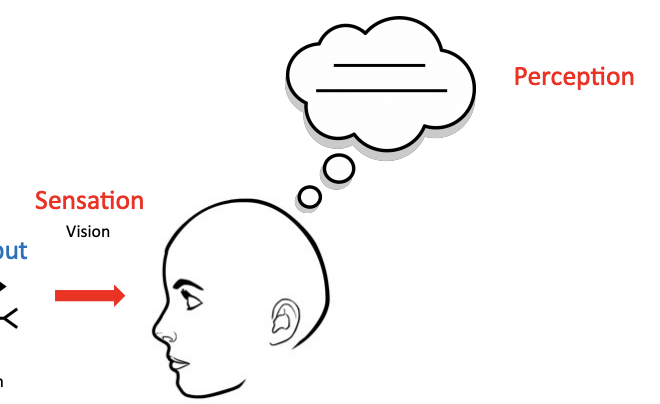
how does stage 3: perception work in mental processing?
act of making sense of the input BUT there could be errors involved in processing
ex: measuring if the lines are the same length with our eyes
how does stage 4: cognition work in mental processing?
involves reasoning
ex: understanding that the lines are the same length—with just perception, we wouldn’t have known this
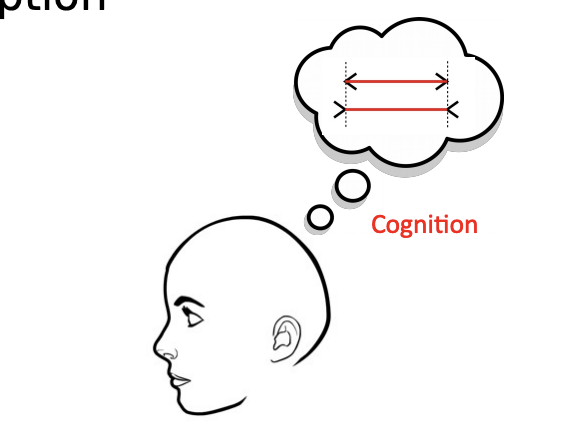
can mental processing go backwards from cognition to perception?
yes; processing is modular & encapsulated or not influenced from other factors
although we have the ability to reason, that reasoning doesn’t update our visual system of interpreting that info
being able to process stimuli devoid of external cues has an evolutionary basis= to have a system that works on its own and isn’t affected by external cues
much of our visual system is modulated & encapsulated
what is development?
change over time
what are the 2 types of time in development?
ontogenetic time
phylogenetic time
what is ontogenetic time?
age-related, over the life span
*onto our life
what is phylogenetic time?
cross-species;evolution
given our history, what might we have from day 1
how might we think similarly to species who share a similar evolutionary history
*across phyle of species
what does change refer to in development?
there’s both imrpvoement as well as decline= change is not always linear & can be backward
ex: memory, fluid intelligence, language learning, acquisition
combining cognition and develoment, what is cognitive development?
studying the change in thinking/reasoning/knowledge across the lifespan (and prior)
origins/starting points = wgat does she know, now and at birth?
how do environmental experiences enrich the origins?
what are some influences to cognitive development?
sociocultural influences
affective/emotional influences
what is the concept of nativism when it comes to understanding development?
certain functions are innate - reflexes are inborn
biologically predetermined, innate behaviors
if we don’t have certain reflexes, it typically signals abnormalities with our bodies
biology has also created a system that’s available at birth and declines/goes away on a very regular mental trajectory
if something stays for too long, then it can also signal something wrong
ex: grasping, rooting, stepping, sucking
what is the grasping reflex?
babies close their fingers around anything that touches their palm
adaptive reasoning = for holding onto objects and their mother
what is the rooting reflex?
(1) turning the head in the direction of a touch on the cheek, near the mouth
what is the stepping reflex?
when a baby is held upright & their feet are supported on a surface, they start stepping, which resembles walking
would be maladaptive if this reflex didn’t go away, as we’d constantly be stepping on ground
how does ‘classic empiricism’ add to the controversy of the idea that reasoning/knowledge is inborn?
Classic empiricism emphasizes the role of experience and sensory perception in acquiring knowledge; suggests that all knowledge comes from sensory experiences and that reasoning is based on these experiences
classic empiricism challenges the notion that reasoning/knowledge is innate or inborn. It argues that knowledge is acquired through observation and experimentation rather than being pre-existing
for most of psychology’s history, a baby from day 1 is beyond unable to do anything; it’s bombarded with visual and auditory info, baby has to learn everything from scratch
what is the challenge of testing innate cognition in humans?
it’s important to remove all irrelevant info, but it’s not ethical to ex: put babies in a black box and remove all stimulants to see how the baby develops
even if it were, it may not be possible to test babies on questions of interest
what is the answer to researching if cognition is innate?
testing on precocial (mostly mature from birth) nonhuman animals
ex: chicks can see & process, walk around from birth
Regolion & Vallortigara’s study on occlusion with chicks
Q: is it the experiences built from living or that evolution has shaped our brains & visual cortex to interpret overlaps of objects as not one object but separate?
(i) newly hatched chicks were placed in cage with an occluded triangle dangling (black block was in front of the triangle) from the center (to test occlusion)
use their ability of imprinting - typically, chicks interpret the first object they see as their mother, will follow it around
(ii) THEN, dangle complete blue triangle vs. disconnected pieces of blue triangle, see what the chick follows
(iii) results:
chicks imprinted on the complete triangle = chicks are inborn with the ability to see complete objects even with occlusion = human infants may also have innate capacity to understand object properties
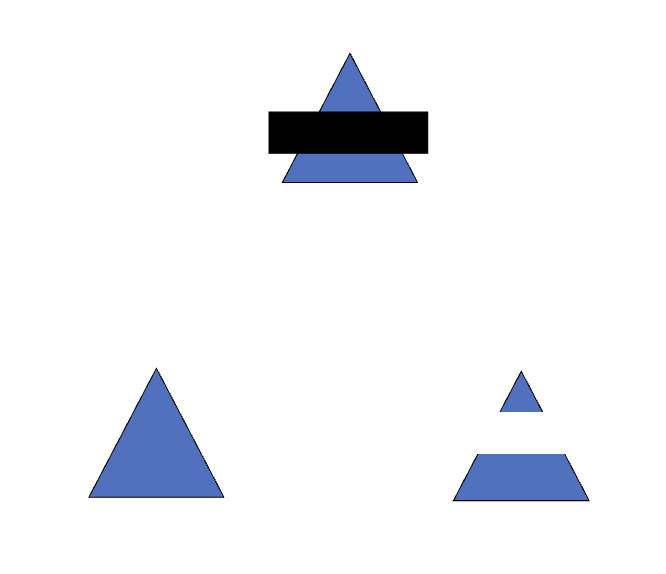
what are the limitations of applying Regolin & Vallortigara’s study on chicks to human infants?
the chick study is a “proof of concept” – knowledge of object occlusion can exist w/o any experience
a) BUT the big diff between human babies and chicks is that chicks are precocial and humans develop much slower
i) so, perhaps this knowledge exists in chicks but not humans
what are alternative interpretations to the chick study in which they concluded that chicks have ‘knowledge of occlusion’?
controversy comes up when we conclude that it is knowledge/reasoning
there are other ways to interpret this, than that its’ organisms’ knowledge
it could instead be the perceptual abilities of infants = by way of gestalt principles
perceptual completion occurs beyond the occlude, just bc our perceptual ability fills in the rest of the info
perceptual similarity, good continuation, perceptual completion
(ii) perceptual abilities come without experience or knowledge, its innate
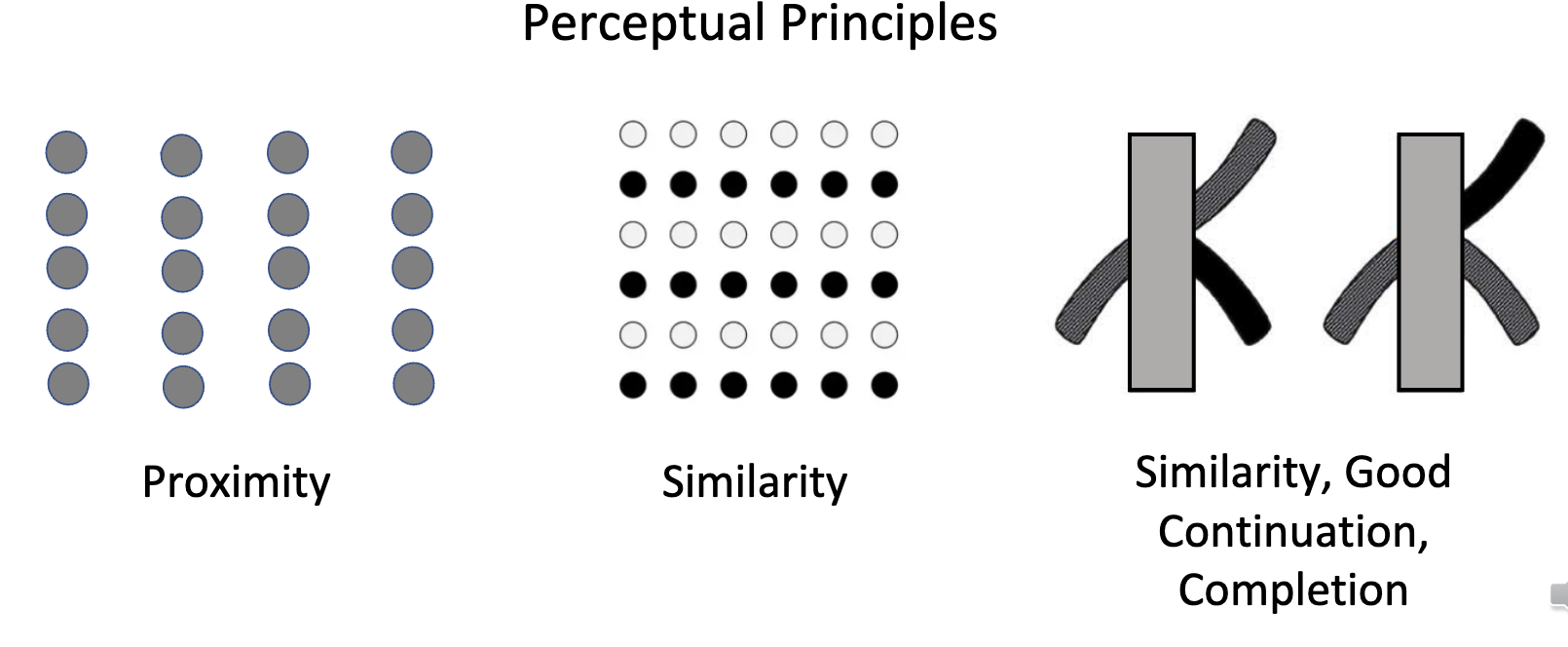
what does “innate” mean?
a) experience is not needed for its emergence
i) ex: child is 3 months old, been raised in an empty room where there was no opportunity to learn occlusion, still would know a triangle is complete even with occlusion = knowledge of occlusion doesn’t require experience with objects or occlusion conditions = occlusion is innate
what would it mean if researchers were to take into consideration experiences before birth (in the womb)?
i) if this matters, then perhaps object knowledge is not innate (as typically conceived)
ii) ex: babies can feel their own bodies in the womb, they can see very blurry information, they could have learned through experience before birth
what if something is not present at birth—it emerges later in life—can it be considered innate?
i) in principle, yes (there’s maturation)
ii) some abilities could emerge later bc programmed to emerge later (e.g., puberty), regardless of environmental experience
what does innate NOT mean?
does NOT mean immutable = inborn capacities can change or develop throughout life!
why might innate abilities be constraints to our interpretations of the world?
mind and brain might be constrained to interpret certain things in certain ways from birth
what are the 3 different types of constraints that our innate abilities may be?
representational constraints
architectural constraints
chronotopic constraints
how might our innate abilities act as representational constraints?
infants come into the world with knowledge abt the nature of OBJECTS (e.g., occlusion, solidity[objects are solid and won’t pass through another], etc.)
ex: MATHEMATICS
subtraction and addition – infants don’t necessarily understand what 1 are 2 are, but they know that if one is added to another, there are more
ex: GRAMMAR
Noah Chomsky &Steven Pinker
we are able to understand & interpret grammar, and how language goes together
when infants are exposed to languages, they start learning without having to go to school
(a) Elizabeth Spelke – human babies have knowledge about all sorts of objects and are adaptive BUT but even more learning might be needed whenever something goes against our innate knowledge
how might our innate abilities act as architectural constraints?
the organization of the brain (i.e. architecture) is innate
(1) e.g., some neurons engage in one type of activity, whereas other neurons engage in other types (e.g., excitation vs. inhibition)
brain regions that process specific types of info
(a) e.g., occipital cortex processes visual info
how might our innate abilities act as chronotopic constraints?
developmental timing is innate
ii) ex: “critical” or “sensitive” periods in language learning
iii) if no exposure early in life, proficiency is greatly reduced
ex: 2nd language acquisition is also easier earlier in development
what are domain-specific abilities?
the cognitive or behavioral abilities that are specific to certain areas of psychological functioning.
ex: skills like language acquisition, mathematical reasoning
Each domain-specific ability is tailored to a specific area of psychological functioning and may vary in terms of development, proficiency, and application across individuals.
historical root: Franz Gall’s phrenology (specific parts of the brain specialize in certain functions)
what are domain-general abilities?
cognitive skills or processes that are not specific to a particular domain or task
can be applied across various cognitive tasks and domains.
ex: working memory, processing speed, attention control, cognitive flexibility, and problem-solving skills.
what is the difference between continuity vs. discontinuity?
when something looks more continuous, implies that there’s the same mechanism underlying that development
b) when something looks more discontinuous, it suggests that there may be different mechanisms
ex: height is discontinuous
i) when looking across age, there are periods where height growth occurs more rapidly than other ages
ii) discontinuity may be supported by exercises, diet, puberty
what is the difference between quantitative vs. qualitative development?
quantitative
i) ex: cats look the same as they grow, might increase in size
b) qualitative
i) ex: butterflies look nothing like how they looked at birth
*both quantitative and qualitative are discussed in terms of knowledge & mental processing
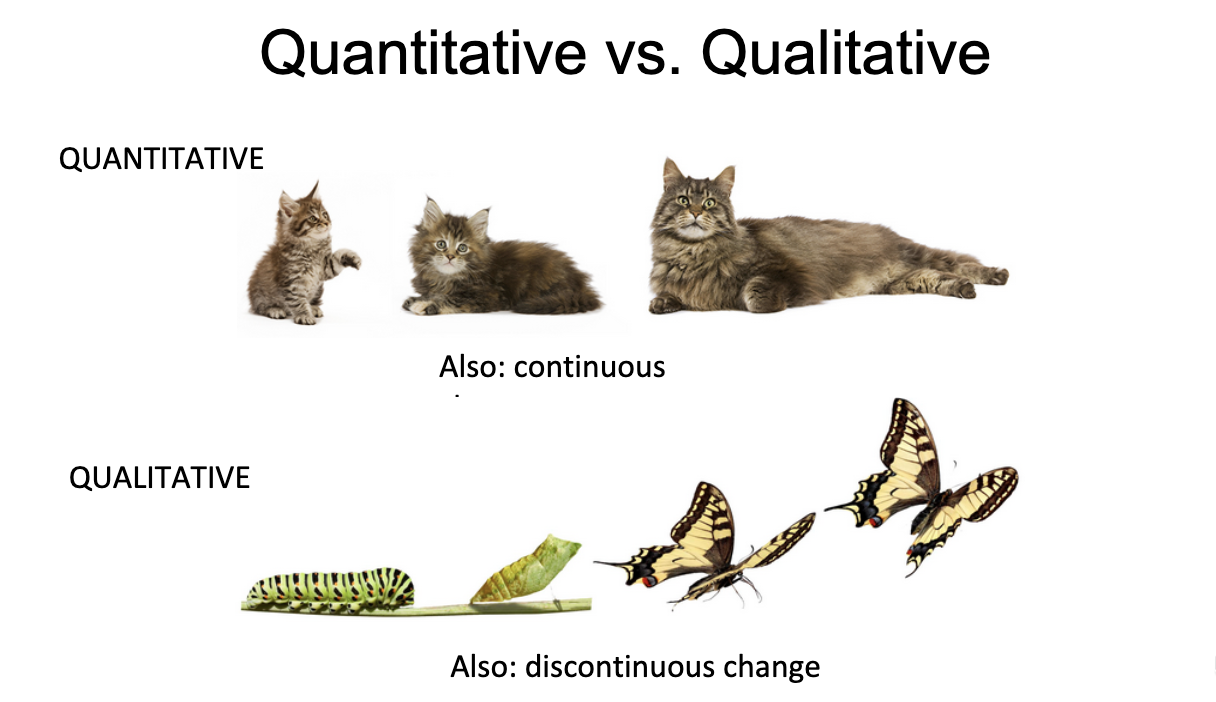
is height a quantitative or qualitative development?
height is quantitative because it’s measurable by number - you can just get more of height but it’s not that short or tall changes the thing itself
Harry Harlow’s experiment of early separattion on rhesus monkeys: PROCEDURE
i) controlled rearing – take away babies from their mother
ii) present 2 models of mothers
one covered with wires, with bottle to feed infants
one covered with soft cloth
Harry Harlow’s experiment of early separattion on rhesus monkeys: RESULTS
baby monkeys preferred cloth monkey, even without the feeding bottle
Harry Harlow’s experiment of early separattion on rhesus monkeys: CONCLUSION
(1) part of the social attachment between a caregiver and an infant is the warmth or closeness that’s made possible = body-to-body connection
ex: common to see baby monkeys hugging themselves often when separated from their mother
which model were the first interpretations of the rhesus monkey experiement consistent with?
“tape recorder model” - whatever gets registered during early development stays over the lifespan = model of STABILITY
how did the subsequent rerun of the rhesus monkeys experiment on early attachment show evidence of plasticity?
i) baby monkey separated from mother at birth, but introduced to sibling later on, monkeys interacted normally
ii) early attachments & their quality matter, BUT there is plasticity
(1) subsequent healthy interactions can occur following bad early interactions
how does the neural insult test case show that stability and plasticity depend on developmental time periods?
neural insult = when there’s damage to brain by way of stroke, tumor, etc
Q: Does the problematic effect on the brain affect stability & plasticity in terms of the brain’s ability to change throughout development?
YES: “if you can arrange it, make sure your brain injury happens early in life rather than later in life”
plasticity/recovery is much more likely early in development than later, at least for some domains
will see more recovery in development if damage occurs earlier
ex: if an adult goes through a stroke & affects language development = will see deficits
but in children, there may be deficits right after damage, but not so much later on = recovery
how was the case of patient EB and KN’s hemispherectomies an example of plasticity in language?
(i) children who had hemispherectomies as infants
(ii) most of their left hemispheres were removed bc they were likely experiencing seizures that couldn’t be treated any other way
(iii) for most individuals, language processing is localized to the left hemispheres
(iv) These patients read, write, and speak normally even though most of their left hemispheres were removed= evidence of plasticity after damage in early development
(v) On the other hand, if a grown adult had their left hemisphere removed, their language abilities would be severely hindered
how is spatial reasoning an example of stability & an exception to the dependence on developmental time periods?
(a) spatial reasoning is localized to the right hemisphere
(b) infants still show deficits with respect to spatial reasoning when they have their right hemisphere removed, unlike language abilities
how has the way we conceptualize children’s thinking changed throughout history?
17th century: John Locke’s idea of “tabula rasa” = we are all born into a “blank slate”
we’re an adult from the get-go bc that’s who we’re learning from
18th century: Jean-Jacques Rousseau’s idea of “noble savages”
children are born good; he went against the idea that children, like adults, are not always moral
today: we are all qualitatively different and not “miniature adults”
there’s a unique period of development – e.g. Freud’s idea of repressions that lead to deficits later on
children now receive protection and rights
e.g. UNICEF’s establishment of children’s rights
children are individuals but don’t have the same capabilities as adults, so they deserve protection
who was Jean piaget & how did he come to be called the “father of cognitive development”?
worked on developing IQ tests during the war, became interested in “genetic epistemology” (i.e. the origins of knowledge)
i) in trying to understand genetic epistemology, he adapted concepts from biology to describe/understand developmental change
according to piaget, what is schema/schemata?
units of understanding that can be hierarchically categorized as well as webbed into complex relationships with one another
(a) organizing info in a way that it makes sense
how is schema different from a mental representation?
schemata can be entirely embodied or in action (it’s in how you interact with it, not just in head)
1. ex: we know how to grab a water bottle, depending on the size = schema is in the action world; it’s muscle memory
a. thus, not a mental representation
according to piaget, what is assimilation?
assimilation is the process of fitting new information into pre-existing knowledge and understanding
ex: A child might have been taught from reading a book that zebras are black and white.
When they see a cow that’s also black and white, they tell their parents that they see a zebra, although it is a completely different type of animal.
the child is assimilating the new object (i.e. black and white cows) to an existing idea (i.e. black and white animals are all zebras).
according to piaget, what is accomodation?
accommodation is the process of modifying existing cognitive schemas or mental representations to incorporate new information or experiences that do not fit into existing schemas
adjusting schemas/understanding of the world to accommodate new knowledge or changing circumstances.
ex: A child might try to pass a tennis ball to their friend and finds that it’s much heavier than the foam balls they used to play with.
The child changes their way of grasping the ball to be able to hold and toss it to their friend without the ball falling from their hand = the child adapts to a new
type of a ball and accommodates their way of grasping it
according to piaget, what is equilibriation?
Equilibration is the process of achieving a balance between existing knowledge and new experiences
involves both assimilation & accommodation
an ongoing process that refines and transforms mental structures, establishing the basis of cognitive development
when confronted with contradictory info = disequilibrium
we adapt thinking to incorporate the new info to reach a more stable equilibrium
according to piaget, development is a Q_________ change
development is a qualitative change, as exemplified by stages
children are qualitatively different thinkers than adults, as opposed to “miniature adults”
according to piaget, developmental stages are domain _______.
developmental stages are domain-general
change is not specific to one domain (e.g. conservation)
more than one area of the brain is recruited in development
learning that affects understanding in one domain applies to understanding in other domains
changes are very similar and can be explained by a common underlying mechanism
what did piaget’s ideas of universal progression and “age as approximation” mean?
(i) One stage precedes another, the later stages override what happened in previous stages = new cognitive abilities
(ii) change will happen generally in the same trajectory, but it’s not like a certain change needs to occur at exactly 2 months old
what was piaget’s idea of constructivism?
cognitive development is the mix of biological maturation and interaction with the environment (i.e. combination of nature and nurture)
(ii) children use innate capacities (i.e. reflexes) to ACTIVELY LEARN about the world through their experiences (i.e. action realism)
(iii) ex: if a baby never played with an object (throw, hold), would never learn anything about it
active interaction is the only way for cognitive development for children
what are the 4 stages of development according to piaget?
Sensorimotor stage (birth to 2 years): Infants learn through their senses and motor actions.
Preoperational stage (2 to 7 years): Children develop symbolic thinking and use language, but struggle with logical reasoning.
Concrete operational stage (7 to 11 years): Children can think logically about concrete objects and events.
Formal operational stage (11 years and older): Adolescents and adults can think abstractly and engage in hypothetical reasoning.
what are the summarized main characteristics of the sensorimotor stage according to Piaget?
children learn about object permanence
children learn about locational independence of objects
this learning is done through interacting with object themselves
the construction of ‘object knowledge’ (schema) at the end of the sensorimotor stage differs qualitatively from that at the beginning
what does does lack of object permanence look like during the sensorimotor stage according to piaget?
there is initially no conservation of object existence/they lack object permanence before 8 months
“out of sight, out of mind” = object ceases to exist if infants do not see it
ex: 3-mo-old is initially interested in a toy they see & tries to grasp it. they will lose interest in a toy after it becomes convered, will no longer try to actively grasp the object
=if a baby doesn’t try to actively search for an object then they lack object permanence
how does the A-not-B error occur after object permanence is developed in the sensorimotor stage according to piaget?
after 8 months, children gain object permanence, understands that objects continue to exist even when out of sight BUT makes the A-not-B error
ex: researcher hides an object in a wooden box with 2 openings covered by a cloth
9-mo-old sees where the object went, opens the correct covering to find the object
BUT has a fixated view on where the object exists (doesn’t have knowledge that object can exist in a different place)
although the researcher placed the object in a different location, the baby searches for it in the place where it was initially placed - incorrect location
a. correct searching at the A location would mean that infants have object permanence, out of sight is NOT out of mind
b. incorrect searching at location B means that infants do not yet understand that object existence is independent of location (and/or action)
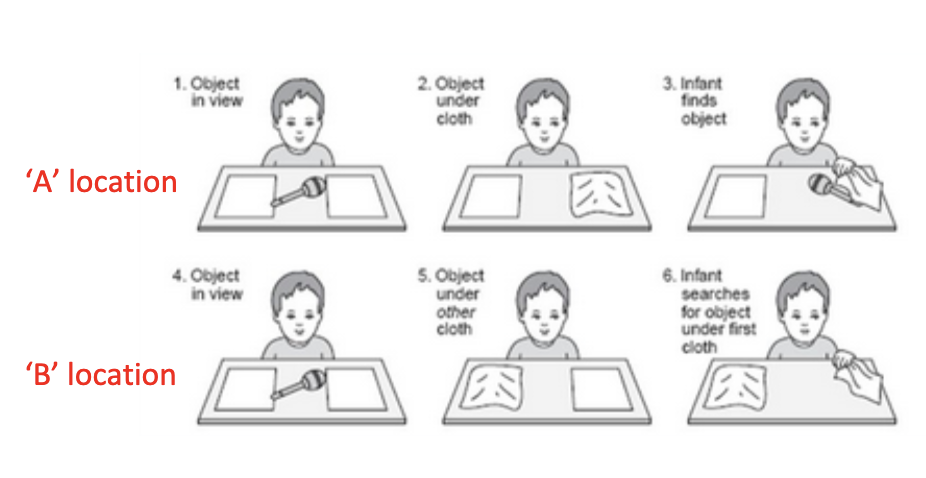
do babies stop making the A-not-error in the sensorimotor stage according to piaget?
by the end of the sensorimotor stage, infants understand that objects can have identities separate from their locations
babies will pass the A not B test
and even variations of it (move object to B, then keep B location covered and not uncover it, babies will still try to search for the object in location B correctly)
how might have piaget underestimated children’s abilities of object knwoledge during the senorimotor stage?
there are some clues that show infants might actually have object knowledge
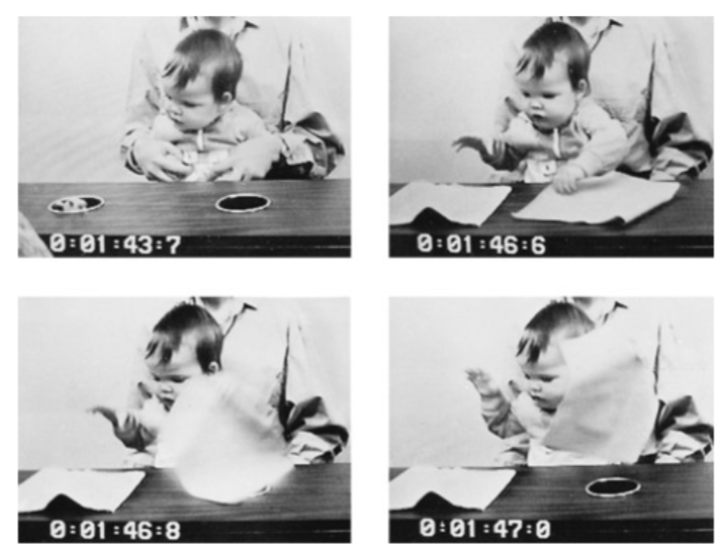
study:
(a) baby sees object go to location B
(b) at B, the cloth is bumpy = clear that there’s an object underneath
(c) the infant keeps their gaze at location B but picks up the cloth at location A
interpretations
(i) babies know the object is at location B, but think that they just need to lift the cloth at location A to get the object – an extreme case of imitation
(ii) dissociation b/t knowledge that’s in one system and not the other
the baby knows that the object is at B, but the action system has built up a response pattern that the infant can’t quite inhibit yet
= difficulty of inhibiting action patterns that have been repeatedly built
what are the summarized main characteristics of the pre-operational stage according to piaget?
mental operations difficult to carry out for infants in this stage
lacks understanding of conservation of entities
begins to engage in symbolic thought (e.g. deferred imitation)
egocentricism
what does it mean for kids in the pre-operational stage to have trouble carrying out mental operations and lack understanding of the conservation of entities?
ex: after seeing water being poured into a narrower but taller glass, kid says that the new glass has more water althought the same volume of water has been trasferred, just from a wider and shorter glass
kids’ schemata are focused on their memories and representations of things in the mind, but they can’t do mental operations
they’re mostly focused on static events (e.g. start and end points) and NOT the change in between (i.e. the operations) = lacks conservation of entities
how do infants engage in symbolic thought through deferred imitation during the pre-operational stage?
children begin to understand that words and objects are symbols/representations of other things
drawing people and objects from their own life but understanding they are only representations
deferred imitation: imitating the way someone talks or moves even when they are not in the room
ex: child says “oh shit” after dropping an object a few days after another adult said “oh shit” when dropping object
how do infants display egocentrism during the pre-operational stage?
“me, myself, and I”
child's thinking is self-centered, or egocentric; a child has difficulty understanding life from any other perspective than their own
ex: a kid will say that another person can see how individuals look like, exactly the way the kid sees them, although the kid and the other person are at different locations (kid facing a person’s front body vs. another person facing the back of the body, they see diff things, but kids will say they all see the same things)
this is domain-general, egocentrism does not only apply to visual abilities
what are the main characteristics of the concrete-operational stage according to piaget?
i) kids have salient spatial awareness (focuses on main things about their surroundings), but are now capable of reasoning about the conservation of entities even after the transformation of those entities, including reversing operations
ex: kid knows that there’s the same amount of liquid in two cups of different sizes
ii) kids now can solve operational problems. HOWEVER, at this stage, abstract thinking is lacking—difficulty understanding non-tangible concepts
ex: cannot define justice, morality
what are the main characteristics of the formal-operational stage according to piaget?
i) children understand abstract concepts
they can imagine hypothetical situations
ii) thinking is characterized as logical and scientific
what are 2 main criticisms of the way he theorized childrens’ development?
he ginored interpersonal relationships and culture (e.g. teachers)
he may have underestimated children’s abilities
how did piaget ignore interpersonal relationships and culture in his theory of development?
children are greatly influenced by those around them, such as their parents, siblings, teachers, and friends but Piaget would argue that these things don’t matter
ii) specifically, on CULTURE and TEACHERS…
Vygotsky would argue that it’s not enough for kids to go around and learn on their own, culture has tools of adaptation that would help children learn
culture (including teachers) provide specific tools for learning (according to Vygotsky, “tools of adaptation”
ex: storybooks, toys
Since Piaget didn’t focus on interpersonal relationships and culture, he didn’t account for the fact that there may be cross-cultural differences
beyond WEIRD (Western, educated, industrialized, rich, and democratic) people
certain things vary across cultures more than other things
ex: when to stop breastfeeding might vary more, but not when kids gain object permanence
how might piaget have ignored interpersonal relationships and culture in his theory of development?
piaget didn’t distinguish between competence and performance - was it that infants were not competent or the task was too difficult for them to perform well?
(a) ex: for the A-not-B error, it could be that infants have too much memory demand, have low motivation, or face inhibition to their executive control, not just that they don’t have object knowledge
babies have been found to make more errors if they’re given more A trials
(c) ex: lift baby before they’re allowed to go to the B location = just changing the posture of a baby before allowing their action changes performance
(d) ex: number conservation could have been affected by not just number knowledge, but also the language that the task is communicated in (infants don’t quite understand language yet), that the task is too demanding for the kid, or the relation between the number and other measurements of objects that confuse kids
Piaget was criticized as people’s performances in specific moments should not account for their overall abilities
but Piaget’s argument was that true competence would result in consistent performance across situations
he stated that competence and performance were intertwined
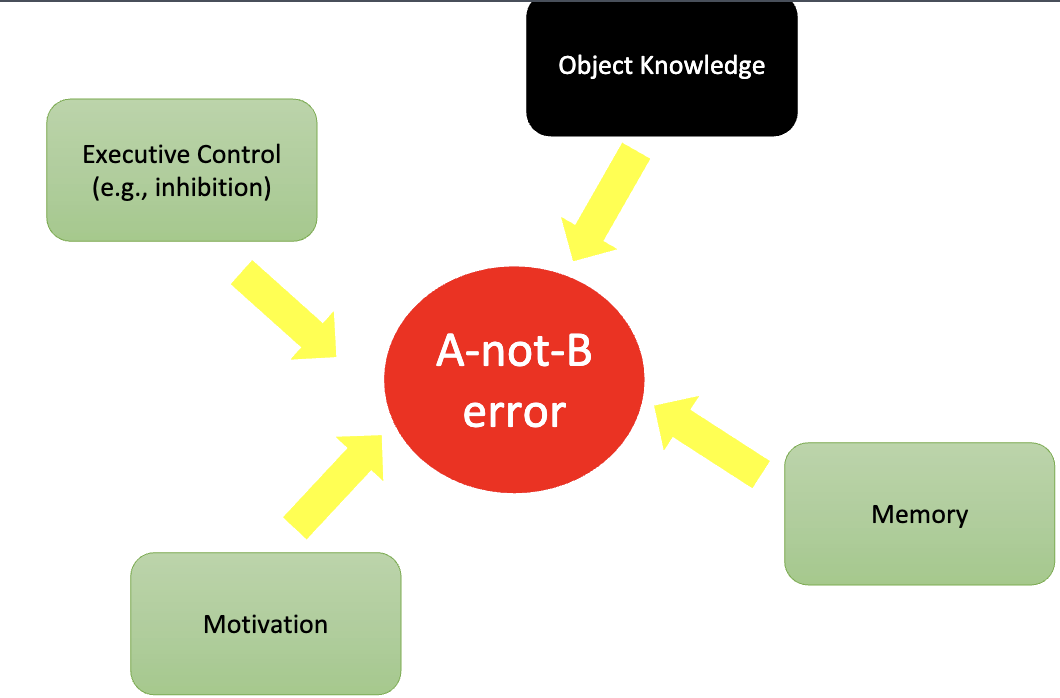
what is one solution to improving on piaget’s approach to the study of cognitive development?
begins with reducing PERFORMANCE DEMANDS
b) one strategy (not just applied to human infants but also other organisms) is to take advantage of what the organism does naturally
(1) ex: cats have a natural tendency to want to get into boxes; BUT not just 3D objects bc cats will also get into the middle of a taped square on the floor
take this tendency of cats to want to get into complete enclosures to test Kanizsa square to test perceptual illusions on cats
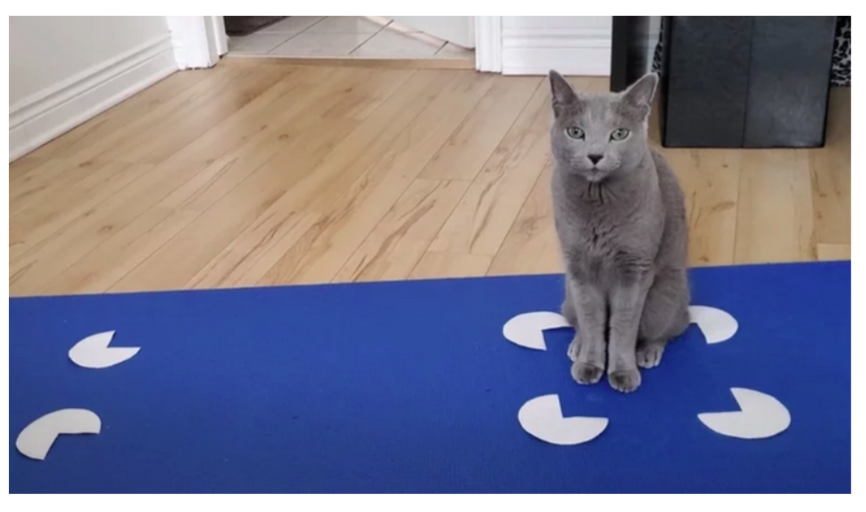
how did R.Fantz improve upon infant testing methods for cognitive development?
designed to tap into what they tend to already do
he developed the contraptions to test children’s tendencies to look at things
if you analyze what they’re lookig at, you can get a sense of how they think
babies inside the contraption, researcjers look inside, (babies can’t see them) to see what the babies are looking at
what are the 5 common paradigms in cognitive development testing that leverage the natural tendencies of young children?
visual attention paradigms
auditory attention paradigms
sucking paradigms
cross-modal matching paradigms
neuroimaging techniques
what are the goals of using the preferential looking method to test the visual attention paradigm?
test whether infants have a preference for specific stimuli
through looking time (looking time for one stimulus is higher than 50% of the combined looking time at both stimuli)
test whether infants can discriminate between stimuli
spontaneous PREFERENCE for a specific stimuli = babies know to discriminate one stimuli from another
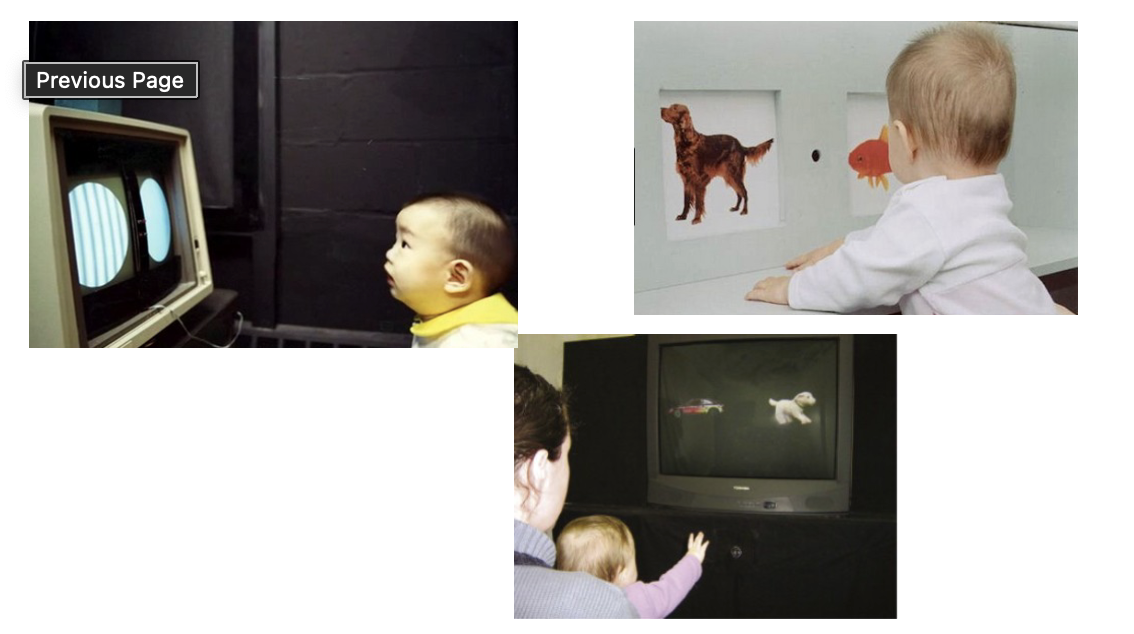
what is the basis of the preferential looking method to test the visual attention paradigm?
an experimental methodology employed by researchers to measure infants’ spontaneous looking behaviors toward visual stimuli
this procedure is based on familiarity: you don't use preferential looking unless you already know that the infant might have a preference for something over the other
ex: would not use preferential looking to flash images of circle vs. square bc different babies have diff preferences and will not result in significant results
it is important to counterbalance the images
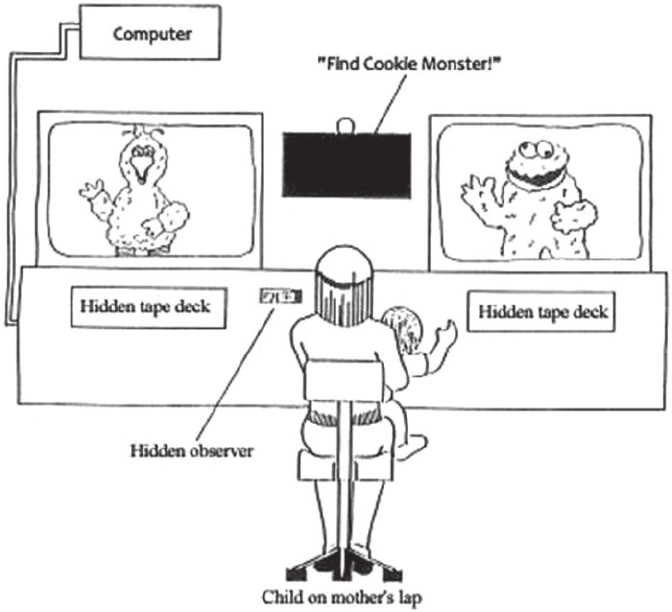
how can preferential looking be used to measure infant visual acuity?
used to assess visual acuity in infants and young children who are unable to identify pictures/letters.
The child is presented with two stimulus fields, one with stripes and the other with a homogeneous gray area of the same average luminance as the striped field.
location of the stripes is randomly alternated.
Typically, children will look at the more complex stripes (if they can detect them) rather than at the blank field.
if the child can see the stripes, they will prefer to look at them. If the child cannot see them, the striped field will look the same as the blank gray field, and the child will not show a preference.
make the striped circle harder to distinguish from a blank circle (width between stripes decreases) smallest stripe width for which the observer can consistently identify the location of the stripes= the child's resolution threshold (visual acuity).
*visual acuity increases with age
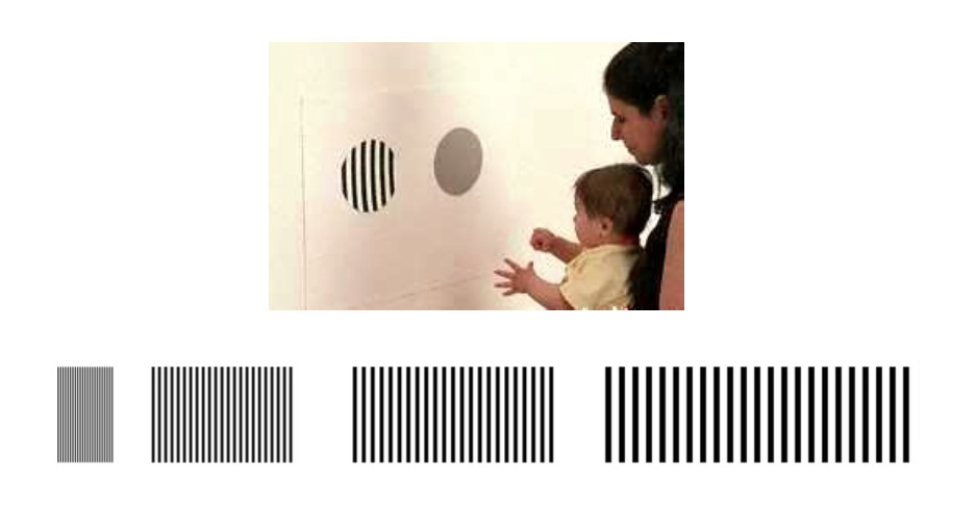
what is the general procedure of preferential looking?
(a) typically compares infants’ looking times toward pairs of stimuli presented side-by-side at the same time (ex: images)
(b) measure the duration of infants’ fixation (i.e. looking times) = dependent variable
(c) if they look longer (=more than 50% of the time) at one of the stimuli = they show a preference
(d) ex: if they look at an image of a face longer than they look at the image of an object
they know how to distinguish the face from the other object
adaptive function of children to recognize faces detect faces of their families
(e) we can conclude that for some reason, there’s a preference (when babies look longer at something)
but we cannot conclude WHY they have the preference = requires further testing
preferential looking study: trucks vs. dolls
1. started with attention getter: to orient their gaze to the center first
2. present infants with truck (male-type toy) vs. a doll (female-type toy)
3. the infants looked back and forth but made a selection with respect to which one they wanted to look at longer
4. hypothesis: if males have a preference toward certain colors, then boys will look at blue longer than they look at pink at 9 months old
this hypothesis cannot be confirmed until subsequent testing
we would know that boys could prefer blue over pink OR truck over doll BUT not both at the same time or why they do
6. alternative explanations: dolls have more curvature and trucks are more angular = its difference in respect to the kind of visual features
conclusion: children have a preference for whatever toy they were socialized to play with during early life
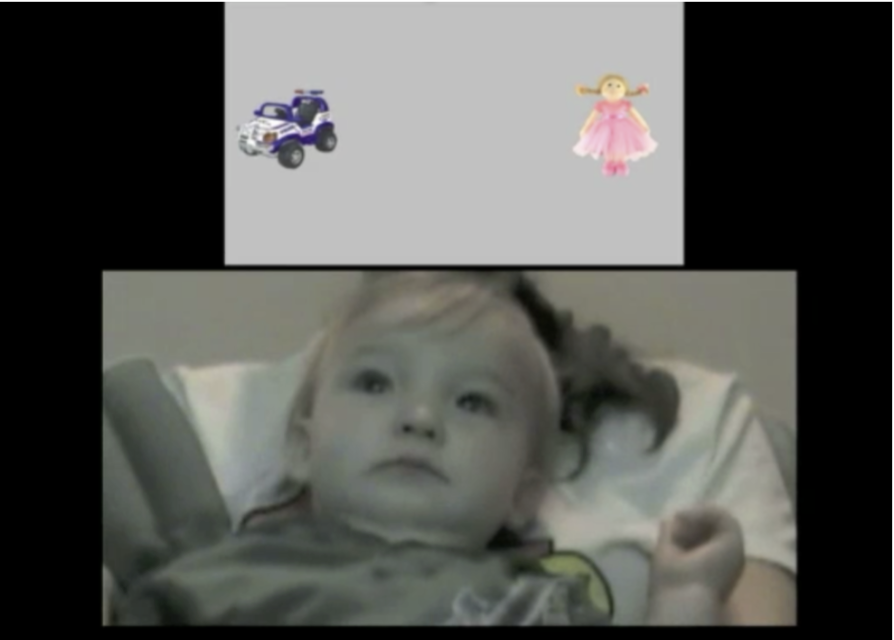
what is the reasoning behind counterbalancing the presentation of stimuli during preferential looking testing?
to ensure internal validity by controlling the potential confounds created by sequence and order effects
ex: baby might just have a preference for a side and not the particular stimuli
must have minimum of 2 trials, where the sides of the stimuli are flipped in one trial
what are the goals of using the change detection method to test the visual attention paradigm?
test whether infants prefer variability in stimuli
test infants’ capacity for working memory
what is the basis of the change detection method to test the visual attention paradigm?
dynamic version of preferential looking paradigm
(i) paired presentation of images
(ii) premised on the fact that infants prefer variability (i.e. preference for things that change over stable things)
(iii) this, if infants detect a difference, then their looking behavior will reflect this discrimination
they will look longer at the changing visual stream (i.e., the more variable display)
change detection study on 10-20 dots to test infants’ numerical acuity abilities to discriminate between numbers: PROCEDURE
Q: how sensitive are infants to differences in objects that differ in number?
tested on 6-month old baby
(ii) display dots that switch in numbers from 10 to 20 dots on one side, display dots that switch in location but stay consistent in numbers from 10 to 10
*at minimum, you need to conduct 2 trials
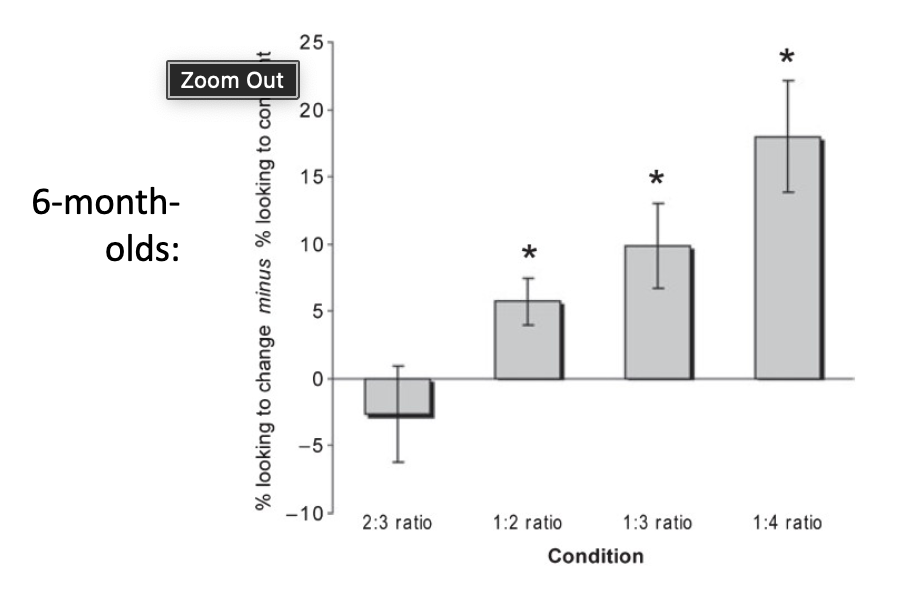
change detection study on 10-20 dots to test infants’ numerical acuity abilities to discriminate between numbers: PREDICTION
if baby looks longer at one side than the other, then they know to distinguish one side from the other
prediction: babies are attracted to more complex varieties = we come into the world with the predisposition that we are more attracted to variable thingS
change detection study on 10-20 dots to test infants’ numerical acuity abilities to discriminate between numbers: RESULTS
babies looked longer and longer at displays that had higher ratios of variability
but they couldn’t distinguish between a 2:3 ratio of variability (10 to 15 dots)
change detection study on 10-20 dots to test infants’ numerical acuity abilities to discriminate between numbers: CONCLUSION
Weber’s law was at play: stimulus sensitivity will increase proportionally with increases in stimulus intensity
we’re better at distinguishing changes with bigger variabilities
our perceptual abilities depend on these characteristics
how does the visual scanning/tracking method work to test the visual attention paradigm?
technology allows researchers to make sophisticated measurements
pupil and corneal reflections = allows us to make more sophisticated measurements
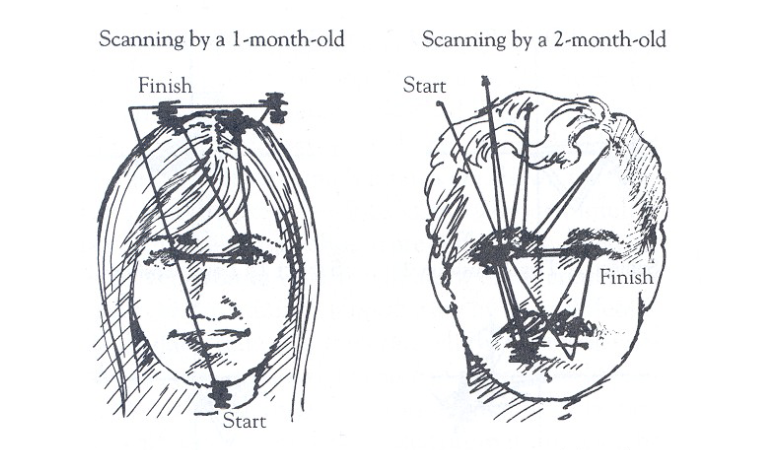
what did the study of infants’ gaze on facial features using visual scanning/tracking method find?
(i) 1-mo-old’s tracking measurement shows that they focus on the outer ridges of the face (hairline, chin)
when they do scan the internal features, they mostly look at the lips bc they move a lot
(ii) 2-mo-old’s tracking measurement shows that they focus on the internal elements of the face (eyes, nose, lips)
(iii) babies that develop autism will continue to look at the outer ridges of faces
this paradigm has diagnostic element = points to infants’ abnormalities in typical development stages
what did the study of infants’ gaze on movement of ball using visual scanning/tracking method find out about their understanding of object permanance & tracking movement of objects?
study on if babies have an ability to understand object permanence & track movement of objects
(i) blue dot as a representation of the baby’s gaze
(ii) infants followed the movement of the ball in the video through their gaze
(iii) blue dot’s movement began to stabilize = baby started to predict the movement of the ball based on repeated viewing of the movement of the ball
conclusions
1. infants knew that the object continued to exist
2. AND they can predict the trajectory of the object
what is the assumption of violation of expectation (VOE) method in testing the visual attention paradigm?
(i) one of the most common paradigms
(ii) present babies with scenarios & ask how they interpret the scenarios
(iii) assumption: if babies are presented with a scenario that goes against their expectations, they will look longer
infants show surprise when witnessing an impossible event
what is the general procedure of violation of expectation (VOE) method in testing the visual attention paradigm?
1st phase of VOE is designed to demonstrate the “state of affairs” to infants - familiarization phae
2nd phase: test phase with 2 types of trials (alternate babies to expected vs. unexpected)
expected trial(i.e. no violation based on previous phase)
unexpected trial (i.e. violation based on previous phase)
3. predicted looking pattern: longer looking towards unexpected than expected trials
what is transitive inference and how does it work as the primary test case of the violation of expectation method?
1. the process of inferring the relation between two items based on their shared relation with a third item
2 things being compared are never directly compared
ex: “paul is taller than larry, larry is taller than ryan, who’s taller: paul or ryan?”
3. according to piaget, this reasoning would develop later on in the formal operations stage
study on infants using transitive inference: PROCEDURE
Q: can babies make transitive inference judgments about the presence of social dominance and tell which one of the puppets dominates the other?
procedure
show video with puppets
familiarization trial: showed hierarchy of power within the puppet world
bear takes object from elephant, hippo takes object from bear (hippo>bear>elephant)
show 2 experimental trials:
congrunt/consistent with A>B>C
incongruent/inconsistent with A>B>C = VOE
*the giraffe was later brought in to show that A is not always bigger than everything, it’s just bigger than the ones shown in the images
study on infants using transitive inference: PREDICTION
prediction
if infants are presented with two trials where one is inconsistent, the infant will look longer at the inconsistent trial (that violates their expectation)
if babies understood transitive inference, they should look much longer at the video where the elephant takes the object from the hippo
if babies don’t understand transitive inference, then they will look equally at the 2 experimental videos
study on infants using transitive inference: RESULTS
infants looked much longer at the incongruent video than the congruent video
study on infants using transitive inference: CONCLUSION
b. infants understood transitive inference at a much younger age that Piaget theorized
i. the performance demands of the tests that Piaget conducted were too high
 Note
Note  Flashcards (22)