091 Module 1 - Soundwave Principles
 Call Kai
 Learn
Learn Practice Test
 Spaced Repetition
 Match
Match Flashcards
 Knowt Play
1/80

There's no tags or description
Looks like no tags are added yet.
Name | Mastery | Learn | Test | Matching | Spaced | Call with Kai |
|---|
No analytics yet
Send a link to your students to track their progress
81 Terms
Echo location uses a _____-echo technique.
pulse
Define the pulse-echo technique.
Pulses of sound are sent into the tissue and echoes returning from the tissue provide anatomic information to form the images.
Define the round trip effect.
Time for a pulse to travel to an anatomical structure and return to the thransducer.
Name intrinsic and extrinsic factors that contribute to brightness of a grey-scale dot.
Intrinsic:
acoustic impedance
reflection type
absorption
Extrinsic:
instrumentation (gains/TGC)
What does TGC stand for?
Time gain compensation.
Define acoustic impedence.
Degree of sound reflection between mediums based on the properties of those mediums.
Write the equation for medium impedance.
Medium impedance = density x velocity
Name the transducer with closely spaced parallel vertical lines.
Linear transducer.
Name the transducer where every pulse originates from the same starting point.
Sector transducer.
Name the transducer where pulses originate from different starting points and travel in slightly different directions.
Curvilinear transducer.
Provide alternate names for 2D B-mode.
grey scale imaging
B-scan imaging
2D imaging
In waves, _____ are areas of high pressure and density while _____ are areas of low pressure and density.
compressions, rarefactions
_____ waves can travel in a medium or vacuum.
Electromagnetic
If the direction of particle motion and direction of the wave are the same, what kind of wave is this?
Longitudinal.
If the direction of particle motion and direction of the wave are opposites, what kind of wave is this?
Transverse.
Sound is a ______ ______ wave.
longitudinal mechanical
Water rippling after throwing a rock in is an example of what kind of wave?
Transverse mechanical wave
Name the 4 acoustic variables.
pressure
density
particle
temperature
Define acoustic variables and why they are of interest to sonographers.
Mechanical changes to the medium when sound is applied. Potential for bioeffects.
Provide an alternate name for a longitudinal wave and one for a transverse wave.
Longitudinal wave = pressure wave
Transverse wave = shear wave
Provide the frequency range for ultrasound and diagnostic ultrasound.
Ultrasound: >20kHz
Diagnostic: 2MHz-20MHz
Provide some conditions in which lower frequencies would be used in ultrasound.
Doppler applications
requires high penetration
with harmonic imaging
Frequency and _____ are reciprocals.
wavelength, period
When frequency increases, what happens to wavelength and period?
Both decrease.
When frequency increases, what happens to the propagation velocity?
Propagation velocity is independent of frequency - it is determined by the properties of the medium.
In the human body, what tissue has the highest propagation velocity?
bone
What happens to wavelength when traveling through bone vs soft tissue?
Bone has high propagation velocity → wavelength stretches out → increased wavelength
Soft tissue has a lower relative propagation velocity → wavelength gets shorter → decreased wavelength
Density and propagation velocity have an inverse relationship. Explain how propagation velocity increases when density increases.
c = √(bulk modulus/density)
↑density → ↑↑↑bulk modulus → ↑propagation velocity
When density increases, bulk modulus increases exponentially.
Propagation velocity is proportional to bulk modulus.
Define bulk modulus.
A measure of the stiffness of a medium.
Strength of the intermolecular bonds.
Provide some descriptors of a medium with a high bulk modulus.
incompressible
inelastic
stiff
To position an echo properly along a scan line, two items of information are required:
the direction from which the echo came from
the distance to the reflector where the echo was produced (GRT)
If GRT=26usec, what is the distance between the transducer and reflecting structure?
13usec/cm of GRT
26usec/(13usec/cm) = 2cm
Define speed error artifact and provide some examples of when it is seen.
The system assumes c=1540m/s. When c is different, structures are drawn at incorrect depths.
Seen:
distal to a calcification
tumor
bayonet sign
Define amplitude.
The peak values of compression and rarefaction.
The ultrasound transducer measures amplitude in…
volts
When transmission power is increased, how is the ultrasound appearance affected?
brighter → stronger return signal
↑penetration → ↑energy
How are amplitude and frequency related?
Amplitude and frequency are not directly related.
They have a commonality in that higher frequencies cause more attenuation and therefore decreased amplitude.
Define acoustic intensity.
Sound shape (area) is not uniform along the length of the beam, and therefore varies in intensity.
Define attenuation.
Decrease in wave amplitude due to mechanical wave interaction with the medium.
Attenuation occurs via:
absorption
reflection
refraction
The dominant form of attenuation in ultrasound is…
absorption
Absorption in increases when ______, ______, and/or ______ are increased.
frequency, viscosity (of the medium), depth
Explain why fluid has very little absorption and what artifact this creates.
Fluid has very low viscosity → less frictional forces → low absorption - low attenuation
Creates posterior enhancement.
Attenuation is _____ dependent.
frequency
Attenuation coefficient measures…
how much sound energy is lost per cm per MHz
If air and lung have negligible absorption, how is their attenuation coefficient so high?
Very reflective → scatters sound energy
Calculate the loss in dB of sound intensity in soft tissue with a 5MHz probe imaging to a depth of 10cm.
a = (0.5dB) x 5MHz x 10cmx2) / cm/MHz
At ½ of the original pulse intensity, how much attenuation has occurred?
3dB
At 1.2 of the original pulse amplitude, how much attenuation has occurred?
6dB
Explain why the liver and diaphragm have different appearances.
The liver has a rough texture, making it a scatter reflector. When the waves interact with each other, then constructive and destructive interactions results in a speckled appearance.
The diaphragm is large and smooth. It is a specular reflector, meaning it is very strong amplitude back to the transducer. This gives the bright appearance.
For specular reflectors, the angle of incidence = the angle of…
reflection
Specular reflections are ______ dependent.
angle
Diffuse reflections are ______ dependent.
frequency
Rayleigh scattering occurs when reflecting structures are very small compared to ______.
wavelength
Is blood anechoic?
No - reflections (Rayleigh scatter) is so weak that the machine assigns the pixels as black.
Blood appears anechoic but is not truly anechoic.
Define acoustic impedence.
Value based on a mediums propagation velocity and density.
Transmission and reflection depends on…
acoustic impedence
Mediums with similar Z values will have more ______.
transmission
Mediums with very different Z values will have more ______.
reflection
how much reflection would occur between mediums if Z1=Z2? Where would this be seen in ultrasound?
Virtually no reflection. Seen in anechoic fluid filled spaces.
Describe why gel is necessary for a good ultrasound.
Air and soft tissue have a large acoustic impedance mismatch, meaning most soundwaves are reflected. Gel eliminates air and has a similar Z value to soft tissue. This ensures the soundwave is transmitted into the body.
Describe the quality that gives a homogenous or heterogenous appearance.
Acoustic impedance.
Homogenous - similar Z values
Heterogenous - multiple Z values
List the two requirements for refraction. What is this called?
oblique incidence angle
difference propagation speeds between mediums
Snell’s Law
Listening time is based on…
depth
propagation velocity
If the PD is 8 cycles long, what kind of modality is assumed?
Doppler
If the PD is 3 cycles long, what kind of modality is assumed?
2D B-mode
Provide another term for time per line.
PRP
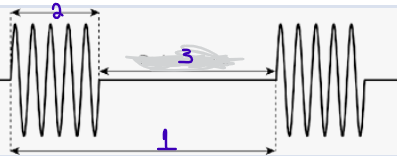
Label each number.
PRP or PRF
PD or SPL ringing time
listening period
What is the PRP when PRF is 5kHz?
PRP = 1/PRF
PRP = 1/5kHz
PRP = 0.2ms
Calculate the DF with a 3MHz transducer, a PRF of 4kHz, and 3 cycles in a pulse.
P = 1/f = 1/3MHz = 0.33us
PRP = 1/PRF = 1/4kHz = 0.25ms = 250us
PD = P x n = 0.33us x 3cycles = 0.9us
DF = PD/PRP
DF = 0.9us/250us = 0.4%
When DF=100, what kind of modality is being used?
CW
What are some controls the sonographer controls that will change DF?
frequency
depth
mode of imaging
Given the same imaging depth, does CD or B-mode have a higher DF?
CD - ↑n
Which mode is the most at risk for causing bioeffects? Why?
CW - highest DF
Calculate the FR when depth = 8cm and 200 scan lines.
PRP = 13us/cm x 8cm = 104us
FT = PRP x # scan lines = 104us x 200 scan lines = 20000us/frame = 20ms
FR = 1/FT = 1/20ms = 0.05kHz = 50Hz
Calculate the SPL of a 3 cycle pulse at a frequency of 4MHz.
λ = c/f = (1.54mm/s)/4MHz = 0.385mm
SPL = λ x n = 0.385mm x 3 cycles
SPL = 1.155mm
If the crystals ring for a longer time, there is a _______ bandwidth.
narrow
If crystals ring for a shorter time, there is a ______ bandwidth.
broad
PD and ______ have an inverse relationship.
bandwidth
Some advantages to a broad bandwidth are:
THI
dynamic frequency tuning
multi-hertz operation
Describe dynamic frequency tuning.
The same transducer was receive many different frequencies.
In the near field, high frequencies are processed, in the far field, low frequencies are processed.

