cell biology
 Call Kai
 Learn
Learn Practice Test
 Spaced Repetition
 Match
Match Flashcards
 Knowt Play
1/72

There's no tags or description
Looks like no tags are added yet.
Name | Mastery | Learn | Test | Matching | Spaced | Call with Kai |
|---|
No analytics yet
Send a link to your students to track their progress
73 Terms
What is a eukaryotic cell?
Cells that have their genetic material enclosed in a nucleus
What are prokaryotic cells?
Cells that do not have their genetic material enclosed in a nucleus
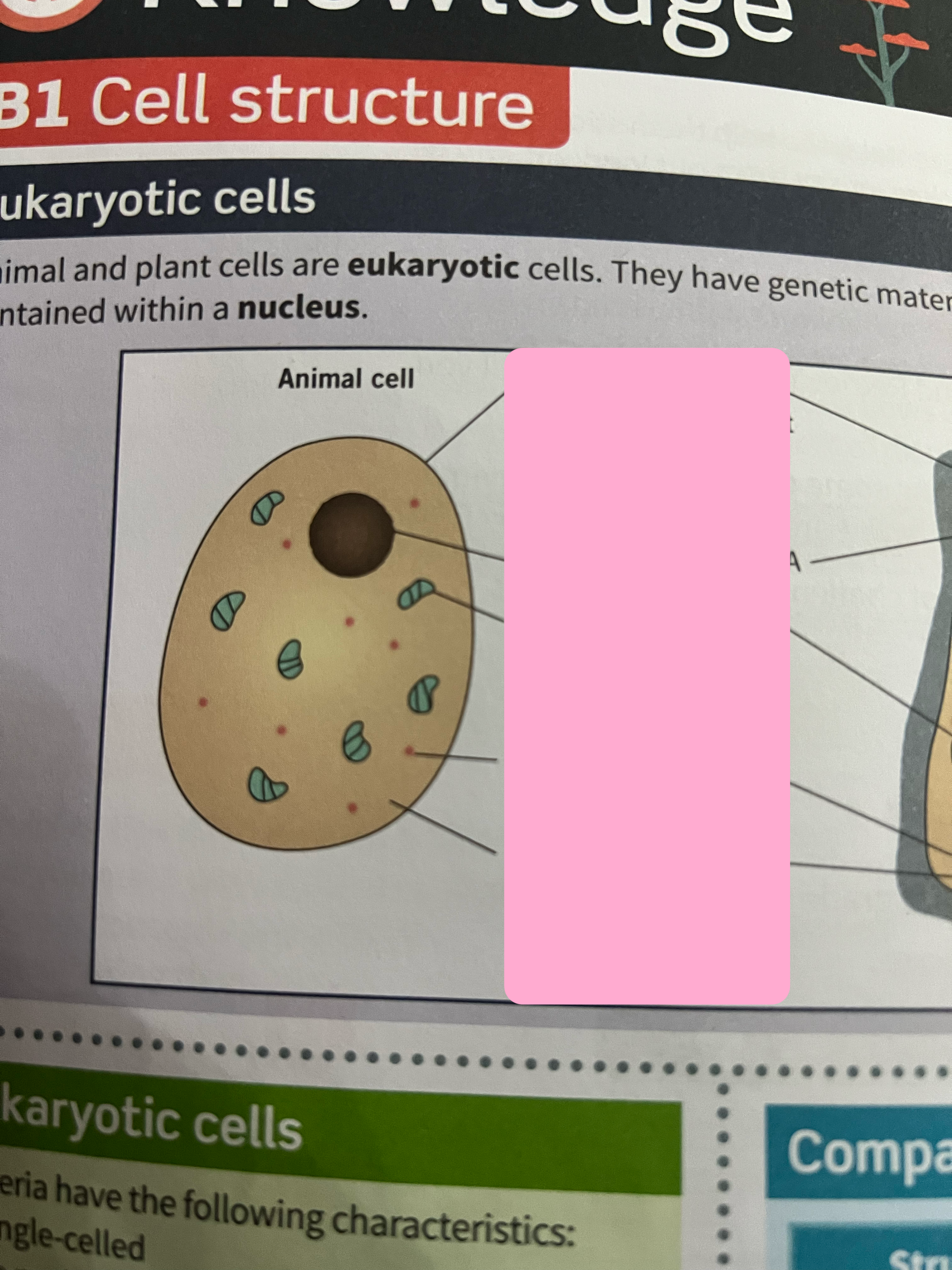
Label the animal cell and the function of the sub cellular structures.

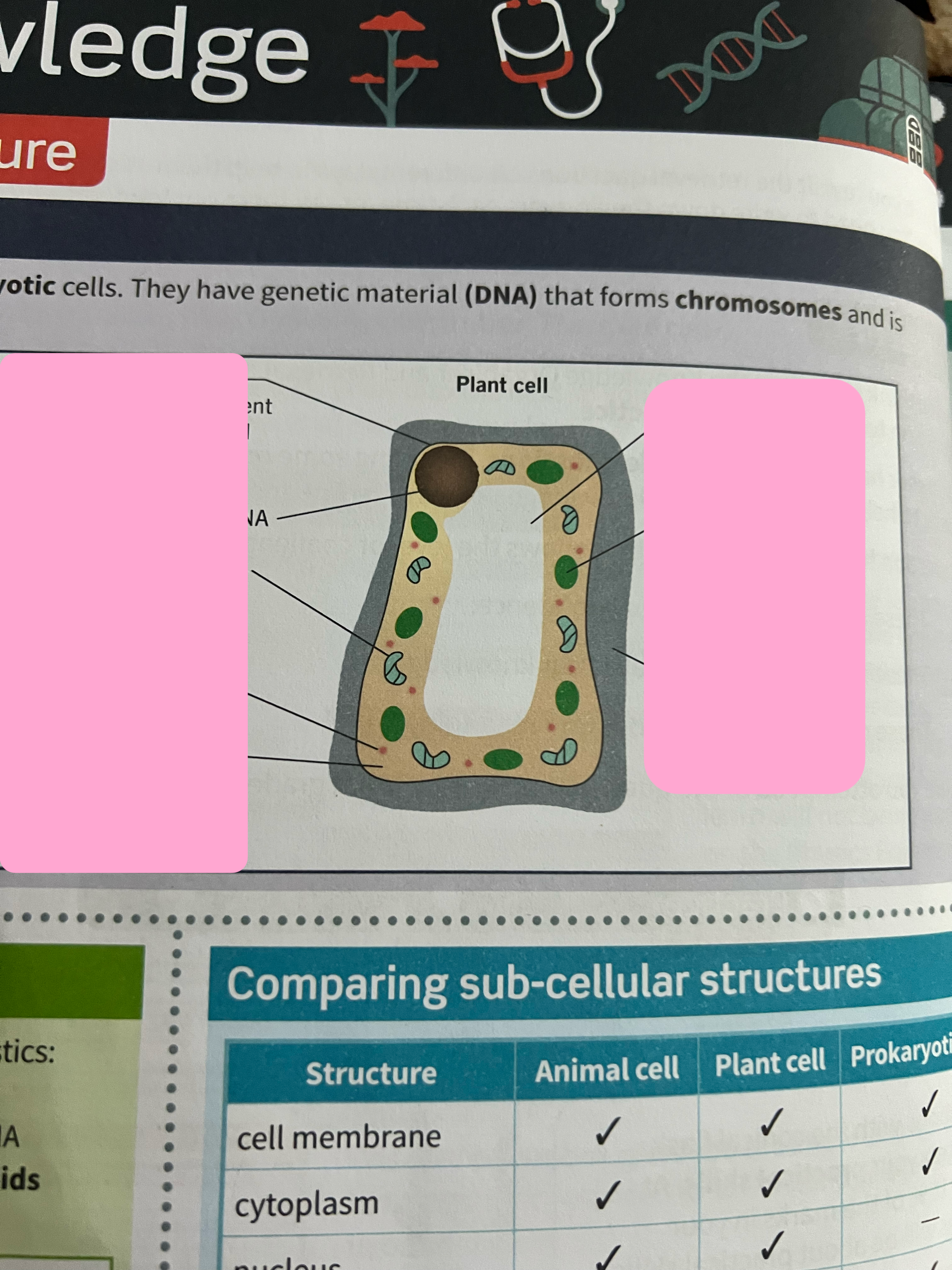
Label the plant cell and the function of the sub cellular structures.

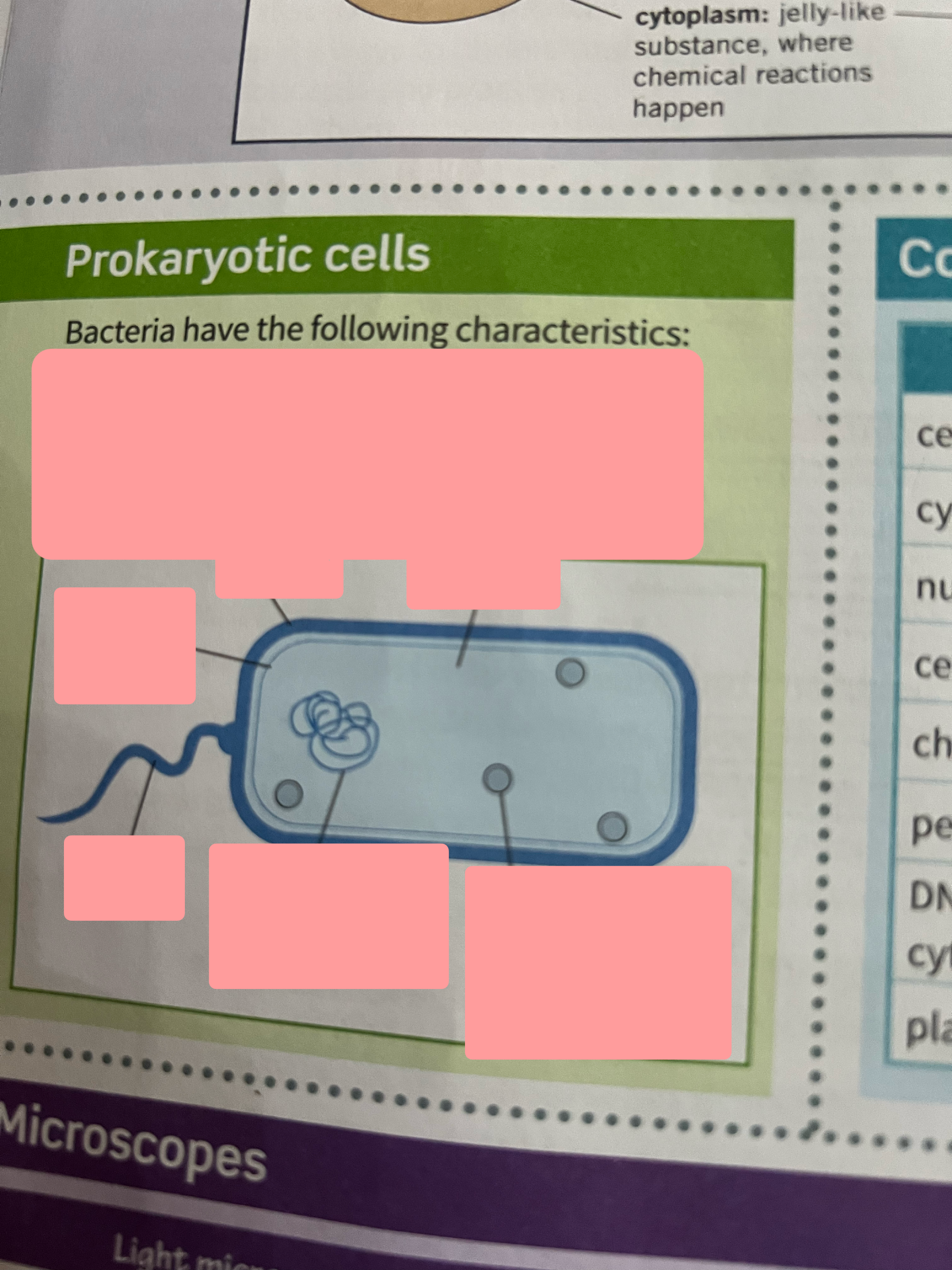
Label the bacteria cell.

What are the characteristics of a bacteria cell?
Single celled
No nucleus- have a single loop of DNA
Have small rings of DNA called plasmids
Smaller than eukaryotic cells
Describe the characteristics of a light microscope?
Uses light to form images
Living samples can be viewed
Relatively cheap
Low magnification
Low resolution
Describe the characteristics of a electron microscope?
Uses a beak of electrons to form images
Samples cannot be living
Expensive
High magnification
High resolution
What is the equation for magnification?
Magnifucation= image size/actual size
What is cell differentiation?
The process where an unspecialised stem cell becomes specialised for a specific function by developing unique sub cellular structures.
When do animal cells differentiate?
At an early stage of development
When do plants cells differentiate?
Throughout its lifetime
What is the function of the sperm cell?
Fertilise an ovum (egg)
What are the adaptations of a sperm cell?
Tail to swim to the ovum and fertilise it
Lots of mitochondria to release energy from respiration enabling the sperm to swim up the ovum
What is the function of a red blood cell?
To transport oxygen around the body.
What are the adaptations of a red blood cells?
No nucleus so more room to carry oxygen
Contains a red pigment called haemoglobin that binds to oxygen molecules
flat bi-concave disc shape to increase surface area to volume ratio
What is the function of a muscle cell?
To contract and relax to allow movement.
What are the adaptations of muscle cells?
Contains protein fibres, which can contract to make the cells shorter
Contains lots mitochondria to release energy from respiration, allowing the muscles to contract
What is the function of a nerve cell?
Carry electrical impulses around the body
What are the adaptations of a nerve cell?
Branched endings, called dendrites to make connections with other neurons or effectors
Myelin sheath insulates the axon to increase the transmutation speed of the electrical impulses
What is the function of a root hair cell?
To absorb mineral ions and water from the soil
What are the adaptations of a root hair cell?
Long projection speeds up the absorption of water and mineral ions by increasing the surface area of the cell
Lots of mitochondria to release energy for the active transport of mineral ions from the soil
What is the function of the palisade cell?
To enable photosynthesis in the leaf.
What are the adaptations of the palisade cell?
Lots of chloroplasts containing chlorophyll to absorb light energy
Located at the top surface of the leaf where it can absorb the most light energy
What is diffusion?
The net movement of particles from an area of high concentration to an area of low concentration.
Describe the movement of particles in diffusion?
Particles move down the concentration gradient- from an area of higher concentration to an area of low concentration.
Does diffusion require energy.
No because it is a passive process.
Name an example of diffusion in the small intestine.
Nutrients in the small intestine diffuse into the blood in the capillaries through the villi.
Name an example of diffusion in the alveoli.
Oxygen diffuses from the air in the alveoli into the blood in the capillaries
Carbon dioxide diffuses from the blood in the capillaries into the air in the alveoli
Name an example of diffusion involving urea
Urea diffuses from cells into the blood for excretion by the kidney.
Give an example of diffusion involving gill filaments.
Oxygen from water passing over the gills diffuses into the blood in the gill filaments.
Give an example of diffusion involving gill filaments and carbon dioxide.
Carbon dioxide diffuses from the blood in the gill filaments into the water.
Give an example of diffusion involving the stomata.
Carbon dioxide used for photosynthesis diffuses into leaves through the stomata.
Give an example of diffusion involving photosynthesis.
Oxygen produced during photosynthesis diffuses out of the leaves through the stomata.
What is osmosis?
The diffusion of water particles from a dilute solution solution to a concentrated solution through a partially permeable membrane.
Describe the movement of particles in osmosis.
Water moves from an area of lower solute concern to an area of higher solute concentration.
Does osmosis require energy?
No osmosis is a passive process.
Give an example of osmosis in plants?
Water moves by osmosis from a dilute solution in the soil to a concentrated solution in the root hair cell.
What is active transport?
The movement of particles from a more dilute solution to be more concentrated solution using energy from respiration.
Describe the movement of particles in active transport
Particles move against the concentration gradient from an area of low concentration to an area of high concentration
Give an example of acts of transport in humans
Add to transport allow sugar molecules to be absorbed from the small intestine when the sugar concentration is high in the blood than in the small intestine
Give an example of active transport in plants
Active transport is used to absorb mineral ions into the root hair cells from more dilute solution solutions in the soil
What are the three factors that effect the rate of diffusion?
Difference in concentration, temperature, surface area of the membrane.
How does difference in concertration affect the rate of diffusion?
The steeper the concentration gradient, the faster the rate of diffusion.
How does the temperature affect the rate of diffusion?
The higher the temperature, the faster the rate of diffusion
How does the surface area of the membrane affect the rate of diffusion?
The larger the membrane surface area, the faster the rate of diffusion.
Describe the surface area to volume ratio of single- celled organisms.
They have a large surface area to volume ratio. This allows enough molecules to be transported across their cell membranes to meet their needs.
Describe the surface area to volume ratio of multicellular organisms.
They have a small surface area to volume ratio. This means they need specialised organ systems and cells to allow enough molecules to be transported into and out of their cells.
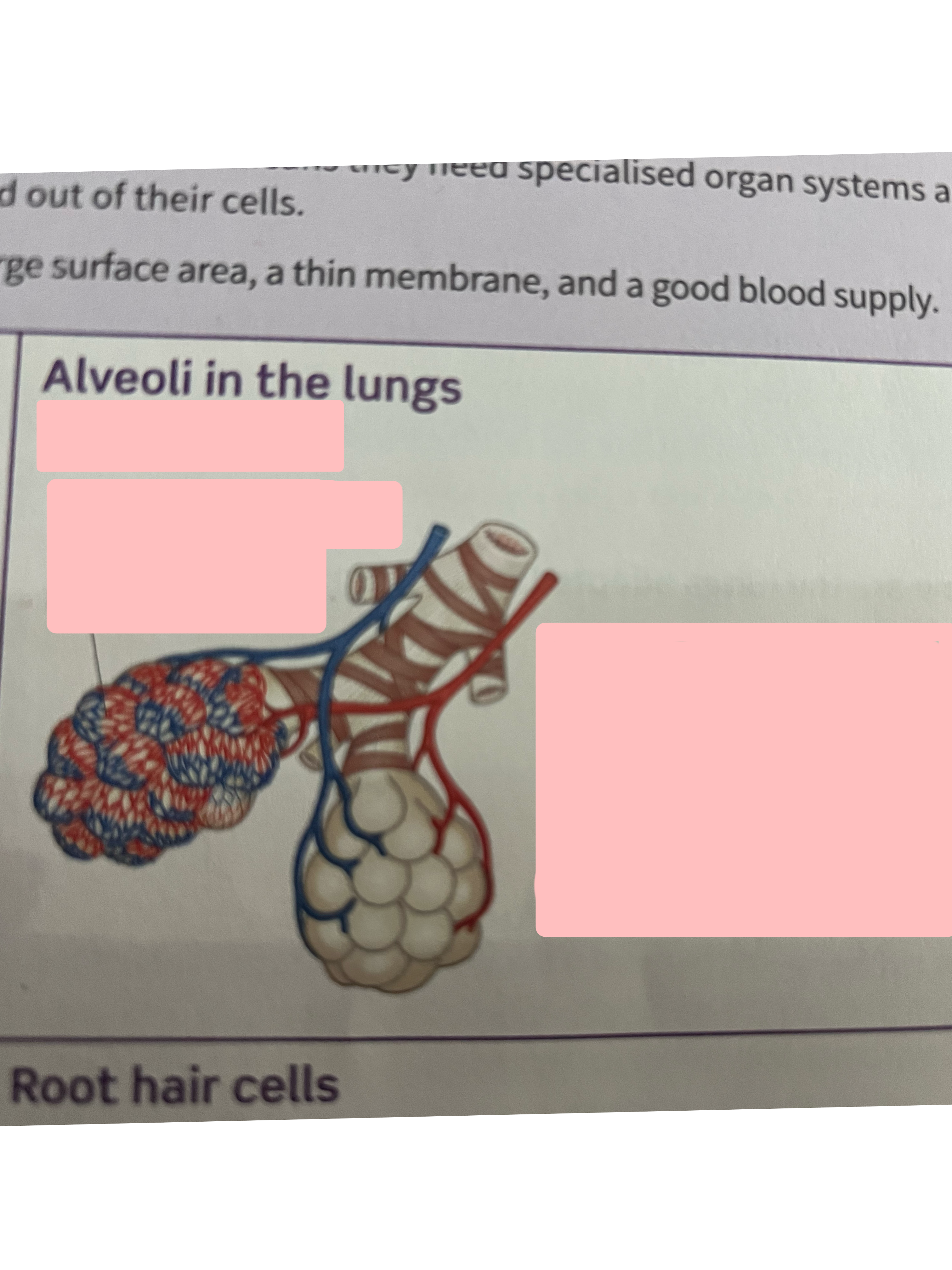
Label exchange surface and adaptations

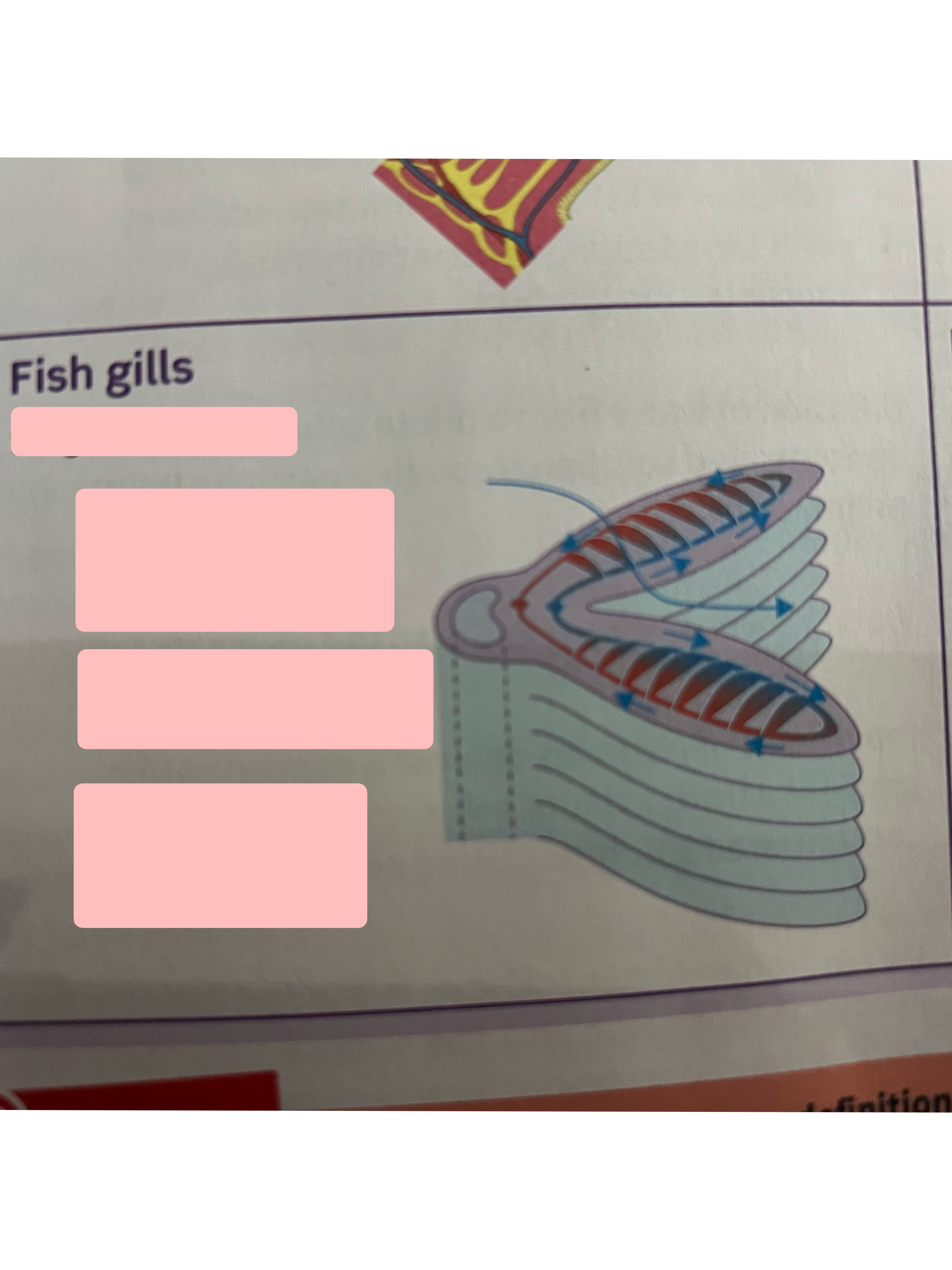
Label exchange surface and adaptations

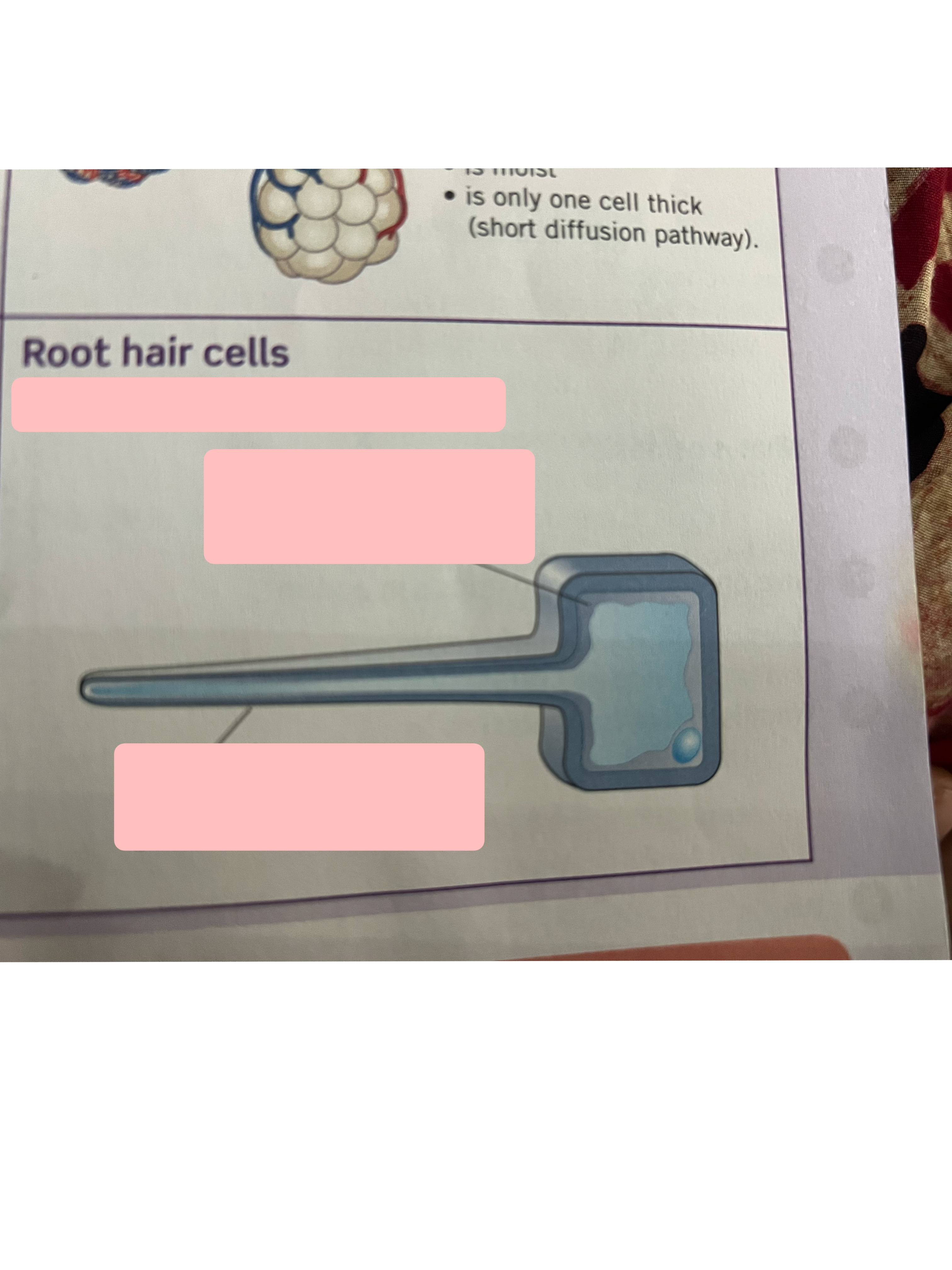
Label exchange surface and adaptations

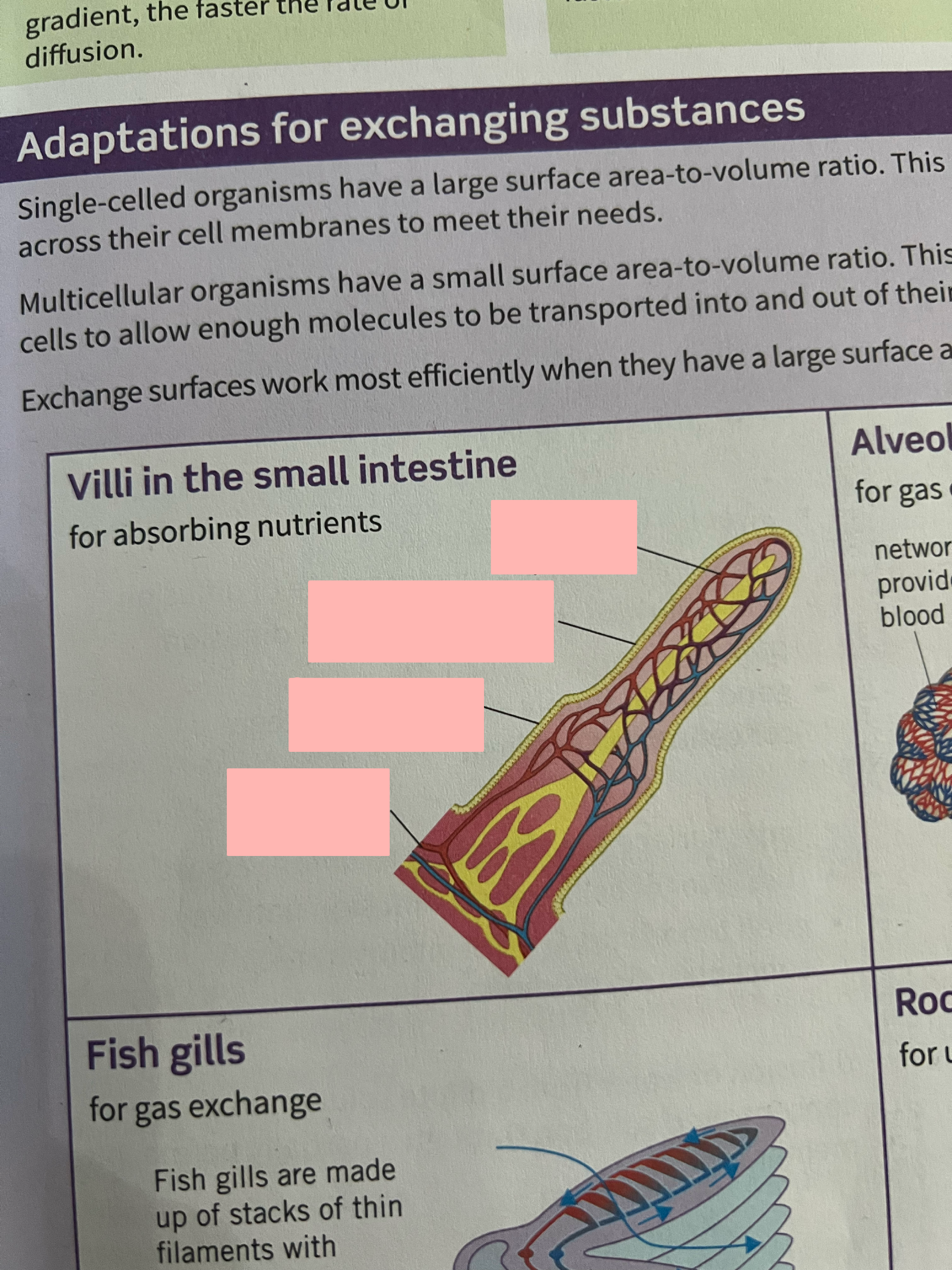
Label exchange surface and adaptations

What does the nucleus of a cell contain?
Chromosomes
What does each chromosome carry?
Each chromosome carries a large number of genes made of DNA molecules.
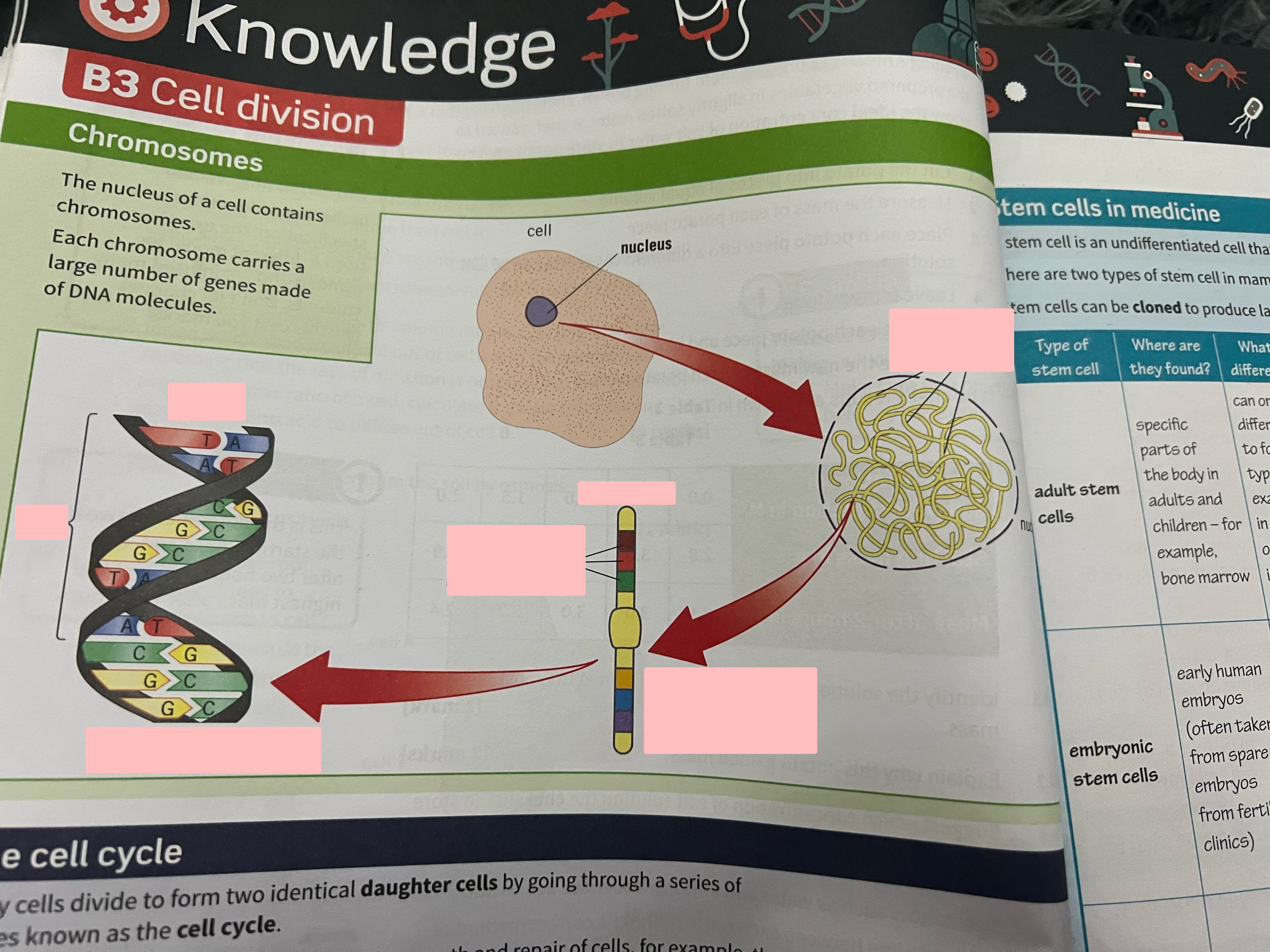
Label the structure of the nucleus of a cell

What is the cell cycle?
A series of stages where body cells divide to form two identical daughter cells.
Why is cell division by mitosis important?
For growth and repair of cells, for example the replacement of skin cells.
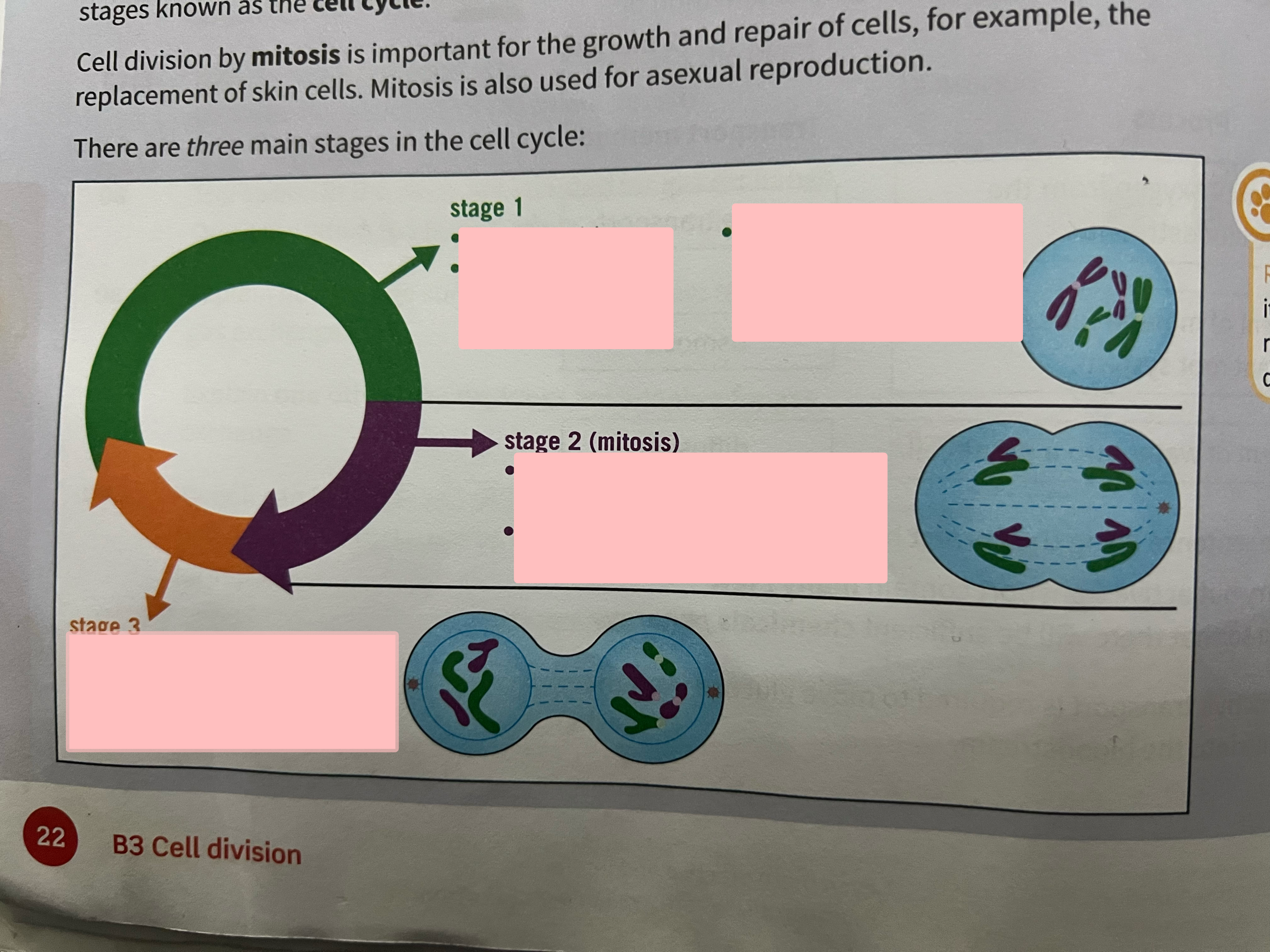
Label the three main stages of the cell cycle.

What are the two types of stem cells in mammals?
Adult stem cells and embryonic stem cells.
Why are stem cells cloned?
To produce large numbers of identical cells.
Where are adult stem cells found?
Specific parts of the body in adults and children, for example the bone marrow.
What can adult stem cells be differentiated into?
Stems cells in the bone marrow can differentiate into types of blood cells.
What are the advantages of adult stem cells?
Fewer ethical issues because adults can consent to have their stem cells removed and used
An already established technique for treating diseases such as leukaemia
Relatively safe to use as treatment and donors recover quickly
What are the disadvantages of using adult stem cells?
Requires a donor potentially meaning a long wait time to find someone
Can only differentiate into certain types of specialised cells so can be used to treat fewer diseases
Where are embryonic stem cells found?
Early human embryos often taken from spare embryos on fertility clinics
What do embryonic stem cells Differentiate into?
Can differentiate into any type or specialised cell in the body for example, a nerve cell or a muscle cell
What are the advantages of using an embryonic stem cell?
Can treat a wide range of disease as can form any specialised cell
Maybe possible to grow whole replacement organs
Usually no donor needed as they are obtained by spare embryos from the fertility clinic
What are the disadvantages of using embryonic stem cells?
ethical issues as the embryo is destroyed and each embryo is a potential human life
Risk of transferring viral infections to the patient
Newer treatment treatments so relatively on the research not yet clear if they can cure as many diseases asphalt
Where are plant meristem cells found?
In the roots and the shoots of the plant
What can plant meristem cells differentiate?
Any type of cell, they can be used to create clones of whole plot
What are the advantages of using plant meristem cells?
Rare species plants can be cloned to prevent extinction
Plants with desirable traits can be cloned to produce large numbers of identical plants
Fast and low cost production of large numbers of plants
What are the disadvantages of using plant meristem cells?
Cloned plants are genetically identical so a whole crop is at risk of being destroyed by a single disease or genetic defect
What happens in therapeutic cloning?
Cells from a patients own body are used to create a cloned early embryo of themselves
Stem cells from this embryo can be used for medical treatments and growing new organs
These stem cells have the same gene as the patient, so are less likely to be rejected when transplanted

