Unit 3 Bio - Microscopes and Cell Membrane
0.0(0)
Studied by 30 people Call Kai
 Learn
Learn Practice Test
 Spaced Repetition
 Match
Match Flashcards
 Knowt Play
Card Sorting
1/66

Last updated 7:01 PM on 11/8/22
Name | Mastery | Learn | Test | Matching | Spaced | Call with Kai | Chat |
|---|
No analytics yet
Send a link to your students to track their progress
67 Terms
1
New cards
Robert Hooke
invented the word “cells” by looking at a piece of cork under a microscope; the little holes looked like chamber cells
2
New cards
Anton Leeuwenhoek
examined pond water and human mouth cells; discovered “bacteria”
3
New cards
Matthais Schleiden
all plants are made of cells
4
New cards
Theodor Schwann
all animals are made of cells
5
New cards
Rudolph Virchow
new cells are produced from the division of existing cells
6
New cards
all living things are made up of cells
cells are the basic units of structure in living things
new cells are produced from existing cells
cells are the basic units of structure in living things
new cells are produced from existing cells
What are the 3 parts of cell theory?
7
New cards
Stage
where the glass slide is placed for observation
8
New cards
objective lens
magnifies the image of the specimen
9
New cards
stage clip
the clips that hold the glass slide on the stage
10
New cards
light source
transmits light through the specimen for better viewing
11
New cards
eyepiece or ocular lens
at top of microscope; magnifies the real image/specimen
12
New cards
diaphragm
controls the angle of the light
13
New cards
coarse adjustment
allows for quick focusing on the specimen by moving the stage up and down
14
New cards
fine adjustment
focuses the image when viewing at higher magnification
15
New cards
arm
supports the tube and connects the base
16
New cards
body tube
separates the objective and the eyepiece
17
New cards
light
Light Microscope or Electron Microscope? uses light to create images of outlines like cells and organisms
18
New cards
light
Light Microscope or Electron Microscope? used on living and non-living specimens
19
New cards
light
Light Microscope or Electron Microscope? Magnification : low (x4), medium (x10), high (x40)
20
New cards
electron
Light Microscope or Electron Microscope? uses a beam of electrons to create images
21
New cards
electron
Light Microscope or Electron Microscope? sees cells as small as 1 millionth of a meter,
22
New cards
electron
Light Microscope or Electron Microscope? vacuum seal organisms/cells so they are non-living
23
New cards
TEM
Transmission Electron Microscope (TEM) or Scanning Electron Microscope (SEM)? explores cell structures/large molecules
24
New cards
TEM
Transmission Electron Microscope (TEM) or Scanning Electron Microscope (SEM)? 2D images
25
New cards
TEM
Transmission Electron Microscope (TEM) or Scanning Electron Microscope (SEM)? specimen must be sliced ultra thin before being examined
26
New cards
SEM
Transmission Electron Microscope (TEM) or Scanning Electron Microscope (SEM)? scans the surface of an organism's/specimens
27
New cards
SEM
Transmission Electron Microscope (TEM) or Scanning Electron Microscope (SEM)? 3D
28
New cards
SEM
Transmission Electron Microscope (TEM) or Scanning Electron Microscope (SEM)? x26 magnification
29
New cards
Stains
dyes used on specimens so they can be seen clearly under microscope
30
New cards
Ribosomes
structures found inside cells that is involved making proteins
31
New cards
Cell membrane
boundary of the cell, controls what goes in and out
32
New cards
Cytoplasm
gel like fluid that fills the cell and gives it its structure
33
New cards
DNA
genetic material/information that makes up the function/structure of an organism
34
New cards
ribosomes, cell membrane, cytoplasm, and DNA
What organelles do prokaryotes and eukaryotes share?
35
New cards
Prokaryotes
have no nucleus, no membrane bound organelles (freely moving), contain bacteria and archaea cells (unicellular)
36
New cards
Eukaryotes
have a nucleus, membrane-bound organelles, contain animal, plant, fungi, and protists cells (unicellular and multicellular)
37
New cards
Archaea
prokaryotes that live in harsh and extreme environments
38
New cards
bacteria
prokaryotes that can destroy reproduction, the cell wall, and proteins
39
New cards
Cell Wall
structural layer surrounding some types of cells, just outside the cell membrane. It can be tough, flexible, and sometimes rigid (protists/bacteria/archaea/plant)
40
New cards
Flagella
hairlike structure that acts primarily as an organelle of motion in the cells of many living organisms (bacteria/archaea)
41
New cards
Golgi apparatus
transport and modifies proteins and lipids into vesicles for targeted destinations (animal)
42
New cards
Mitochondria
all cells and chloroplast in plant cells function and energy processing
43
New cards
lysosomes
a membrane-bound cell organelle that contains digestive enzymes (animal)
44
New cards
Fluid Mosaic Model
describes the structure of the plasma membrane as a mosaic of components —including phospholipids, cholesterol, proteins, and carbohydrates—that gives the membrane a fluid character
45
New cards
Integral proteins
helps transport certain material across the cell membrane
46
New cards
Peripheral proteins
a class of membrane proteins that attach to the lipid bilayer; support, communication, enzymes, and molecule transfer in the cell.
47
New cards
Cholesterol
helps maintain flexibility of membrane
48
New cards
Phospholipids
makes up the bilayer; phosphate heads are polar, hydrophilic; two lipid tails are hydrophobic and nonpolar
49
New cards
Glycolipids
involved in cell to cell recognition; maintain stability
50
New cards
Glycoproteins
enable cell to cell recognition
51
New cards
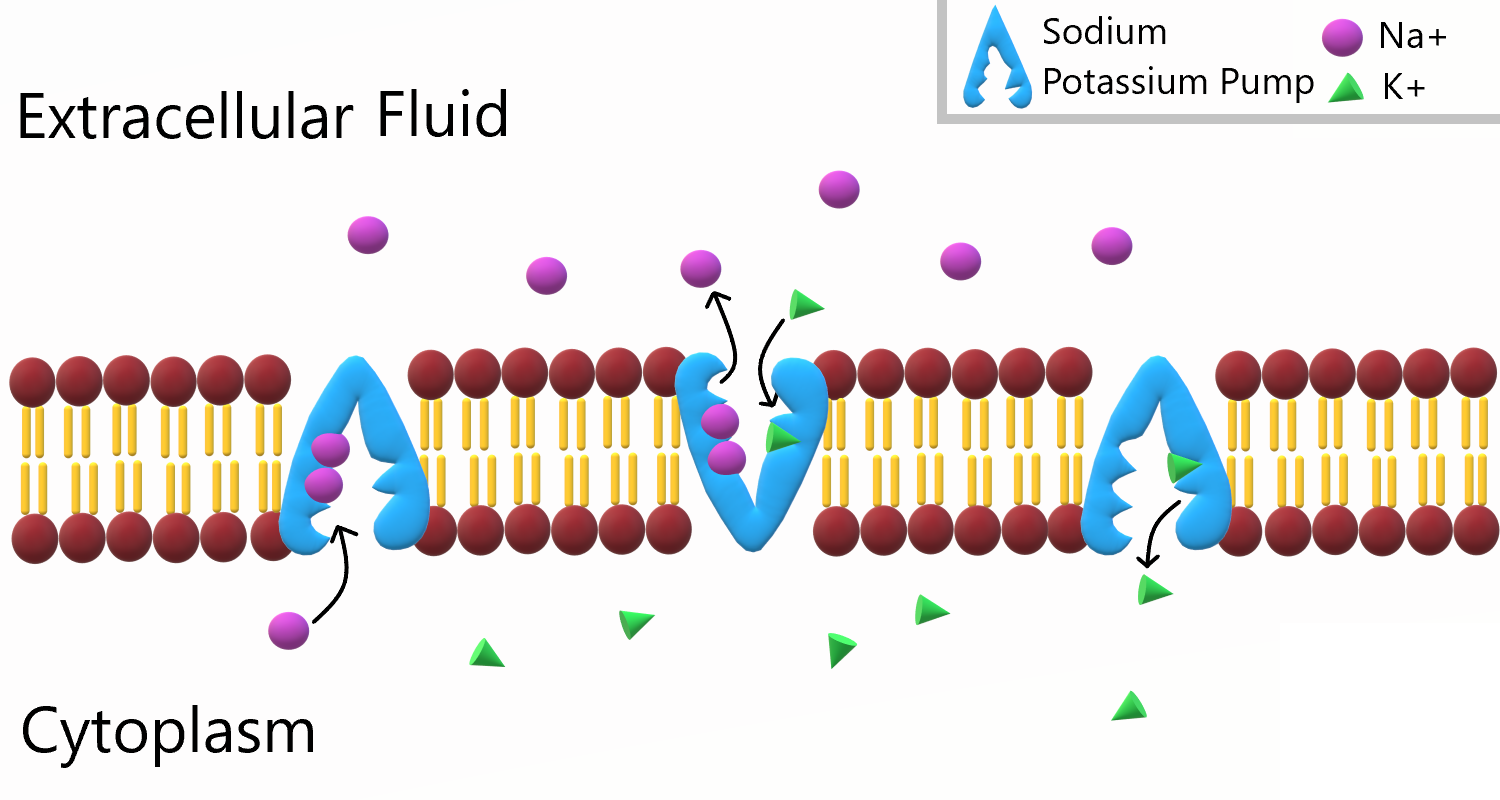
Active Transport
most chemicals use it, requires energy (ATP) - cellular energy; low to high concentration; uses carrier proteins and ATP to transport materials against concentration gradient
52
New cards
exocytosis
AT; materials get transported outside of a cell caused by a vesicle
53
New cards
endocytosis
AT; how materials get inside the cell
54
New cards
phagocytosis
endocytosis; engulf harmful bacteria, membrane forms vesicle around the bacteria and then the enzymes destroy it
55
New cards
pinocytosis
endocytosis; surrounds things that have already been dissolved
56
New cards
receptor-mediated endocytosis
uses receptors to import macromolecules from the extracellular fluid. Occurs in very small concentrations
57
New cards
Passive Transport
does not require energy; high to low concentration gradient (moved with it)
58
New cards
Diffusion
when molecules get crowded and they would find spaces that aren’t crowded.
59
New cards
Osmosis
diffusion; movement of water molecules
60
New cards
Facilitated diffusion
particles use a channel protein to cross the membrane: large, ionic, and polar molecules
61
New cards
Simple diffusion
particles move directly through the cell membrane: small and non-polar
62
New cards
Concentration Gradient
occurs when the concentration of particles is higher in one area than another
63
New cards
Protein Channels
PT; span the membrane and make hydrophilic tunnels across it, allowing their target molecules to pass through by diffusion
64
New cards
Protein Pumps
AT; move ions against the gradient of concentration across membranes
65
New cards
Small hydrophobic molecules and gasses like oxygen and carbon dioxide
What molecules/particles can easily go through the membrane?
66
New cards
Large molecules, polar molecules, and ions, glucose, amino acids, proteins, they need a channel or pump
What molecules/particles have a harder Time Moving Through the membrane?
67
New cards
polar molecules like water have a harder time because the inside of the cell membrane is a lipid which is nonpolar. This means they are hydrophobic and hate the water that is going through them. They want to try and get away from it
Why do polar molecules like water, have a harder time going through the membrane?