BCS 111 Lecture 12
 Studied by 0 people
 Call with Kai
 Learn
Learn Practice Test
 Spaced Repetition
 Match
Match Flashcards
 Knowt Play
1/35

There's no tags or description
Looks like no tags are added yet.
Name | Mastery | Learn | Test | Matching | Spaced | Call with Kai |
|---|
No analytics yet
Send a link to your students to track their progress
36 Terms
Piaget’s Cognitive development stages
Sensorimotor stage (birth - ~ 1.5 yo)
Preoperational stage (1.5 – 7 yo)
Concrete operations stage (7 – 12 yo)
Formal operations stage ( > 12 yo)
Operation
Why is it called “operation”?→ Mental operation of “representations”
What is exactly a mental representation?
Simply put: a long-term memory trace of an object/concept/word/event, etc.
Each box = mental representation
Sensorimotor stage (birth - ~ 1.5 yo)
Building up the “database” of memory representations through sensory input and perception
(cont)
Lack of object permanence: Why peek-a-boo is funny to babies (esp. before 8 mo).
Due to very weak memory representation of objects → weak concept of “existence”
Preoperational stage (1.5 – 7 yo)
Burst of vocabulary size
Arbitrary connection between sound and object
Language-specific labels (i.e. words)
(cont)
Egocentric: thinking from one’s own perspective
Development of “Theory of Mind”
Seeing from others’ perspectives: Three-mountain task
Development of Theory of mind in the preoperational stage:
Interpretation of others’ behaviors and feelings
Seeing from others’ perspectives
Sympathy
Lying/cheating
Socialization
Testing Theory of Mind
Sally-Anne false belief task
Sally (left) has a basket and Anne has a box. Sally put her marble in the basket and then left. Anne moved the marble to the box. Where will Sally look for her marble when she returns?
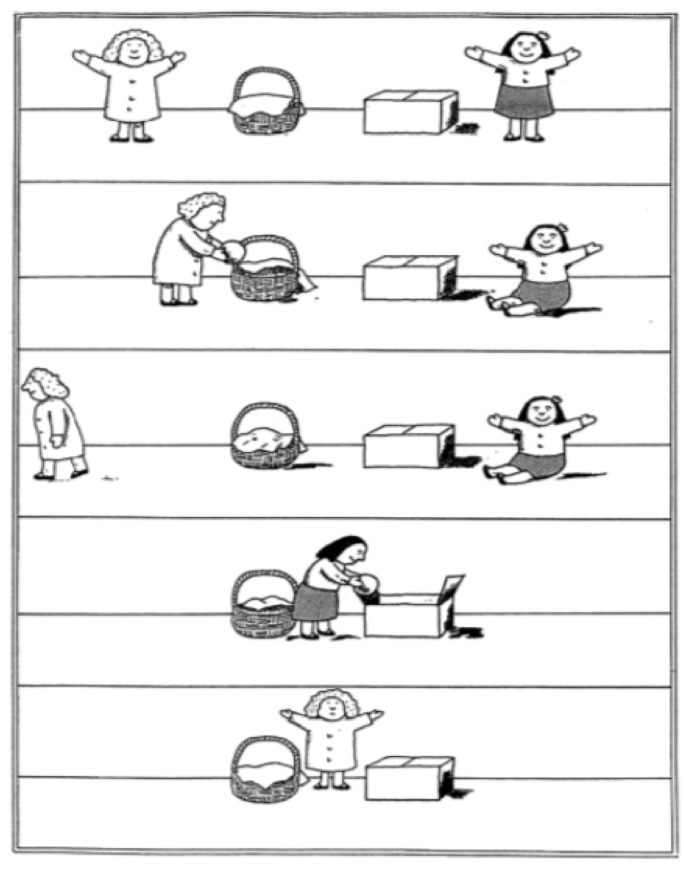
(cont)
If answer: The box: from “your” (observer’s) perspective (failed the test!)
The basket: Sally’s perspective (evidence of ToM)
Theory of mind
Children with autism spectrum disorder (ASD): tend to look for the marble in the box
Delayed development of ToM
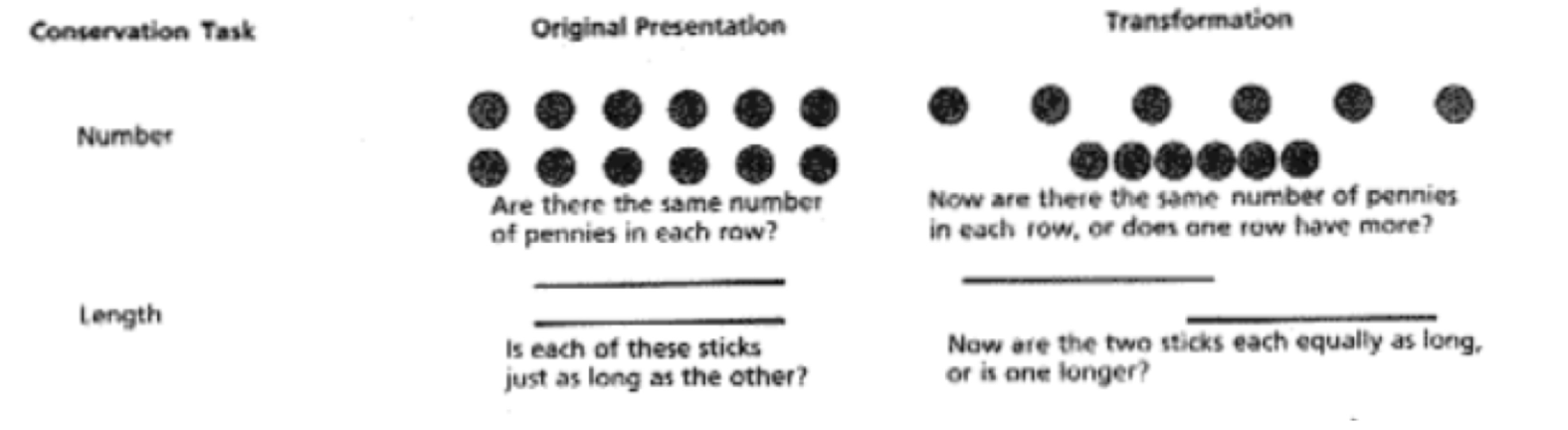
Another characteristic of preoperational stage: fail to mentally reverse an action
Conservation tasks: judge if the two sets of dots are of equal quantity or length
Preoperational children judge only by perceived difference → incorrect judgment on transformed stimulus
Concrete operations stage (7 – 12 yo)
Theory of mind developed
Ability to “reverse” transformation in the conservation task → better judgment
Developed sense of quantity
Formal operations stage ( > 12 yo)
-
Logical thinking
solving abstract logic problems
Reflective abstraction
learning by self-reflection from past experiences
Capable of abstract mental operations using mental representations
Potential problems with Piaget’s theory
Does everyone follow those discrete stages of development?
Age range reliable in each range?
Theorized based on small sample size (Piaget’s 3 children)
(cont)
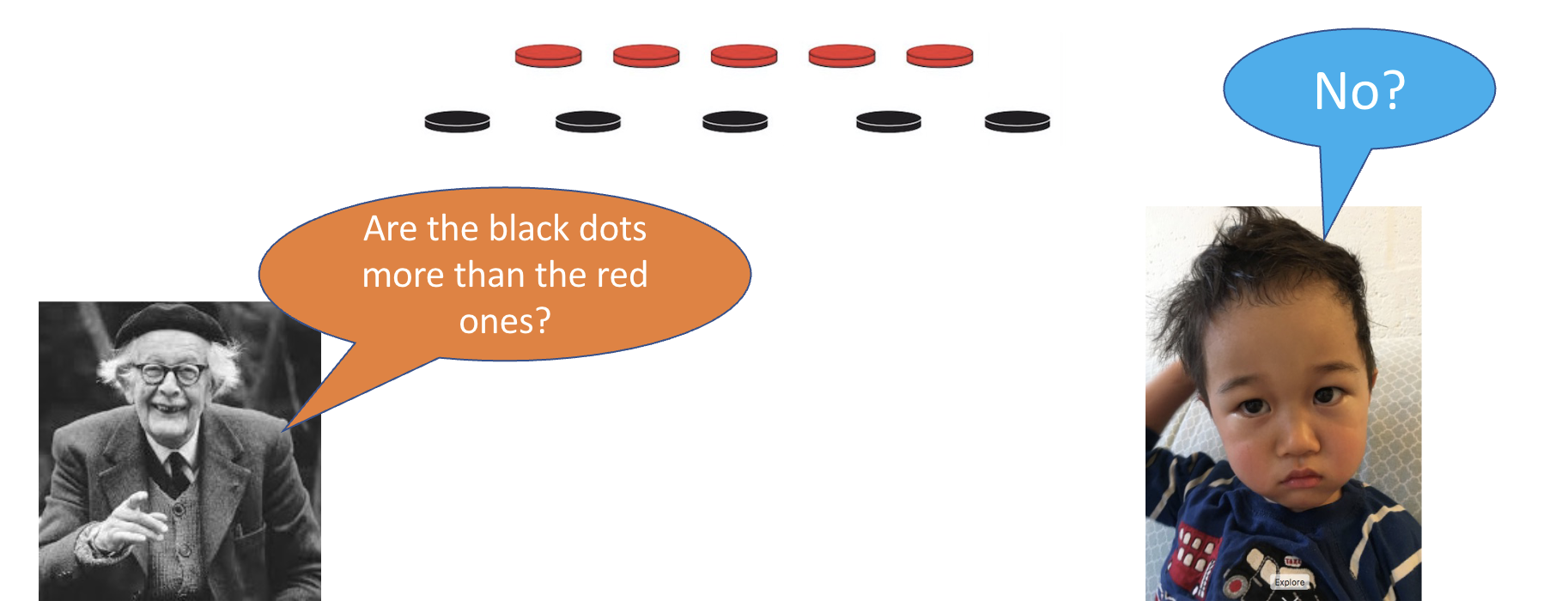
Experimenter’s bias in asking questions
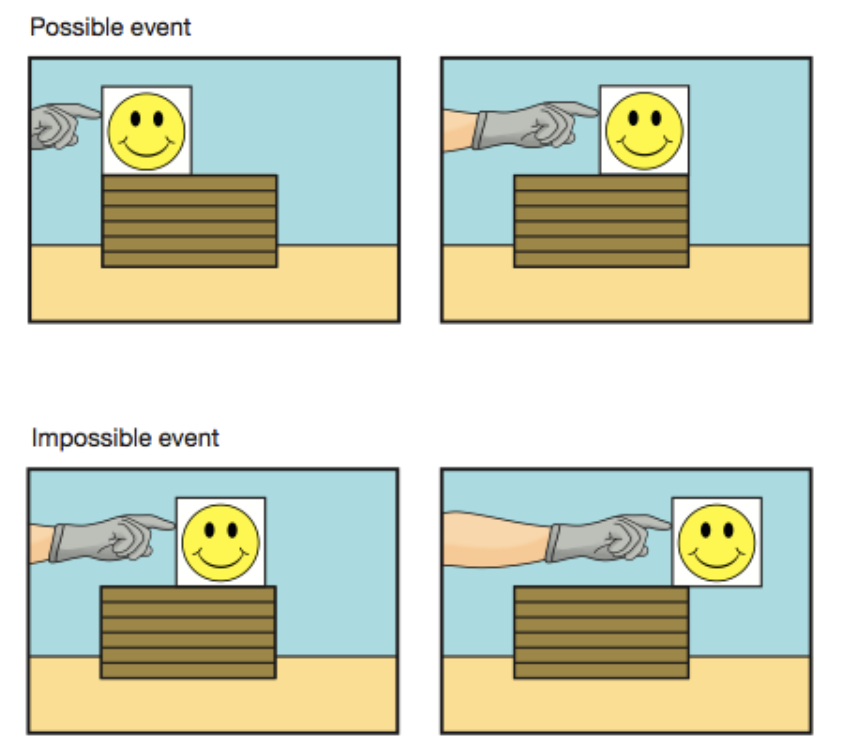
One evidence against Piaget’s theory of development: Perceptual development in infancy
Predictions based on Piaget’s theory: babies in sensorimotor stage should show no differences in their responses when seeing both events.
HOWEVER, 3-mo babies already show surprisal effect when seeing the impossible event!!
Other views on cognitive development…a review
-
Nativism
biologically determined (nature)
Empiricism
learning through experiences (nurture)
Behaviorism
conditioning and reinforcement
Nature vs. Nurture debate
which one plays a bigger role in development
Some insights from studies of twins who grow apart
Twins studies show that genes seem to play a bigger role in development, but learning and experiences are still crucial
Other perspectives on cognitive development
Empiricism: Mind as a blank slate at birth
Knowledge built upon experiences and education
(cont)
Behaviorism
Learning through conditioning and
reinforcementStimulus-response
Chomsky’s view of development - Nativism
Pre-wired biological functions - innateness
Innate ability to acquire any language regardless of how complex it is
The input from the environment is not good enough for children to acquire their native language
Brain development
Growing frontal lobe: developing language, emotion, inhibitory control, etc.
Growing gyri and sulci
Development of neural network: expanding connections among regions
Development of Attention
Shift from holistic to analytic approaches as a child gets older
“Find the two pictures that match exactly.” Older children can do this better than younger children
Pay more attention to details/features (analytic approach)

Development of object recognition
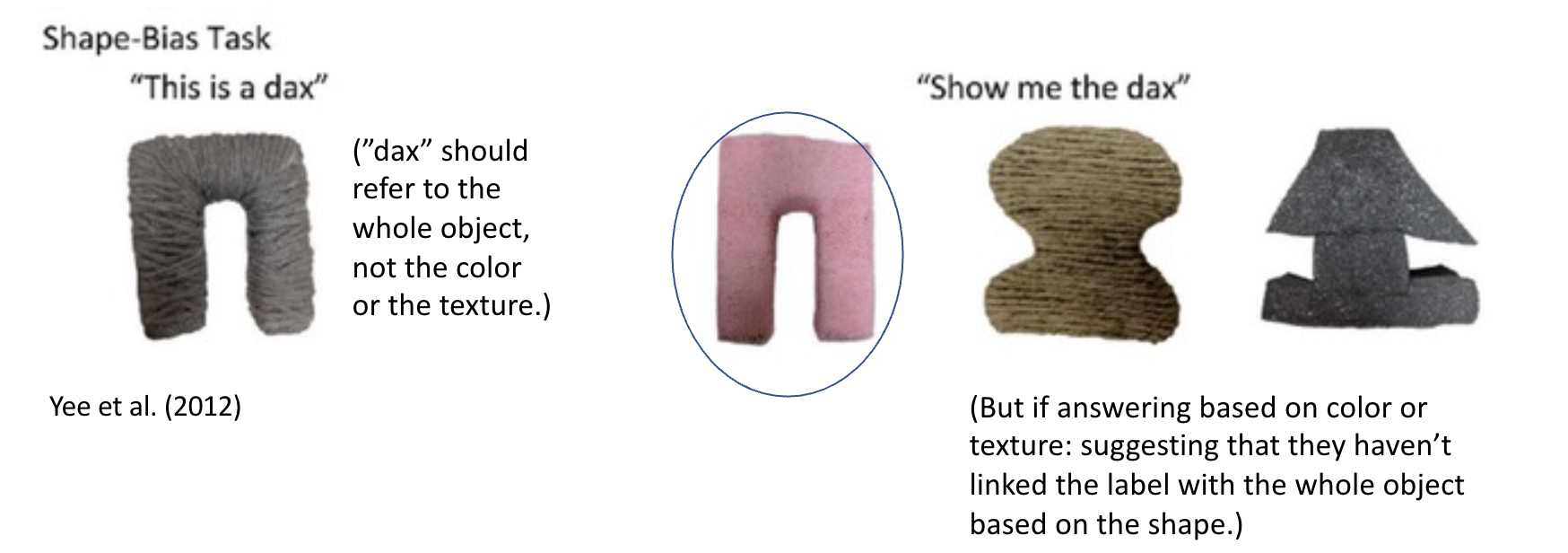
2-3 yo categorize objects by shape with the same label: “shape bias”
12-18 mo don’t show strong shape bias → less attentive to shapes
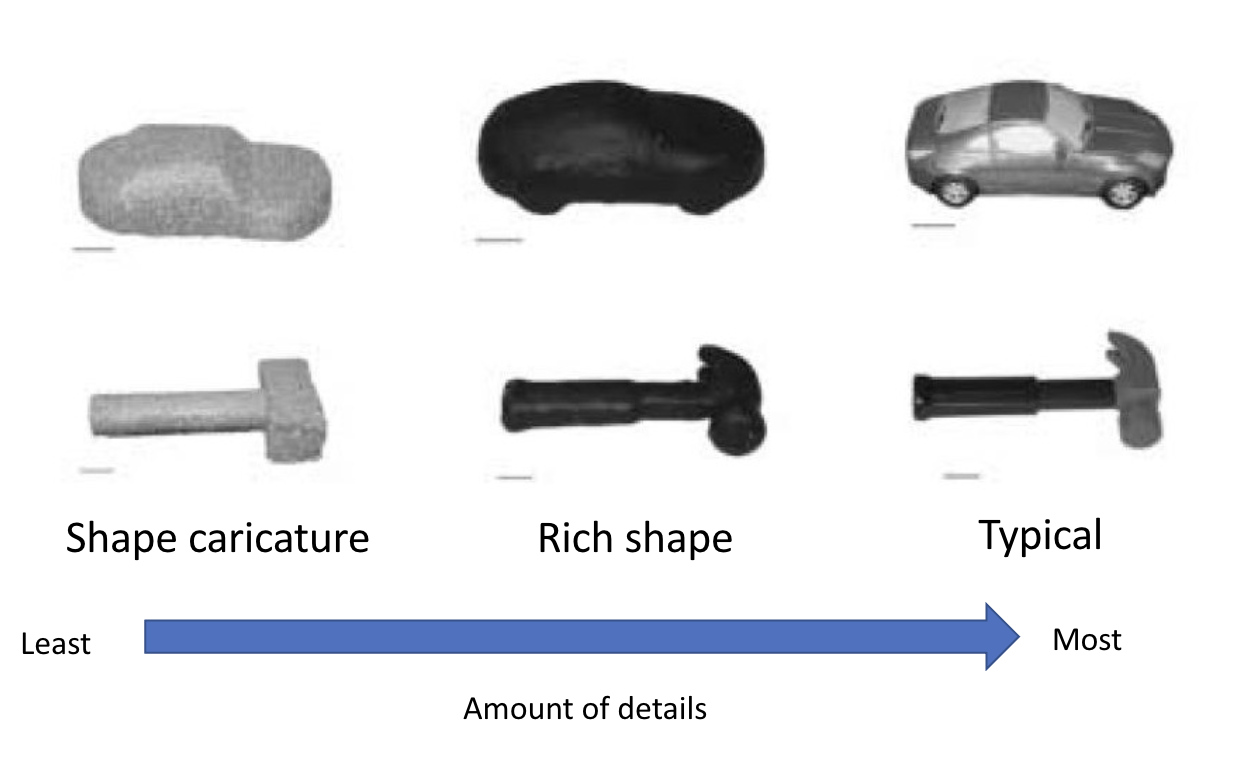
What if we manipulate the details of the object to examine how children categorize them?
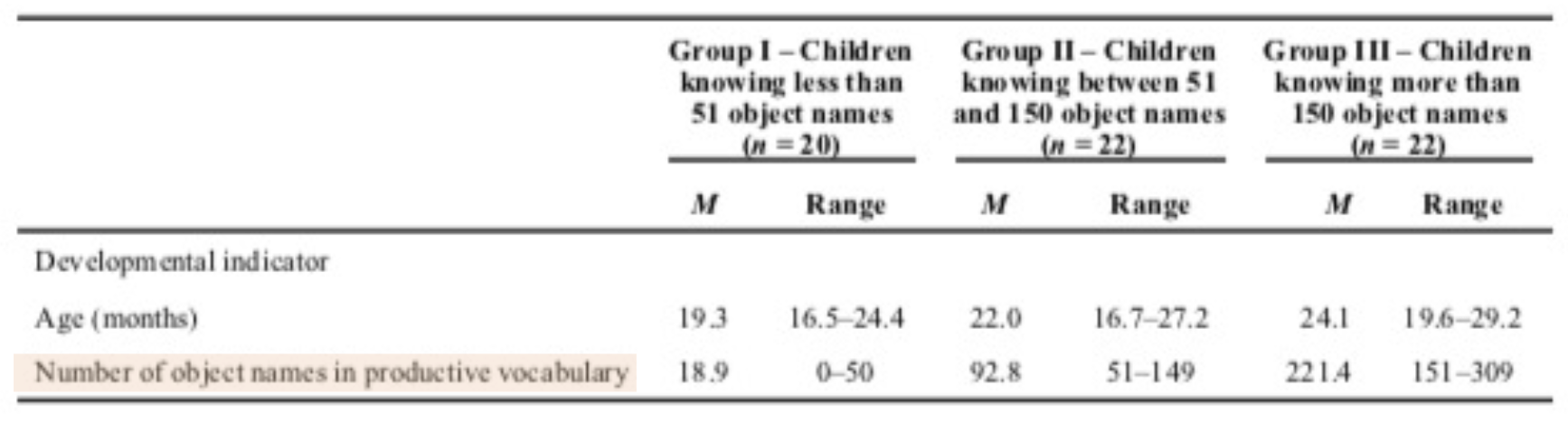
16.5 - 29 mo young children divided into 3 groups based on vocabulary size (see next slide)
English as their first language
Task: Object identification by pointing at or picking up the picture
Development of object recognition
3 subgroups of young children with varying vocabulary size
Productive vocabulary: words they can produce
(cont)
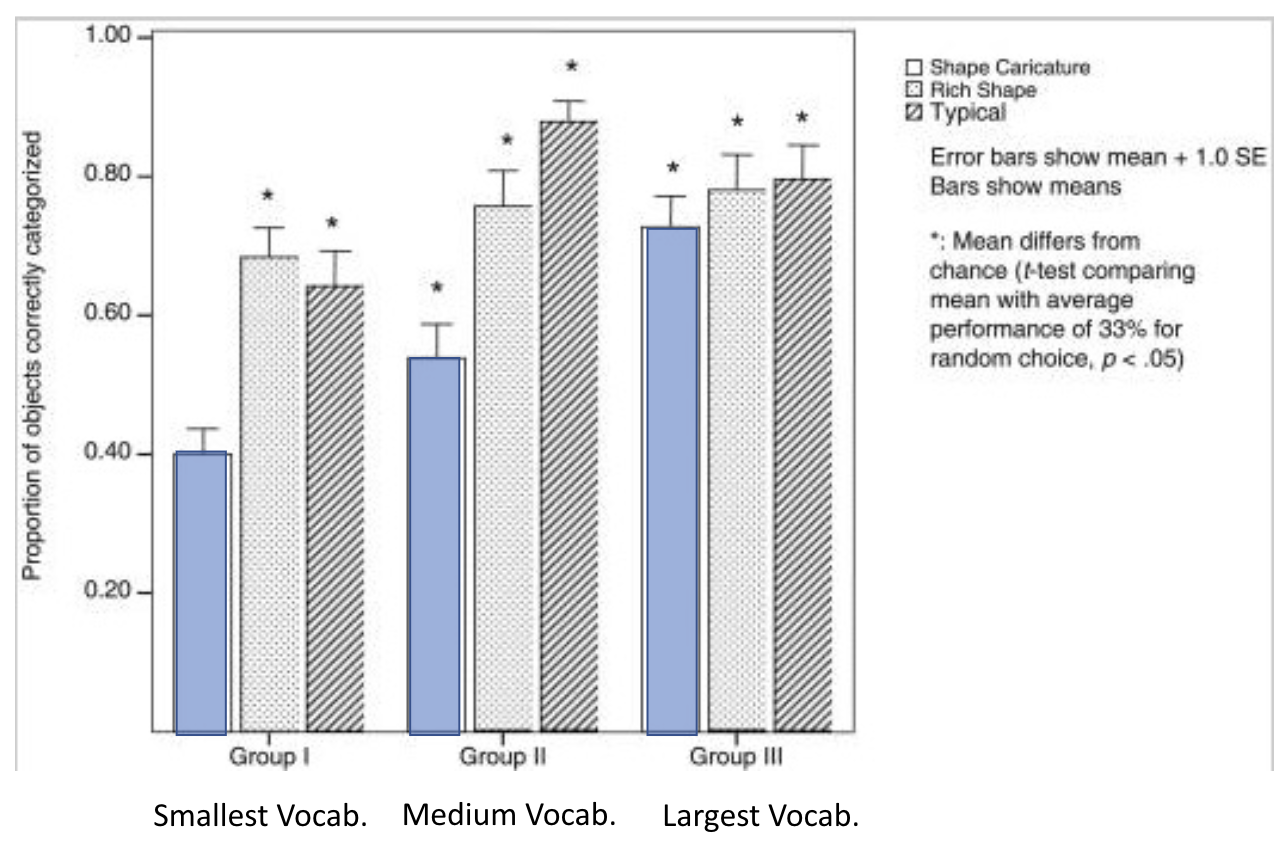
Group III showed no sig. diff. among the 3 types of objects
Among the 3 types of objects, categorization of shape caricature is highly correlated with vocab. size → Larger vocab. size leads to better categorization just by rough sketches of objects
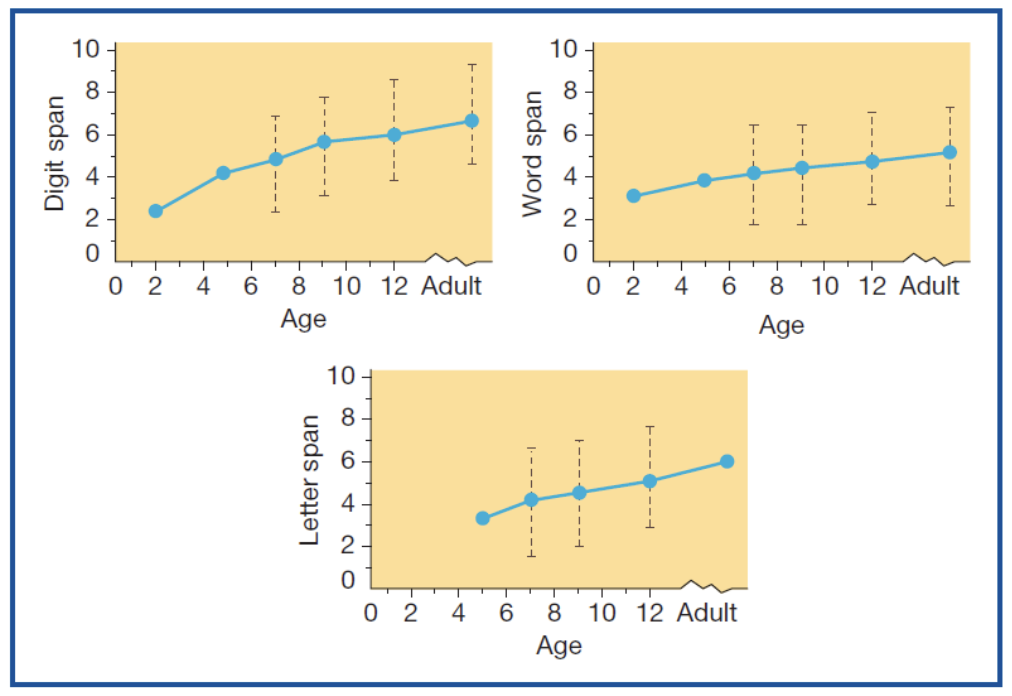
Development of working memory
Working memory capacity increases with age
Alternative explanations:
Processing speed (instead of memory capacity) increases with age
Less familiar with the experimental contexts and procedures at younger ages
Summary: Cognitive development
Some potential problems with Piaget’s stages of development: age range, sample size, “operations” in each stage
Nature vs. Nurture: twins studies show that genes seem to play a bigger role in development, but learning and experiences are still crucial.
Young children (before 3 yo) pay less attention to details of an object in categorization → shape bias shown in 2-3 yo
Abstraction in categorization develops with vocabulary size.
Working memory development can also correlate with processing speed and familiarity with the tasks.
 Note
Note  Flashcards (102)