VCE BM Unit 3: AOS 2: Human Resources
 Call Kai
 Learn
Learn Practice Test
 Spaced Repetition
 Match
Match Flashcards
 Knowt Play
1/87

Earn XP
Description and Tags
This set of flashcards encompasses area of study 2 of the Unit 3 VCE Business management study design for 2024
Name | Mastery | Learn | Test | Matching | Spaced | Call with Kai | Chat |
|---|
No analytics yet
Send a link to your students to track their progress
88 Terms
Human Resources overview
is the organisation of employees’ roles, pay and working conditions
HR managers aim to increase efficiency and productivity of their workers by handling this relationship well
Promotes high levels of motivation and job satisfaction among staff
HR is considered vital to a company’s success even though it is not a directly generate revenue
HR includes
Motivation of staff
Recruitment and selection of new staff
Job interviews and testing
Staff training and development
Performance appraisals
Occupational Health and Safety
Planning for future staffing needs
Termination management
Negotiating pay and conditions and dispute resolution
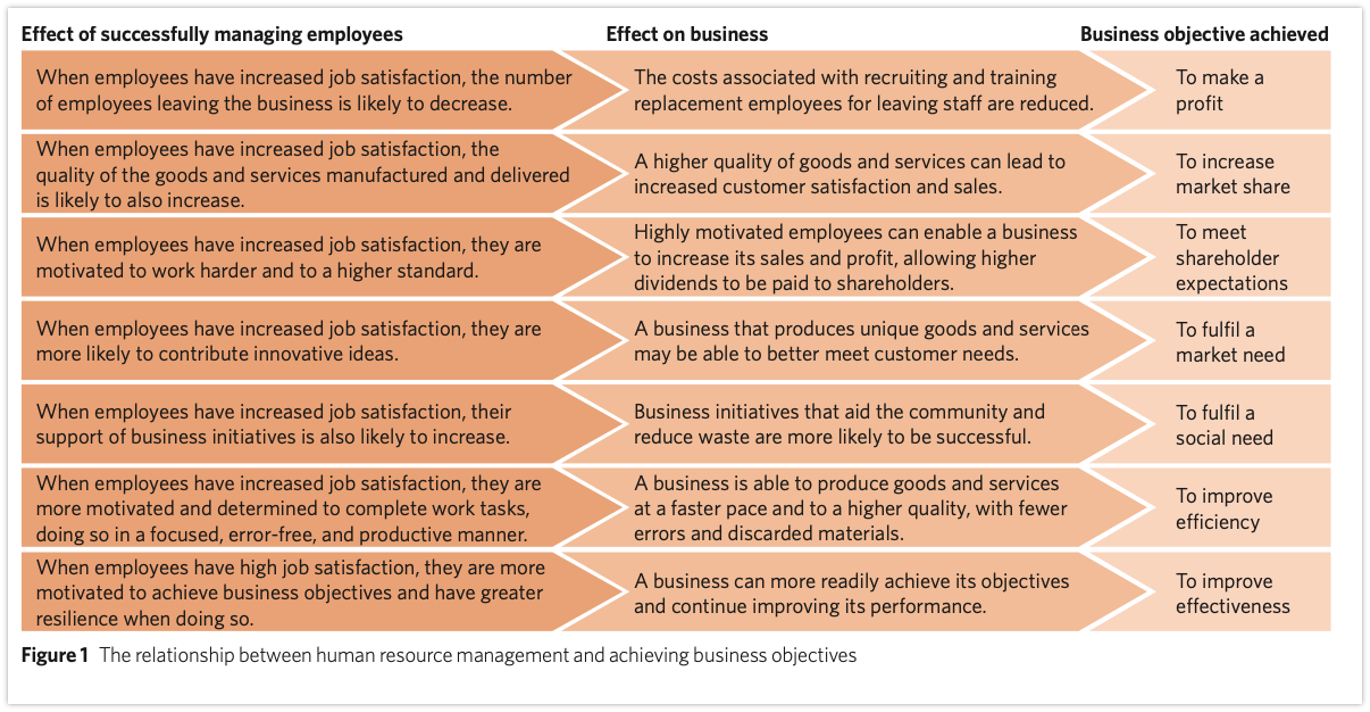
Link between HR and business objectives
HR managers coordinate and direct employees throughout all stages of their employment
If managed correctly employees feel more valued, encouraged and motivate to perform at their best
High performing employees can improve business performance and help a business to achieve their objectives
Motivation
the willingness of an individual to expend energy and effort in completing a task
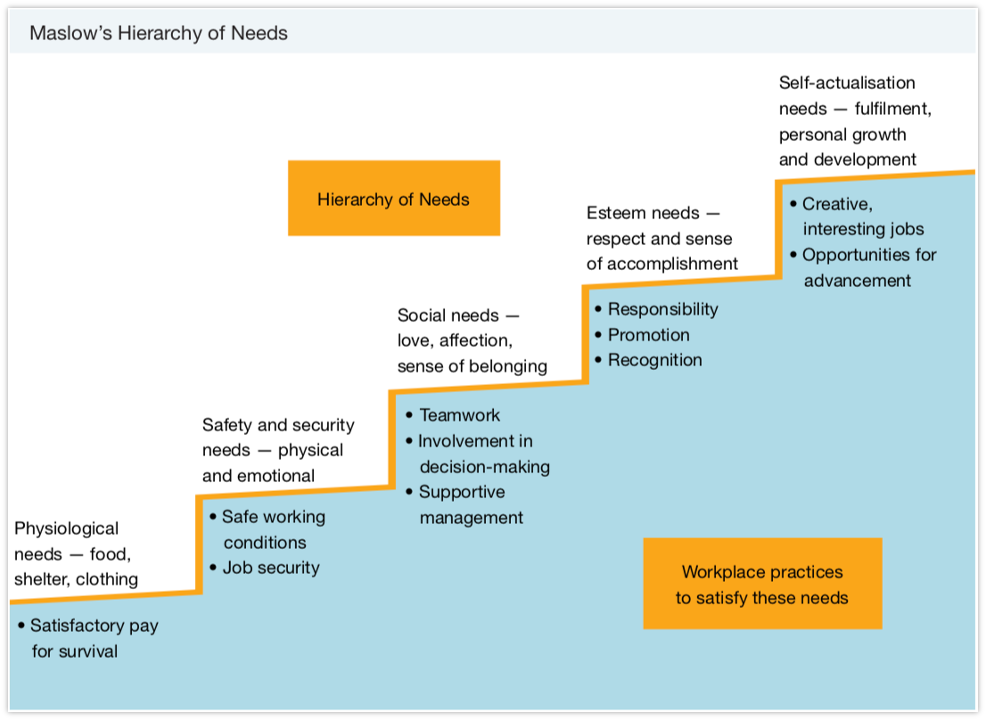
Maslow’s Hierarchy of needs
a motivational theory that suggests people have five fundamental needs, and their sequential attainment of each need acts as a source of motivation.
A need is what a person requires.
assumes these needs could be arranged into a series of steps, where each need must be satisfied, and once that happens, that need no longer motivates, and the next need on the hierarchy is now the motivator.
This theory is important, as it suggests businesses must create workplaces that can satisfy all needs.
If businesses focus only on pay rises, this only satisfies lower level needs, meaning employees are never fully motivated and satisfied, which can lead to issues around productivity.
Maslow’s physiological needs
the basic requirements for human survival, such as food, water and shelter
Maslow’s safety and security needs
the desires for protection from dangerous and threatening environments
Maslow’s social needs
the desires for a sense of belonging and friendship among groups, both inside and outside the workplace
Maslow’s esteem needs
an individual’s desires to feel important, valuable and respected
Maslow’s actualisation needs
the desires of an individual to reach their full potential through creativity and personal growth.
Maslow’s needs
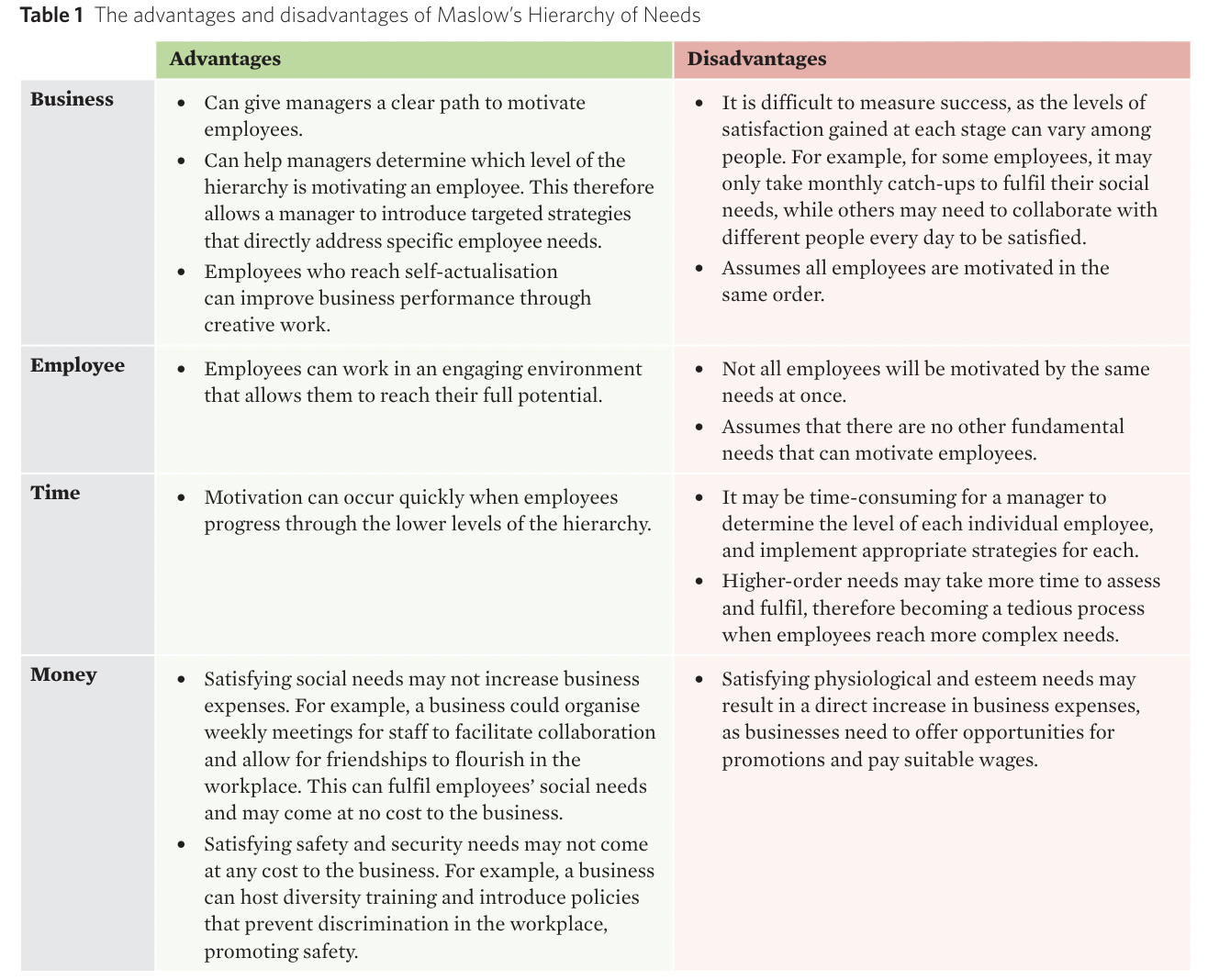
Evaluation of Maslow’s hierarchy of needs
Locke and Latham’s goal setting theory
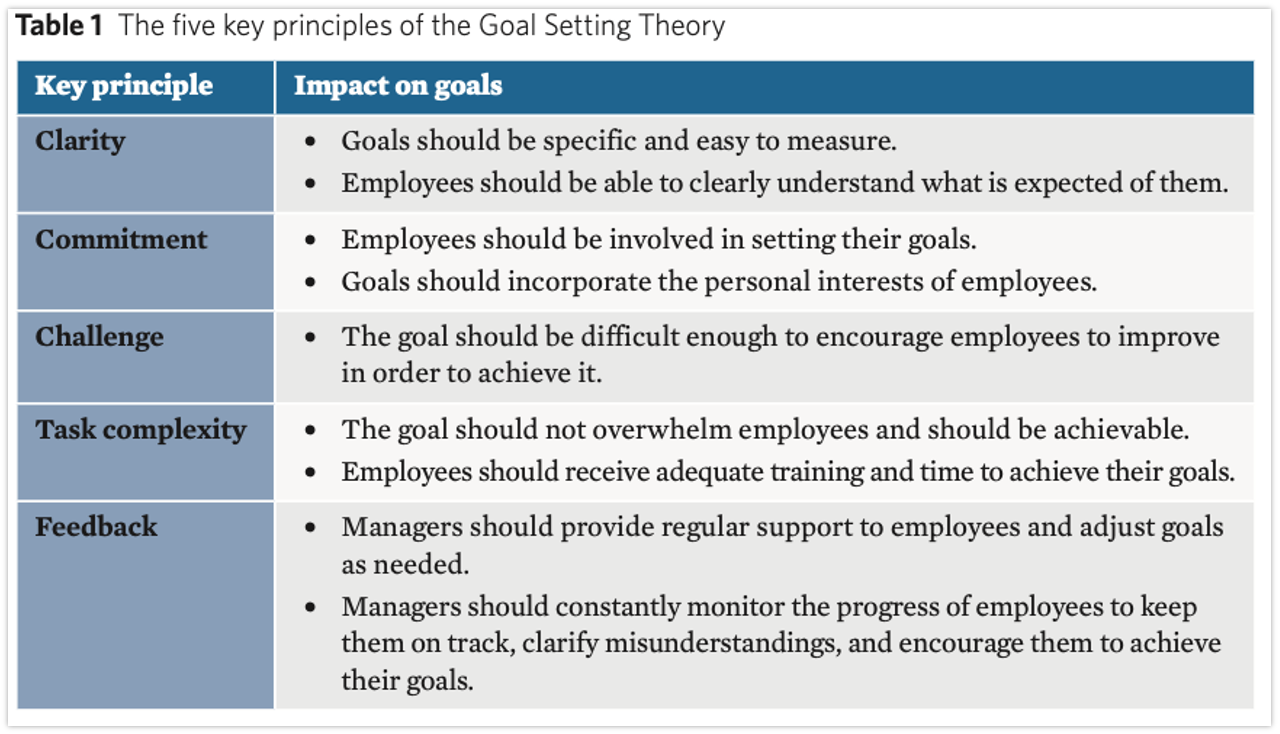
This theory states that employees are motivated by clearly defined goals that fulfil five key principles.
Specific and difficult goals were more motivating than easy and vague goals, but the goals must still be achievable and not overwhelming.
Key principles of Locke and Latham’s goal setting theory
Evaluation of Lawrence and Nohria’s four drive theory
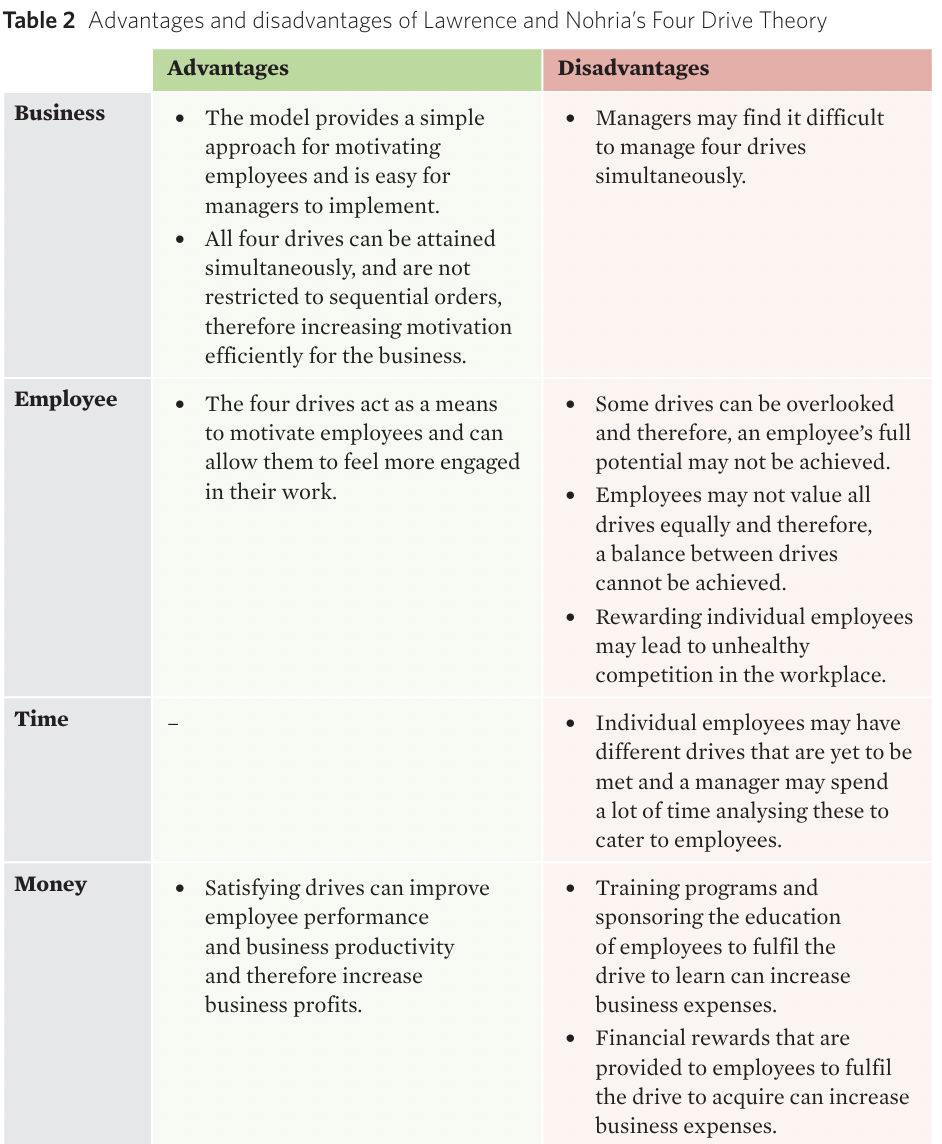
Lawrence and Nohria’s four drive theory
Is a motivational theory that suggests that people strive to balance four fundamental desires:
The Drives to Acquire, Bond and Learn are active drives, while the drive to defend is a latent drive, that is it only comes into play in the face of a threat.
Lawrence and Nohria’s drive to acquire
desire to own material goods, desire for status, power and influence.
This can also include achievement. This can be seen in a workplace by:
Remuneration levels are competitive in the industry
Monetary rewards for improvements in performance
Pathways for promotions
Increased Responsibilities
Lawrence and Nohria’s drive to bond
the desire to participate in social interactions and feel a sense of belonging
This is a sense of belonging. This can be seen in a workplace by:
Introducing recreational team bonding such as sports days
Encouraging group work instead of tasks to be done by a single person
Celebrating employee milestones and birthdays
Holding social events that employees can regularly attend and participate in
Lawrence and Nohria’s drive to learn/comprehend
the desire to gain knowledge, learn new skills and experience.
This includes the need to learn, provide mental challenges and interest. This can be seen in a workplace in the following ways:
Facilitating internal and external work-related training courses
Adopting a mentoring system between junior and senior employees
Regularly rotating the types of tasks assigned to employees
Assigning challenging work task to employees to broaden their range of skills
Sponsoring employees to pursue further education and qualifications
Lawrence and Nohria’s drive to defend
the desire to protect personal security as well as the values of the business
This comes into play in ensuring the work environment is safe and non-threatening. This can be seen in a workplace in the following ways:
Developing a vision that employees agree with
Implementing policies using employee input
Ensuring that managers represent business values
Building trust by supporting and collaborating with employees
Facilitating transparent communication between managers and employees
Implementing job contracts so that employees understand their work responsibilities and requirements
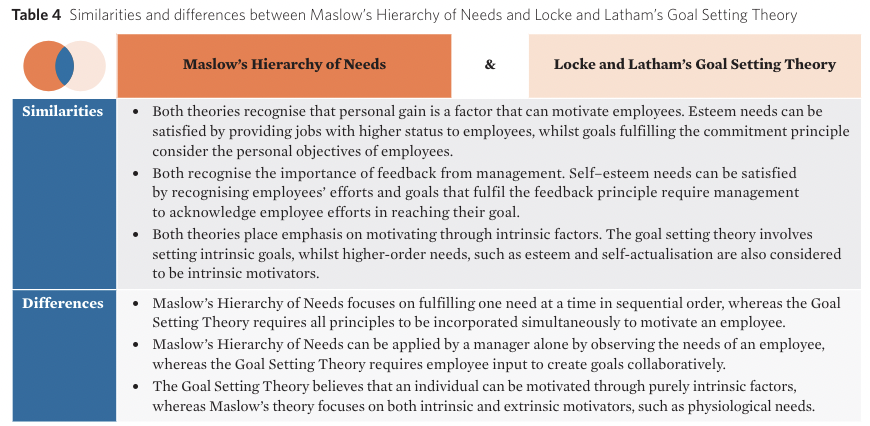
comparison of Locke and Latham vs Maslow
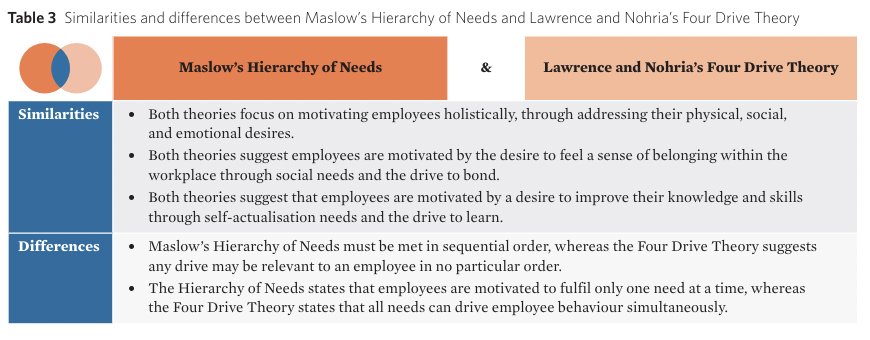
comparison of Maslow and Lawrence and Nohria
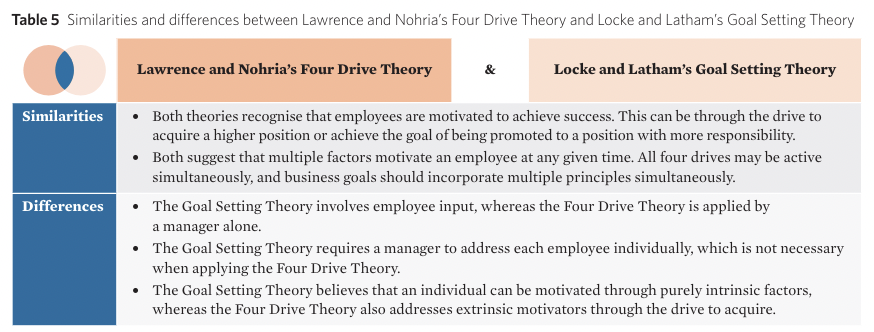
comparison of Locke and Latham and Lawrence and Nohria
Performance related pay (financial motivation strategy)
All employees go to work to earn money so they can buy goods and services and enjoy a lifestyle they want. The chance to earn extra money by improving work performance can be a powerful motivator.
There are many ways employers can motivate employees including:
-Pay increases
-Bonuses
-Commissions
Pay rise
a permanent increase in an employee’s salary or hourly wage rate.
Bonus
a one-off payment made for meeting a set objective. It is provided in addition to employee’s regular salary
commission
a payment provided to an employee for selling a good or service. It is usually paid as a percentage of the price of the good or service being sold. E.g., a real state agent earn 2% - 2.5% on the sale price of a house.
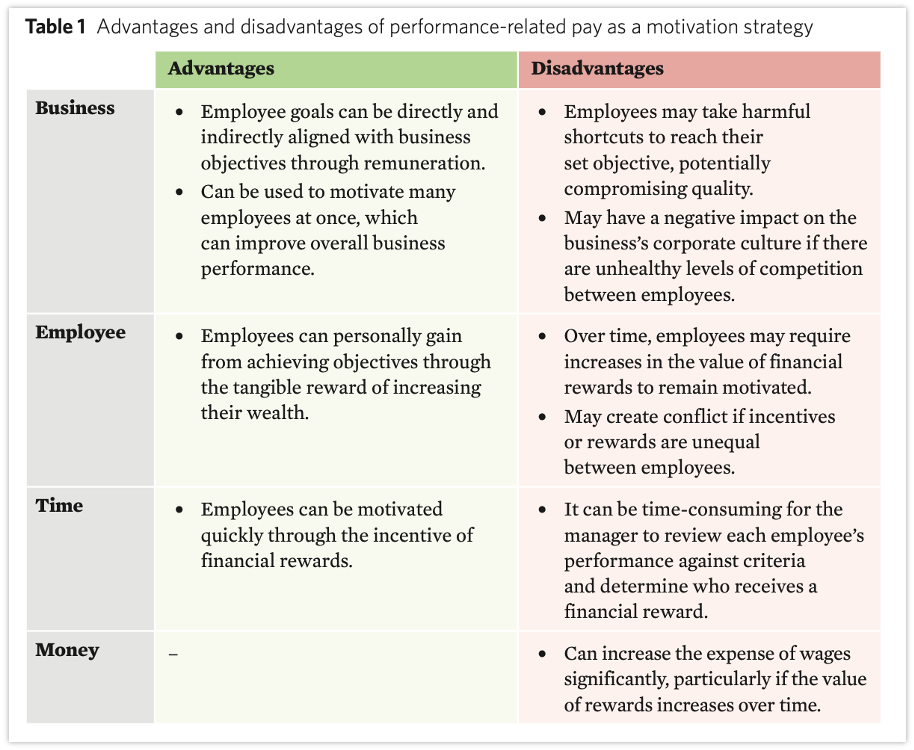
evaluation of performance related pay
career advancement (non financial motivation strategy)
the upwards progression of an employee’s job position
Seen as a motivator for ambitious employees who want more responsibility, authority or job status. Examples include
Job enlargement – combining various duties within an existing role
Job enrichment – an increase in the level of responsibility and complexity in an existing role
A manager can use _______ as a motivation strategy in the following ways:
Ensuring employees are aware of any promotion criteria
Ensuring employees are aware of any senior positions that need to be filled
Promoting from within the business to ensure that employees are constantly working towards career progression.
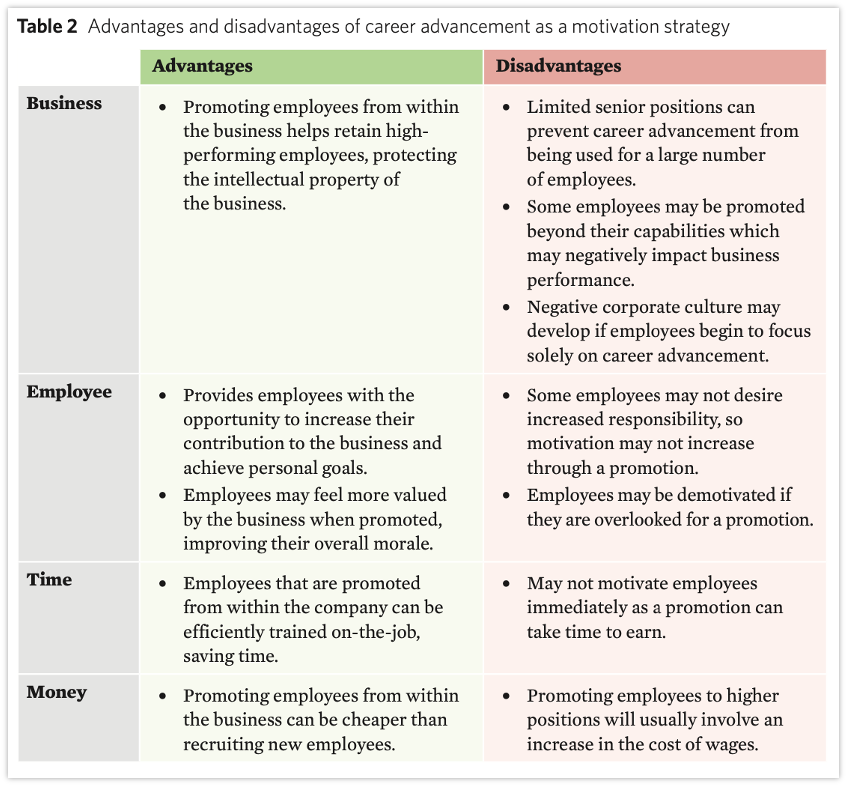
evaluation of career advancement
investment in training (non financial motivation strategy)
allocating resources to improve employee skills and knowledge
Gives employees the expertise to perform at a higher level and can be motivating as it provides opportunities to develop their abilities through their work.
Can also encourage a positive corporate culture that values personal growth and sharing of knowledge
Can be implementing through on the job and off the job training.
On the job training can be through providing employees with mentoring or training programs with the business
Off the job training is normally done by the business paying for employees to be trained by other professionals outside of the business.
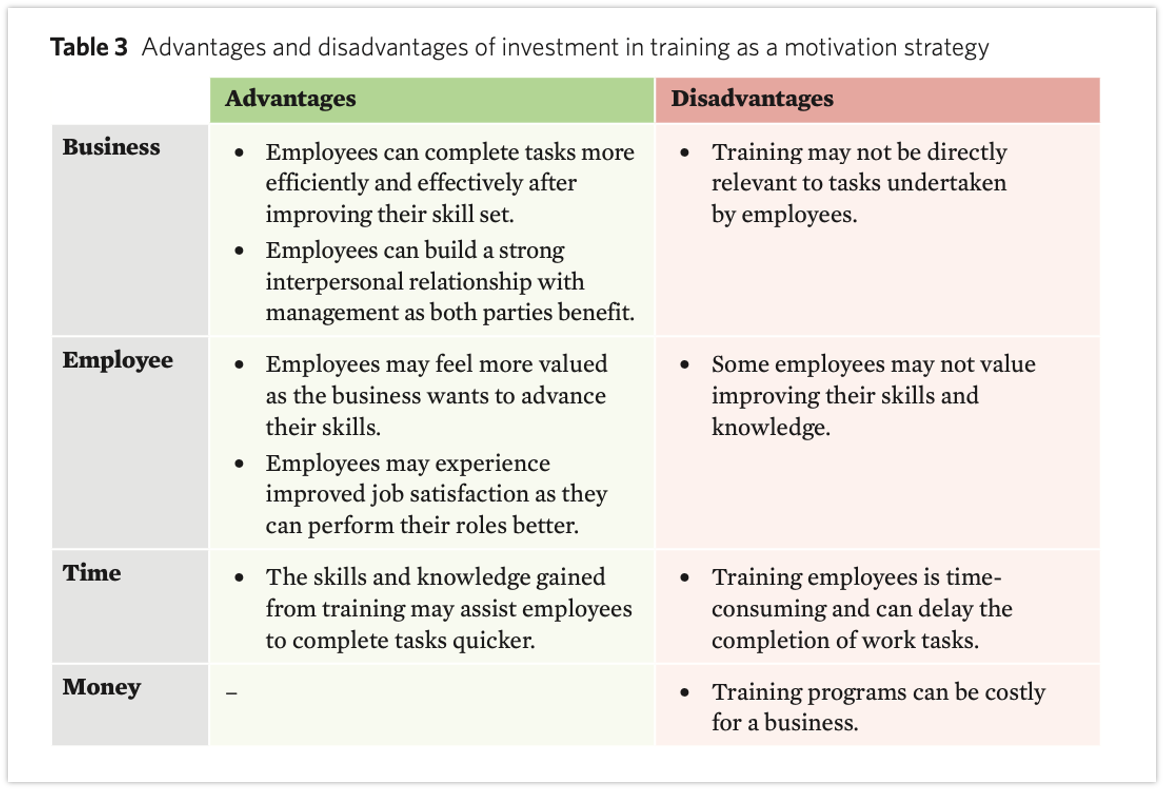
evaluation of investment in training
support (non-financial motivation strategy)
strategies that involve providing employees with any assistance that improves their satisfaction at work.
Motivates employees as it allows them to feel valued, understood and considered by their managers.
Can improve employee morale and corporate culture
Managers can support employees in the following ways:
Regularly checking on their health and wellbeing
Praising and encouraging good performance
Recognising achievements through rewards or personal recognition
Accommodating for an employee’s out of work obligations
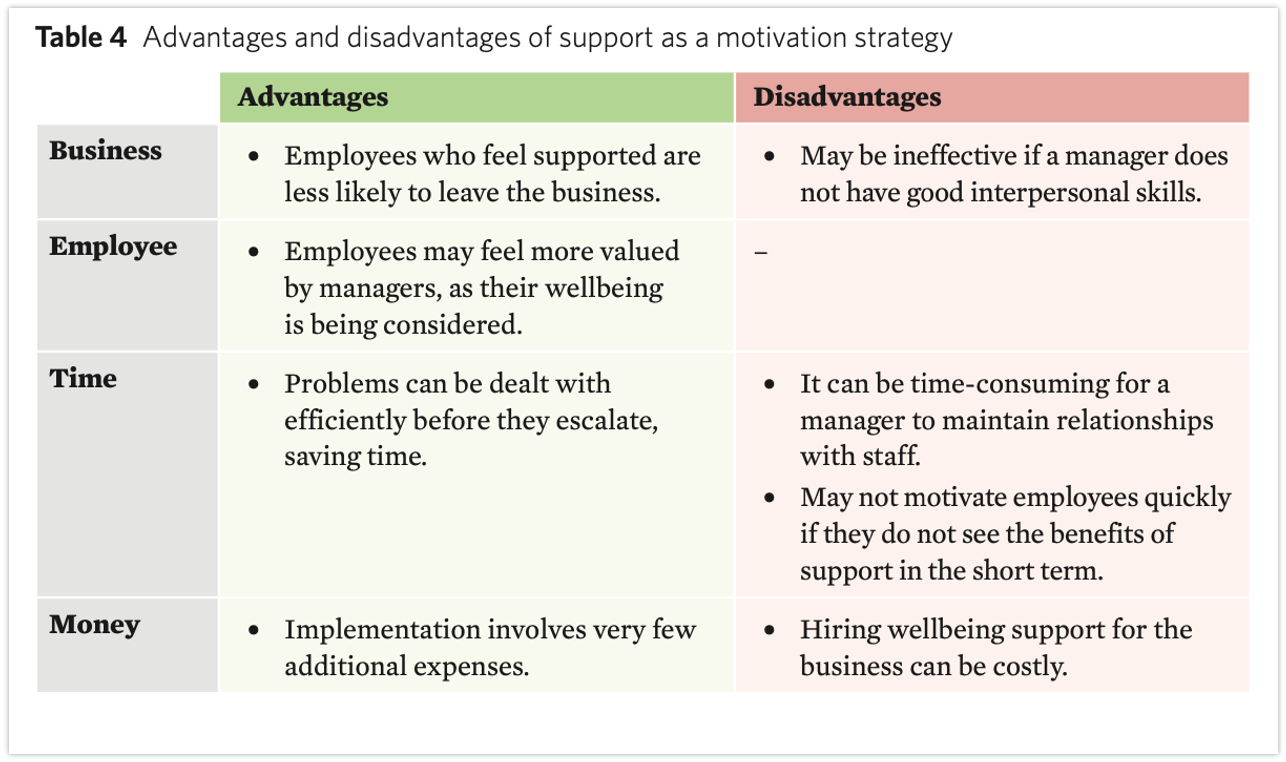
evaluation of support
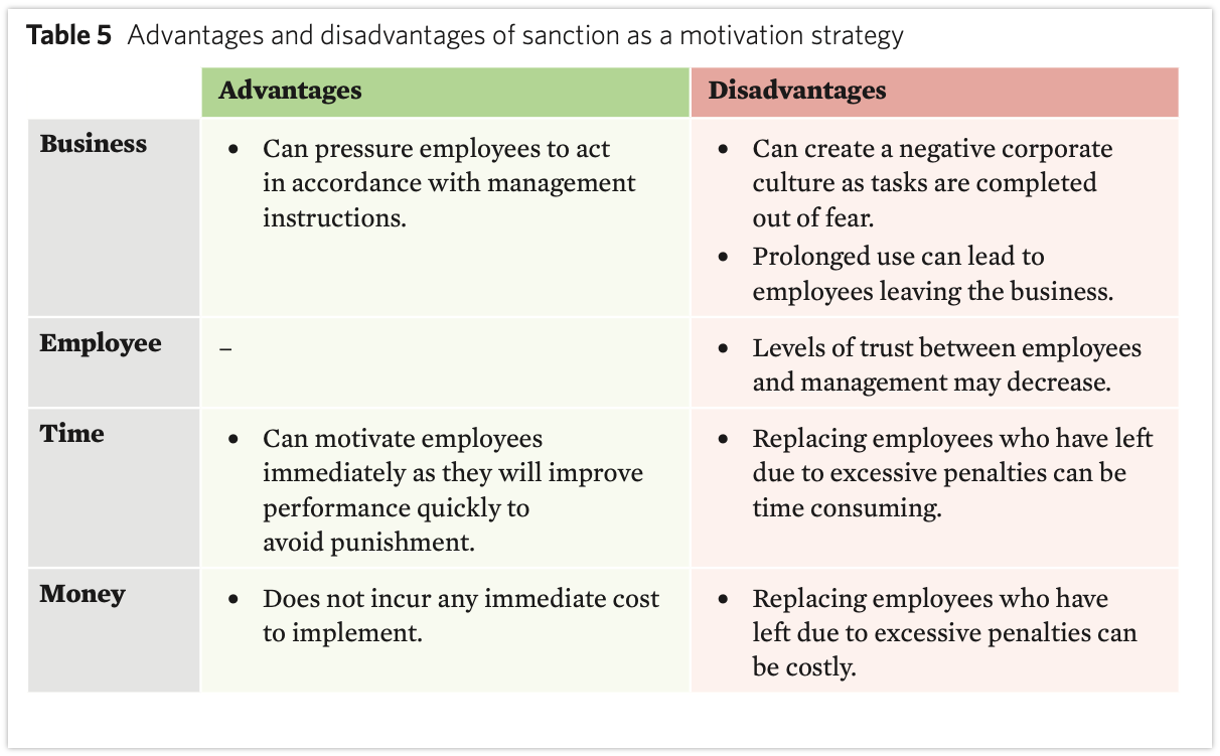
sanction (non-financial motivation strategy)
strategies that involve penalizing employees for poor performance or breaching business policies
Motivates employees who fear punishment for failing to fulfil business expectations
When used, employees are more likely to abide business policies, minimise errors and put effort into their work.
Managers can apply sanctions in the follow ways:
Verbally warning employees
Providing written warnings
Dismissing under-performing staff
evaluation of sanction
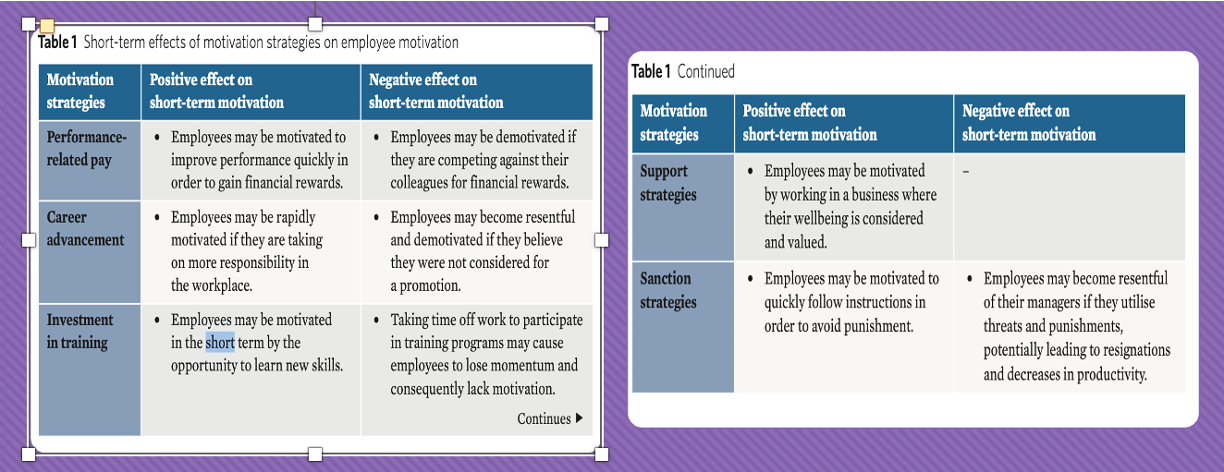
short term motivation strategies
strategies that are usually easy to implement and can be quickly implemented and increase motivation quickly
-performance related pay
-investment in training
-sanction
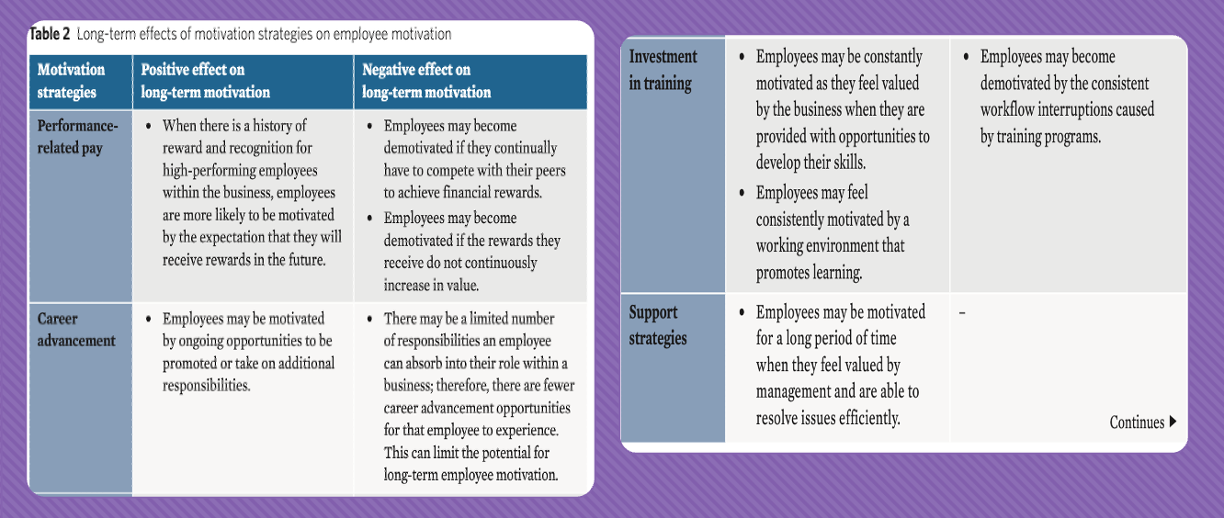
long term motivation strategies and their effects
strategies that are more difficult or timely to implement which will usually only see improvements on motivation over a longer period of time
-support
-career advancement
-investment in training
-Can create a positive a positive work environment where employees consistently feel valued and have strong relationships with management and their colleagues.
-Can improve corporate culture and provide employees with personal development opportunities should be implemented by managers.
-Can contribute to a negative corporate culture as they do no allow for the development of strong interpersonal relationships with management and often cause employees to compete with one another for rewards.
evaluation of short term motivation strategies
evaluation of long term motivation strategies
Training
focused on an employee’s current job and is aimed at improving the employee’s skills, knowledge, attitudes and behaviour to allow employees to do their job more efficiently and effectively than before.
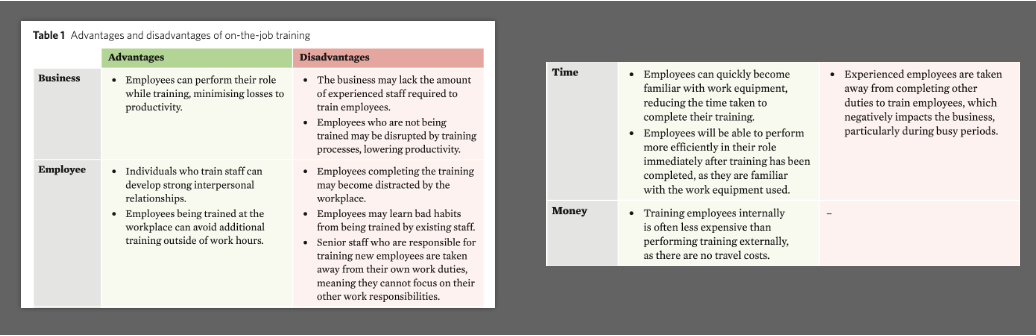
on the job training
Involves employees improving their knowledge and skills within the workplace.
It helps by allowing employees to interact and become familiar with the equipment, machinery or processes in the workplace which are related to their role.
This type of training can occur while employees are performing their role.
Examples include:
-Being coach by an existing employee on how to perform a specific role
-Having a senior staff member act as a mentor who provides continuous support and advice on how to perform tasks to the employee
-Job shadowing (following and observing) an experienced employee working in the same position
-Hiring an external trainer to give on site demonstrations of specific tasks
-Having employees rotate between different jobs to gain experience in a variety of roles (is a common practice in graduate programs)
evaluation of on the job training
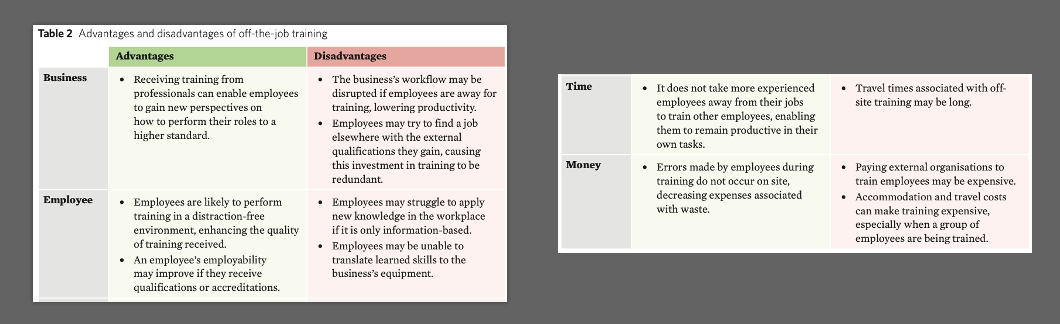
off the job training
Involves employees improving their knowledge and skills in a location external to the business
Usually involves sending employees off site to perform specialized courses where professional instructors teach them how to perform their job to a higher standard.
Examples include:
-Attending conferences that provide theoretical knowledge to employees
-Performing simulations or workshops external to the workplace, where employees learn new skills
-Attaining specific qualifications from TAFE, university or other higher education courses that are funded by the business
-Online training courses that are performed outside of the traditional working hours.
evaluation of off the job training
performance management
management that focuses on improving how well a business and individual are going, and whether they are meeting their objectives.
-A business can use a number of different strategies to measure and evaluate an individual’s contribution towards achieving business objectives.
These include:
-Performance Appraisals
-Management By Objectives
-Self-Evaluation
-Employee Observation
performance appraisal
the formal assessment of how efficiently and effectively an employee is performing their role in the business based on a set of prepared criteria, involving feedback.
There are 5 main objectives
1. To provide feedback from management to employees regarding work performance.
2. To act as a measurement against which promotions and pay rises can be determined.
3. To help the business monitor its employee selection.
4. To identify employee’s training and development needs.
5. To identify new objectives and put a plan in place to improve future performance.
If most employees continually perform below expectations, the business must look at their recruitment/selection/training requirements.
all should include feedback (positive and negative), including targets for improvement. Otherwise they are useless.
essay method of appraisal
A manager keeps a journal on each employee. Notes are often restricted to specific aspects of their job.
critical incident method of appraisal
Similar to essay method, but the manager records only exceptionally good or exceptionally bad performance.
comparison method of appraisal
Each employee is ranked according to a list of pre-determined performance characteristics.
management by objectives
This is where managers and employees agree on a set of goals, with individual employee goals ultimately leading to business goals.
This gives a clear standard for employees to reach.
cycle:
1.•Business Objectives are clearly defined
2.•Individual Employee goals are negotiated
3.•Regular Monitoring of Progress
4.•Performance Feedback
5.•Performance Appraisal on achievement of goals
6.repeat
Management by objectives evaluation
Advantages | Disadvantages |
+Aligns personal objectives with business objectives, builds in employees’ self-interest and motivation. +Makes it very clear what is expected. +Involves collaboration with employees and should improve workplace relationships. | –Designing and reviewing objectives can take time. –If linked to remuneration, (i.e., performance-related pay) can increase expenses. –Can be demoralising if they don’t achieve objectives. |
performance appraisal evaluation
Advantages | Disadvantages |
+Involves communication with employees and should improve workplace relationships. +Can help identify areas requiring further training. +Can provide information to determine employees’ readiness for promotion or dismissal. | –Can be a very time-consuming process. –Sometimes instils fear in employees over possible dismissal, or failure to achieve desired |
employee self evaluation evaluation
Advantages | Disadvantages |
+Generally, very quick and easy to administer, and doesn’t use much of the manager’s time. +The employer can get an insight into the | –Open to personal biases, whether excessive, |
employee observation evaluation
Advantages | Disadvantages |
+As the assessment is conducted whilst they +Gains information from a number of sources, peers, customers, managers, etc. +Can identify areas requiring further training. +Can provide information to determine employees’ readiness for promotion or dismissal. | –Can be a very time-consuming process. –Can catch the employee on a “bad day” which may not be reflective of their general ability. –Can be stressful for the employee if they –If they are aware they are being observed, |
employee self evaluation
This is where employees self-assess, based on a set of agreed criteria.
Examples would include:
-What are my strengths?
-What are my weaknesses? How can I improve them?
-What could I have done better during the period under review?
-What initiatives could I take to become a better employee in the future?
Employees should also consider their current role, how their role may change, and how they could take on greater responsibility or leadership positions in the future.
can highlight need for training, to improve performance and productivity.
Employees are encouraged to keep evidence when completing self-evaluation, as this shows a measurable basis for their evaluation.
employee observation
involves an employee being monitored and assessed against a range of criteria by other employee/s within the business.
This can then inform a discussion between the manager and employee about performance and where to improve.
One common approach is the 360 degree approach:
Used most often for managers and supervisors
-Seek input from group of people (8-12), completing confidential and anonymous forms.
-The idea is to identify strengths and weaknesses, and a broad range of observations can provide a comprehensive review of performance.
-The process is useful in evaluating leadership, teamwork and interpersonal skills.
-It is not useful in evaluating technical skills or the achievement of objectives.
termination
the process whereby a business ends its employment contract with an employee.
This is normally managed by the HR Manager, who must ensure the employee is treated fairly and within the law.
A business must also consider what the employees are legally entitled to and support services if they are transitioning away from the business.
There is both voluntary and involuntary:
Voluntary: Retirement & Resignation
Involuntary: Dismissal & Redundancy
retirement (voluntary termination)
Involves an individual deciding to leave the workforce permanently as they no longer wish to work.
-There is no official legal retirement age.
Reasons employees choose to retire:
-Have earned enough money over their life to support themselves financially
-Age may reduce their physical ability
-Choose to no longer be a part of the workforce and follow non-work-related pursuits
Many businesses will provide advice and assistance to employees to help them prepare for retirement.
resignation (voluntary termination)
Involves an employee voluntarily terminating their own employment, usually to take another job position elsewhere.
People may leave for:
-Advance their career elsewhere
-Increased wages
-Better working conditions
-Use of a preferred management style at another business
-A business may choose to investigate the reasons why the employee has resigned. This is usually done via an exit interview
Usually the employee must give notice of their intention to resign, length of this depends on the employment agreement and the industry. It may be a few hours for some casuals to a month for some professional jobs.
redundancy
involves an employee no longer working for a business because there is insufficient work, or their job no longer exists.
This often occurs for two reasons:
-Due to business change. E.g. when a business introduces new technology why may replace the roles of current employees meaning they are no longer required by the business.
-The business cannot afford to pay the current number of employees they have. Often results in costs needing to be reduced. Therefore, numerous employees are made redundant and merge the roles of staff to reduce their wage expenses.
Voluntary occurs when the business allows employees to nominate themselves to become redundant after the business announces the process will occur. Employees will usually do this as they are enticed by financial incentives.
Involuntary occurs when the manager notifies employees that their position is redundant and gives them no choice.
dismissal (involuntary termination)
involves the involuntary termination of an employee who fails to meet required work standards or displays unacceptable or unlawful behaviour.
A manager can choose to terminate an individual's employment of they continue to failing to meet business objectives, have poor performance or breach the terms of their contract.
Dismissal must be done in a fair and lawful manner. If not, the business can be liable for unfair dismissal.
For dismissal to be fair, the business must have provided numerous warning that have been properly documented and offered opportunities for the employee to improve their performance.
Employees can also be immediately dismissed for discrimination, theft, fraud, bullying and negligence.
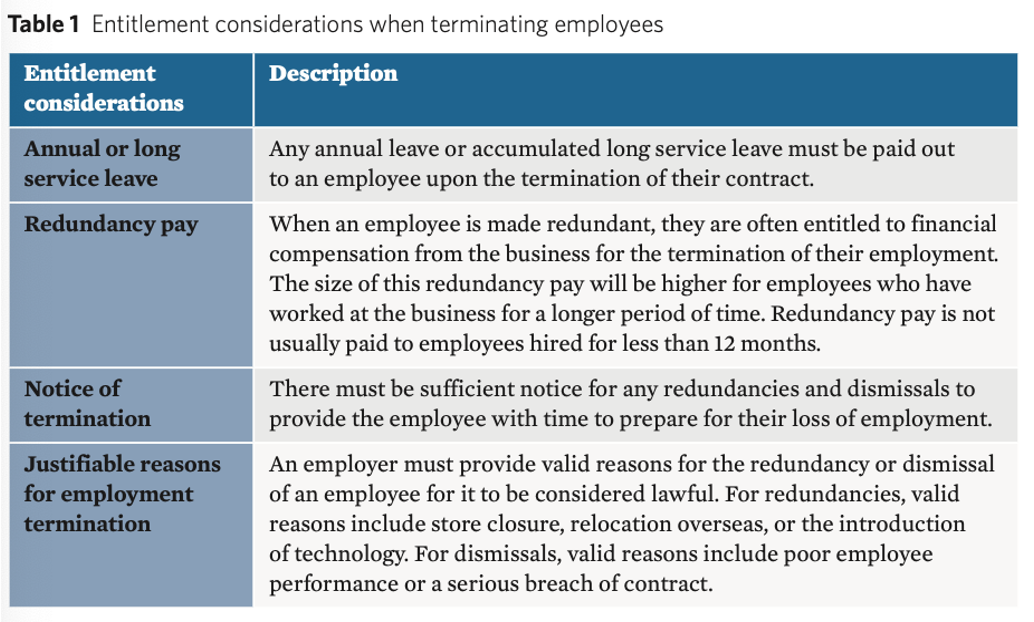
entitlement considerations
legal obligations an employer owes to its employees following the termination of their employment contract.
transition considerations
Social and ethical practices that a manager can consider implementing when terminating employment.
A manager can assist employees during the termination process by:
-Offering resume writing or interview training to employees to improve their employability
-Providing networking support for employees in the form of contacts that they can use to gain future employment.
-Provide flexible working hours that allow employees to attend interviews at other businesses
-Introducing counselling and financial services to ease the uncertainty of leaving the business
-Holding celebrations and providing recognition of the achievements of employees who are leaving the business
-Slowly reducing the working hours of retiring employees to help them adjust to a change in their lifestyle
workplace relations
the interactions between employees and employers (or their representatives) within a business's internal environment (including wages and conditions of employment).
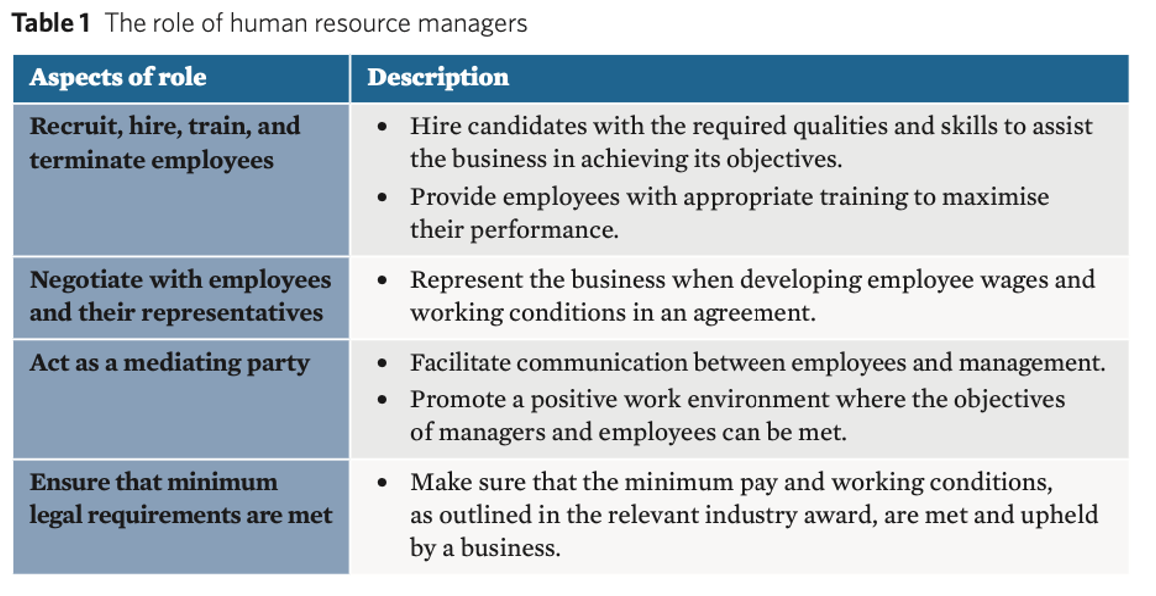
HR managers and their role
individuals who coordinate the relationship between employees and management within a business
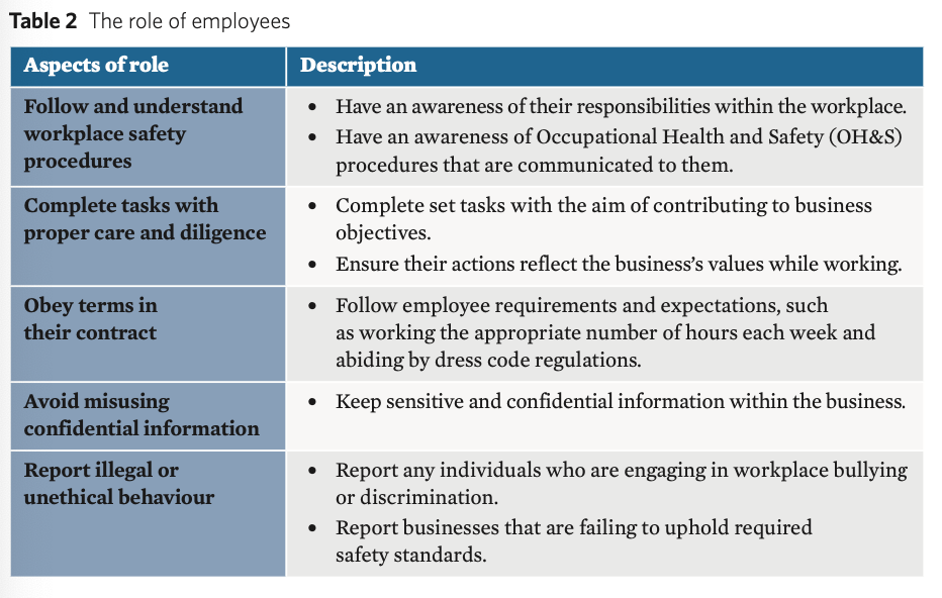
employees and their role
individuals who are hired by a business to complete work tasks and support the achievement of its objectives.
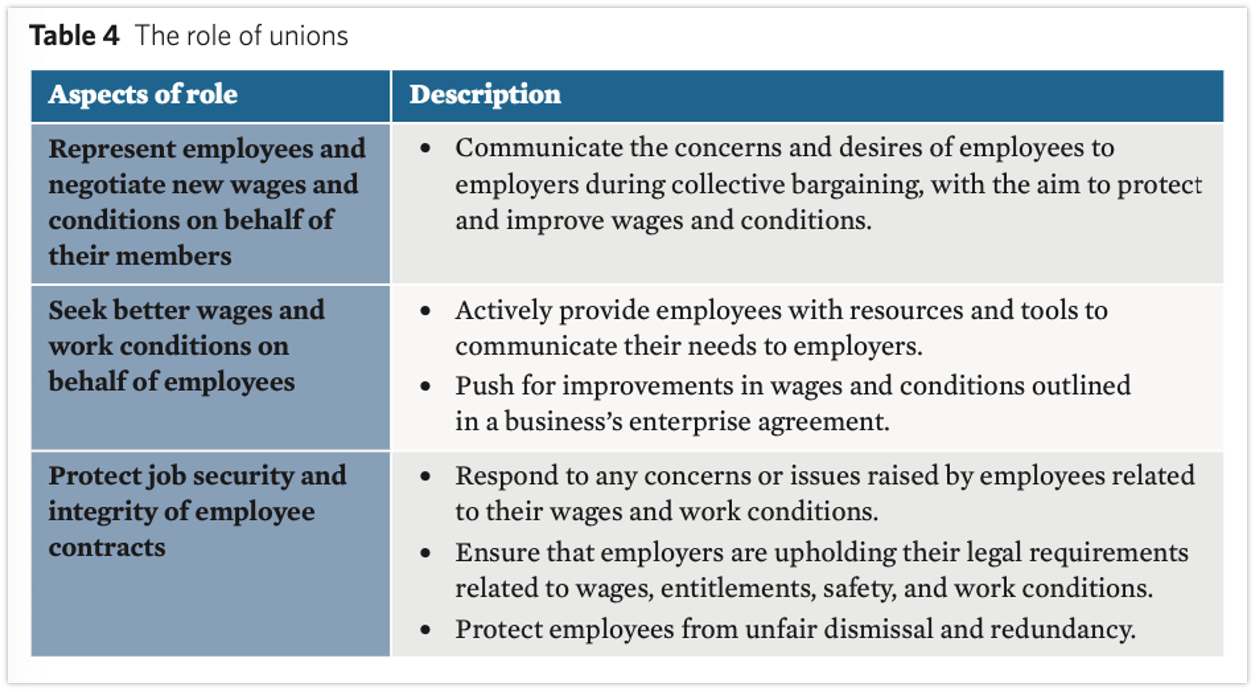
trade unions and their role
organisations composed of individual who represent and speak on behalf of employees in a particular industry to protect and improve their wages and working conditions.
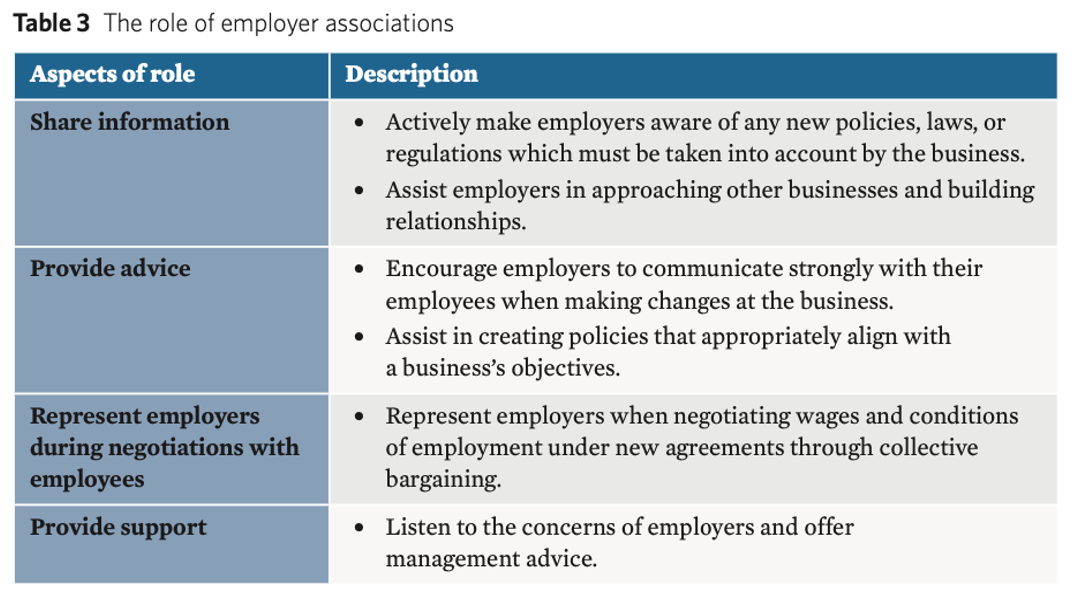
employer associations and their role
advisory bodies that assist employers in understanding and upholding their legal business obligations.
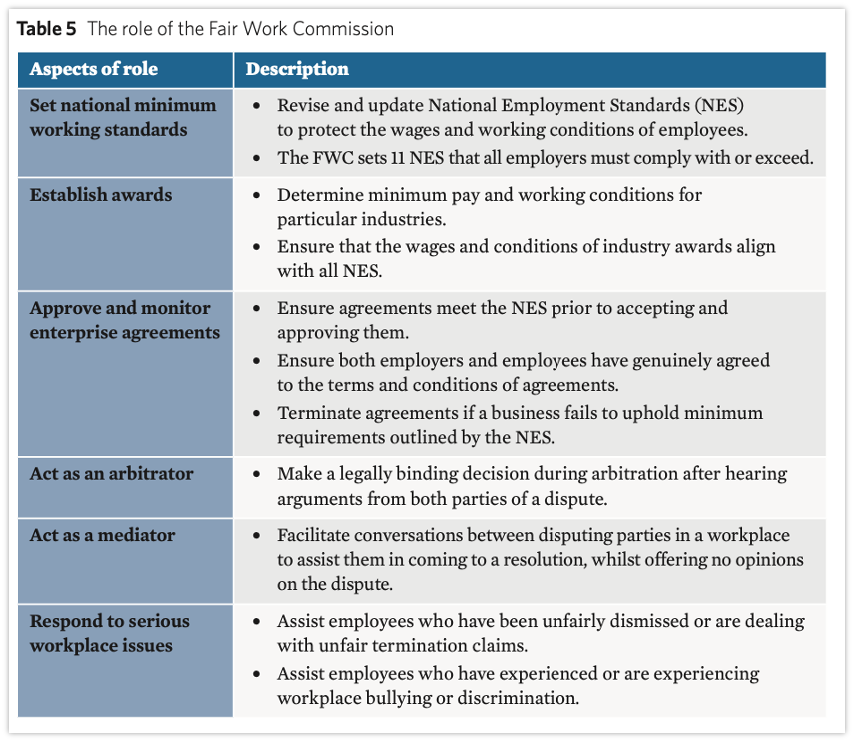
fair work commission and their role
Australia's independent workplace relations tribunal that has a range of responsibilities outlined by the Fair Work Act.
They ensure that the rights of employees are protected.
-Rights include engaging industrial actions and the right to be protected from unlawful discrimination.
Industrial Action is the steps taken by employees or employers to settle a workplace dispute about working conditions. Employees can delay, limit or refuse to work.
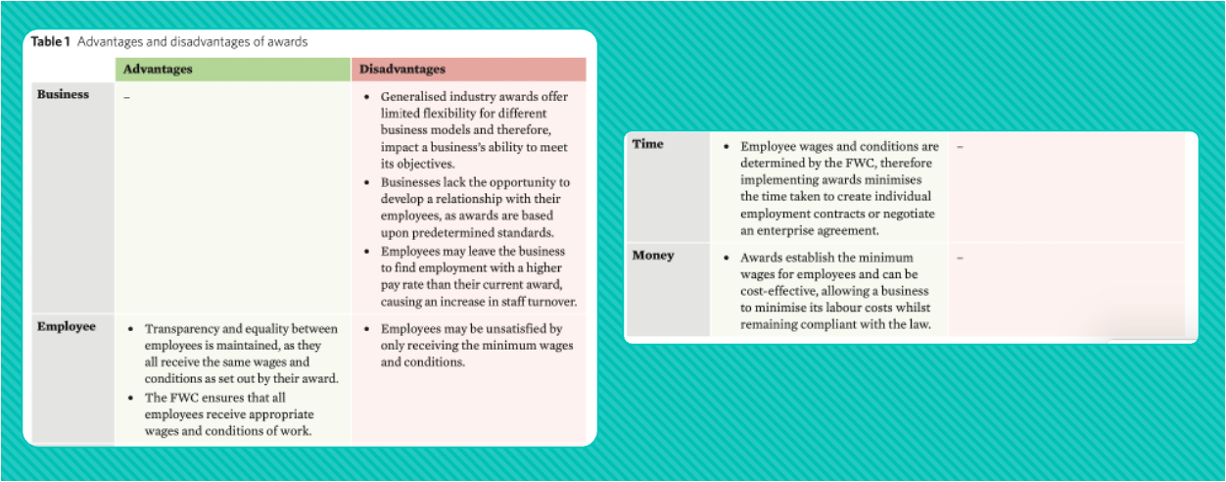
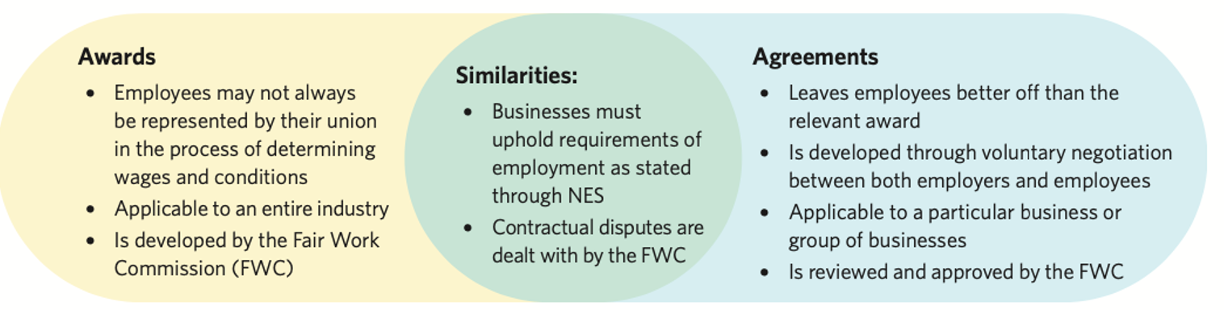
Awards
a legal document which outlines the minimum wages and conditions of work for employees across an entire industry.
Now (with the shift to decentralised workplace relations) they exist mainly as a safety net – that is, collective and individual agreements can’t make the workers ‘worse off’ than they would be under the Industry-wide Award. An award is the national minimum standard for an industry.
they cover things like:
-Minimum wages
-Maximum weekly hours of work
-Annual leave
-Penalty rates
-Termination entitlements
evaluation of awards
collective or enterprise bargaining agreements
legal documents that outline the wages and working conditions of employees and are applicable to a particular business or group of businesses.
Even though they are part of the ‘decentralised’ system, and therefore negotiated for separately, these agreements cannot leave employees worse-off than the relevant Industrial Award.
they must be updated regularly to ensure standards and worker expectations are upheld by a business and employee rigths are protected.
are determined using collective bargaining which is the process of negotiation between employers and employees, or their chosen representatives, to reach an agreement regarding employee wages and conditions of employment.
Once all parties involved in collective bargaining have come to an agreement, it needs to be submitted to the Fair Work Commission for approval.
To be approved by the Fair Work Commission, enterprise agreements must:
-Provide employees with wages and conditions that exceed the relevant industry award overall, as determined by the 'better off overall test.'
-Be mutually agreed upon by employees and their employer
-Be documented in writing
-Comply with the FWC's National Employment Standards
evaluation of agreements
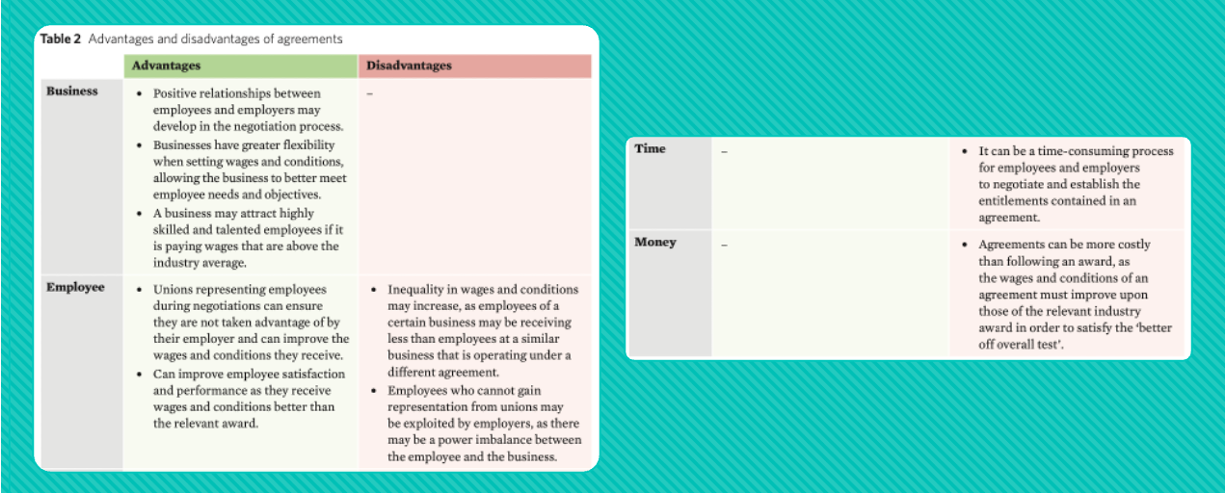
comparison of awards and agreements
the dispute resolution process
a series of steps that conflicting parties follow in order to resolve a disagreement and reach a resolution
Fair Work Regulation 2009 outline the steps that must be taken when resolving disputes when they are related to workplace agreements or national employment standards.
The aim of the steps is to only resort to more formal methods such as mediation and arbitration when absolutely necessary.
dispute resolution process steps
1.Disputing parties try to resolve the dispute within the business. This may be done through discussions between disputing employees, managers and relevant representatives (union). This is organized by the business.
2.If the dispute is unable to be resolved the business can involve and independent third party such as the Fair Work Commission (FWC) to facilitate/run the resolution process.
3.The third party will try resolve the dispute first by using mediation. E.g., Conversations between the disputing parties which are run by an independent third party.
4.If mediation is unsuccessful, then the case will be escalated/raised to the arbitration process whereby a tribunal member/judge makes a decision that all parties will be legally bound by.
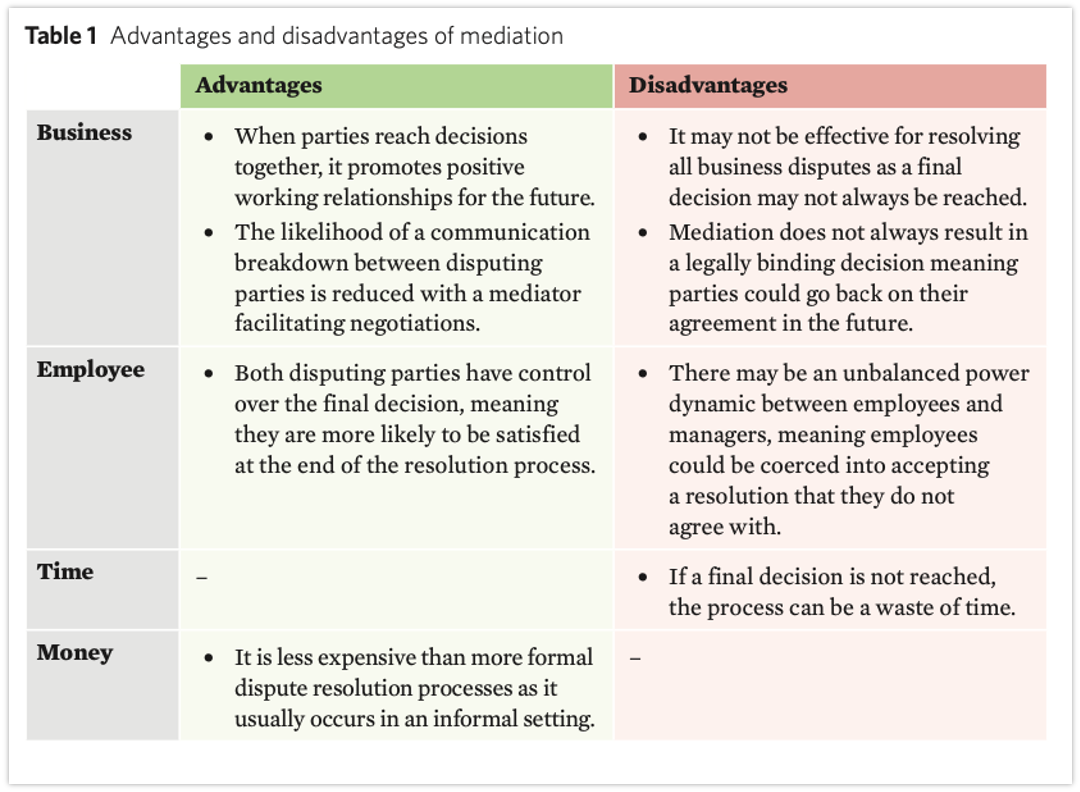
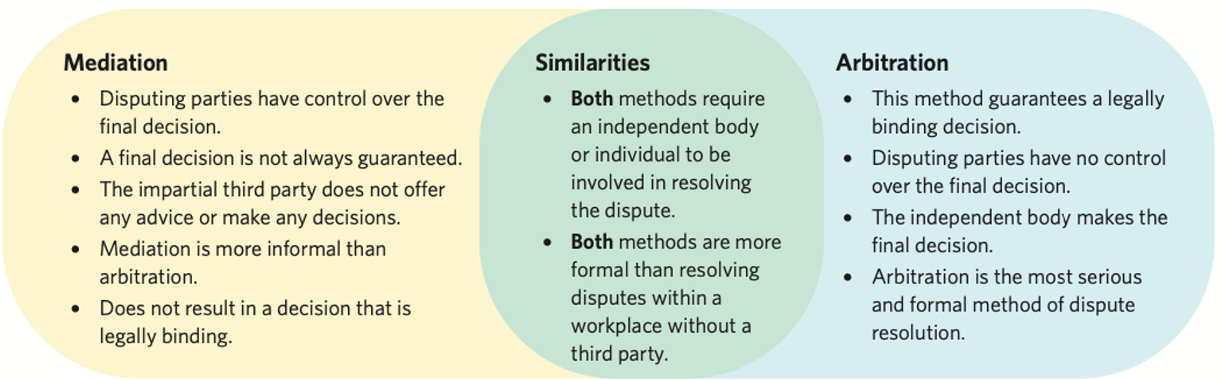
mediation
Involves an impartial third party facilitating/running discussions between disputing parties to help each side of the conflict reach a resolution themselves
Third party does not have to be from the Fair Work Commission but can be.
Role of the third party is to facilitate/run discussion and not offer opinions/advice
The result is not legally binding meaning disputing parties can go back on the resolution.
An agreement may not always be reached
evaluation of mediation
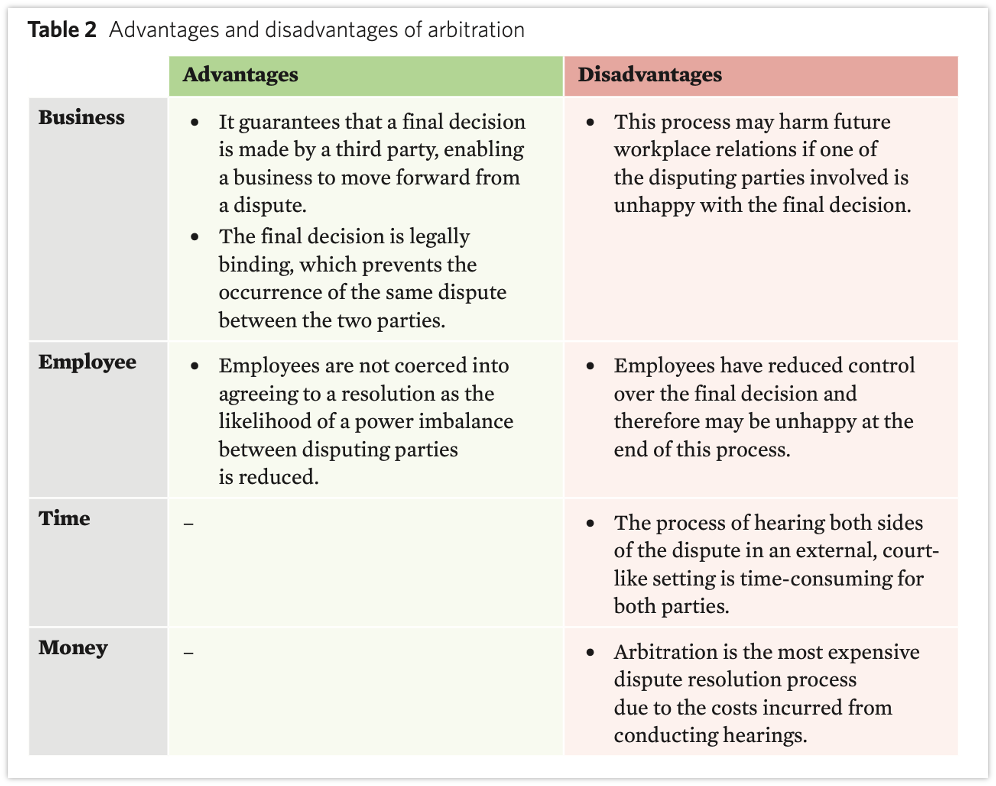
arbitration
Involves an independent third party hearing arguments from both disputing parties and making a legally binding decision to resolve the conflict
Legally binding – a judgement that requires/prohibits certain actions of parties and is enforceable by law.
Third party is a tribunal member/judge and is often from the Fair Work Commission (FWC)
They listen to both parties before making the legally binding to resolve the conflict
evaluation of arbitration
industrial action
involves employees or employers taking relevant steps to settle workplace disputes
Employee examples include
-Employees purposefully being absent from work
-Refusing to complete tasks
-Strikes
Employer examples include
-Can lock employees out of the workplace
doing this is legal only when a business and its employees are bargaining for a new employment agreement. Under all other circumstances it is illegal and punishable by law.
comparison of mediation and arbitration
Conflict
a conflict or dispute can occur in any business and may be between an employee and employer, two employees, or an employee and the business in general
Causes:
-disputes relating to the conditions of an award or EBA for the business
-disputes relating to the conditions of an award or EBA external to the business
Strikes
when employees withdraw their labour for a period of time in pursuit of improvements in their employment conditions
Lockouts
when employers close the workplace for a period of time as a means of applying pressure to employees during industrial conflict
protected industrial action
action taken by either party to a dispute that has been approved by the fair work commission
unprotected industrial action
industrial action that takes place prior to the expiry date of the previous agreement held between an employer and its employers and is thus unlawful and unprotected.