REL 1310 Exam 4 Review
0.0(0)
 Studied by 0 people
 Call Kai
 Learn
Learn Practice Test
 Spaced Repetition
 Match
Match Flashcards
 Knowt Play
Card Sorting
1/110

Earn XP
Description and Tags
Last updated 9:15 PM on 12/7/22
Name | Mastery | Learn | Test | Matching | Spaced | Call with Kai |
|---|
No analytics yet
Send a link to your students to track their progress
111 Terms
1
New cards
Primary Sources of Paul
Undisputed letters (7)
2
New cards
What are the undisputed letters of Paul (7)
1 Thessalonians, 1 & 2 Corinthians, Galatians, Romans, Philippians, Philemon
3
New cards
secondary sources of paul
disputed letters (2 thess, colossians, eph, pastoral letter - 1 & 2 Timothy and Titus) & acts of the apostles
4
New cards
Pauls' life before becoming a Christ-follower
upbringing in diaspora Judaism, Tarsus
Pharisee, zealous for the torah and its traditions
Persecutor of Christian communities
Pharisee, zealous for the torah and its traditions
Persecutor of Christian communities
5
New cards
Damascus Road experience
Paul describes experience in terms of a prophetic calling; Acts narrates as a conversion
6
New cards
Nota Bene
the 3 missionary journeys are only convenient classification drawn from Acts not Paul's letters
7
New cards
Paul's Mission Strategy
urban, Marketplace - leatherworkers, Network of ministers - "worker of the gospel"
8
New cards
ancient letter form
Salutation, Senders, Recipients, Greetings, Thanksgiving/Prayer, Body of Letter, Closing (Greetings, Parting Prayer/Grace)
9
New cards
How did Paul write his letters
Christianized the formal features
10
New cards
Occasional nature of Paul's letters
Paul's letters address specific churches at specific times about specific issues
11
New cards
Jewish thought about the end-time
Prophetic Eschatology & Apocalyptic Eschatology
12
New cards
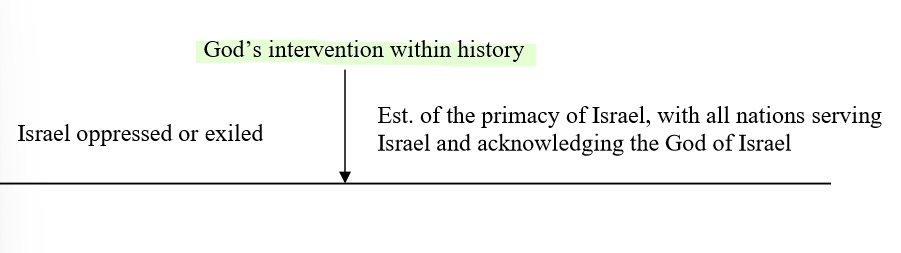
Prophetic Eschatology Characteristics
Historical continuity, national in scope, changes within history but continues
13
New cards
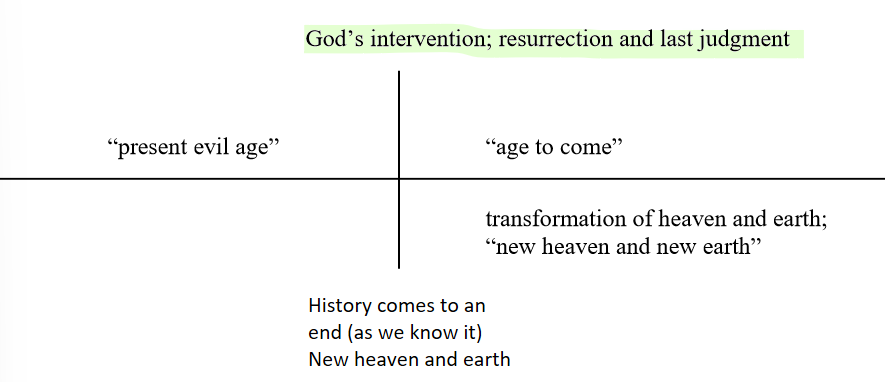
Apocalyptic Eschatology Characteristics
Historical discontinuity, cosmic in scope, history comes to an end (as we know it), new heaven and earth
14
New cards
Eschatology
Thinking or ideas about the end times
15
New cards
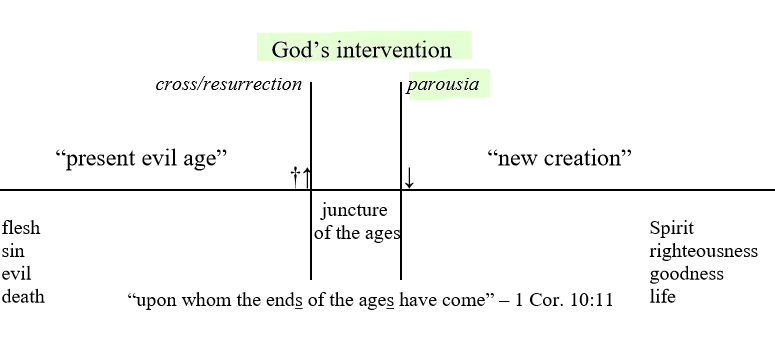
Paul's Christian Adaptation of Apocalyptic Escatology
God's intervention, cross/resurrection, Parousia, present evil age, juncture of the ages, new creation
16
New cards
Parousia
the arrival, the advent, the coming
17
New cards
1st Corinthians is not the only letter, missing some, one-sided, Corinthian correspondence
true
18
New cards
Occasion of 1 Corinthians
oral reports by Chloe's people & report by the Corinthians
19
New cards
Paul's response to the Corinthian letter
rhetorical marker peri de; signals a question or topic raised by the Corinthians in their letter
20
New cards
Peri de
now concerning
21
New cards
Rhetorical use of Corinthian Assertations
Paul quotes the Corinthians to set up in order to correct
22
New cards
Reconciling 1 Corinthians 11 & 14
Textual Issue, Corinthian Slogan, Unmarried women vs. married women
23
New cards
Textual issue
Paul wrote 11 but not 14 (scribal note)
24
New cards
Corinthian slogan
Paul's position in 11; Corinthians' position in 14
25
New cards
Unmarried women vs. married women
11 assumes unmarried; 14 assumes married
26
New cards
Occasion of Galatians
influenced by "another gospel," which is being preached by some Jewish-Christian missionaries ("Judaizers"), probably from Judea. This other gospel emphasizes the complementary function (along with Christ) of the law in the act of justification, particularly the act of circumcision, dietary laws, and observance of special feasts.
27
New cards
Justified/justification
Reckoned as righteous/righteousness; covenant language, covenant is relational; to be in a right relationship with god, part of the people of God
28
New cards
Faith/believe
trust and obey [action required]
29
New cards
Faith and believe part of speech in Greek
noun and verb same word
30
New cards
Biblical faith/believe is ___ a mental affirmation
not
31
New cards
"faith in Jesus Christ"
Jesus is the object of our/human faith
32
New cards
"Jesus Christ's faith(fulness)"
Jesus is the subject of the act of faith (in God)
33
New cards
A case for "Jesus Christ's faith(fulness)"
Consistent with Paul's Christocentric view of salvation as opposed to anthropocentric view of salvation
34
New cards
Christocentric view of salvation
what Christ did on the Cross
35
New cards
Anthropocentric view of salvation
centered on human decision
36
New cards
Is there a human response (faith?)
Yes, but human faith is established first by Christ's faithfulness
37
New cards
Salvation (justification) is anchored in ...
what Christ did on the cross; not our decision
38
New cards
Paul's Gospel
apocalyptic inclusio
39
New cards
Apocalyptic inclusio
"present evil age" and "new creation"
40
New cards
Scope of Paul's Gospel
big, cosmic
41
New cards
Apocalyptic terms of Paul's gospel
The root problem lies not in our individual transgressions, but in the power called the present evil age, which enslaves us to Sin. This predicament is rectified by God, who in Christ conducts an act of liberation, delivering us from the enslaving power of the present evil age.
42
New cards
Why is Ephesians & 1 Timothy Disputed?
Writing style and language/vocab, theology, historical perspective
43
New cards
Why the practice of pseudonymity?
A disciple intent on faithfully applying Paul's teaching to a new situation; acknowledges apostolic origin
44
New cards
Occasion of Ephesians
The letter does not reflect any particular problem or situation in a specific congregation
45
New cards
Textual problem of Ephesians
"in Ephesus" not found in earliest manuscripts
46
New cards
Is Ephesians Occasional?
No, circular letter intended for many churches
47
New cards
Theme of Ephesians
Cosmic significance of the church in God's plan
48
New cards
The church in God's plan is ...
the fulfillment of God's design to gather all things together in Christ, a "new humanity" created by God in Christ, called to be the medium of God's revelation, must lead a life worthy of that calling
49
New cards
Literary context of Eph 5:22-6:9
5:21 adopted for wives; 5:2 adopted for husbands
50
New cards
Cultural context of Eph 5:22-6:9
Instructions and rules for household relationships are a common Greco-Roman topic in political and moral writings. Ephesians simply adopts the structure of household management from its culture, but at the same time, Ephesians also seems to subvert conventional social patterns/relations by infusing these instructions with Christian theological images and principles.
51
New cards
How is Eph. 5:22-6:9 countercultural?
Addresses the subordinate persons in the social order (wives, children, slaves) as moral agents who must choose to "be subject." & Ephesians is notable for its reciprocity from the husband/father/mater. The language of power and authority are absent; it charges husband/father/master to act with love, patience, and kindness
52
New cards
How must Eph. 5:22-6:9 be read?
various contexts; The social hierarchy of the household codes is the social structure of the Greco-Roman world and is a given for the author (in the world). But this given social structure is infused and even subverted with Christian theology, values, and principles (but not of the world)
53
New cards
Occasion of 1 Timothy
Threat of false teaching
54
New cards
theme of 1 Timothy
management and conduct of the church as the household of God
55
New cards
Purpose of 1 Timothy
to guard against and combat false teaching by inserting the authority structure of the Greco-Roman household onto the church. The church becomes the Greco-Roman household "super-sized," and the authority of the household head becomes the model for the exercise of authority in the church
56
New cards
Household of God (highest to lowest authority)
bishop, elders, widow/women elders?, deacons, congregation
57
New cards
What is the occasion of the pastorals (1 timothy 2:8-15)?
threat of false teaching
58
New cards
what is the nature/characteristics of the false teaching in the pastorals?
Promotes "myths and genealogies" and "knowledge" & Advocates ascetic practices, such as forbidding marriage and demanding abstinence from foods
59
New cards
Who are the false teachers deceived by? Who are they deceiving?
Satan/demons; others
60
New cards
Who is false teaching in 1 Timothy?
young women
61
New cards
Conclusion of 1 Timothy
How is this passage appropriated/applied for today?
62
New cards
Genre of Hebrews
"words of exhortation" - homily/sermon
63
New cards
Authorship of Hebrews
Anonymous
64
New cards
Recipients of Hebrews
Christian Group possibly in Rome
65
New cards
Purpose of Hebrews
"exhort" its readers to endure/persevere and remain faithful
66
New cards
Situation of the readers of Hebrew?
Weary in their Christian commitment and in danger of abandoning the Christian faith & Experiencing hardships and sufferings because of their Christian identity
67
New cards
Argument in Hebrews
Series of exposition and exhortation
68
New cards
What do the expositions in Hebrews demonstrate?
The superiority of Jesus and His salvation
69
New cards
How are the expositions in Hebrews set up?
Comparison (synkrisis) with Israel's traditions (compared to something that is really good)
70
New cards
What is each exposition followed by in Hebrews?
an exhortation
71
New cards
Logic of Hebrews argument
because Jesus offers a superior salvation, one should endure and remain faithful
72
New cards
faithfulness
advantageous
73
New cards
defection
disadvantageous
74
New cards
exhortation in Hebrews is ...
climatic to endurance and faithfulness
75
New cards
Author of James
"James, a slave of God and of the Lord Jesus Christ," Jesus's brother/pseudonymity
76
New cards
Pseudonymity in James
Material originates from James, but has been highly edited by someone later
77
New cards
Recipients of James
"to the 12 tribes in Dispersion"
Perhaps Jewish Christians, but could simply be addressing a general Christian audience from an early Judean Christian perspective
Perhaps Jewish Christians, but could simply be addressing a general Christian audience from an early Judean Christian perspective
78
New cards
"12 Tribes"
symbolic title for Christians expressing the conviction that they are "true Israel"
79
New cards
"the dispersion"
traditionally used for those Jews living outside Israel/Palestine (Jewish homeland)
80
New cards
Genre of James
Parenesis with epistolary intro; NT counterpart of the OT wisdom literature
81
New cards
Parenesis
a form of moral exhortation that emphasizes traditional instructions in the mode of imperatives
82
New cards
Purpose of James
To remind its readers of their fundamental values and morals as they face internal challenges, like conflict and favoritism
83
New cards
James & Paul contradictory?
fruit of the spirit same; Paul = justified by faith; James justified by works of the law not just faith alone??
84
New cards
Occasion of 1st Peter
suffering of Christians living in Asia Minor
85
New cards
What type of letter is 1st peter?
Circular
86
New cards
What is the nature of 1st Peter Suffering
Local and sporadic
87
New cards
What type of local & sporadic persecution did Christians experience in 1 Peter?
Social harassment, verbal abuse, mob action, imprisonment, exile, execution (occasionally)
88
New cards
What is the Strategy of 1 peter to deal with the suffering?
Preserve group cohesion (unity) by emphasizing group identity & promote social adaptability
89
New cards
How to preserve group cohesion (unity) by emphasizing group identity
Readers addressed as exiles and resident aliens (estrangement in this world) & conversion emphasized (new identity to understand experience of harrassment/persecution)
90
New cards
How to promote social adaptability?
"conduct yourselves honorably" assimilate to context; harassment expected but not prompted by believers
91
New cards
Social adaptability - "honoring the emperor"
honoring for benefaction not as a god
92
New cards
Social adaptability - observe household codes with emphasis on socially inferior members
slaves and women followed Greco-Roman norms in terms of household roles to counter accusations and suspicions of domestic and political rabble-rousing
93
New cards
Three interpretive approaches to Revelation
predictive, historical, mytho-poetic
94
New cards
Author of Revelation
John the Christian prophet
95
New cards
Recipients of Revelation
7 churches in the province of Asia
96
New cards
Genre of Revelation
apocalypse
97
New cards
Greek word for apocalypse
apokalupsis
98
New cards
Apocalypse definition
a type of literature in which a revelation is given by God, to a human seer/visionary, through an otherworldly mediator, disclosure of future events and/or transcendent reality functions to interpret earthly circumstance and to alter the understanding and behavior of the audience
99
New cards
Compositional Techniques of Revelation
Symbolism, Numerology, formalized surface structure, recapitulation
100
New cards
Symbolism in Revelation
the language of apocalypses is the expressive language of poetry, which uses symbols and imagery to articulate a sense or feeling about the world; some symbols explained, self-explanatory, common-image, and in other literature
 Note
Note  Flashcards (73)