5. The Visual Cortex/Beyond Scenes and Objects
 Studied by 0 people
 Call with Kai
 Learn
Learn Practice Test
 Spaced Repetition
 Match
Match Flashcards
 Knowt Play
1/38

Earn XP
Description and Tags
January 20, 2026
Name | Mastery | Learn | Test | Matching | Spaced | Call with Kai |
|---|
No study sessions yet.
39 Terms
The organization of ____ represents an ‘electronic map’ of the retina which is ____.
V1; Retinotopic
Retinotopic
Two points that are close together on an object are also represented in parts of the cortex that are close together.
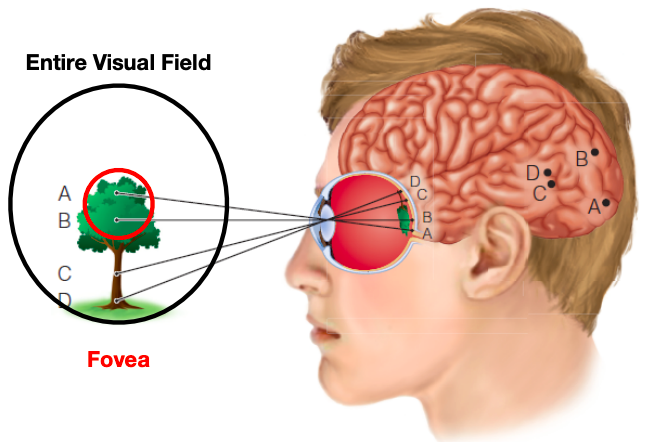
Cortical Magnification
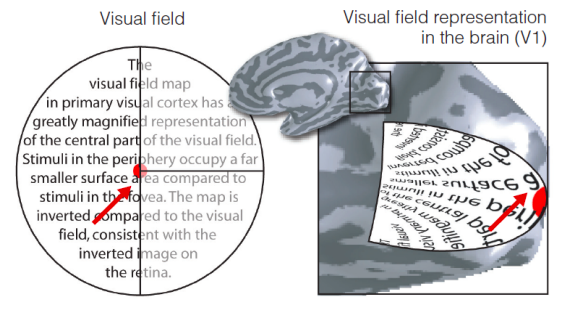
A small area of the fovea is represented by a large area on the visual cortex.
Contributes to high acuity vision
Cortical Magnification
Describes the disproportionate amount of visual cortex dedicated to processing stimuli from the center of your vision (fovea) compared to the periphery.
Single-cell Recordings
A technique using microelectrodes to measure the electrical activity (voltage or current changes) of an individual neuron or small group of neurons.
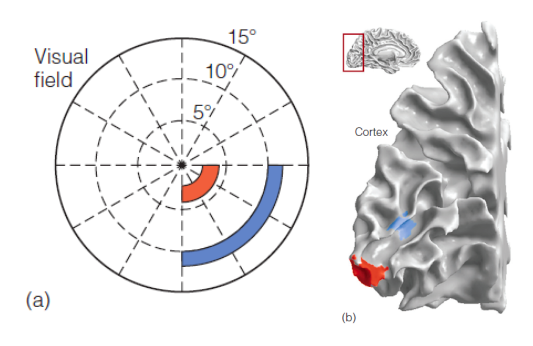
The red region (fovea) takes up ____ of the visual field than the blue region (in the _____), yet activates a _____ chunk of the visual cortex.
The red region (fovea) takes up less of the visual field than the blue region (in the periphery), yet activates a larger chunk of the visual cortex.
Visual Field vs Representation in V1
IT Neurons
Neurons in the inferotemporal (IT) cortex respond to more complex stimuli than neurons in V1.
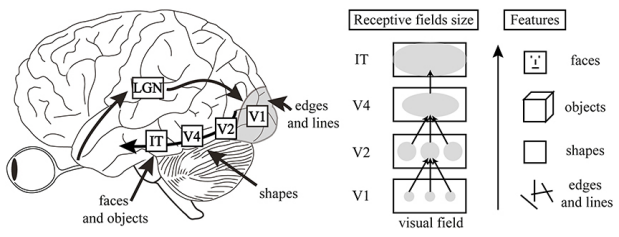
The _______ has _______ which tend to respond best to faces.
The Fusiform Face Area (FFA) has neurons which tend to respond best to faces.
Sensory Coding
Refers to the way perceived objects are represented through neural firing.
How might sensory coding of more complex objects be accomplished? Three (general) theories are…
Specificity Coding
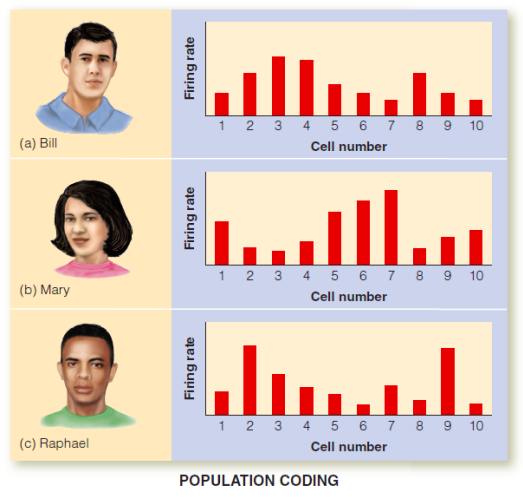
Population Coding
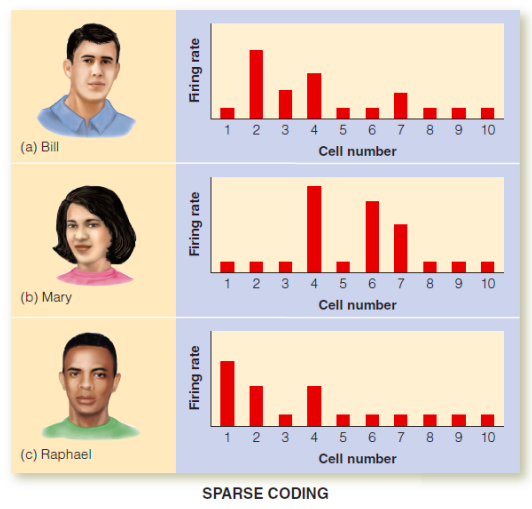
Sparse Coding
Specificity Coding
Specific (individual) neurons respond to specific stimuli.
Leads to the grandmother cell hypothesis.
Grandmother Cell Hypothesis
A hypothetical neuron that uniquely fires for one specific, complex concept, like seeing your grandmother, acting as a highly specialized "recognizer" for that single item.
Quiroga et al. (2005, 2008)
Measure the response of individual neurons in humans undergoing surgery for epilepsy, finding neurons that seemed to respond to the presentation of specific faces.
Reported results for a patient undergoing surgery for epilepsy had the activity of individual neurons in their temporal lobe recorded.
Neurons were found that responded to images of one specific actor but not others, which could potentially represent an example of specificity coding.
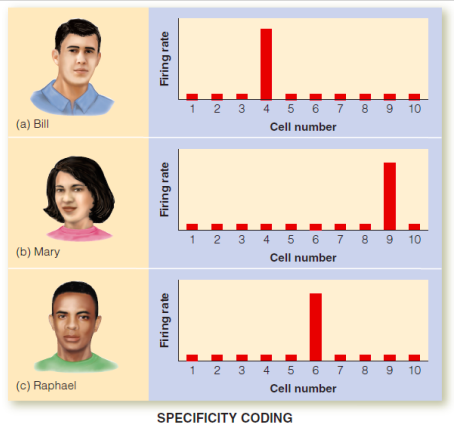
Problems with specificity coding…
Too many different stimuli to assign specific neurons
Most neurons respond to a number of different stimuli
If you only observe a single neuron firing in response to a single stimulus, how do you know if other neurons (which aren’t currently being measured) are also firing?
Population Coding
Pattern of firing across many neurons codes specific objects.
Large number of stimuli can be coded by a few neurons
In theory, could code for a very large number of representations
Sparse Coding
Only a relatively small number of neurons are necessary to code for each concept/identify, etc.
This theory can be viewed as a midpoint between specificity and population coding
Some evidence across modalities for sparse coding, at least for some things
_____ _____ _____ structures are extremely important for memory.
Signals coming from IT cortex project to _____.
Medial temporal lobe (MTL) structures are extremely important for memory.
Signals coming from IT cortex project to MTL.
Modularity
Proposes the mind isn't a single general processor but a collection of specialized, independent modules for different tasks, each with distinct functions, operating characteristics, and sometimes location.
Modularity and the FFA
The way we process faces is somehow ‘special’ and may involve some dedicated neural mechanisms, or modules, that are specialized for processing particular kinds of stimuli.
Evidence: The fact that temporal lobe damage in humans can result in prosopagnosia (an inability to perceive faces).
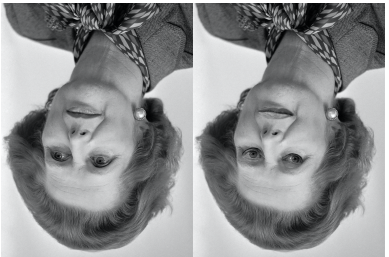
Inversion Effects
Inversion effects are strong for faces, and are said to occur for stimuli that people have difficulty noticing unusual details (anomalies) in when turned upside down.
Experience-Dependent Plasticity
The brain's lifelong ability to reorganize its neural connections (synapses) in response to unique life experiences, learning, and environmental stimulation.
Expertise Hypothesis
Proposes that brain regions (e.g. FFA), thought to be face-specific, actually process any object category for which a person gains extensive, fine-grained visual expertise.
____ ____ ____ responds best to spatial layout.
Parahippocampal place area responds best to spatial layout.
____ ____ ____ responds best to pictures of full bodies and body parts.
Extrastriate body area (EBA) responds best to pictures of full bodies and body parts
Distributed Representation
A cognitive and neural concept where a concept isn't stored in one specific spot but as a pattern of activation across many neurons or processing units, with each unit contributing to multiple concepts, mimicking how the brain efficiently encodes complex info.
True or False: Distributed Representation and Localization of Function can be compatible/complimentary.
True.
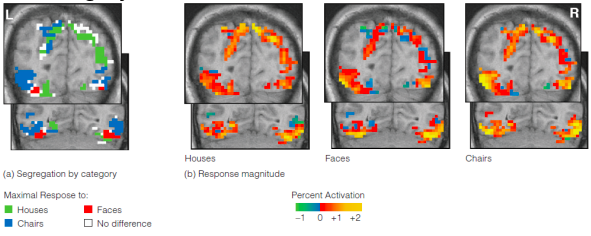
Ishai et al. (2000)
Used fMRI to image neural activation in humans resultant of presenting stimuli from three categories: houses, faces, and chair.
Image ‘a’ demonstrates differences in the location of maximal activation associated with each stimulus category.
This is consistent with the idea of localization of function.
Image ‘b’ demonstrates that each of these stimuli category activate widespread areas of cortex.
This supports the idea of distributed representation.
Huth et al. (2012)
Showed participants various stimuli coded as belonging to various categories, then examined neural activation as a function of those categories.
Noticed multiple points across the cortex are coded as belonging to the same category of stimuli (e.g. humans).
Suggests that some kinds of stimuli are processed in more than one location
This may also depend in part on what you’re doing with a given stimulus
Multidimensional Stimuli
Sensory inputs or data defined by multiple, interacting features (dimensions) rather than a single one, requiring complex perception and processing.
E.g. Facial Stimuli
Emotional aspects
Where someone is looking
How parts of the face move
How attractive a face is
Whether the face is familiar
Function of the Occipital Cortex
Occipital Cortex (OC): Initial processing.
Function of the FFA
Fusiform Face Area (FFA): Basic face processing.
Function of the Amygdala
Amygdala (A):
Emotional reactions: face expressions and observer’s emotional reactions).
Familiarity: familiar faces cause more activation in the amygdala and other areas associated with emotions.
Function of the Frontal Lobe
Frontal Lobe (FL): Evaluation of attractiveness.
Function of the Superior Temporal Sulcus
Superior Temporal Sulcus (STS):
Gaze direction
Mouth movements
General face movements
Inverse Projection Problem
Refers to the task of determining the object responsible for a particular image on the retina.
This is not straightforward, as any given two-dimensional image formed on the retina could be formed by many different three-dimensional objects in the environment.
Occlusions
A process whereby something is hidden or obscured from prominence or view. Objects can appear blurred, fuzzy, or distorted in various ways.
Viewpoint Invariance
The ability to recognize an object despite changes in the observer's viewing angle

Perceptual Organization
Refers to the process by which elements in our environment get grouped together to create our perception of the environment. This involves both:
Grouping (‘putting together’ objects)
Segregating (separating objects)
 Note
Note  Flashcards (341)