4.2 - Export subsidies in high tech industries
 Studied by 0 people
 Call Kai
 Learn
Learn Practice Test
 Spaced Repetition
 Match
Match Flashcards
 Knowt Play
1/9

There's no tags or description
Looks like no tags are added yet.
Name | Mastery | Learn | Test | Matching | Spaced | Call with Kai |
|---|
No analytics yet
Send a link to your students to track their progress
10 Terms
Are high tech industries concentrated
Often highly concentrated
mono/oli gopoly → high markups
High entry costs protects firms from new entrants
large amount of K needed to become competitive - scope for sub
Subsidy doesn’t make sense in perfect comp - other incentives used
High tech industries & Govt subsidies
Receieve substantial subsidies
HTI are K intensive
Need large amount of capital up front to invest
Govt needs to subsidies or many firms wont
Sub reduces costs → firms more competitive → displace foreign comp
US / Europe HTI example and how sub given
Aircraft industry
US sub - low interest loans from Govt agency
EU sub - given direct to firm
UK sub - Freeports (give tax relief - sub as HTI use these areas intensively)
Why do Govt want HTI
Possible spillover benefits + other positive externalities
knowledge diffusion → productivity gains
Subsidy = production increase = externalities increase + competitiveness UP → profits UP
If profits > sub then net gain
Strategic use of sub
Govt plays game to attract HTI and encourage them to relocate to H
BUT if everyone subsidises then no net gain for anyone
all lose cost of sub - INEFFICIENT
Boeing vs Airbus example - Assumptions
Imperfect comp
2 firms (duopoly) - Both firms profitable
Each firm has 2 options - produce or nor produce
compete for sales (ignore dom sales - no CS)
Welfare only dependent on profits from sales to RoW + cost of sub
Boeing vs Airbus example - FT
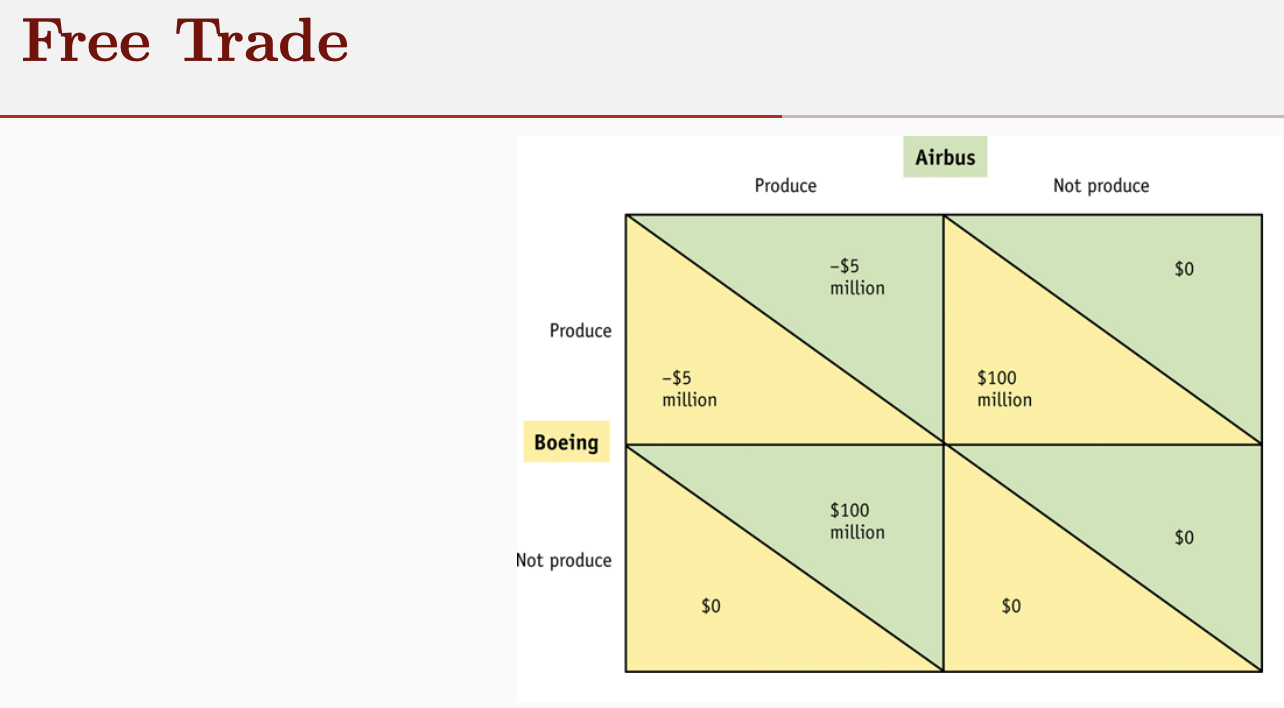
Symmetrical payoffs
Best response when 1 firm produces is to not produce
1st mover advantage key
NE is when 1 firm produces and the other doesnt
Boeing vs Airbus example - Subsidy to Airbus
Govt might want to change equilibrium so firm makes positive profits even if other 1st producer (subsidies)
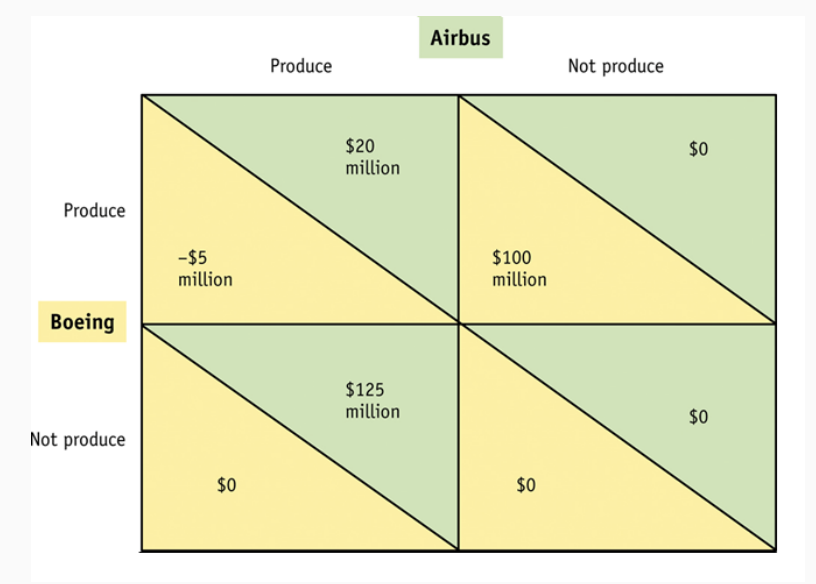
EU provides $25m sub if Airbus produces
hoping spillovers > $25m (profit 125-25 sub = 100m)
New Best Response for Airbus is to produce even if B produces
BR for B is to not produce
New NE is A produces but B not producing - shifted equilibrium
Boeing vs Airbus example - Subsidy to B
US may respond with own sub to incentivise production
identical $25m sub
New NE when both produce
A&B get $20m profit BUT sub cost = $25m
Net welfare = -$5m for both EU & US (INEFFICIENT)
transfers losses from firms → Govt (nationalises losses)
Are subsidy wars inefficient
Yes
This supports WTO strategy of fighting X subsidies
allows tariffs on F firms who sub to discourage subsidies
Nations may keep increasing sub to incentivise firm to stay
fight for highest sub = welfare keeps falling + inefficiency growing
hard to compute losses in reality though
 Note
Note  Flashcards (85)