homeostasis
 Studied by 0 people
 Call Kai
 Learn
Learn Practice Test
 Spaced Repetition
 Match
Match Flashcards
 Knowt Play
1/32

There's no tags or description
Looks like no tags are added yet.
Name | Mastery | Learn | Test | Matching | Spaced | Call with Kai |
|---|
No analytics yet
Send a link to your students to track their progress
33 Terms
physiological variable
a measure of a bodily condition or function
examples of physiological variables
blood glucose concentration, blood pressure, temperature
homeostasis
the dynamic maintenance of physiological variables within a predictable range
set point
the normal ‘basal’ or ‘at rest’ value for a physiological variable
physiological variables are
inter-dependent
osmolality
amount of solute present in the blood -> sodium content mainly determines the plasma osmolality
negative feedback
A change is sensed, and a response is initiated to reverse that change
The effect is therefore to maintain physiological variables within a predicted range
feed-forward
Anticipation of a change brings about the response to that change before the change can be detected by negative feedback sensor
positive feedback
A change in a variable triggers a response that causes further change in that variable
The effect is therefore amplification of the change rather than normalisation
example of positive feedback in homeostasis is the
process of childbirth
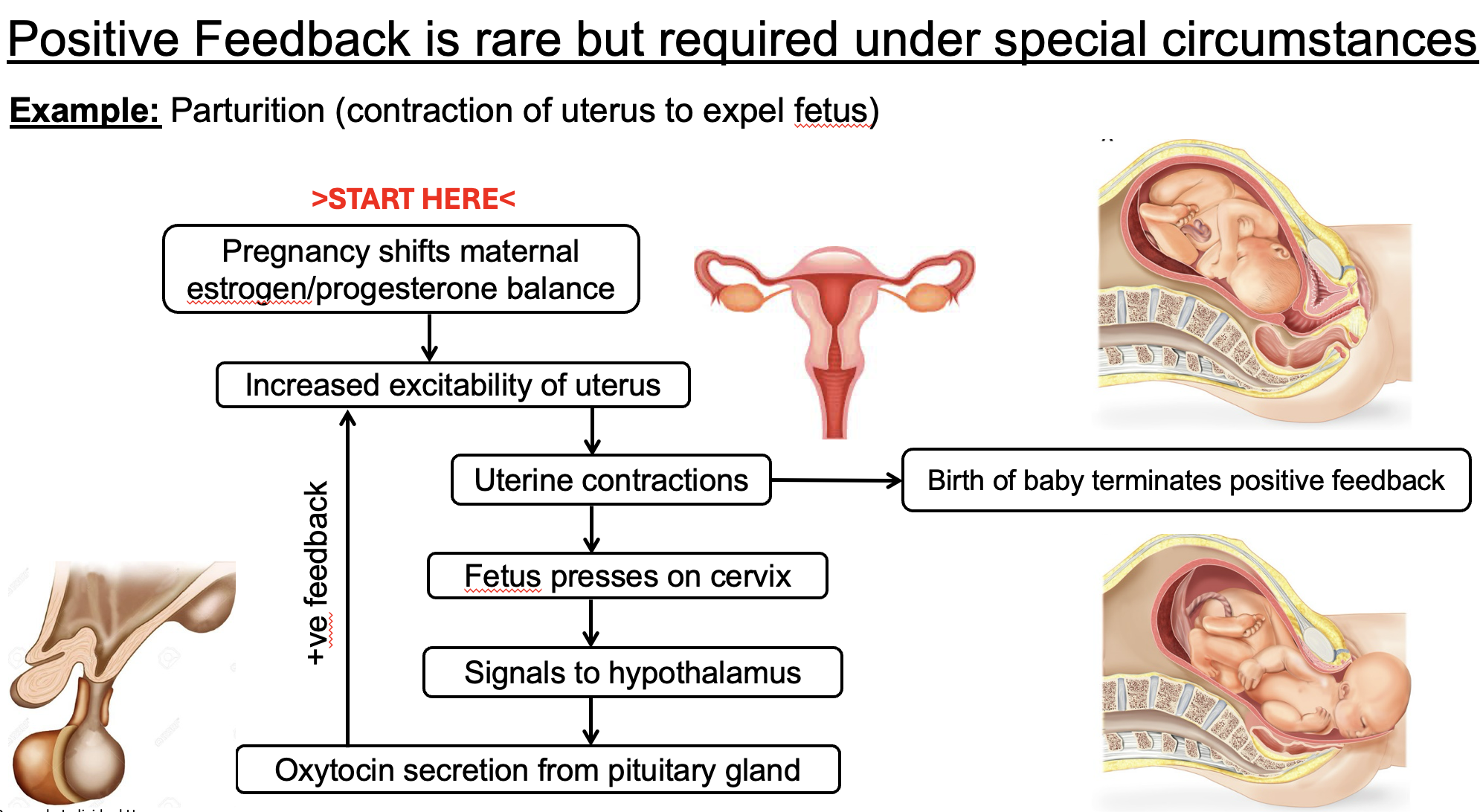
how is process of childbirth an example of positive feedback
the pressure of the baby's head on the cervix triggers the release of oxytocin
which causes stronger uterine contractions.
This greater pressure on the cervix leads to the release of even more oxytocin, amplifying the contractions until the baby is born and the stimulus is removed.
Stimulus: The baby's head presses against the cervix, stretching it.
Detection: Nerve signals are sent from the cervix to the brain.
Response: The brain signals the pituitary gland to release oxytocin.
Action: Oxytocin causes the uterus to contract more forcefully.
Amplification: The increased contractions stretch the cervix further, which triggers the release of more oxytocin.
Completion: This positive feedback loop continues to intensify contractions until the baby is delivered, which removes the initial stimulus
example of feed-forward
fight or flight
features of negative feedback
a physiological variable drifts away from its set point
sensors detect the change in the variable
signals are carried from sensors to integrating centre via afferent pathway
integrating centre compares inputs from sensors against physiological set point and initiates response
signals carried from integrating centre to effectors via efferent pathway
effectors produce response that brings variable back to set point
3 types of signalling pathway
neuronal
hormonal
paracrine
many neuronal integrating centres are in the
midbrain or brain stem
neuronal essential for
temperature control
osmolality control
blood pressure control
blood gas/breathing control
paracine homeostatic control features
sensors, integrating centres and effectors are all located in the same tissue
efferent pathway involves secretion of diffusible substances from one group of cells to act on another group of cells nearby
can operate in parallel or independently of neuronal and endocrine control
diffusible substances may act on cell surface receptors or intracellular targets of effectors
communication with effectors is usually via the
sympathetic and parasympathetic nervous systems
sympathetic and parasympathetic nervous systems have
opposing actions on bodily functions
resulting in fine-tuning of physiological variables
e.g. of fine tuning of physiological variables
cardiac output & blood pressure lung ventilation
Sympathetic = accelerator (increase HR, BP, breathing)
Parasympathetic = brake (slow HR, lower BP, calm breathing)
fine tuning meaning
gradual changes (not rapid) to produce the final response
how does temperature control involve negative feedback
stimulus = drop in ambient temperature causes drop in body temperature
hypothalamus (sensor) detects change
neurons communicate with hypothalamus via afferent pathway
integrating centre - hypothalamus compares against set point for temperature
integrating centre sends nerve signals so from hypothalamus to effectors
the effectors are skin blood vessels and muscle
so skin shivers for heat production and reduced blood flow to reduce heat loss and blood vessels constrict to increase temperature
human endocrine organs
pancreas
thyroid gland
adrenal gland
ovaries
testes
hypothalamus
pituitary gland
classes of hormones
peptides
polypeptides
glycopeptides
example of peptide hormones
ADH
Oxytocin
example of polypeptide hormones
insulin
growth hormone
examples of glycopeptide hormone
luteinizing hormone
follicle stimulating hormone
thyroid stimulating hormone
paracrine control
Sensors, integrating centres and effectors are all located in the same tissue
Efferent pathway usually involves secretion of diffusible substances from one group of cells to act on another group of cells nearby
May be part of negative feedback or feed-forward pathways
May operate in parallel or independently of neuronal and endocrine control
Diffusible substances may act on cell surface receptors or intracellular targets of effector cells
tyrosine derivatives
thyroxine
adrenaline
derivatives of cholesterol
estradiol
cortisol
aldosterone
testosterone
what is the sensor of increased blood glucose concentration
pancreatic beta cells
what hormone is secreted when blood glucose concentration increases
insulin
examples of paracrine homeostatic control
NO in blood vessels released to diffuse to smooth muscle cells to cause them to relax and dilate
Histamine release in Inflammation act on blood vessels to increase permeability
Neurotransmitter release at synapses to transmit signals
Growth factors in tissue repair released at site of injury for cell division/ matrix regeneration
 Note
Note  Flashcards (23)