Constitutional Law
 Studied by 6 people
 Call Kai
 Learn
Learn Practice Test
 Spaced Repetition
 Match
Match Flashcards
 Knowt Play
1/120

There's no tags or description
Looks like no tags are added yet.
Name | Mastery | Learn | Test | Matching | Spaced | Call with Kai |
|---|
No analytics yet
Send a link to your students to track their progress
121 Terms
Background to the Articles of Confederation
Background
After the Dec. of Independence, Congress set to draw up a document to serve as a legal framework
Articles written by a committee of the Second Continental Congress of the original 13 states
Headed by John Dickinson, who actually had refused to sign the DOI
Dickinson initially proposed a strong central government, but fear of past experiences with Britain undermined that
Ended up giving limited power to Federal Govt
Also disputes re handling of control over western territories. Border states wanted more control, other states wanted share of the profits
Control of all western lands eventually given to Federal Govt
Final ratification of the AOC in March 1781
Provisions of the Articles of Confederation
Loose confederation of independent states giving limited power to central government
Each state only had one vote in a single house of Congress
Congress could set up postal dept, raise armed forces, control western territories, and coin, borrow/appropriate money, declare war, and enter treaties/alliances with other countries with a 9/13 vote
No independent branches
Nationally binding state judiciaries
Weaknesses of the Articles of Confederation
Not enough power to federal government, resulted in national and international problems
Most notably, could not regulate trade or levy taxes
States would refuse to give government money, entered tariff wars with one another
Could not pay off its debts from the revolution, could not fund attacks from the British and Spanish encroachment
Article 1, section 8 of Constitution
Article I, section 8, enumerates the powers of Congress
Clause 1
The Congress shall have Power To lay and collect Taxes, Duties, Imposts and Excises, to pay the Debts and provide for the common Defence and general Welfare of the United States; but all Duties, Imposts and Excises shall be uniform throughout the United States;
Clause 3
To regulate Commerce with foreign Nations, and among the several States, and with the Indian Tribes;
Clause 18 added the power to “make all the laws that shall be necessary and proper for carrying into execution the foregoing powers, and all others powers vested, by this Constitution” Aka Necessary and Proper Clause
Article III
Creates the judiciary
Article III Judges are USSC judges, those of the federal courts of appeals and district courts, and US Court of International Trade. Appointed by President and confirmed by Senate. Life tenure
Section 2
The judicial power shall extend to all cases, in law and equity, arising under this Constitution, the laws of the United States, and treaties made, or which shall be made, under their authority;--to all cases affecting ambassadors, other public ministers and consuls;--to all cases of admiralty and maritime jurisdiction;--to controversies to which the United States shall be a party;--to controversies between two or more states;--between a state and citizens of another state;--between citizens of different states;--between citizens of the same state claiming lands under grants of different states, and between a state, or the citizens thereof, and foreign states, citizens or subjects.
Tenth Amendment
The powers not delegated to the United States by the Constitution, nor prohibited by it to the States, are reserved to the States respectively, or to the people.
Didn’t include the term “expressly” because there were "embarrassments" regarding its inclusion in the Articles of Confederation
Additional principles of the Constitution
Enumerated v. nonenumerated powers
Congressional disputes
If Congress doesn’t like USSC statutory interpretation, Congress can amend the law
Disagreement over Constitutional interpretation requires amendment
Marbury v. Madison
Refresher facts
Election of 1800, lame duck judicial expansion and appointees. Marbury appointed, but did not get commissioned
Rule
A law repugnant to the constitution is void
Judicial Review
Power of the Court to interpret whether laws are unconstitutional
Interpretation looks at intent through words, structure, history, policy/practical consequences
Additional facets
Arguments in favor of Judicial review
Otherwise, legislative omnipotence = too much legislative power
The judicial power of the United States is extended to all cases arising under the Constitution.
Clear violations
Oath of Supreme Court
Supremacy Clause
Marshall’s interpretation of section 13 of Judiciary Act and Article III aren’t necessarily the only interpretation. He creates a conflict
Most famous quote
“It is emphatically the province and duty of the judicial department to say what the law is.”
Holding
Congress cannot expand original jurisdiction of the Supreme Court
Article III, section 2 sets out Jx of the court
McCulloch v. Maryland
Refresher facts:
First Bank of the US engaged in private banking, but also acted as depository for US funds
Second Bank was quite unpopular, faced a lot of opposition
Overexpanded credits in the West and South, then cut them back. Caused state-incorporated banks to fail
A number of states sought to exclude the Bank, by either state constitutional prohibitions, or by imposing heavy discriminatory taxes.
The tax in McCulloch was relatively mild
Rule
Congress has the authority to pass legislation that is needed to execute its listed powers. Necessary does not mean “absolutely necessary”
Rational basis review
The Constitution is the highest law in the country, and any state law that conflicts with valid federal law is invalid
Other Takeaways
The Constitution is a great outline. If it contained everything, it’d be a tax code. Powers are implied
“we must never forget that it is a constitution we are expounding.”
The N&P Clause is an expansion of power, not a limitation
Power to destroy (tax the bank) is in opposition to Congress power to create (the bank)
Would have needed CONFIDENCE that states would not abuse ability to tax
Congress’ welfare power
Does not exist
Gibbons v. Ogden (1824)
Refresher Facts:
NY statute gave exclusive right to Ogden to navigate steamboats b/w NYC and NJ
Federal Act also permitted navigation to Gibbons
Rule
Congress can regulate the instrumentalities of interstate commerce
“Among the several States” means intermingled with, and so does not stop at the external boundary
Champion v. Ames [The Lottery Case] (1903)
Refresher Facts
The Federal Lottery Act prohibited interstate travel of lottery tickets. This was applied to shipping a box of tickets from TX to CA
Fear of harming the public morals
Rule
Congress is permitted to regulate commerce, including shipments, between two or more states.
Protective principle = Congress can regulate the use of the channels of interstate commerce to prevent items from entering interstate commerce depending on standards (moral concern, dangerous, etc)
Congress cannot have purely welfare policy though, but dual purpose is okay
Houston, East & West Texas Ry. v. United States [Shreveport Case] (1914)
Refresher Facts
The Interstate Commerce Commission fixed interstate railroad rates westward from LA to TX.
ICC ordered affected railroads to raise rates for intrastate shipments to same TX markets
These suspended that rates set by Texas Railroad Commission, which were lower for intrastate than interstate
Rule
Congress may prevent the common instrumentalities of interstate and intrastate commercial intercourse from being used in intrastate operations to the injury of interstate commerce
Hammer v. Dagenheart (1918)
Refresher Facts
Congress had tried to prohibit interstate transportation of products from factories that used child labor
Rule
Under the Lottery cases, Interstate commerce was necessary to the accomplishment of the harmful results Congress sought to regulate
[The] grant of power to Congress over the subject of interstate commerce [was] not to give it authority to control the states in their exercise of the police power over local trade and manufacture.
Overruled by US v. Darby (1941)
Carter v. Carter Coal Co. (1936)
Court invalidated New Deal coal regulation, finding wage and hour practices were local and only indirectly affected interstate commerce.
N.L.R.B. v. Jones & Laughlin Steel (1937)
Court upheld NLRB order protecting union workers at a Pennsylvania steel plant; marked shift toward recognizing national industries as interstate webs of activity and broadened Commerce Clause power. “Switch in time that saved nine”
Court switched to uphold a Washington state minimum wage law.
This broke from prior Court rulings that struck down similar economic regulations.
His vote helped end the Court’s resistance to New Deal reforms.
The phrase means his “switch” avoided FDR’s court-packing plan, which threatened to add more justices.
Wickard v. Filburn (1942)
Purely local growth and consumption of wheat can still affect the larger wheat industry, we can look at the aggregate effect
Overproduction leads to farmers not making enough money
Accordingly, within Commerce power to regulate
U.S. v. Darby (1941)
Refresher Facts
Appellee acquires raw materials in Georgia, which are turned into finished lumber that is then shipped in interstate commerce
Section 15(a)(1) prohibits shipment in interstate commerce goods produced by employees whose wages and hours of employment do not conform to the FLSA
Rule
It’s okay for Congress to have a general welfare motive so long as activity being regulated has substantial effect on interstate commerce. Rational basis review
Court unanimously overruled Hammer, upheld Fair Labor Standards Act, and adopted substantial effects test to validate federal wage and hour regulation via commerce power. Broadens scope of power of Congress. Activity that Congress is regulating must have a substantial effect on interstate commerce to be upheld
Heart of Atlanta Motel, Inc. v. United States (1964)
Refresher Facts
Heart of Atlanta sits near interstate highways, 75% of guests from other states. refused to rent to Black Americans
Senate Commerce Committee had made it clear that Title II aimed to operate under Equal Protection Clause of 14th Amendment to ensure equal access to public establishments
Rule
Power of Congress to promote interstate commerce also includes the power to regulate local activities in both the States of origin and destination, which might have a substantial and harmful effect upon that commerce
Other
The Civil Rights Act did not indicate congressional findings, but the legislative record shows evidence of the burdens of discrimination by race or color by businesses within interstate commerce
Impedes interstate travel
Katezenbach v. McClung (1964)
Found that Congress acted within its power under the Commerce Clause of the United States Constitution in forbidding racial discrimination in restaurants as this was a burden to interstate commerce.
Again, more testimony to support effect of discrimination on business and travel
Half of the food the restaurant uses has traveled in interstate commerce
United States v. Lopez (1995)
Refresher Facts
Gun-Free School Zone Act of 1990, federal offense to knowingly possess a firearm in a place that person knows is school zone or reasonably could believe it is a school-zone
March 1992, respondent was at 12th grade student caught with a handgun and five bullets at school
Rule
Three broad categories of activity that Congress can regulate
Use of the channels of interstate commerce (Darby)
Can regulate and protect the instrumentalities of interstate commerce, or persons or things in interstate commerce (Shreveport)
Can regulate those activities that Congress rationally could have found to have a substantial relation to/substantial effect on interstate commerce (Jones & Laughlin Steel)
Substantial Effects Test (weigh and balance)
Whether the terms of the law in question are commercial or not commercial
Whether there is jurisdictional element that, on a case by case basis, could show that the activity in question affects interstate commerce (dispositive)
For example, if the statute clearly stated that “no guns that have travelled through interstate commerce can be possessed on school grounds”
Whether there is legislative history/data that shows how the activity can affect interstate commerce
How attenuated the link is between the activity and interstate commerce
Misc
Narrows Congress’ Commerce Clause authority
Didn’t overrule anything. Harmonizes various rules
United States v. Morrison (2000)
Refresher Facts
Petitioner Brzonkala alleged that responded, a fellow college student, repeatedly raped her
Sued under section 13981 of USC, part of the Violence Against Women Act of 1994, which provides civil remedy for victims of gender-motivated violence
US intervened to defend Constitutionality of section 13981 of the Act
Petition seeks to sustain this section as a regulation of activity that affects interstate commerce
Rule
Even if there is an economic effect of sizeable magnitude, the issue is whether the regulated activity has a direct or indirect effect on interstate commerce
Substantial effect is a legal inquiry, not a factual one
Other
Court concerned with lack of economic purpose, only general welfare purpose present
Gonzales v. Raich (2005)
Refresher Facts
Controlled Substances Act, prohibited local cultivation and use of marijuana even when in compliance with state law authorizing its use for medical purposes
Congress argues that leaving home-consumed marijuana outside federal control would similarly affect price and market conditions
Rule
Congress may regulate even purely local, intrastate activity under the Commerce Clause if that activity is part of a broader class of economic activities that, in the aggregate, substantially affects interstate commerce.
Misc
Congress’s purpose was to eliminate drug use (which isn’t clearly
economic) but a means to achieve this was eliminating the market for it. Congress criminalized
home growing and consumption to achieve the purpose of eliminating the market for a product it
deemed so dangerous it outlawed it entirely in IC.The Gonzales law was part of a larger scheme
of regulations that made this eliminate-the-market-entirely purpose apparent.
New York v. United States
Facts
Low level radioactive waste disposal, forced states to take title to waste
Rule -- An act of Congress cannot commandeer the legislative process of the States by compelling them to enact and enforce a federal interest (NY v. United States), or by compelling them not to act (Murphy)10
Court reasoning - No matter how powerful the federal interest involved, the Constitution simply does not give congress the authority to require the States to regulate
Where a federal interest is sufficiently strong to cause Congress to legislate, it must do so directly; it may not conscript state governments as its agents
Printz
Federal gun control act required actions by State local law enforcement officers
Regulation was temporary, a lot less work imposed on states
Didn’t involve policy
But court still found it is commandeering
How can a federal statute be found an unconstitutional infringement of State sovereignty when state officials consented to the statute’s enactment?
State officials cannot consent to the enlargement of the powers of Congress beyond those enumerated in the Constitution
Preemption
Express
Implied
Field
A rare application; Did Congress intend to be the exclusive actor in this field?
The structure of the statute lays out that Congress has exclusively occupied the field, i.e. immigration law
Conflict
Physically impossible
Impossible to comply with both federal and state law - An inevitable collision
If a state law permits, but does not require, conduct that a federal law prohibits, it is not physically impossible to comply with both statutes
If a state law prohibits what a federal law merely permits but does not require, compliance with both statutes is possible
Frustrate the purpose
What does the state law do? Does it frustrate what the federal law wanted to do?
This is the catch-all
Origins of Taxing and Spending Powers
Article I, section 8
“Congress shall have Power to lay and collect Taxes…and provide for the common Defence and general Welfare of the United States”
Does not restrict the purpose for which Congress can spend money
Butler established that Congress has broad authority to tax and spend for the general welfare
Taxing Power, main facets and remaining limit
If Congress has the power to regulate the activity taxed (almost always), then the tax is necessary and proper to effectuate the regulatory power (most often Commerce power)
If Congress does not have the power to regulate the activity taxed (rare), then the tax must have the attributes of a tax, not a regulation
One limit remains
Congress can’t tax an activity that it can’t regulate under the Commerce Clause such that it’s a regulation and not a tax
Basically, tax cannot be a penalty
Test the Court applies when distinguishing a valid tax from a penalty under the Taxing Power
Has to raise revenue
The payment is set lower than the cost of compliance, so it leaves individuals with a genuine choice rather than coercing behavior.
The payment does not depend on wrongful intent or scienter.
The payment is collected by the IRS in the same manner as other taxes, and lacks punitive enforcement methods such as criminal sanctions. (Penalty would go right to the Treasury
South Dakota v. Dole
5 prong test to uphold spending
Spending must serve the general welfare, with deference to Congress’s judgment.
Conditions on funds must be stated unambiguously so states know the consequences.
Conditions must be related to the federal interest in the program that will receive/lose federal money
Spending conditions cannot violate other constitutional provisions.
Conditions can’t be coercive, is there a real choice?
Is it a gun to the head? (Sebelius)
Extraordinarily high impact on average state budget
Transforms an existing program by imposing vastly greater responsibilities on states (which is can’t refuse b/c of the impact on budget)
Standing, generally
Issue is whether litigant is entitled to have the court decide the merits of the dispute or of particular issues
Judicially self-imposed limits on the exercise of federal Jx
Based in separation of powers
Allen v. Wright + Lujan
To have standing, a P must allege personal injury fairly traceable to the D’s allegedly unlawful conduct and likely to be redressed by the requested relief
Not a mechanical assessment though, nor are there precise definitions of what “fairly” traceable mean
3-Prong test
“Injury-in-fact”
Concrete and particular (not generalized)
Actual or imminent (timing)
Misc
The Court has regularly accepted the proposition that non-economic injuries can satisfy the constitutional requirement, provided that they are pleaded with sufficient specificity
Future injuries
Present problems to confirm standing
However, a π satisfies the injury-in-fact requirements where he alleges an intention to engage in [conduct] arguably affected with a constitutional interest
Causation (fairly traceable to the challenged action)
Pure speculation and triangular causation are links too attenuated to link the actual defendant
Redressability (can the court give you the relief from the ∆ unlawful conduct)
Causation + Redressability = Nexus requirement
An asserted right to have the Government act in accordance with law is not sufficient, standing alone, to confer Jx on a federal court
Associational Standing
An association may sue to redress its members injuries, even without a showing of injury to the association itself
Warth
Association must allege that its members, or a member, are suffering immediate or threatened injury as a result of the challenged action
Hunt
Three prong association standing test
Its members would otherwise have standing to sue in their own right
The interests it seeks to protect are germane to the organization’s purpose, and
Neither the claim asserted nor the relief requested requires the participation of individual members in the lawsuit
Political Question Doctrine
Baker v. Carr
Characteristics that mark a question as political
Textually demonstrable constitutional commitment of the issue to a coordinate political department
A lack of judicially discoverable and manageable standards for resolving it; or
An unusual need for unquestioning adherence to a political decision already made
Court has only found a few parts of Const. to present political questions
Art. IV, set 4: the guarantee clause
Art. V amendment process, to the extent that Congress has discretion to establish a “reasonable time” within which proposed amendments must be ratified
Art. I, sec. 6, Senate is sole power to try all impeachments
Dormant Commerce Clause rule statement
States cannot pass laws that discriminate against or unduly burden interstate commerce, even when Congress has not acted
Philadelphia v. New Jersey (1978)
Facts
Operators of NJ landfills, together with out-of-state cities that had disposal agreements, brought Commerce Clause challenge
State Reg
No person shall bring into this State any solid or liquid waste originated or collected outside of the State
NJSC upheld the statute
Rule
A state may not discriminate against articles of commerce from outside the state unless there is a valid reason, apart from origin, to treat them differently.
State laws that are simple economic protectionism are subject to a virtually per se rule of invalidity under the Commerce Clause.
Maine v. Taylor (1986)
Upheld Maine law prohibiting importation of live baitfish into Maine
There were uncertainties about baitfish parasites and their effect on local unique fish populations, and less discriminatory means of protection were not available
Sporhase v. Nebraska (1982)
Found that water is an article of commerce, requiring Commerce Clause analysis of state laws that restrict its transfer to other states
A reciprocity requirement is an explicit barrier to commerce between states
Generally, Dormant Commerce Clause Cases that Discriminate on Their Face
Baldwin, Dean Milk Co
Baldwin (1935)
Facts
NY regulated minimum prices at which producers could sell milk to dealers. Prohibited sale in NY of milk bought outside the state for lower prices
This was direct economic price control of other states’ business
Rule
A state may not regulate intrastate prices by prohibiting the importation of less expensive goods in interstate commerce
One state in its dealings with another may not place itself in a position of economic isolation.
Dean Milk Co (1951)
Madison, Wisconsin, ordinance that prohibited the sale of milk not processed at approved pasteurization plants within five miles of Madison's central square.
Court says there are reasonable alternatives
Charge to have far away milk be inspected by local officials
Could exclude milk that doesn’t meet their standards
Also, doesn’t matter that other Wisconsin milk is affected, so long as this also affects interstate commerce (which is does)
Generally, Dormant Commerce Clause Cases that are Neutral on Their Face. Also, background to these cases
Breard, Hunt v. Washington State Apple Advertising, Minnesota v. Cloverleaf Creamery, Bibb
Background
Since Southern Pacific Co. U. Arizona, 325 U.S. 761, in 1945 the Court has said that it will apply some form of balancing test to gauge the permissibility under the Commerce Clause of state legislation that does not discriminate on its face and has a legitimate local purpose but incidentally burdens interstate commerce
Example
State bans in-state sale of milk produced by cattle fed a hormone deemed dangerous to health by state legislature
Out of state milk producers could sue and a balancing test would apply
Breard v. Alendaria (1951)
Upheld ordinance forbidding door-to-door soliciting of orders for sale of non-food merchandise
Breard and his crew were seeking subscriptions of out of state magazines
Court protected residential privacy/nuisance
Rule
Regulation that leaves out of state sellers on the same basis as local sellers cannot be invalid for that reason
Hunt v. Washington State Apple Advertising (1977)
Ruled that NC violated Commerce Clause when it barred in state sale of closed apply containers bearing any grade marks except those of USDA or a not graded mark
Trying to avoid deception and fraud
But court says how does a not graded mark prevent deception/fraud?
Law was challenged by WA apple growers
Rule
Even if law is facially neutral, it can still be discriminatory if it: targets out of state competitors, strips orgs of advantages they paid money to obtain, or leveled down quality of products
Minnesota v. Cloverleaf Creamery
Upheld state law that banned nonreturnable milk containers made of plastic but permitted other nonreturnable milk containers made of pulpwood
Did not discriminate between in state and out of state containers
Only if the burden on interstate commerce clearly outweighs the State’s legitimate purposes does it violate the Commerce Clause
Bibb v. Navajo Freight Lines
Illinois statute required trucks/trailers on State highways to have curved rear fender mudflaps
Court found
State safety regs receive strong presumption of constitutionalist, but this can be overcome if they strongly impose on interstate commerce
Here, interchanging mudflaps costs time and causes a burden on IC
It’s not just about cost of compliance, but how the cost can be distributed across the economy
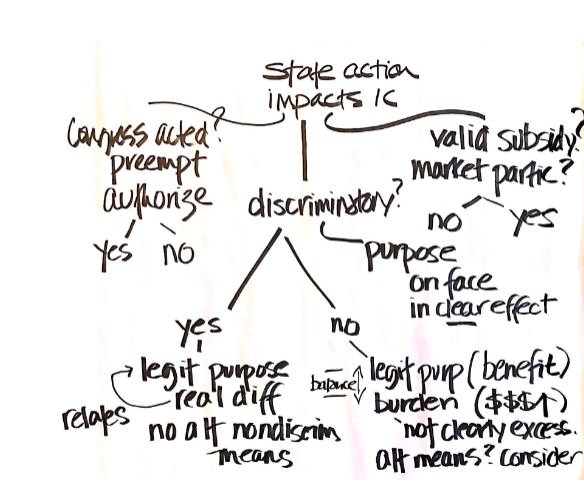
Dormant Commerce Clause analysis flowchart
If facially neutral, but still situationally discriminatory based on the facts (Hunt Apple), then move to discriminatory prong analysis
Garcia v. San Antonio Metropolitan Transit Authority
The new majority in Garcia rejected as “unsound in principle and unworkable in practice” the attempt in NLC v. Usery to carve out a sphere of state government autotomy based on the “traditional,’ ‘integral,’ or ‘necessary’ nature of governmental functions”
Congress may impose generally applicable laws on states so long as they state so clearly.
States’ sovereign interests [are] more properly protected by procedural safeguards inherent in the structure of the federal system than by judicially created limitations on federal power
The political process ensures that laws that unduly burden the States will not be promulgated -- Procedural safeguard
Ashcroft
Clear statement rule
Congress must clearly state its intent to invade areas of traditional state regulation and sovereignty
Presumption that Congress does intend to invade, so they must make clear otherwise
Independent and Adequate State Ground
Q to ask: Could federal judicial outcome change or be different than the state judicial outcome on appeal?
Subsidies and Dormant Commerce Clause
More like spending, less like a reg
West Lynn Creamery (1994)
Here, tax was on everyone, but the effect on in-state producers was offset because of the subsidy. So effectively this was a discriminatory tax on out-of-state
Market Participation and Dormant Commerce Clause
Reeves (1980)
Alexandri Scrap, state was a buyer and paid for scrap removal services, but required more paperwork for out of state recyclers. This was okay
Here, State is seller of cement/concrete. Buyer v. seller makes no difference
South Central Timber Development v. Wunnicke (1984)
Required processing of timber within Alaska, protected Alaskan processors
Rule
A state may not be able to claim the market participant exception to the Dormant Commerce Clause doctrine when the state imposes conditions that have a substantial regulatory effect outside the market in which it participates.
Article II Powers to the President
Chief Executive/Administrative Officer
Commander in Chief
Chief of State
Appointment and Removal
Power to recommend fiscal policies
Law enforcement
Clemency/pardons
Veto power
Legislative proposals
Executive Orders
Emergency powers
Foreign affairs
Executive agreements
Youngstown
Test to answer: Does the President have the power to do this?
What has Congress said?
Look at
Statutes in the field
Custom/acquiescence
Other, eg Constitutional structure, legislative history
Is the answer yes, silence, or no?
If Congress said no, does President have the exclusive power to do what he’s trying to do?
Medellin
Pres does not have power to make states follow treaties
Congress has to pass the treaty into law, more than just ratify
Zivotofsky
Held that act of Congress requiring the SOS to allow citizens born in Jerusalem to list POB as Israel on passports contradicted longstanding Executive policy of neutrality towards Jerusalem
This act interfered with Pres’ exclusive power to grant formal recognition to a foreign sovereign
Rule
Reception Clause
Pres has power to receive Ambassadors and other public ministers (Article II, section 3)
Implied is power to recognize other nations
Pres can also nominate ambassadors and other ministers and consuls
Perez
Upheld federal ban on extortionate credit transactions/loan sharks
Thought purely intrastate, “they may, in the judgment of Congress affect interstate commerce”
Congress need not make particularized findings to legislate
Curtis Wright
“ Curtis Wright, so I’m right”
Facts
Joint res of Congress authorized Pres to prohibit sale of arms to Bolivia and Paraguay, if Pres found that it would contribute to the reestablishment of peace b/w them
Pres proclaimed an embargo, D indicted for violating
Lower court found the joint res was an unconst delegation of legislative power
Analysis
Pres alone has power to speak or listen as a representative of the nation
Pres is the “sole organ” of the nation in its external relations
National Pork Producers
A state law that does have extraterritorial effects but does not purposefully discriminate does not necessarily violate the dormant Commerce Clause. Under the Pike test, a court must assess “the burden imposed on interstate commerce” by the state law and prevent its enforcement if the law’s burdens are “clearly excessive in relation to the putative local benefits.”
Strauder v. West Virginia (1880)
First post-Civil War race discrimination case to reach the SC
Invalidated state murder conviction b/c state law forbade black people from serving on juries
“What is equal protection but that all persons…shall stand equal before the laws of the states…?”
Though this seems limited to race, at the time
Korematsu v. United States (1944)
Facts
Japan attack on Pearl Harbor, FDR signed executive order to exclude any persons from designated areas
War Relocation Authority implemented curfew on Japanese citizens, excluded from homes, and placed in internment camps
Analysis
Court says all racially discriminatory legal restrictions are suspect, but not all are unconstitutional
Must be held to the “most rigid scrutiny”
Upheld law regardless
Later overturned!!
Palmore v. Sidoti (1984)
Florida’s denial of child custody to white mother because her new husband was black violated equal protection
“The effects of racial prejudice, however real, cannot justify a racial classification removing an infant child from the custody of its natural mother…”
Railway Express Agency v. New York (1949)
NYC banned ads on vehicles except for a business’s own delivery trucks.
Court upheld under EP rational basis; law need not eliminate all similar evils.
Jackson: Difference between self-advertising and advertising for hire is reasonable.
New Orleans v. Dukes (1976)
Ordinance banned new pushcart vendors in French Quarter, exempting 8+ year vendors.
Upheld under rational basis; aimed to preserve historic character and tourism.
New York City Transit Auth. v. Beazer (1979)
Transit Authority excluded methadone users from employment.
Upheld; safety concerns and uncertainty of treatment are rationally related to job performance.
USDA v. Moreno (1973)
Food Stamp Act excluded households with unrelated members (“anti-hippie” rule).
Struck down; animus toward unpopular groups is not a legitimate government interest.
Plessy v. Ferguson (1896)
Louisiana’s “separate but equal” railway law upheld as reasonable under police power.
Harlan dissent: Segregation intended to enforce white supremacy; compared to Dred Scott
Brown v. Board of Education (I) (1954)
Facts
Several cases from KS, SC, VA, DL
Black minors seeking admission to public schools on nonsegregated basis
Originally denied on separate but equal basis of Plessy
Issue
Whether Plessy should apply to public education
Analysis
History of the 14th Amendment and what various sides wanted/intended do not shed much light here
Status of public education at the time of the Amendment also confounds things
In South, movement for free common schools had not yet taken hold
We must consider public education in the light of its full development and its present place in American life throughout the Nation
Holding
Segregation of schools solely on the basis of race? Turns out, not okay
Bolling v. Sharpe (1954)
Public school segregation in DC is an arbitrary deprivation of liberty in violation of Due Process Clause of the Fifth Amendment
Discrimination may be so unjustifiable as to be violative of due process
Liberty extends to the full range of conduct which the individual is free to pursue, and it cannot be restricted except for a proper governmental objective.
Brown v. Board of Education (II) (1955)
Addressing relief to be accorded
Courts would have to assess whether school authorities are making good faith implementation
Remanded to the local courts to such end
guiding principles of equity
Washington v. Davis (1976)
Facts
Police officer testing for positions in DC
Test 21 examines verbal ability, vocabulary, reading, and comprehension
4 times as many black applicants failed the test compared to white applicants
But the department did take active steps to hire black officers
Procedural Hx
District Court held Test 21 was not discriminatory
Court of Appeals held that lack of discriminatory intent was irrelevant; disproportionate failure rate meant failed the test unless it could be shown it was an adequate measure of job performance and success in training program
Issue and Analysis
Whether a law that doesn’t reference race is nonetheless unconstitutional because it has a racially disproportionate effect
Strauder mention!
Discriminatory purpose can be inferred from totality of the relevant facts, including uneven impact
But, this alone does not trigger strict scrutiny
Here, Test 21 is neutral on its face and rationally may be said to serve a purpose the gov’t is empowered to pursue
Strict scrutiny here would have far-reaching effects (919), so not doing it
FN 14, would affect voting, bridge tolls, draft deferment, jury service, sales tax…
Rule
A statute, otherwise neutral on its face, must not be applied so as invidiously to discriminate on the basis of race.
A facially neutral statute violates the Equal Protection Clause only if motivated by a discriminatory purpose
the Court did not address in detail what counts as a discriminatory purpose.
Yick Wo (1886)
Facts
SF ordinance: cannot operate a laundry in a wood building w/o consent of board of supervisors
P, Chinese immigrant, had operated one for 22 years. Had all the right permits, but not consent by the board
Many Chinese laundry operators had been arrested for violation
Analysis
“Whatever may have been the intent of the ordinances as adopted, they are applied with a mind so unequal and so oppressive as to amount to a practical denial by the State of equal protection”
Rule
Facially neutral + applies with “evil eye and unequal hand” w/ respect to race = equal protection violation
Analysis moves to strict scrutiny
Difference between this case and Washington v. Davis is that here there is an inferred racial intent based on statistics
Armstrong (1996)
Ds failed to make a prima facie case of racially selective prosecution in drug sale/possession cases, not entitled to discovery
Claimant must show that similarly situated individuals of different race were not prosecuted
Mass. v. Feeney (1979)
Upheld MA’s absolute lifetime preference to veterans for state civil service positions, even though it overwhelmingly advantaged male applicants
Facially neutral towards group + discriminatory effect towards group = two step test
Whether statutory classification is actually neutral
Here, statute serves legit/worthy purposes
If it is not, whether the adverse effect reflects invidious group-based discrimination
Absolute preference was not established for purpose of discriminating
Line draw between veterans and nonveterans was not pretext for gender discrimination
Rule
Discriminatory purpose implies more than intent as volition or intent as awareness of consequences. lt implies that the decisionmaker, in this case a state legislature, selected or reaffirmed a particular course of action at least in part 'because of, not merely in spite of, its adverse effects on the identified group
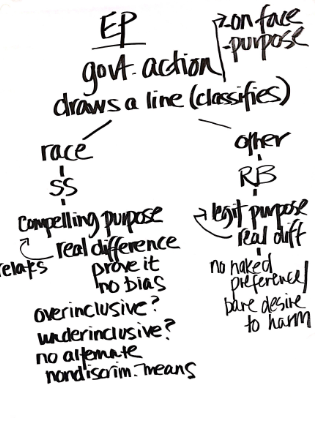
EP general test + sex-based test
In between rational and SS
Important purpose
+means that substantially relate to the purpose
Real diff
Prove it
Over/under
No alternative nondiscriminatory means
Reed v. Reed (1971)
RB with a bite
Law involved preferring men to women when two people were otherwise equally entitled to administer an estate
Struck down in violation of Equal Protection
Said the law was arbitrary/without rational basis
Frontiero v. Richardson (1973)
Invalited a law that automatically granted a dependency allowance to male military members for their wives, but women had to prove dependence for their husbands
Court says sex based discrimination is subject to close scrutiny
Craig v. Boren (1976)
Somewhere between rational basis and strict scrutiny
Sex discrimination must serve important gov’t objective and must be substantially related to that objective
Invalidated law prohibiting sale of certain alcohols to men under 21 and women under 18
United States v. Virginia (1996)
Facts
Virginia Military Institute (VMI), reserved exclusively for men despite being a public institution
Originally, district court upheld policy and COA reversed and remanded. Remedial plan was to set up a parallel college on a separate campus, just for women. But this wouldn’t have the same teaching methods or physical rigor as VMI
Issue
EP violation?
Find no evidence in this record that VMI’s men-only admission policy is in furtherance of a state policy of diversity
And thus no exceedingly persuasive justification
If so, what is the remedy?
VMI’s sister college didn’t contain the same rigorous military training
Geduldig v. Aiello (1974)
Law excluded disability that accompanies normal pregnancy and childbirth from CA’s disability insurance system did not exclude anyone because of gender
Program divided recipients into two groups: pregnant women and nonpregnant persons
Unless there is a proven pretext, then lawmakers are free
Saving money/efficiency is not an important enough purpose by itself to impose sex-based line
Fundamental rights for DP
Marriage
Contraceptives
Family living
Child Rearing
Right to Die
Right to travel from state to state
Right to vote
NO right to protection from government
Results of Lochner Era
Court would often substitute its own economic wisdom for that of Congress or state legislatures
Freedom to contract > individual protections
Sustained regulation of workplace hours for women in Muller v. Oregon, based on sex stereotypes
Anti-union as well
Adkins, found federal statute prescribing minimum wages for women in DC violated due process
Regulation of prices for commodities/services also violated due process
Cases that signaled end of Lochner
Nebbia v. New York
1933, NY enacted law creating Milk Control Board that could set max and min prices. Nebbia, owner of a store, convicted of selling milk before the minimum
Freedom of contract is fundamental, but public can also regulate it in the common interest
With respect to due process, a state is free to adopt whatever economic policy may reasonable be deemed to promote public welfare, and to enforce that policy by legislation adapted to its purpose
Rule
If laws are passed that are seen to have a reasonable relation to a proper legislative purpose, and are not arbitrary or discriminatory, the requirements of due process are satisfied
Moves us away from Lochner
West Coast Hotel
overturned Adkins and sustained a state minimum wage law for women
Carolene Products
Upheld federal statute prohibiting shipment in interstate commerce of “filled milk”
Skinner v. Oklahoma (1942)
Invalidated OK’s habitual criminal sterilization act
Runs afoul of EP clause because
Marriage and procreation are “fundamental” to basic existence and survival
Roe v. Wade (1973)
Jane Roe alleged she was unmarried and pregnant and unable to get a legal abortion in Texas because her life did not appear to be threatened by continuation of pregnancy
Concerns mentioned re safety of procedure, balancing mother’s life and fetus’ life
No express Constitutional right to privacy, but court has held that right to privacy exists
Here, right of privacy is broad enough to include a woman’s decision whether or not to terminate pregnancy
[Where] certain "fundamental rights" are involved, the Court has held that regulation limiting these rights may be justified only by a "compelling state interest." and that legislative enactments must be narrowly drawn to express only the legitimate state interests at stake.
“person” as used in the 14th Amendment, does not include the unborn
Planned Parenthood of SE PA v. Casey (1992)
Affirms Roe, in three parts
Woman’s right to get an abortion before viability without undue interference from the state
Confirming state’s power to restrict abortions after fetal viability
State has legitimate interests from the outset of the pregnancy in protecting health of mother and fetus
Dobbs v. Jackson’s Women’s Health Org. (2022)
Mississippi law prohibits abortion after 15th week of pregnancy
Overrules Roe and Casey
Constitution makes no reference to abortion and is not protected by the DP clause of 14th Amendment
Reasoning
Roe had weak reasoning based on “rights” not in the Constitution
Cites Gedulig on 287, there is no pretext here
Substantive DP protects certain rights in 8th Amendment + list of fundamental rights not in the Constitution itself
For fundamentals, ask whether it is deeply rooted in our history and tradition, and whether it is essential to our nation’s liberty
Until 20th century, there was no support for right to obtain an abortion
Bowers v. Hardwick (1986)
Respondent charged with violating GA law criminalizing sodomy
Issue
Whether Constitution confers a fundamental right upon homosexuals to engage in sodomy
Court discusses historical ban on sodomy, even under the original 13 states
To claim a right to engage in this conduct as deeply rooted in nation’s history is “facetious”
Court concerned with expanding judicial reach through Due Process Clause
Doesn’t matter whether the conduct is done privately at home. Compares to possession of drugs
Morality is a sufficient rational basis
Romer v. Evans (1996)
1992 CO referendum holding no protected status for gay people
State claims it simply puts gay people on the same level as straight people, no special treatment
But here, CO already has anti-discrimination laws for certain groups. Amendment 2 nullifies protections for targeted class in multiple areas
Rule
If a law neither burdens a fundamental right nor targets a suspect class, we will uphold the classification so long as it bears a rational relation to some legitimate end
This law is both too narrow and too broad
Identifies a single trait and then denied wholesale protections
Bare desire to do harm cannot constitute a legitimate government interest
Lawrence v. Texas (2003)
At issue is validity of TX statute making it a crime for two people of same sex to engage in certain intimate sexual conduct
Due Process analysis
Reassessing Bowers
“Its continuance as precedent demeans the lives of homosexual persons”
Bowers is now expressly overruled
Liberty is the key!!
Goes back into the history of anti sodomy laws
Mentions Casey and Romer
Obergefell v. Hodges (2015)
Kennedy again restates that Constitution promises liberty
Petitioners are 14 same-sex couples and two men whose partners are deceased, challenging laws preventing same sex marriage or recognition of same sex marriage performed in another state
Analysis
Marriage has deep historical importance
Marriage has even changed over time. Used to be arranged based on political, religious, financial concerns
Right to marry is fundamental under DP Clause
Loving cite!
Four principles of relevant precedents (337-338)
“The Court, in this decision, holds same-sex couples may exercise the fundamental right to marry in all States”
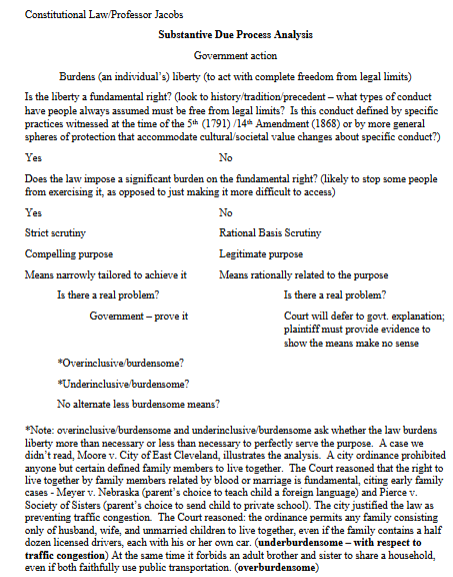
Substantive DP test
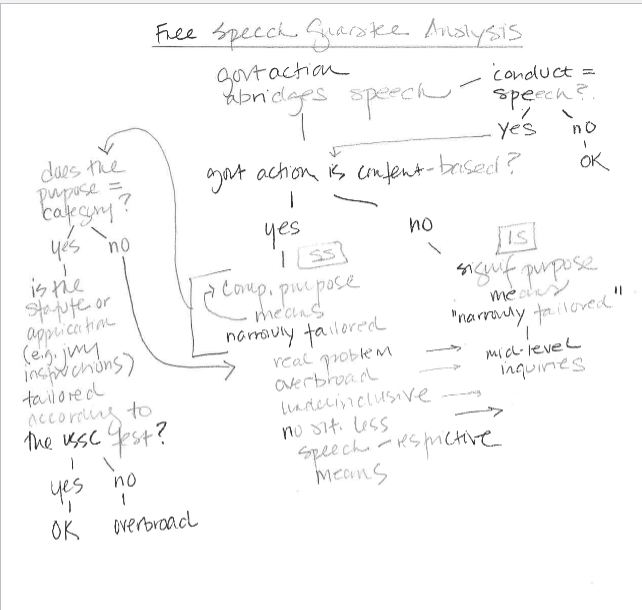
Free Speech Flowchart
Flowchart
Ask first, traditional public forum or limited public forum?
If traditional, standard flowchart analysis
If limited public forum
Is there viewpoint discrimination?
Is the subject matter restriction reasonable?
If yes to both, then SS
Categories of Protected Speech
Political and Ideological Speech
Concerning politics, nationalism, religion, or other matters of opinion
Can include money or symbolic acts
Generally strict scrutiny
Commercial Speech
Speech that merely proposes a commercial transaction or relates solely to the speaker’s and the audience’s economic interests, less protection than Political Speech
At least intermediate scrutiny if directed at non-misleading speech concerning a lawful activity
Laws restricting this kind of speech are Constitutional only if they directly advance a substantial gov’t interest and are not broader than necessary
Simon & Schuster v. Crime Victims Bd. (1991)
NY’s “Son of Sam” law requires an accused/convicted criminal’s income from works describing his crime to be deposited in an escrow account. These funds are made available to victims of the crime/criminal’s other creditors
Background to law: 1977 NY terrorized by serial killer, rights to his story were worth a lot
Henry Hill, Goodfellas!!
Rule
Statute is presumptively inconsistent with the First Amendment if it imposed a financial burden on speakers because of the content of their speech
In order to justify differential treatment, State must show that its regulation is necessary to serve a compelling state interest, and is narrowly drawn to achieve that end.
State has compelling interest in ensuring that victims of crime are compensated by those who harm them. And to ensure that criminals do not profit from their crimes
Here, rule was way too overinclusive
Ward v. Rock Against Racism (1989)
NYC’s attempt to regulate volume of amplified music at the Bandsheel Amphitheater
Requires performers there to use sound-amplification equipment and a sound of technician provided by the city
Rule
Government may impose reasonable restrictions on the time, place, or manner of protected speed, provided the restrictions are justified without reference to the content of the regulated speech, that they are narrowly tailored to serve a significant government interest, and that they leave open ample alternative channels for communication of the information.
But, it need not be the least restrictive or least intrusive means of doing so.
So long as the means are not substantially broader than necessary to achieve the gov’t interest
Gov’t isn’t treated like a private party just because they own property, still subject to free speech guarantee through 14th amendment
Brandenburg + incitement test
Appellant is leader of a KKK group, convicted under Ohio statute of advocating the duty, necessity, or propriety of crime, sabotage, violence, unlawful methods of terrorism as a means of accomplishing industrial or political reform and of voluntarily assembling a group to teach or advocate the doctrines of criminal syndicalism
Appellant had contacted a reporter for a TV station and invited him to a rally
Whole thing recorded, anti-black, anti-Jew statements
Test/Rule
Speech may be prohibited only if:
The speech is directed to inciting or producing imminent lawless action, (specific intent) and
The speech is likely to incite or produce such action (do it do it do it, mere advocacy is protected)
PP v. American Coalition of Life Activists (2002)
9th Circ. COA - some vigorous anti-abortion speech should be analyzed under a true threats standard rather than Brandenburg
Advocating violence is protected, threatening it is not
True threat = speaker means to communicate a serious expression of an intent to commit an act of unlawful violence to a particular individual or group of individuals
Chaplinsky
Fighting words
Facts
Appellant is a JW who was preaching in the streets and denouncing organized religion
Appellant was warned based on listeners being upset, but he kept going and a disturbance occurred
Police officer took appellant to the station, without arresting him.
Court upheld conviction, analysis
Classes of speech that don’t raise Constitutional problem
Lewd and obscene, profane, libelous, insulting or fighting words
Fighting words
Those by which their very utterance inflict injury or tend to incite an immediate breach of the peace
Offensive is what people of common intelligence would understand words likely to cause an average person to fight
Directed at an individual though
A statute punishing verbal acts, carefully drawn so as not to unduly impair liberty of expression, is not too vague for a criminal law
 Note
Note  Flashcards (37)