week 10 + 11 - les pronoms personnels
 Studied by 0 people
 Call Kai
 Learn
Learn Practice Test
 Spaced Repetition
 Match
Match Flashcards
 Knowt Play
1/22

There's no tags or description
Looks like no tags are added yet.
Name | Mastery | Learn | Test | Matching | Spaced |
|---|
No study sessions yet.
23 Terms
what are the ‘pronoms personnels sujets’ and what do they do?
je, tu, il, elle, nous, vous, ils, elles - replace the subject
what are the ‘pronoms personnels réfléchis’ and what do they do?
me, te, se, nous, vous - used with verbes pronominaux, vary according to the subject and replace a COD or COI
what are the ‘pronoms personnels toniques’ and what do they do?
moi, toi, lui, elle, nous, vous, eux,elles, soi - Allow you to emphasize something, to reinforce or to insist
what do we use to replace an object noun, abstract noun or geographical name which is connected by an ‘à’ + example?
we use ‘y’ - Je m’habitue à ma nouvelle maison → Je m’y habitue
what do we use to replace a person name which is connected by an ‘à’ + example?
we use ‘lui’ (singular) or ‘leur’ (plural) - ce Livre appartient à mon pere → ce livre lui appartient
when it is a name of a person, the preposition 'à' followed by the forme tonique of the personal pronoun should be retained in what case? + example
Certain verbes such as etre à, faire attention à..(normally when we would say ‘of/in’ after - to think of = penser à) - Je fais attention à la petite fille → Je fais attention à elle
Some common English verbs don’t use a preposition, but in French they require ‘à’. What are 2 examples?
to obey someone - obléir à quelqu’un
to phone someone - téléphoner à quelqu’un
When do we replace a noun by using ‘en’?
an article partitif (du, de la, des) or an article indéfini (des) - used when the quantity is undetermined
2 examples showing the difference when the quantity is undetermined vs determined?
Je veux des pommes (undertermined - des) → J’en veux (I want some)
Je veux les pommes (totality - les) → Je les veux (I want them)
When the noun is followed by a numeral or qualitative adjective, or when it is modified by an adverb of quantity (much, too much, little, etc.), what is the noun replaced by? + 2 examples
‘en’, and the adjective or adverb is retained:
Elle a trois enfants - Elle en a trois (She has 3 of them)
J’ai beaucoup de travail → J’en ai beaucioup
what is used to replace an object noun, an abstract noun or a geographic name which is connected by ‘de’? + example?
‘en’ - Je me souviens de ma premiere maison → Je m’en souviens.
how do we replace a name of a person which is introduced by ‘de’ + example?
use the forme tonique - J’ai peur de ce professeur → J’ai peur de lui
what is the pronom neutre in French?
le
what do we use the pronom neutre to replace + example?
an adjective, verb, clause or sentence - es-tu drole? Je le veux.
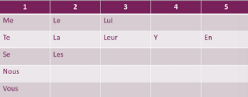
can you combine 2 pronouns from the same column?
no, and you cannot use pronouns from column 1 and 3 together
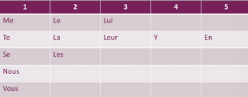
What replaces lui and leur when columns 1+ 3 are combined + example?
à + pronom tonique - Elle me présente à lui
where do object pronouns usually go in a sentence?
they go before the verb, except in the affirmative imperative
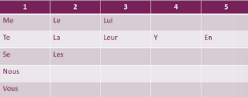
what must be respected when using multiple pronoms objet?
the fixed order of pronouns in the pronoun table
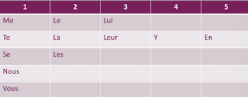
where do object pronouns go in the affirmative imperative? + example
after the verb - hyphens are necessary between the verb and pronom
donnez-m’en
ecris-la-moi
what happens to 'me’ and te’ in the affirmative imperative?
they become moi and toi
what happens in the forme négative of the affirmative imperative?
pronouns stay before the verb,a dn the negation goes around the pronoun + verb group
do we use tonic pronouns in the negative imperative>
no, we use the normal pronoun forms
2 examples of the normal vs negative affirmative imperative?
dis-moi la réponse → ne me dis pas la réponse
dis-la-moi → ne me la dis pas.
 Note
Note  Flashcards (78)