Lec37: Muscle physiology

0.0(0)
studied byStudied by 0 people
0.0(0)
call kaiCall Kai
learnLearn
examPractice Test
spaced repetitionSpaced Repetition
heart puzzleMatch
flashcardsFlashcards
GameKnowt Play
Card Sorting

1/31

encourage image

There's no tags or description

Looks like no tags are added yet.

Last updated 5:53 PM on 2/3/26
Name
Mastery
Learn
Test
Matching
Spaced
Call with Kai

No analytics yet

Send a link to your students to track their progress

32 Terms

1
New cards

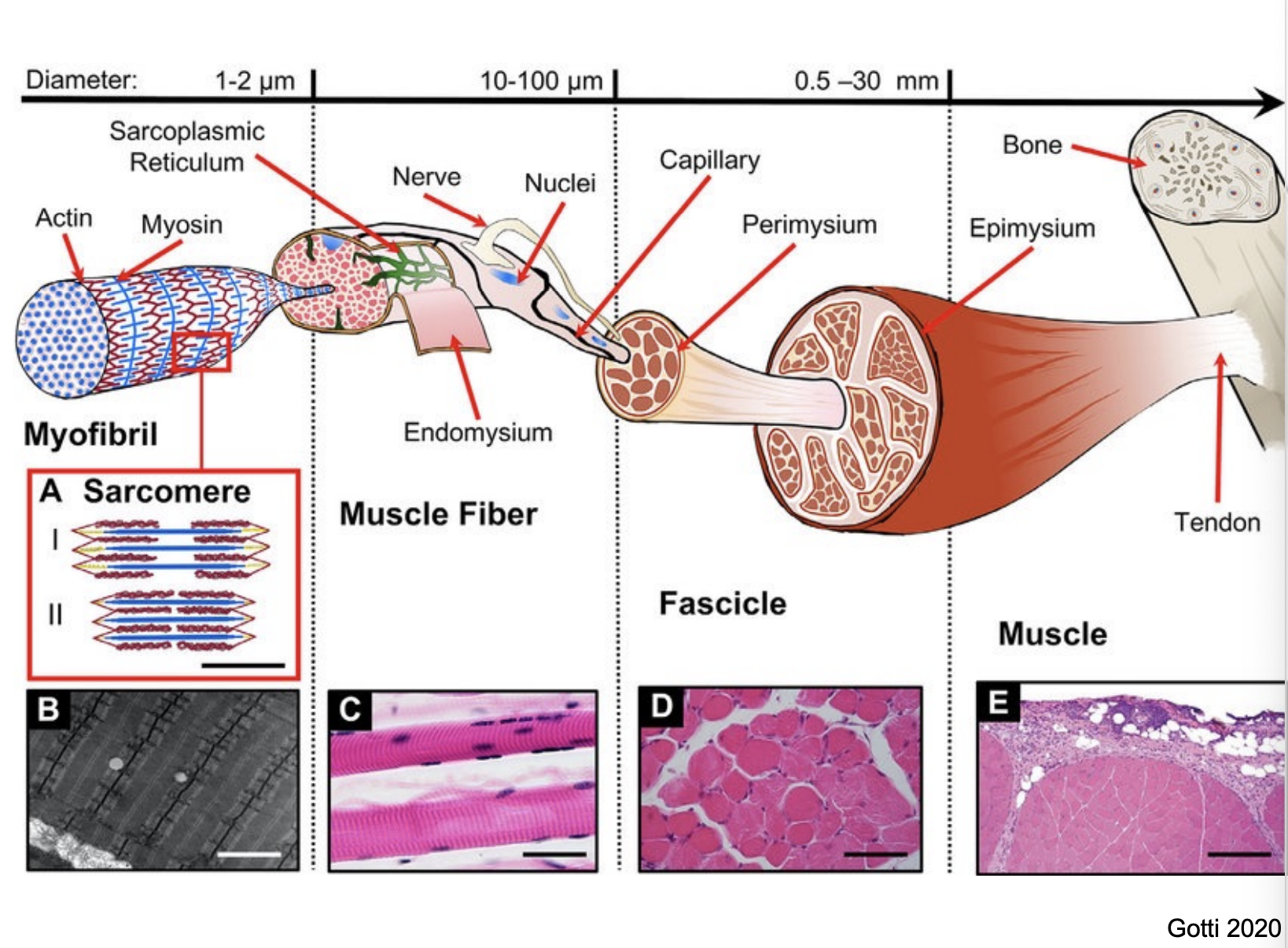
The basic unit of a muscle is the muscle cell, also known as a _______ or _______. These cells are unique because they are __________, meaning they contain many nuclei, which are typically located at the periphery of the cell. They appear _________ under a microscope due to the organized arrangement of internal proteins.

muscle fiber or myocyte

multinucleate

striated (striped)
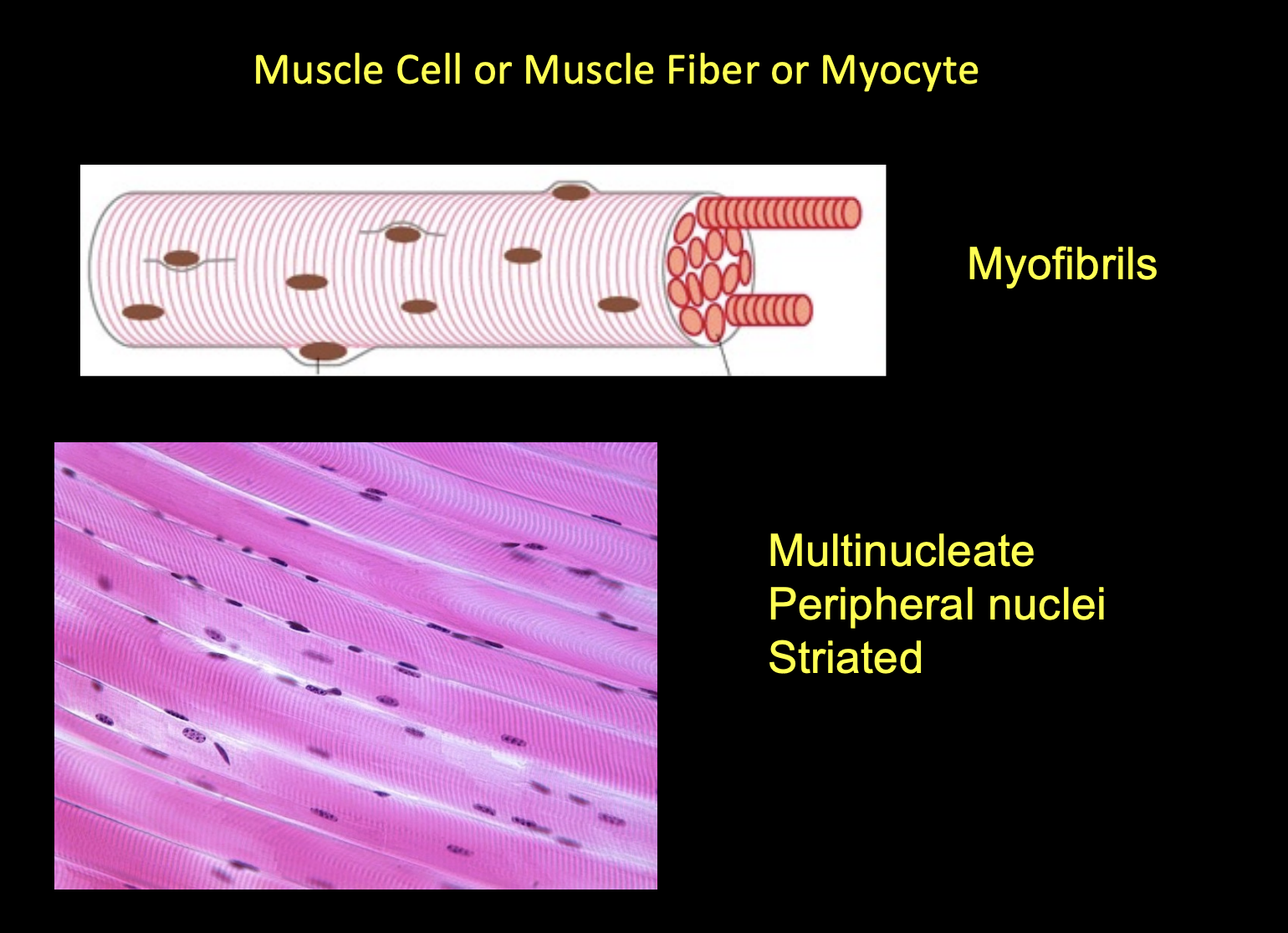
<p><span style="background-color: transparent;"><span>muscle fiber or myocyte</span></span></p><p><span style="background-color: transparent;"><strong><span>multinucleate</span></strong></span></p><p><span style="background-color: transparent;"><strong><span>striated</span></strong><span> (striped)</span></span></p>
2
New cards

The outermost connective tissue layer surrounding the entire muscle.

Epimysium
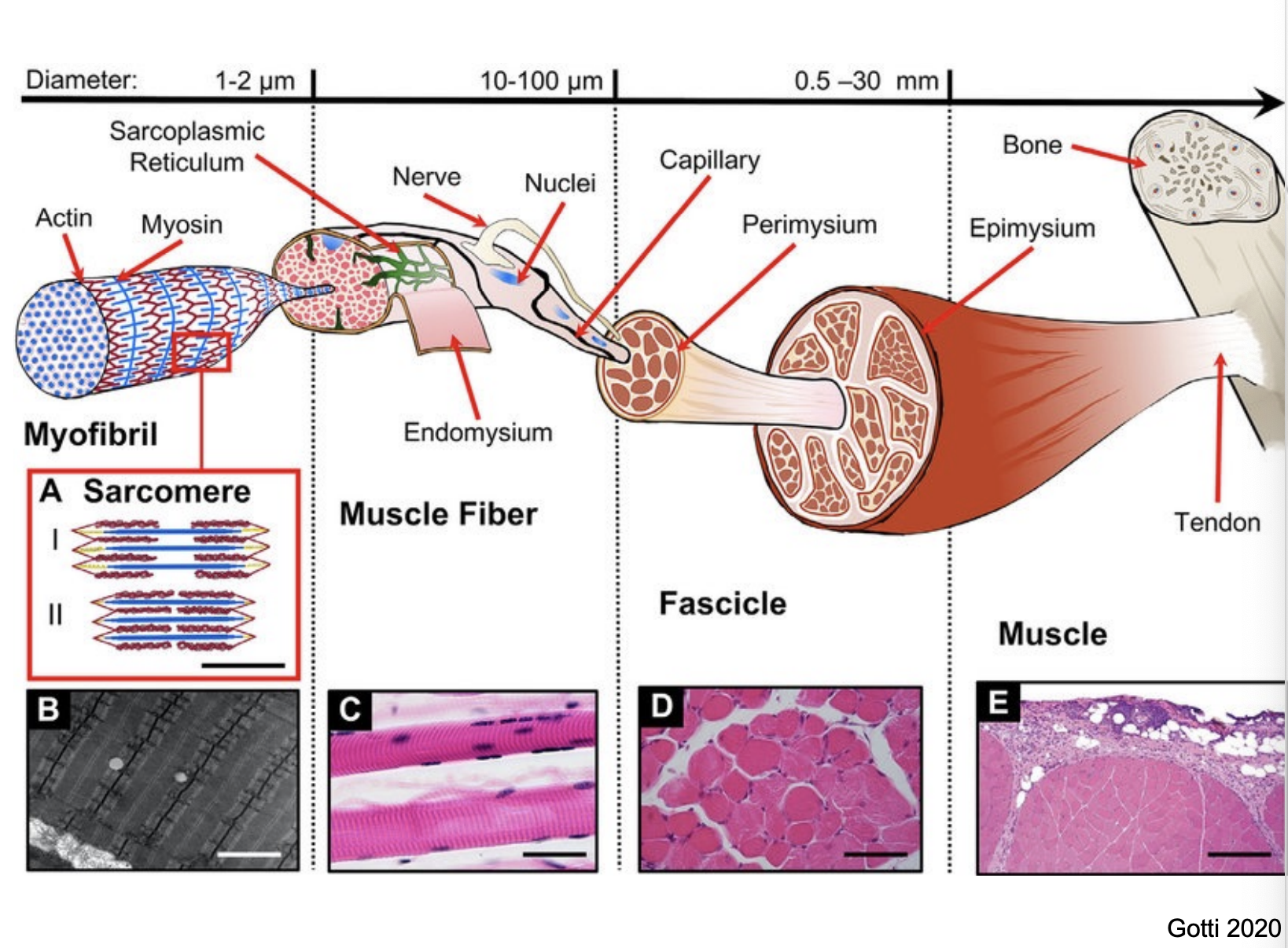
<p><span style="background-color: transparent;"><strong><span>Epimysium</span></strong></span></p>
3
New cards

Connective tissue that groups muscle fibers into bundles called fascicles.

Perimysium
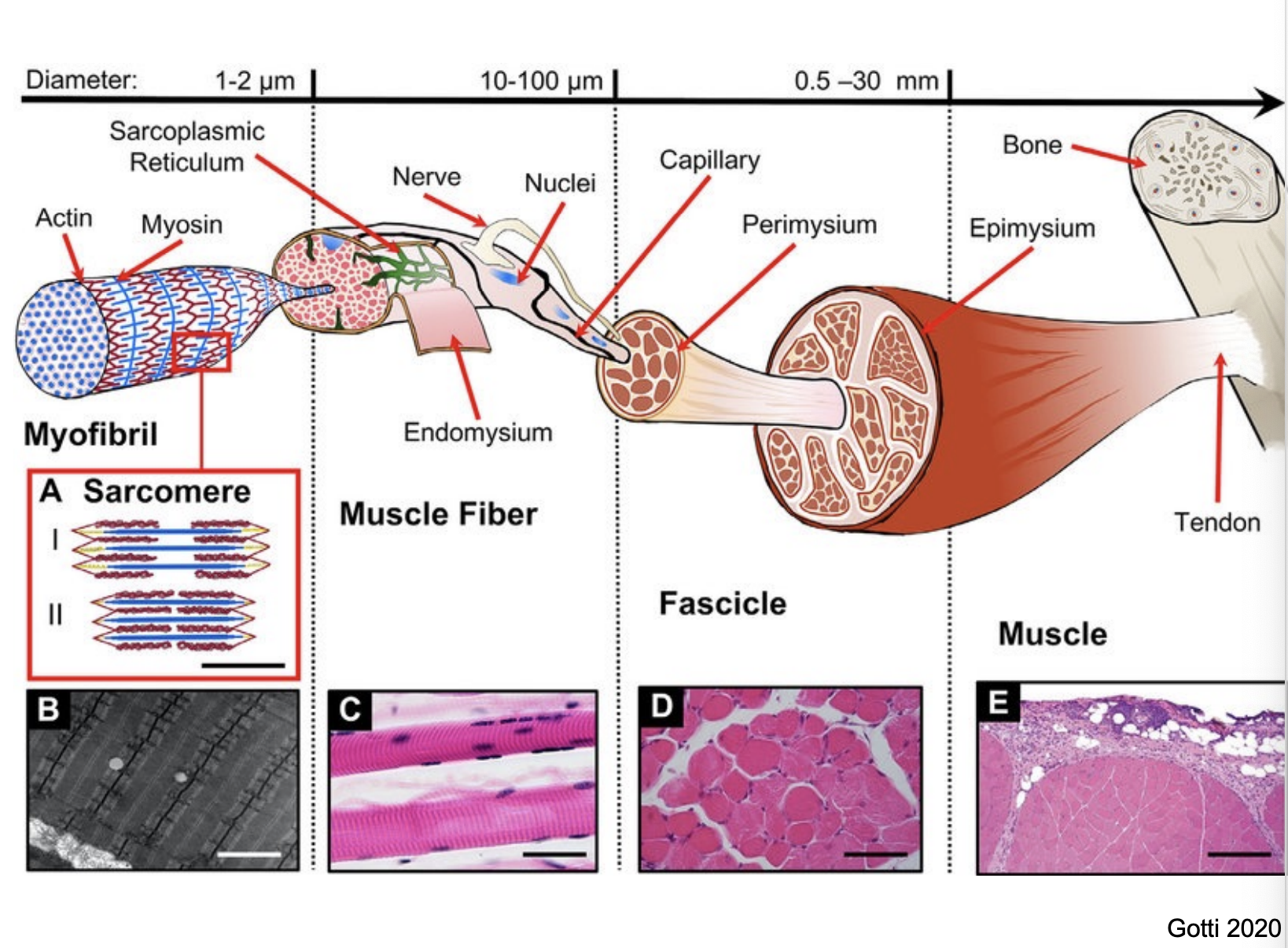
<p><span style="background-color: transparent;"><strong><span>Perimysium</span></strong></span></p>
4
New cards

A fine layer of connective tissue that surrounds each individual muscle fiber.

Endomysium
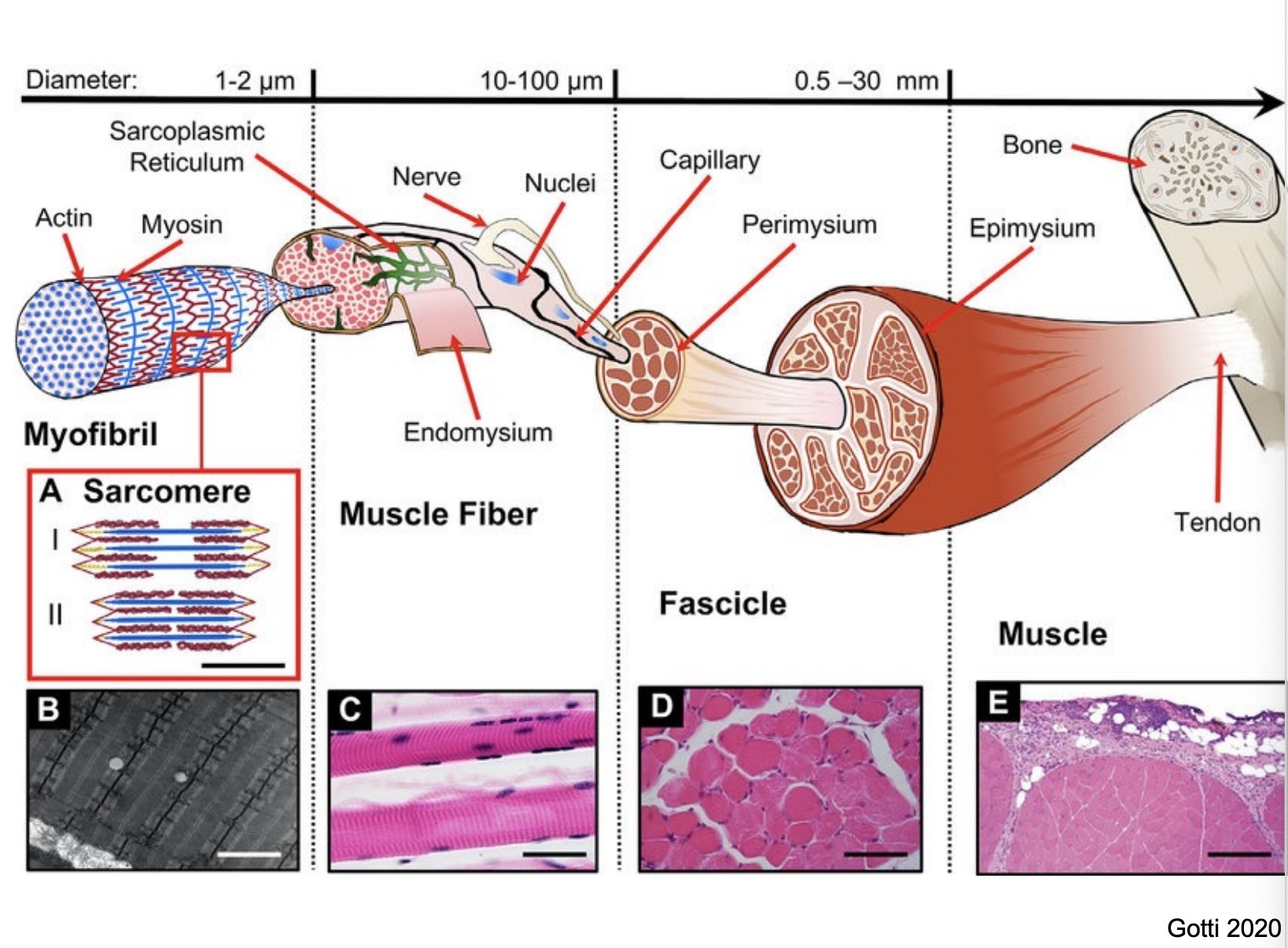
<p><span style="background-color: transparent;"><strong><span>Endomysium</span></strong></span></p>
5
New cards

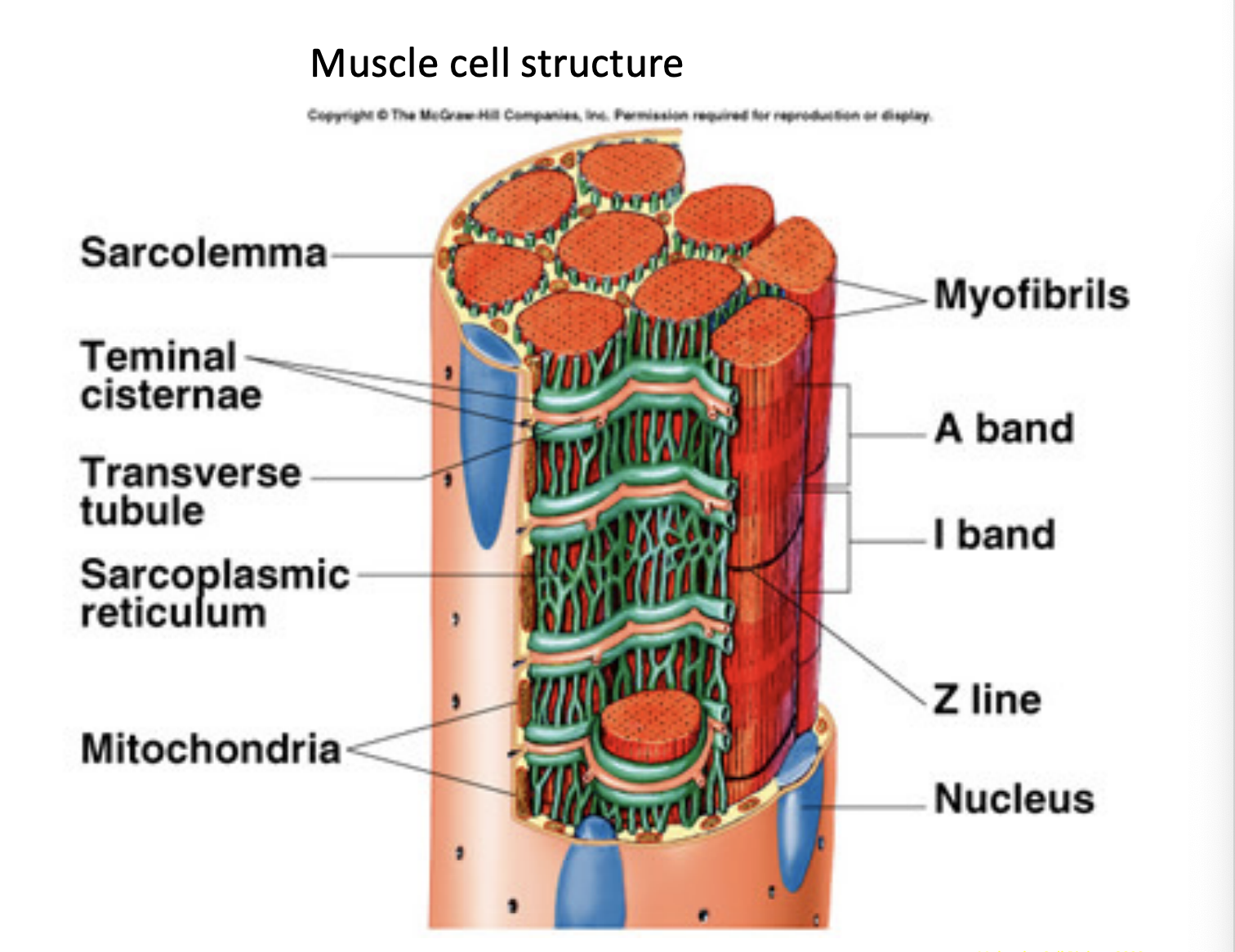
Inside each muscle fiber are _________, which contain the contractile machinery. The fiber also contains a specialized endoplasmic reticulum called the _____________, which stores calcium, and T-tubules, which are deep invaginations of the plasma membrane (sarcolemma) that help transmit electrical signals.

myofibrils

Sarcoplasmic Reticulum (SR)
<p><span style="background-color: transparent;"><strong><span>myofibrils</span></strong></span></p><p><span style="background-color: transparent;"><strong><span>Sarcoplasmic Reticulum (SR)</span></strong></span></p>
6
New cards

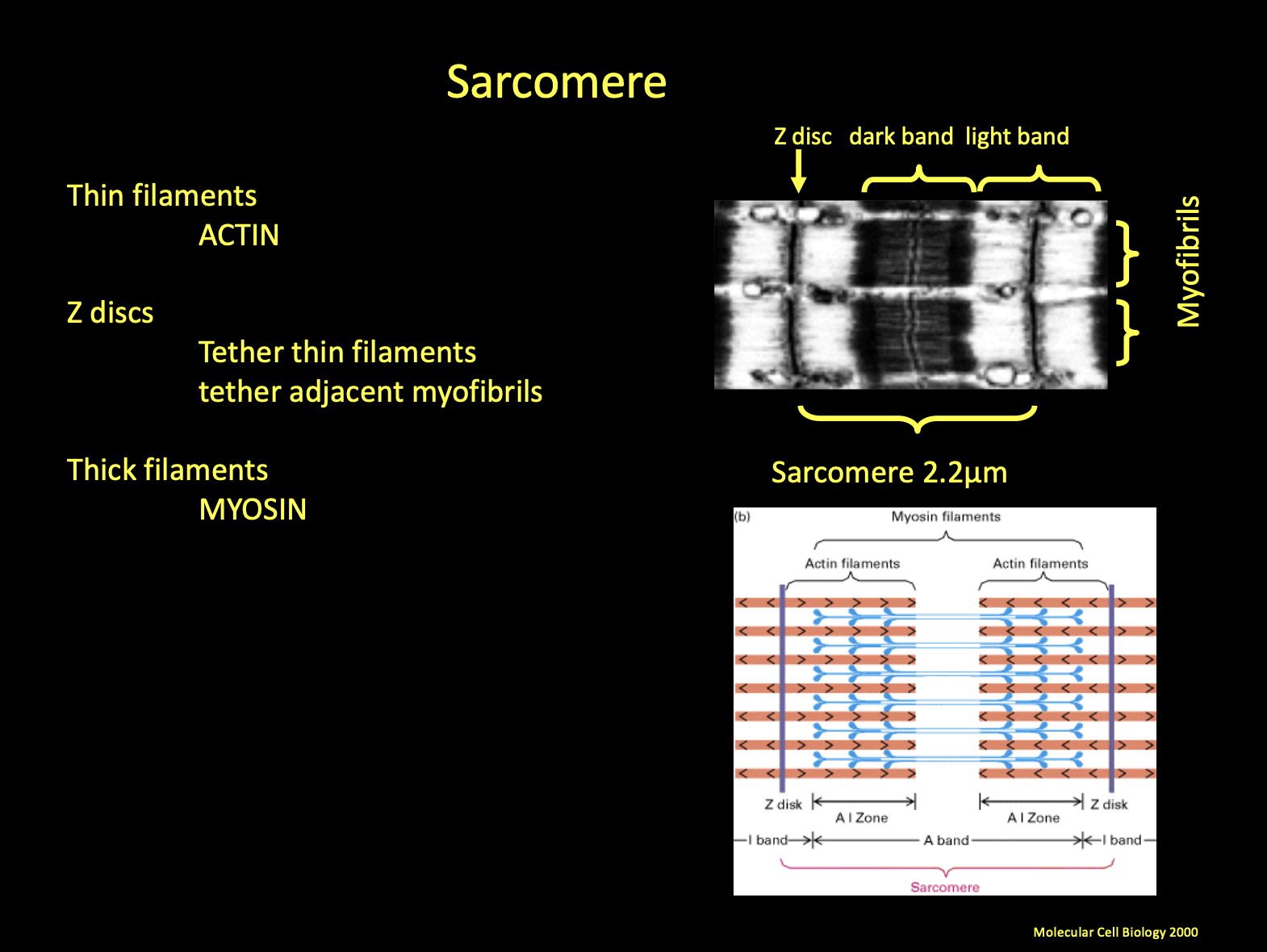
The _________ is the smallest functional unit of a myofibril, measuring approximately 2.2 µm in length.

sarcomere

7
New cards

Describe the 2 filaments that make up the sacromere.

Filaments: It is composed of two main types of protein filaments:

  • Thick Filaments (Myosin): Located in the center of the sarcomere (the A-band).

  • Thin Filaments (Actin): Attached to the Z-discs at the ends of the sarcomere.
<p><span style="background-color: transparent;"><strong><span>Filaments:</span></strong><span> It is composed of two main types of protein filaments:</span></span></p><ul><li><p><span style="background-color: transparent;"><strong><span>Thick Filaments (Myosin):</span></strong><span> Located in the center of the sarcomere (the A-band).</span></span></p></li><li><p><span style="background-color: transparent;"><strong><span>Thin Filaments (Actin):</span></strong><span> Attached to the </span><strong><span>Z-discs</span></strong><span> at the ends of the sarcomere.</span></span></p></li></ul><p></p>
8
New cards

What are the bands and discs that make up the sarcomere?

  • Z-discs: These define the boundaries of the sarcomere and tether the thin filaments.

  • I-band: The light region containing only thin filaments.

  • A-band: The dark region containing the full length of the thick filaments.

9
New cards

Muscle contraction begins with a signal from the __________

nervous system.

10
New cards

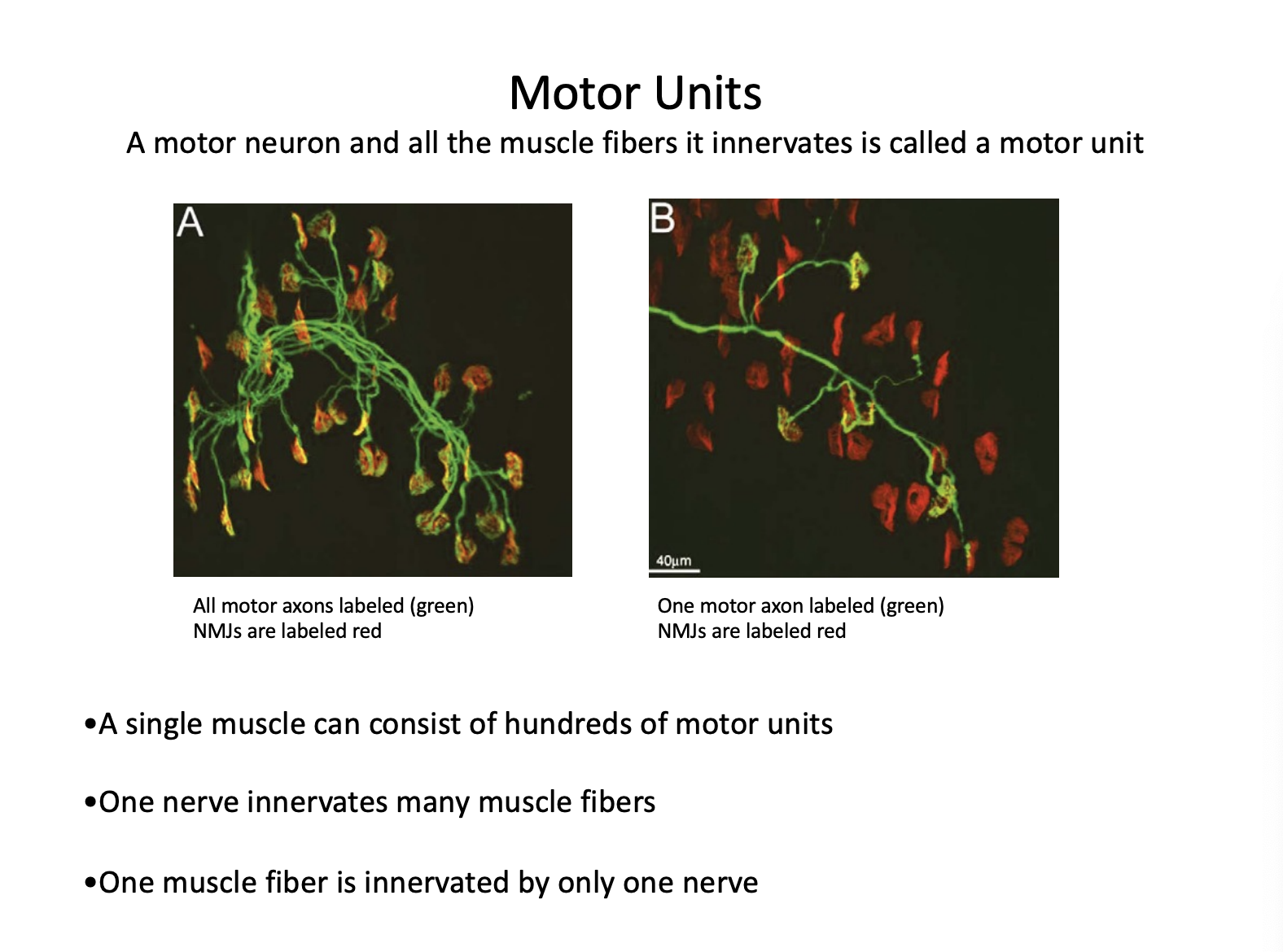
A ________ consists of a single motor neuron and all the individual muscle fibers it innervates.

motor unit
<p><span style="background-color: transparent;"><strong><span>motor unit</span></strong></span></p>
11
New cards

Describe the innervation of the motor unit.

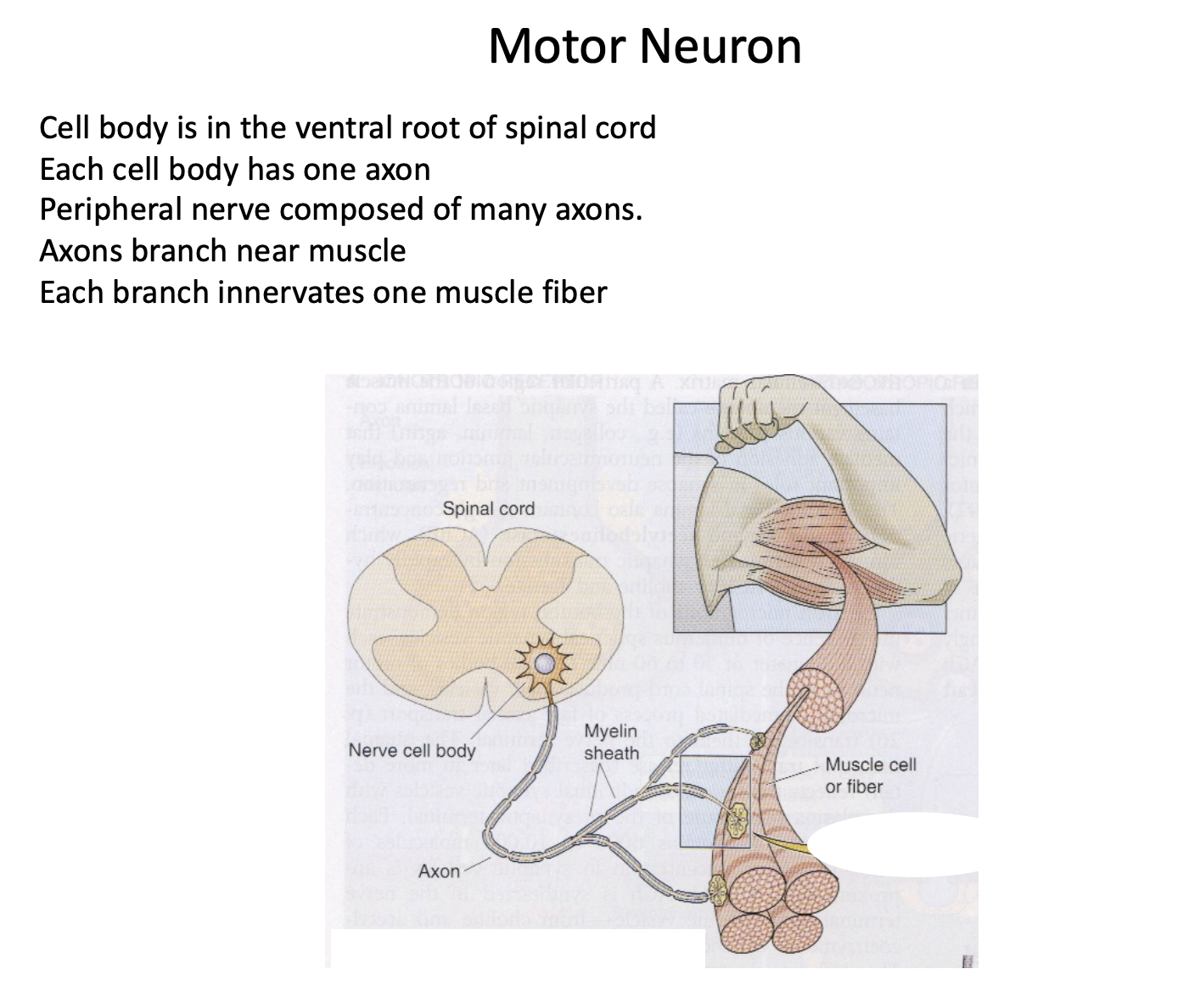
Innervation Rules: While one motor neuron can innervate many muscle fibers, each individual muscle fiber is innervated by only one motor neuron.

12
New cards

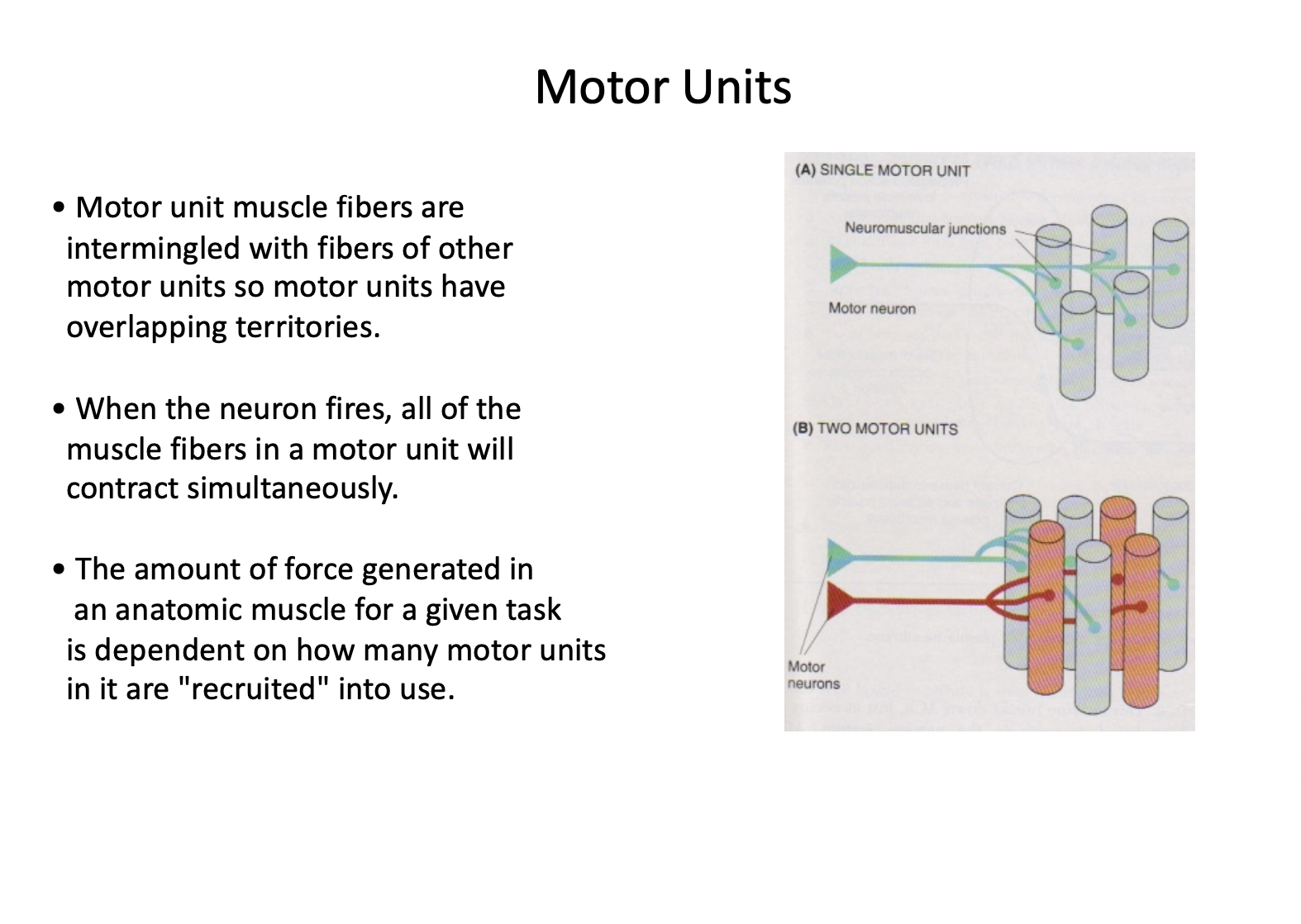
T/F: The force generated by a muscle depends on how many motor units are "recruited" or activated.

True
<p>True</p>
13
New cards

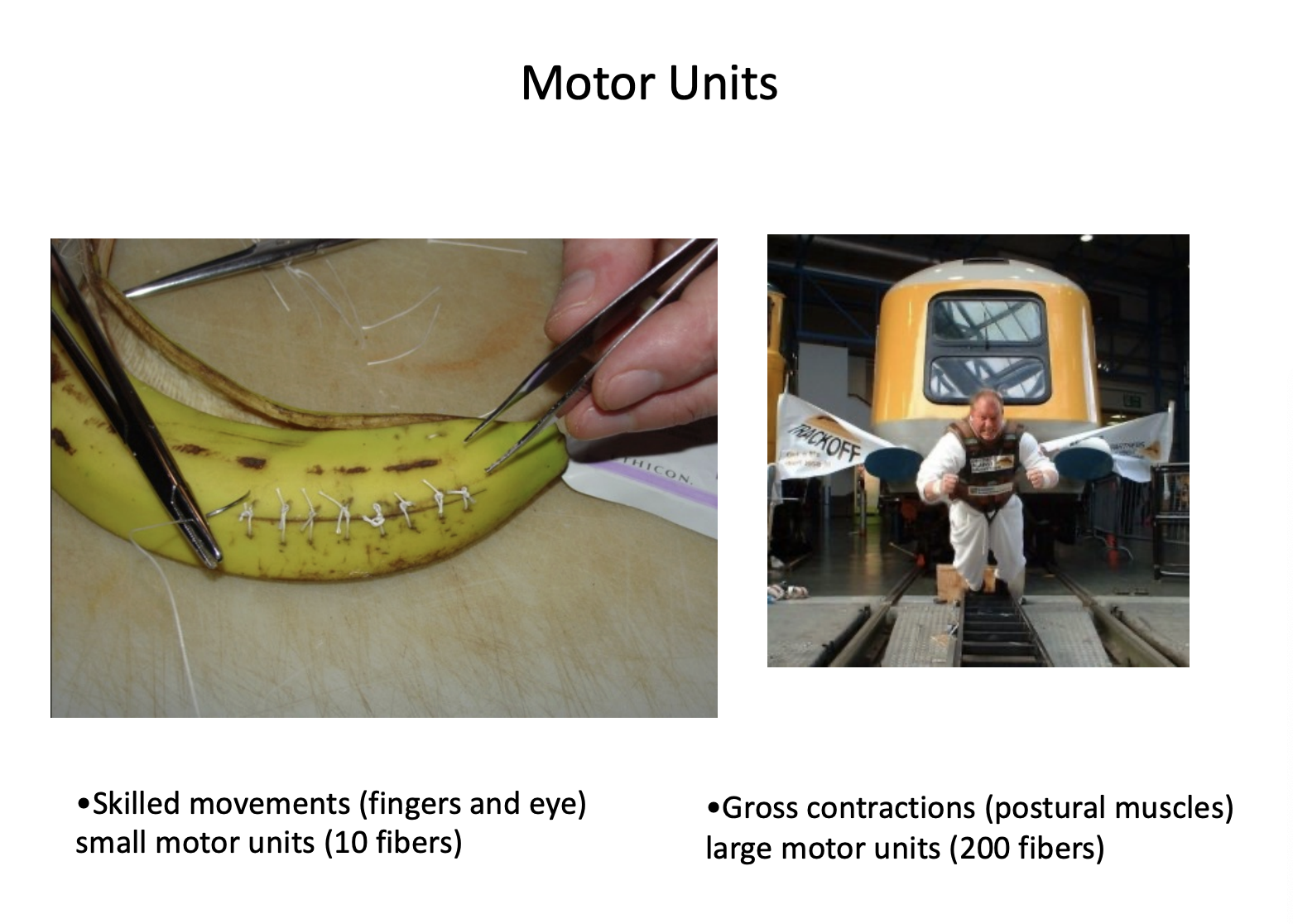
T/F: For skilled movements (like the fingers or eyes), motor units are small (e.g., 10 fibers). For gross contractions and posture (like the back or legs), motor units are large (e.g., 200+ fibers).

True.
<p>True. </p>
14
New cards

The ___________ is the "synaptic contact" or bridge between the nervous system and the skeletal muscle.

The Neuromuscular Junction (NMJ)

15
New cards

Describe the structure of the NMJ.

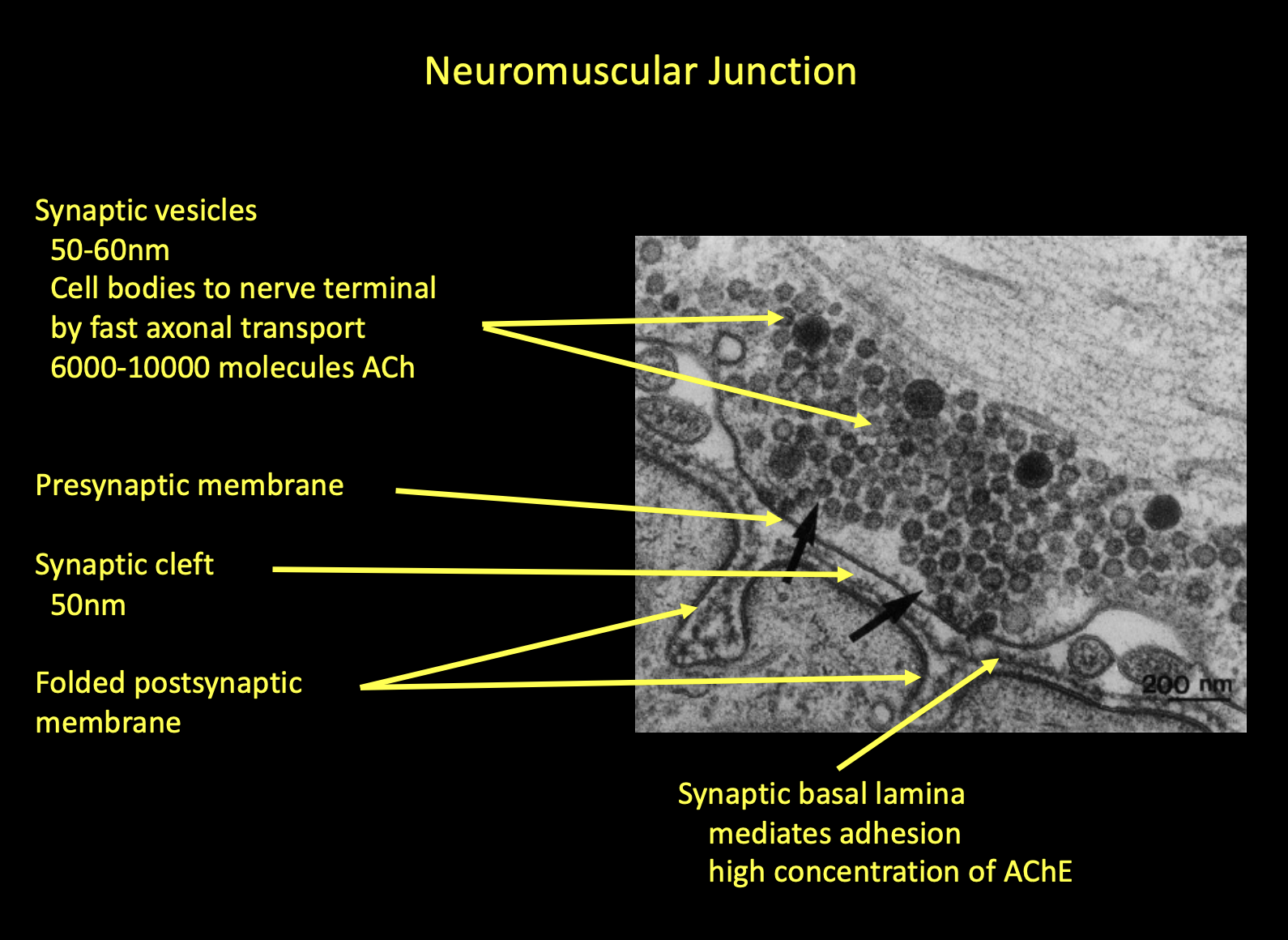
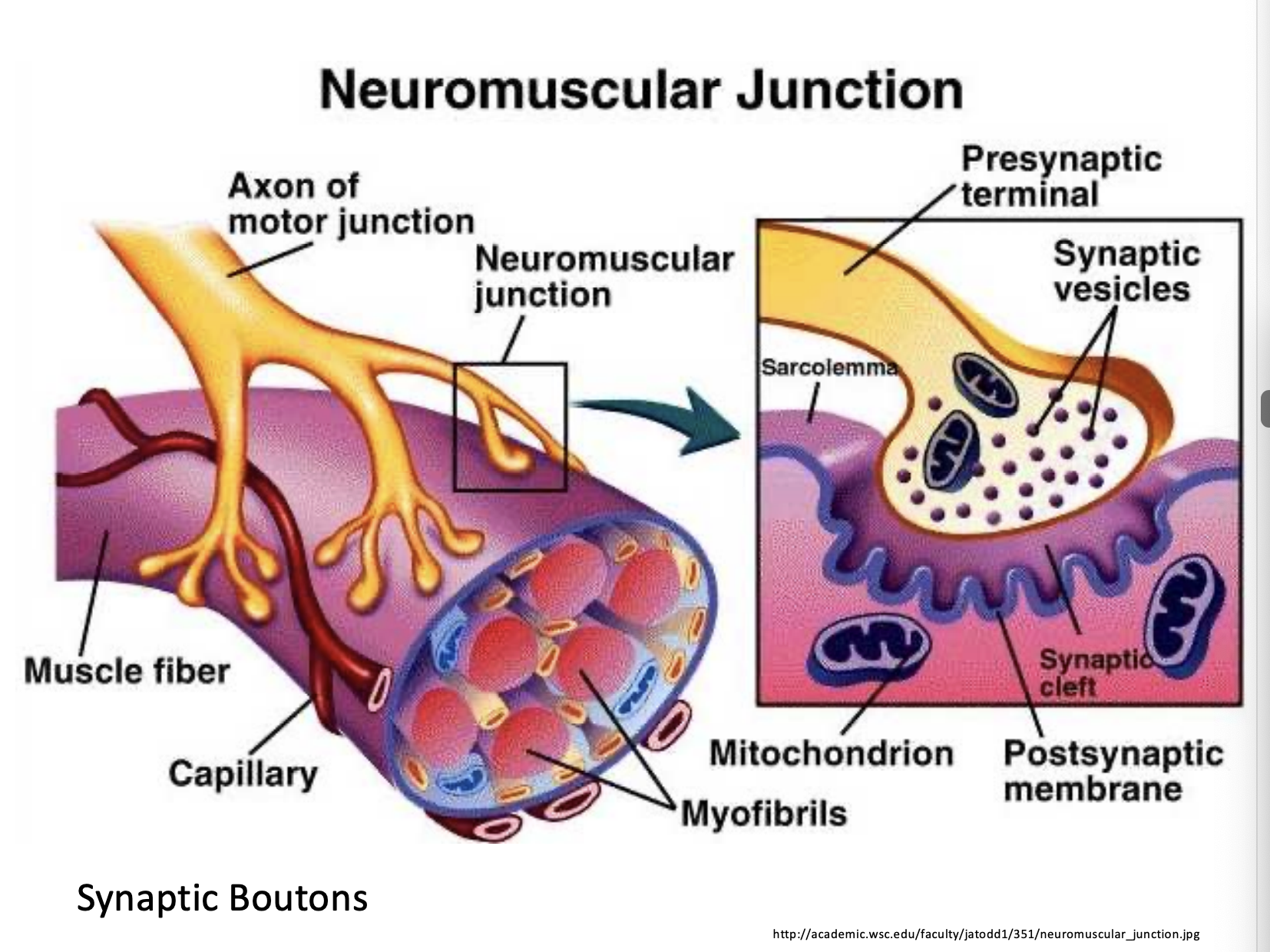
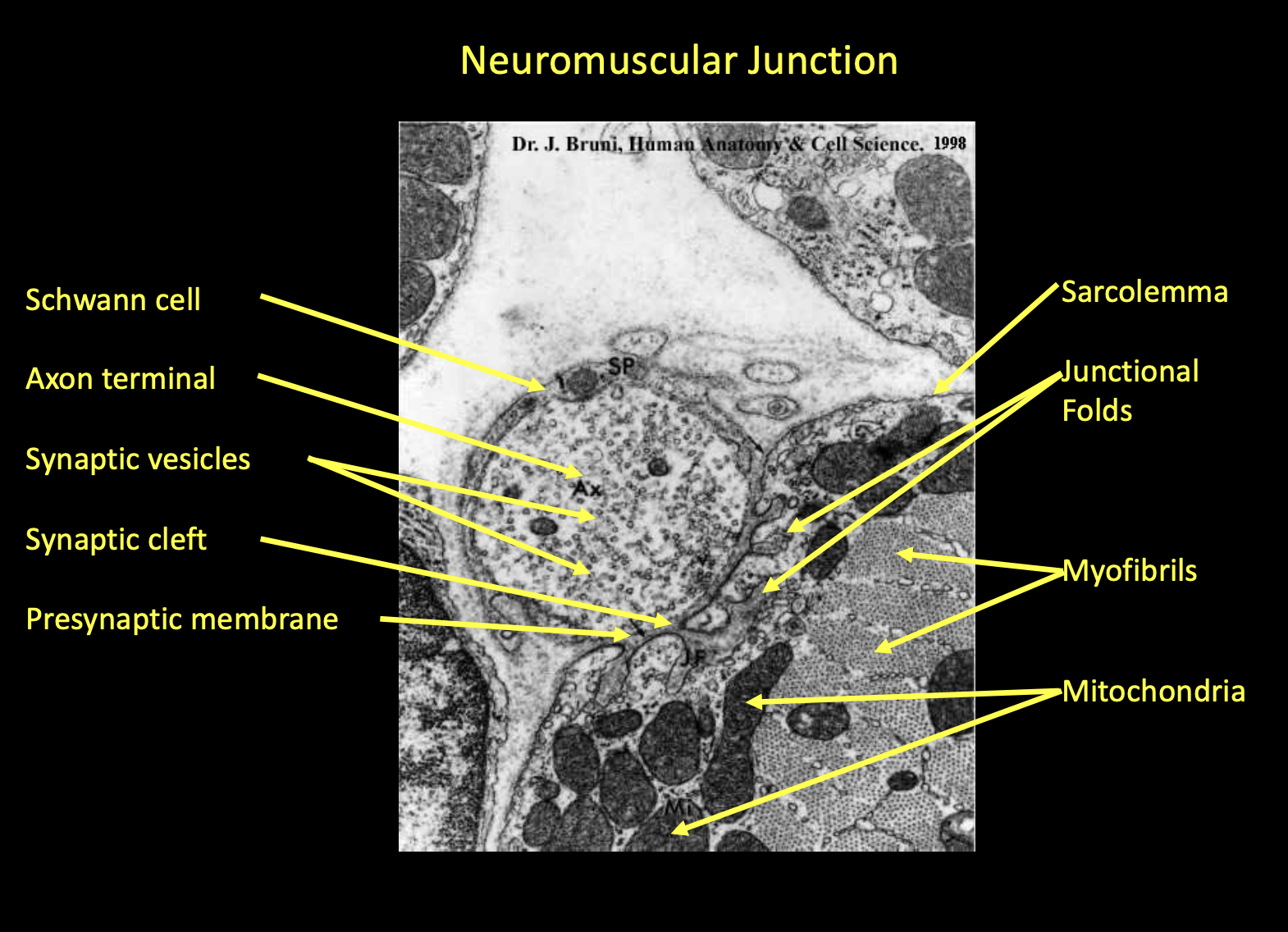
It consists of the axon terminal (presynaptic), the synaptic cleft (the gap), and the motor end plate (the folded postsynaptic membrane of the muscle fiber).

16
New cards

The nerve terminal contains vesicles filled with approximately 6,000 to 10,000 molecules of the neurotransmitter ___________

Acetylcholine (ACh).

17
New cards

T/F: The motor neuron is an individual nerve cell. The motor unit is a functional grouping. It is defined as one motor neuron PLUS all the muscle fibers it innervates.

True.

18
New cards

The cell body of the motor neuron is in the ______ root of the spinal cord.

Ventral root of the spinal cord.
<p>Ventral root of the spinal cord. </p>
19
New cards

Each cell body has ___ axon

1 axon

<p>1 axon</p>
20
New cards
<p>What are the transmission steps at the NMJ?</p>

What are the transmission steps at the NMJ?

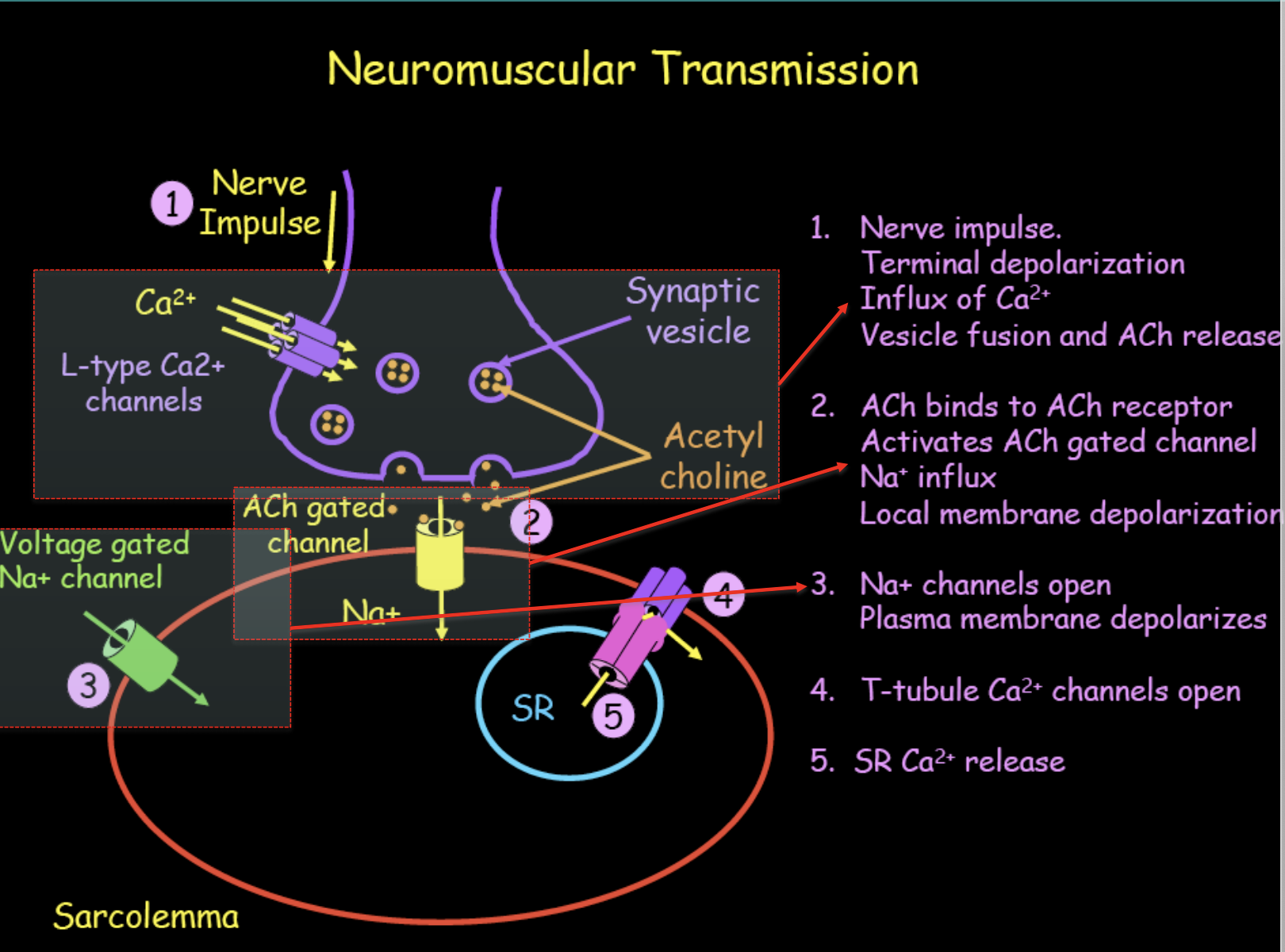
  • Transmission Steps:

    1. An electrical nerve impulse reaches the terminal, causing an influx of Calcium (Ca²⁺) through L-type channels.

    2. This triggers vesicles to fuse with the membrane and release ACh into the synaptic cleft.

    3. ACh binds to ACh-gated channels (receptors) on the muscle membrane.

    4. This causes Sodium (Na⁺) influx, leading to a local membrane depolarization.
<ul><li><p><span style="background-color: transparent;"><strong><span>Transmission Steps:</span></strong></span></p><ol><li><p><span style="background-color: transparent;"><span>An electrical nerve impulse reaches the terminal, causing an influx of </span><strong><span>Calcium (Ca²⁺)</span></strong><span> through L-type channels.</span></span></p></li><li><p><span style="background-color: transparent;"><span>This triggers vesicles to fuse with the membrane and release ACh into the synaptic cleft.</span></span></p></li><li><p><span style="background-color: transparent;"><span>ACh binds to </span><strong><span>ACh-gated channels</span></strong><span> (receptors) on the muscle membrane.</span></span></p></li><li><p><span style="background-color: transparent;"><span>This causes </span><strong><span>Sodium (Na⁺) influx</span></strong><span>, leading to a local membrane depolarization.</span></span></p></li></ol></li></ul><p></p>
21
New cards
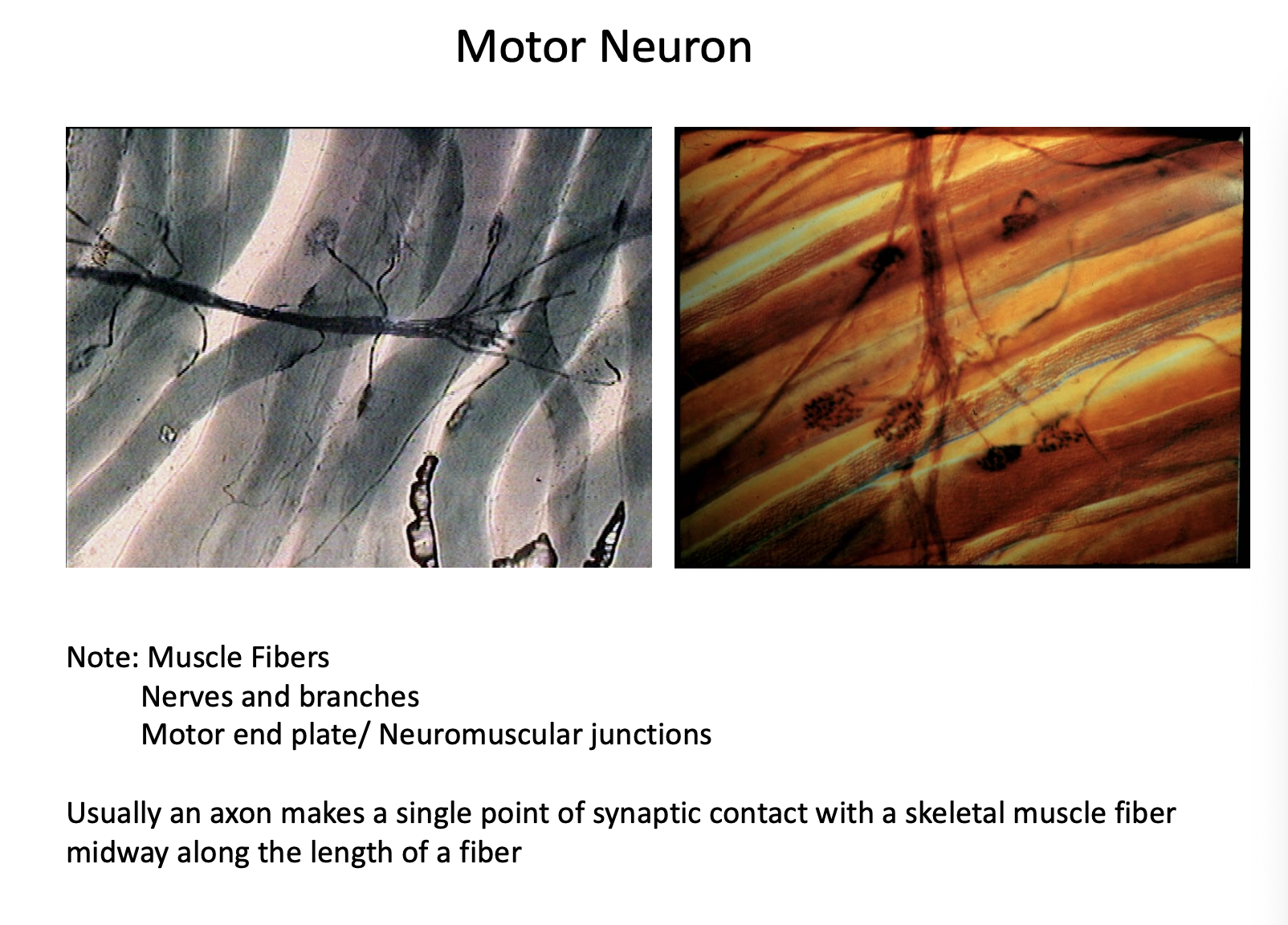
<p>Images of the NMJ </p>

Images of the NMJ

knowt flashcard image
22
New cards

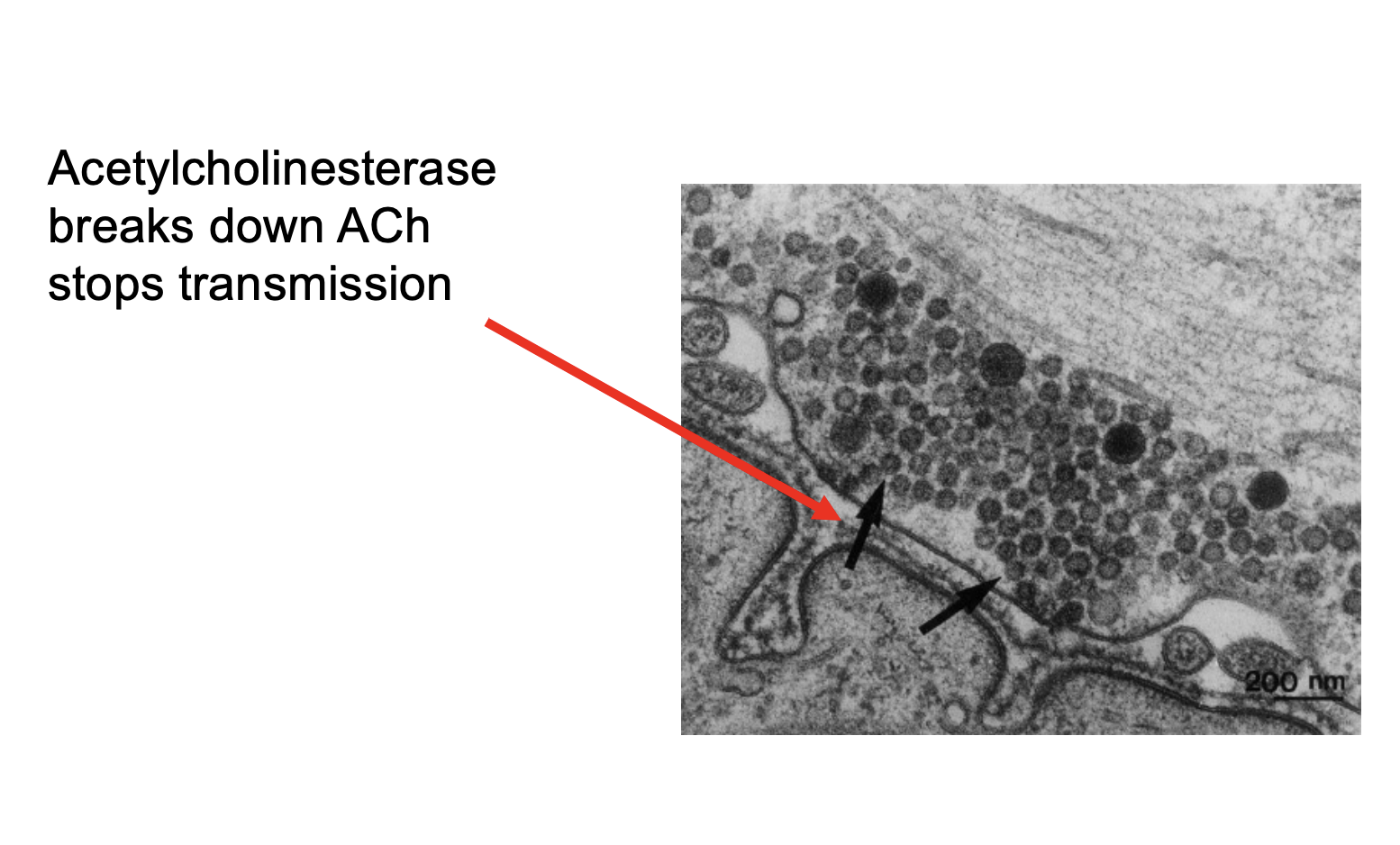
____________ breaks down ACh, stopping transmission

Acetylcholinesterase
<p>Acetylcholinesterase</p>
23
New cards

T/F: E-C coupling is the process by which an electrical stimulus (excitation) leads to a mechanical response (contraction).

True.
24
New cards
<p>What is the triad?</p>

What is the triad?

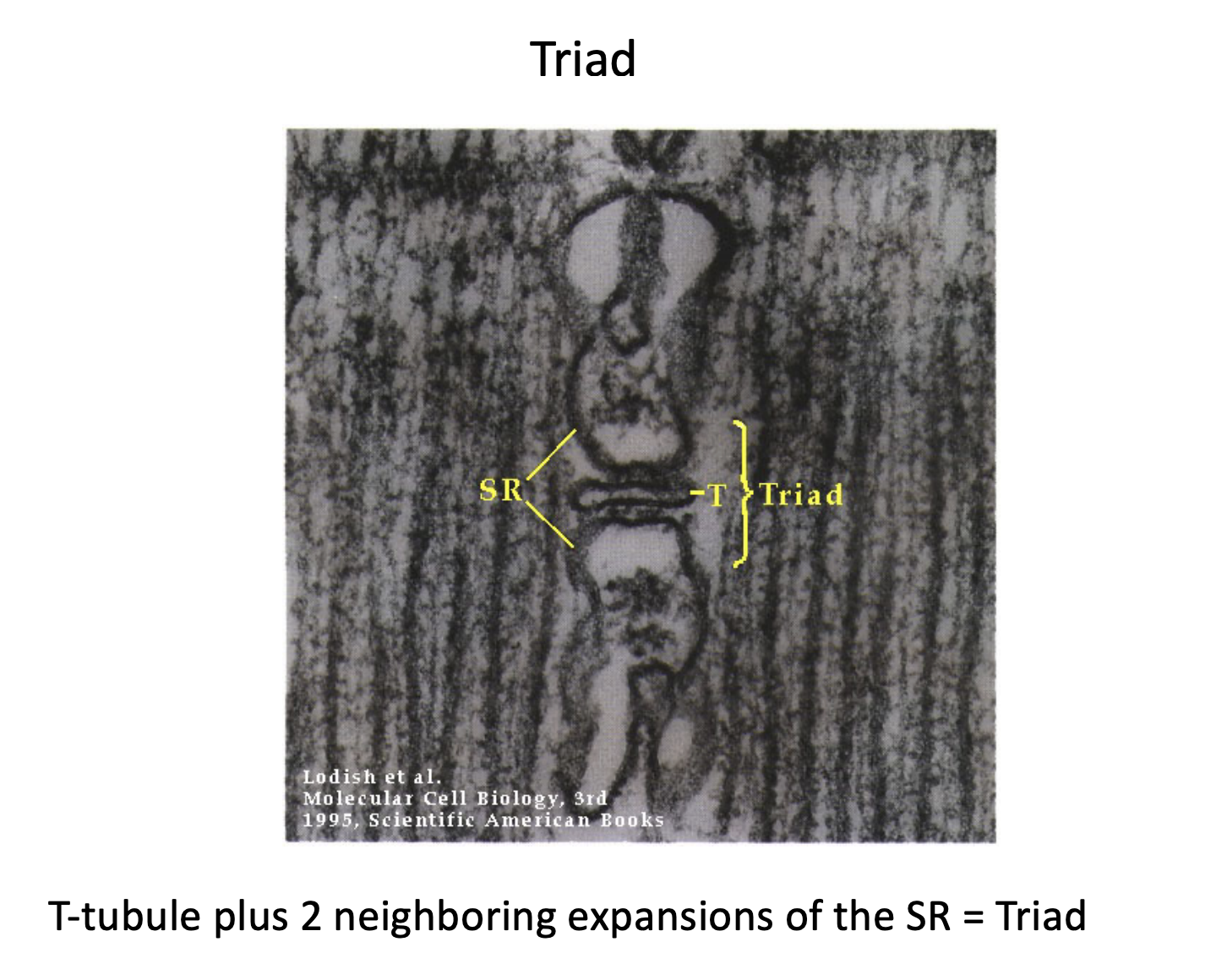
The Triad: This is a critical structure for signaling, consisting of one T-tubule and two neighboring expansions of the SR called terminal cisternae.
<p><span style="background-color: transparent;"><strong><span>The Triad:</span></strong><span> This is a critical structure for signaling, consisting of one </span><strong><span>T-tubule</span></strong><span> and two neighboring expansions of the SR called </span><strong><span>terminal cisternae</span></strong><span>.</span></span></p><p></p>
25
New cards
<p>Describe the release of Calcium from the triad. </p>

Describe the release of Calcium from the triad.

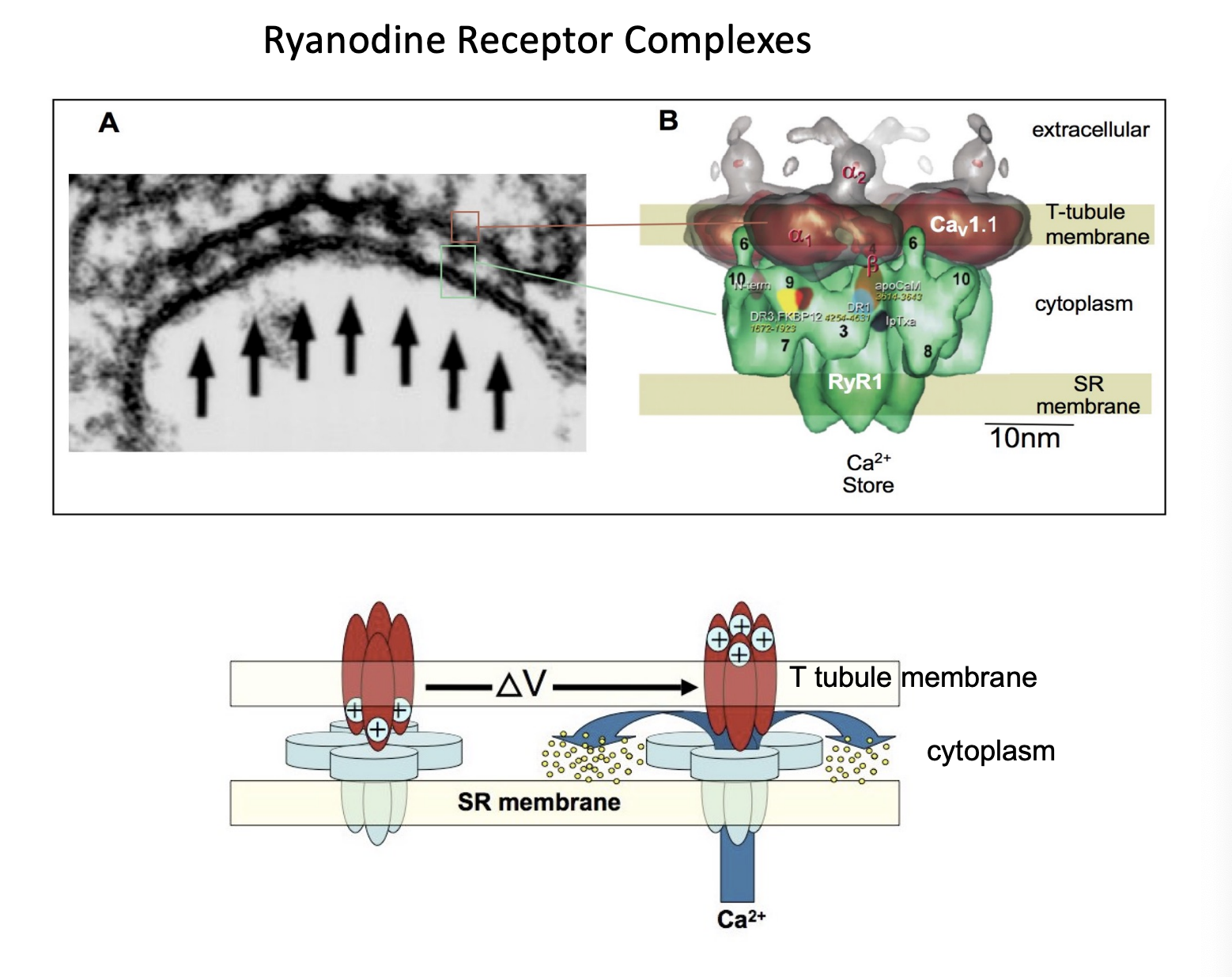
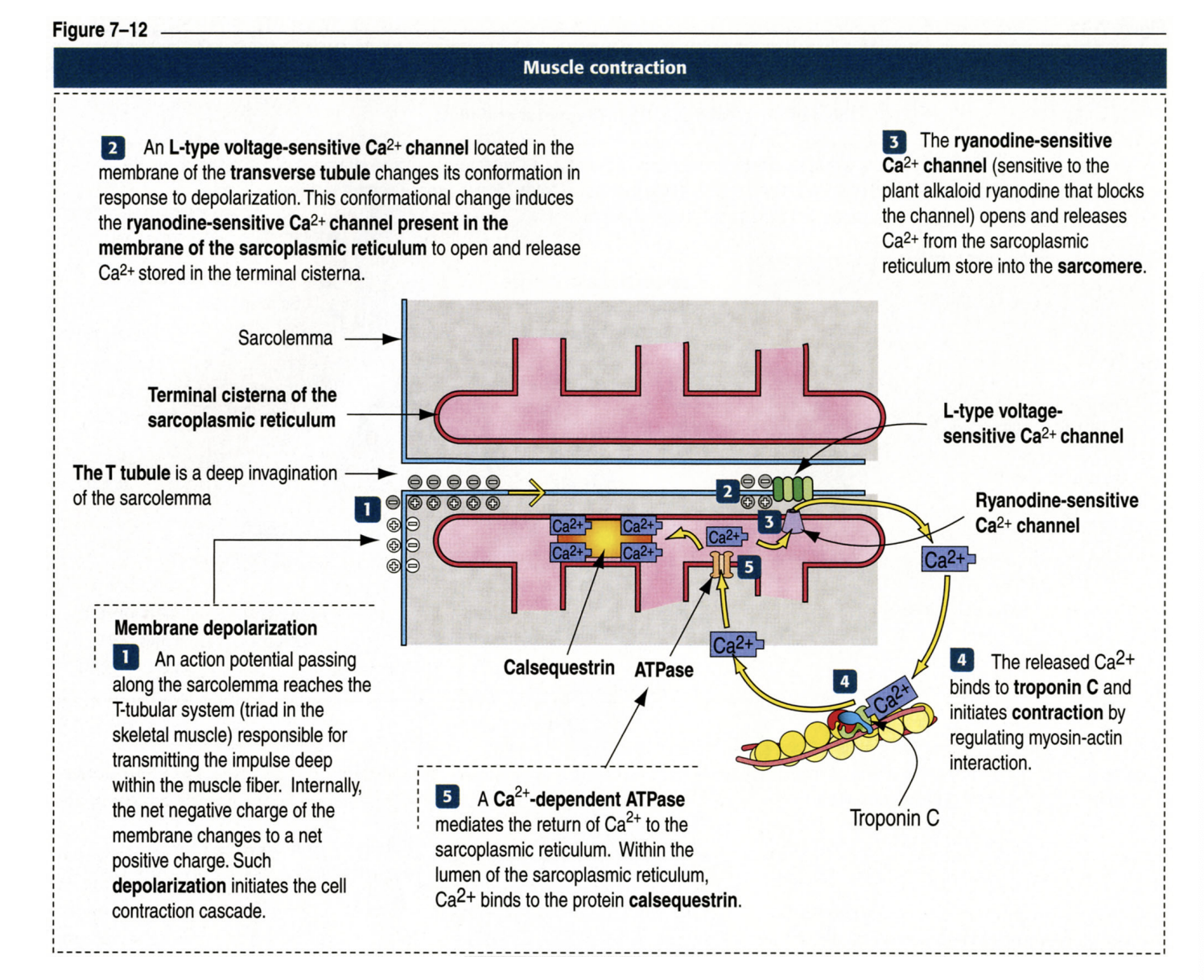
The Calcium Release Mechanism:

  1. An action potential travels down the T-tubule.

  2. This activates L-type voltage-sensitive Ca²⁺ channels (also known as DHPR) in the T-tubule membrane.

  3. A conformational change in the L-type channel physically triggers the Ryanodine-sensitive Ca²⁺ channels (RyR) on the SR to open.

  4. Calcium is released from the SR stores into the cytosol of the muscle cell.
<p><span style="background-color: transparent;"><strong><span>The Calcium Release Mechanism:</span></strong></span></p><ol><li><p><span style="background-color: transparent;"><span>An action potential travels down the T-tubule.</span></span></p></li><li><p><span style="background-color: transparent;"><span>This activates </span><strong><span>L-type voltage-sensitive Ca²⁺ channels</span></strong><span> (also known as DHPR) in the T-tubule membrane.</span></span></p></li><li><p><span style="background-color: transparent;"><span>A conformational change in the L-type channel physically triggers the </span><strong><span>Ryanodine-sensitive Ca²⁺ channels</span></strong><span> (RyR) on the SR to open.</span></span></p></li><li><p><span style="background-color: transparent;"><span>Calcium is released from the SR stores into the cytosol of the muscle cell.</span></span></p></li></ol><p></p>
26
New cards

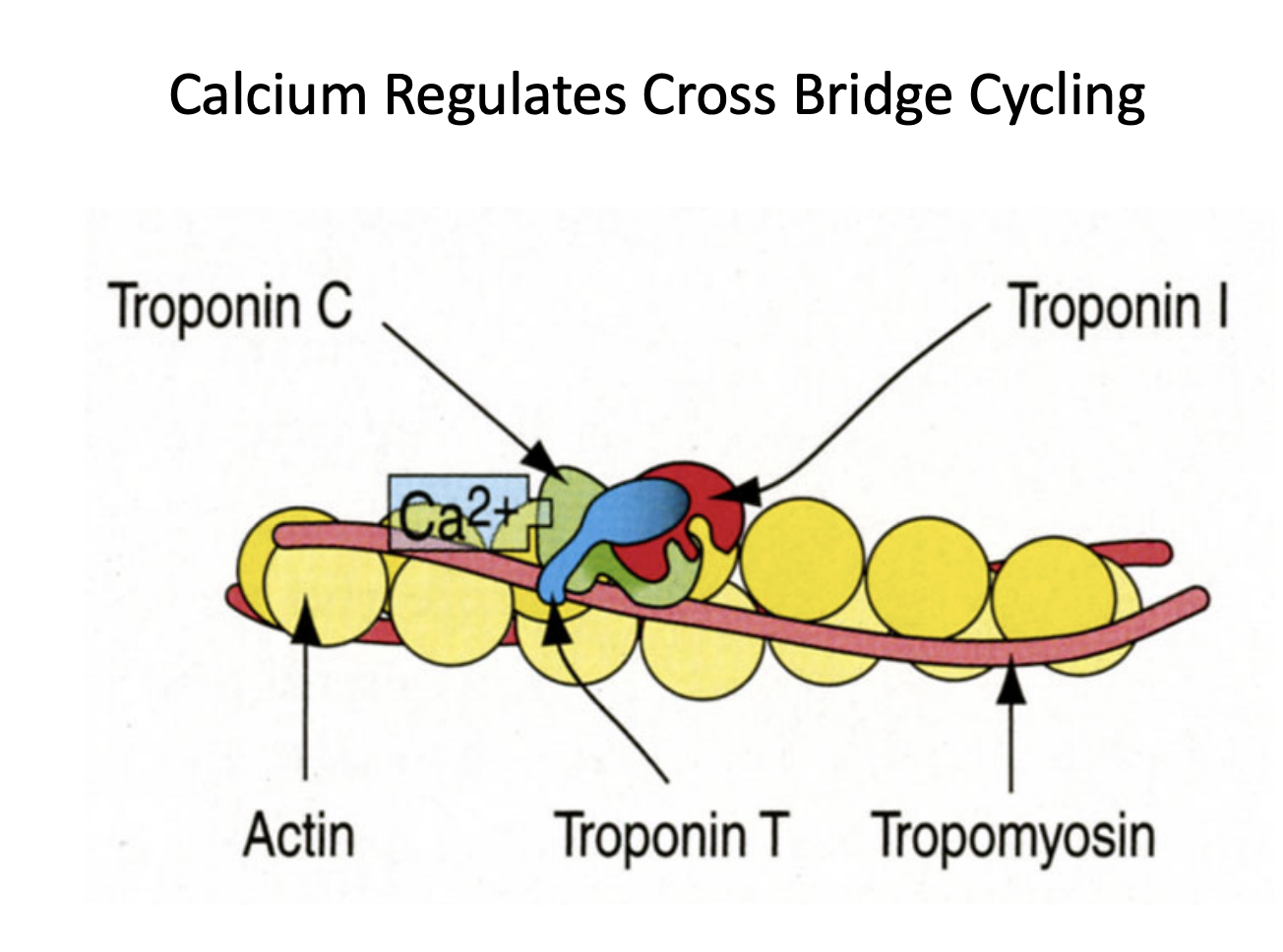
T/F: Calcium serves as the "on/off" switch for contraction.

True.
<p>True. </p>
27
New cards

Describe how calcium regulates cross bridge cycling.

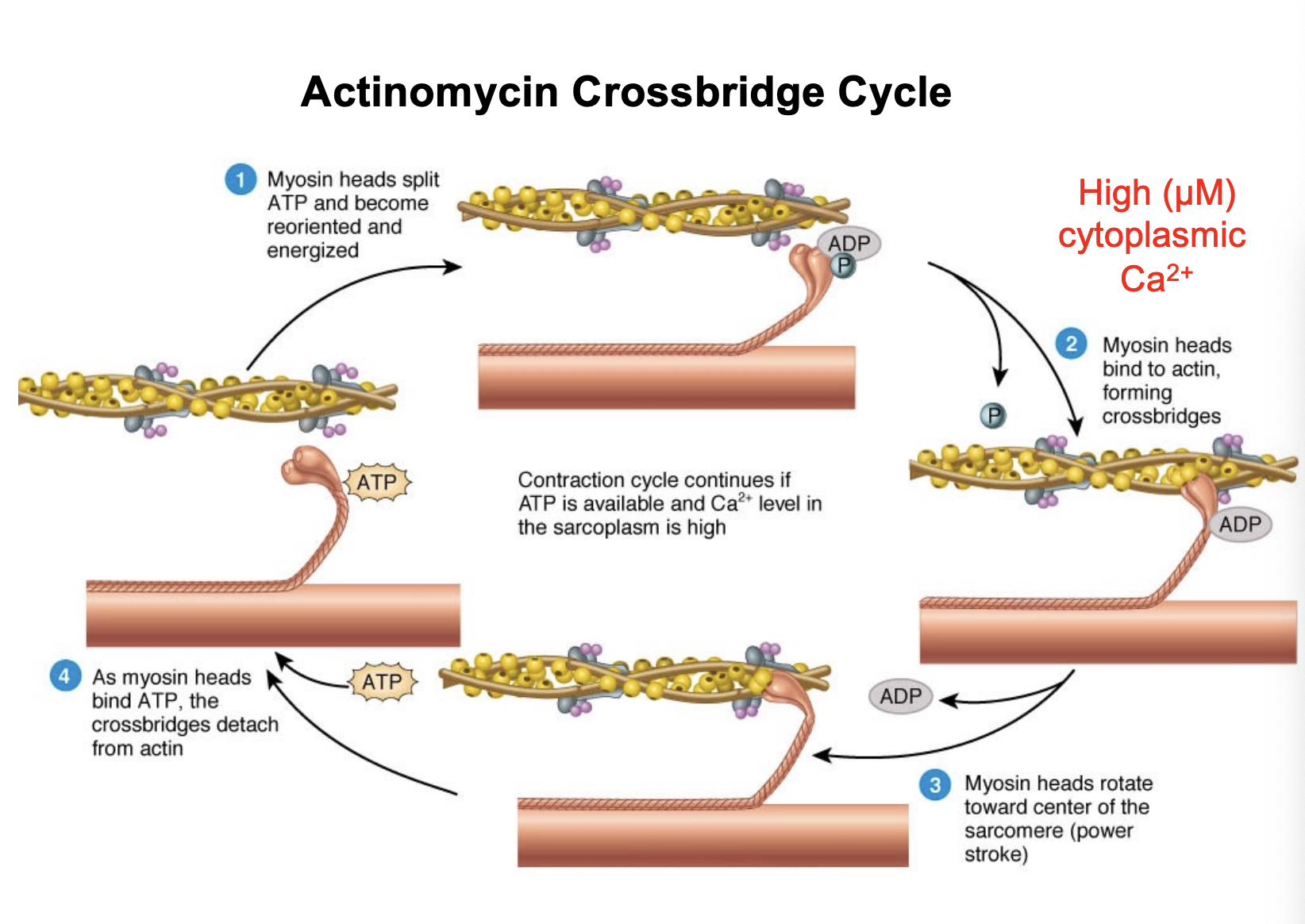
Regulation: In a resting state, the interaction between actin and myosin is blocked. When Ca²⁺ is released, it binds to Troponin C. This causes a shift in the troponin-tropomyosin complex, exposing the binding sites on the actin filament.

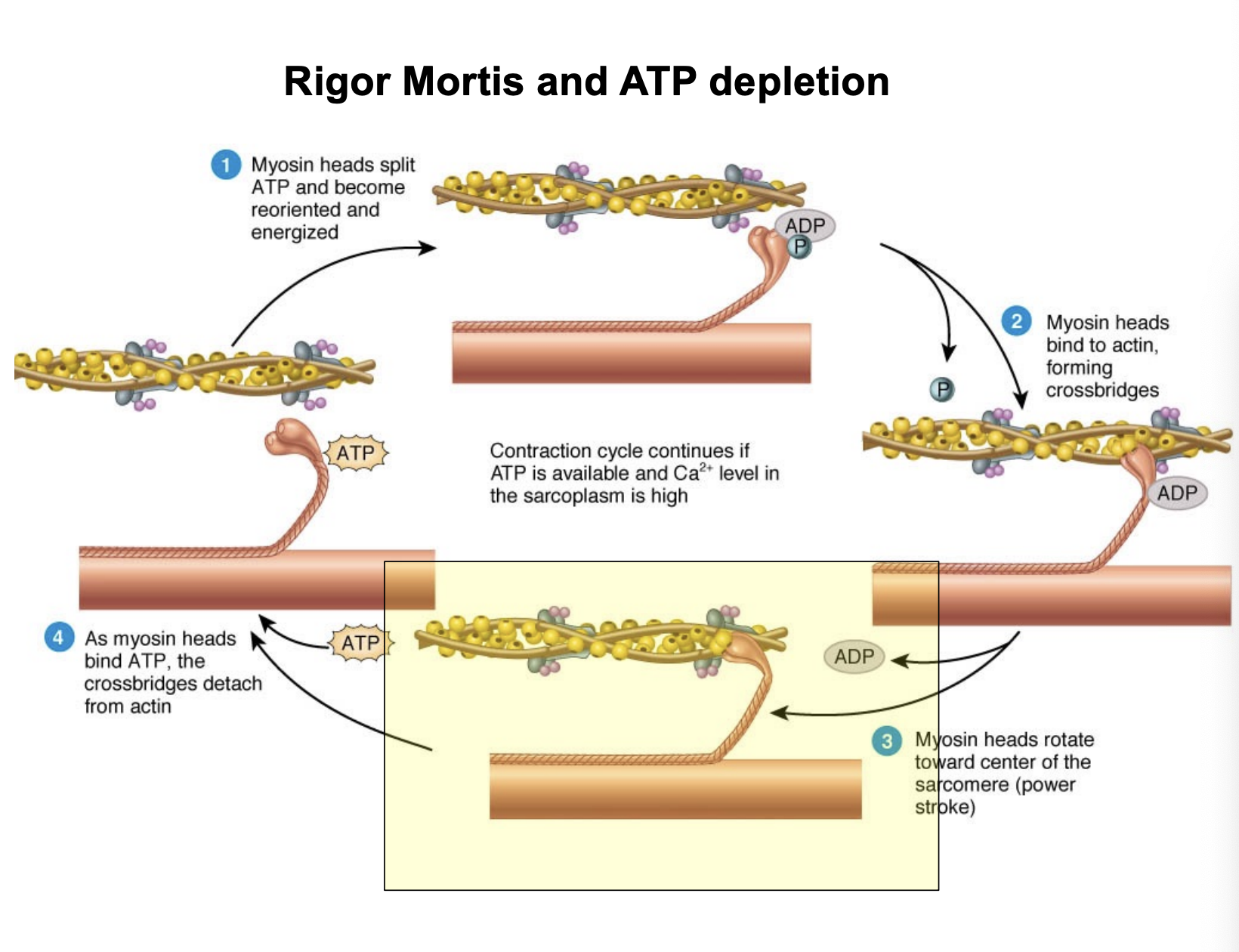
The Cycle: Myosin heads then bind to actin, forming "cross-bridges." They use energy from ATP to pull the actin filaments toward the center of the sarcomere (the power stroke).
<p><span style="background-color: transparent;"><strong><span>Regulation:</span></strong><span> In a resting state, the interaction between actin and myosin is blocked. When Ca²⁺ is released, it binds to </span><strong><span>Troponin C</span></strong><span>. This causes a shift in the troponin-tropomyosin complex, exposing the binding sites on the actin filament.</span></span></p><p><span style="background-color: transparent;"><strong><span>The Cycle:</span></strong><span> Myosin heads then bind to actin, forming "cross-bridges." They use energy from </span><strong><span>ATP</span></strong><span> to pull the actin filaments toward the center of the sarcomere (the power stroke).</span></span></p><p></p>
28
New cards

What is rigor mortis?

Rigor Mortis: This occurs when ATP is depleted. Without ATP, the myosin heads cannot detach from the actin filaments, leaving the muscle in a state of permanent contraction or stiffness.
<p><span style="background-color: transparent;"><strong><span>Rigor Mortis:</span></strong><span> This occurs when ATP is depleted. Without ATP, the myosin heads cannot detach from the actin filaments, leaving the muscle in a state of permanent contraction or stiffness.</span></span></p>
29
New cards

Explain how a contraction is terminated.

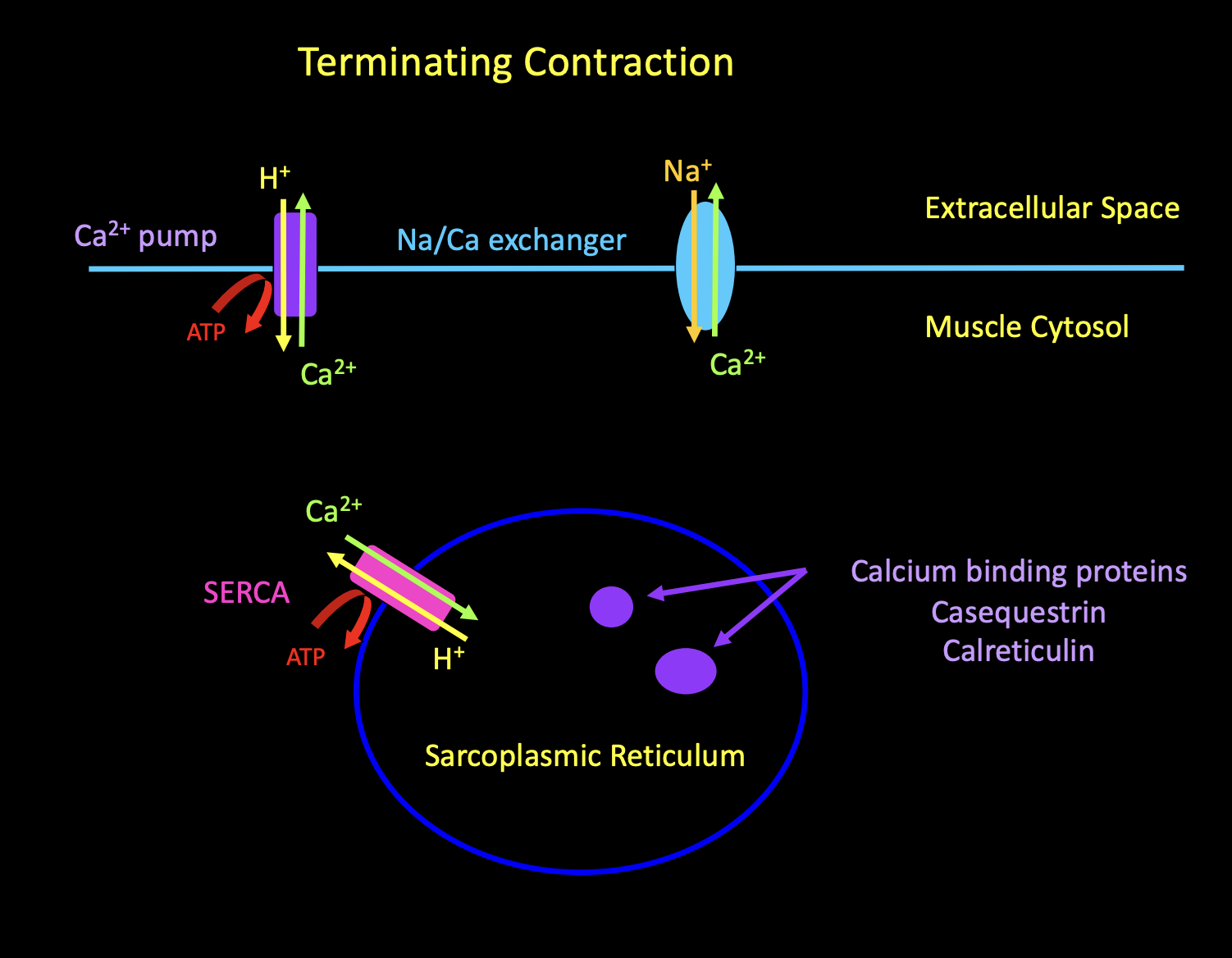
To stop a contraction, calcium must be removed from the cytosol.

  • SERCA Pump: A Ca²⁺-dependent ATPase (SERCA) actively pumps calcium back into the Sarcoplasmic Reticulum.

  • Calsequestrin: Once inside the SR, calcium binds to the protein calsequestrin for storage.

  • Acetylcholinesterase (AChE): In the synaptic cleft, this enzyme breaks down ACh to stop the initial electrical signal.
<p><span style="background-color: transparent;"><span>To stop a contraction, calcium must be removed from the cytosol.</span></span></p><ul><li><p><span style="background-color: transparent;"><strong><span>SERCA Pump:</span></strong><span> A Ca²⁺-dependent ATPase (SERCA) actively pumps calcium back into the Sarcoplasmic Reticulum.</span></span></p></li><li><p><span style="background-color: transparent;"><strong><span>Calsequestrin:</span></strong><span> Once inside the SR, calcium binds to the protein calsequestrin for storage.</span></span></p></li><li><p><span style="background-color: transparent;"><strong><span>Acetylcholinesterase (AChE):</span></strong><span> In the synaptic cleft, this enzyme breaks down ACh to stop the initial electrical signal.</span></span></p></li></ul><p></p>
30
New cards

How does black widow venom interfere with the NMJ?

Black Widow Venom: Causes an explosive, uncontrolled release of ACh, leading to initial spasms followed by paralysis.
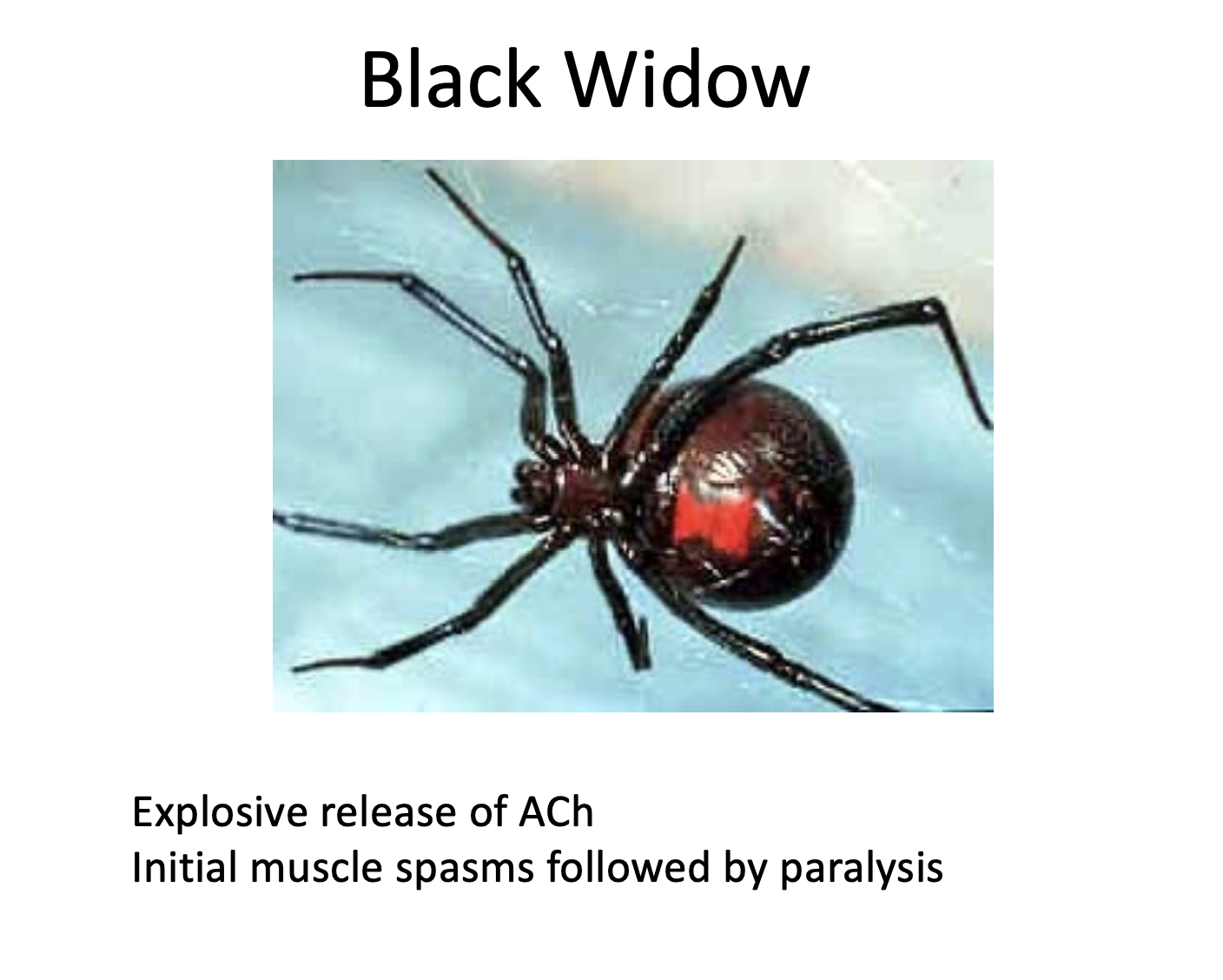
<p><span style="background-color: transparent;"><strong><span>Black Widow Venom:</span></strong><span> Causes an explosive, uncontrolled release of ACh, leading to initial spasms followed by paralysis.</span></span></p><p></p>
31
New cards

How does curare arrow poison interfere with the NMJ?

Curare: An arrow poison that binds to and blocks ACh receptors, preventing the muscle from receiving the signal to contract.
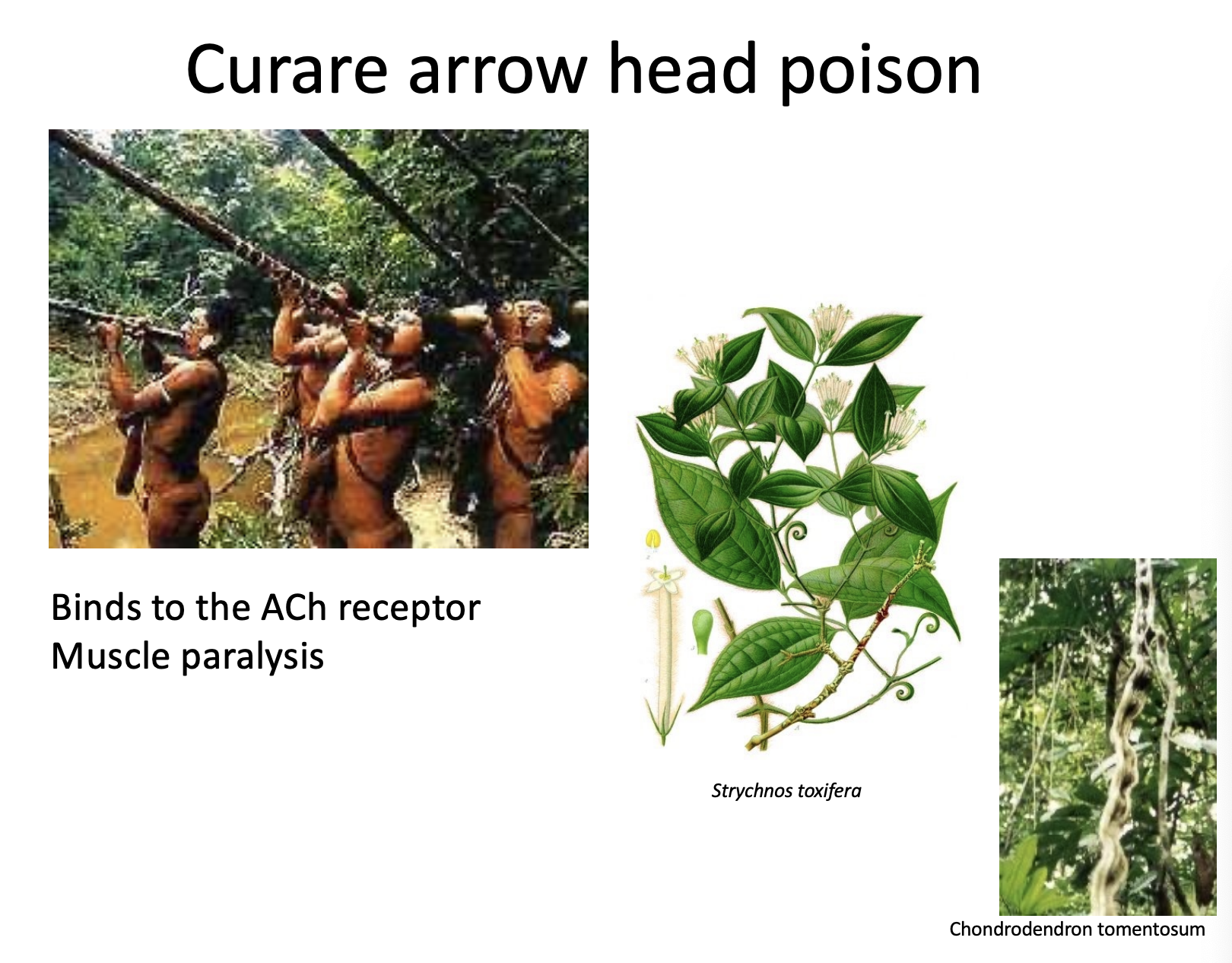
<p><span style="background-color: transparent;"><strong><span>Curare:</span></strong><span> An arrow poison that binds to and blocks ACh receptors, preventing the muscle from receiving the signal to contract.</span></span></p>
32
New cards

How does Botulinum Toxin interfere with the NMJ?

Botulinum Toxin (Botox): Produced by Clostridium botulinum, it blocks the release of ACh from the nerve terminal, preventing contraction entirely.
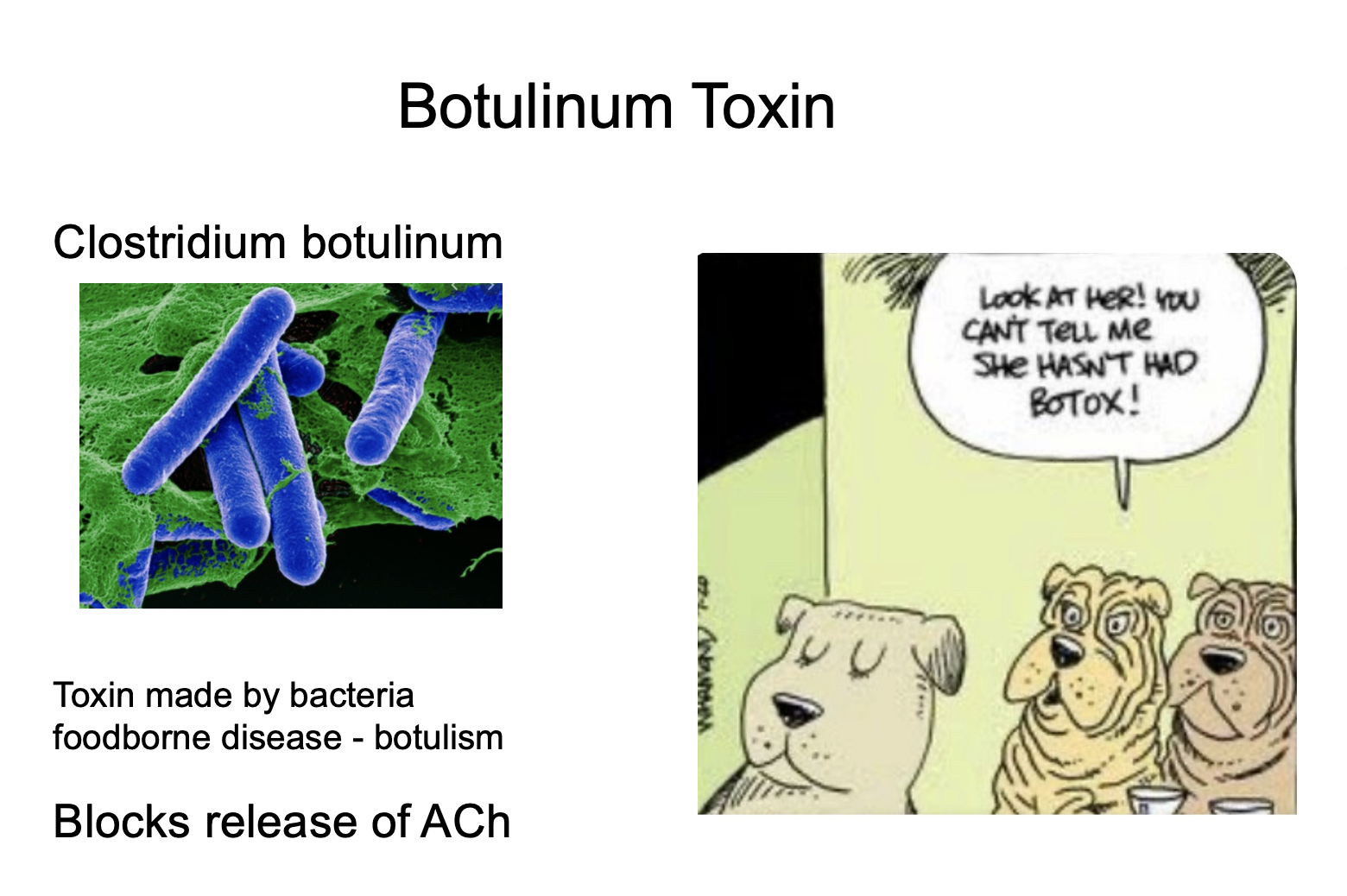
<p><span style="background-color: transparent;"><strong><span>Botulinum Toxin (Botox):</span></strong><span> Produced by </span><em><span>Clostridium botulinum</span></em><span>, it blocks the release of ACh from the nerve terminal, preventing contraction entirely.</span></span></p><p></p>

Explore top flashcards