Ecology Exam 2
 Studied by 0 people
 Call Kai
 Learn
Learn Practice Test
 Spaced Repetition
 Match
Match Flashcards
 Knowt Play
1/88

There's no tags or description
Looks like no tags are added yet.
Name | Mastery | Learn | Test | Matching | Spaced | Call with Kai |
|---|
No analytics yet
Send a link to your students to track their progress
89 Terms
What are adaptations?
variations of phenotypes. helps an organism gain more fitness in its environment
3 requirements of natural selection
heritability
variation
fitness (survival and reproductive responses)
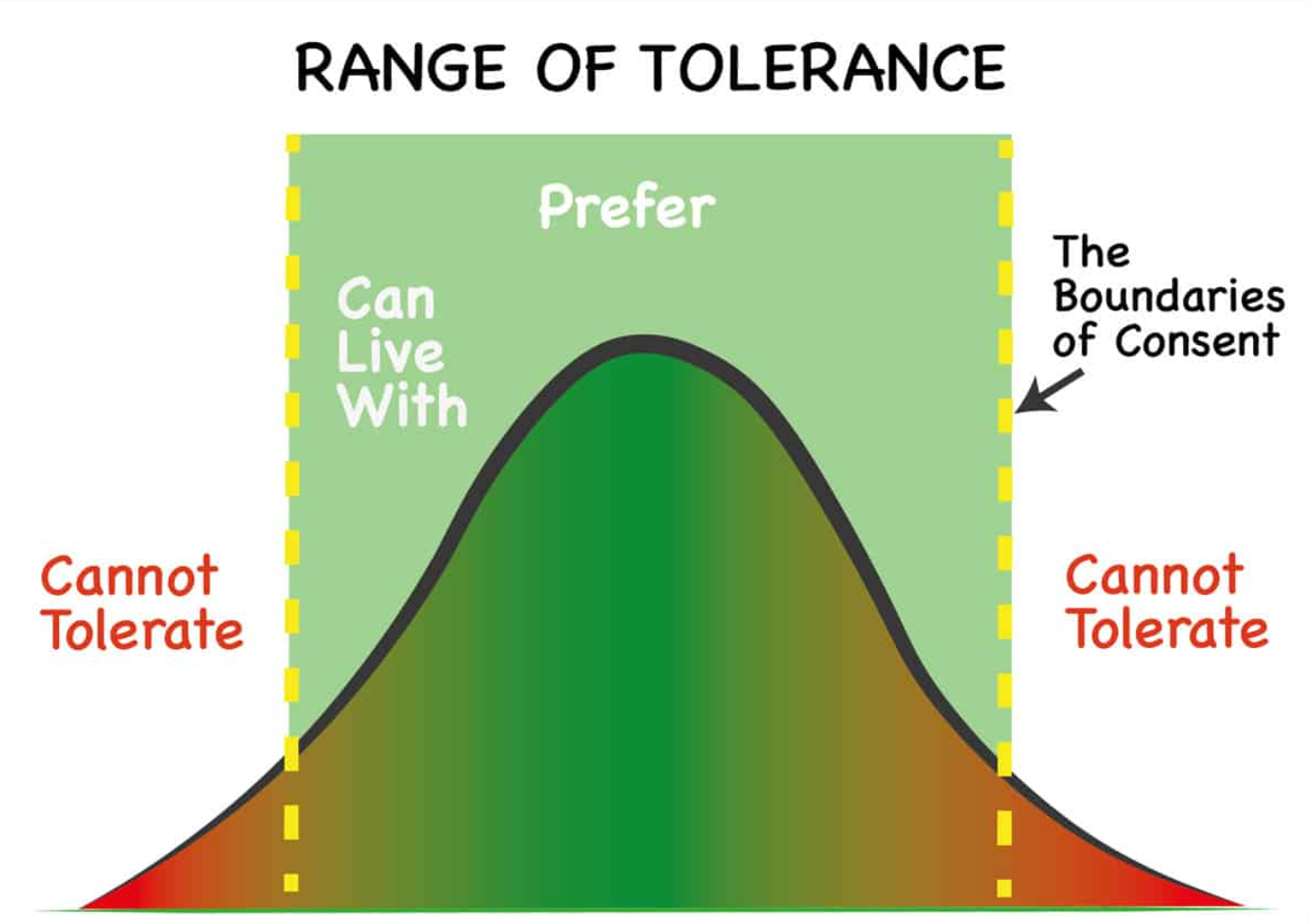
range of tolerance
range at which an organism can optimally exist
heat is a big stressor for most animals
Thermal Properties of water
high heat capacity (how many calories it takes to raise water temperature by 1° C
note: C = Kcal and c = calories; we are using little c
absorbs more than air
resists phase and temperature changes
Density
water is very dense
800x denser than air
lipids and fats are less dense (why we float)
bones and proteins are denser than water
What are the properties of water?
High heat capacity (limits thermoregulation)
Adaptations
density
viscosity
solvent capacity
osmotic potential
viscosity
resistance of movement (drag)
reduces or increases drag
Solvent Capacity
water has a medium movement capacity (movement and reactivity)
can transport important elements and nutrients/micronutrients
all soluble in water
salt calcium and hydrogen
H+ ion is reactive (pH)
Osmotic Potential
Force of attraction between water and aqueous solutions
units of pressure MPa
passive transport is semipermeable membrane
Adaptation for Density
swim bladder (fish and kelp)
algae use oil droplets to stay afloat
adaptations for viscosity
streamlined body shape (like a dolphin)
zooplankton want to float, so they have appendages to use viscosity in a different way
Solvent Capacity and Osmotic Potential adaptations
passive and active transport allows water to go through semipermeable membrane
Hyperosmotic vs hypoosmotic vs isotonic
affects nitrogen balance
Passive transport
molecules move along concentration gradient; moves from many solutes to few solutes
osmosis
diffusion
facilitated transport
Active Transport
cells transport molecules against gradient to maintain concentration
Note: expends more energy because cells work against gradient
Vesicles -endocytosis and exocytosis
Protein pumps
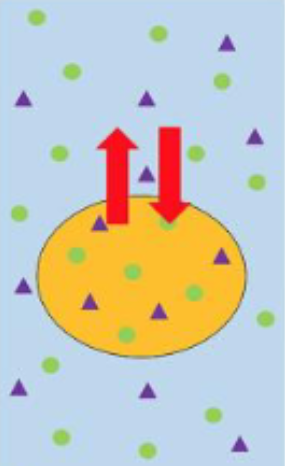
Isotonic cells
Water flows from cells and surroundings equally
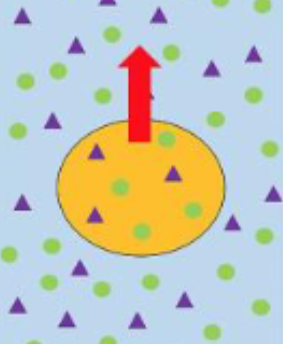
hyperosmotic cells
water flows out of cells and cell shrinks
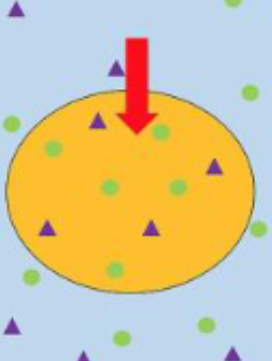
hypoosmotic
water flows into cell and cell grows
Are Freshwater fish hyper- or hypo- osmotic? What does that mean?
Freshwater fish are hyperosmotic, meaning they have a higher concentration of solutes in their body than in their surrounding water.
How do freshwater fish take in water? What happens to most of the water they take in?
They take in water through their food and osmosis in their mouth and gills. Water passes through their body and kidneys filter out excess water causing a lot of urination.
How do freshwater fish take in solutes? What happens to most of the solutes they take in?
Solutes are taken in through the food they eat and active uptake in the gills. Most of the solutes remain in the fish because the kidneys reabsorb it.
Are Saltwater fish hyper- or hypo- osmotic? What does that mean?
Saltwater fish are hypoosmotic meaning organisms have a lower concentration of solutes than their surroundings
How do saltwater fish take in water? What happens to most of the water they take in?
Drink lots of water and retain most of it. Water lost through gills (osmotic loss) and urination. The kidneys conserve most of the water so they only urinate a little.
How do saltwater fish take in solutes? What happens to most of the solutes they take in?
take in salts through the water that they drink. They excrete most solutes from their kidneys and gills
Salt balance in coral reefs
high temperatures → Ocean evaporation → higher salt concentrations → coral bleaching
salt balance adaptations in mangrove trees
high solutes in roots and leaves lead to salt glands in leaves and active transport in roots to remove excess salt
Ammonia (NH3) in the role of nitrogen balance
byproduct of protein digestion, toxic to tissues
Excreted easily in aquatic systems
Dilute urine
Sharks/Rays Nitrogen Balance
Urea (CO(NH2)2)
damages proteins
Use it to add/subtract solutes from the blood
Trimethylamine oxide protects proteins
Terrestrial Nitrogen Balance
Uric Acid (C5H4N4O3)
little water needed
Urea
Loop of Henle
Explain Cohesion-Tension Theory
how water moves across gradients
Transpiration:
osmotic potential draws water in
root pressure and cohesion draw water up xylem
Gravity pushes it back down
Water potential in leaves- evaporation creates tension in leaves
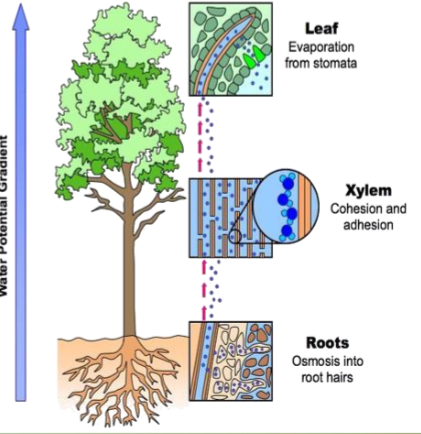
adhesion
water sticks to a surface
cohesion
water molecules stick to other water molecules
What do soils provide?
nutrients and water
matric potential
stickiness of soil particles; how easy is it for plants to pull water from the soil?
increased volume = increased stickiness
Note: clay soils have highest surface area to volume ratio
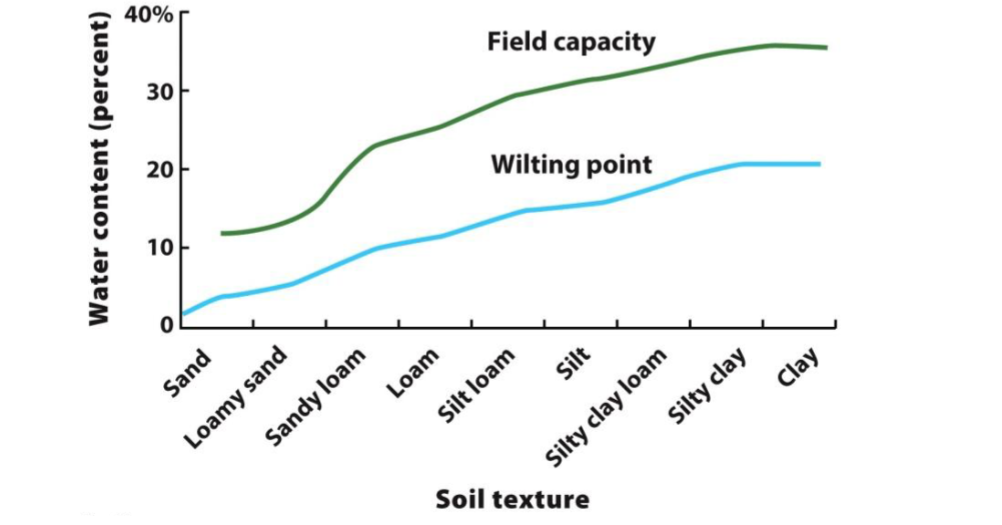
Field Capacity
how much water the soil holds before sinking into the water table
Wilting Point
point at which plants can no longer pull up water from the soil
Note: think about when you are sipping a drink through a straw. when you get to the end you can still see a little in the bottom but you can’t suck it up with the straw.
What do most soils consist of?
Sand, silt and clay
What is the best type of soil? Why?
loamy soils, they have a medium field capacity and wilting point compared to clay and sandy soils
thermal optimum
indicates the temperature at which organisms have their best performance
between 0 -100°C
<45°C for Eukaryotes
What are some pros of heat?
Kinetic energy
movement of molecules
speeds up chemical reactions
What are some cons of heat?
denatures proteins and destabilizes protein structures
lose structure
malfuctions
homeotherm
maintain constant temperature internally
poikilotherm
relies on ambient temperatures (body temperature varies)
heterotherms
body temperatures differ between both internal and ambient temperatures
Ectotherm
body temperature determined by surrounding temperatures
Endotherms
generate metabolic heat to raise body temperatures (internal)
Heat Budget
what energy is required to perform typical behaviors (growth, reproduction etc.)
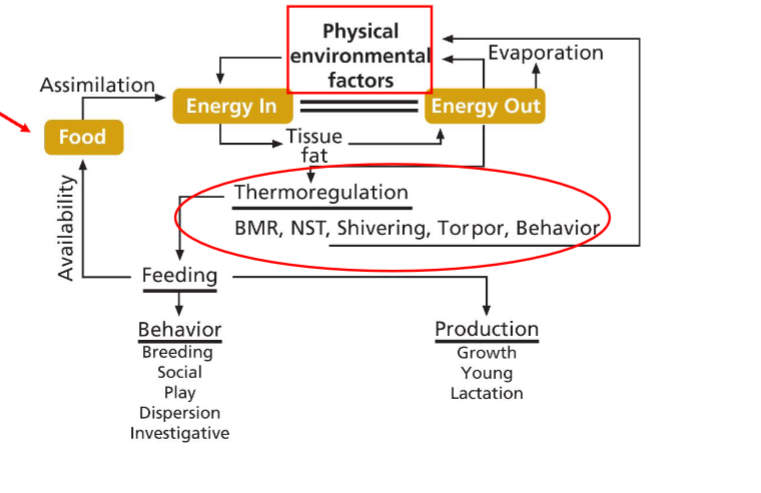
Thermal Inertia
The resistance to a change in temperature due to a large body volume.
surface area to volume ratio
smaller animals have a higher ratio meaning they are going to lose or gain heat faster than a larger animal
the smaller the animal, the larger the ratio
What are the 4 sources of heat?
Radiation, Conduction, Convection, Evaporation (and Respiration)
Radiation
Infared
sun, sky, land, surfaces
reradiation occurs from air and landscape
conduction
direct contact
Based on:
SA:V
ambient vs. internal temperature
resistant to heat transfer
water has low resistance
heat loss in water 20x faster than in air
Convection
transfer by movement
gain energy and move away
disrupts boundary layer (spines, hair etc.)
Evaporation
gas exchange and surface
rise of water loss
rate doubles with each 10°C increase (dry only)
relative humidity (humidity sucks)
What are some ways organisms cope with the cold?
Homeostasis: keep body temperature above freezing
biomechanical responses
biochemical responses
anatomical responses
behavioral responses
Muscle Heat
red muscle in fish
muscle contractions to create heat
countercurrent heat exchange
Movement of two fluids in opposite directions on either side of a barrier through which heat or dissolved substances are exchanged.
blood shunting
allows specific blood vessels to shut off so that less of an animal’s warm blood flows to the cold extremities.
antifreeze molecules
glycerol is used to lower the temperature at which the cells freeze
glycoproteins coat hydrogen ions to prevent ice layers from forming
Ex. Antarctic fish and terrestrial invertebrates
What do plants do to resist freezing?
move water out of cells; grow lower to the ground and closer together to conserve heat (tundra)
Photosynthesis
6C02 + 6H20 + proteins → C6H12O6 + 6O2
Light Reactions
C3 Photosynthesis
C4 Photosynthesis
CAM
C3 Photosynthesis
CO2 + RuBP → 2G3P
Occurs in the Mesophyll
2G3P enters the Calvin Cycle
self-limiting CO2 intake from environment
CO2 comes from opening stomates
allows for gas exchange; causes water loss
not good for plants in hot, dry, climates
C4 Photosynthesis
CO2 + PEP → OAA
Occurs in the mesophyll
PEP grabs to CO2 better; don’t have to leave stomates open
CAM Photosynthesis
“Crassulacean Acid Metabolism”
Calvin Cycle at night (stomates bring in CO2 at night when it’s cooler)
pushes CO2 into bundle sheath and perform photosynthesis during the day
What are some anatomical adaptations of plants to cope with temperature?
increase edge to surface area on leaves
no leaves at all
waxy cuticles
recess stomates
Note: the goal is to increase boundary layer to avoid evaporation
What are some anatomical adaptations of animals to cope with temperature?
Anatomical structures (heat shields and large ears
Boundary Layer (puffing of feathers, fur, etc.)
Kidney size and function
Adaptation vs. Acclimation: Adaptation
evolutionary process
better suited for their environment (increased fitness)
Acclimation
doesn’t drive evolution
often reversible
response to environmental variation
can happen quickly
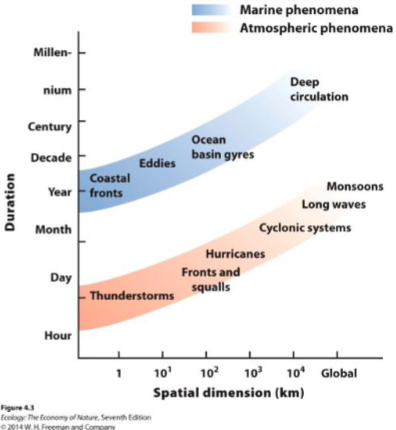
can be spatial or temporal
temporal variation
fire, disease, etc.
temporal vs spatial variations
climate vs weather
Spatial Variation
climate, topography, soil
Spatial - temporal Correlation
Phenotypic Plasticity
The ability of a single genotype to produce multiple phenotypes
Inducible
(Ir)reversible
Fast/slow
Types:
physio
morpho
behavioral
life history
Non-plastic phenotype
phenotype that is only good for one environment. Does not change when the environment changes
plastic phenotype
a phenotype that can be helpful in many environmental conditions. It lowers fitness in both however some fitness is better than no fitness
Coping with the environment
Look at notes and slide show
microhabitats
an area within a habitat that has a slight change in temperature. Often allowing for an animal to move there as a coping strategy for the heat or cold
What are the types of dormancy?
aestivation, hibernation, torpor, diapause
diapause
insects: used whenever there are unfavorable conditions
hibernation
endotherms: store body fat, lower heart rate and body temperature
aestivation
similar to hibernation but in hot, dry climates
torpor
short periods of time; body temperature drops
What is the goal of optimal foraging?
minimize expenditures and optimize benefits
What are the types of optimal foraging?
central place foraging
risk-sensitive foraging
optimal diet composition
diet mixing
Central place foraging
graphs predict optimal amount of time to travel to get more food
greater risk of predators and energy expenditure the farther away you go
cost/benefit analysis
law of diminishing returns
risk sensitive foraging
based on the variability and risk associated with food sources, balancing energy gain against potential dangers
small and large chub experiment
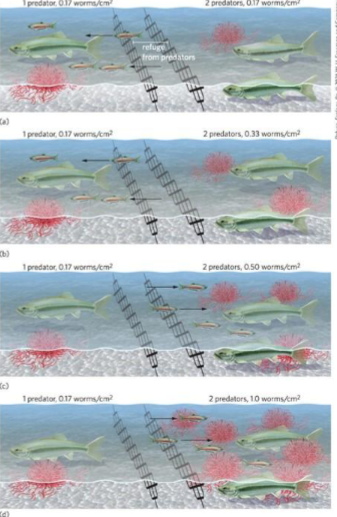
optimal diet composition
energy expenditure/handling time are considered
Things to consider:
energy output from food
handling time
encounter rate
always eat highest energy food item if abundant; only eat lower energy items if high energy items are scarce
diet mixing
mixing foods together to get more nutrients
How do organisms know they need to make adaptations?
timing of physiological and behavioral change
assess the environment
assess individual needs
What does an organism’s ability to assess the environment include?
food supplies
predation risk
indirect environmental cues (photoperiod)
What does an organism’s ability to assess individual needs include?
growth, reproduction, senescence
metamorphosis, dormancy
behavior
climate change (makes these more difficult)
 Note
Note  Flashcards (39)