3.5: Population size and ecosystems
 Studied by 0 people
 Call Kai
 Learn
Learn Practice Test
 Spaced Repetition
 Match
Match Flashcards
 Knowt Play
1/124

There's no tags or description
Looks like no tags are added yet.
Name | Mastery | Learn | Test | Matching | Spaced | Call with Kai |
|---|
No analytics yet
Send a link to your students to track their progress
125 Terms
Define ecosystem
A group of interdependent organisms and their habitats in an area that has fairly uniform conditions
Define habitat
The part of an ecosystem in which particular organisms can live. It can be very specific (e.g. micro-habitat)
Define biological niche
Its role in a habitat where the species live and the environmental conditions that it requires.
Define population
All the organisms of one species living in a particular habitat or area (abundance of one species)
Define community
All organisms of all species that live together in a particular ecosystem or habitat
Define abiotic factors
Non-living, physical factors of an ecosystem, such as salinity, pH, temperature aND humidity.
Define biotic factors
The effects of the activities of living organisms an other organisms such as predation, competition and symbiotic relationships.
Two types of symbiotic relationships?
Scavengers, carnivores, detritivores (physically consume dead organic matter)
Decomposers/saprophytes that secrete extracellular enzymes to absorb the products of dead organic matter.
What is the exclusion principle?
If two species are occupying one niche, one normally outcompetes the other/
What is the only way that two organisms can occupy the same niche
Resource partitioning
Intra vs interspecific competition
Intaspecific = same
Interspecific = different e.g. Paramecium proves the exlusion principle as they compete for the same niche
Exponential vs logistic growth of population.
Exponential is J-shaped and logistic is S-shaped.
Exponential is seen in a bacteria culture
Logistic is more realistic and almost all populations look like this
How is growing bacteria exponential?
All factors that are barriers are removed in a lab
What is the carrying capacity.
The maximum number of individuals of one species an area can hold, so there are overshoots and undershoots fluctuating around the carrying capacity,
How do log graphs work?
Plotted on a log10 graph as the numbers needed on axis are too large (e.g. 2 = 10²)
If it is a decimal, find the antilog (10^number)
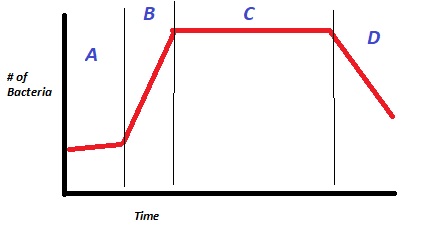
Label the steps of the one-step growth curve
Lag phase
Exponential/log phase
Stationary phase
Death phase
Explain the lag phase
Initially, population doesn’t increase, then there is growth due to a period of adaptation and preparation for growth by equilibrating to environment. In sexual reproduction, its the time taken to reach sexual maturity.
Explain the exponential phase
As numbers increase, without a limiting factor more individuals can reproduce.
Why can the exponential phase not be maintained indefinitely?
Environmental resistance sets in. Less food, waste concentration and lack of space means it still increases, but at a slower rate. Abiotic and biotic factors plat a role.
Explain the stationary phase
Birth rate is equal to death rate as the carrying capacity is reached
Explain the death phase
The factors that slow population growth at the end of the log phase become more significant and population decreases until death rate > birth rate
Do predators or prey often have a larger population?
Prey as they follow a cyclical pattern with predators fluctuating.
Explain how paramecium proves the competitive exclusion principle.
Both feed on the same thing and one species reproduces faster.
What is a density dependent factor?
Bitotic factors. High population means effects are stronger and higher growth.
What is a density independent factor?
Affects population regardless of population density, e.g. extreme weather, volcano or forest fire.
How does the population fluctuate if there is an increase in population above optimum?
There will be increased competition or predation, so a fall in population happens to return optimum population.
Define abundance
The number of individuals in a species in a given area or volume
Why is a log graph used for population growth? What would 2 mean on the graph?
Numbers too large to plot on a normal axis. 2 means 102.
If the population started at 102 and grew to 105 in 5 days, what is the population growth per day?
(100,000 - 100) / 5 =19,980
How to measure abundance of animals?
Capture-remark experiment or kick sampling
How to measure abundance of plant species?
Using a quadratic to caculate mean number of individuals to find density, estimating percentage cover or percentage frequency.
How to measure distribution.
A line transect with measured intervals.
What diagram shows abundance and distribution along a transect?
Kite diagram, but numbers rounded so accuracy lost.
Where does energy to support all organisms come from?
The sun incorporated by photosynthesis, but also comes from chemical reactions incorporated in chemosynthesis.
How is energy lost in the food chain?
Energy flowing reduces and ultimately leaves as heat.
What is a saprobiont?
Organism that derives energy and raw materials for growth from extracellular digestion of dead or decaying material.
What are detritivores and detritus?
Detritivores are organisms like earthworms which feed on small fragments of organic debris (detritus)
What are decomposers?
Microbes such as bacteria and fungi that obtain nutrients from dead organisms and animal waste, and complete decomposition started by detritivores.
What is gross primary productivity?
The rate of production of chemical energy in organic molecules by photosynthesis in a given area, in a give time e.g. respiration to fuel things like protein synthesis.
What is net primary productivity?
Energy in the plants biomass which is available to primary consumers e.g. food available to primary consumers, or in crops the yield that may be harvested.
How to calculate NPP?
GPP - respiration = NPP
What is primary productivity?
The rate at which producers convert energy into biomass.
What is secondary productivity?
The rate at which consumers accumulate energy from assimilated food in biomass in their cells or tissues in heterotrophs (animals, fungi, and some protists and bacteria).
How is energy lost in a food chain
Energy egested, lost as heat or remains in parts not eaten (e.g. horns and fur).
Problems with pyramid of numbers [3]
Doesn’t take into account size of organisms
No recognition between adult vs juviline
Difficult to draw to scale with large numbers
Problems with pyramid of biomass [4]
Difficult to measure accurately e.g. plants roots
Pyramids of biomass may be inverted.
Trophic level may seem to contribute more than it does as some things not transferred like bones and beak.
Different lifespans
What is succession?
A directional change in a community and the species it contains over times and is the sequence of changes that leads to a stable climax community.
Features of the climax community|?
High in biodiversity, so stable and highly productive, with no further major changes.
What is primary succession?
A change in structure and species composition of a community overtime in area that has not been previously colonised (i.e. no soil in a volcanic or bare rock conditions).
What is each stage in succession called?
Sere/seral stage
What happens with each seral stage?
Each stage changes the environment making it more suitable for new species to colonise the area, if a new species enters by immigration it may outcompete.
What is the xerosphere?
Plant succession in an area limited by water availability e.g. extremely dry desert.
4 steps of primary succession?
Pioneer species
Annual plants, Perennial plants and grasses
Shrubs and softwood trees and pines
Climax community
Pioneer species:
Where do they first grow?
What is formed and how?
What happens overtime?
Grow in cracks of rocks with no soil needed
Humus formed by a mutualistic relationship between algae and fungi and form primitive soil (small nutrients and thin base layer).
Erosion of rock by weathering and lichen decomposition occurs in the humus layer to build up, and is decomposed by secretion of enzymes.
What are annual and perennial plants?
Very small plants with shallow roots to grow in the humus layer. They die and decompose, so soil becomes rich in nutrients, thickening the soil. Able to grow because of wind-blown spores.
How does succession progress to shrubs and softwood trees or pines?
Because the soil is thicker and richer in nutrients, larger organisms with deeper roots can survive as water is held more efficiently.
How is a climax community established?
Contains hardwood trees and is the final stage of succession with shrubs, due to thick nutrient-rich humus developing to create a stable community.
Why are there no annuals and perennials in a climax community?
Outcompete them with not enough light to grow.
What happens to plant vs animal diversity in a climax community?
Plant biodiversity decreases: due to abiotic conditions of light energy not reaching bed and so annuals and perennials cannot grow.
Animal biodiversity increases: microhabitats and food for animal niches for both vertebrates and invertebrates.
What makes the climax community stable?
Every organism has its own niche, so it is stable and there is little competition.
4 steps to summarise succession?
Lichens and mosses develop humus layer
Shallow and small roots grow in hummus layer and die to develop nutrients and thicken soil.
Shrubbier plants grow in deeper and richer soil, which plants can be eaten by herbivores as they are coarser. Develop soil level further.
Climax community is stable and so plant BD decreases and animal BD increases.
What type of competition is there between each seral stage of succession?
Interspecific competition, making environment more stable for another species.
What 3 things does a climax community have an equilibrium between.
GPP and respiration
Energy from sun and respiration
Nutrients in soil and decay
What is secondary succession? What if it’s a wildfire?
After a major natural disaster for example, succession begins again from bare soil, is climax community achieved much faster as there may be viable spores, bulbs and seeds. Wildfires increase soil fertility.
What is a disclimax and name 3 examples?
Humans interfere and thus prevent the climax community from forming. e.g. cattle grazing, farming and deforestation.
What is mutualism and give one example?
An interaction between organisms of two species from which both derive benefit e.g. flowers and their pollinators.
What is commensalism and give one example?
An interaction between organisms of two species from which one benefits but the other is not affected. e.g. squirrel benefits from tree and tree isn’t affected.
3 major biological processes of the carbon cycle and one extra.
Respiration - organisms breathe and release CO2 into atmosphere.
Photosynthesis - carbon in fossil fuels burnt and released.
Decomposition - absorbs CO2
Combustion - breakdown of dead organic matter and carbon enters the soil.
5 main forms canon is stored in the carbon cycle
Carbon dioxide (CO₂) in the atmosphere
Living organisms (plants, animals, decomposers)
Dead organic matter
Fossil fuels
Oceans (dissolved CO₂, shells, limestone)
How do producers remove carbon dioxide from the atmosphere?
Through photosynthesis, where CO₂ is used to make glucose and build plant biomass.
How does carbon move from producers to consumers?
Through feeding (consumers eat plants or other animals)
How do producers and consumers return carbon dioxide to the atmosphere?
Respiration
What happens to carbon when plants and animals die?
Carbon enters dead organic matter and is broken down by decomposers.
How do decomposers affect the carbon cycle?
They respire, releasing carbon dioxide back into the atmosphere.
How does combustion affect the carbon cycle?
Burning fossil fuels releases carbon dioxide back into the atmosphere.
How does carbon move between the atmosphere and oceans?
CO₂ dissolves into oceans and can be released back into the atmosphere. Dissociates to HCO3- when dissolved in seas.
How does carbon become locked into limestone?
Marine organisms use dissolved carbon to make shells; over time these form limestone.
How does deforestation increase carbon dioxide levels? [3]
Fewer trees → less photosynthesis
Trees are often burned, releasing CO₂
Decomposing trees release CO₂ through respiration
How does deforestation affect carbon storage?
It reduces the amount of carbon stored in plant biomass.
How does burning fossil fuels affect the carbon cycle?
It releases large amounts of carbon dioxide into the atmosphere faster than natural processes can remove it.
What type of radiation from the Sun reaches the Earth?
Short-wave radiation.
What type of radiation does Earth emit?
Long-wave (infrared) radiation.
How do greenhouse gases trap heat?
They absorb long-wave radiation and re-radiate it back toward Earth.
2 major greenhouse gases?
CO2
Methane
7 main effects of global warming.
Melting of polar ice caps
Extreme weather events become more frequent
More forest fires
Desertification decreasing water supply
Migration of species to other places more suited for life
Crop yields decrease with pests increases.
Decreae in pH (CaCO3 dissolves shells) due to increase In CO2.
3 things that happen when carbon dioxide dissolves in water.
Equation
Why does acidification occur?
Shells?
CO2 + H2O → H2CO3 (carbonic acid) made when dissolved in water, dropping pH.
The weak acid breaks down to release H+ + HCO3- and this proton release means faster acidification.
Shells dissolve due to pH drop as CaCO3 makes hard shell and protons stop this forming as they bond with protons and dissolve existing shells.
How do you improve soil? [3]
Crop rotation to allow soil to become rich again with different root depths.
Use clover to cover soil between planting crops as it protects the quality of the soil.
Improve drainage to avoid waterlogged soil to avoid oxides of nitrogen being produced as it promotes anaerobic bacteria.
2 methods to prevent affects of agriculture on global warming?
Reduce meat rich diets as less cattle means less methane and grow high sugar grasses as less methane is produce e.g. rapeseed.
Produce drought and salt tolerant plant species to increase their yield to feed the population via genetic engineering. These problems arise from sea and temperature rising.
Define carbon footprint?
The total amount of carbon dioxide attributable to a person or company or product over one year.
3 ways that crops indirectly affect carbon produced?
Production of herbicides and fertilisers
Machines made and powered by fossil fuels
Transfer of produce away from farms
Why is nitrogen needed in organisms?
Amino acids, chlorophyll, proteins.
Why can nitrogen from air not be incorporated into organisms?
In a stable inert gas with the triple bonded N2 it needs lots energy to break and there are no enzymes to break this. Plants can only use organic nitrogen containing compounds.
4 stages of nitrogen fixation?
Nitrogen fixation
Ammonification
Nitrification
Dentrification
What does nitrogen fixation rely on? What is the rare, alternative method?
Relies on prokaryotes that reduce N2 to ammonium (NH4+). They have the nitrogenase enzyme, so are nitrogen-fixing organisms.
Lightning can break N2 bond and forms nitric oxide.
Nitrogen fixing organisms. 2 examples and where they are found.
Azotobacter is free living in soil and turns N2 and NH4+.
Rhizobium is a symbiotic bacteria in angiosperm.
Uptake into plant.
Active transport of ammonium into the root hear cells which lowers water potential and increases solute potential, so water can diffuse in with osmosis.
Where is rhibozium formed??
In root nodules of legume plants (e.g. peas, beans and clover). The nodules formed when rhizobium enters RHC of host plants.
What relationship does rhizobium have with the plant.
Mutal symbiosis as plant gets ammonium and R uses plant as it is a carbohydrate and sugar source.
Why are root nodules pink and why?
Gene of host plant code for leg-haemoglobin that binds any molecular enzyme. Nitrogenase enzyme is poisoned by high oxygen concentration so it prevents denaturing of nitrogenase enzyme, so ATP still needed.
What is ammonification?
Adding ammonium ions into the soil by the decomposition of dead organic matter. Proteases digest proteins; deaminase reduces to form NH4+ ions. (removal of amine group).
 Note
Note  Flashcards (57)