bsci 366 - gas exchange
 Studied by 1 person
 Call Kai
 Learn
Learn Practice Test
 Spaced Repetition
 Match
Match Flashcards
 Knowt Play
1/150

There's no tags or description
Looks like no tags are added yet.
Name | Mastery | Learn | Test | Matching | Spaced | Call with Kai |
|---|
No analytics yet
Send a link to your students to track their progress
151 Terms
partial pressure of gas
total pressure exerted by a mixture of gases is the sum of individual pressures exerted by each of the component gases
partial pressure of gas dissolved in aqueous solution
when a gas is dissolved in water and the system is at equilibrium, the dissolved gas is in equilibrium with the gas in the air above it, so they have the same partial pressure
henry’s law explains..
partial pressure & concentration of a gas in an aqueous solution are proportional to each other
-the higher the partial pressure of a gas above a liquid, the more of that gas will dissolve in the liquid; if the partial pressure decreases, the dissolved gas concentration decreases.
what does the equilibrium concentration of gas in liquid depend on?
partial pressure of gas and K
what is “K” in the Henry’s law equation?
henry’s constant → how soluble a specific gas is in a specific liquid at a given temperature
high K
dissolves easily
low K
dissolves less easily
what is “P” in the henry’s law equation
partial pressure of gas (in gas phase)
what is “C” in the henry’s law equation?
concentration → the amount of gas per volume of liquid
if we consider a system in which the oxygen concentration in the gas phase and the adjacent water is identical, would you expect oxygen to diffuse between the air and water? if so, which way?
yes, from the water into the air because partial pressure is higher in the water
does gas dissolve better in warm water or cold water?
cold water
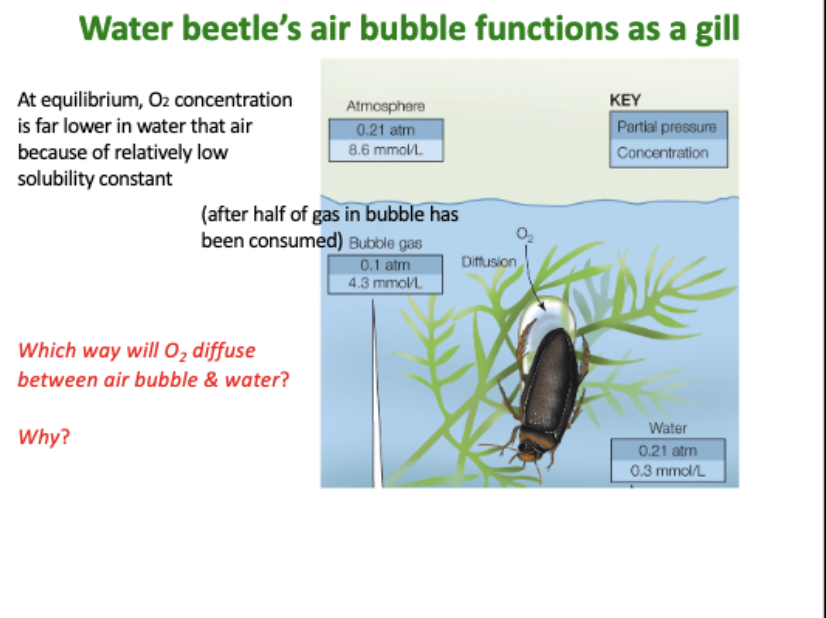
which way will O2 diffuse between air bubble & water? why?
it will diffuse into the air bubble because diffusion of gas is driven by partial pressure, and the partial pressure of the water is greater.
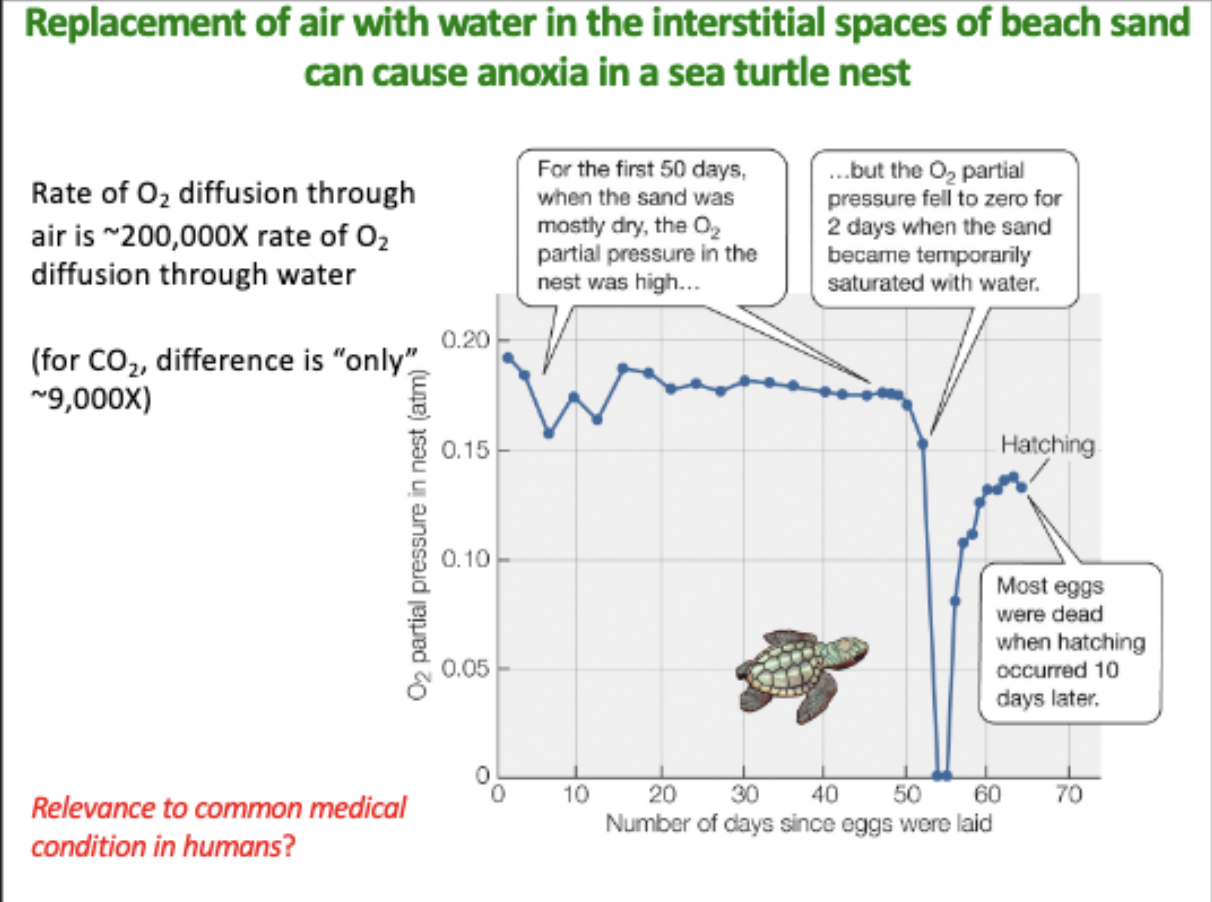
what is the explanation for this graph, and what is the relevance to common medical condition in humans?
just as water-filled sand drastically slows oxygen diffusion to turtle embryos, fluid-filled alveoli in conditions like pulmonary edema, pneumonia, severely impair oxygen diffusion and can cause hypoxemia (low blood oxygen).
what is true about animals and their size?
small organisms such as anchovy larvae can meet oxygen demand by diffusion alone because diffusion distances are short, but as body size increases, diffusion becomes too slow and bulk flow through a circulatory system becomes necessary.
what kid of gas molecules contribute to partial pressure of gas?
free (unbound)
what is there to know about between hemoglobin, free gas molecules, and their contribution to partial pressure?
because only free gas contributes to partial pressure, hemoglobin binding of O₂ and conversion of CO₂ to bicarbonate allow blood to transport large amounts of gas without increasing partial pressure, thereby maintaining diffusion gradients.
what are the two main processes by which animals move fluids to transport gases?
breathing & pumping blood
what are the two types of convective transport?
unidirectional flow & tidal flow
diffusion
movement down a partial pressure gradient, no energy required, efficient only over very short distances, time increases with distance² (very slow over long distances)
bulk flow (convection)
movement of air or blood as a mass, requires energy (breathing, heart pumping), efficient over long distances
what does your body alternate between when transporting O2 from the atmosphere to the mitochondria?
bulk flow and diffusion
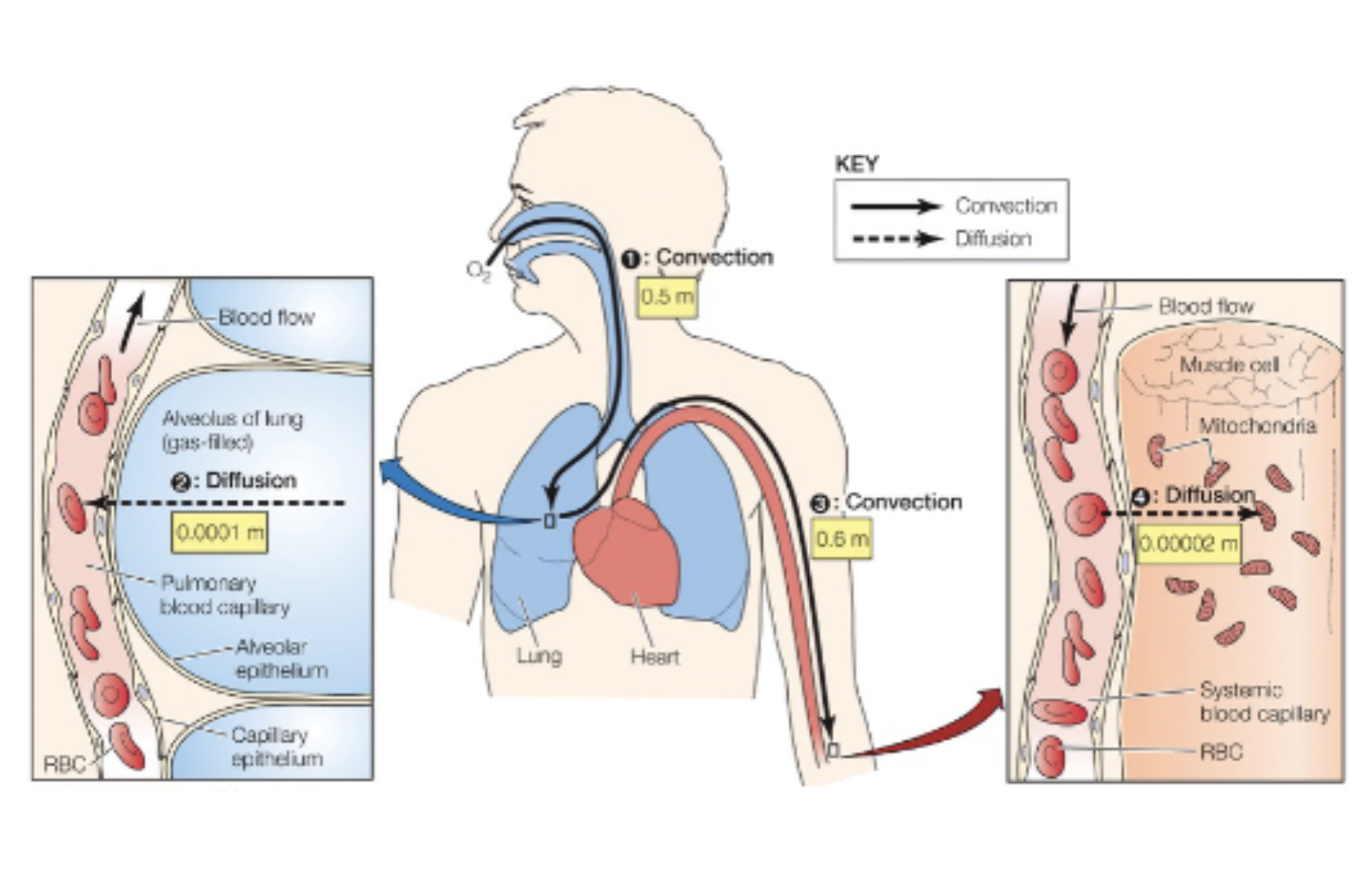
what is happening in this picture?
an example of how our bodies utilizing bulk flow (convention), and diffusion
convection - air to lungs, blood to tissues
diffusion - alveoli to blood, blood to mitochondria
convective transport - unidirectional flow
rir (or water) moves in only one direction across the breathing surface, so fresh oxygen is always passing through. (ex. fish gills, bird lungs)
convective transport - tidal flow
air moves in and out of the lungs along the same pathway, like breathing in and then breathing out. (ex. humans, amphibian lungs).
the oxygen cascade
like a cascading stream, oxygen moves through the body because its partial pressure drops step-by-step from the air to the mitochondria, and each drop is what allows oxygen to keep moving forward.
why is extracting oxygen from water generally more work than from air?
each liter of water is more costly to pump because of relatively high densit & viscosity of water
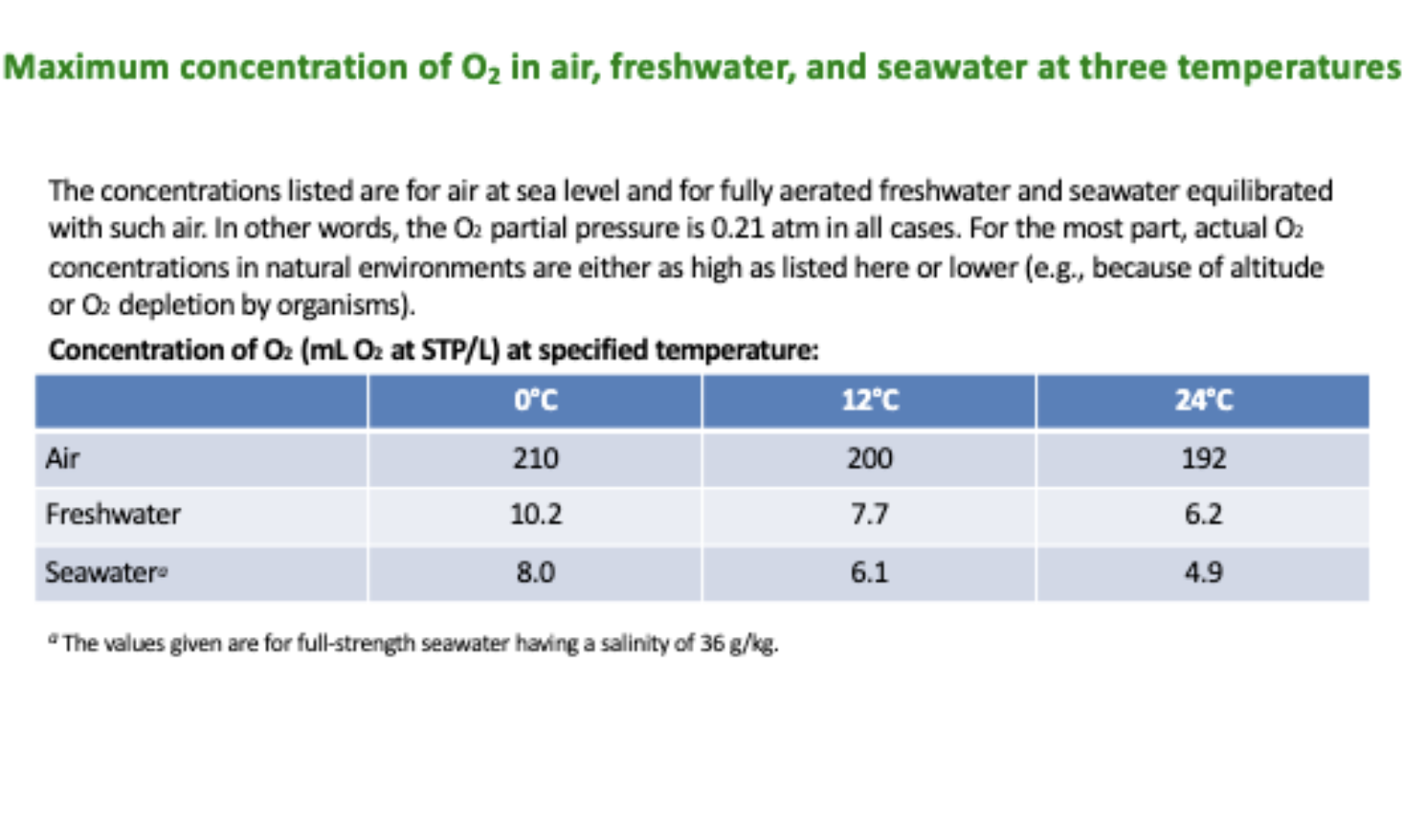
what does this table show?
this table shows that oxygen concentration at a given partial pressure is much higher in air than in water and decreases with increasing temperature and salinity.
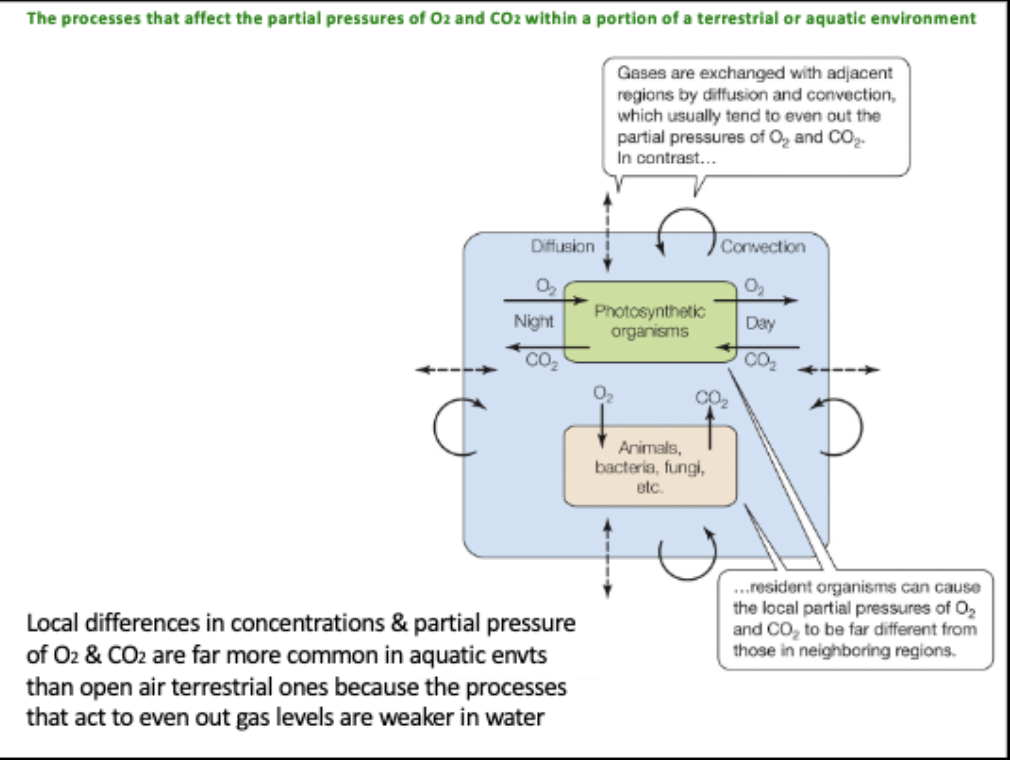
what does this picture show?
in aquatic environments, biological activity can strongly change local O₂ and CO₂ partial pressures because diffusion and convection are weak, allowing gases to build up or be depleted locally.
external respiration (breathing)
the transport of O2 and CO2 to and from the gas-exchange membrane
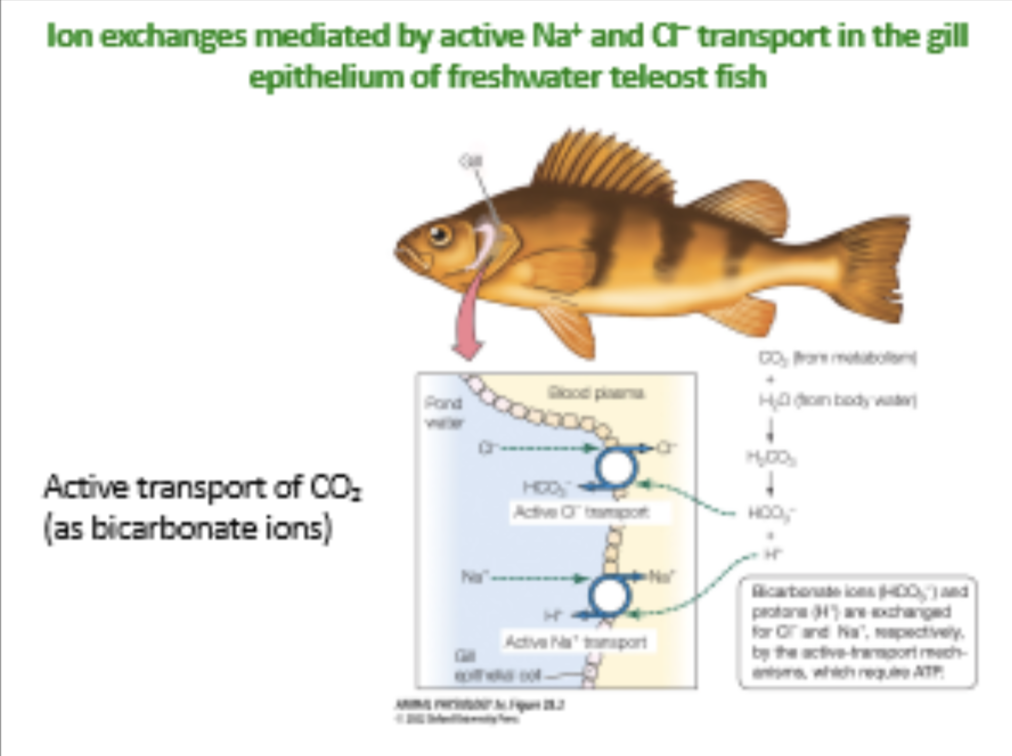
what is the main idea of this photo?
freshwater fish use active ion transport in their gills to regulate ions and remove carbon dioxide, even though these processes require energy.
gills
evanginated structures (folded outward from body) surrounded by the environmental medium - branchial
lungs
invaginated structures (folded inward from body) containing the environmental medium - pulmonary
what is true about water breathing animals and CO2 partial pressures in water?
water breathers end up with very low CO₂ in their blood because getting enough O₂ from water forces them to flush out CO₂ extremely efficiently.
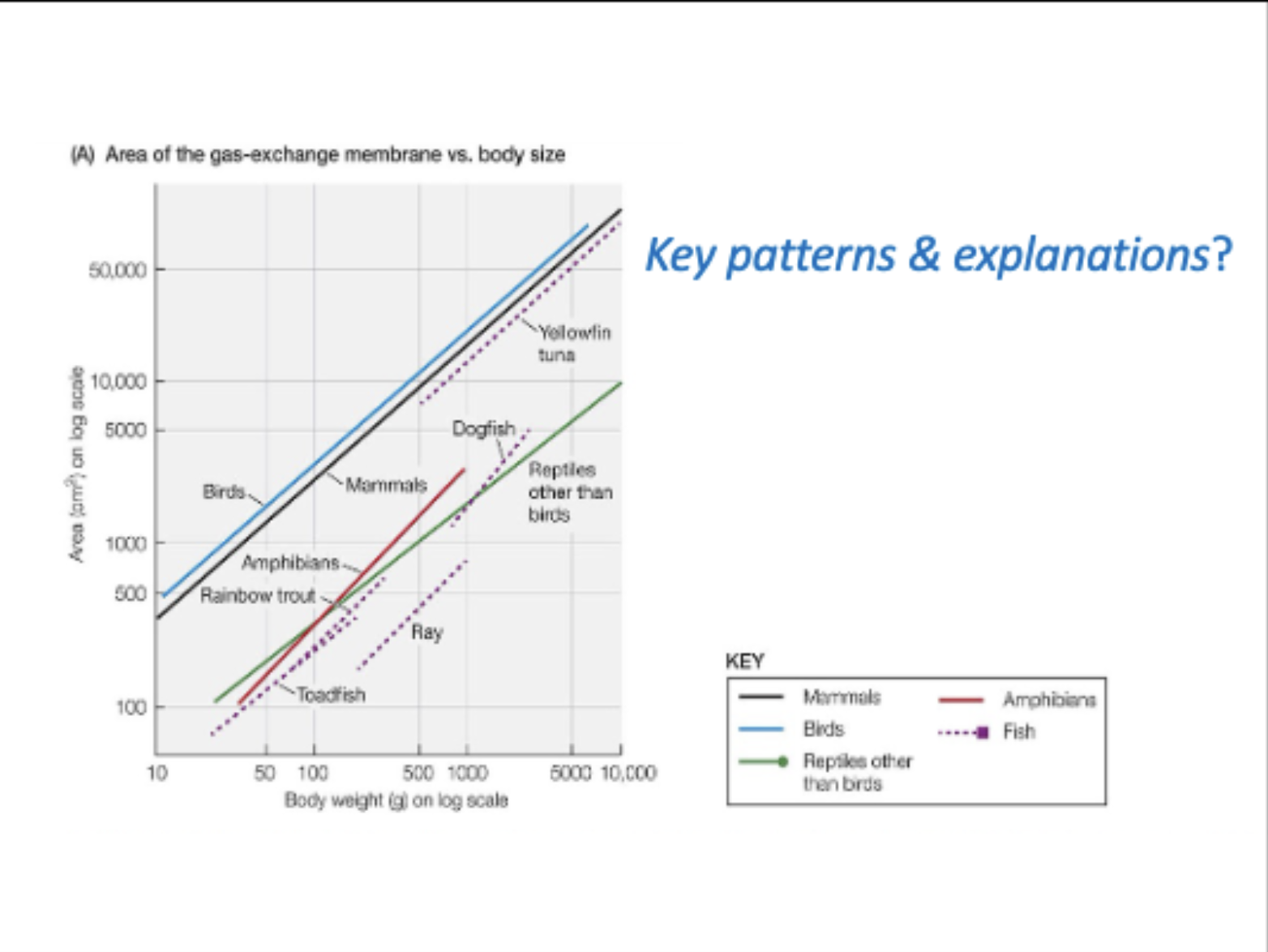
what are the key patterns & explanations of this graph?
birds & mammals (which independently evolved homeothermy) both have much more exchange membrane surface area per unit mass than most others on the graph
what is there to know about yellowfin tuna?
they have unusually large gill surface area,
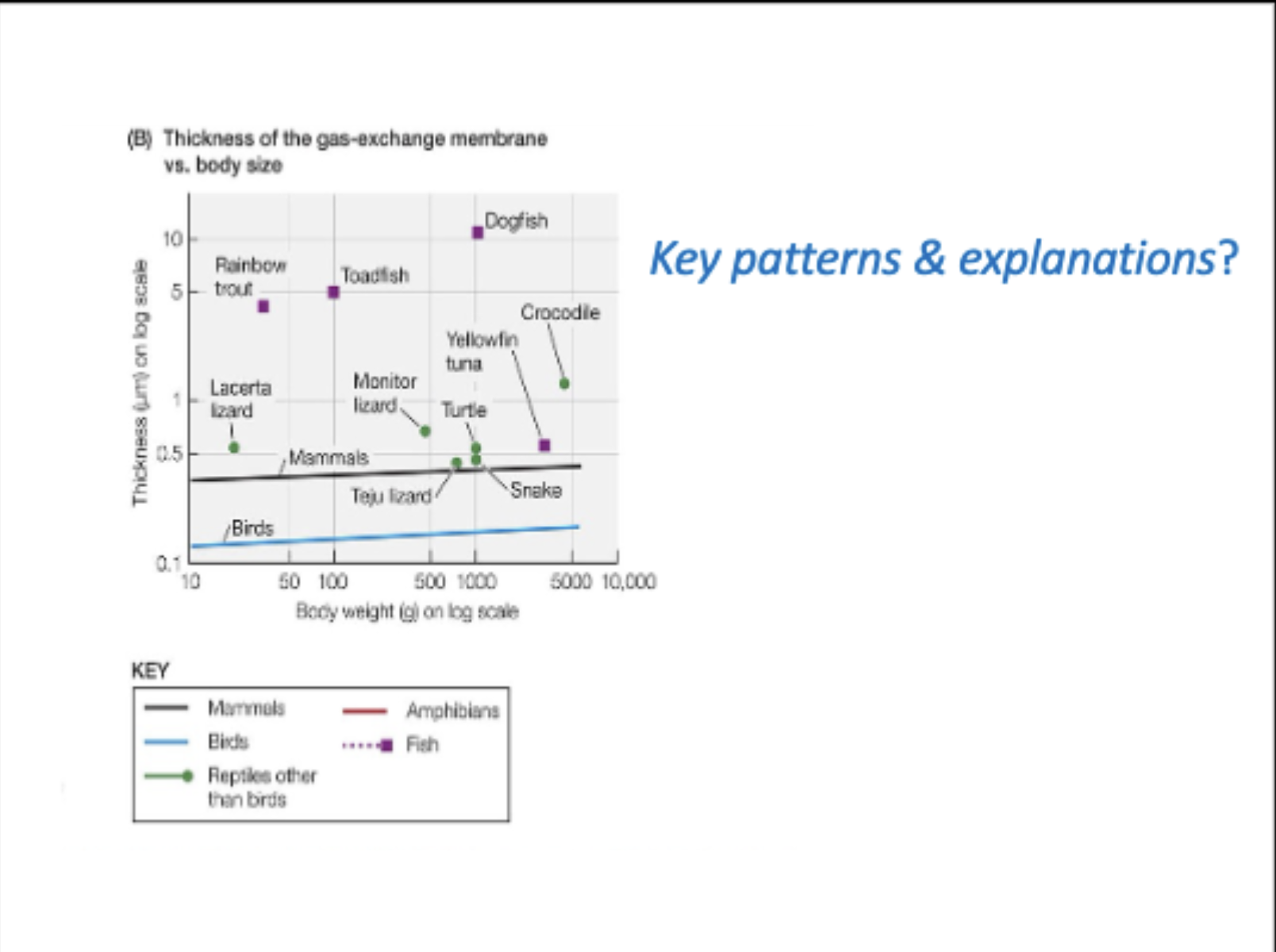
what are the key patterns & explanations?
gas exchange membrane far thinner in mammals and (even more strikingly) in birds
why do most mammals and birds rely almost entirely on lungs for gas exchange?
their high metabolic rates require rapid oxygen uptake that skin diffusion cannot provide, and their dry, keratinized skin greatly limits O₂ diffusion.
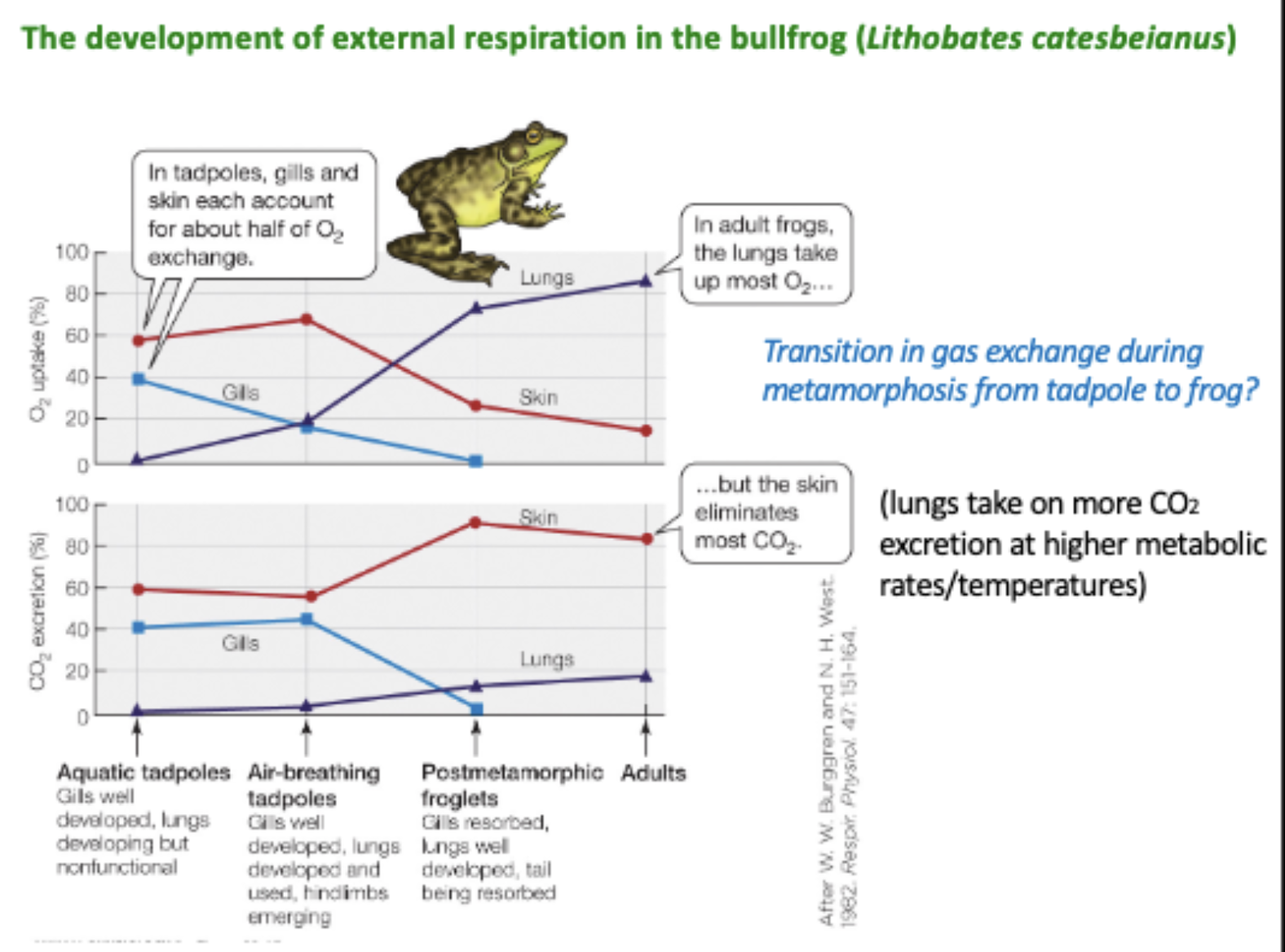
what are the main takeaways from these graphs?
during metamorphosis, bullfrogs transition from gill- and skin-based gas exchange to lung-based oxygen uptake, while the skin remains a major route for CO₂ excretion throughout life.
what would be the expectation for a frog hibernating at the bottom of a pond in terms of external respiration?
relying almost entirely on skin for O2 and CO2 exchange
what are the finest airways in the mammal lung called?
alveolar sacs
where does gas exchange occur in mammals?
in the respiratory airways of the lungs
respiratory bronchioles (last 2 or 3 branches)
alveolar ducts
alveolar sacs
what accounts for most of the gas exchange surface?
alveoli
a pair of human lungs has an estimated _____ alveoli, averaging ~0.25 mm in diameter
500 million
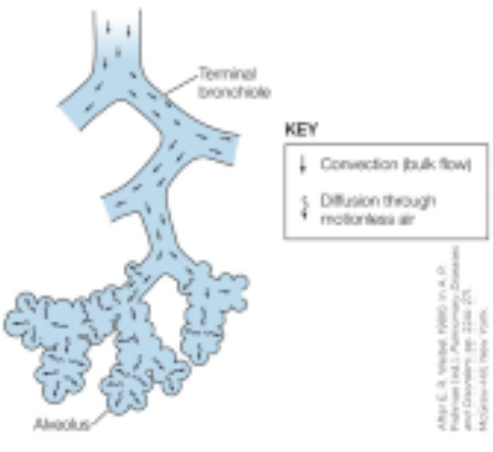
what is true about the mechanisms of gas transport in the final branchs of mammalian lungs during inhalation?
convective air flow slows as it moves deeper into the lungs, and air in alveolar sacs is motionless
what is true about mammals and their response to CO2 levels dropping?
In mammals, breathing is controlled mostly by CO₂ (and pH), not by oxygen—and during exercise, breathing increases even before blood gases change because the brain and muscles signal ahead of time.
how does bird breathing differ from mammal breathing?
the primary bronchus passes through the lung (like a main highway) and connects anterior and posterior secondary bronchi via parabronchi, creating rigid lungs with unidirectional airflow and highly efficient cross-current gas exchange
parabronchi
small tubes that connect anterior and posterior secondary bronchi
where does gas exchange happen in birds?
air capillaries that branch out from parabronchi
birds - afferent blood vessel
brings oxygenated blood in
birds - efferent blood vessel
carries oxygenated blood out
how does breathing by aquatic invertebrates work?
many aquatic invertebrates don’t have lungs, gills, or even blood vessels — they breathe directly through their body surface using diffusion.
what kind of gas exchange system do molluscs use?
countercurrent exchange
do aquatic invertebrates use countercurrent, cocurrent, or cross-current exchange?
none (if they have gills)
how do insects breathe?
by using a tracheal breathing system - a network of air-filled tubes that deliver oxygen directly to cells
where does gas exchange happen in insects?
tracheoles
tracheoles
thin-walled end-tubules at the end of tracheae
what structure serves as the “lung” in insects and spiders?
a system of gas-filled tubules called tracheae
what percentage of oxygen delivered to systemic tissues in arterial blood is actually used by a person at rest?
25%
whats the x axis of the oxygen-hemoglobin disiation curve?
partial pressure of O2 in blood
whats the y axis of the oxygen-hemoglobin dissociation curve?
O2 concentration of blood
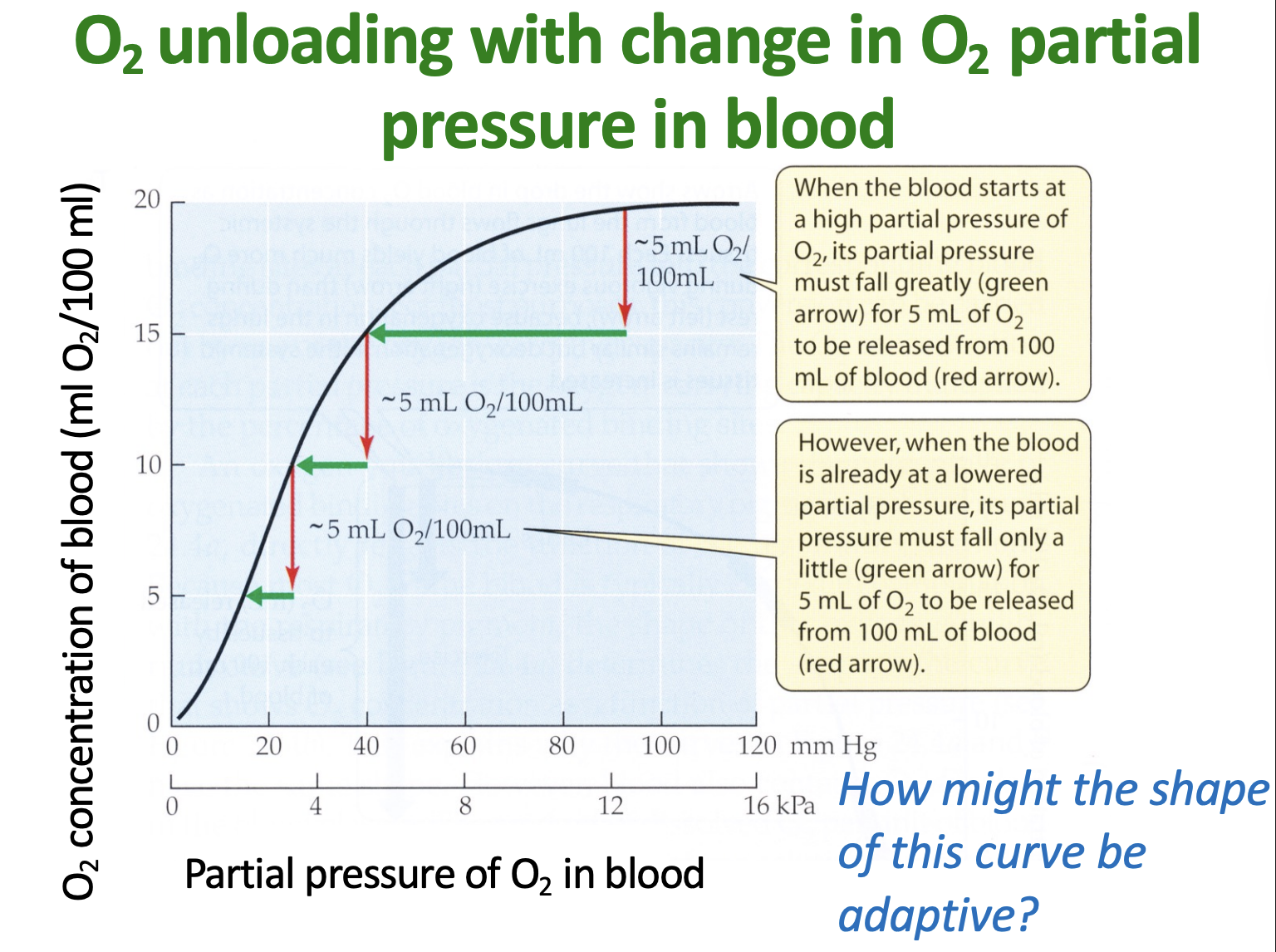
what is this graph showing?
at high partial pressure, hemoglobin is almost fully saturated, so to release 5 mL O₂, PO₂ has to fall a lot
at low partial pressure, hemoglobin is partially unloaded, so to release the same 5 mL O₂, PO₂ only needs to fall a little
however, you don’t lose much oxygen-carrying capacity from small drops in lung oxygen.
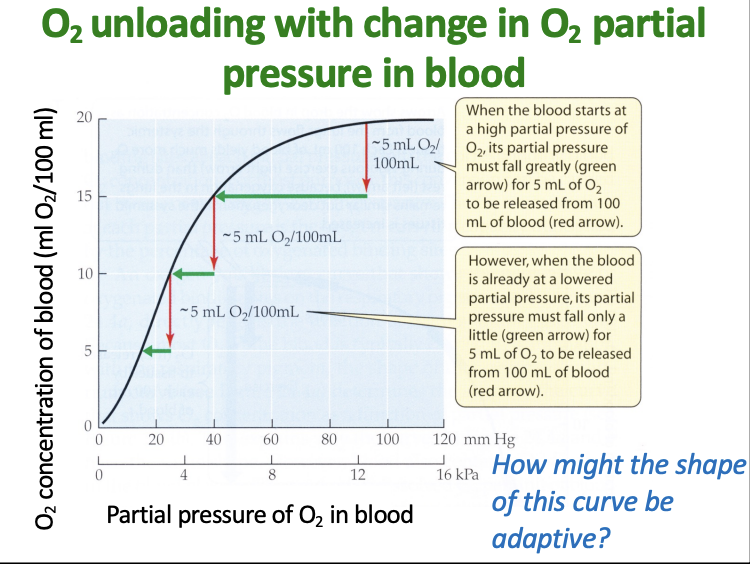
how might this curve be adaptive?
in mammalian muscle, aerobic metabolism fails only at very low PO₂ (~10 mm Hg), and by that point hemoglobin has already released ~90% of its oxygen, ensuring maximal oxygen delivery before mitochondrial respiration becomes impaired
how do fish do negatively feedback control their breathing?
fish decrease gill ventilation in response to higher O2 in blood (because they already have enough)
what is true about mammals (and insects) and negative feedback control of their breathing?
breathing rate responds more to blood CO2 than O2. large changes in blood O2 are needed to cause significant change in breathing rate
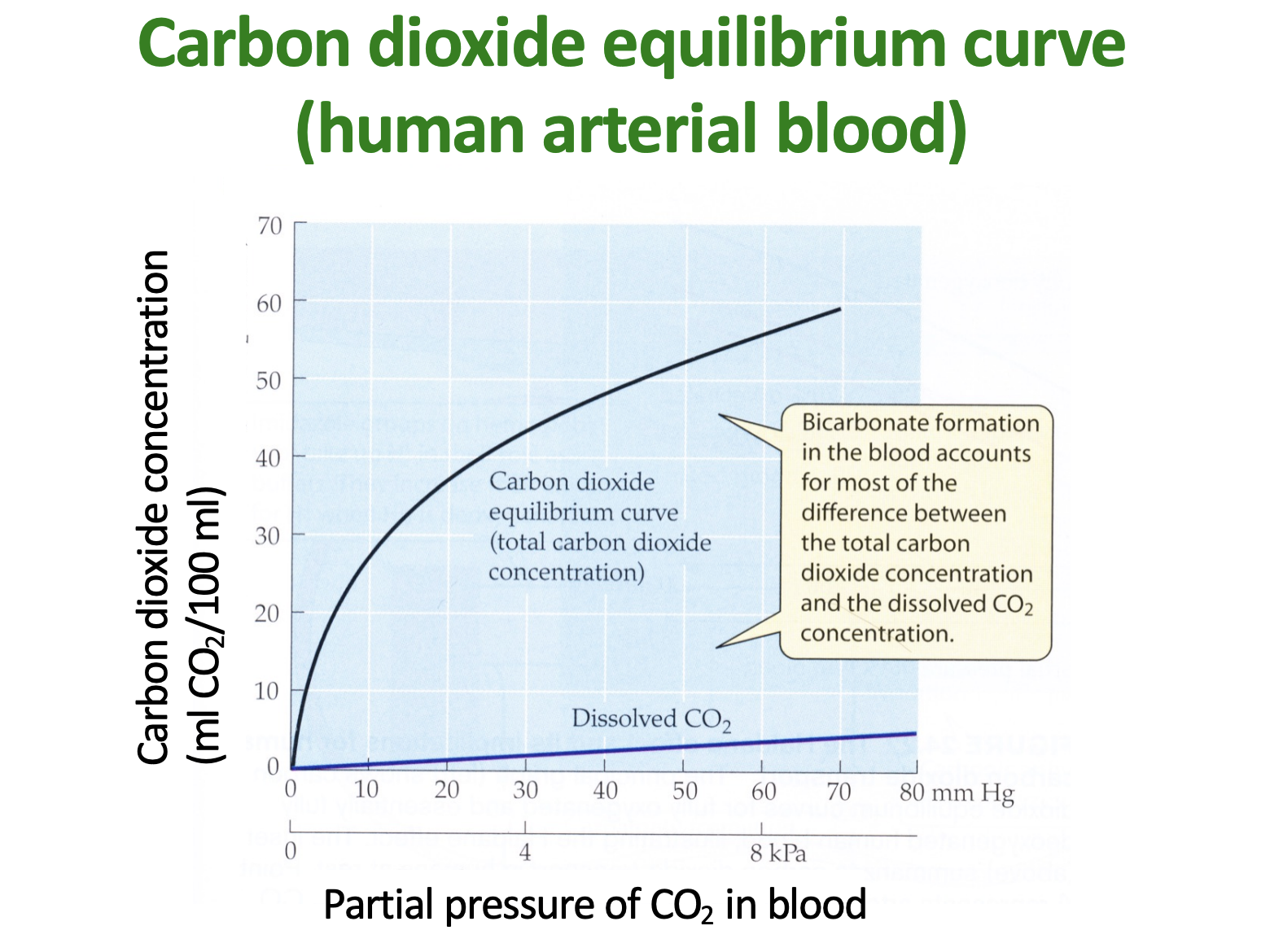
what does this graph show?
the carbon dioxide equilibrium curve shows that most CO₂ in blood is transported as bicarbonate rather than dissolved gas, allowing large amounts of CO₂ to be carried and making small changes in PCO₂ a powerful signal for regulating breathing.
how is CO2 transported in blood?
as bicarbonate
bicarbonate
highly soluble, allows blood to carry large amounts of CO2 away from the tissues
what happens when CO2 in the blood increases?
partial pressure of CO2 increases
H+ increases causing pH drops
neural centers in medulla oblongata of brain detect these changes and increase breathing rate
what happens if CO2 concentration in blood decreases?
partial pressure decreases
H+ decreases causing the pH to increase
brain responds by slowing down breathing rate
bohr effect
increased CO₂ and/or increased H⁺ (lower pH) reduce the oxygen-binding affinity of respiratory pigments (like hemoglobin)
what does the bohr effect do to the oxygen-hemoglobin dissociation curve?
shifts the curve to the right, so at any given PO₂ less oxygen is bound and a higher PO₂ is required to achieve the same saturation.
P50
the partial pressure of O2 at which hemoglobin is 50% saturated
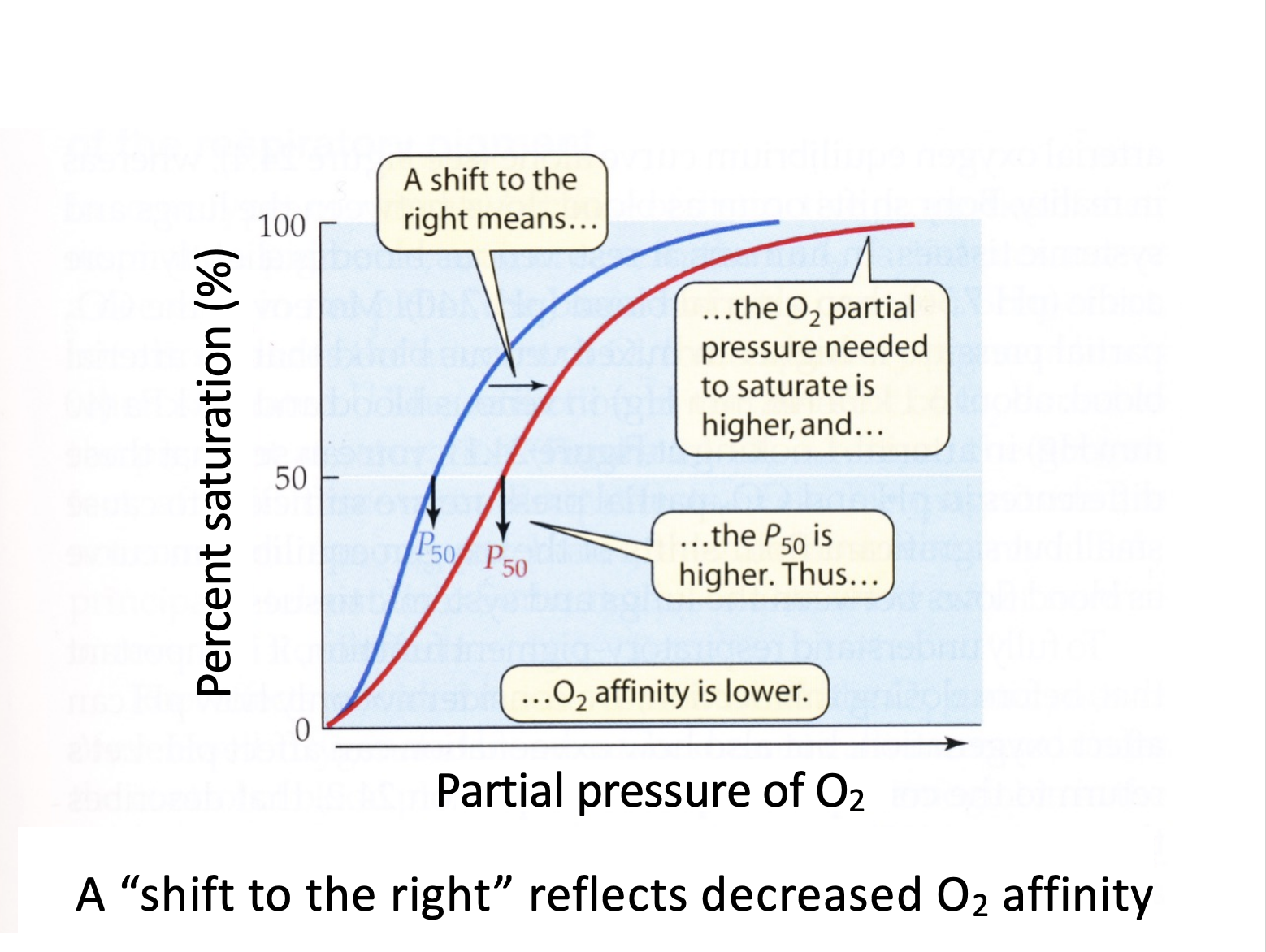
what does “a shift to the right” reflect?
the O2 partial pressure needed to saturate is higher, and the p50 is higher, this the O2 affinity is lower
higher p50 equals
lower affinity
lower P50 equals
higher affinity
which fish would you expect to have hemoglobin with a higher P50 (and why)?
carp adapted to sluggish life in murky low-oxygen water
or trout adapted to active life in oxygen-rich mountain stream?
trout adapted to active life in oxygen-rich mountain stream
when blood pH decreases, what happens to affinity for oxygen
affinity decreases
what happens when the affinity for O2 decreases?
the CO2 partial pressure increases
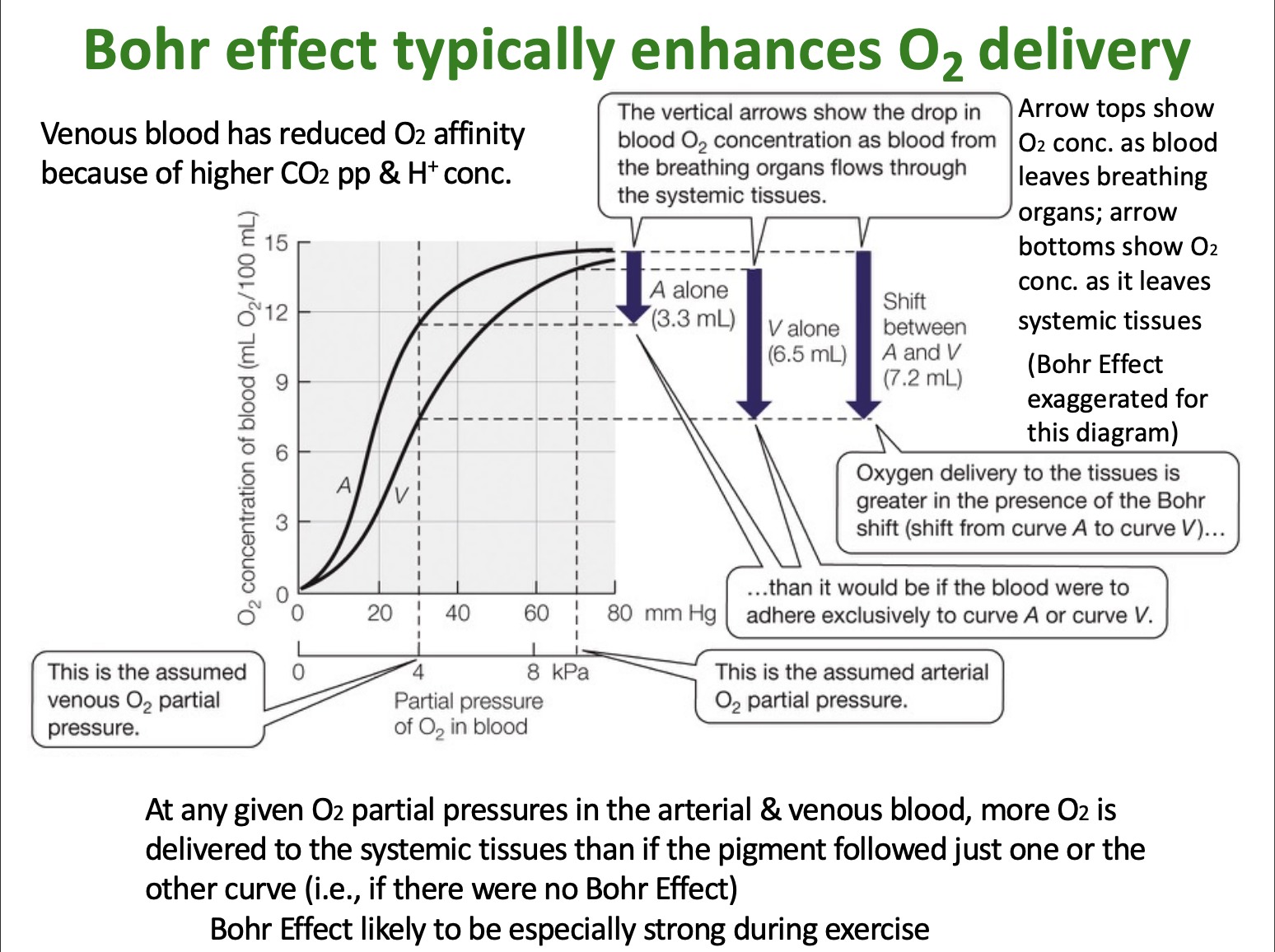
what does this graph show?
at any given O2 partial pressures in arterial & venous blood, more O2 is delivered to the systemic tissue because of the Bohr effect
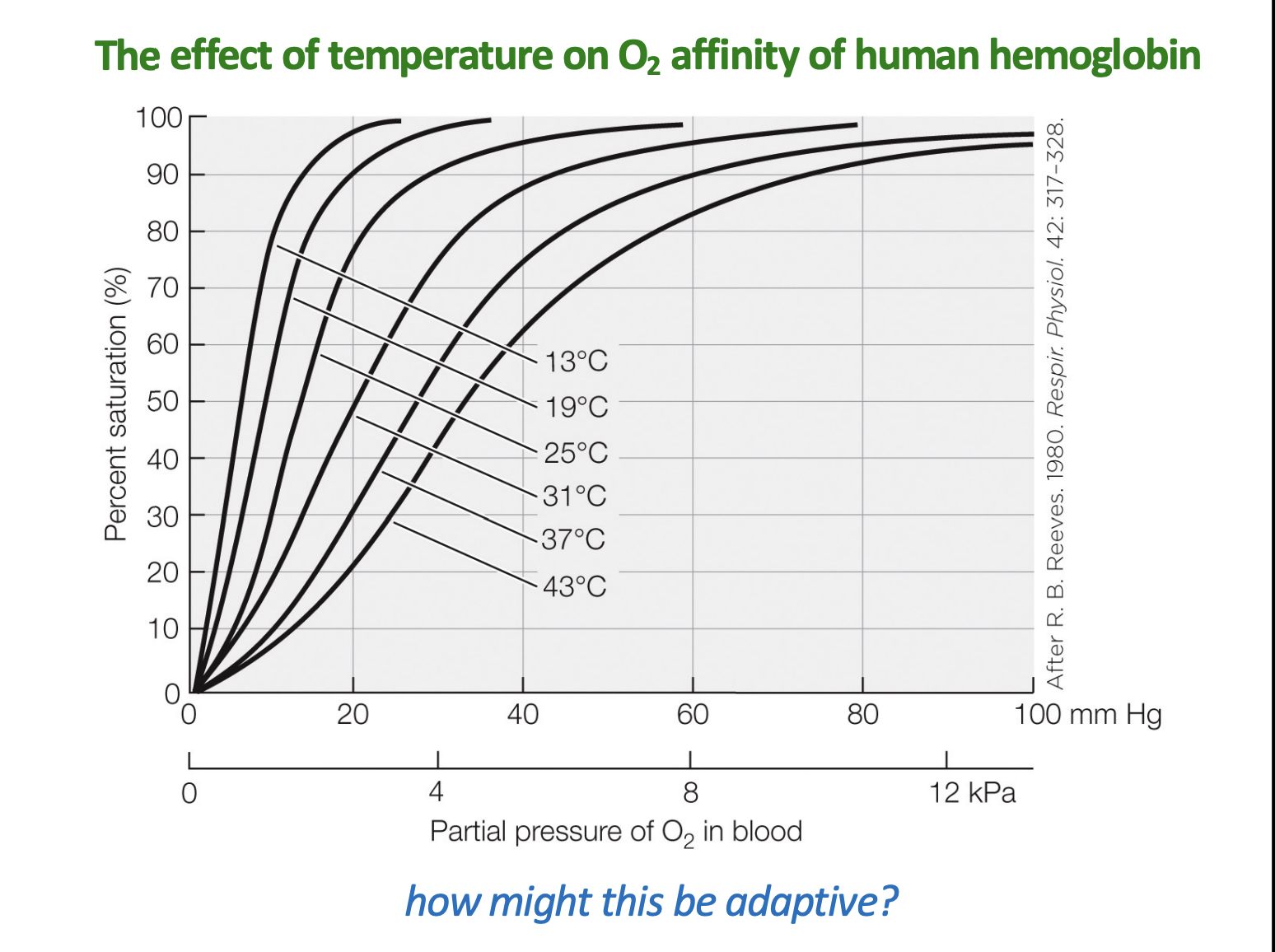
what does this graph show?
lower temperature = curve shifts left = higher O2 affinity
higher temperature = curve shifts right = lower O2 affinity
exercising muscle tissue…
have higher CO2 pp & H+ conc. (=lower pH) and therefore lower O2 affinity (Bohr effect)
are warmer and therefore have lower O2 affinity (temperature effect)
what does 2,3-bisphosphoglycerate (2,3-DPG) do to O2 affinity and p50?
it reduces O2 affinity and raises P50
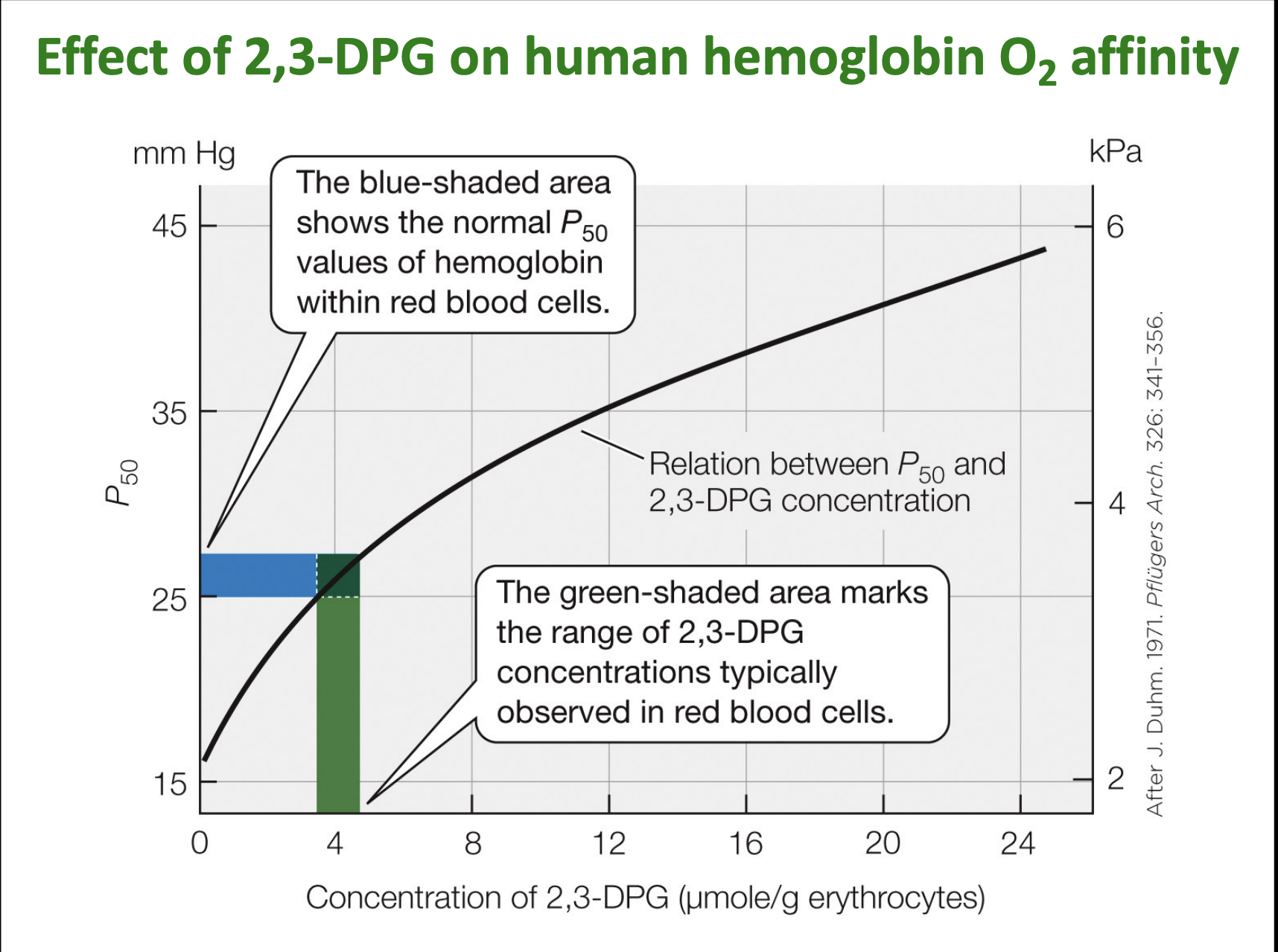
what does this graph show?
this graph shows that increasing 2,3-DPG concentration in red blood cells raises hemoglobin P₅₀, thereby decreasing oxygen affinity and enhancing oxygen unloading, with normal physiological levels of 2,3-DPG exerting strong control over hemoglobin function.
what is true about humans with anemia and their relationship with 2,3-DPG?
chronic increases in 2,3-DPG lower hemoglobin’s oxygen affinity, allowing each hemoglobin molecule to release more oxygen to tissues and partially compensating for the reduced amount of hemoglobin in the blood.
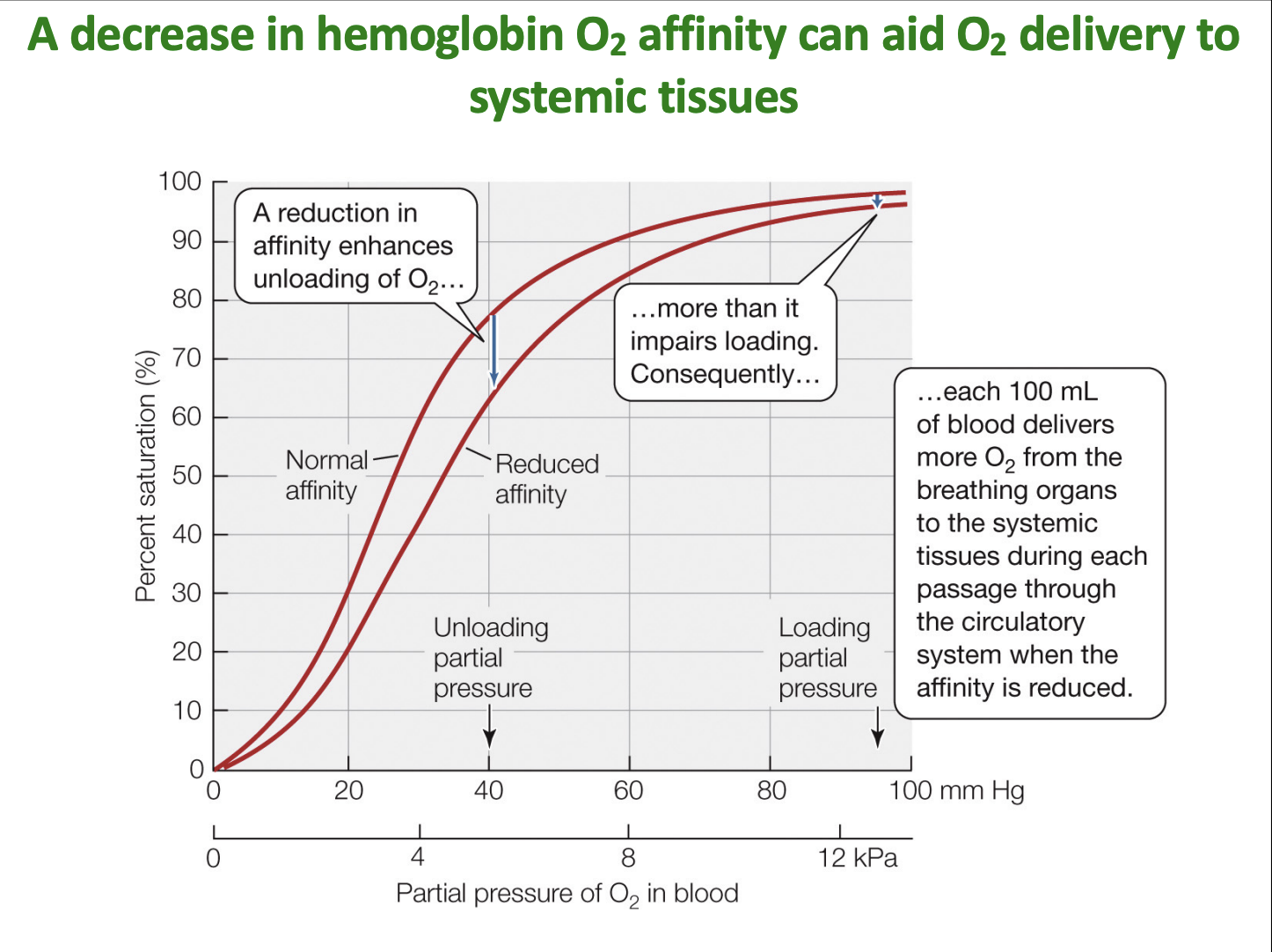
what does this graph show?
lowering hemoglobin’s O₂ affinity can increase the amount of oxygen delivered to tissues per pass through the circulation.
does the hemoglobin in arterial or venous blood have lower O2 affinity?
venous blood
what does shifting to lower affinity in systemic tissues (venous blood) do?
promotes O2 release
what does shifting to higher affinity in breathing organs (arterial blood) do?
promote O2 uptake
what are functions of respiratory pigments?
routine transport of O2 in blood
storage
buffer blood pH by removing H+
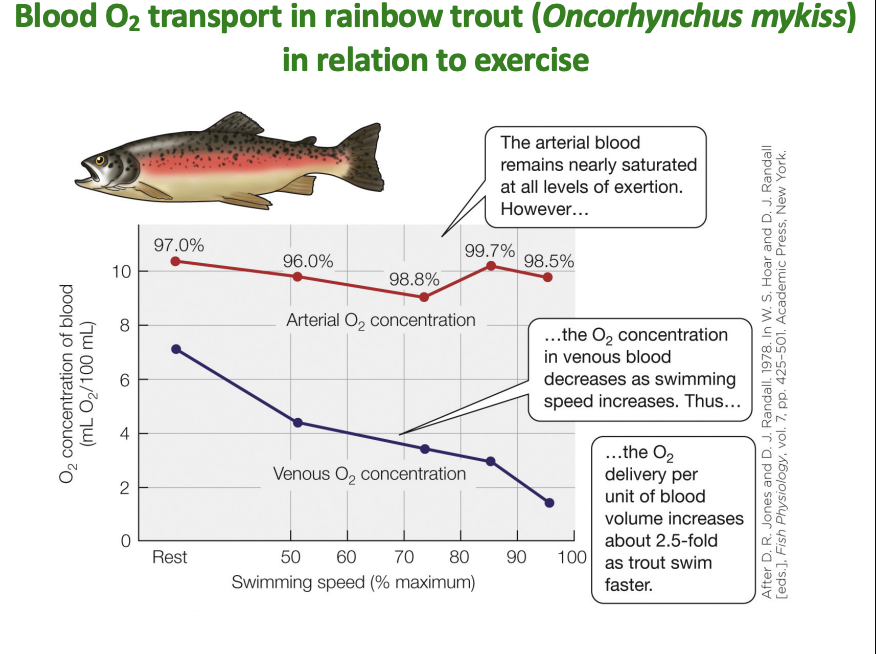
what does this graph show?
the trout’s gills and blood can load oxygen effectively in arterial blood even during intense exercise.
venous O₂ concentration drops as swimming speed increases. muscles are extracting more oxygen from each unit of blood as exercise increases.
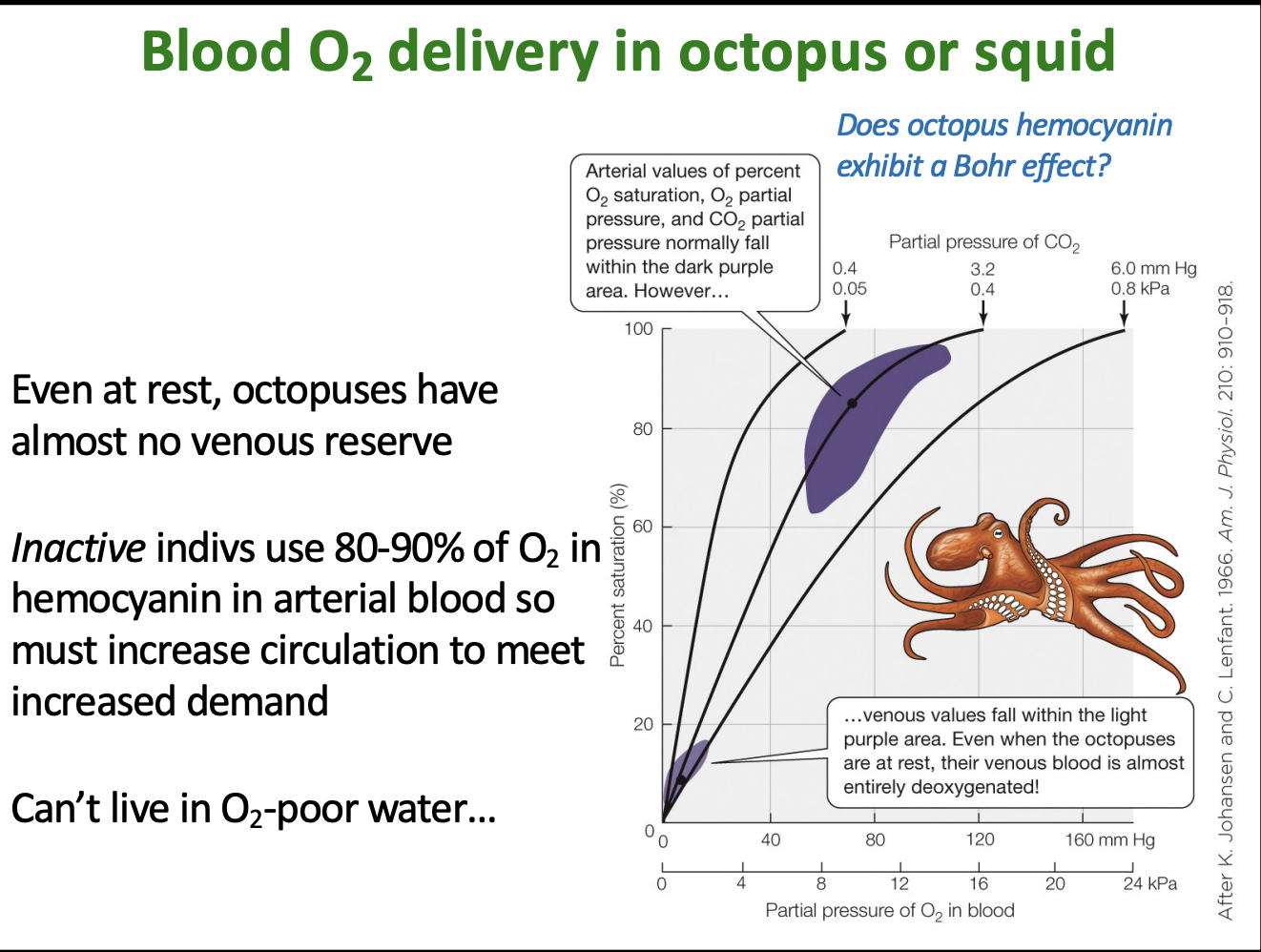
what does this slide show?
octopus and squid rely on hemocyanin, which allows high oxygen extraction even at rest, leaving almost no venous oxygen reserve; as a result, increased oxygen demand must be met by increasing circulation rather than extraction, limiting their ability to tolerate low-oxygen environments.
animals with hemocyanin…
tend to have lower O2 capacity
how do some vertebrates modulate respiratory pigment concentration?
some vertebrates can acutely change O2 capacity by moving blood cells in and out of spleen
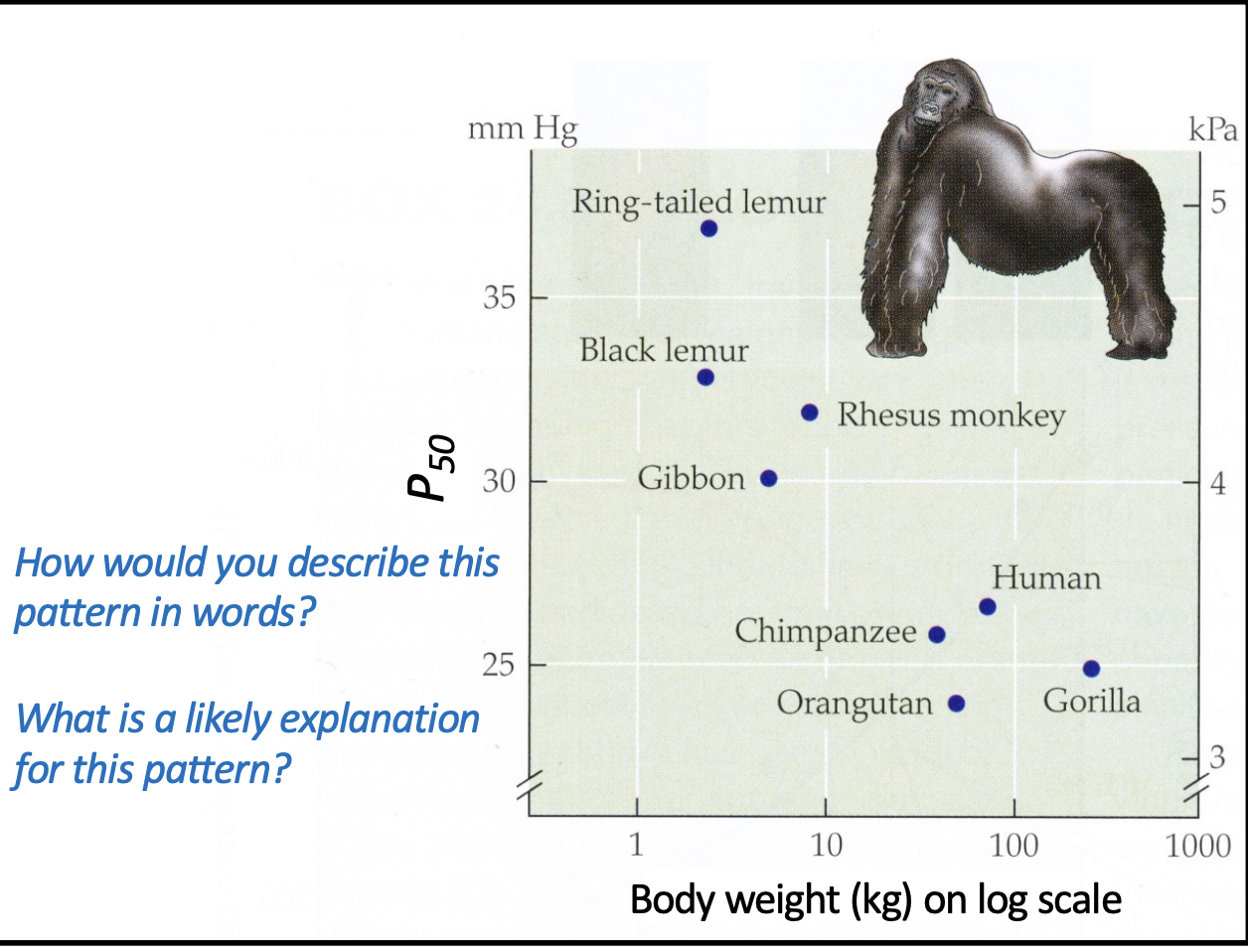
what does this graph show?
smaller body size, lower oxygen affinity due to higher mass specific metabolic rate and having a higher demand for energy.
the larger the body size, the lower the p50, meaning they have higher oxygen affinity
what is the oxygen-carrying capacity of mammals & birds?
typically 15-20 ml O2/100 ml
what is the oxygen carrying capacity of fish, amphibians, andnon-avian replites
5-15 ml O2/100 ml
what are interspecific patterns of evolutionary adaptation of respiratory pigments?
different species have evolved respiratory pigments with different oxygen affinities that match their activity level and environmental oxygen availability.
what are intraspecific patterns of evolutionary adaptation of respiratory pigments?
within a species, oxygen affinity of respiratory pigments can be adjusted through physiological mechanisms (e.g., Bohr effect, 2,3-DPG) to meet changing metabolic demands.
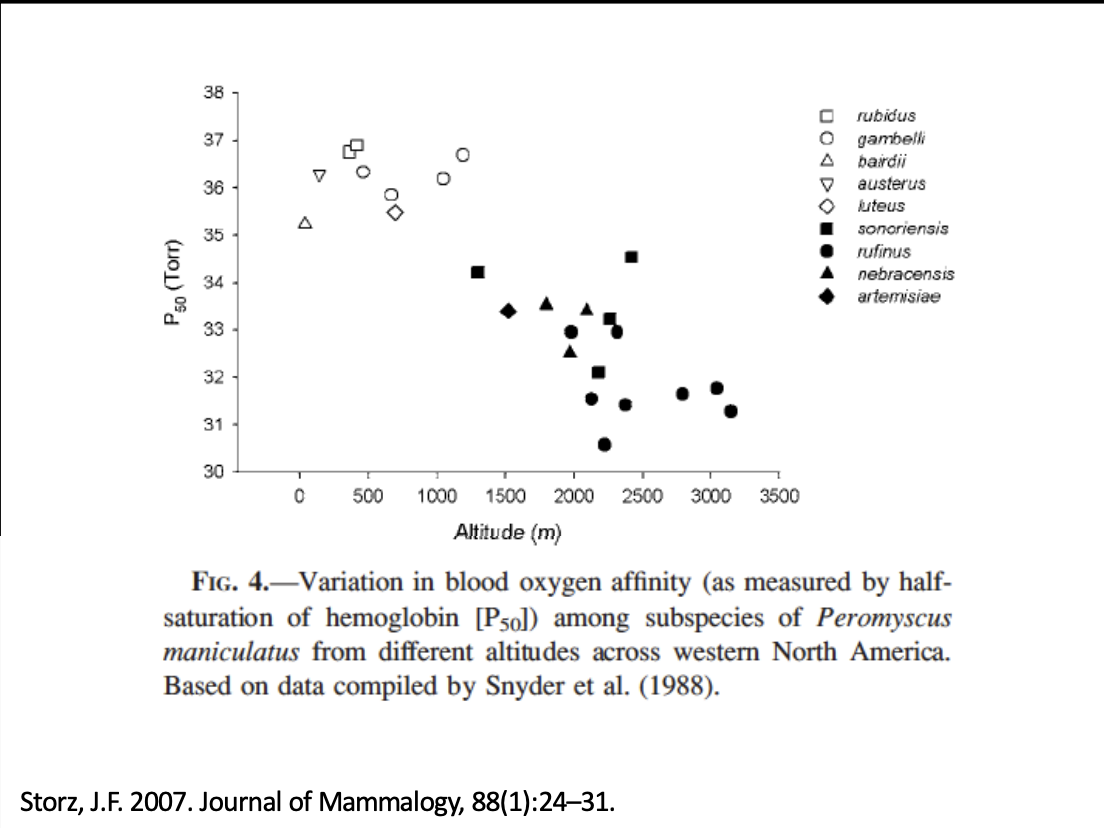
what does this graph show?
as altitude increases, p50 decreases meaning high-altitude subspecies have hemoglobin with higher oxygen affinity
 Note
Note  Flashcards (20)