Social Influence Questions
 Studied by 6 people
 Call Kai
 Learn
Learn Practice Test
 Spaced Repetition
 Match
Match Flashcards
 Knowt Play
1/18

Earn XP
Description and Tags
Name | Mastery | Learn | Test | Matching | Spaced | Call with Kai |
|---|
No analytics yet
Send a link to your students to track their progress
19 Terms
What was Orne and Holland’s main criticism of Milgram’s study? (1 mark)
Lacked internal validity
Outline the authoritarian personality as an explanation of obedience. (4 marks)
A dispositional explanation, which suggests obedient behaviour is due to internal traits such as personality type, rather than external / situational factors
These dispositions are developed from strict discipline from parents
These include:
respect for authority
obedience to those in power
dismissiveness to those with a perceived lower status
Adorno developed an ‘F-scale’ to measure personality type
Briefly explain one limitation of the authoritarian personality as an explanation of obedience. (2 marks)
Explanation cannot easily account for obedience of entire groups/societies
Situational factors, eg. proximity (Milgram), may have greater influence on obedience levels
Explanation maybe flawed because it relies on self-report (questionnaire data)
Maya wants to encourage the workers in her office to use their own reusable cups at work, rather than the disposable paper cups provided by the company.
Explain how Maya might show either commitment or flexibility to persuade the workers to change their behaviour. (2 marks)
Commitment: Maya might place herself at some inconvenience – she may volunteer to buy some reusable cups.
This will draw more attention to her ‘cause’ (augmentation principle)
Briefly outline three findings from Asch’s research into conformity. (3 marks)
Individuals conform to incorrect group majority
A dissenter with the majority reduces conformity, even if they disagree with the individual
Conformity increases with group size, but only up to a certain point
Explain one limitation of Asch’s research into conformity. (3 marks)
Lacks mundane realism: Asch’s task was artificial - not a valid measure of real-life conformity where conforming takes place in a social context
Lacks ecological validity: research was carried out in a laboratory, so behaviour may not represent real world conformity
Gender bias/lack of generalisability: use of a male sample thus may not represent female behaviour
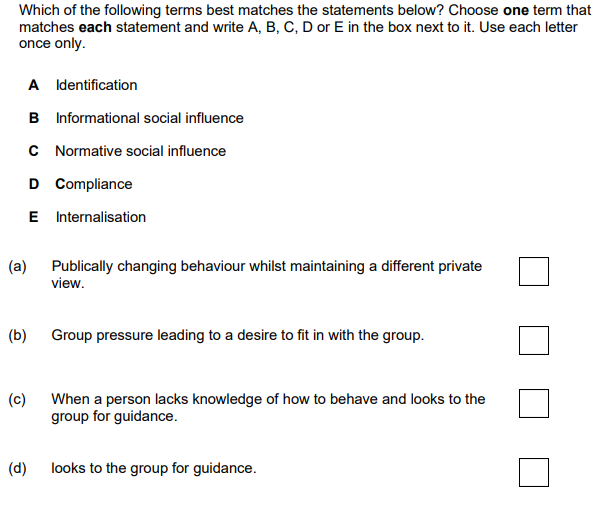
(a) D
(b) C
(c) B
(d) A
Many people have criticised Zimbardo’s prison study.
Identify and briefly discuss two reasons why people have criticised Zimbardo’s prison study. (6 marks)
Possible criticisms:
Ethics - psychological harm - participants soon became distressed.
Zimbardo himself took part in the action
Possible discussion points:
Whether or not the distress should have been anticipated.
Whether or not the consent gained was sufficiently informed.
Zimbardo’s own behaviour affected the way in which events unfolded, thus the validity of the findings could be questioned.
Explain what is meant by internalisation. (3 marks)
Internalisation is accepting the group’s beliefs as own
Change in both public and private views
Permanent change as it is still present even when not in the group
Explain what is meant by compliance. (3 marks)
Compliance is going along with the group to fit in
Even if not really believing their view point
For example, in Asch's study, many of the naïve participants went along with the wrong answer so as not to look stupid
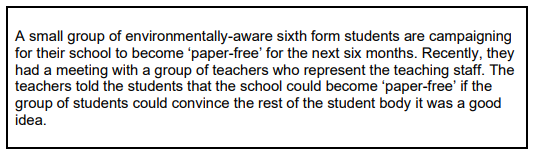
Read the item and then answer the question
Use your knowledge of conformity and minority influence to explain the factors that will determine how successful the small group of students will be.
Factors affecting minority influence:
The student body are more likely to be convinced if the group of students are consistent, committed and show flexibility in their views. (examples)
Application of explanations of minority influence: e.g. social cryptoamnesia; the snowball effect; social impact theory.
Factors affecting conformity:
Group size (the campaigning group is ‘small’, the student body is the majority); unanimity (there may be other students who agree with the small group); etc.
Application of explanations of conformity: explanations of how views may change through informational social influence
Choose one of the ethical issues in Milgram’s study and explain a way of dealing with it. (2 marks)
Deception could be dealt with by debriefing the participant.
It would have to be explained why it was necessary to deceive them and answer any questions that they might have wanted to ask, as well as reassuring them.
In a hospital, you are very likely to obey a nurse. However, if you meet her outside the hospital, for example in a shop, you are much less likely to obey. Using your knowledge of how people resist pressures to obey, explain why you are less likely to obey the nurse outside the hospital. (4 marks)
Legitimacy of authority may not be recognised, especially if there is no uniform
Location may not be legitimate for the nurse to give an order.
Outline one advantage of conducting obedience research outside a laboratory setting. (2 marks)
High in ecological validity,
this means that the results can be generalised beyond the research setting.
Outline one limitation of conducting obedience research outside a laboratory setting. (2 marks)
There is a lack of control
other factors may have influenced the outcome.
Marcus wants to persuade his group of friends to go travelling in the summer but the rest of the group would like to go on a beach holiday.
Briefly suggest how Marcus might use the three behaviours that you have identified in your answer to the previous question to persuade his friends to go travelling. (3 marks)
Marcus could show consistency by keeping on repeating the same message about how great it would be to go travelling
Marcus could show commitment by explaining how he is taking time and working hard to plan the travelling trip and saving for the trip
Marcus could show flexibility by listening to the others and agree to going on a beach holiday at the end of the travelling trip
Explain what is meant by locus of control. (4 marks)
Locus of control is how much a person believes that they have control over their own behaviour.
Scale with internal at one end and external at the other.
Internal refers to those people who see that they have a great deal of control over their own behaviour and will take responsibility for their actions.
External refers to those who believe that their behaviour is controlled by other forces such as luck or fate.
Daniel and Matthew are in the same class at school but have very different views on success. Daniel is convinced that success is due to hard work and determination, whilst Matthew believes that luck and fate determine success. The class is putting on a play and neither Daniel nor Matthew wants to participate. Their friends are trying to persuade them to take part.
Another boy in the class, Tom, refuses to take part in the play. Explain how Tom's refusal to take part might affect Daniel's and Matthew's ability to resist social influence. (2 marks)
Tom's refusal will increase their ability to resist social influence
Tom acts as social support/presence of a role model of non-conformity
Three students, George, Petra and Dan, have just started in the sixth form. Dan is a confident person who thinks that his fate lies firmly in his hands. By the end of the first week, Dan has put himself forward to be nominated as the class representative. Petra has also put her name forward to be nominated. She believes it is just luck whether or not she will be selected and feels that there is not much she can do about it. George did not put his name forward because his father told him not to.
Which one of the three students is most likely to resist pressures to conform? Use your knowledge of psychology to explain your choice. (4 marks)
Dan is most likely to resist pressure to conform.
He has an internal locus of control and research has suggested that those people who believe that they are in control of their environment are less likely to conform.
Also much more likely to behave independently.
Dan's attributional style allows him to resist the pressure to conform doesn’t seek social approval
 Note
Note  Flashcards (23)