Northern Ren. Midterm
 Call Kai
 Learn
Learn Practice Test
 Spaced Repetition
 Match
Match Flashcards
 Knowt Play
1/106

There's no tags or description
Looks like no tags are added yet.
Name | Mastery | Learn | Test | Matching | Spaced | Call with Kai |
|---|
No analytics yet
Send a link to your students to track their progress
107 Terms
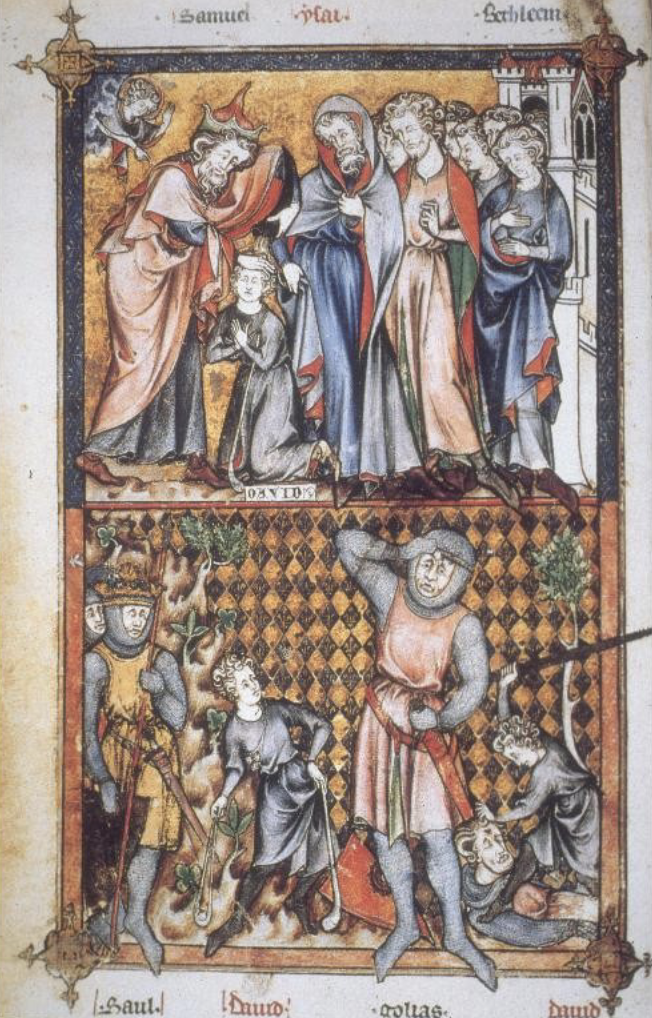
Master Honoré, Story of David, Breviary of Philip the Fair, 1296
Page from the Breviary of Phillip the fair, reigning king, particularly skillful ruler who sustained French power through his time
Before the end of his reign the pope was induced to leave Rome and rule from avignone, inside the French Kingdom, so center of catholic church may move to France showing how much power and significance they held
Master Honore was an appreciated royal servant, member of royal court with an official appointment despite this not being the norm in the early middle ages, so in medieval period but place of artists is starting to change
Breviary meaning: Prayer book which involves shortened versions of full prayers, Ancestor of book of hours, which isn't that much different, Set of prayers for different times of the year
Full paged miniature pictures and illustrations was not new but many manuscripts didn't have this much illustration since it was so costly to make something with so many pages like this and it would have taken so much time so this would have been extremely expensive
In many Christian prayers the book of psalms, or a series of songs/poems written by David, first a Jew Shepherd and then the king of the Jews, but a lot of prayers were based on these psalms mostly praising G-d that David is said to have written and many of these texts were said to be pre Christ so the bottom illustration shows David receiving a prophecy and Gabriel is also seen, names Saul, David, Goliath and David again since he is shown twice
This young boy with a slingshot is about to bring down huge Goliath, three moments in this scene wind up of the stone, then stone hitting Goliath, and then the third scene of David reappearing and beheading Goliath. Idea of incorporating different scenes in one picture, Ton of gold leaf, used for both manuscripts and tempera on wood paintings, extremely expensive but also very thin and hard to use, but essential part of manuscript making
Differs from earlier manuscripts especially seeing the very expressive faces, like Goliaths face and movement, Honores is using modeling to suggest facial features like the shadowing of the eyes and chin, variation of light and dark and the faces in particular show early modeling, including chiaroscuro,
There is a frame which is conventional for manuscripts but some of the figures break the frame like how Goliath is so big he can't even fit in the frame, sword goes way beyond the frame which shows so much emphasis, transgression of the frame is done for dramatic purposes (David borrows a sword from his fellow soldiers but too big for him so has to hold it back so far so takes a while for this hit to reach Goliath's head which creates drama)
Diaper pattern, set of diamonds interlocking with different colors, in the blue one shows the fleur de lis, used by king of France so makes since it was for Philip the fair, so his personal and family emblem and the colors that represent them
Continued narrative where three diff scenes happening at once, counts as a way of dramatizing the event
Jean Pucelle, Book of Hours of Jeanne d'Evreux, 1325-1328
Even more compact, meaning it can be portable version of a breviary meaning it was just for individuals and not for group prayer in anyway
Meaning hours of the day you pray on, good christians were given instructions on when to pray, 9 times a day when you were supposed to pray, a lot of people didn't unless you were in like a monastery as in monks or nuns because some of the prayers are even in the middle of the night
Right prayer for each time of day along with right prayer for various times of year, elaborate set of calender pages which told you the important dates of the year so not just time of prayer but what day is special
Goal is to make them somewhat customizable for patrons so you could get your book inscribed with specific stuff you like most like if you have a favorite saint or smth
Many books of hours are elaborately decorated since intended for wealthy people, sometimes tiny size meant they were even more expensive since its so hard to make smth so tiny
This one was made for Queen of France despite being produced with little variety of palette and no gold leaf, but maybe in acknowledgement that this was an artist that could produce excellent effects without using much color of gold leaf
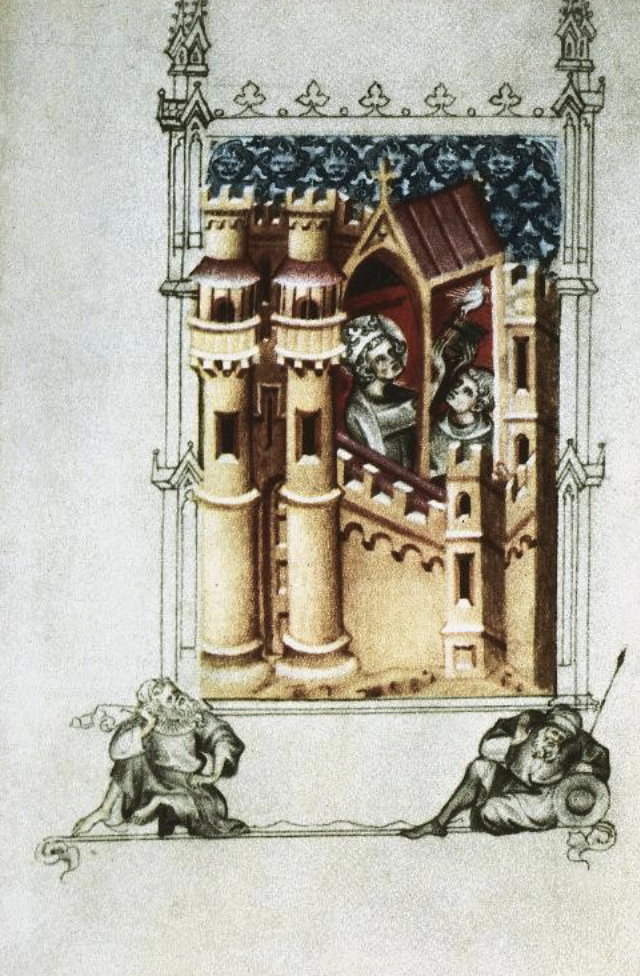
Jean Pucelle, Book of Hours of Jeanne d'Evreux, 1325-1328: St. Louis in an Islamic Prison Receiving His Breviary from a Dove
Receiving his breviary from a dove Dollhouse effect where a wall is removed so we can see it. The volume he is receiving is like an old fashioned version of a full breviary since its just so massive
See the stuff Honores could do but even better with this modeling, chiaroscuro and shadowing with some whole figures outside of frame that are pretty much just black white and gray
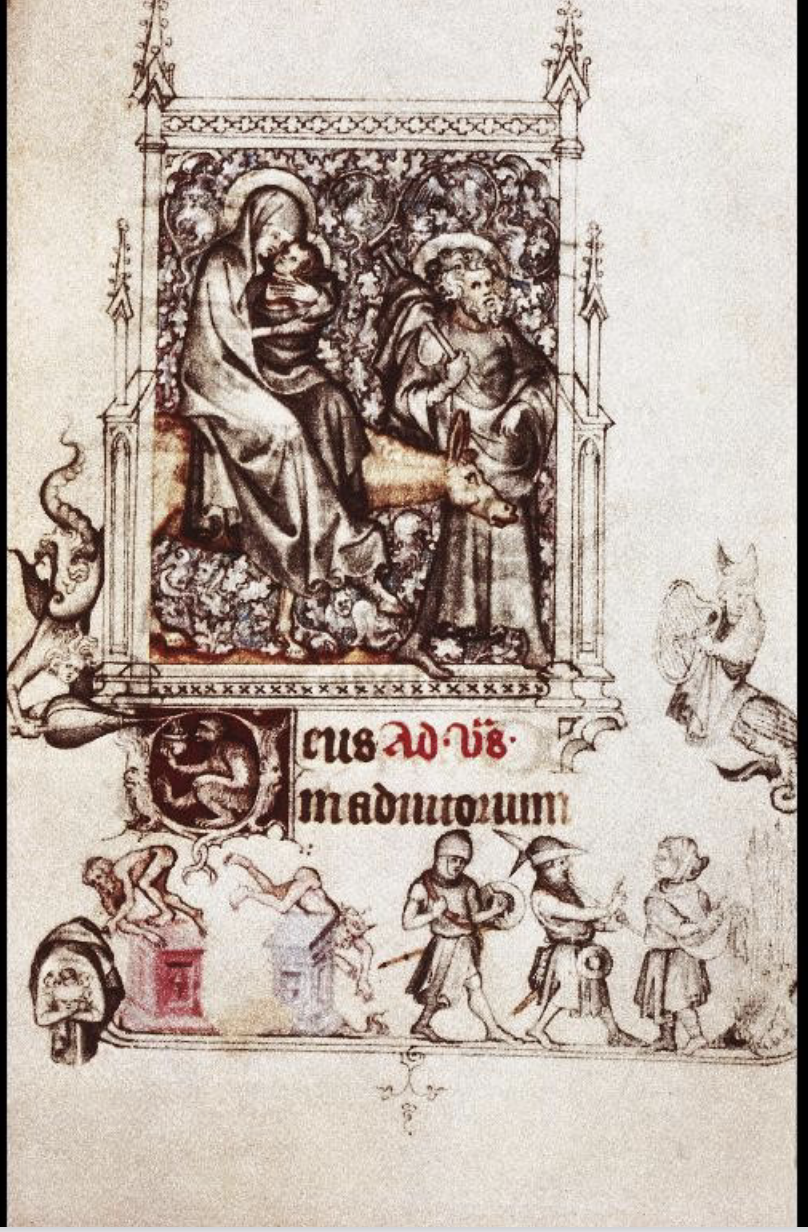
Jean Pucelle, Book of Hours of Jeanne d'Evreux, 1325-1328: Flight into Egypt
We have more frame transgression seen with Josephs feel and the donkey carrying Madonna and child fleering from Herod's murderers is cut out of frame so we just see one hoof, so you can push out of it but also suggest things are obscured by the frame, which suggests motion and idea of something happening
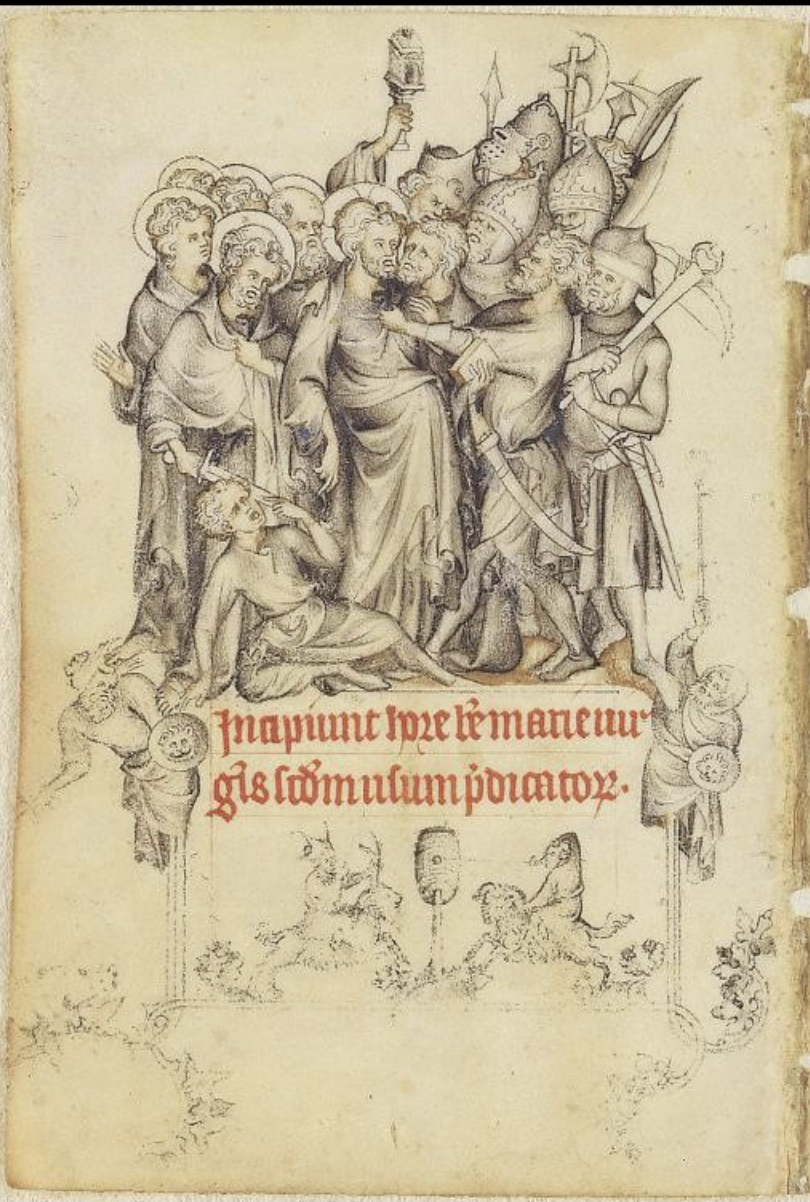
Jean Pucelle, Book of Hours of Jeanne d'Evreux, 1325-1328: Arrest of Christ
Pucelle as an innovator doesn't always have his scenes in frames, especially when it's a scene outdoors just takes place in background of the page so in a way it makes the blank page part of the scene, modelling and light and dark of the figures is very strong here
Peter cutting off ear of one of the soldiers in fury of Christ's arrest
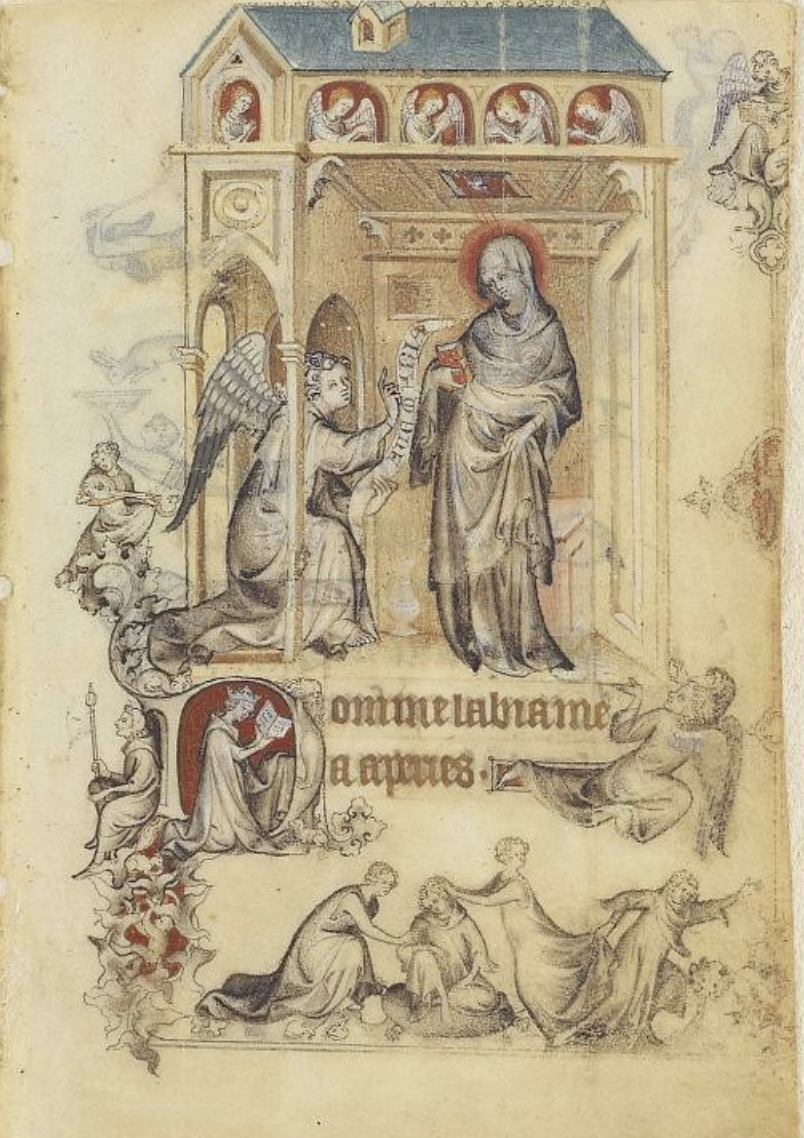
Jean Pucelle, Book of Hours of Jeanne d'Evreux, 1325-1328: Annunciation
Illuminated initial again, sees possible Jeanne d'Evreux looking at a book, so the patron and queen is part of the book, but she's reading a full breviary not just a book of hours
See Gabriel coming to Mary to tell her of the pregnancy, Mary is chosen by G-d to bare the divinity and son of Christ who will sacrifice himself to wash the sins of humanity and then will rise from the dead, so this is when Gabriel is telling Mary she is being chosen, Mary replies modestly saying she will do as they wish, happening through trapped door where you can see dove, symbol of her and the rays that will enter her body
She looks like she might already be pregnant but sway back posture was exceptionally popular in France, long thin figures and curving posture were what fashionable women aspired to look like
Not just a little gothic structure despite pointed arches flat roof, Gabriel is partly concealed in this anti room to the main room, door on the other side as well, foreshortened ceiling where the beams seem to come together and sense of deeper space, Duccio does create the anti room but angel does not appear to actually be in the anti room since he is not blocked at all by the post so outside of this, so Pucelle takes it even a step further than experimentation of Italian artists
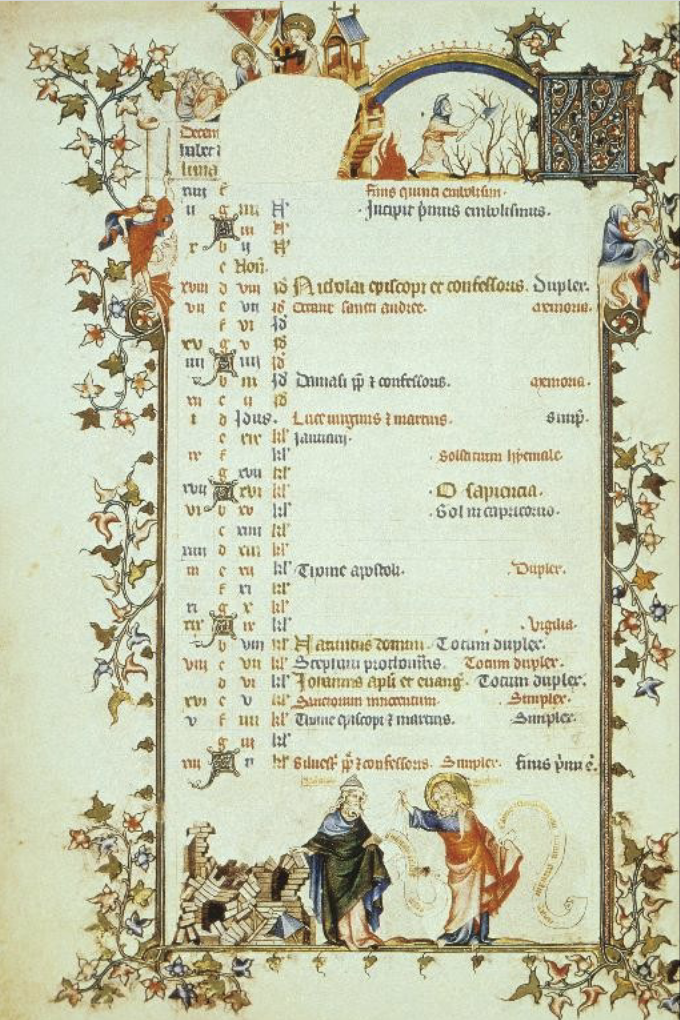
Jean Pucelle, Belleville Breviary, 1323-1326 Calendar page: December
Full color work with more gold leaf, probably also a royal commission, floral decoration around fame is traditional for French manuscripts
Seeing the process of a Jewish man and Christian figure, seeing Jewish temple being taken down and Christian will put their temple their since so much of Christianity about deconstructing Judaism and reconstructing Christianity, each of the calendar pages have a stage in this process
In the top right you see man cutting trees, in fall you grow trees to cut them in winter for fire, Polleder trees, still real feature of European landscape, which is why there's a little fire behind him, emphasis on staying warm in the cold winter months
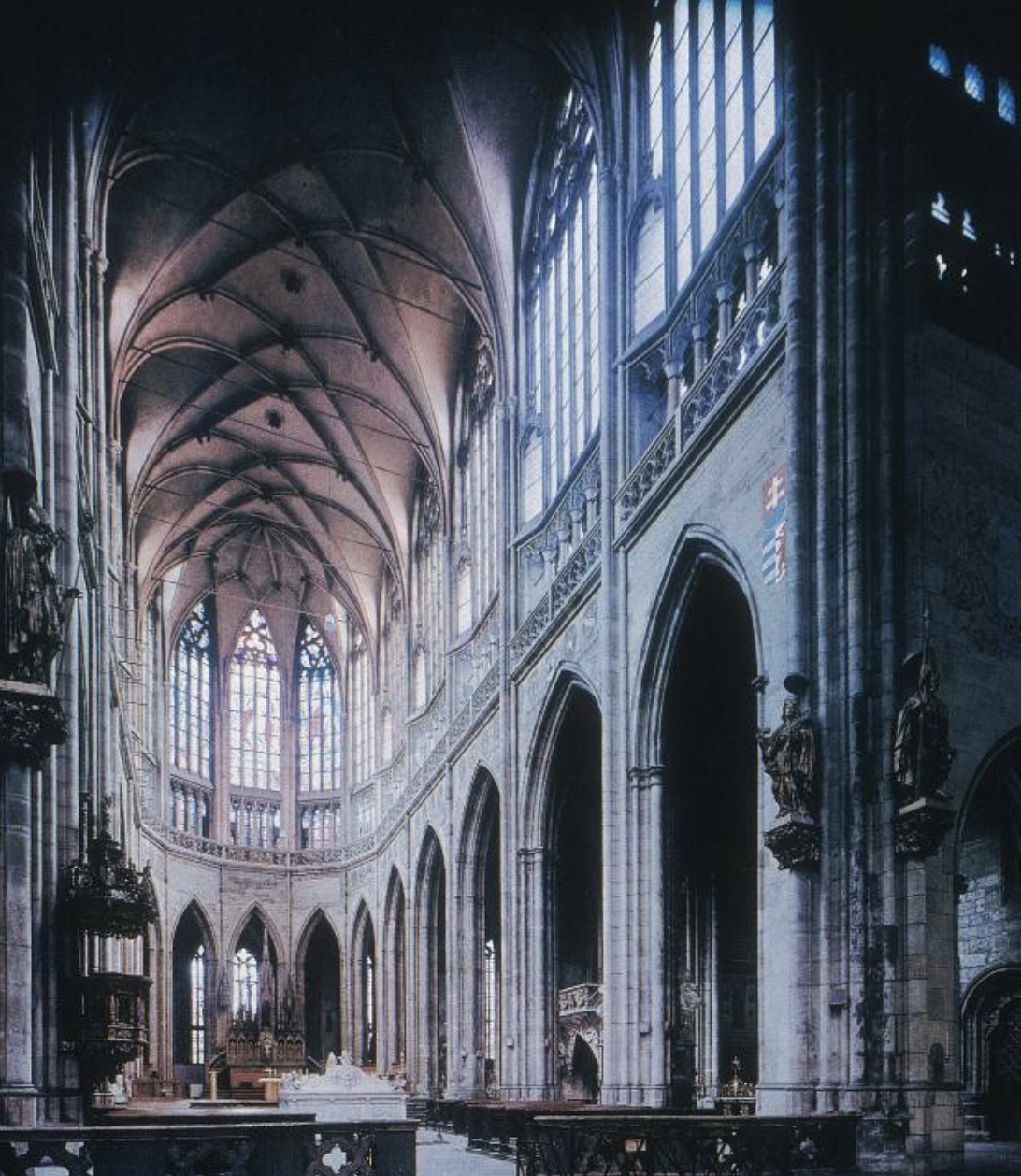
Bohemia: Peter Parler and Shop, triforium busts from St. Vitus Cathedral, Prague, 1375-1379
German influenced especially from Parler family, German gothic with these pointer arches and vaults, triforium below the window above the arch holds head sculptures
The Parlers workshop was builders and sculptors which was common because if you could work with stone you can build and sculpt, often sculpture and building made from same thing
Peter Parler was probably responsible for the design and the set of heads throughout the triforium, heads of current and past rulers from the Kingdom of Bohemia, so definitely a court or royal cathedral
Usually just a bust, this was tradition from ancient Rome despite Prague not have been being part of Ancient Rome
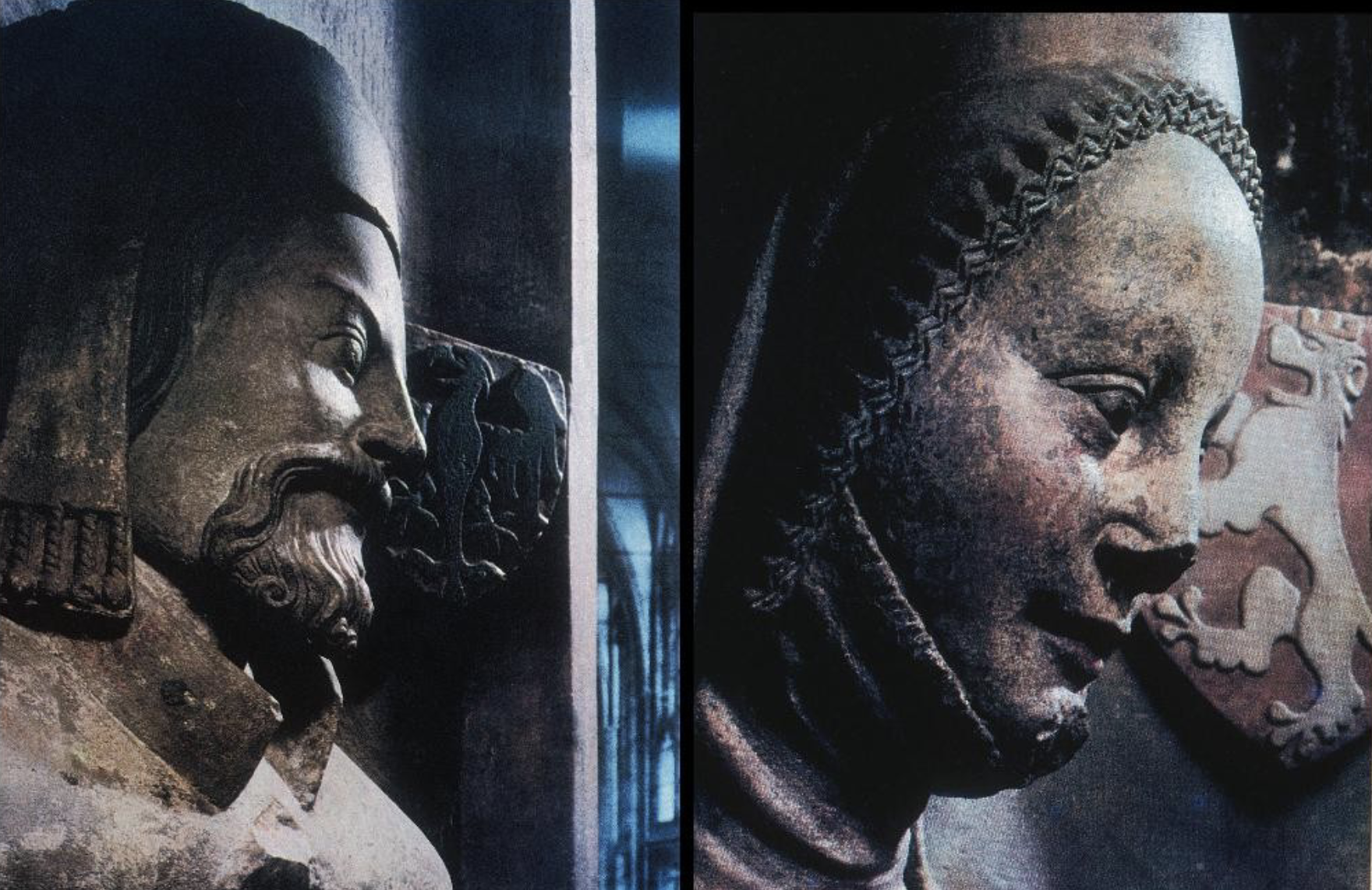
Bohemia: Peter Parler and Shop, triforium busts from St. Vitus Cathedral, Prague, 1375-1379
Charles bust: Assumed to be Charles, Next to his imperial coat of arms, along with the symbol of the Eagle
Elizabeth of Bohemia: One of Charles’ wives, she's the one who brought Charles to Prague and helped him become Holy Roman emperor, rounded cheeks and small nose which is beauty standards, next to her is again coat of arms and symbols of Prague so while these might not look like them but recognized by symbols
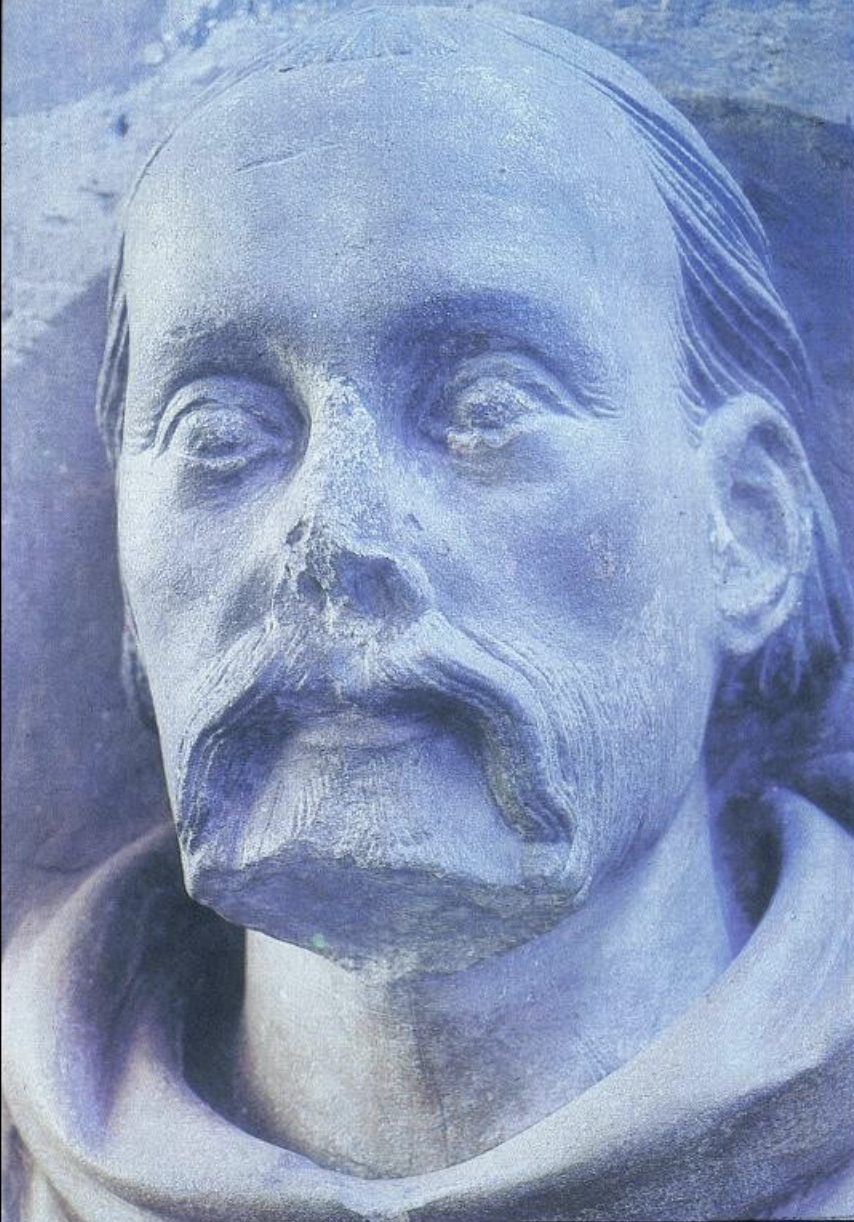
Bohemia: Peter Parler and Shop, triforium busts from St. Vitus Cathedral, Prague, 1375-1379: Peter Parler Bust
Super weird statue that doesn't show what an aristocrat would've looked like, assumes its a self portrait, less neat hair like a symbol of someone working, if it is him one of the first self portraits, at least stone self portrait of this area, tells us Peter has faith in himself, and Charles doesn't mind that he gets the glory showing that having a successful artist is something to advertise
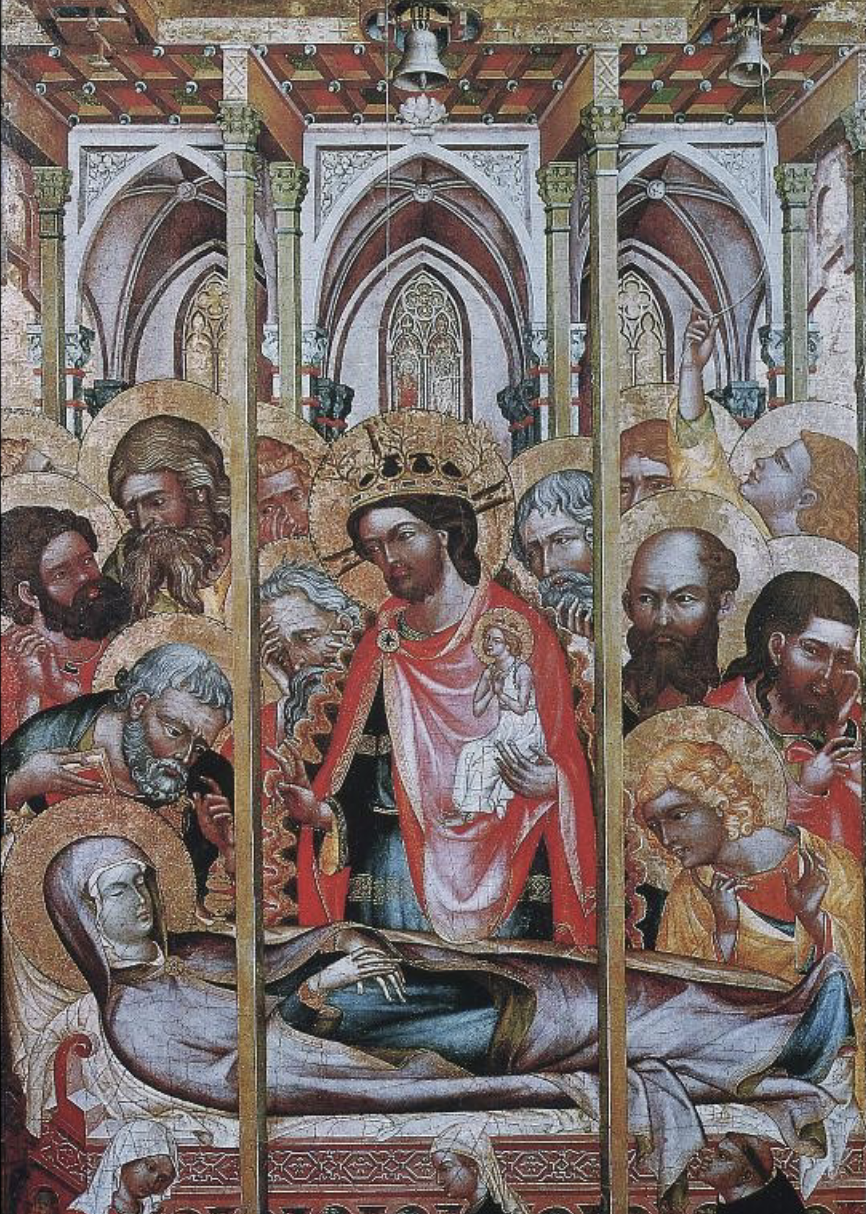
Bohemia: Death of the Virgin, c. 1350-1360
During Emperor Charles IV reign, lots of paintings since he brought so much money, so he and his bishops and other people in his circle commissioned many more paintings. Painting like this likely would've hung behind an Alter, where central rituals of Christianity take place, so much gold leaf, and just huge. 3 weird tiny figures at the bottom, heads bent, 2 are female and third is a man with the shaved head a clergyman would have had, likely all the clergy family with their brother since monks can't get married
Women looking down like all kind of do to show modesty, “Donor portrait”, these 3 at the bottom probably paid for this and this is their tribute to show their piety but also their influence
Either Death of Mission of the Virgin, Mary dies but her death is temporary since instantly Christ appears to take her soul up to Heaven, seen with Christ reaching out for her, since her soul is pure she doesn't need to wait for judgement, Christ just brings her right up, no last judgement
This is why Mary looks dead with her hands crossed but someone taking her, the little child carried by Jesus is happy
Christ and Mary are kind of neutral where all the apostles are so distressed since they can't see Jesus taking her away so they're sad their leader dies, one apostle shown ringing a bell which is how you learned of a death in medieval Europe, Charles family had also married into Byzantine empire so Byzantine and Italian influences, Vertical elements interrupt these faces suggest that these figures are inside
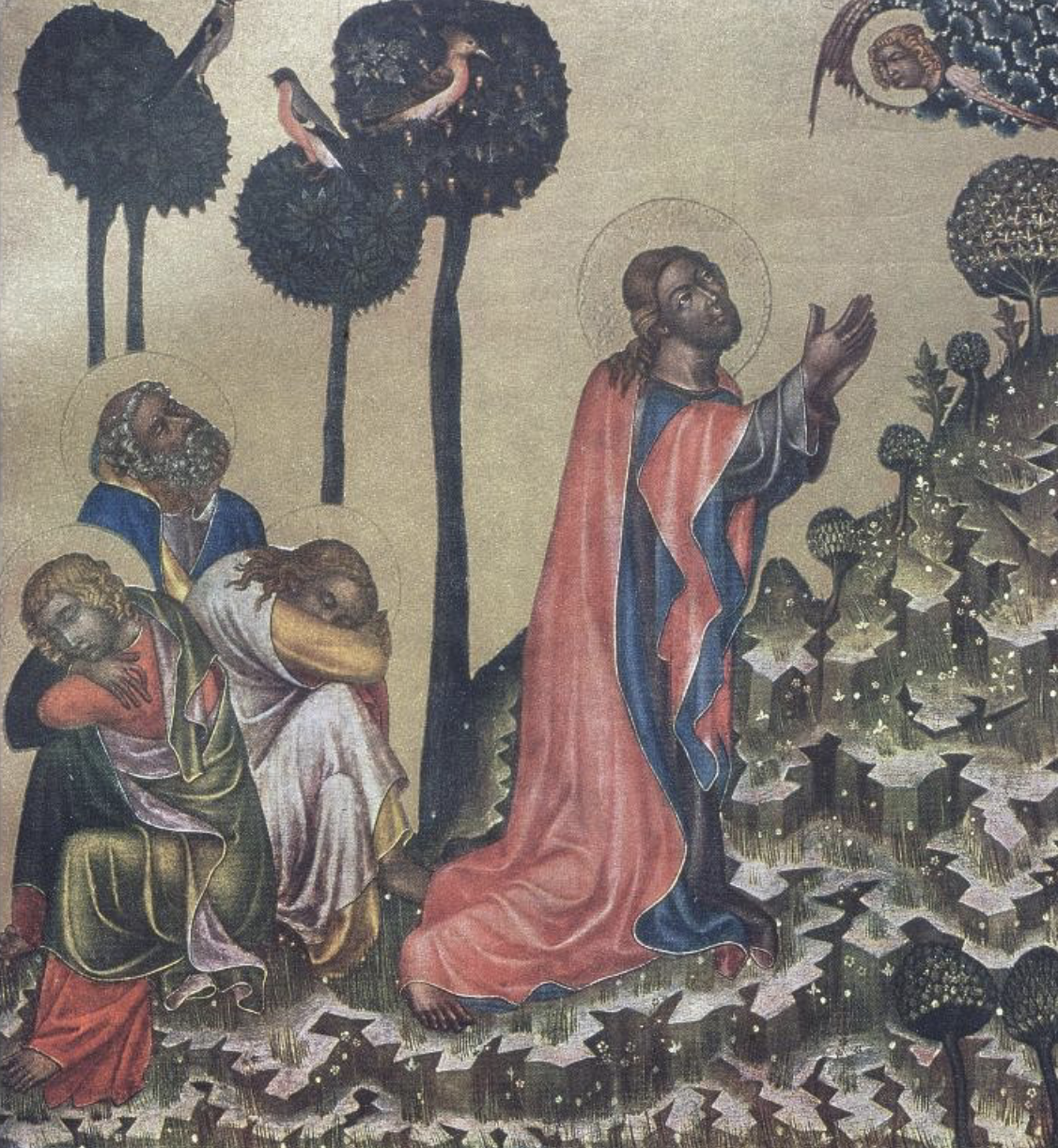
Bohemia: Vyšši Brod Master, Vyšši Brod Altarpiece, c. 1350 agony in the garden
Night of the last supper right before he was captured so final moment for him to commune with G-d the father, so he is said to ask if he has to go through with this but then drinks from a cup and agrees to sacrifice himself in a way
Nighttime scene which is what his apostles are seen sleeping behind him
Not at all realistic like the hillside looking like poured concrete which strange lollipop like trees, this approach can be seen in early Byzantine and Italian art, begins to appear at end of ancient world to show rugged landscape
Some trees look like they sprout from halos but super weird shape, these leaves show its an Oak tree also with acorns, birds are super accurate and clearly are realistic birds, we see this style especially in Northern Europe of mixing older version of depicting the world and increasing interest in meticulous detail
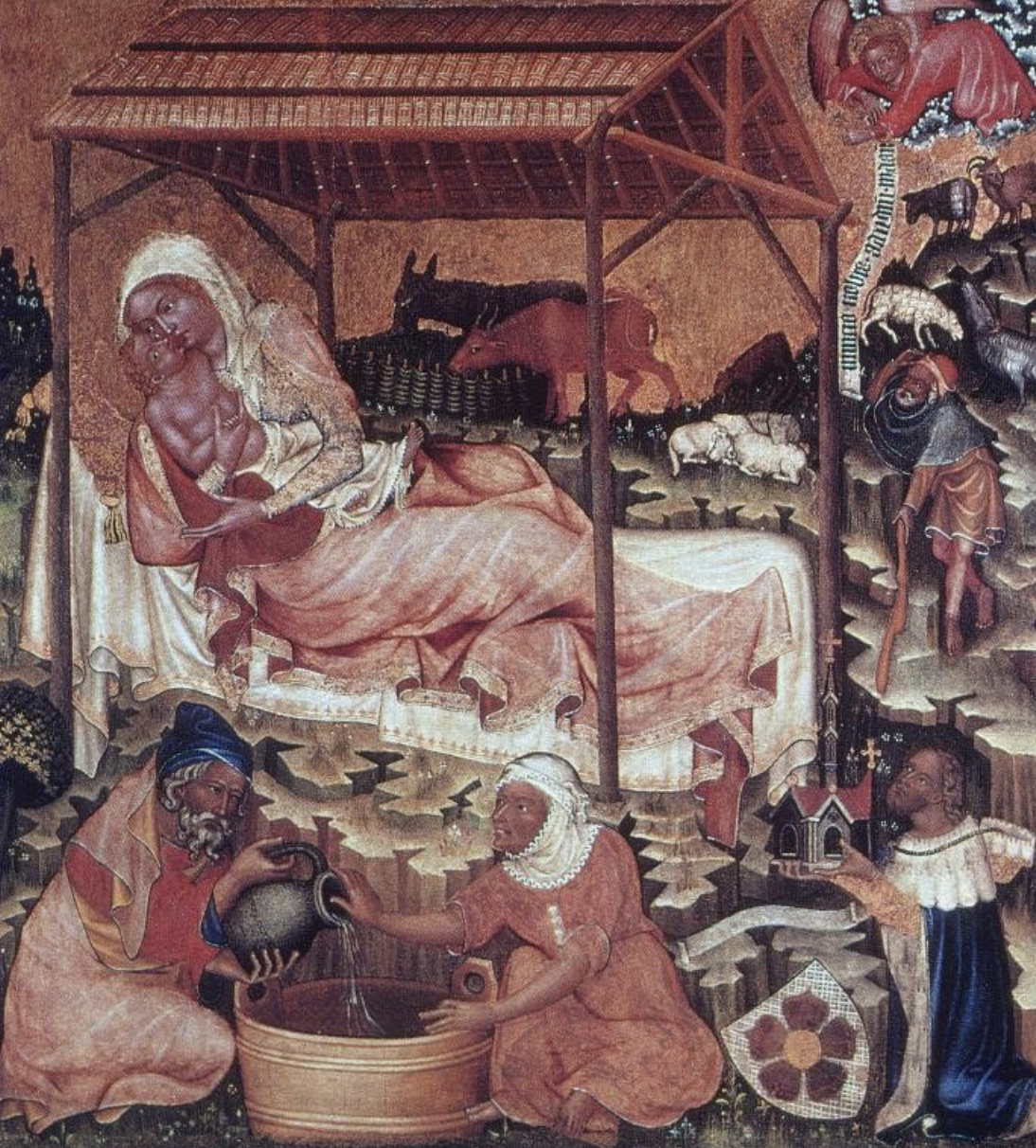
Bohemia: Vyšši Brod Master, Vyšši Brod Altarpiece, c. 1350 Nativity
weird offering and no compelling landscape, yet some naturalistic details like the pouring out of this bath water and a midwife checking the temperature, see some study of nature but then the weird ancient ground
Enclosing figures is once again important
Very thin post to not block so much but still want to show a more coherent 3 dimensional shape to enhance the narrative, traces of new ideas coming likely from Italy with an emotional impact
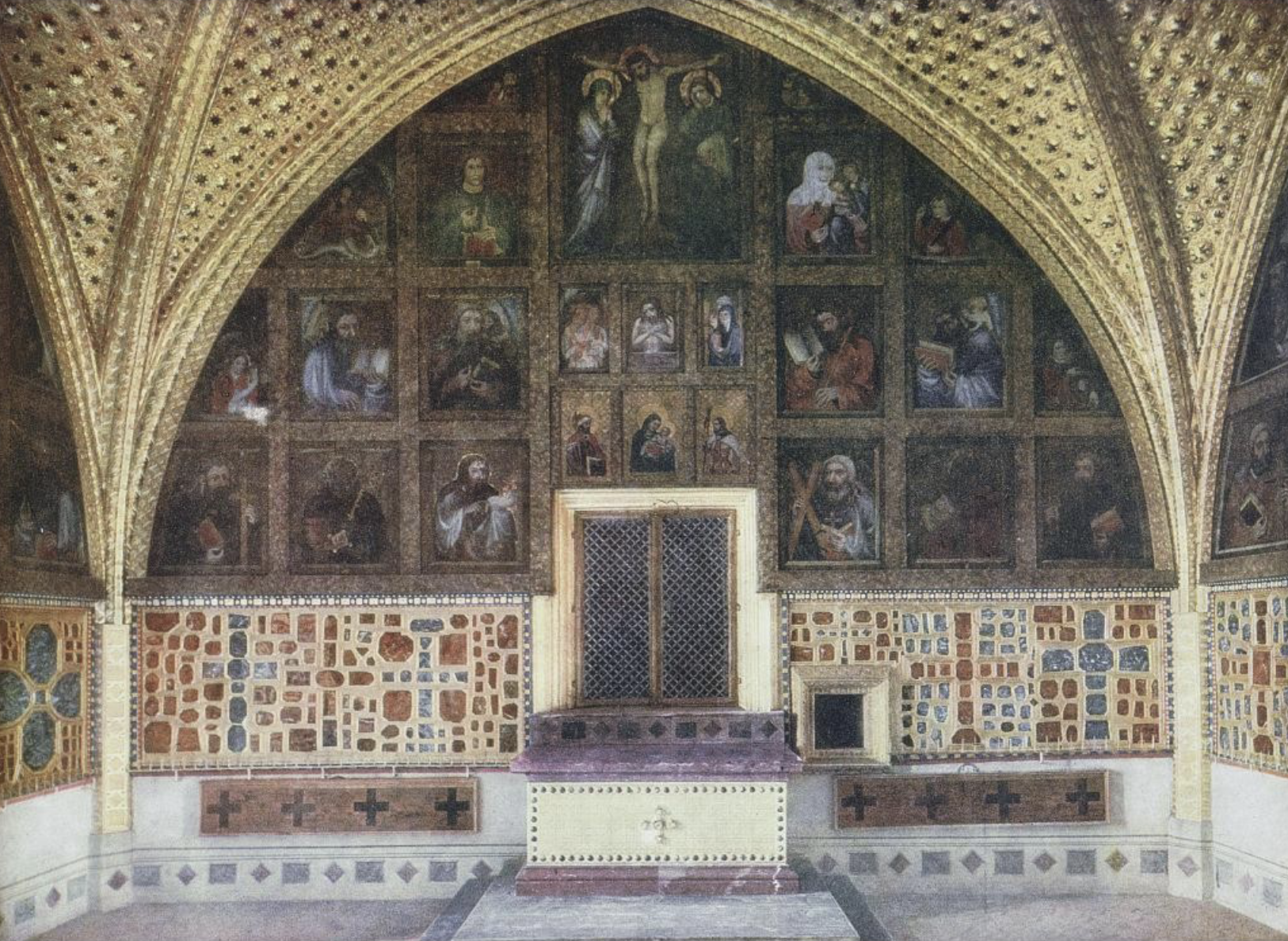
Bohemia: Chapel of the Holy Cross, 1357-1367, Karlštejn Castle, near Prague, Karlštejn, meaning Charles’ stone of fortress
Lower walls are made with semi precious stone, not diamonds or rubies but extremely expensive still, the stones make up a cross shape, below would be candles that reflect off the shining stone
Big semi circular areas full of panels, some are narrative like the crucifixion but many are portraits of individual saints, the saints reflect which relic Charles would have owned, a relic referring to a piece of a Saint, like parts of their body or something their owned, usually these relics would be to display to have a traditional real mass, these relics would be extremely expensive and whole churches would be built at times to house just one, reliquaries
Saw collecting these as a marker of power but also as a way to boost ourselves to get to Heaven, so these portraits reflect who Charles thought he had relics from
St. Vitus, old king of Bohemia, or others that weren't super local but ones important to Charles for some reason
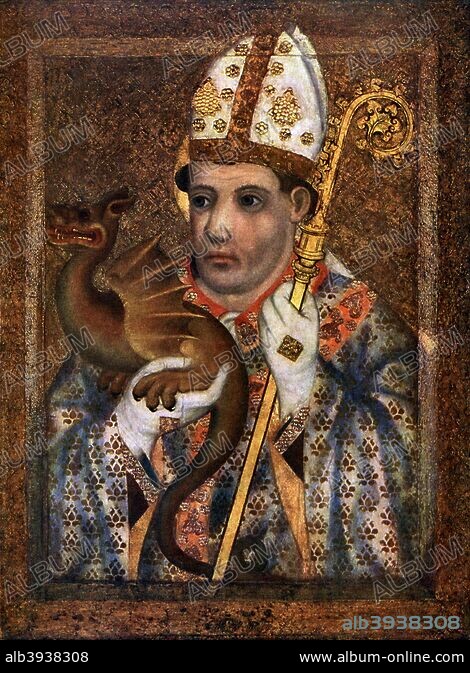
Bohemia: in Karstejn castle, Master Theodoric, Saints,1365-1367 St. Hilary
We see his Bishops hat basically just breaking the frame since his face is so large proportionally, you have a frae but figures si 3d they push out
Holding staff which is typical of bishop, also this dragon that he is said to have pacified so symbols are shown
Looks somewhat similar to this fresco from Italy, in a monastery, we know that this painter had some panels that went north with Charles so perhaps Theodoric had seen them
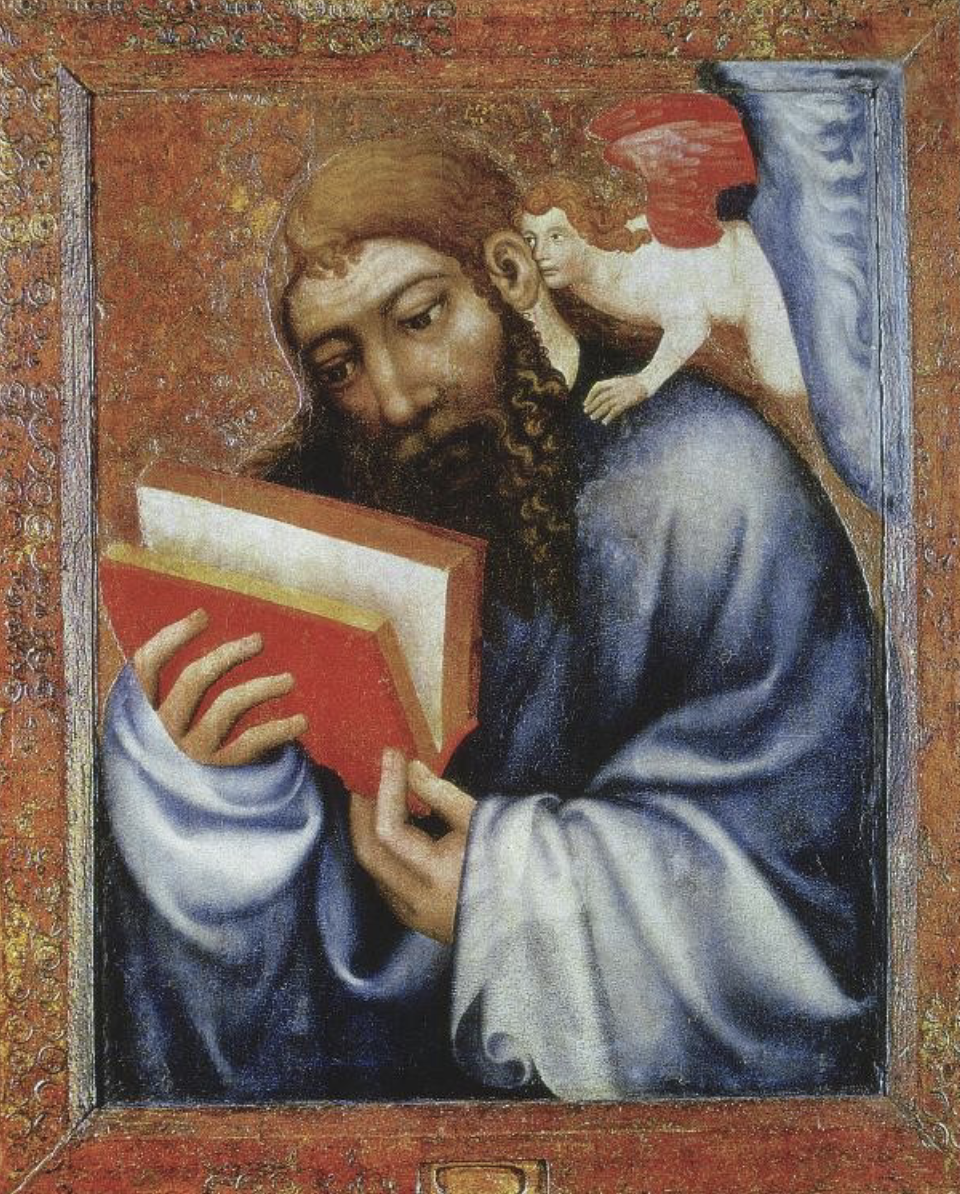
Bohemia: in Karstejn castle, Master Theodoric, Saints,1365-1367 St. Matthew
Some of these images just look like comics and are ridiculous
Mathew, unlike Hilary who was a bishop was not super fancy since he wasn't that like high up
No real attribute expect the book he is writing but the way he's holding the book makes us wonder if he even knows what it is since he's looking at it sorrowly but might be thoughtful about it since angel seems to be dictating what he should be seeing
Modeling with light and dark becomes even more clear in his face
None of these figures are super elegant
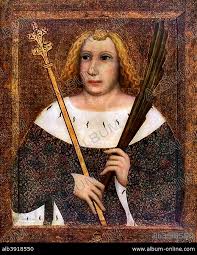
Bohemia: in Karstejn castle, Master Theodoric, Saints,1365-1367 St. Vitus
Important part of Bohemia again, martyrs palm since he died for the faith
He's a young man who doesn't have much of a beard
Wearing a weird garment that's known for these black wiggles which be reserved for kings since its a kind of weasel that has white and black, shows his importance
He has very blonde hair but looks almost as if he's balding, meant to look like a local, as many Czech men do indeed bald early on
Shows local guy that Charles wants to attach him too
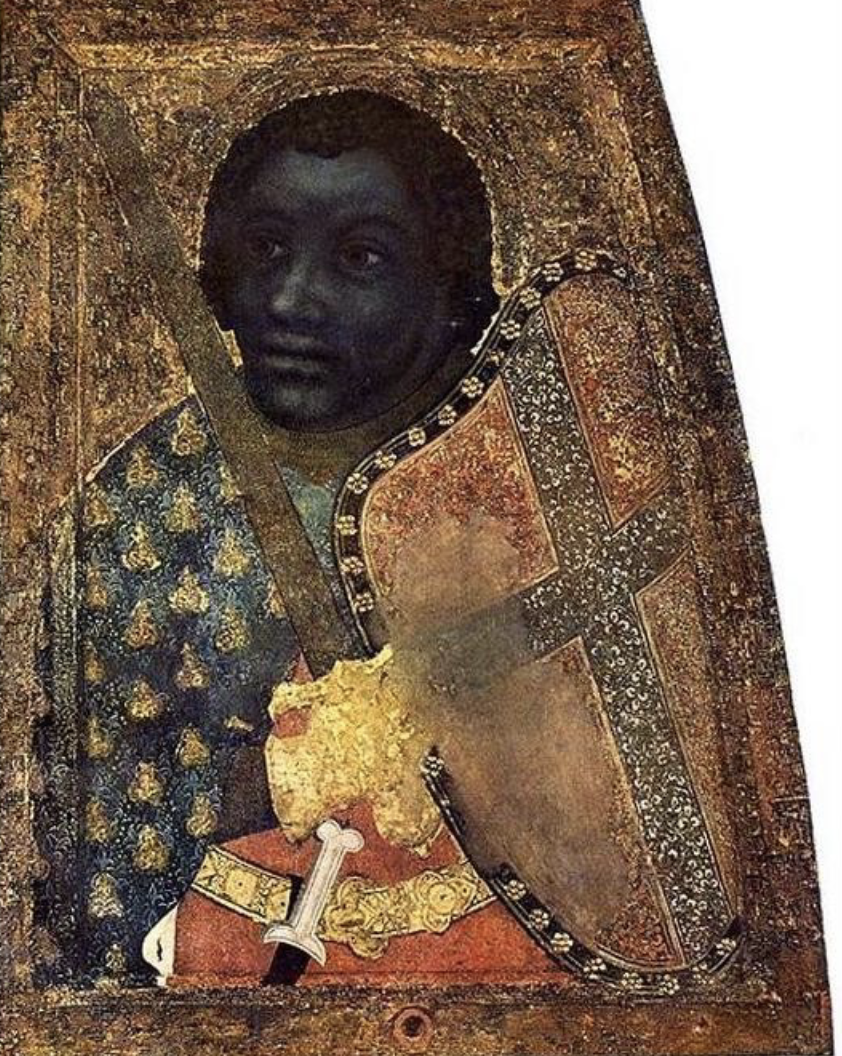
Bohemia: in Karstejn castle, Master Theodoric, Saints,1365-1367 St. Maurice
Super different than Vitus
Ancient Roman soldier before year 300, said that his unit was said to be sent to Switzerland to take out Christians but he wouldn't since he was Chritian so killed and becomes Martyr
From Egypt and dying for his faith his story becomes super popular, only soon before after this European artists decided to render him not from North Africa but from from full African descent with dark skin, changed up Emperor Fredrick, would have been a model for this in Germany
His sword was a very important relic, at times used to knight emperors
They want to be universal ruler like in the 1200s, like Frederich the second
who had Black subjects, some of the Black people were brought to Mediterranean through slave trades, others were members of black Christian communities through Africa like Nubia and Ethiopia, these black kingdoms sent monks to these monasteries, and as these crusades started happening they saw these black monks so this idea was not super unfamiliar, Charles wanted to send a representative to Ethiopia so it was very useful for him to have a black saint
People he is ruling are slavic but he wants to rule all so shows people from other areas, like Black people to show who he wants to end up ruling
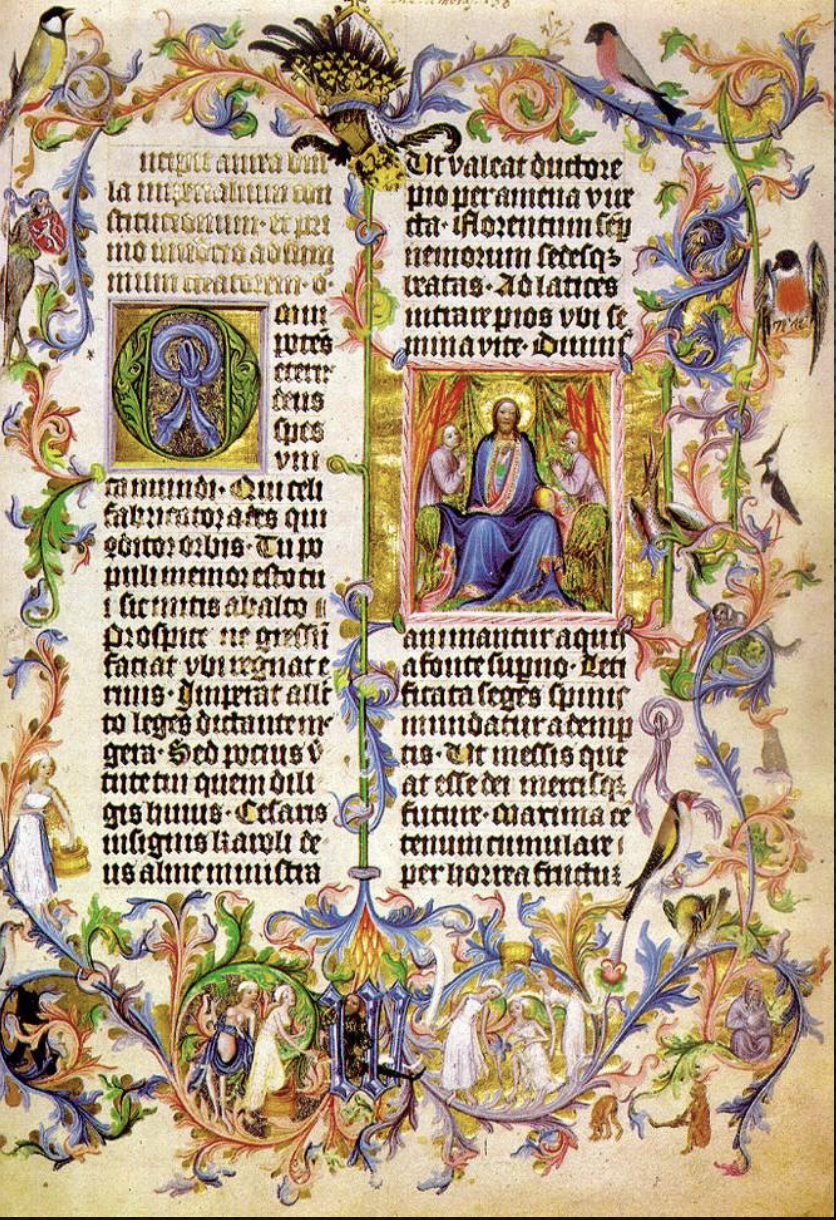
Bohemia: Page from the Golden Bull of Charles IV, c. 1400
Shows a very important document that lays out royal power in Prague, establishing important religious status, making Bohemia into more important place
Bull is like a decoration not an animal
Interesting stuff shown through the margins, and many gorgeous birds like the Vyšši Brod Master
We have these vines which are pretty typical, and inside the loops and between the loops show these peculiar scenes
Man with long beard who is trapped inside a 3 dimensional W, W standing for Wenceslas, Charles IV’s son and surrounded by these women basically in their underwear and these women are barbers despite that not making historical sense, so they're coming up to him and trying to trim his hair and civilizing/taming him, so these women are coming to smooth him out and making him more of like a typical man, lot of playfulness at times in these pages like the one with the game of tag, many of these do show men as rough burly and aggressive, but in this courtly world the function of women was to civilize and tame them through the delights of courtly love, this is a comical version of this, women seem to be gossiping and laughing at this
Above this see a woman holding a bucket hinting to it being a barber
Also see a figure in the upper left who is carrying shield of lion of Bohemia and seems to be hairy all over, creature of early imagination of a person who grows up in this wild with hair all over and is not civilized, so while Wenceslas is also not tame this guy is even more untame
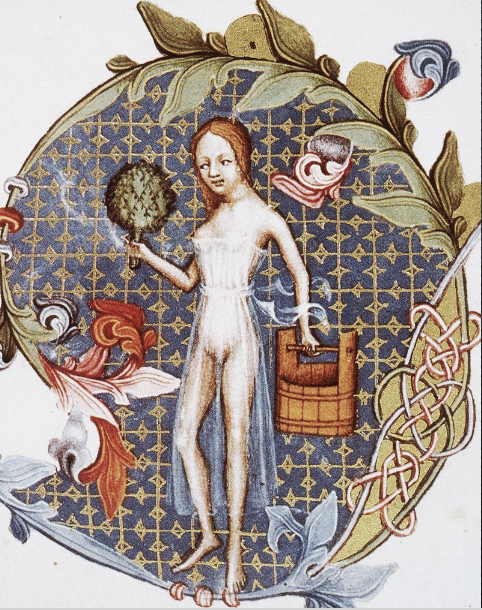
Bohemia: Marginalia from the Bible of Wenceslas IV, c. 1390-1400
Bible made for Wenceslas, same kind of off female barber supposed to tame a man, symbol that men likely would've enjoyed very much since she is shown once again
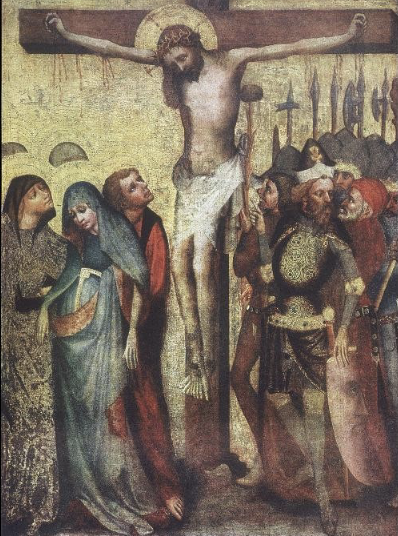
Bohemia: Trebon Master, Trebon Altarpiece, c. 1385-1390, Crucifixion
Under Wenceslas, Trebon Master, Trebon Altarpiece, c. 1385-1390, Trebon the place, focus on stories from end of Christs life, Trebon master has a somewhat darker outlook than some of the others shown, with kind of profound sadness
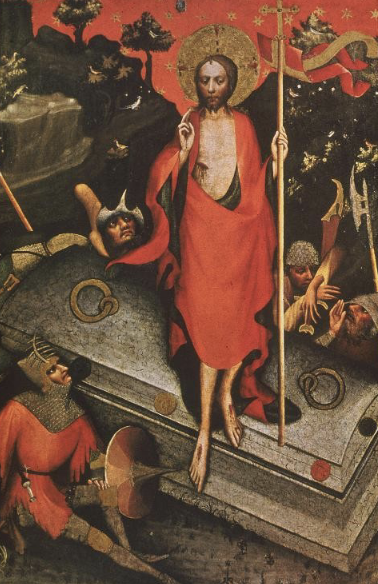
Bohemia: Trebon Master, Trebon Altarpiece, c. 1385-1390, Resserection
Not a gold leaf but a red sky, almost like a red sky but with stars so we can still read it as a sky, Christ here is thoughtful rather than sad and has risen above this death but can still see his wounds, similar to the Vyšši Brod Master’s trees
The cave coffin thing is still shown closed from the Roman seal to show that Jesus has magically come out of this coffin not just opened it, the soldiers are awake and seeing him
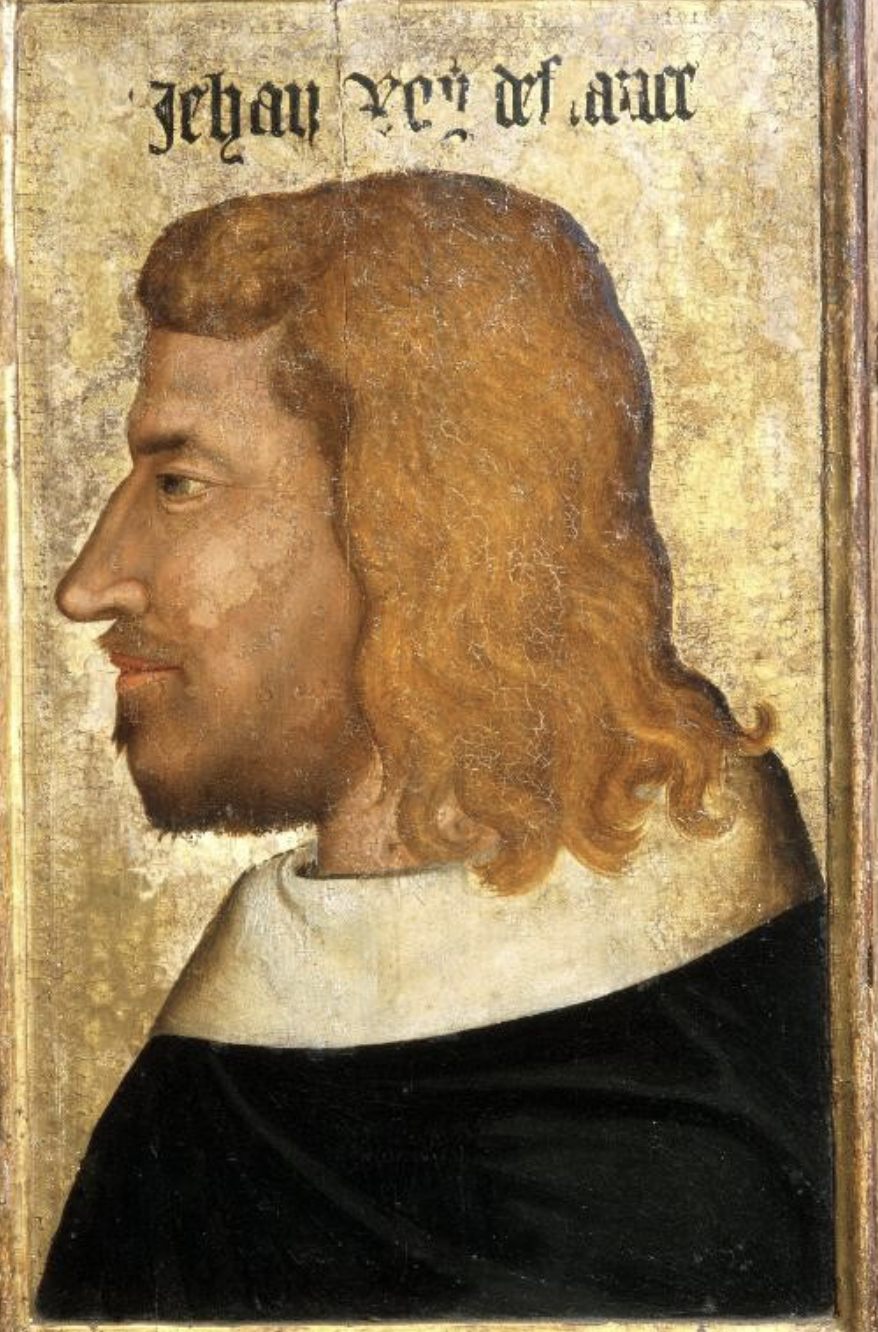
Paris: Girard d'Orléans (?), King Jean II (the Good), before 1356
Esteemed for his high moral character, he was captured in battle by the English
He resisted for quite some time which probably made it worse for France
We don't know much about d’Orleans and he's kind of mysterious
Labeled “John King of France”
Freestanding individual portraits were very rare at this time so this was extremely odd for this time, early 1300s is when we see more particularized portraits where you were supposed to recognize who its depicting, for this one he definitely has idealized figures with the short beard, the mustache and long curly hair but its not the generic nose everyone has so reason to believe this is recognizable
As far as painting, this the format where things start
People seen in profile is very distinctive, shape of the nose and shape of the forehead, it does tend to look somewhat unmobile, seem kind of fixed in this pose but this has a fixed dignity
King is wearing robes but there not elaborate or luxurious, not wearing crown which used to be the way of knowing it was a king, so he has dignity but its not like elaborate
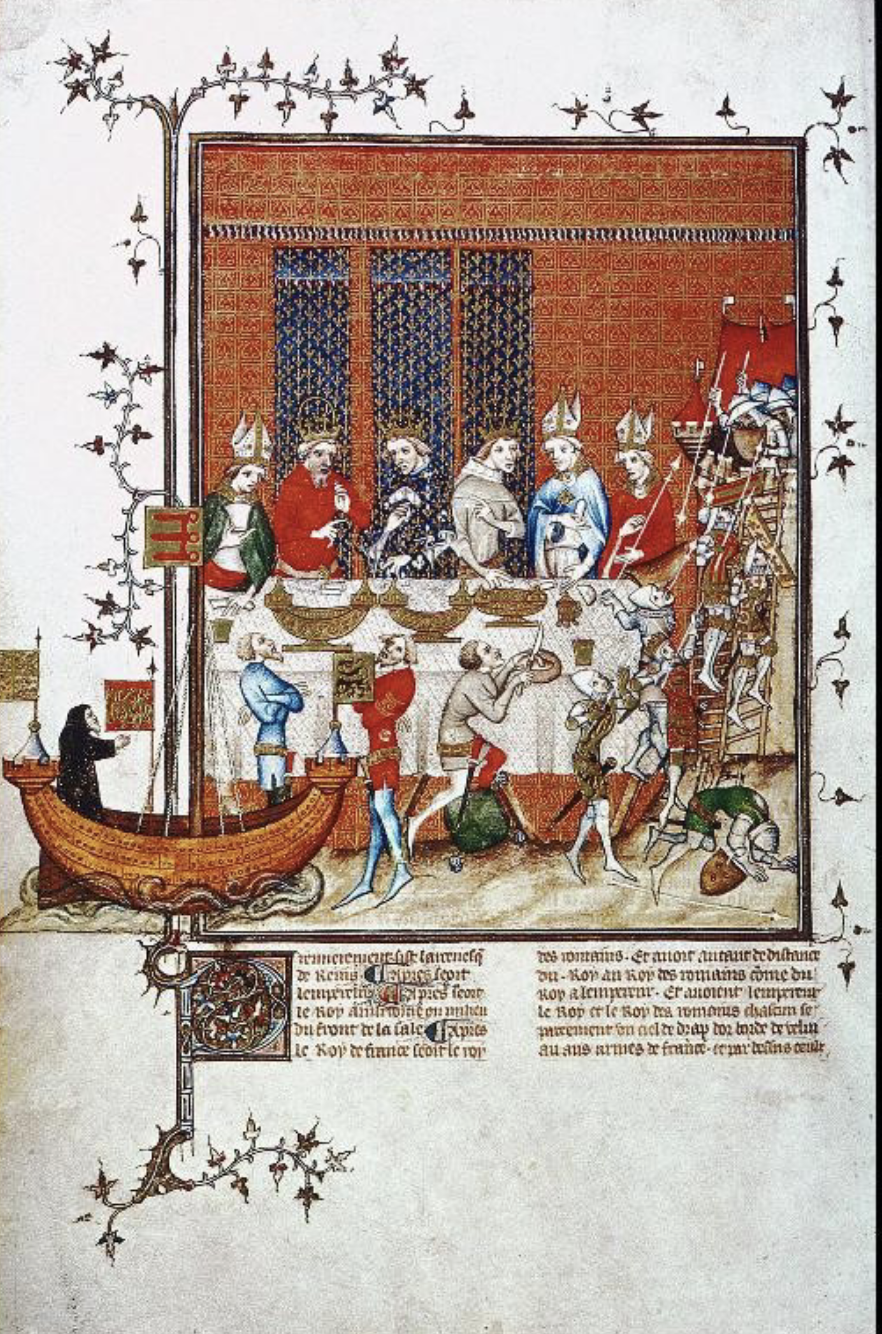
Paris: Banquet of Charles IV of France in Paris, from Les Grandes Chroniques de France, 1375-1379
After the death of king John, picture of a recent banquet, practically a depiction of a celebratory event, Banquet held by French king, Charles the 5th, to recommend Holy Roman emperor
Those weird vessels on the table that look like boats are salt sellers, would have been extremely expensive, there to show wealth and hospitality of the host
Members of other aristocratic families given the pleasure of being able to serve them
Fleur de les shown in the back, French royal emblem
Court of Bohemia and Court of France together
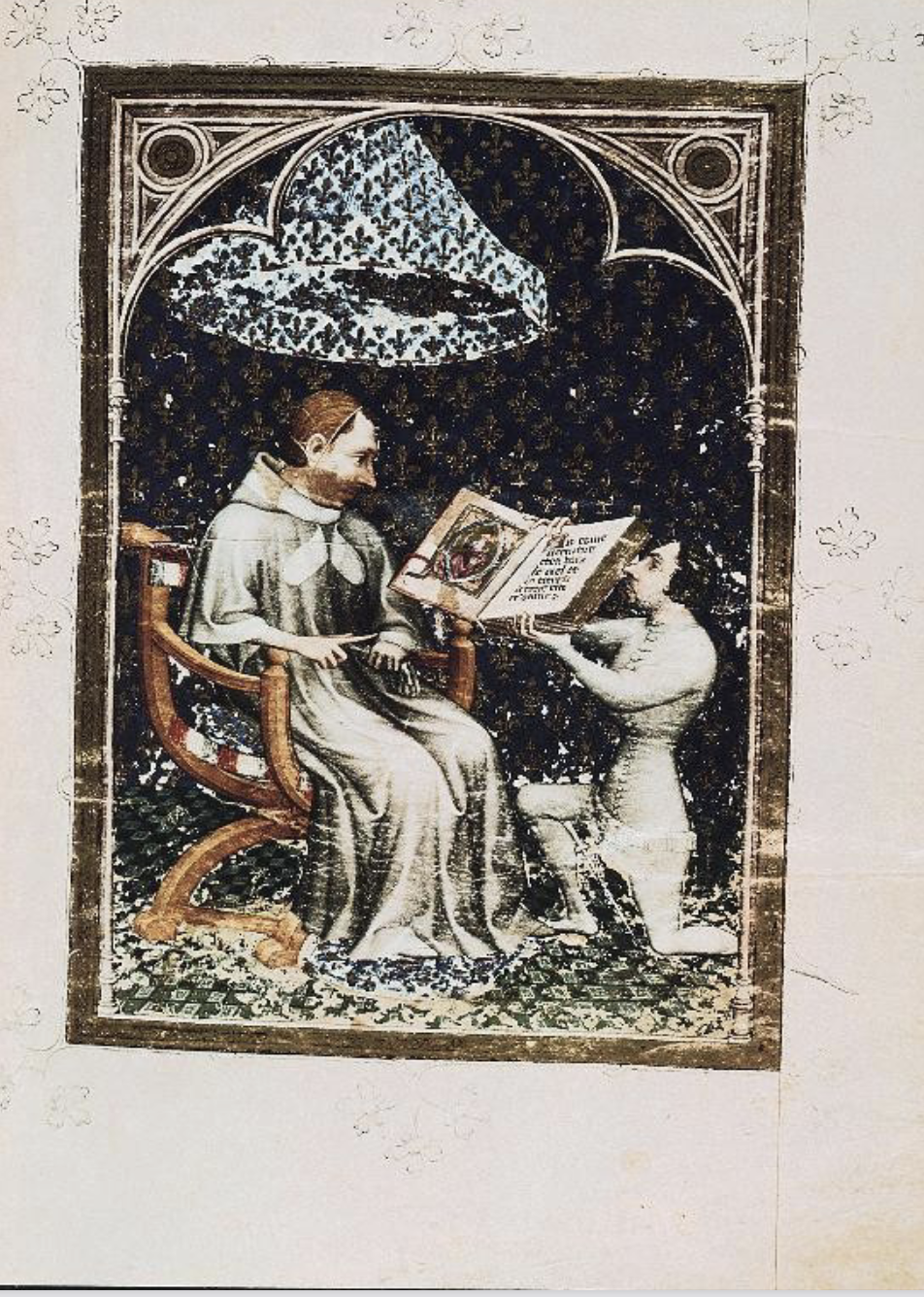
Paris: Jean Bondol, Presentation of a Bible to Charles V by Jean de Vaudetar,
Bible historiale (Hague Bible), 1371
After Honores and Pucelle, most of the skillful manuscript makers were known and even signed their works
Shows presentation of the book itself
Bondol is very interested in this idea of Monochrome or grisailles, Even though its not full color its still very elaborate, this guy presenting the book has buttons going all down, robes of the King guy of sorts seems to wear a robe from the graduation ceremonies, not on a golden throne but shown in the eyes of an intellectual but seeing the golden Fleur des les and this circular canopy acts as stand in for crown along with red and white stripes around the chair, so very subtly see that he is a royal
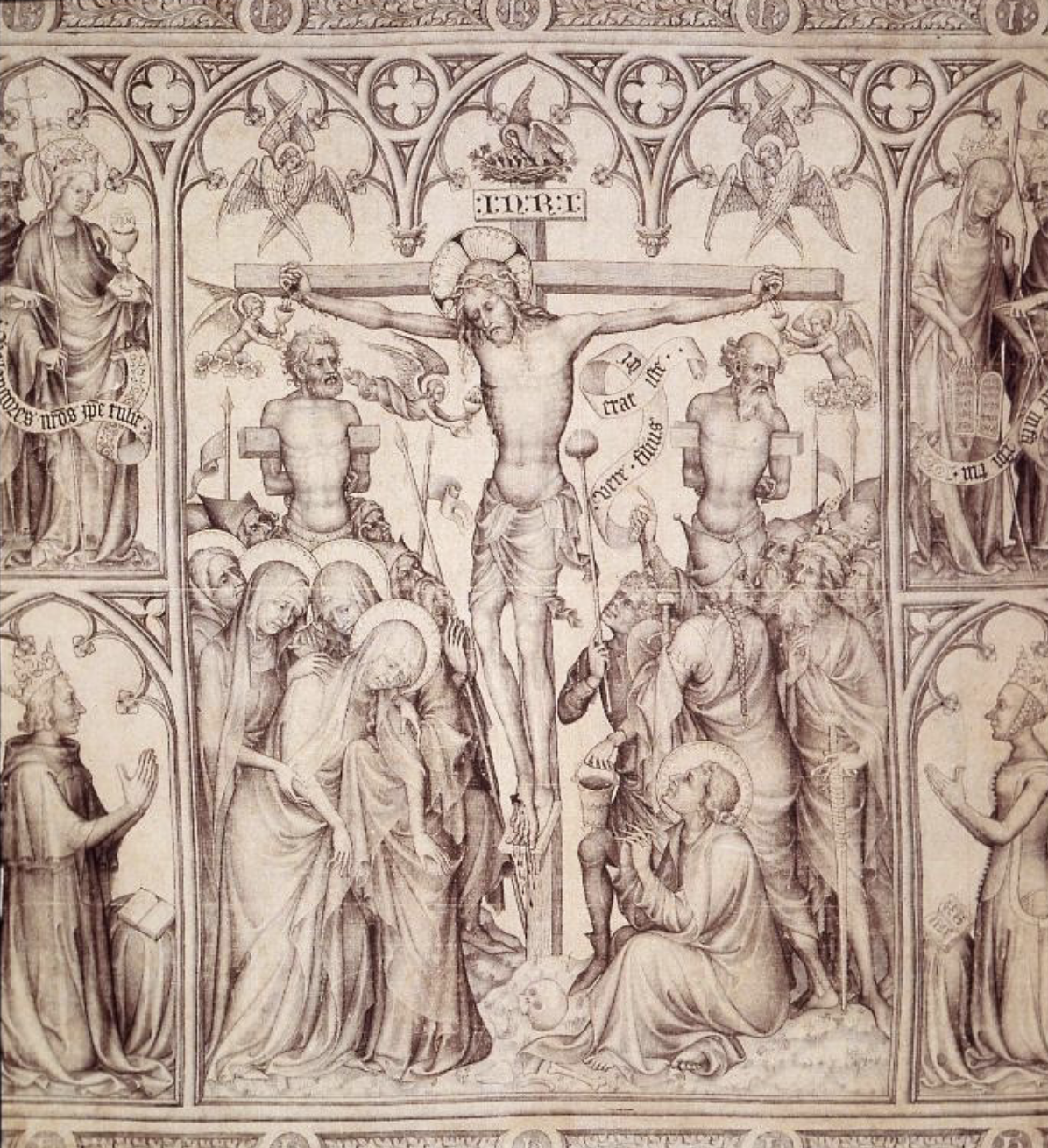
Paris: Parement de Narbonne (altar frontal), Crucifixion, before 1378
Huge piece of cloth that would've covered the front of an altar in a Cathedral in France
Very luxurious painted fabric, not tapestry, but very well taken care of, It was supposedly always monochrome and never like colored in, has stories from the life of Christ
King and queen of France are seen kneeling to the crucifixion so portraiture within this modeling is very well done here, can see Christ's rib cage and like the shadows of the audience
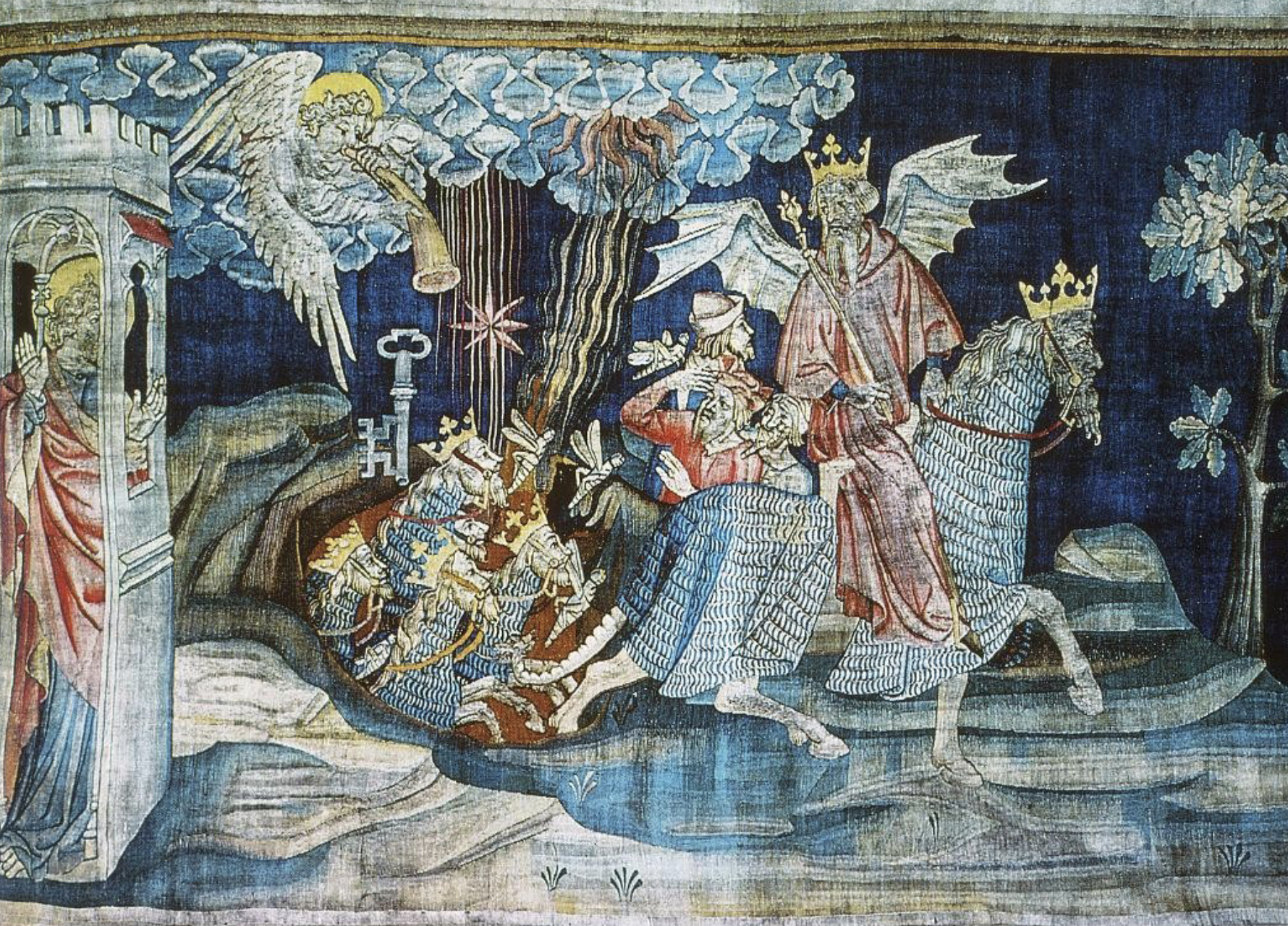
Paris: Jean Bondol and Nicolas Bataille, Angers Apocalypse tapestries, c. 1375-1379
Another textile from a cathedral, Capital of a dutchie, and aristocratic thief, huge project with like 28 scenes of this story of the apocalypse, vision of the end of the world and end of the material universe, book of revelations, or book of apocalypse, fire in heaven descending to earth, locusts coming down, star falling from Heavens to the Earth, horses face is a human face with a long beard and a crown, visions of what will occur in the future
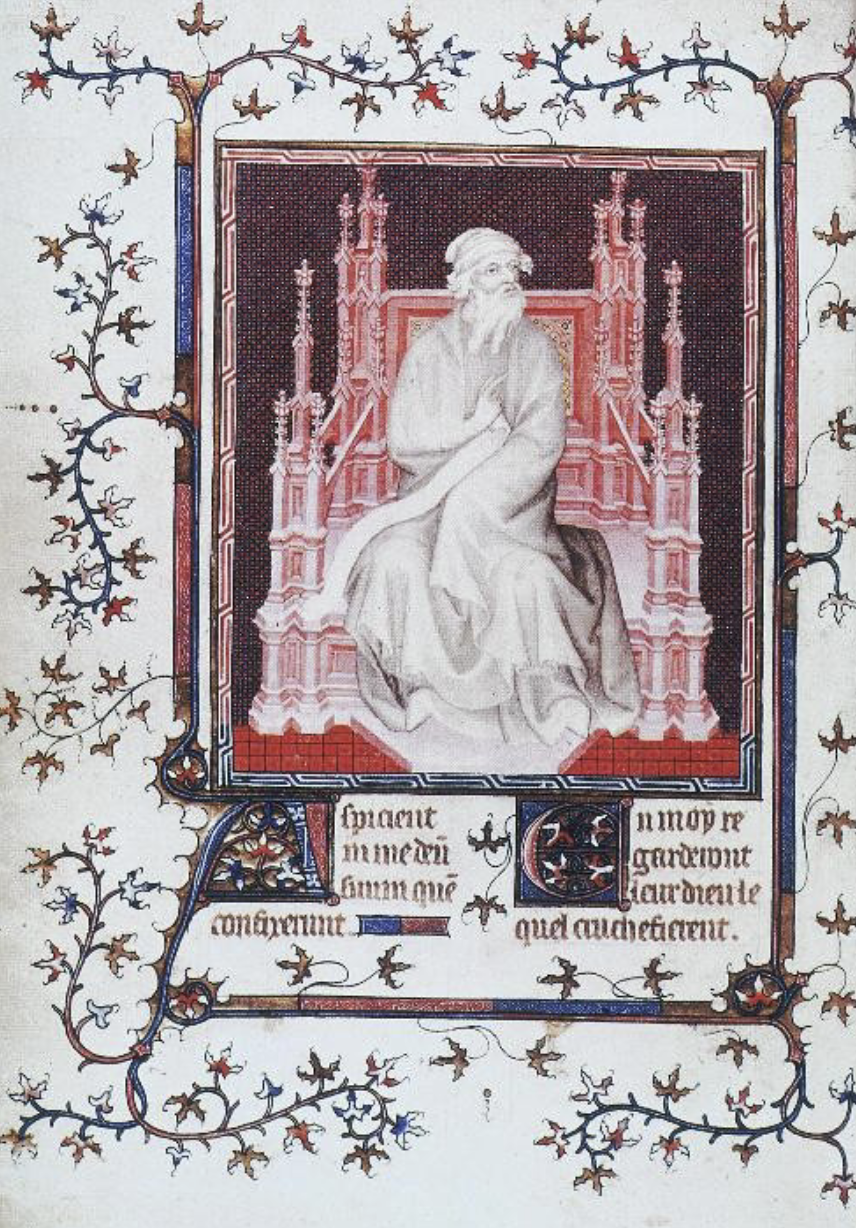
Paris: André Beauneveu, Isaiah, Psalter of Jean de Berry, c. 1380-1385
Charles the 6th his son sucked and wasn't a good ruler, Manuscripts were always needed and dint matter how poor it had become Beauneveu was both a manuscript and a sculptor, not much work as a sculptor which is probably why he did more manuscripts, Psalter is a book of psalms
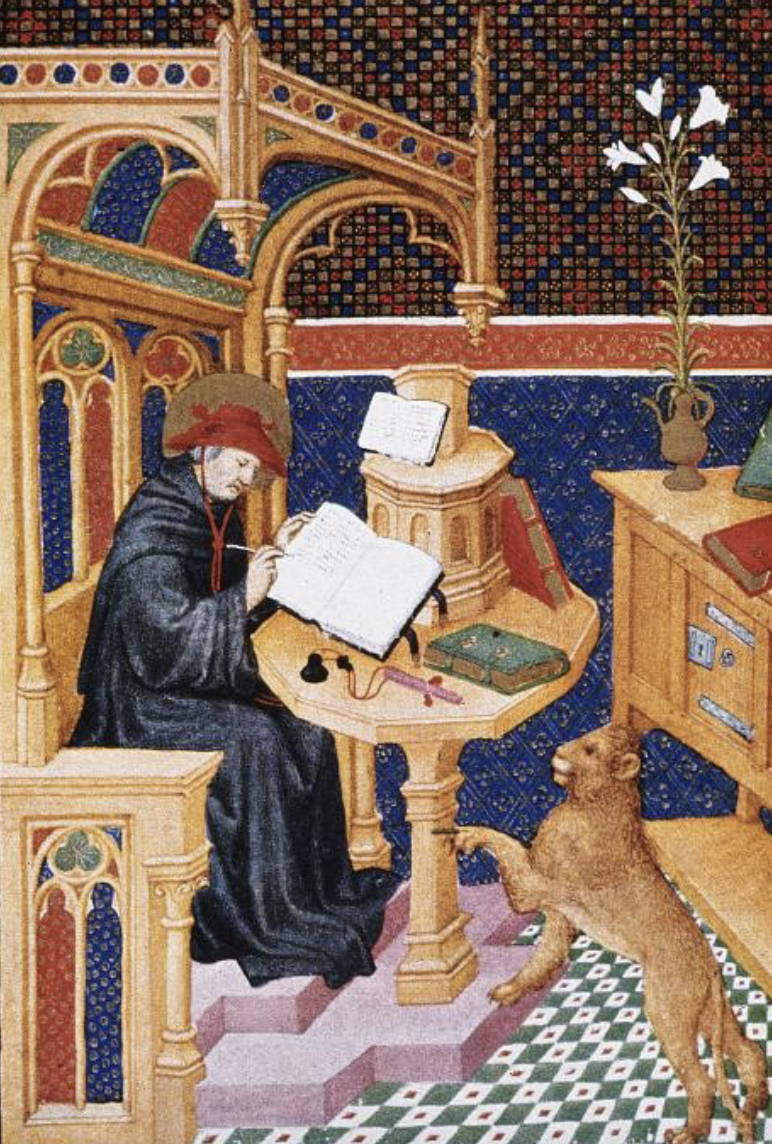
Paris: Boucicaut Master, Hours of Maréchal Boucicaut, c. 1408 St. Jerome in His Study
Jerome is the one who translated the bible and that's what he is shown doing here, referred to as one of the fathers of the church, wearing the red hat since he is a cardinal so appointed by priest
Cardinals are the ones who elect a new pope, Jerome was thought to be one of the very first ones, in 1400s thats the mark so even though probably wouldn't have worn it in his actual time but 1400s context
Lion is there since its a story from when he was a hermit, he encountered a lion who was in pain because a thorn was in his paw and G-d protected him to go help the lion and he helped it and then became his friend
Foreshortening seen here where it looks lower on the other side to show its going to the back, gives ample space for Jerome to sit in
Foreshortened chest as is the floor, floor tiles are red green and white which are the colors Marchal Boucicaut uses
Floor not seen where it hits the wall so a bit unclear which is his more traditional structure
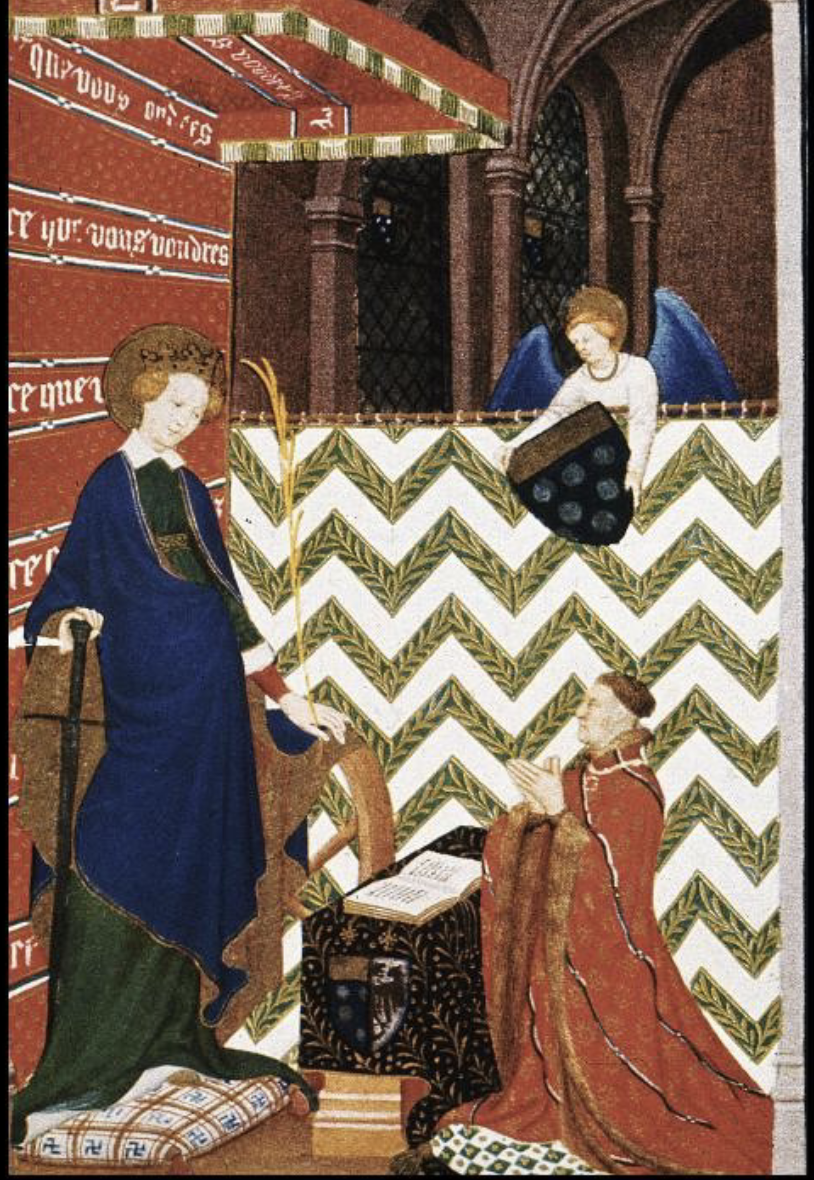
Paris: Boucicaut Master, Hours of Maréchal Boucicaut, c. 1408 Boucicaut Worshipping St. Catherine
Shows Marechal Boucicaut himself kneeling, praying and as hes praying has a vision of St. Catherine, Catherine was also a princess so seen here wearing a crown, standing on a cushion that almost has swastika like shaped patterns, while she has the halo but not her setting in heaven its where Boucicaut would have been praying, clearly post death since Catherine's head is back on
Big piece of fabric that comes out and hangs over Catherine, cloth of honor
Everything is like branded, so Boucicaut's coat of arms, has his personal motto over everything “What you will” or what you would like of me, showing loyalty to the king, The profile is here again, weird haircut but very typical of this time
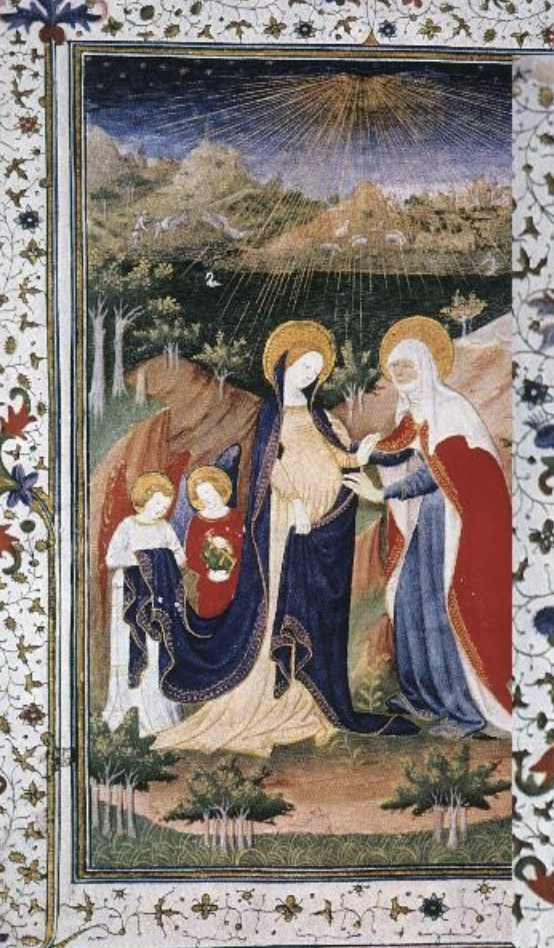
Paris: Boucicaut Master, Hours of Maréchal Boucicaut, c. 1408, Visitation
The margins are gorgeous and full colored, Cult of Mary had just grown throughout all of Europe and very popular, most cathedrals dedicated to her, shows John the baptist who acts for G-d, he is another miraculous baby despite him having actual father, Mary meets Elizabeth, landscape setting not just an interior
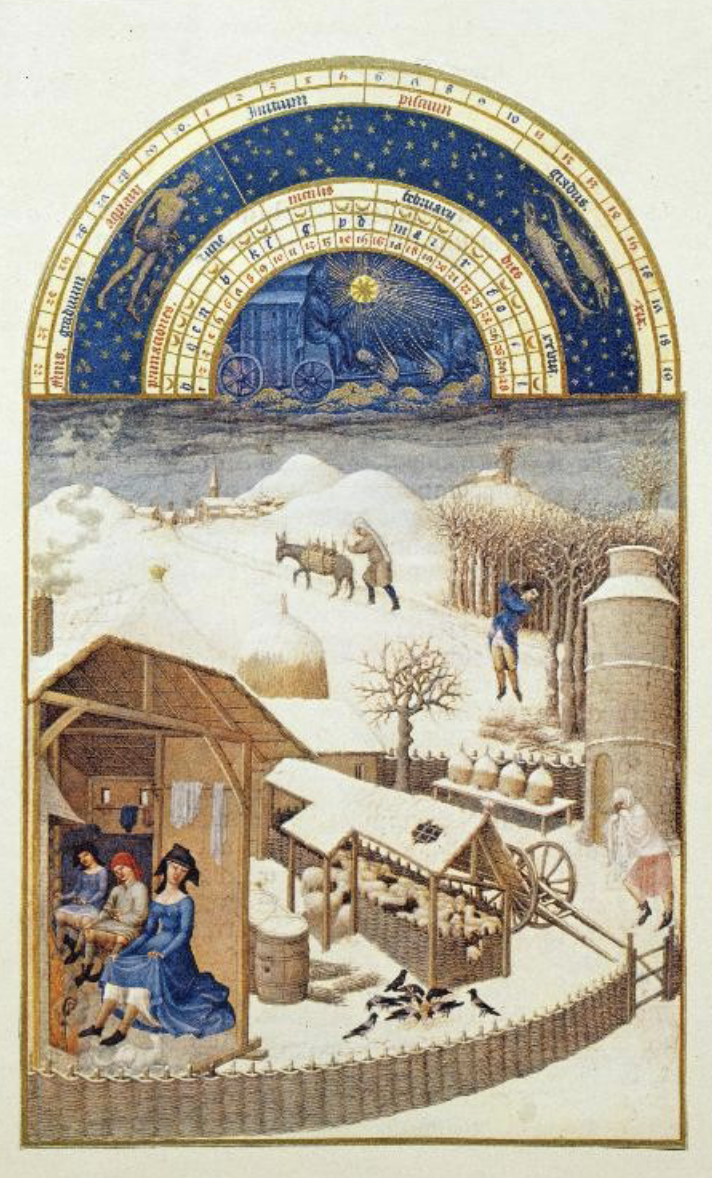
Paris: Limbourg Brothers, Très Riches Heures de Jean de Berry, 1413-1416, February
Early representation of snow in medieval art, might even be the first, snow was not permanent in France, so here the permanence of it is rare, January is about aristocrat living in a heated castle, February is about peasants freezing
No aristocrat would be lifting up their clothing to warm themselves, clearly a peasant
Person from highest level, uncle of king, three men who emerged from growing centers to get patrons, who are representing the lowest class
Middle class is growing so much but they are told to depict how the rich live and how the poor live
Cloudy winter sky, after 1400s is when we see the notion of a skyscape
European crows, bundles of sticks, made by someone who would have seen this low class, so we see middle class artists who are familiar with the low class
Vast majority of people do live on land, even though middle class is growing
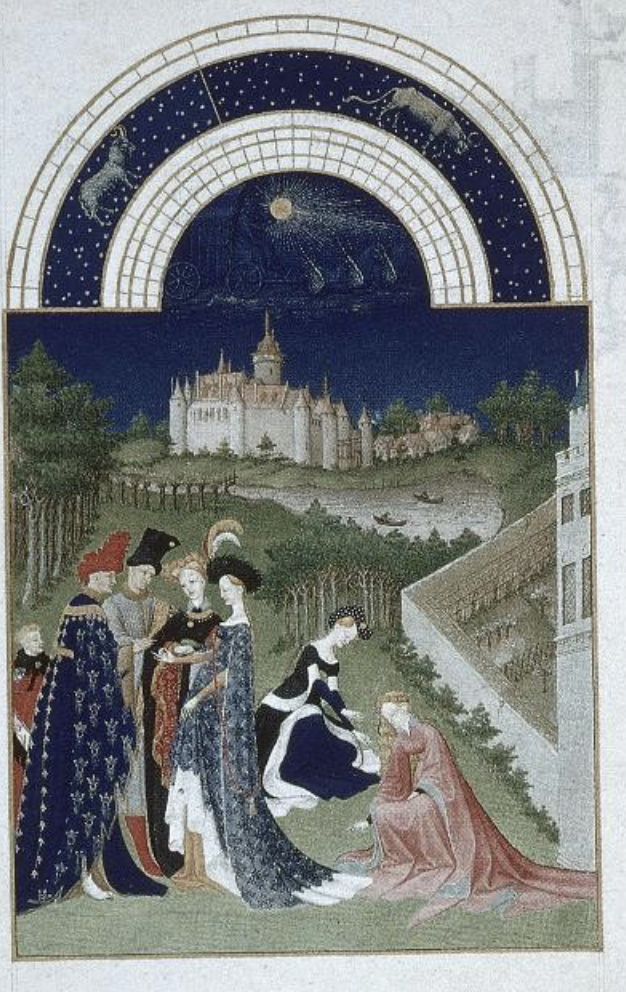
Paris: Limbourg Brothers, Très Riches Heures de Jean de Berry, 1413-1416, April
In the world of the aristocrat, dominated it but does not show fully springtime is an exalted season especially in the higher class, melting of cold organic life coming back, notion of courtship and falling in love in spring, each entry shows what saint is celebrated on day, but obviously main focus is on the miniature, the illustrations, not inside anymore because April is a lovely month, on a lawn
Gradually the serfs that he owned or owed him would build stuff on their land, trade off for them building houses at foot was that the duke would like protect you in ways
Chateau, not fortress, but a place where you spend leisure and pleasurable time, looks as if on steep hill or angled up
Wall garden that is very popular, wall protected tender plants from wind and retained heat so in fall they can grow longer
Series of small trees with white blossoms, temporary moment where fruit tress bloom, like temporary moment of snow falling
Sky is now a brilliant blue with no clouds
In foreground we see group of about 7 figures, super tall and lanky, definitely exaggerated, elaborate robes which somewhat flesh out, slender necks, pale skin and very high foreheads with women, luxury textiles and elaborate head gear
We have men and women mixed and perhaps a scene of a double date and courtship
The women in the right seen bending down maybe to pick up wildflowers
So aristocrat world dominates lower half, but rustic world does appear, two boats in the lake and even little floats and net being used to catch fish, so in back we still see some sort of hard labor and again idea aof what is done to sustain food
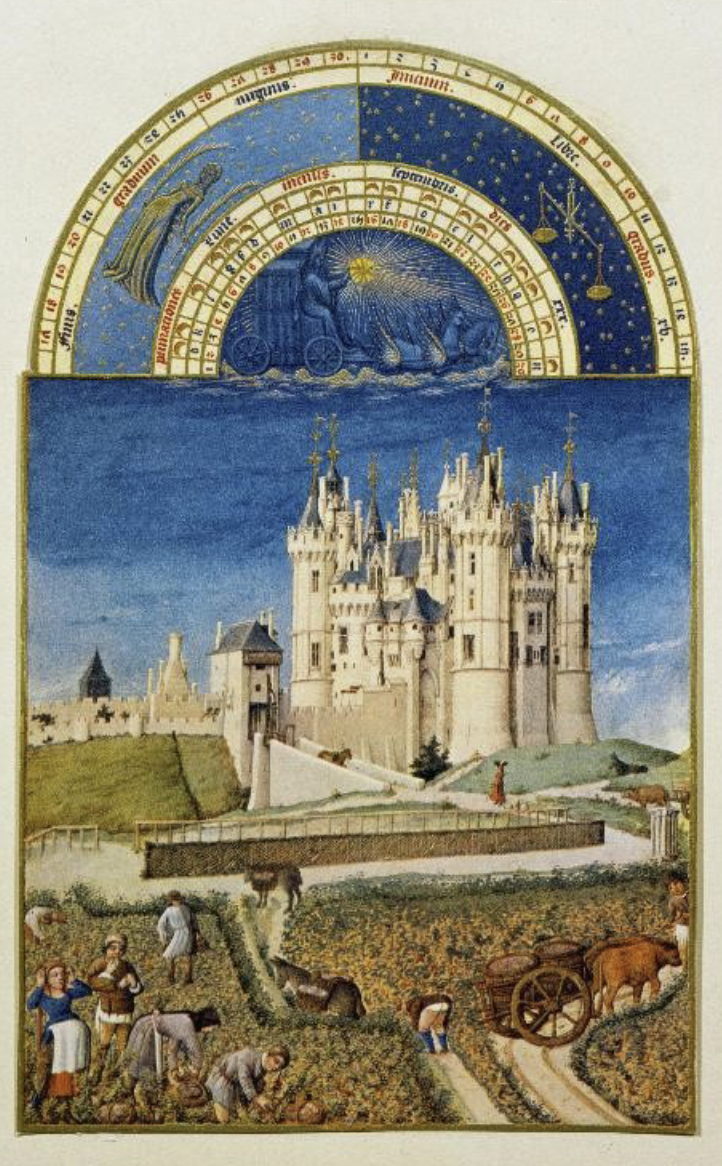
Paris: Limbourg Brothers, Très Riches Heures de Jean de Berry, 1413-1416, September we see the hard work of bending over but also that you get to sample product while gardening, but also lack of decorum with this one person bending over definitely showing his underwear, grapes seen growing which aristocrats would've been interested in since Wine is really big even then
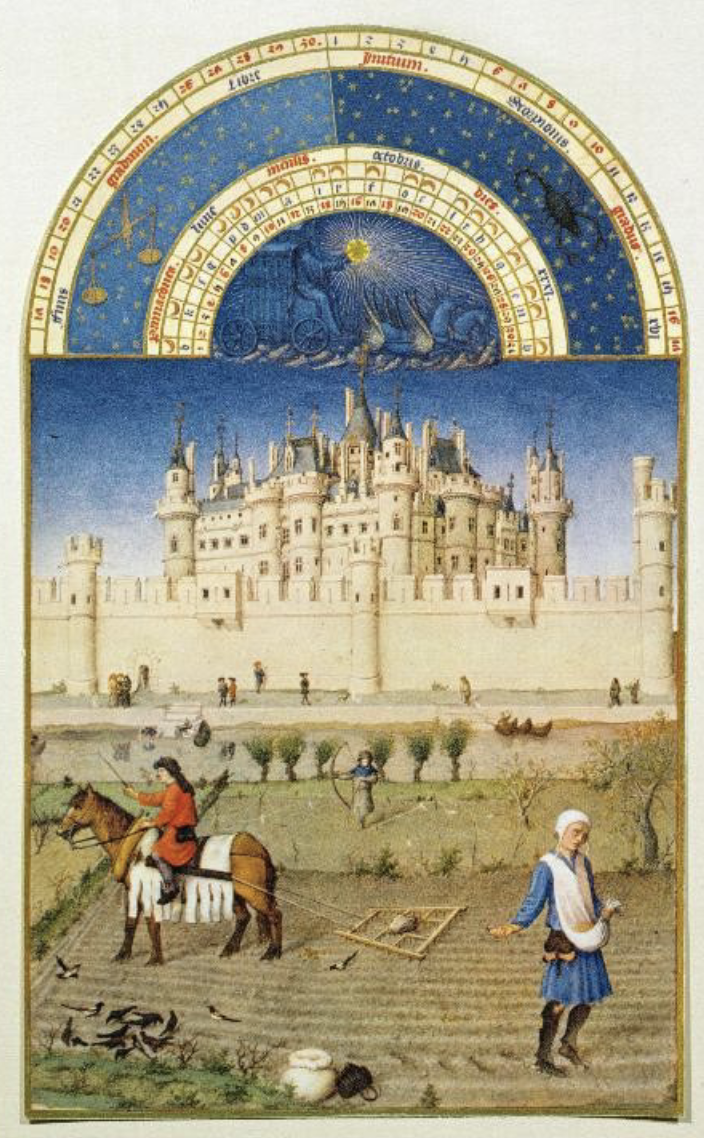
Paris: Limbourg Brothers, Très Riches Heures de Jean de Berry, 1413-1416, October
we see people strolling in boats, man holding bow and arrow who wouldn't have been hunting but we know militia companies who were training to defend and practiced weaponry down by the rivers, we see the plowing and sowing, again birds in this case magpies, notion of cast shadows seen here clearly with horse and people
Cast shadows are clear here which is key, in october when days get shorter, presence of cast shadows is one of the most notable features of changing, while you can't grab them and they're not solid the brothers are starting to introduce them
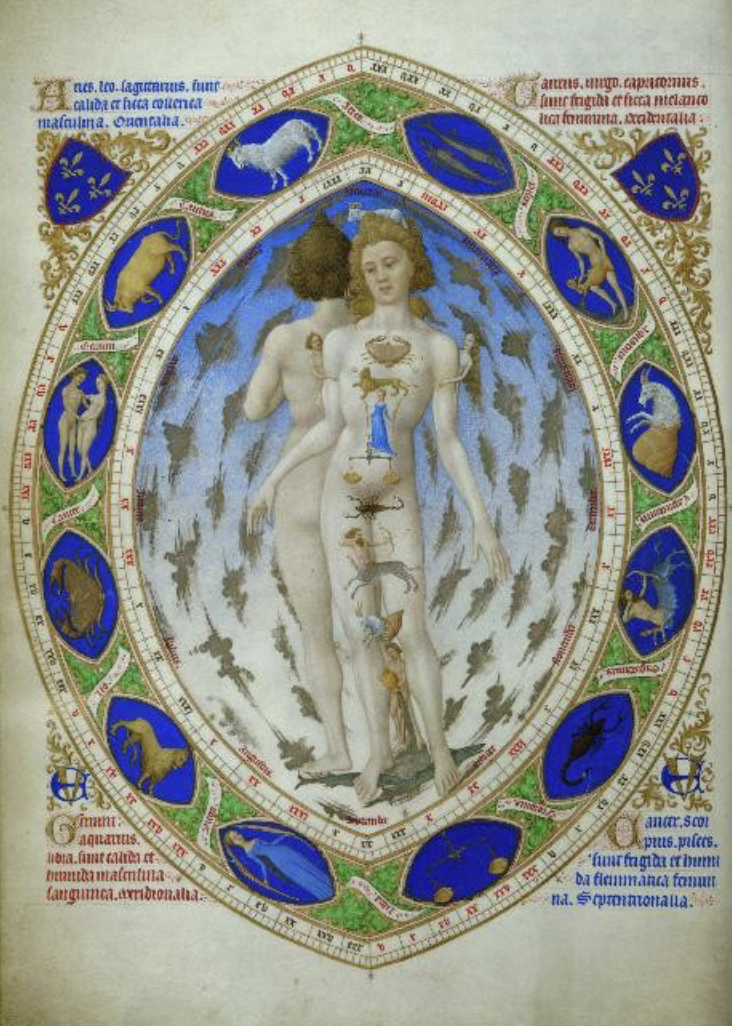
Limbourg Brothers, Très Riches Heures de Jean de Berry, 1413-1416, Zodiacal pair
Not by any means a requirement of a book of hours, extras, All signs of zodiac, but the passage of time and passage of planets in constellations were featured in each calendar page so we know system of solar system and zodiac are key to Duke, along with many other royals and aristocrats
Fleur de les again since sign of the royal family
Mandorla form, usually singles out Christ to show hes important, but in this one inside the Mandorla shape which is framed by the signs of Zodiacs, inside we have a couple, perhaps Gemini sign, genders are left rather unclear and only one face turned to us, body facing us has zodiacs pasted on themselves, so usually associated with passage of time and constellations but in the middle we have this medical idea that different parts of your body are affiliated with different signs of zodiacs like how your arms are gemini or your genitals associate with scorpion, so you can use astrology to diagnose medical problems, artists were very familiar with the connection of astrology to medicine which were all explanations of G-ds creations
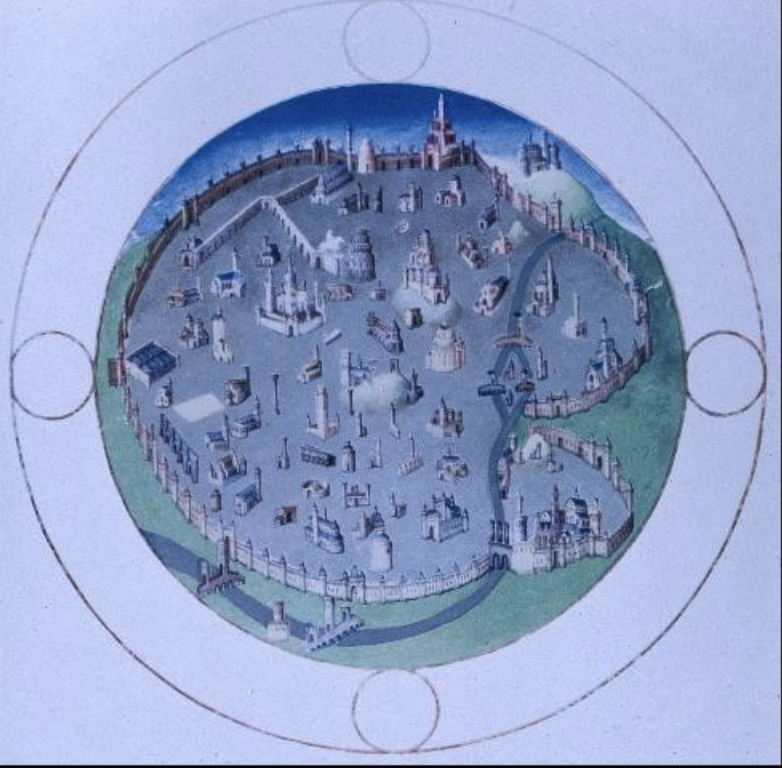
Paris: Limbourg Brothers, Très Riches Heures de Jean de Berry, 1413-1416, Plan of Rome
Not by any means a requirement of a book of hours, extras, makes a little more sense why this would be included since Rome is like the setting of some of the places where Saints are buried and other sacred events, Idea of people imagining themselves high up and looking down on the world
We see the rivers, the Vatican and a number of churches, representations of things that are not Churches also like a series of aqueducts bringing water in, the brothers likely hadn't been to Rome but there were guidebooks that told people what to expect on their pilgrimage
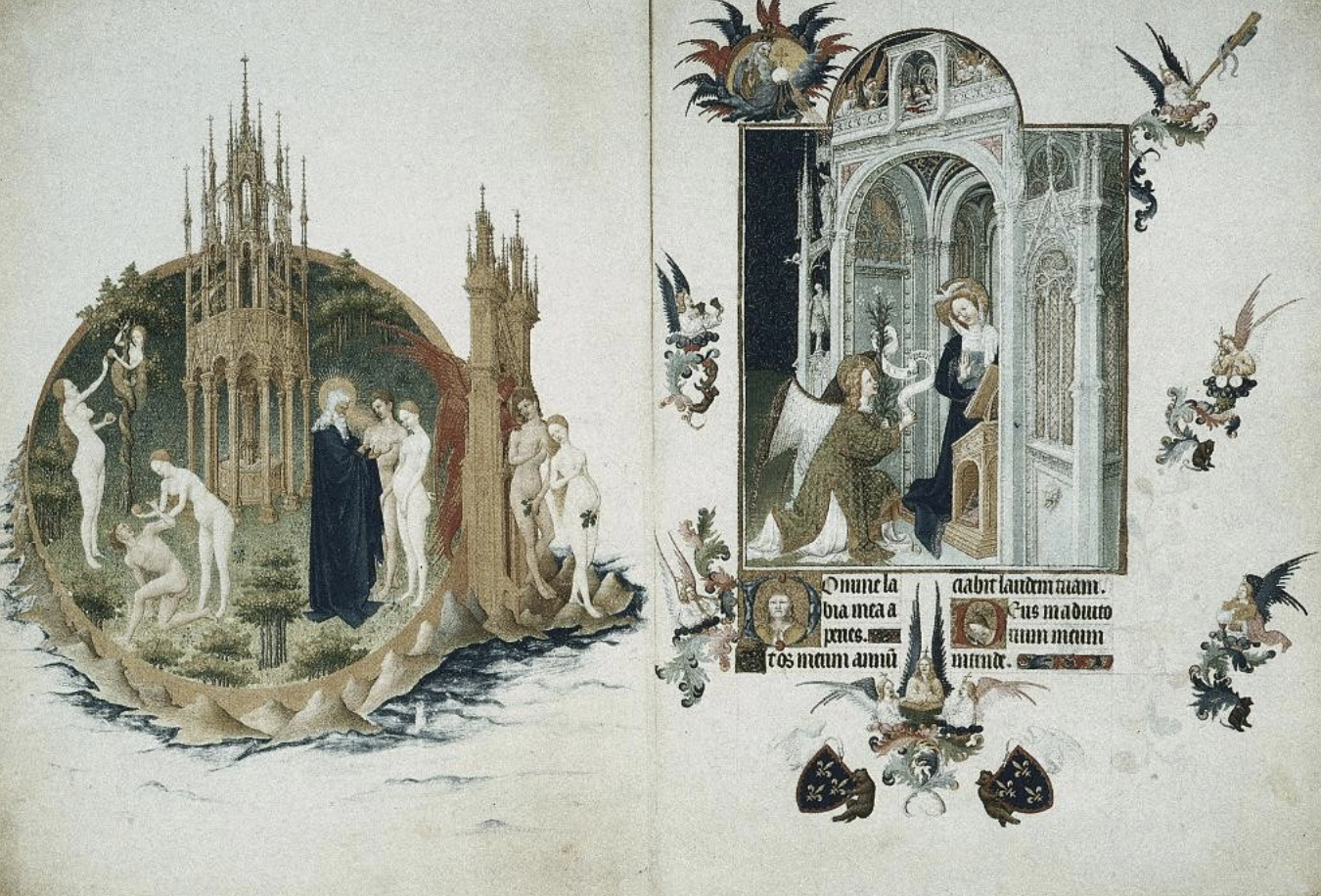
Limbourg Brothers, Très Riches Heures de Jean de Berry, 1413-1416, Double page spread of the annunciation and also the Fall of Adam and Eve and Expulsion
Marginal illuminations
Mary is inside and being approached
We see Adam and Eve set in front of this void of the resort of the universe, idea of telling the stories in several small scenes isn't new but its something artists really become fond of, last phase not whole story of creation, begins with temptation by the serpent to Eve, her offering to Adam, G-ds confrontation and then at his orders a fiery angel expels them
Nudity is not absent in early medieval art, but after fall of Roman empire there was a shift away from representing naked body which previously was so important but with Adam and Eve its key to show nudity since they knew no clothing until they knew shame, figures here are typical of the brothers and this time with pale skin and long and slender, Adam is darker which is an idea of after they're expelled since men go outside more to hunt but present even before they leave the garden, high forehead of Eve and even serpent which is half snake half female human of sorts
While they could have concealed Adams genitals they do not, idea of exploring sexuality after eating
Female nature of serpent is not biblical but it evolves in Christian nature, on one hand women have no sexual feelings but on other woman can't control themselves, Eve is obviously blamed for most of this, Eve convincing partly unwilling Adam, so idea of female temptress
Surreal image of mountains below giving way to a wall, weird trees that don't seem to scale, but narrative does take us along and gives us the message, Mary's role is to undo the sin that Eve did and sin in general and since these books are usually dedicated to Mary it is key that they show Adam and Eve's story
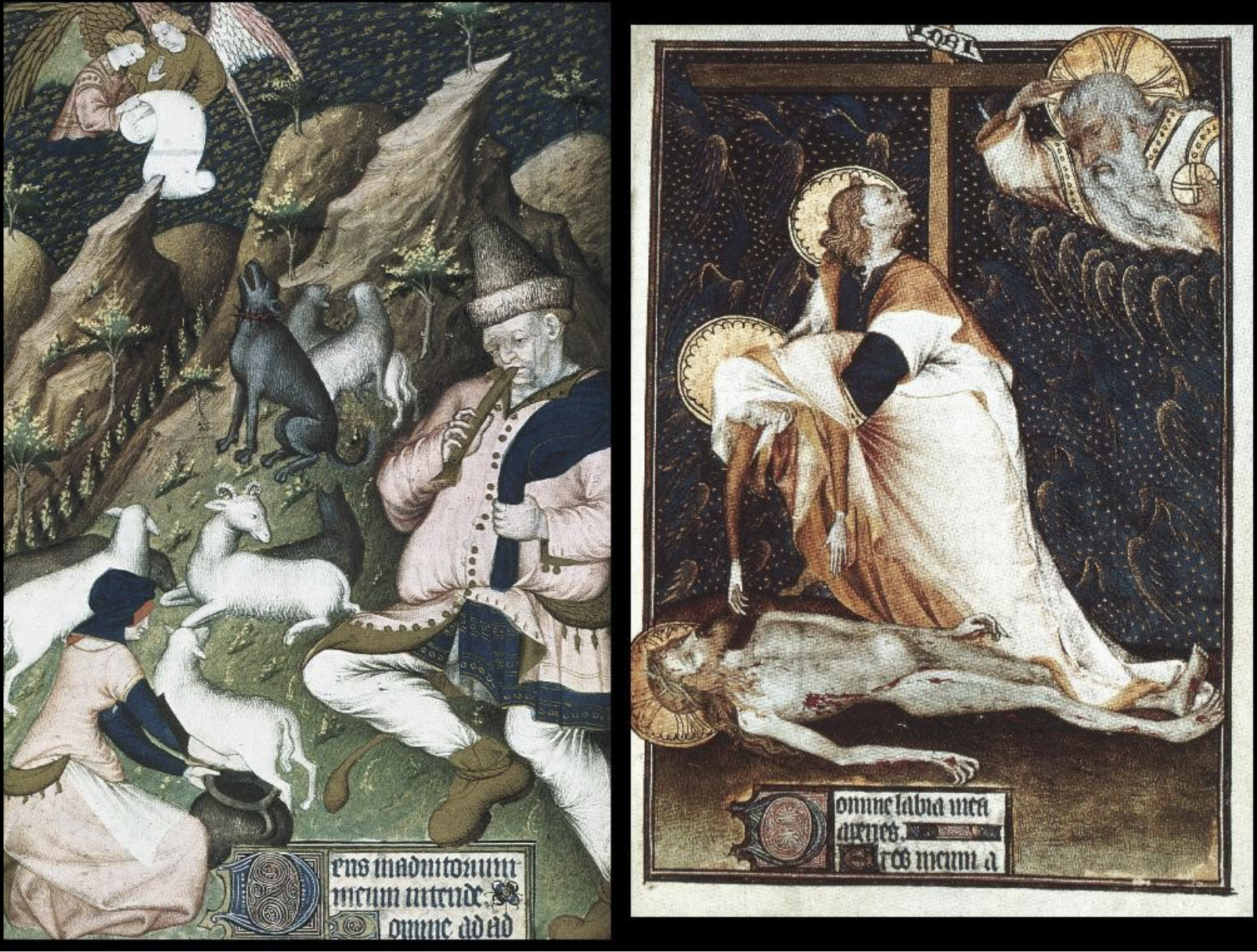
Rohan Master, Lamentation and annunciation of the shepherds 1418-1420
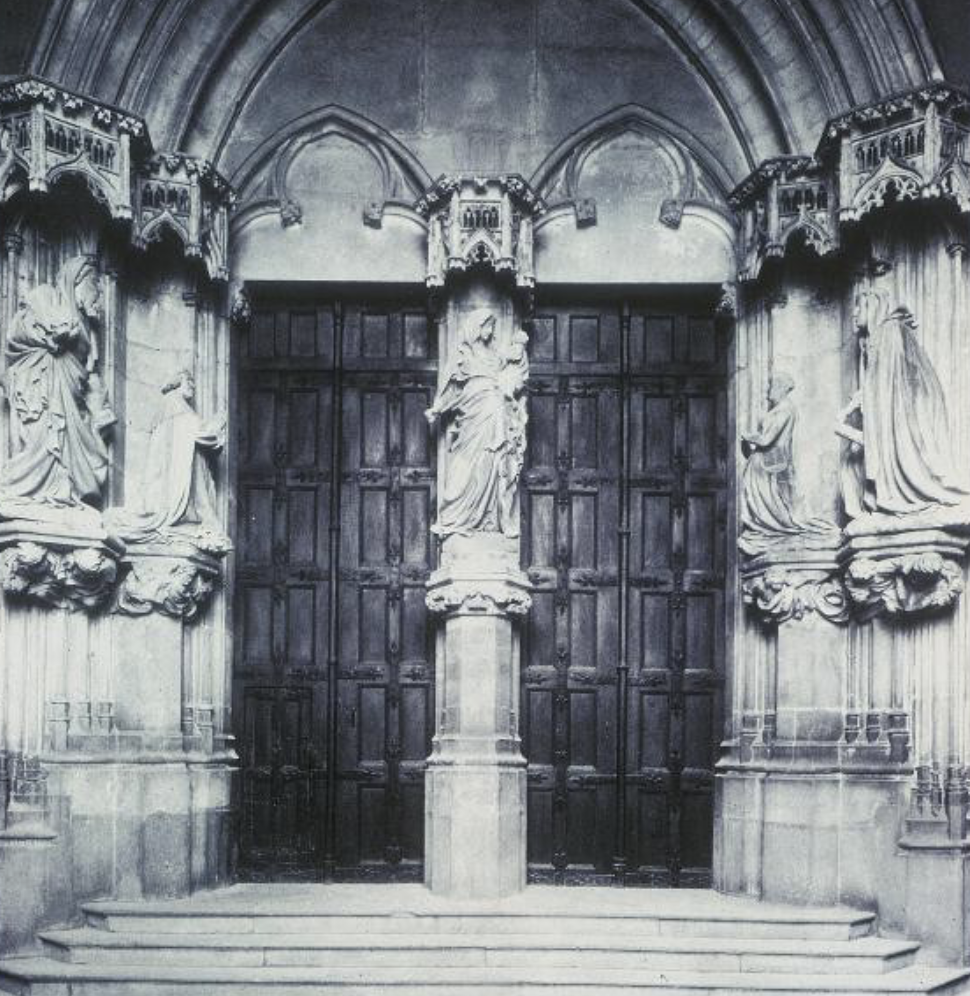
Burgundy: Claus Sluter, portal of the church of the Chartreuse de Champmol, Dijon, 1385-1393
Sculpted doorways have been around for quite sometime
One of his earliest sculptures, Individual figures are fewer and larger, carved very carefully, pieces of portal laid out, the jam surrounding the portal (the right and left side in front of door)
Jams are not new but Sluter makes it much more theatrical, life size and large portraits of the patrons not just the saints, Also complete freedom from the background, not much of a relief, there not just a column and not anchored to it almost like they could actually step out
Up above we see the typenum with archivals, concentric circles, archivals and tympanum now empty but jams were pretty much all left
Weird architectural canopies above, since want to keep water off, decorative and mimic the other arches on the building
What is new is 4 of the figures are sacred history but 2 are duke and dutchess, Phillip and Margaret, Margaret who brought Burgundy by marriage to Phiukllip so of the figures 2 are contemporary figures, to show respect to holy figures they are placed kneeling, even though kneeling closer to Madonna and child than the saints, kneeling but not very smaller
These figures are huge, not just tall but wide, with robes and lots of fabric super wide, Mary is massive with robes also taking up much space, she's kind of swinging and not collumlike like other Jam statues, 1400s we get version of Mary holding Jesus with a hip out, Sluter didn't invent this but uses it here
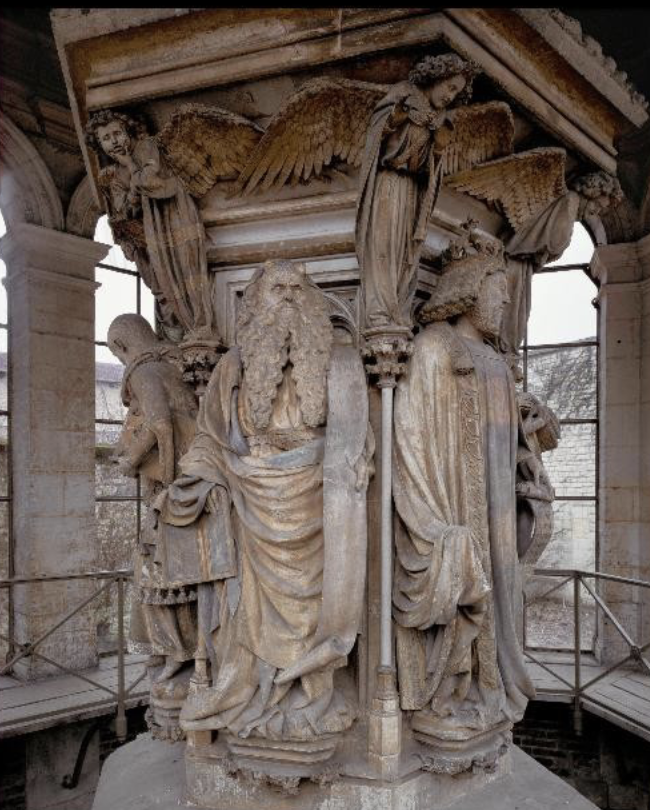
Burgundy: Claus Sluter, Well of Moses (Puits de Moise), Chartreuse de Champmol, Dijon, 1395-1406
Obviously wells are key since this is how they get water but water is also very significant to Christianity with Baptisms, ritual substances
Duke Philip the Bold commissioned these monks to come and pray for his life. Moses is often shown with horns because of a misunderstanding of the Torah where the lights are beaming off him (rays of lights). Huge advancement from the chartres cathedral sculptures where they are not just part of the sculpture but actually coming off of the marble. Shows they are actual humans not just pillars.
There are much more details in the face in a veristic way but also idealized with exaggeration of oldness, some even show wrinkles, curls in the beard and just overall more expression and realism.
Old testament prophets holding up the new testament and also showing their approval of the new testament. Coming out of the niches, stepping into our places. Look and see their sorrow, feel sorrow and pray, pray to protect the king. Monks pray for their life, even after they’ve gone, this piece reminds them of their duties. Affective piety, practice that’s supposed to invoke sorrow and pity in praying.
Supposed to step to the cloister and see these figures that are larger than life with such realistic rendering with the hair but also the emotion they have life behind them
In addition to theatrical performances, a lot of aristocracy was theatrical with like the clothing, elaborate code of manners, Emotion was common at this time and these figures showing like mourning in public was somewhat contemporary, fashionable in this time
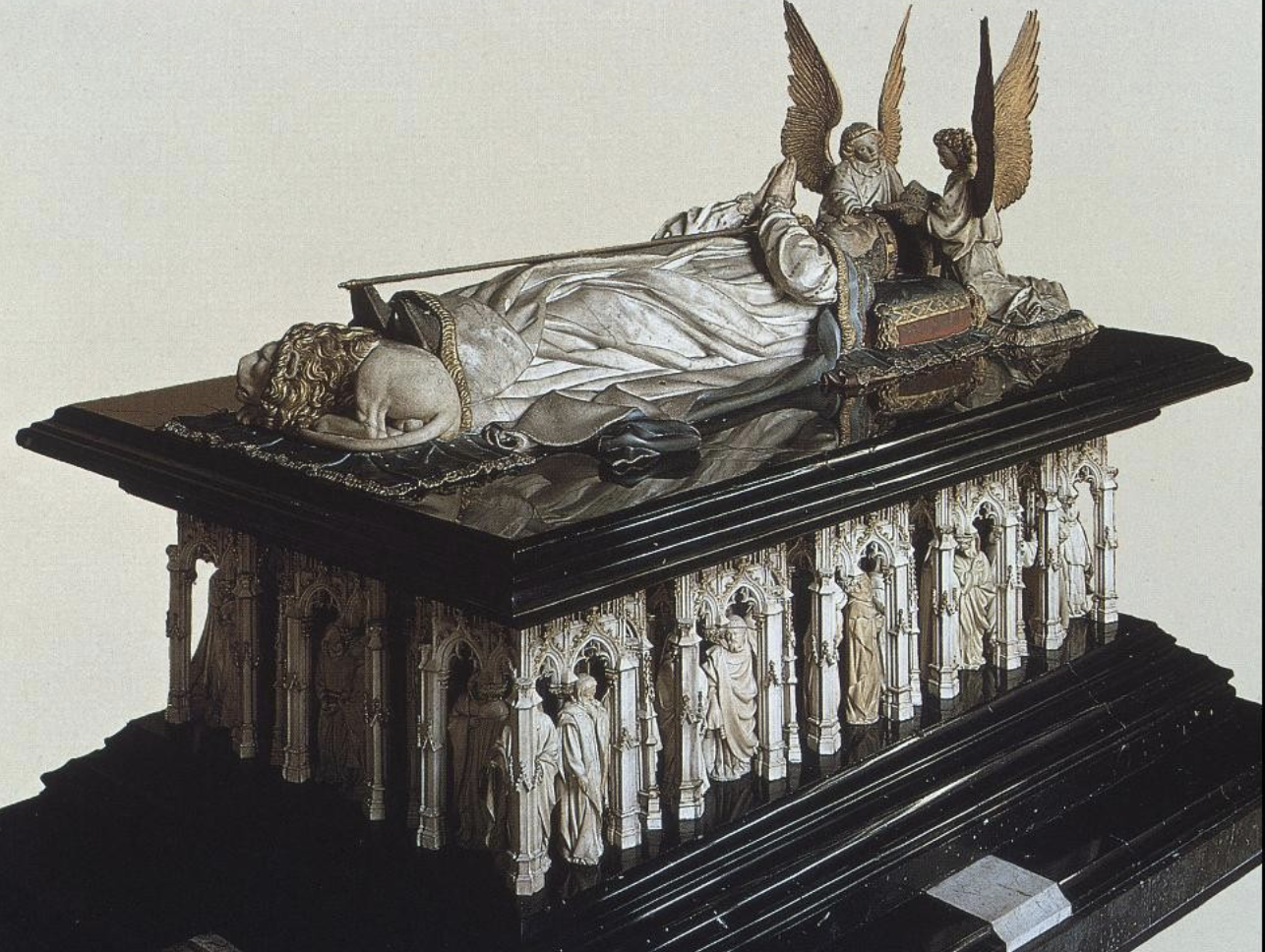
Burgundy: Claus Sluter, Tomb of Philip the Bold, from the Chartreuse de Champmol, Dijon, finished by 1414
He undertook many tombs including this one, this was never intended to be exposed to the elements like the well of moses and its made of much more expensive luxurious stones like white marble
Polychrome referring to painted sculpture, not different color of stone but different hues of paint
His head is resting on an elaborate pillow with two angels attending him and a lion, symbol of power and fierceness is nestled at his feet
Sluter memorialized the sort of funerary ritual, some monks have covered their face with their hats almost like they're ashamed of their grief and how sad they are, or perhaps because the cadaver smelled so bad but that's not super likely, the amount of monks would be how much in the charter house and while it may not be portraits each has their own character
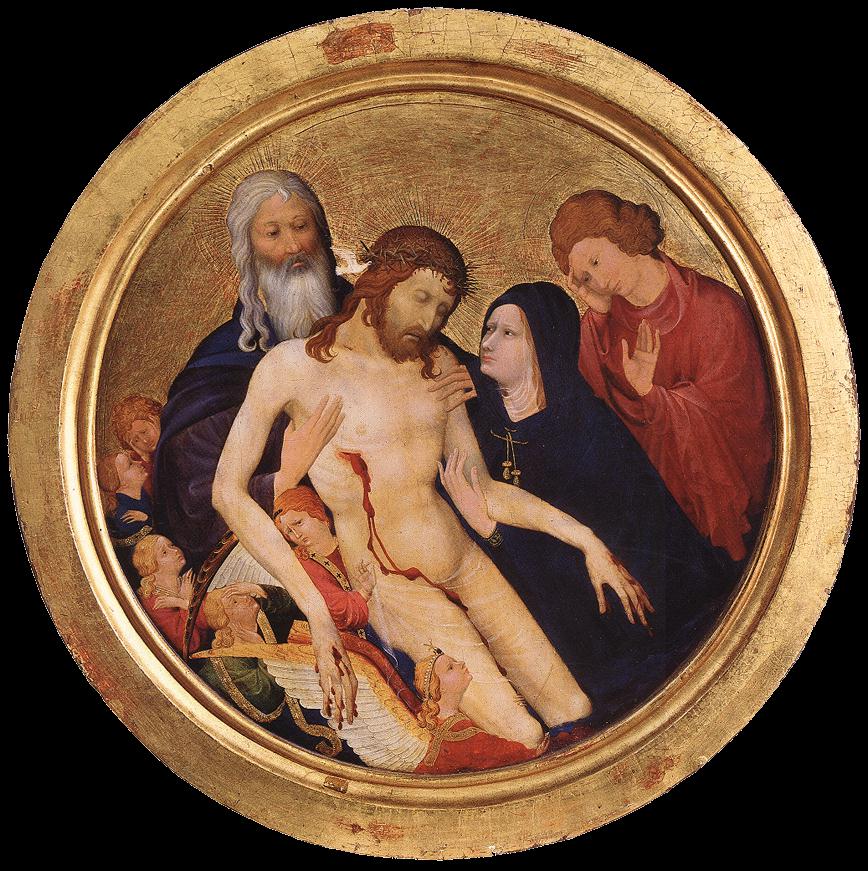
Burgundy: Jean Malouel, Lamentation of the Holy Trinity, c. 1400-1415
Malouel, or meaning good painter in Flemish or Dutch, he was definitely from the low countries and maybe related to other artists
Dukes of Burgundy went to low countries to find most talented painters to decorated Chartreuse de Champmol, he was chosen
Likely supposed to be displayed in the church, likely because that church is dedicated to the trinity and this image highlights the trinity: G-d, Christ and the holy spirit
Christ taken from the cross, G-d helping to hold him up and in between them is a mini dove of sorts used to portray the holy spirit
G-d is not mentioned in the lamentation it is just like his loved ones like Mary but G-d is added in, and extensive group of tiny angels seen helping Christ
John the evangelist seen at the far right, one of the gospel writers an apostles and book of revelations writer, and since youngest of followers he's beardless
Circular composition which is complex compositional issue while still using central axis, Early 1400s late 1300s, tends to focus on elegant human forms that are tall and lanky, these painters are often preoccupied with fancy materials like gold leaf and rich colors like blue and red
These artists also want to render recognizable detail, so while its elegant and almost idealizing it also wants to render familiar scenes from our environment
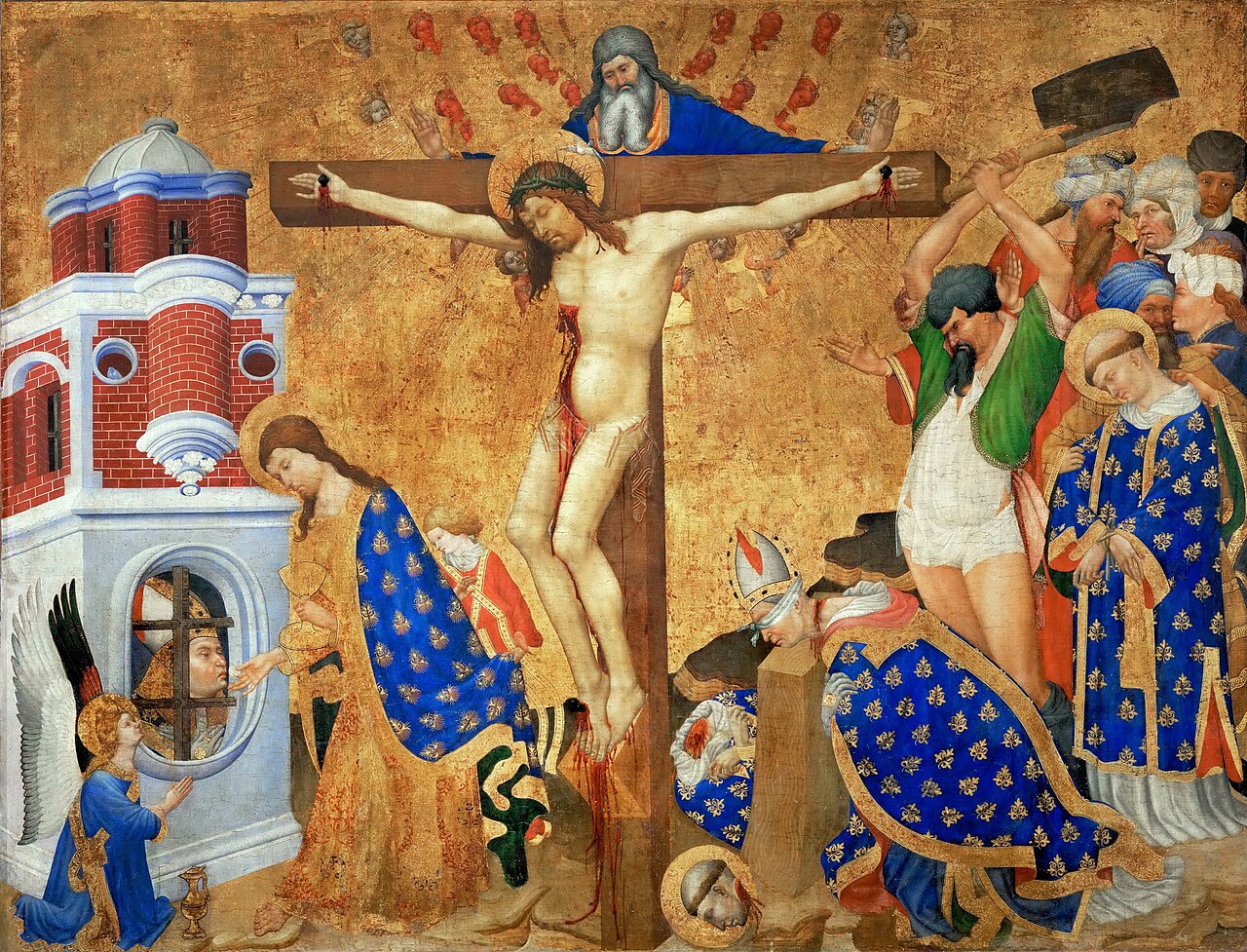
Burgundy: Jean Malouel and Henri Bellechose, Martyrdom of St. Denis with the Trinity, c. 1415-1416
Normal people dont have last names so Malouel is great painter Bellchose is like beautiful thing talking about how great his paintings are
Once again we see trinity with G-d on top, remnants of little dove above Christ's halo and now Christ on the cross
St. Denis was a saint particularly important to kings, he was an early religious leader in Paris who was beheaded but after it was removed he picked up his head and walked back to Paris, seen here being beheaded, he was important to France and Burgundy rulers still related to French royals and this is like before they got mad at eachother
We also see Christ offering a communion wafer and chalice wine to St. Denis on the left side
The center is more so Malounel and the sides are kind of Bellechose
We see Bellechose’s style, the architecture looks like a face with a porthole eyes a weird nose and then the mouth is huge and looks like its about to at the communion wafer as well
On the right scene we see some of Malounel's interpretation with international gothic style, even as being beheaded st. is like elegant but also certain level of brutality with how big the knife is and how much he has to reach up to really get as much of a hard hit as possible
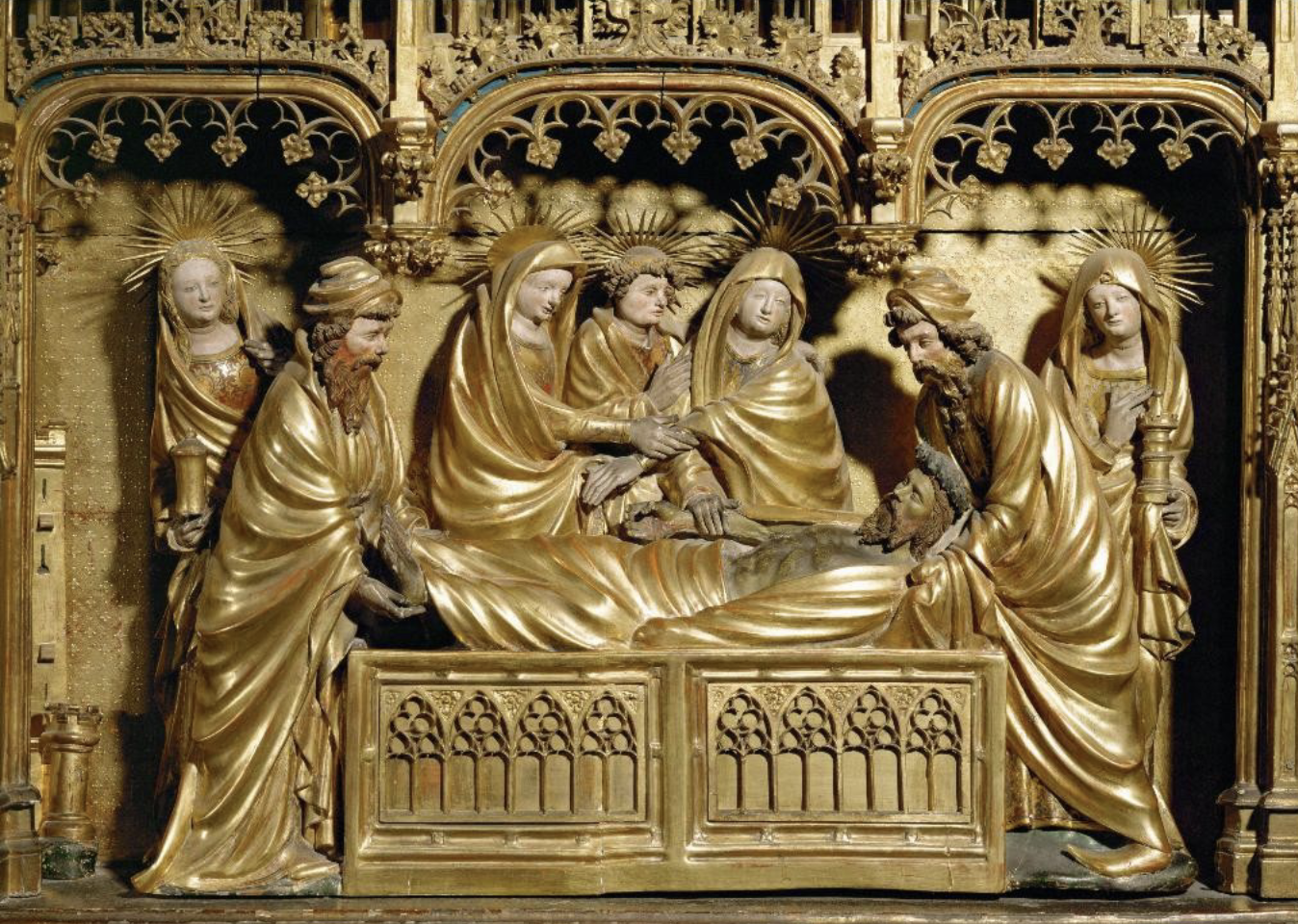
Burgundy: Jacques de Baerze, Entombment, from the retable de Champmol, polychrome wood relief, before 1399
Retable meaning a large work above and behind an alter, usually reserved for most elaborate alters
These sculptures are usually wood same with the paintings being done on wood
All throughout Northern Europe and Spain we see the retable form, little less commonly used style and label in Italy
Its interior is all wood sculpture decorated with paint but also much gold lead
Baerze was not a super key figure
Crucifixion in middle we see tiny scene of adoration of magi and similar to tomb we see decorative gothic arches and ornamental forms raised in very center, you only really saw the open version of a retable on feast days or like important days, this of course would be a triptych and would usually be seen in closed forms
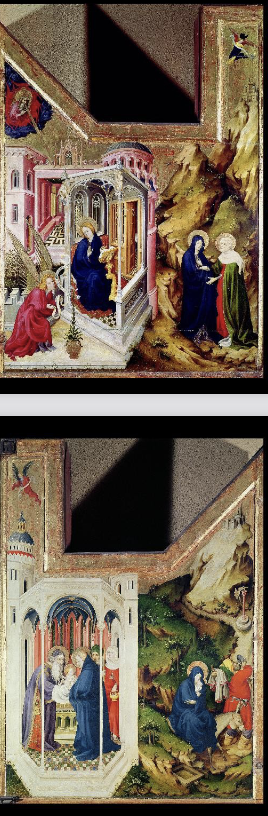
Paris: Melchior Broederlam, outer wings of retable de Champmol, before 1399
Annunciation and Visitation
The landscape seen primarily in visitation is not very innovative or super interesting, similar to Bohemian painting in like 1350, while there is a sky no atmospheric sky which nobody really did in 1390, but in terms of physical setting he was introducing still like fabulous developments
Mary is lodged in a small room off the Jewish temple when she is visited, she is in this weird porch, maybe anti-room or maybe dollhouse effect again, she's studious and pious and she's studying, interesting that there's another interior room behind her which would've been her bedroom, does kind of allude to the fact shes pregnant
On exterior we see people like Moses with horns
Domed structure with round arches and buttresses in this weird room behind her, speculation of what the Jewish temple looked like suggested that it was rounded, round headed arch isn't relating to ancient Rome but to past of like gothic or medieval to suggest older order
G-d is very close to like the top of the building, different forms of architecture used symbolically to suggest transition of Jewish world to Christian world, the lily is shown since the white lily is pure and a symbol of Mary
Hortes Conclusus, an enclosed garden, enclosing part meaning unpenetrated like how she's a virgin but still growth in the garden and becoming fertile but while not penetrated so miraculous conception
Presentation and Flight into Egypt
Later events of Christ being born and bringing him to the temple with slender columns showing their inside without really blocking them as we see in earlier usually Italian tradition
Drinking out a canteen, what you'll need to do on the road and the belt tucked into, idol falling off the pedestal as they are on their way
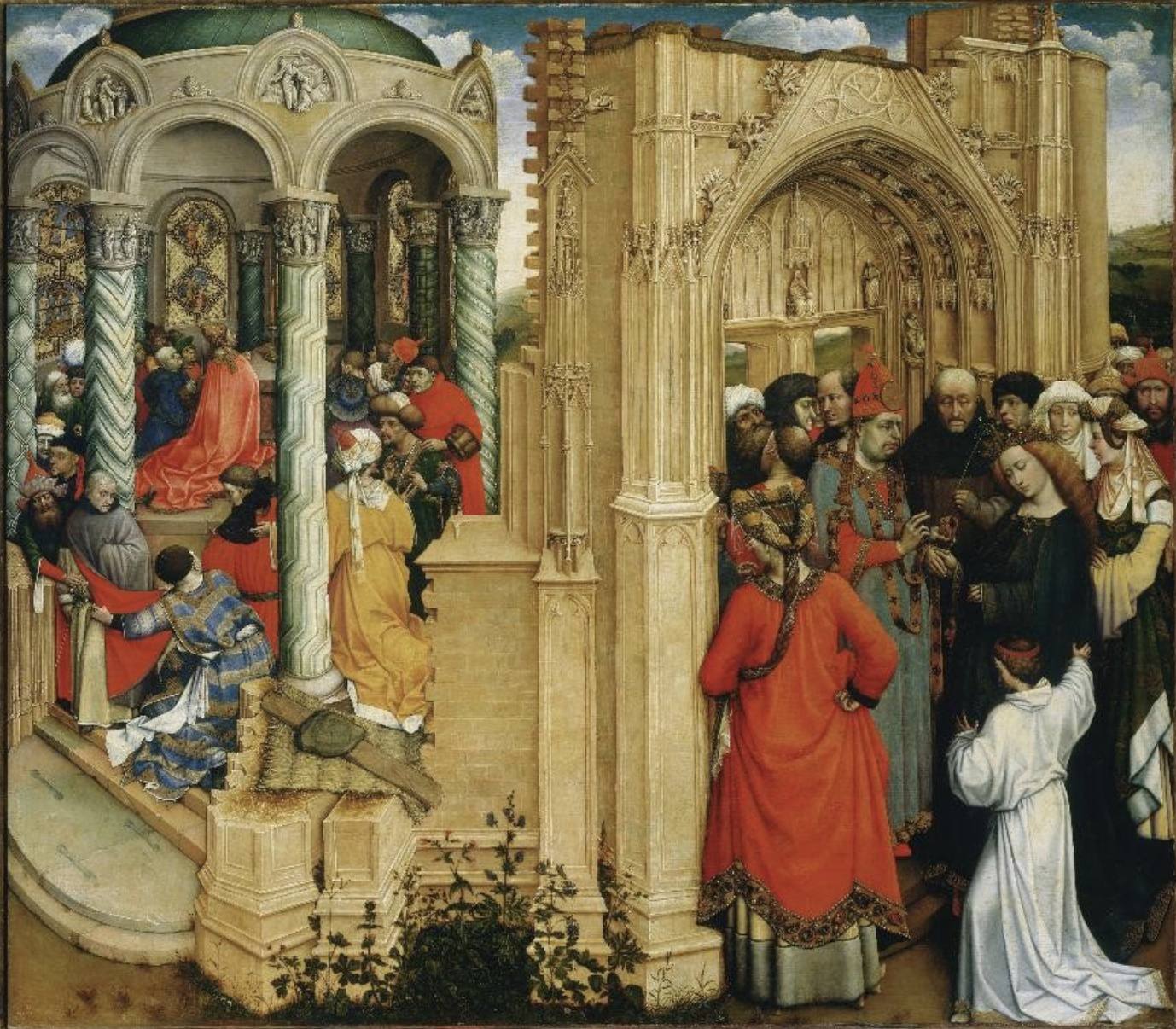
Campin: Miracle of the Rod and Betrothal of the Virgin, c. 1420
Story of how Mary was chosen as a wife for Joseph, it is said that suitors for this beautiful maiden gathered for a chance to be her husband and there was a test where they were given dry twigs and prayed and one of the twigs bloomed while praying and that was Joseph so here we see the prayer and then the betrothed
Potential for shift of medium, panel painting used egg tempera, for panels which were not bendable you can use egg yolk not just white which binds it rather permanently, but oil paint at this time had been used at this time to paint banners, as the oil drys it maintains on surface but also on textile it stays somewhat pliable
So technology for oil paint is there but only in like 1420s do artists try to blend oil paint with tempera and use solely oil paint
Def see some expert atmospheric skies being shown, grassy hills smoothly extending in background space, The architecture is very odd cause some looks complete and some doesn't, almost like the idea that a Jewish temple being taken apart to make a Christian temple, Campin is showing a complex version of this and a more focused and systematic version
We see columns with designs on them which is typical Romanesque style before 1200, the only thing not really Romanesque is the stained glass, this building would be an earlier phase of human history, but the arches in right side is very gothic which at this time was modern style
We see a Rabbi performing a blessing before Mary and Joseph holding hands, Mary needs to marry Joseph partly to prevent devil from thinking she was chosen since she just has a husband, Trying so hard to express moving from one era to another with Judaism to Christianity
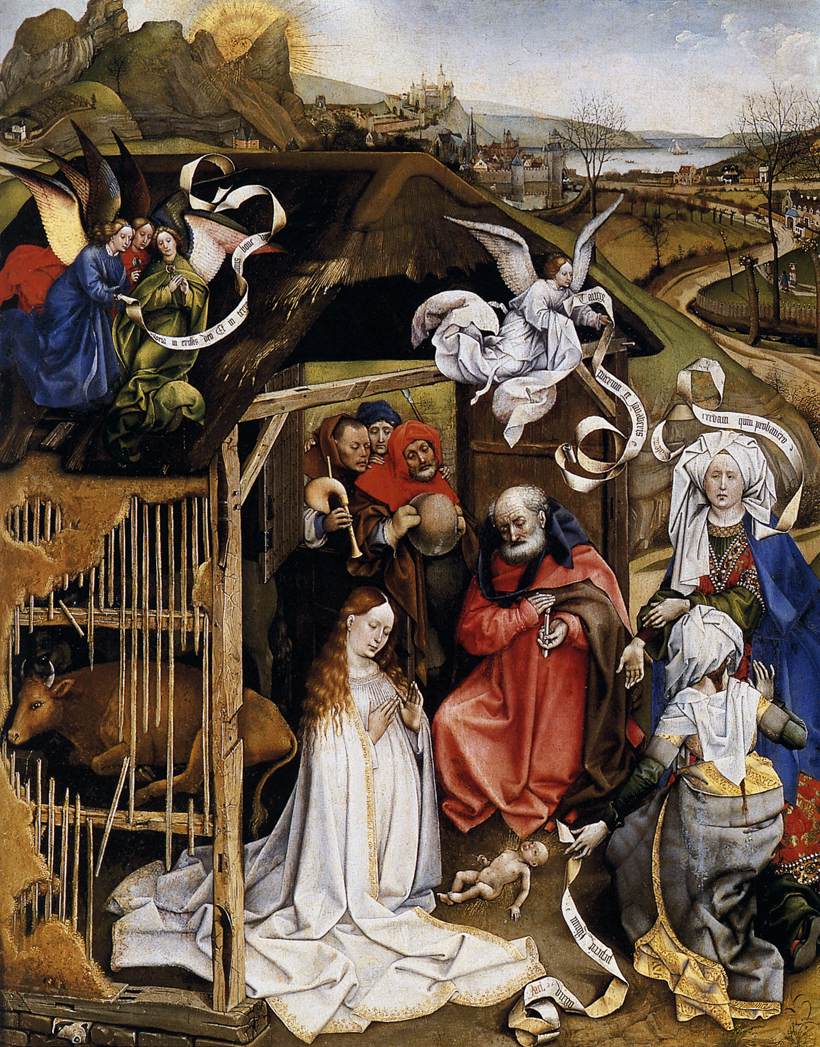
Campin, Nativity, 1425
We see extras like the three shepherds who hear the news super early, we see midwives for Mary but midwives are never really mentioned in Bible, the midwives are wearing much more spectacular garments alluding to a legend that one of the midwives did not believe messiah was born here and her hand was withered, so intrusions from the world of the elite, but the rest of the image sets the nativity in a rather rustic and believable world, shed is falling apart so no need for dollhouse effect, we see ox and donkey who were present at this time, the roof in bad shape and the wood being like destroyed
We see a very complex landscape with some rather fantastical scenes, we see a rudded road twisting int the distance and a series of unblossomed trees since its like Christmas time, woven fence hemming in a field and then what appears to be a monastery or an inn/blacksmith, and tons of cast shadows which would be very key for December
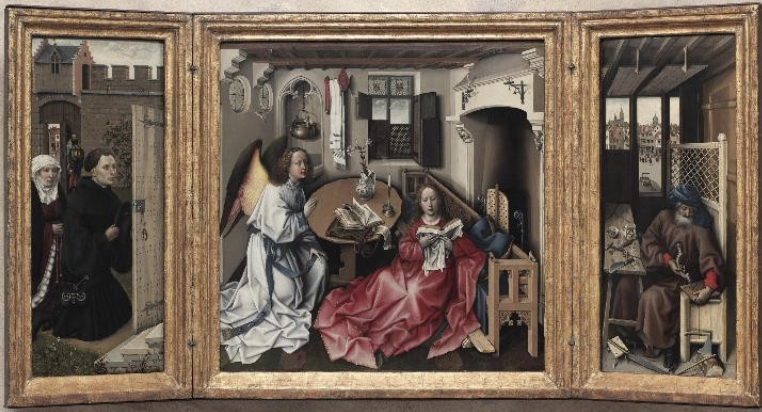
Robert Campin, Annunciation (Merode Altarpiece), c. 1425-1432
Whole thing is disguised symbolism
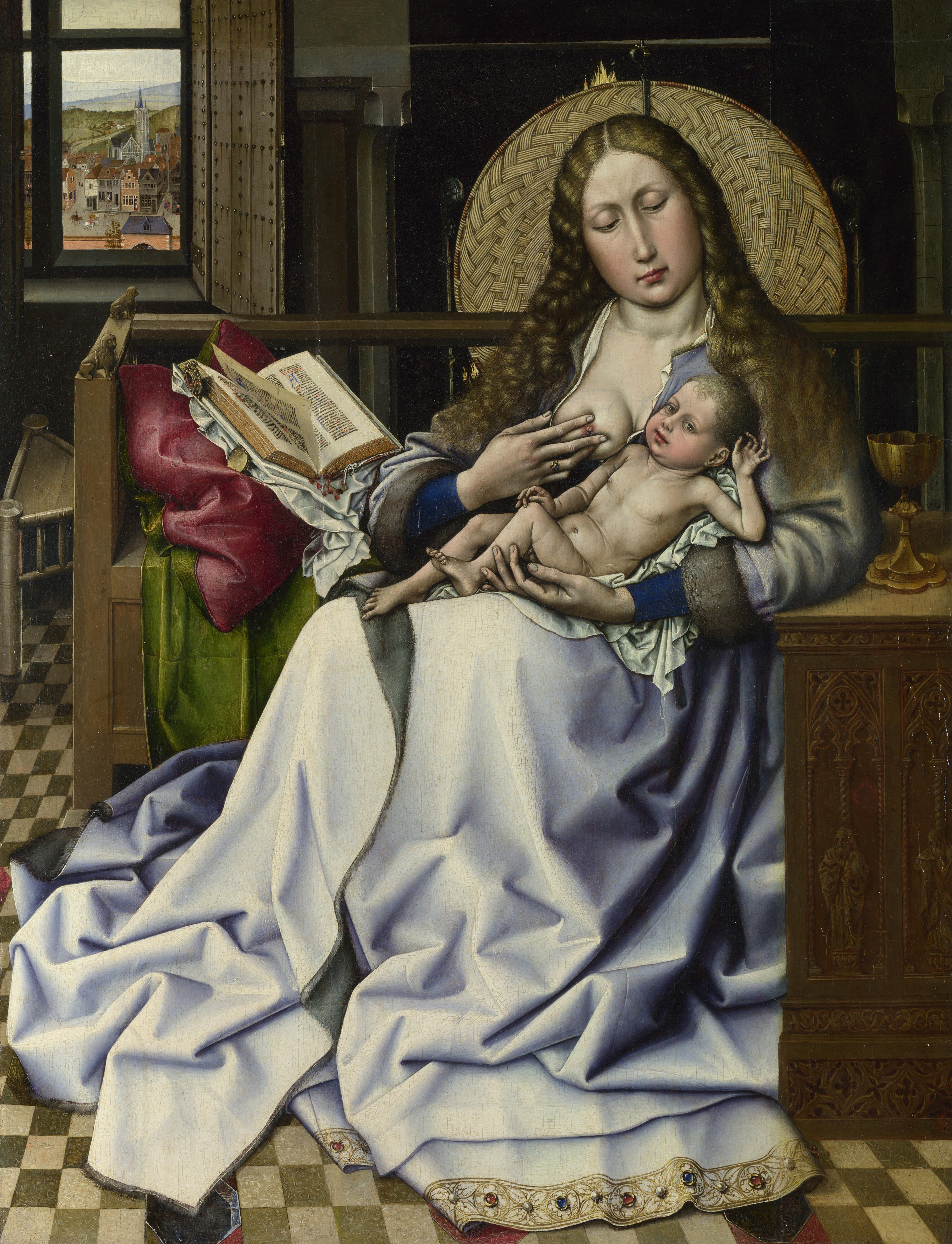
Campin, Salting Madonna, c. 1430
Since likely owned by this one guy in a place called salting, look out the window and Mary with a fire screen as halo like we've seen before of people kind of hiding the halo or introduce it as not a solid gold object, so again functional but also symbolic
In the back its very detailed again but we even see roofers, people who are needed to keep the town going and keep it functional
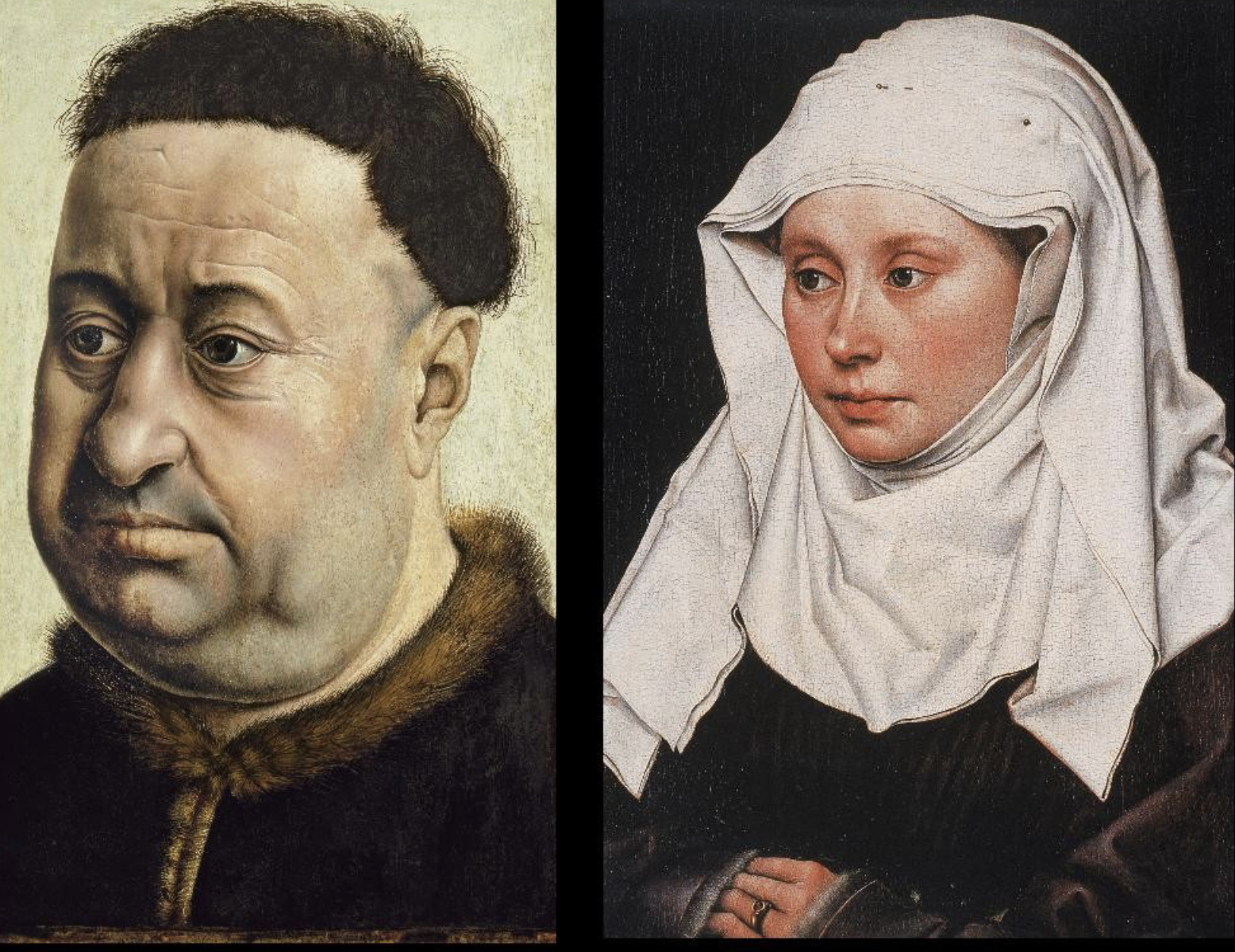
Campin, Robert of Masmines, c. 1430
He became very famous and talented as a portraiture, he made these individual specific portraits, not the same with John in profile view, but in roughly 40 degree angle so like three quarters
We see faces in the way we typically see people, since we don't usually talk to people in direct profile, you usually see people in somewhat the third quarter
Campin really kind of perfected this and started it and it really catches on
Imperfections allowed for men if kind of shows who specifically they are like with Robert we even see a bit of a 5 o'clock shadow
While women might not have been necessarily recognizable we don't know if its idealized or just how she looked
Light is coming likely from the front, some shadows from left but really from front which makes them look a lot more real
Linen is for women, fur for me
Pins shown in women's linen hat, pins would have been very expensive since had to be handmade so this would have been very expensive
Likely use of oil glaze which is useful in some translucent effect
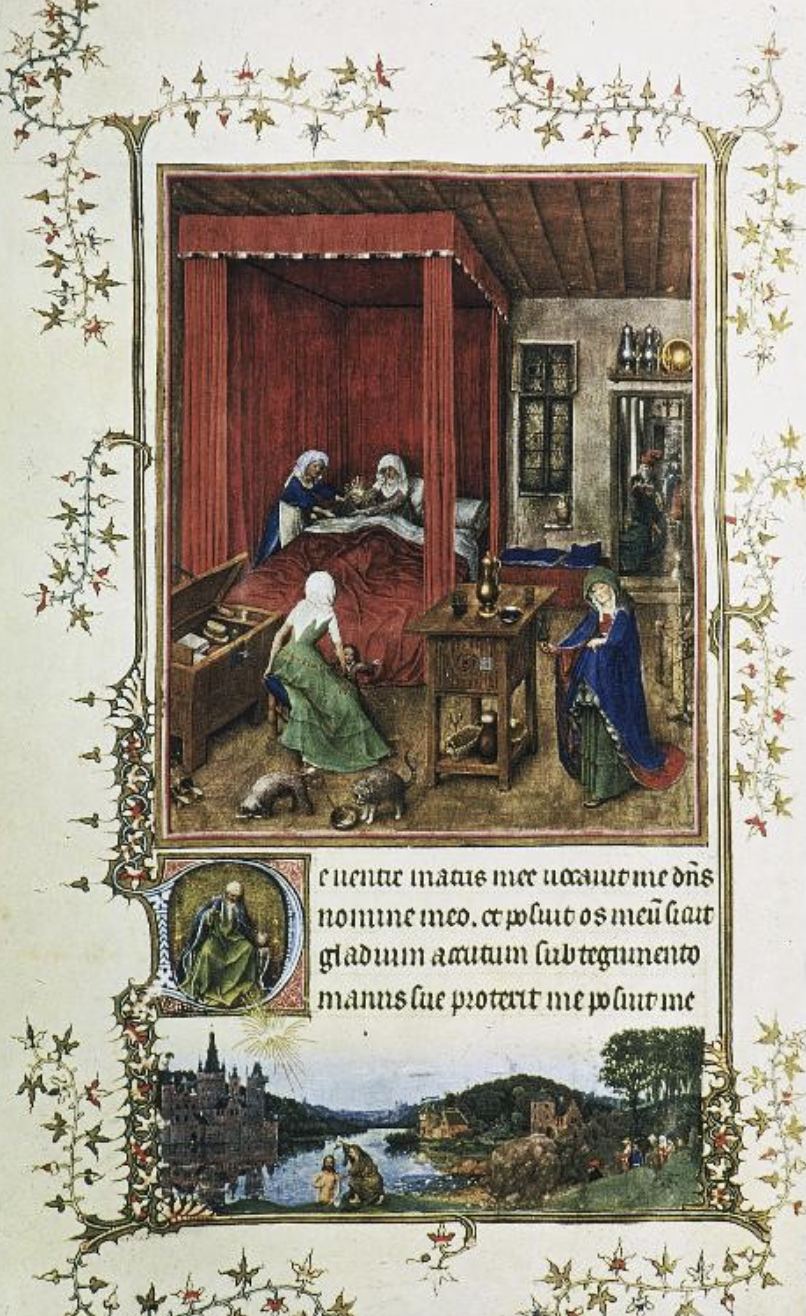
"Hand G," Birth of St. John the Baptist, Baptism, Turin-Milan Hours (Très Belles Heures de Notre-Dame), c. 1420 or c. 1440-1450
“Hand G” as in a name for one of the hands working on this manuscripts but some argue Hand G is actually Van Eyck, but if we look at main illumination we see stuff that's replicated in Van Eyck's later works
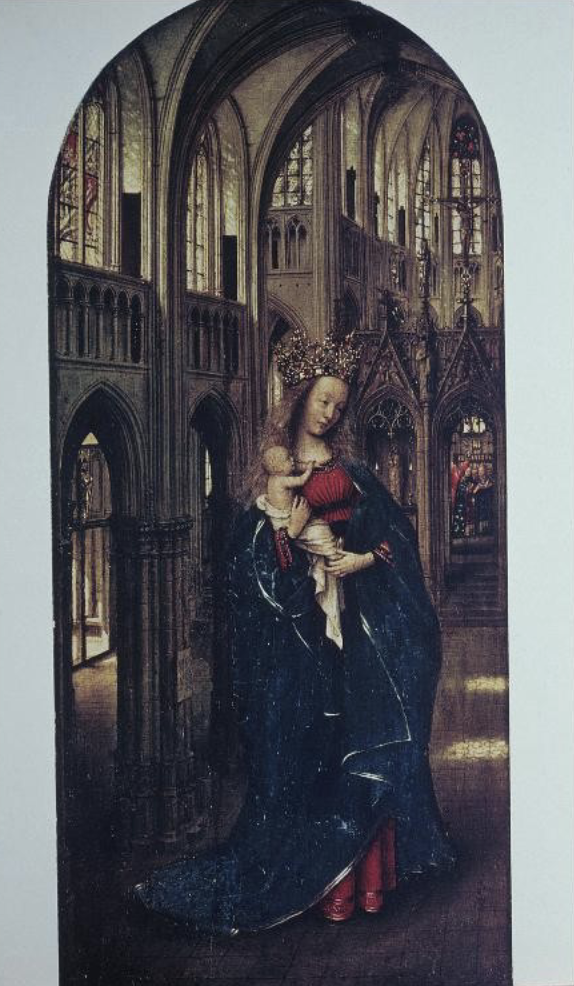
Jan van Eyck, Madonna in a Church, c. 1438-1440 (?)
Stained glass windows, pointed arches, definitely gothic style used in church construction
Christ is very tiny here, looks like premature almost, but this is obviously not Bethlehem where he was born, so story is taken out and put in contemporary situation
Christ and Mary were poor but shown as powerful and wealthy themselves, crown placed on her head, not earthly crown since when she went straight to heaven after death she was like treated as a queen
Large church in the sense of big arches and little arches, stained glass and pointed, but Mary looks half as tall as the church, so maybe evidence of Eyck saying she's important by making her so big, but also a symbol of the church since she is a vessel, a womb for Jesus, so institution itself is a vessel like Mary, church as physical but also conceptual thing, so notion of mary standing for church is a pretty common idea
We see a cross with christ hanging on it, so christ is an infant but also in church we see crucifixion, during Mary and Christ's lifetime no actual church only after he died, so anachronism is clear, meaning error in chronology
Windows would be north facing, but in Europe light never enters through north even at midsummer when super bright, Sun is somewhat south, Eyck is so careful about accuracy so many believe this is deliberate and intended to indicate we are not on Earth here and we are taken outside of time, have to understand this is on a heavenly plane
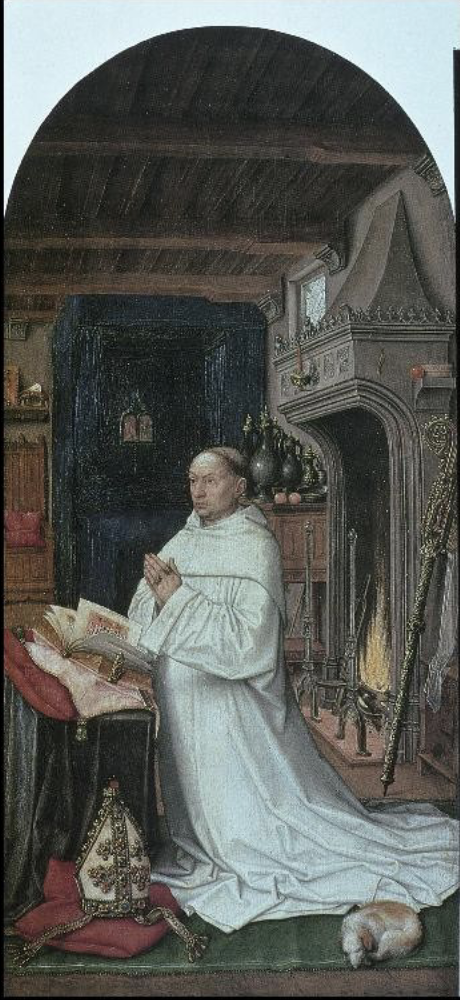
Jan van Eyck, Annunciation in a Church, c. 1435-1437
In church interior not in like Marys specific house off a Jewish temple
Style of floor decoration that existed in paintings like this, using stones grooves are cut and sometimes inlay and sometimes elaborate images in the floor, like this scene of David and Goliath, so sacred stories on the floor, but also round designs between the scenes like the symbol of sagittarius, so astrological signs represented or implies, Mary standing over where Virgo, or the virgin would be
Amazing design like in the velour cushion, but also highly constructed and deeply thought out symbolic scenes, disguised symbolism, not deliberate attempt to confuse but the pieces should all fit together
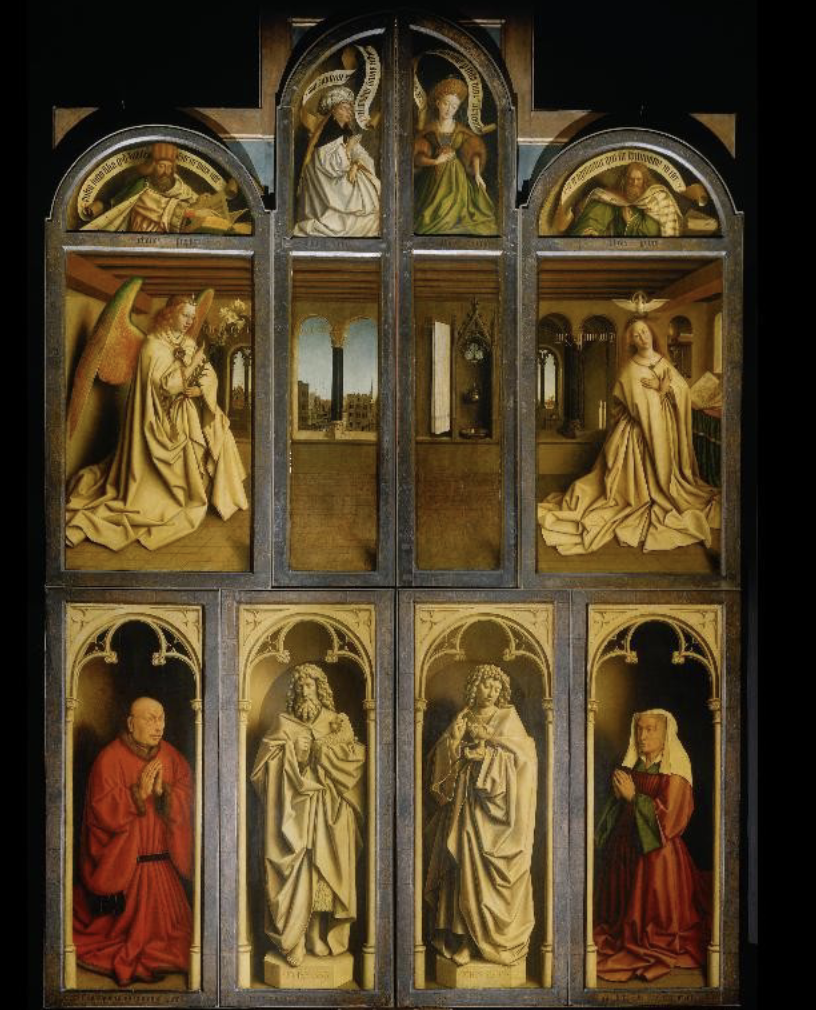
Jan and Hubert van Eyck, Ghent Altarpiece, outside
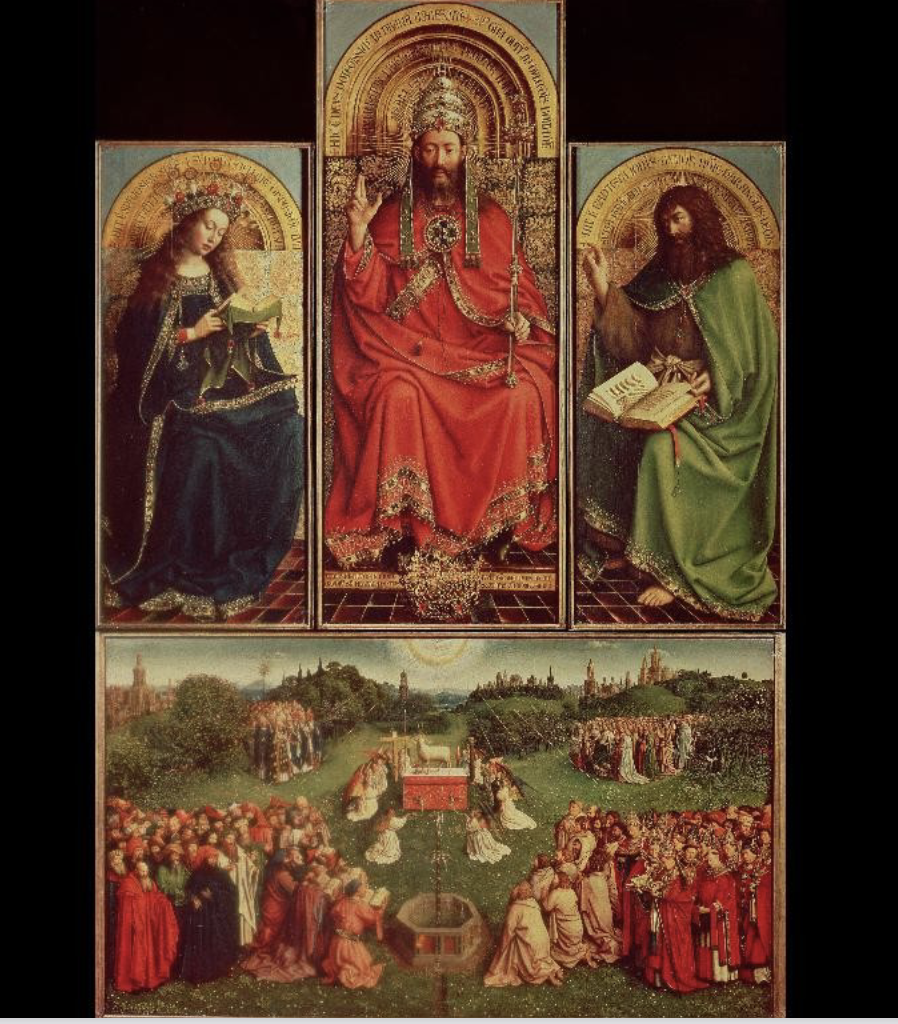
Jan and Hubert van Eyck, Ghent Altarpiece, c. 1426-1432 center panel open
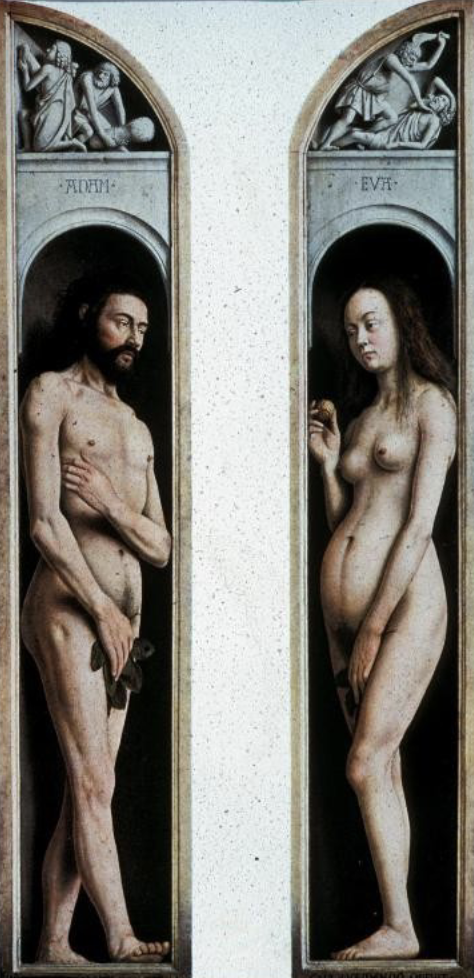
Jan and Hubert van Eyck, Ghent Altarpiece, c. 1426-1432 Adam and Eve
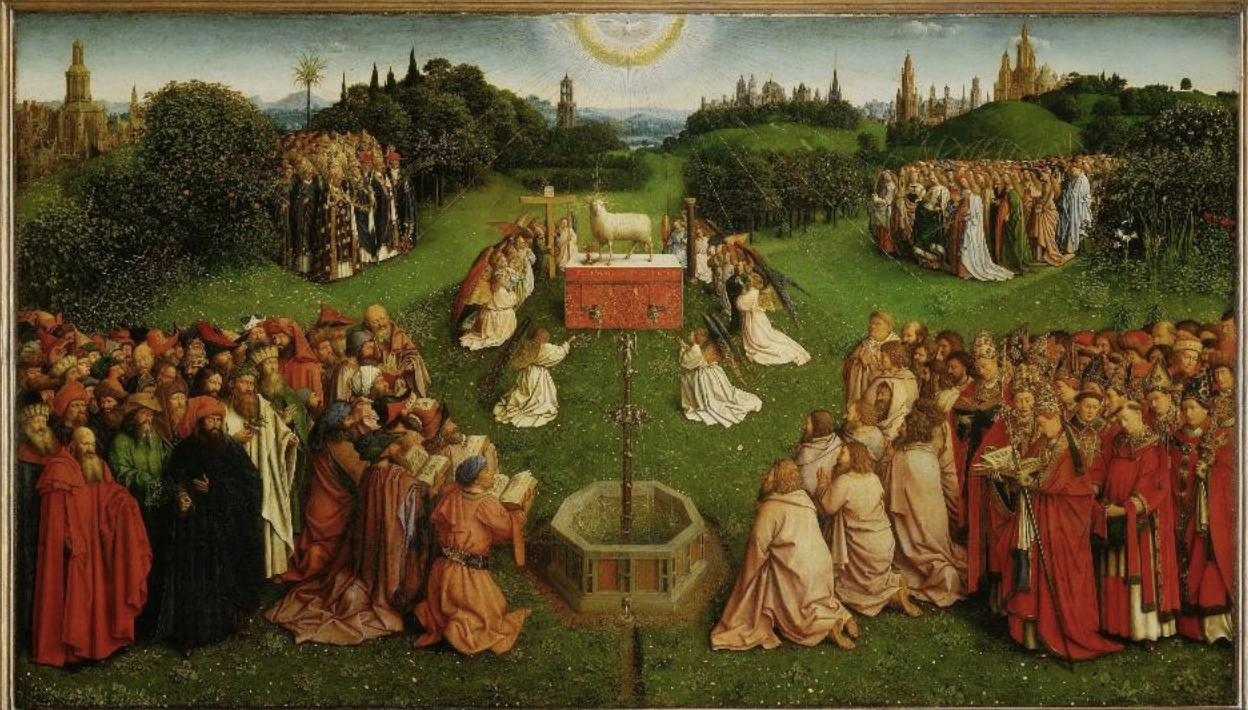
Jan and Hubert van Eyck, Ghent Altarpiece, c. 1426-1432 Adoration of the Lamb
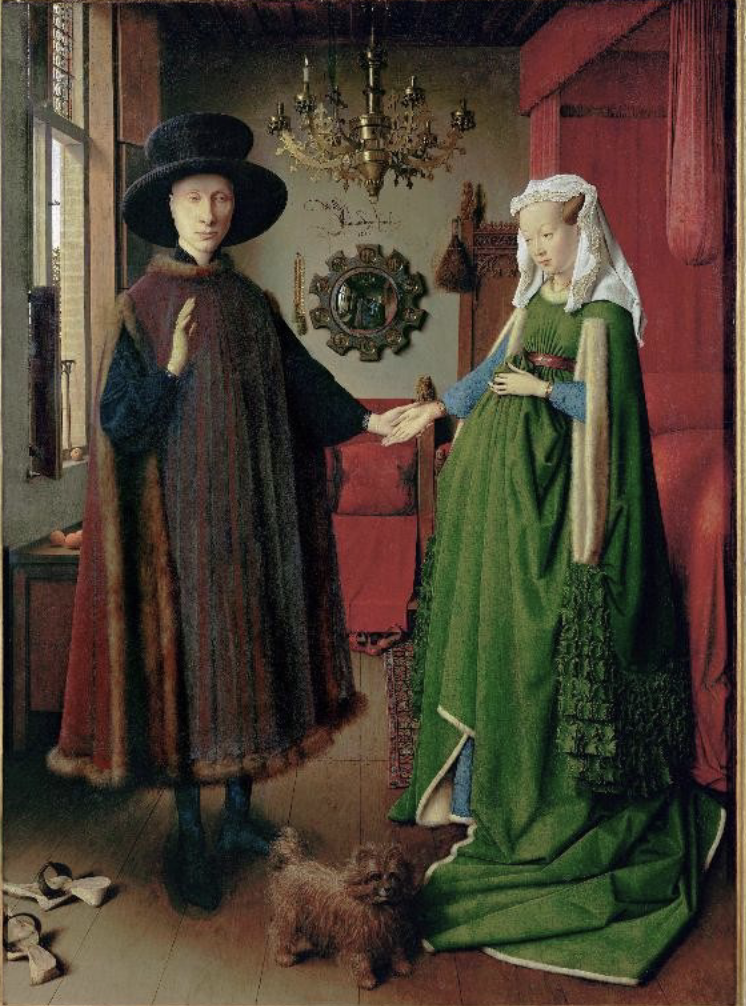
Jan van Eyck, Giovanni Arnolfini and Giovanna Cenami, 1434, Arnolfini portrait
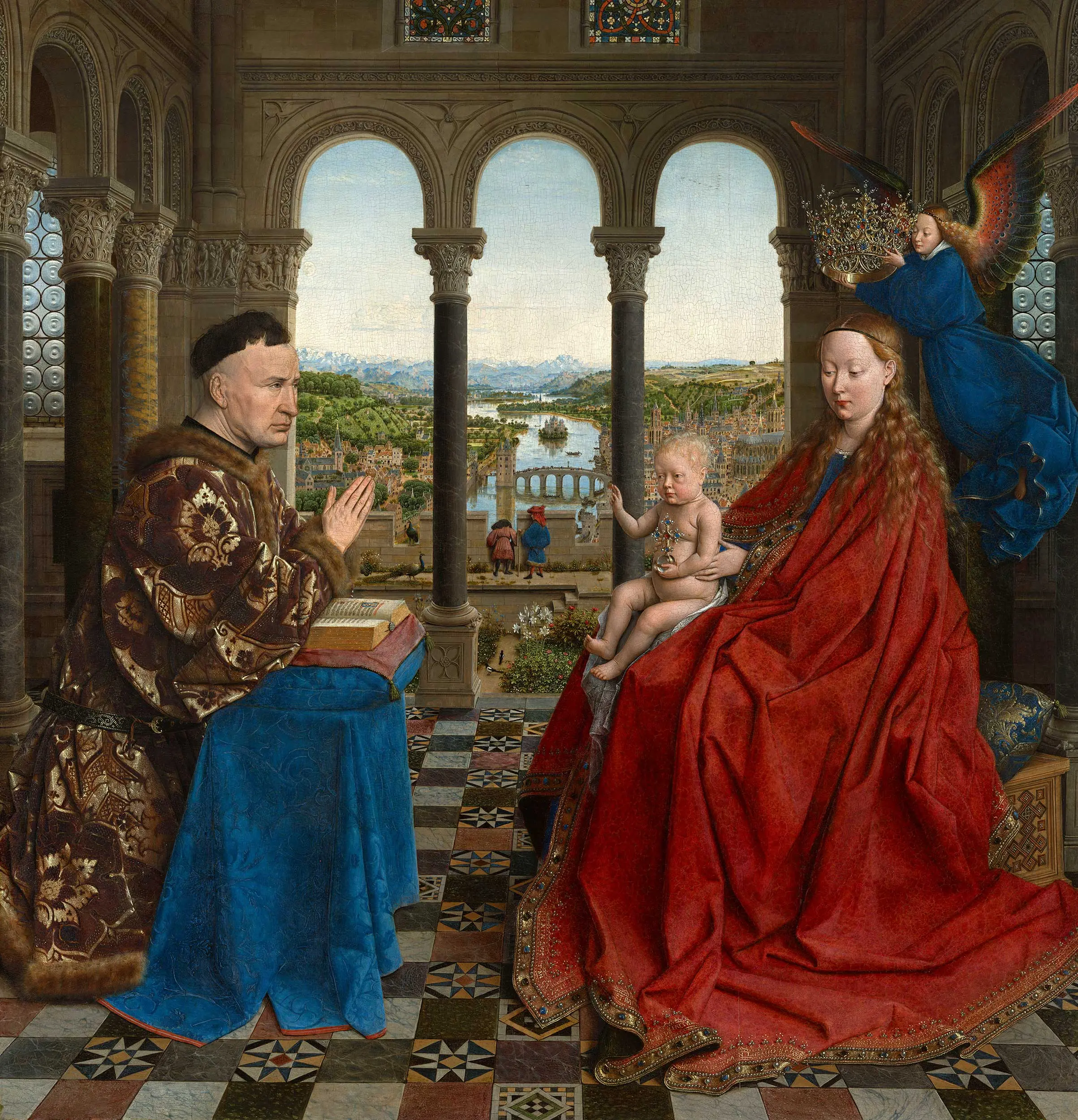
Jan van Eyck, Madonna and Child with Chancellor Rolin, 1435
Angel about to crown Mary as queen of heaven
Kind of heavenly sphere, Rolin after Duke was most important in Burgundy, he was super wealthy and loved art and commissioned a lot, he loved power and didn't mind stepping on other people to get it, insists here he is a pious person, on par with Mary here, same height
So he's some sort of prime minister in a way to the duke so he's really 2nd most important person in Burgundy and here its not held back how elaborate and wealthy he would, wearing such expensive clothing, not humble in the way the patrons from the Ghent altarpiece are displayed and he's basically same size as Mary, only distance and separation between two are the lines on the floor
Rolin is at his prayers and having a vision they are not supposed to be in same room, but it looks so physical here it seems as if hes looking right at her and they're actually next to each other, Mary as usual looks down modestly, but Christ makes benediction right at him, vision seems to be of consummate luxury, this is not contemporary building they are in, veined columns and stained glass, beautifully tiled floor, luxury is very part of this world
His face is marked by age and imperfections with folds
Hillside in settlement with slope of people working on it, clearly vineyard, Rolin owned many vineyards and he wants them shown in this religious painting
Not quite in profile we get a little bit of second eye so closer to third quarter but not as informal but still not as formal or stiff as pure profile
Figures seen in the back wearing not as elaborate clothing but still relatively, both look pretty separate from the scene, draw us in past the immediate scene in the foreground to the deep world that is evoked, figures that look further into image drag us further into the image, we see a river that bisects the city and a great tower leading to arched bridge and vessels on the river carrying many people like a ferrie, we even see edge of city, cities at this point actually did end rather abruptly, things shift to blue and gray tall set of mountains that are snowcapped, all these elements creating depth of space
For Rolin we see his vineyard and for Christ and Madonna behind them we see a typical gothic church, Mary as symbol of church since she is also a vessel, this isn't a specific building or cathedral he is able to like imagine this on his own
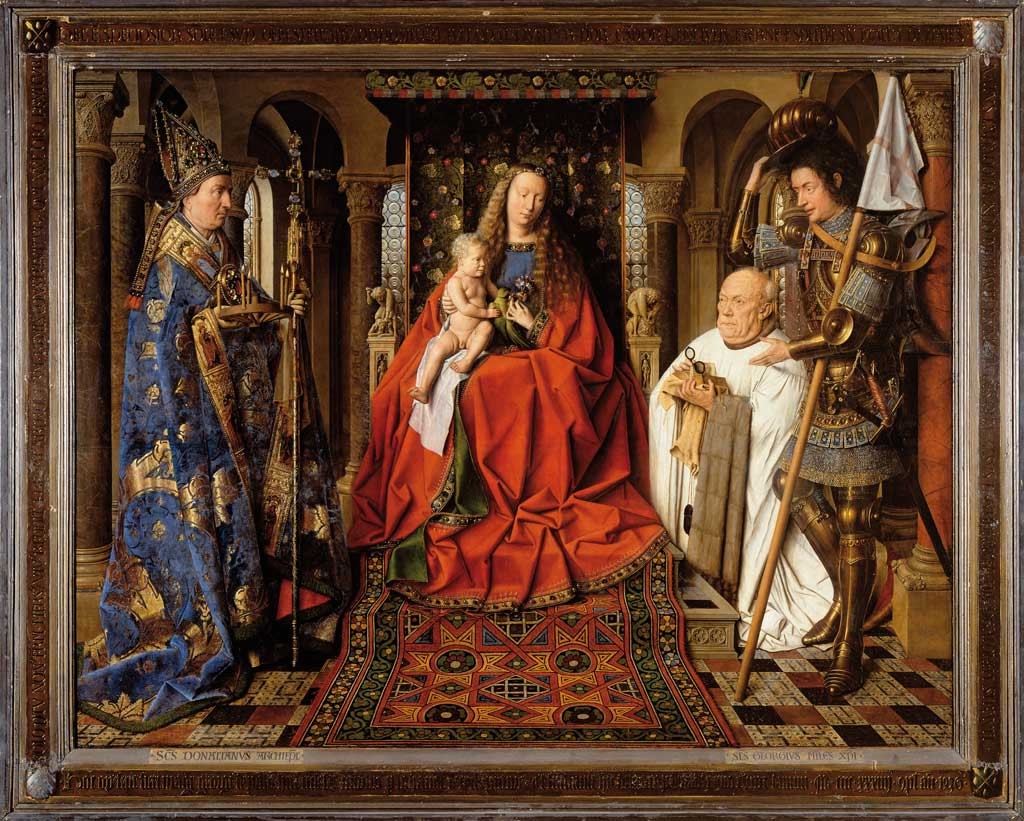
Jan van Eyck, Madonna and Child with Canon George van der Paele, 1436
Wealthy enough on his own or inherited wealth to commission a painting of this kind
Round headed arched in Romanesque style
Colorful geometric carpet seen, in 15th century we start to see luxury textiles from various parts of Asia coming into Europe
Mary and Christ flanked by two saints on left and right including St. George who is on the right, this was patrons own personal patron saint since they have same name
Canopy again above Marys head
Elderly man with many wrinkles, sparse hair, standard of portraiture here but extreme of wrinkles and age, changes of color around the eye showing his age, and a new way or marking age would be seen in the spectacles, now associated with intellectualism in this time, so saints like Jerome who are scholars often has spectacles on or near and often times priests
In the blue robe again no gold but done with yellow paint but looks so real, looks even more real than if used actual fold leaf since wouldn't be able to mimic turning of the fabric
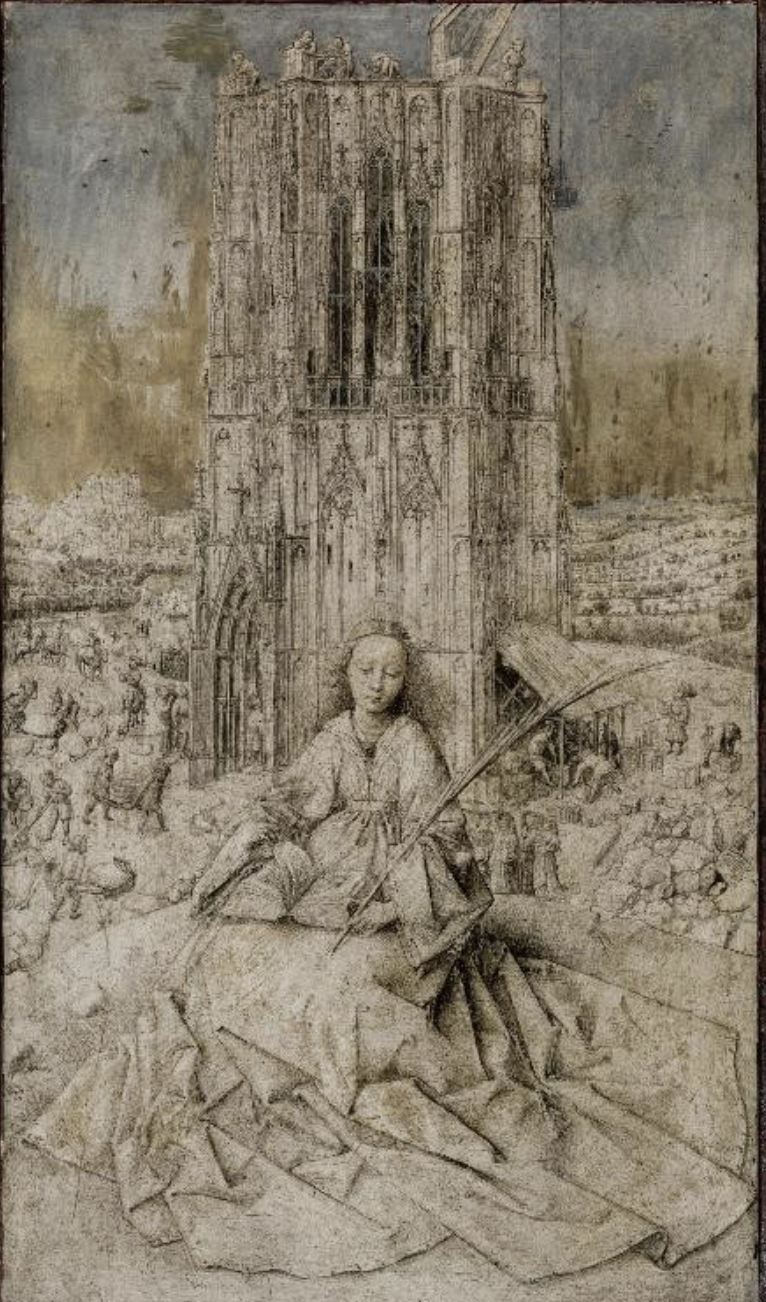
Jan van Eyck, St. Barbara, 1437
Basically monochrome, Barbara was imprisoned in a tower by her father who disapproved of her Christians belief, tower is seen behind her but seen as unfinished with workers down below
Barbara is seen as rather idealized with her figure and perfect egg shaped, holding martyrs palm symbol of dying for faith
Even without color we see deep space like these fields with trees, Eyck is a great master of color but doesn't even need it to create this space
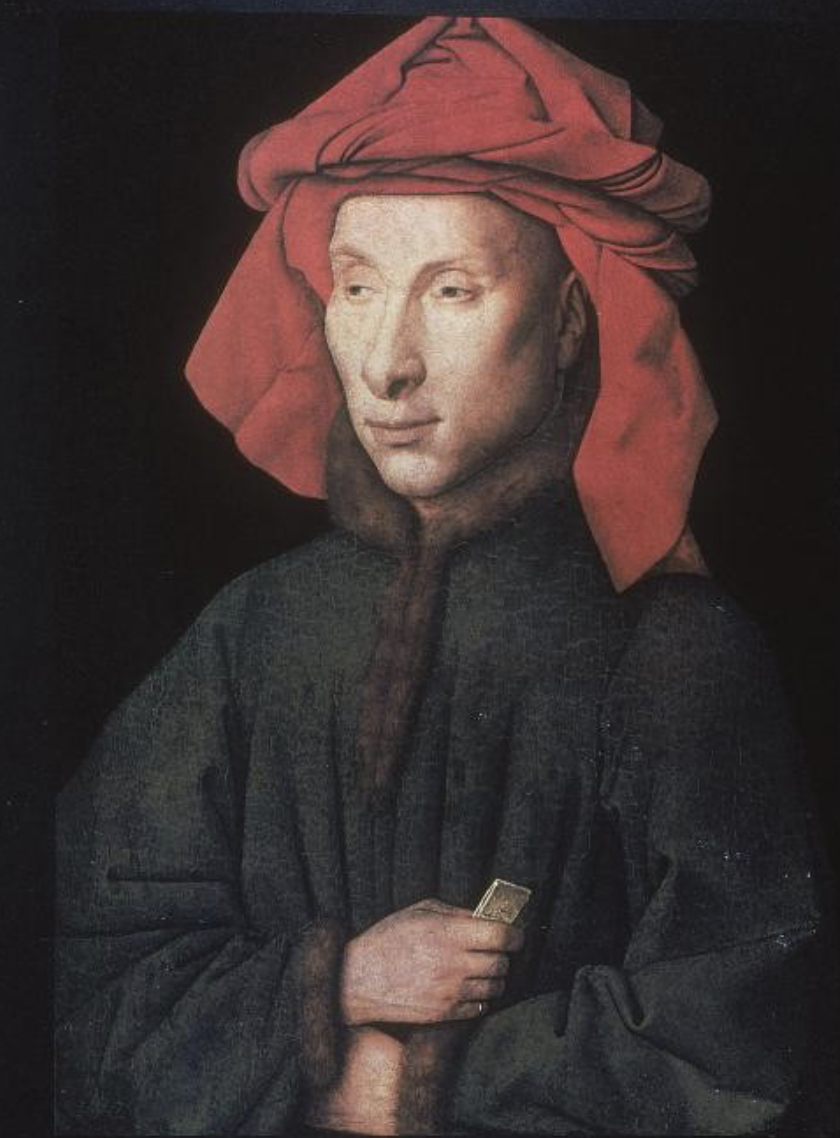
Jan van Eyck, Portrait of Giovanni Arnolfini, c. 1435
Half length image since we see roughly half the body, Arnolfini immediately recognizable based of his nose and space between hsi nostrils and lips, cheekbone structure, definitely same man in Arnolfini wedding/portrait
Wearing dark robe but still has fur lining and trimming, holding a small piece of paper with some unclear meaning l
Shown in 3 quarter view Campin had popularized
Portrait doesn't give away much about them, almost looks like lost in own thought
Red hat was pretty typical of merchants and other people at this time not eccentric specifically, the figure has such a specific face but seems almost emotionally removed from viewer
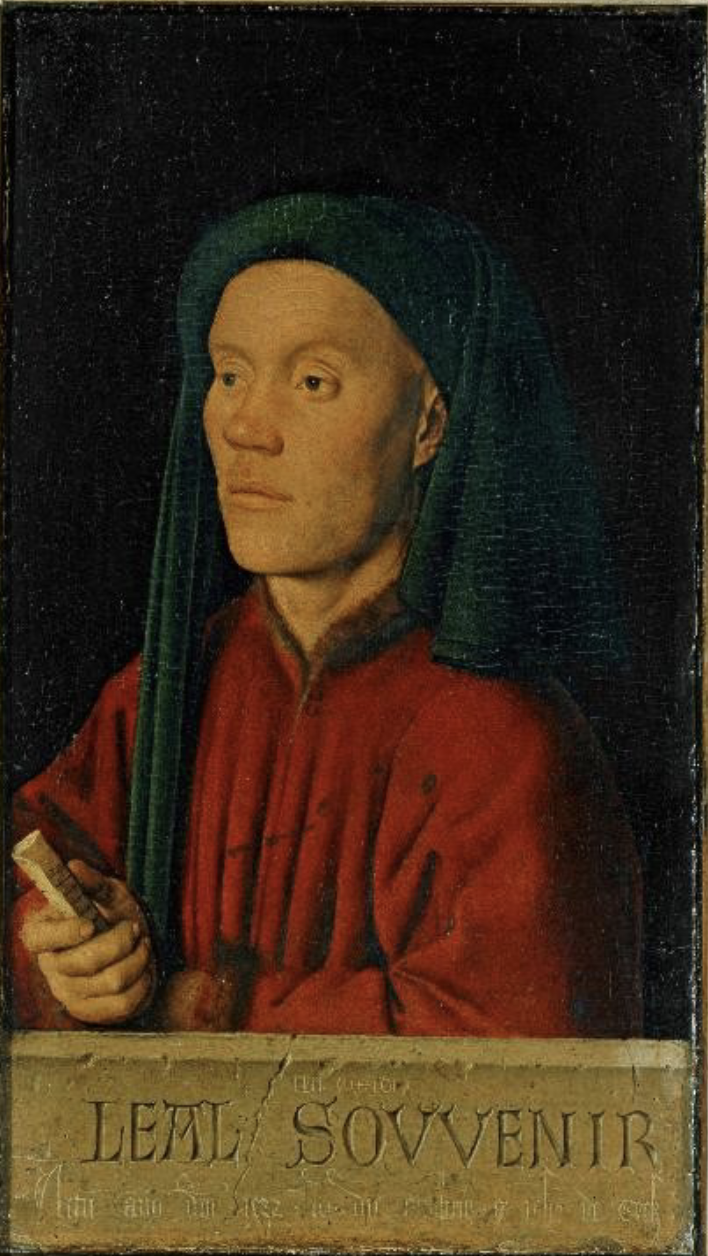
Jan van Eyck, Tymotheos (Gilles Binchois), 1432
Slightly different format but still half length where we see head neck and hands, we see here a low wall, Parapet which is like a barrier, this is way to depict pictorial space of this imaginary plane dividing us from figure which shows the figure behind it, but in Eyck's portrait don't really create deep space in portraits since usually just dark space, Parapet looks really old and has inscription of “loyal remembrance" (implies solidarity among artists working for court) which many other words hard to see but one shows greek letters so we can identify him as Tymotheos which was a nickname for famous musician names Gilles Binchois, so not a person of exalted wealth above Van Eyck but pretty much same level as Eyck since they both could be hired by like dukes, so way of showing Dukes taste to hire best painter and trendiest musician
Figure holding rolled up piece of paper or parchment but interesting inscriptions
While Campin proceeds Eyck, Eyck's work is really new and its starting some new era, patrons commission “new art”
Three quarter view looking off in the distance as if he's lost in his own thoughts, typical distance seen in Van Eyck's work
Artists seeking to get out of just being seen as craft person but someone who's an intellectual and can think of new things
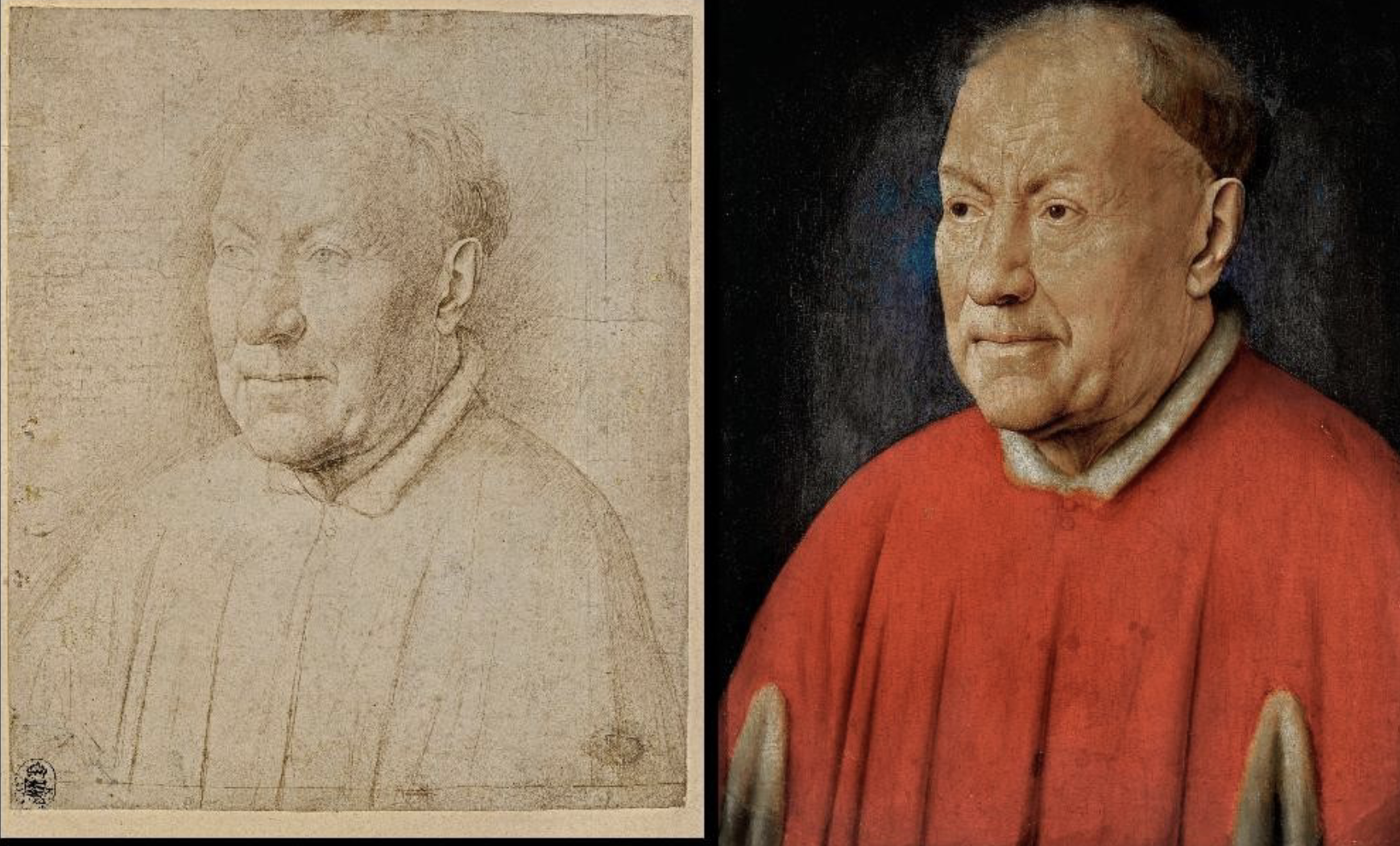
Jan van Eyck, Portrait of Cardinal Nicholas Albergati, silverpoint, 1431?, painting, c. 1435
In the drawing seems to be a bit more lively which is typical since drawing done from life where as painting is not, oil paint and some solvents are messy and smelly and can get on clothing so patrons would be drawn from life but not painted, more of an alertness in the drawing than in portrait, so maybe sense of no revealing of the sitter and portrait has to be more passive and unemotional
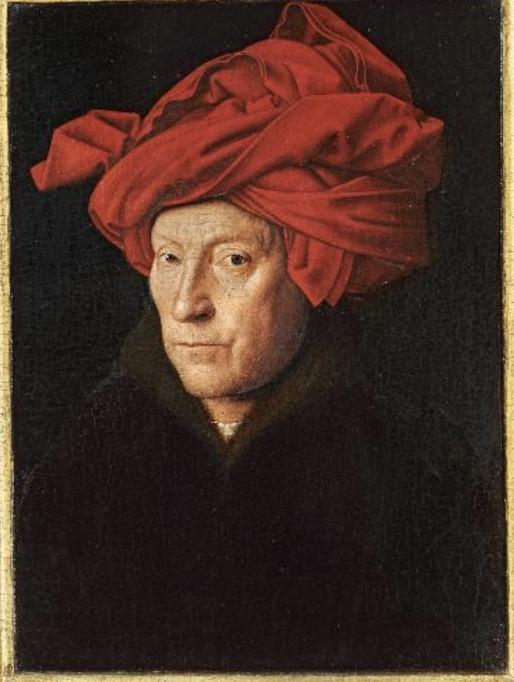
Jan van Eyck, Man in Red Turban, c. 1433
Figure is in three quarter view with half length but smaller so arms not there so in between half length and mid length but here we also see a figure actually staring right back at us
Respectable to show a little bit of white undergarment on neck, socially acceptable but no other lavish detail in clothing but in the head gear we see a little more extravagant then even what Arnolfini was shown
Face itself is really stoic and no emotion but we also see some stubble and 5 o’clock shadow which isn't new but very noticeable here
Here we see an original frame which is not super common and many interesting inscriptions on frame itself “Jan Van Eyck made me” and gives the year but also the actual day made, October 21st which is super unusual
On the top not in latin, in a version of dutch which is spoken in low countries pretty often it says “The best I can do” which makes sense for Eyck since he's always trying to outclass others but might also have been a self portrait, since also this is what you would get when you look at yourself in the mirror you wouldn't get outside view, mirrors were also growing in popularity and not just convex mirrors, but rolled and flat mirrors and use of mirrors increases and artists become more and more obsessed since it takes 3d and put on flat surface of mirror just like what painters do
Self portraits as symbols os saying how important you were just as musicians can have a portrait made of their status, but self portraits also show proof of your talent and that you can actually paint, you need things in workshop to show what you can do since usually you paint something and then it gets taken away to patron so this stays in workshop showing what he can do, the best he can do
While we do indeed get someone looking at us we dont see much of their personality
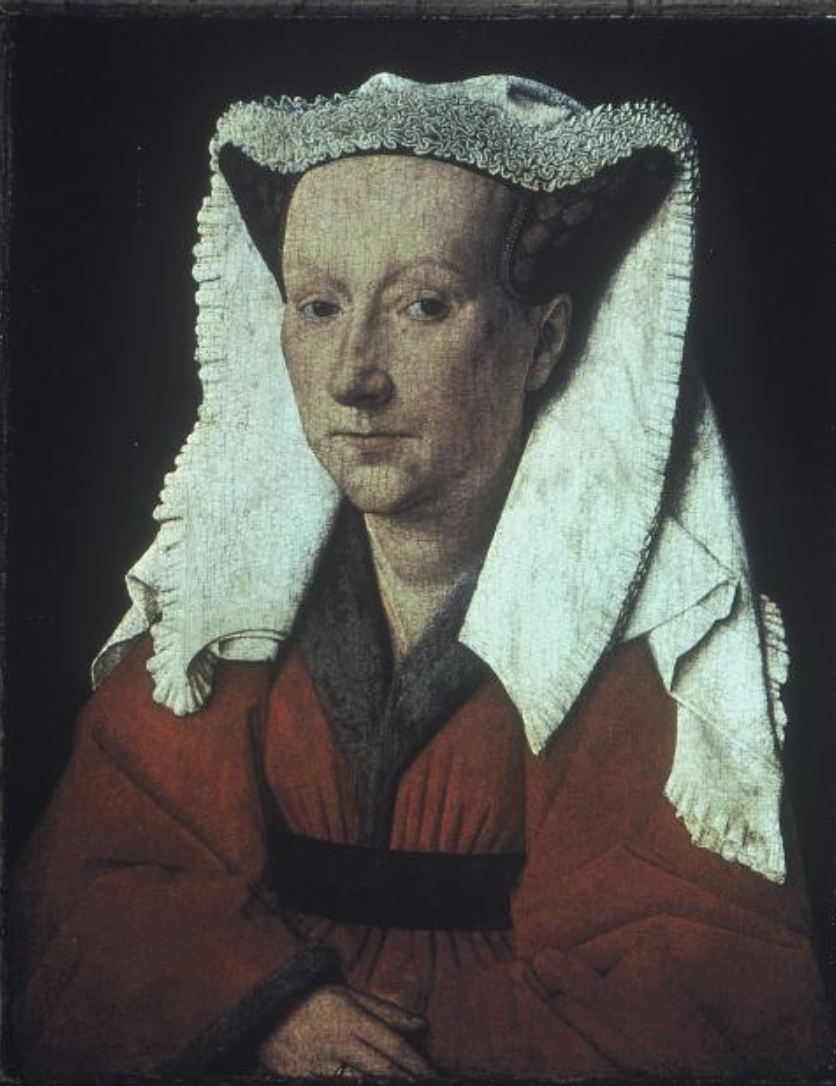
Jan van Eyck, Portrait of Margaretha van Eyck, 1440
Identified as his wife, lacy headgear and again direct look which outside shop wouldn't have been the norm or wanted but now for him what he would like to advertise to as something he can do
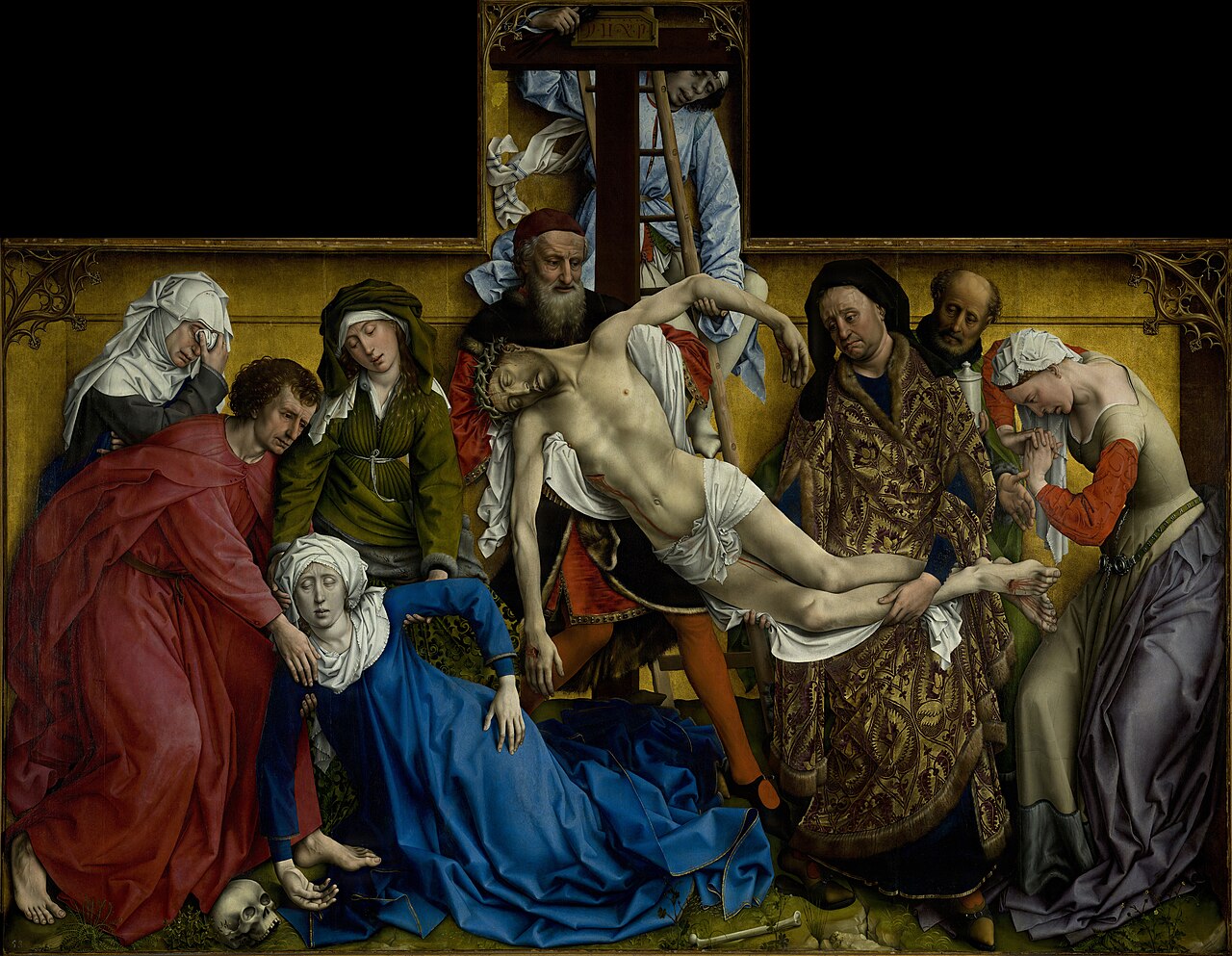
Rogier van der Weyden, Deposition, c. 1435-1438
Rather large, not as big as Ghent altarpiece but still big, figures close to life size
We do see grass which would be accurate to where Christ was actually crucified, but we do see two different kind of scenes with exterior and interior and where they meet
Not commissioned by single individual but by a confraternity, a club of sorts of men dedicated to their religion, fraternity of area right outside Brussels, prosperous southern Netherlandish suburb
In a way this confraternity are almost a militia where they train with like legit weapons, but these clubs also had a religious undertone, were allowed to have a chapel of sorts and would likely want to bury their dead near the alter
Fitting subject to be commissioned by group since we have a group being painted here with elements of the Holy Kinship not just Mary and Christ but the Magdalen, St. John Evangelist,and other figures from gospel said to assist with burial of Christ, whether any of these figure represent people from the club isn't super clear
Christ on cloth is usually represented as unclothed usually since people crucified were usually stripped naked, here he's wearing loin cloth but not really
At heart of picture we see a moving echo of Christ's own complex and awkward posture of his body with that of Mary, the physical task of holding an adult man is super hard since so heavy and so many limbs so bring down from cross would be super hard and Weyden displays how difficult thai would be also with intent of not wanting to damage this holy body, Mary's body also had to be held since as usual she is shown fainting at the site of Christ's execution
Weyden is more open to emotion than predecessors with just so much grief being shown here, wrinkling of brows suggesting sorrow and frowns, and moving cloth up to eyes to wipe away tears and also literal tears being shown on Mary’s face, figures bending to show sorrow and not to hit their heads
Just lot of echo between Mary and Christ not just in posture but their hands being parallel with Christs hand stigmata and Mary's pale unharmed hand so maternal empathy that if your child dies apart of you also dies
Can see his feet bleeding straight down since he was hung with feet down but now we see still bleeding since drip is now going other way so we see how Weyden really understands space and anatomy
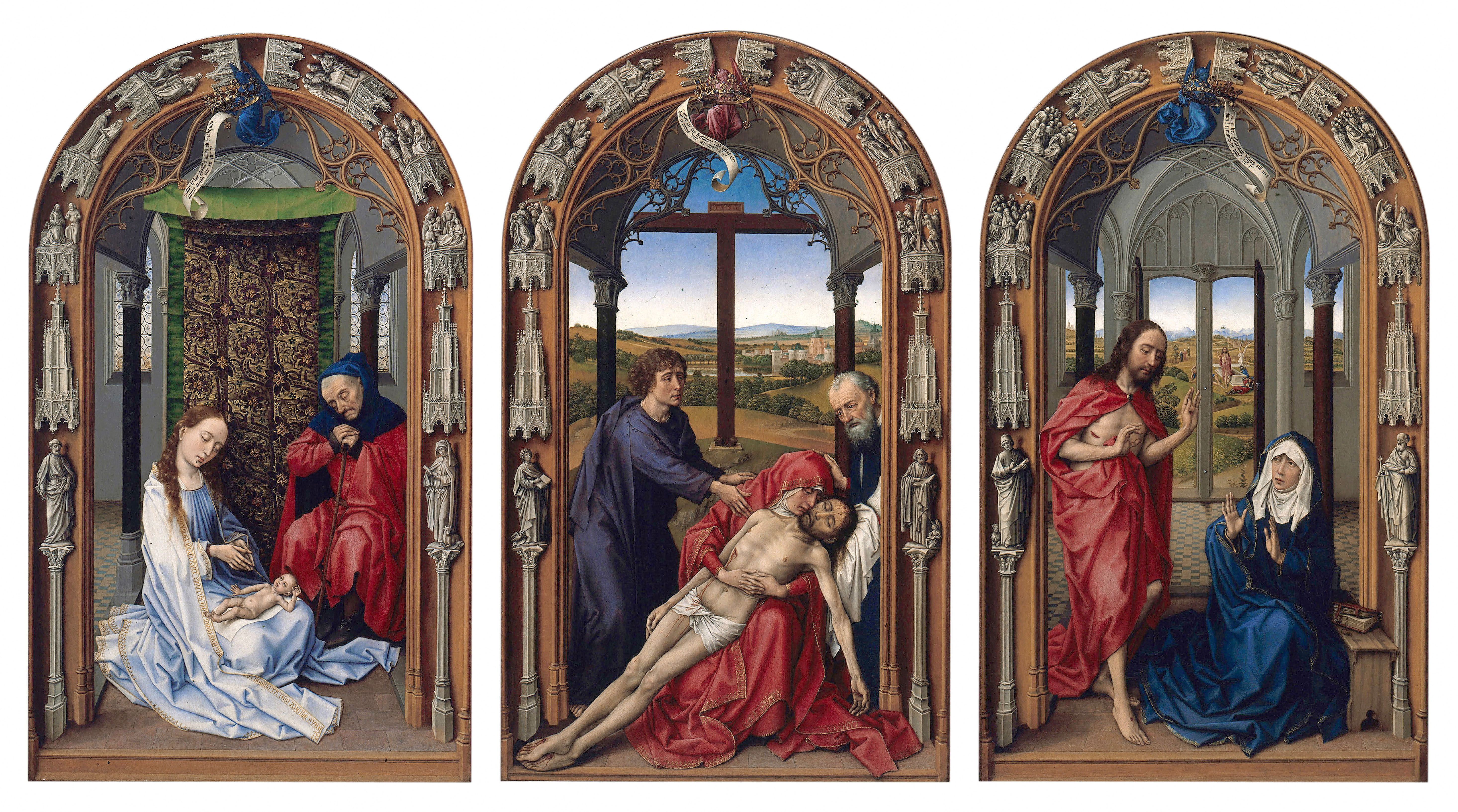
Van Der Weyden, Christ Appearing to His Mother, Miraflores Altarpiece, c. 1440-1444
Triptych with three part panels and all panels are all same size
Spain under Hapsburg dynasty so holy Roman empire but also kings at time
Romanesque style part of it with the faux sculptures being in gothic style with the decorated capitals and these like elaborate scenes in the arches and pointed supports for the arches
Nativity on left, middle is lamentation and on the right is the rare scene of resurrected Christ appearing towards mother before he ascends
Beautiful lush calm landscapes stretching out behind them, the right panel is like most focused
On the right in the back of two of Mary's friends walking to tomb of Christ, quite a lot of narrative taking place above arch including scenes early on in Mary's life and even ones after like her ascension to heaven
Starting early certain stories of bible start getting preformed in church usually by the alter and it was part of mass and the ritual taking place and as time went on some performances become very elaboartee with decorative costumes and even stage tools like having flying angel and then they start moving outside the church like on the street, Miracle Plays
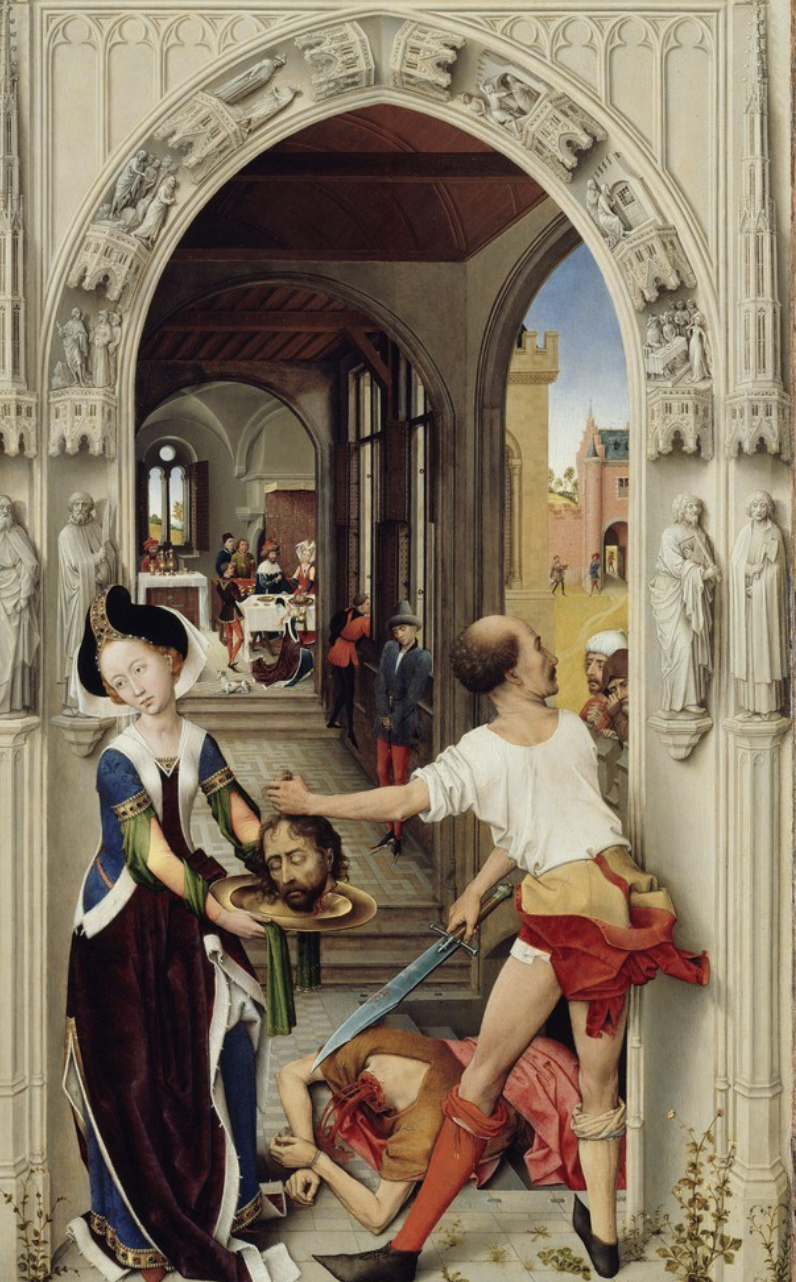
Van Der Weyden, Beheading of the Baptist, St. John the Baptist Altarpiece, c. 1440-1450
Similar to Christ appearing to Mother in Miraflores Altarpiece
This seems a bit later since appears he's experimenting here and pushing the element and format that's typical of him
In this one has much more pointed arch and is in Grissailes
More interior complex over exterior complex
With the dress it seems a lot more contemporary partly because Mary and Christ kind of have to be depicted in these weird rooms
Executioner shown as gaudily dressed but unkempt which is also typical
These figures push boundary of architecture more where as in altarpiece they like barely come out of the building but in this piece they're more clearly like escaping the building
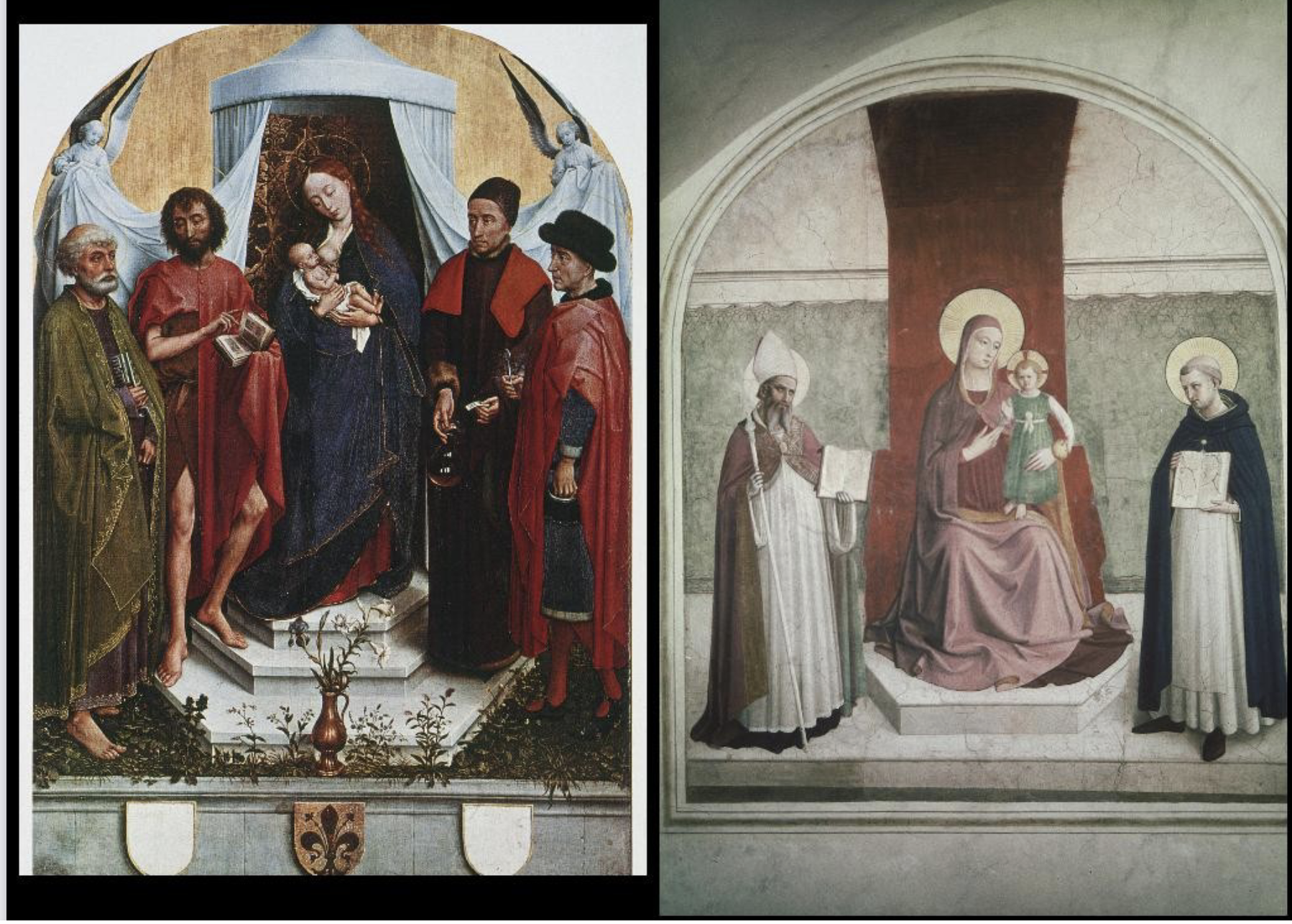
Weyden: Virgin and Child with Four Saints (Medici Madonna), c. 1450
Weyden had actually done pilgrimage to Italy so he shows some influence by Rome paintings
But in Northern works the child is always way way tinier which we see here and they bend heads in similar ways but faces and head shapes are different
He didnt profoundly change ways of working by his Italian exposure but def had some influence
Image of Madonna and the child flanked by saints, or holy conversation is pretty typical but presence of relative informality that is unique to this
St. Peter carrying keys and on right see two men holding book and vile which are both doctor saints who were also patron saints of Medici family in Florence so might be commission executed when in Italy or at the very least related to his Italian journey
The linear perspective system was invented and popularized in Florence in like 1425 and was popular really starting in 1450 but Van der Weyden didn't really care and this didn't really influence how he painted even though other northern artists probably would've loved to copy it, he didn't
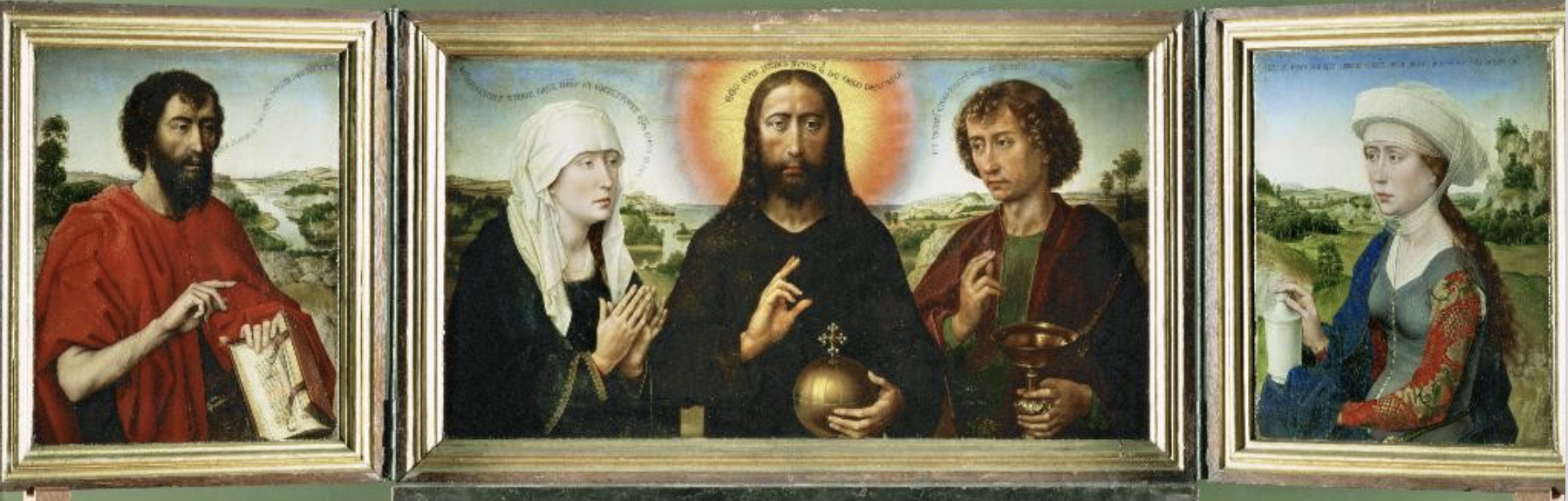
Van der Weyden, Christ with John the Baptist, Mary, John the Evangelist, Mary Magdalen (Braque Triptych), c. 1452
All figures shown at half length so for small commission instead of shrinking figures just cuts half of them so they can be closer to lifesize but here still a little smaller than lifesize
John the baptist on left panel, Mary on the left side most popular, than on right is John the evangelist, right panel is Mary Magdalen
Evangelist is youngest apostle who writes gospels and revelations where as Baptist is more part of his childhood
Magdalen hoding ointment since she like helps heal him, but also her eleaborte garment allude to prostitution background and ointment jar can double as perfume jar
A little similar to deis groups since like three important figures
Above Christ says “I am the bread which came from Heaven” which actually written by evangelist so he's almost a footnote, made to underlie miraculous transformation of him turning into the like wafer, gives meaning to skyscape behind so maybe why not in a church portal or in dark background like portraits, to be bread from heaven helpful tro play on landscape along with sun both halo but also physical event in the sky
Baptist pointing towards christ and is there as sidepost of here is the messiah since he often literally points to christ
Magdalen has sense of melancholy since going to help Christs dead body
On closed wings of altarpiece we see cross of latin inscription and then skull as memento mori and coat of arms for Braque the patron and is a sheaf of wheat, wheat is substance that makes communion wafer so focus on wafer makes sense since that is his coat of arms
So personal element to theological meanings found in work
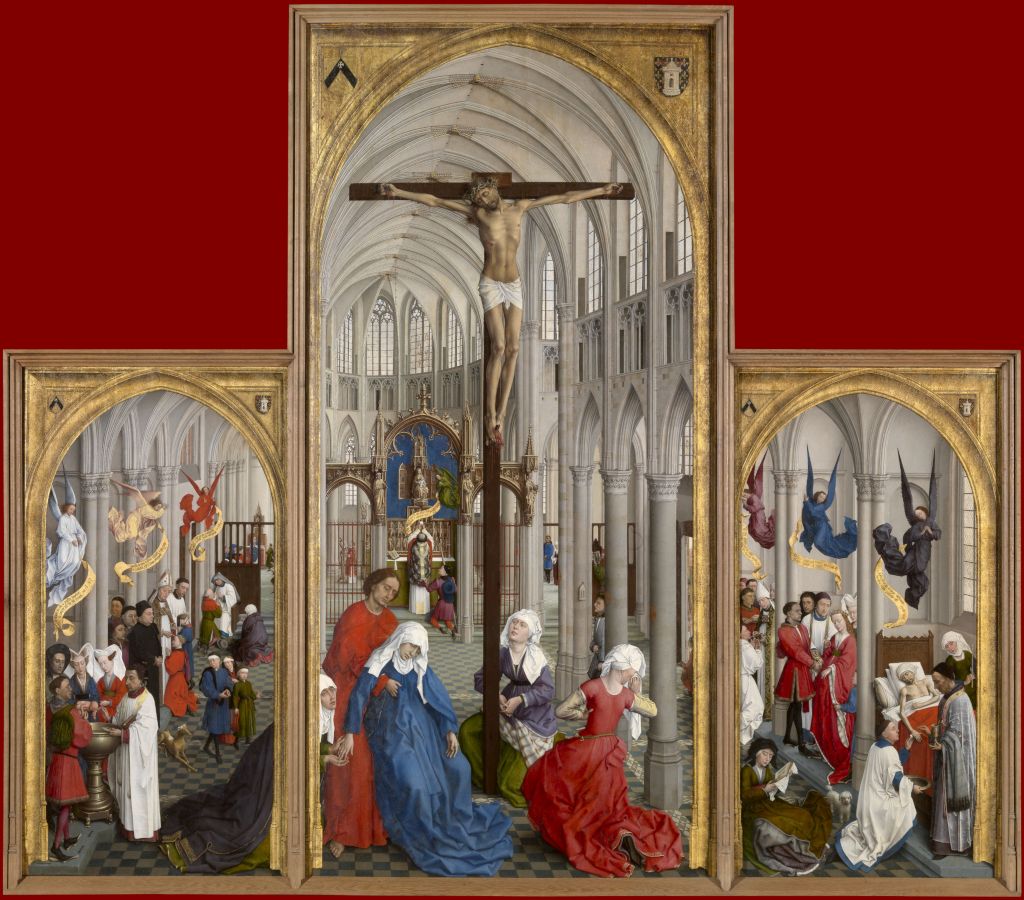
Van der Weyden, Altarpiece of the Seven Sacraments, c. 1435-1455
Commissioned by another churchmen with particular dedicated or teaching function
About not just seven sacraments since front and center is image of crucified christ but also question of why crucifies christ in church since clearly happened outside in Jerusalem, so maybe more of statue of this in church which isn't super uncommon since usually paintings in Italy by altar of crucifixion
Here we see another anachronism with that
Modern gothic style church but image of christ is way before institution of christ even founded
Seven sacraments including baptism and Eucharist, but also illustrated here in sort of teaching way so priests and church leaders could point to it when teaching, behind we see someone receiving eucharist and the raising up of the wafer symbolically from the heavens in the very center, in the wings which are side aisles of gothic church, on foreground really clearly on left panel is baptism, behind baptism we see conformation and behind that is confession, on right panel we see the last rights which is supposed to help cleanse sin from soul so we started with baptism on left and all way to last rights, then marriage in back, and then in back is holy orders how priests enter priesthood and get exalted level, so left panel is early stuff, center is stuff that always happens throughout, and right panel is later adult stuff
Things happened inside churches and this painting shows people would circulate and use church for many things like in one chapel was mass and in one part of the church at same time a different ceremony could happen
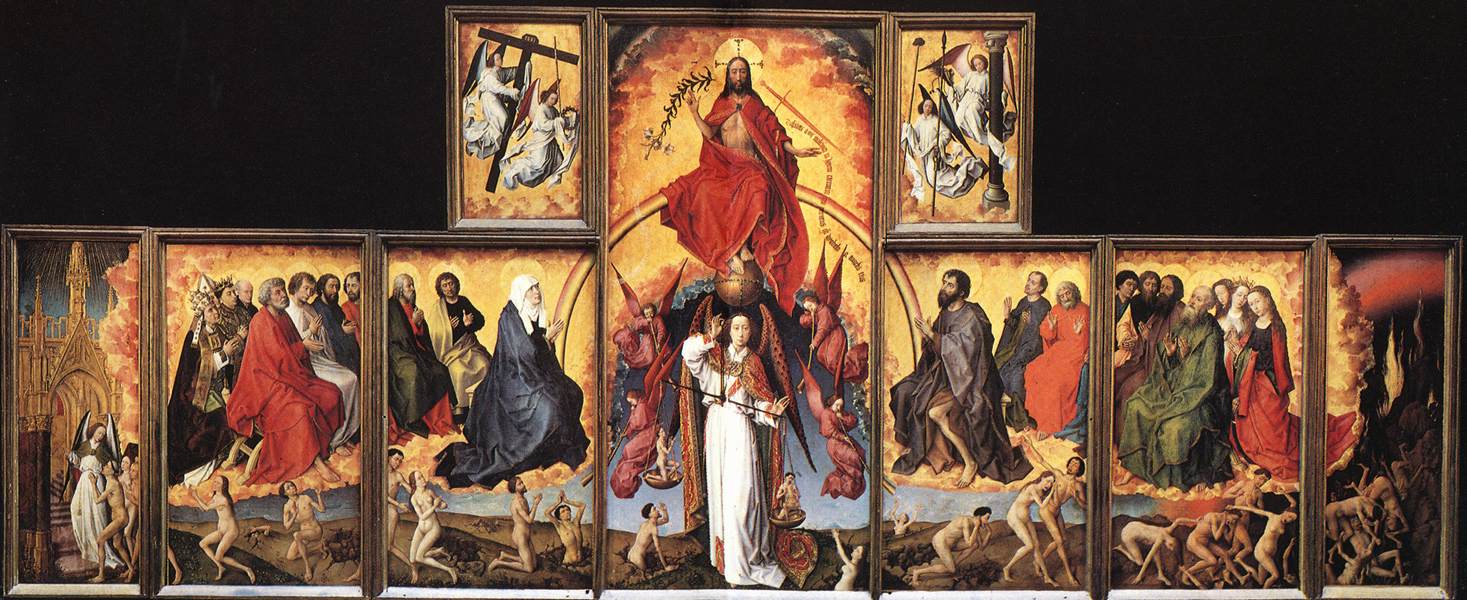
Van der Weyden, Last Judgement (Beaune Altarpiece), Beaune (pronounced like Bone), Hôtel Dieu, c. 1445-1448, OPEN
Affective Piety
This was a hospital which in this time it was actually really hard to cure things so this was more a place to care for ill people rather than healing, in most places operated by monks or nuns so they are religious and mostly about palliative care not actual curing just relieving pain and give comfort, but also try to ready somebody for passage into the afterlife
Part of financial support since some vineyards given to hospitals so they could make an income
St. Sebastian who you pray to since he survived all his arrows he was shot with, Patrons being seen here and their coat or arms and book of hours in front of them, so gift from second most important people to the hospital when closed
We see Christ seated on rainbow with a Lily and a sword, reward and punishment symbols and showing wound in his hand like his own suffering
Beneath Christ is st. michael who according to tradition weighs soul
Also see the heavenly chorus here of sorts with saints and on left is figures approaching gates of heaven including monk with weird haircut and on right proactively is figures about to drop in burning inferno
Angels are carrying instruments of passion
Then also some wonderful details like the dead coming back to life and coming out of the earth
Those gong towards Hell no like demons dragging people to Hell, so when brought back to life you know where you're going no one to drag you there and once you understand you're condemned you see weird actions like man biting his hand symbolic of anger and hurting self out of fury, and not adam and eve but another couple destined to Hell,
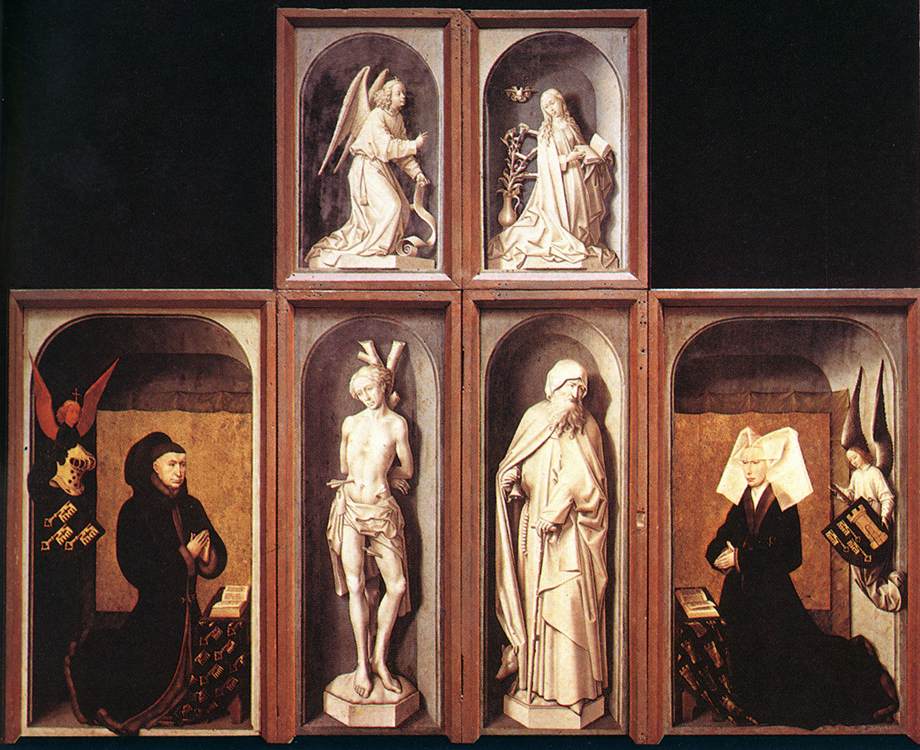
Van der Weyden, Last Judgement (Beaune Altarpiece), Beaune (pronounced like Bone), Hôtel Dieu, c. 1445-1448, CLOSED
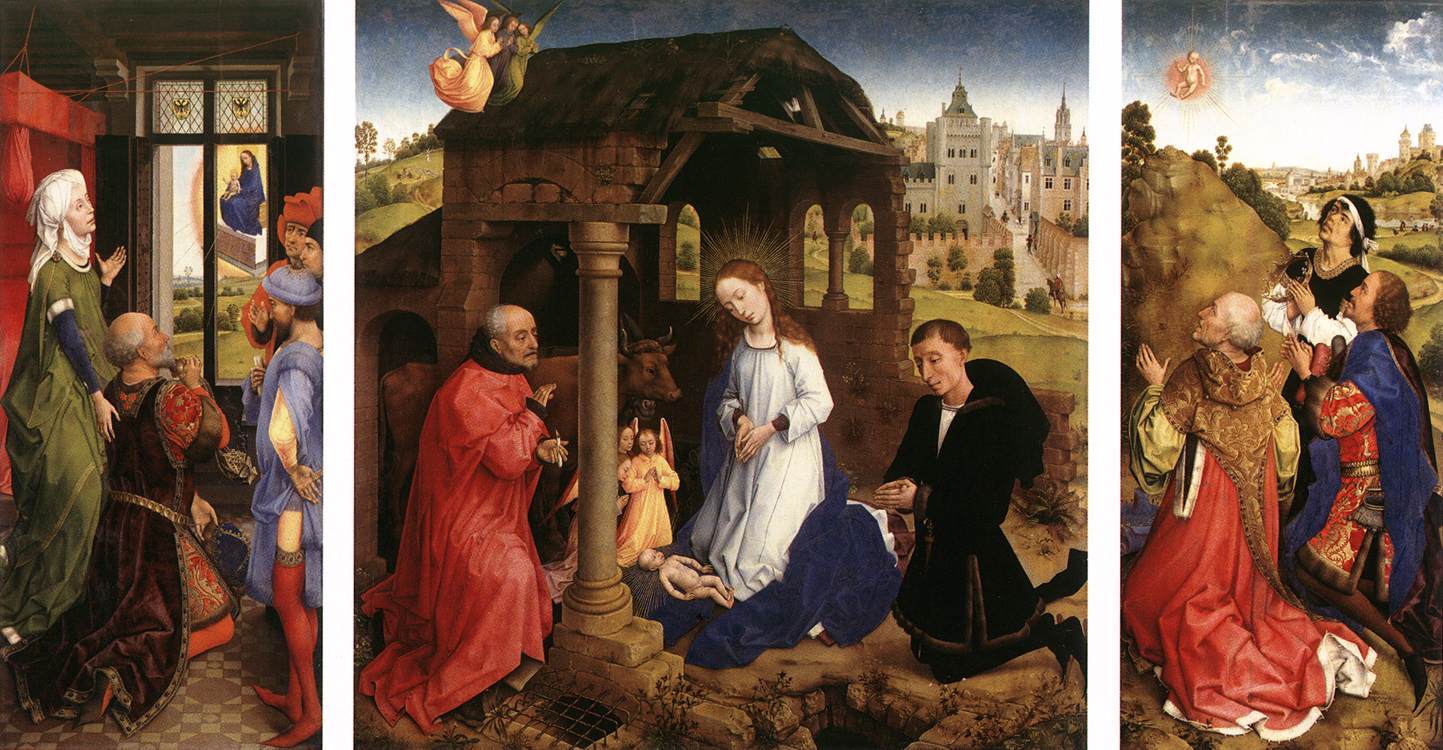
Van Der Weyden Bladelin Altarpiece, 1452-1455
Hall of Justice, courtroom in Brussels, draws upon Van Eyck and Campin and after 1440 def looks carefully at Van Eyck since Duke of Burgundy highest valued patron liked Van Eyck
Made for Bladelin who lived in Flanders near Ghent and Bruges and was involved in building port city in Brughes which may be alluded to in background, he was a wealthy upperclass figure but not like a duke or major employees but back to bourgeois patron, rather similar to earlier works by Campin
Augustus and the Tiburtine Sibyl
Emperor Augustus who ruled during Christ's child and was told by Sibyl, profit telling Roman Emperor of Christ child being born, story not found in Bible but popular in this period
Madonna and child on hovering alter on back
Stained glass windows of two eagles, emblem of Holy ROman emperors since they claim to be descendant
Nativity
See this ruined sculpture since manger of Bethlehem rumored to be in King Solomon's palace of sorts
Bladelin is in this center panel and gets almost direct view of the child
City in background related to cityscapes seen in like Campin and Van Eycks showing hes just as good at creating this like world with really being in the city and slightly curved streets and pitched housing with people on horseback
The Magi See the Star
Story of Magi and a version where they see star of Bethleehme in sky which brings them to Mary giving birth
Often shown as a star but here star of Bethlehem represented as an infant, sort of clearer message of what they are being brought to
Van Der Weyden, Columba Altarpiece, before 1464
Many think this is his last subject, all events part of infancy cycle
Annunciation
Bed here with suspended canopy thing like Arnolfini portrait pretty typical
Adoration of the Magi
Youngest of the magi is thought by some scholars to be portrait of new duke of burgundy, charles the Bold
Presentation in the Temple
Christ in the temple like all born Jewish males
- Interior pace for presentation which had to be part of Hebrew temple with old style architecture but also exterior of the building shown in central panel despite the pieces not connected
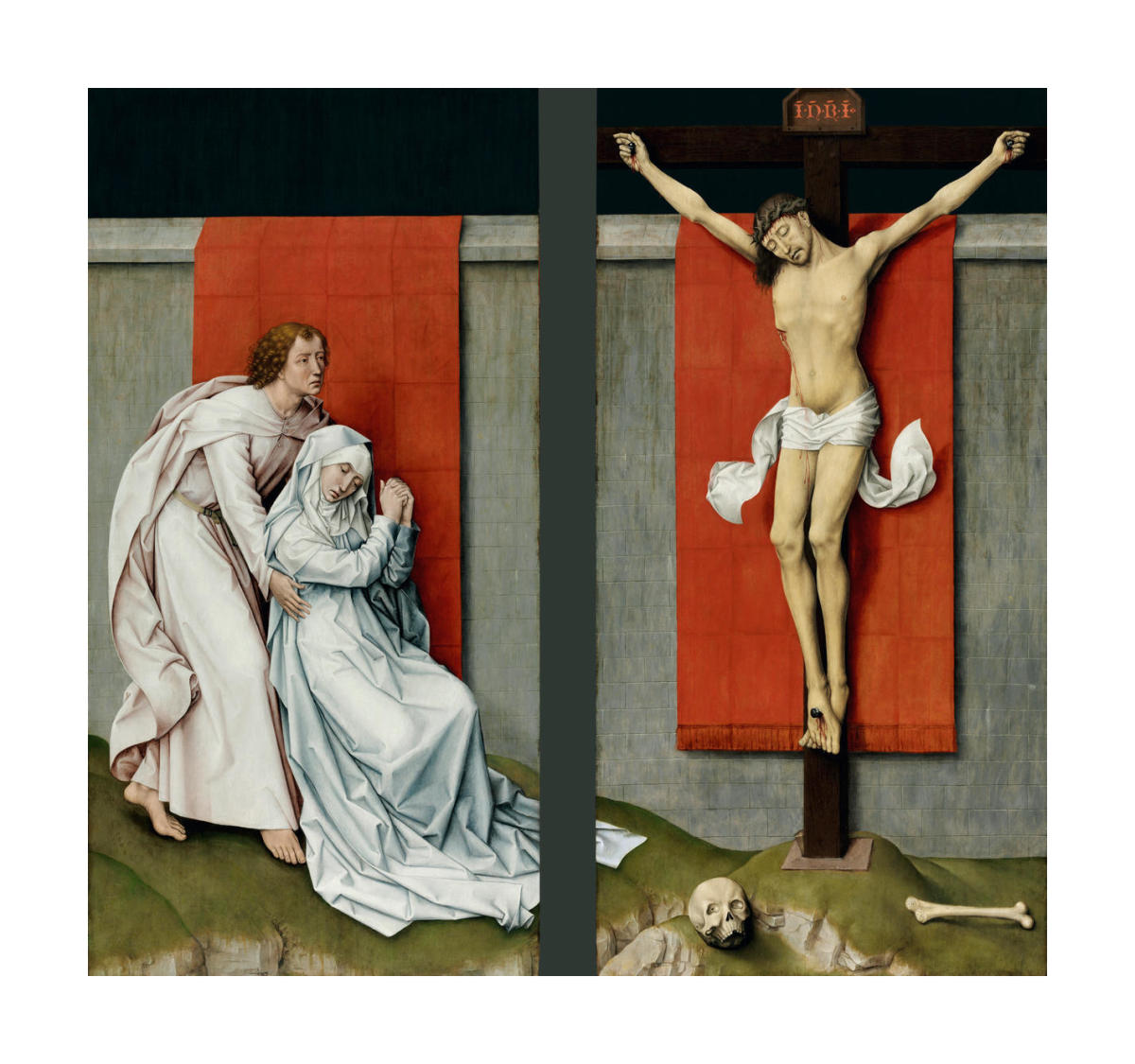
Van der Weyden, Crucifixion Diptych, 1460
Image of crucifixion but set up in unusual way despite manya artists later imitating its construction
We are outdoors but no blue sky aybe because sky goes dark at his death even though foreground well lit
Hill of skull and bones like says in Bible and in front of beautiful stone wall
Not monochromatic but despite read fabric on walls its pretty simple
Christ's body is highlighted by this fabric and is a little related to cloths of honor
Collapsing Mary and St. John with sorrow expression trying to hold Mary and starkness of the work is that its two part work, diptych but Mary's garment trails off in the other panel
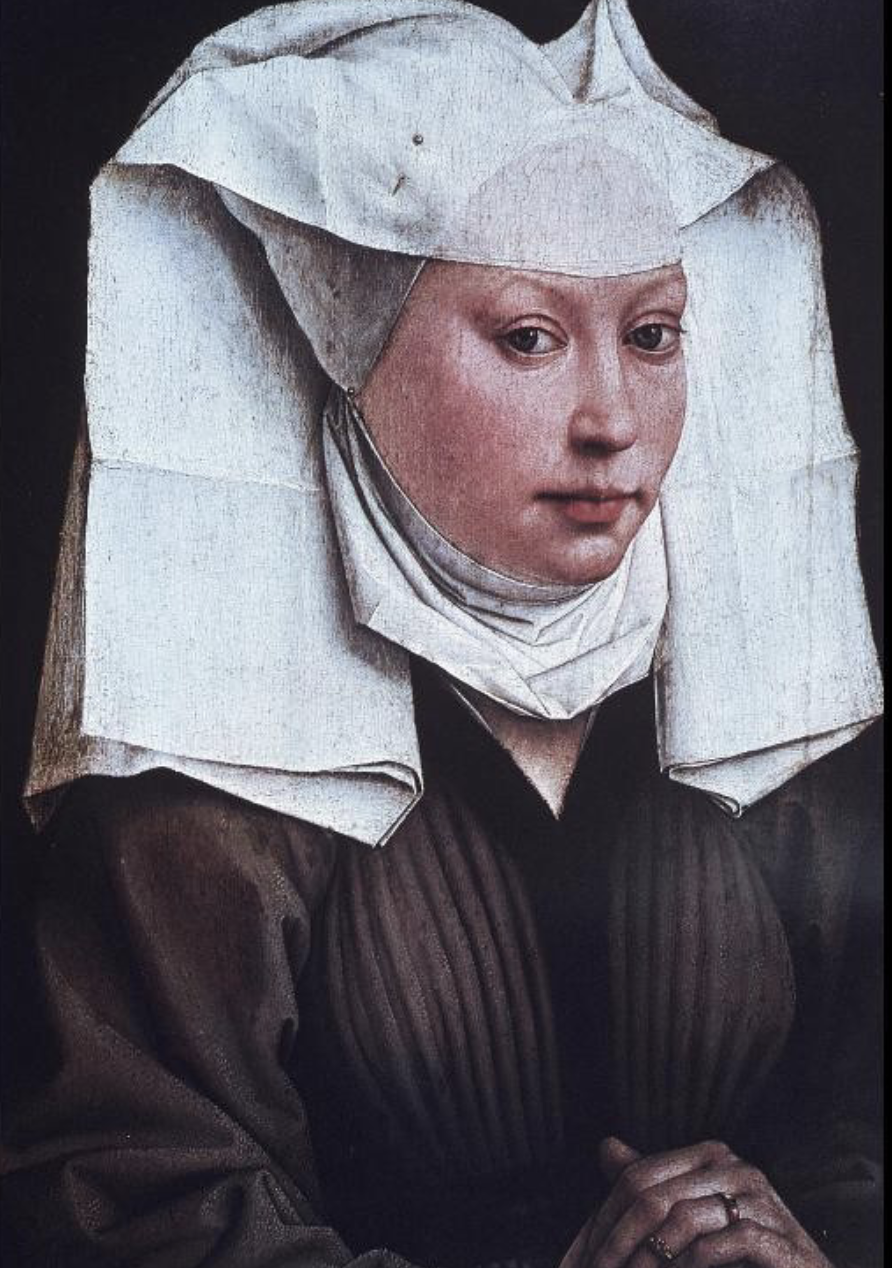
Van der Weyden, Portrait of a Woman (Berlin), c. 1435-1440
Rather early in his career and looks very similar to Campin's portrait of a woman with same kind of glimpse to torso, fur lined rome and look
Suggestions to affluence with head gear and other clothing pieces and one little pin fixed on the hair, significant again since pins were new and very costly
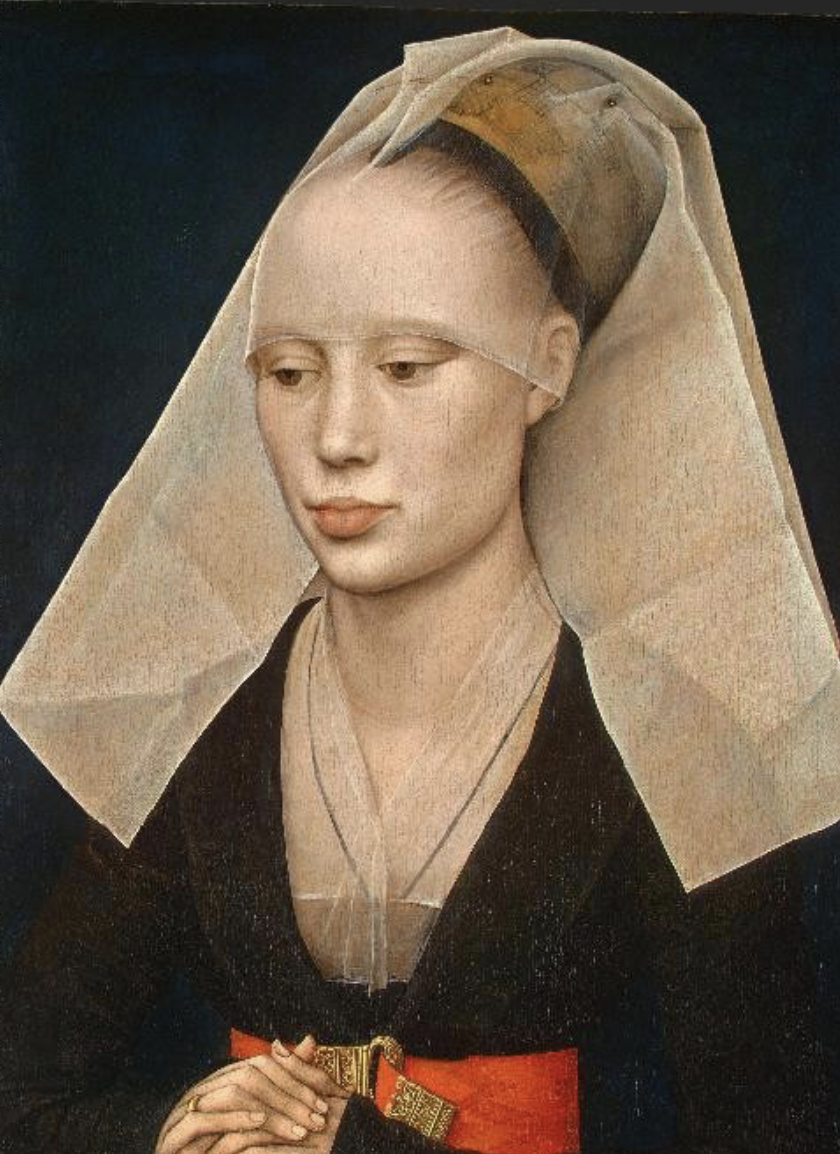
Van der Weyden, Portrait of a Woman (Washington), c. 1455
Face is in a different position here but hands are both clasped even though not much space for the hands but face is very diff type and standards of beauty appeal to different classes, this one is a lot more aristocratic so her long thing face with pointed chin and emphasis on pulling hair from forehead are much more aristocratic where as covered forehead is upper middle classes so Weyden calibrated work to fit terms based on diff class backgrounds and revealing both these special classes commission him
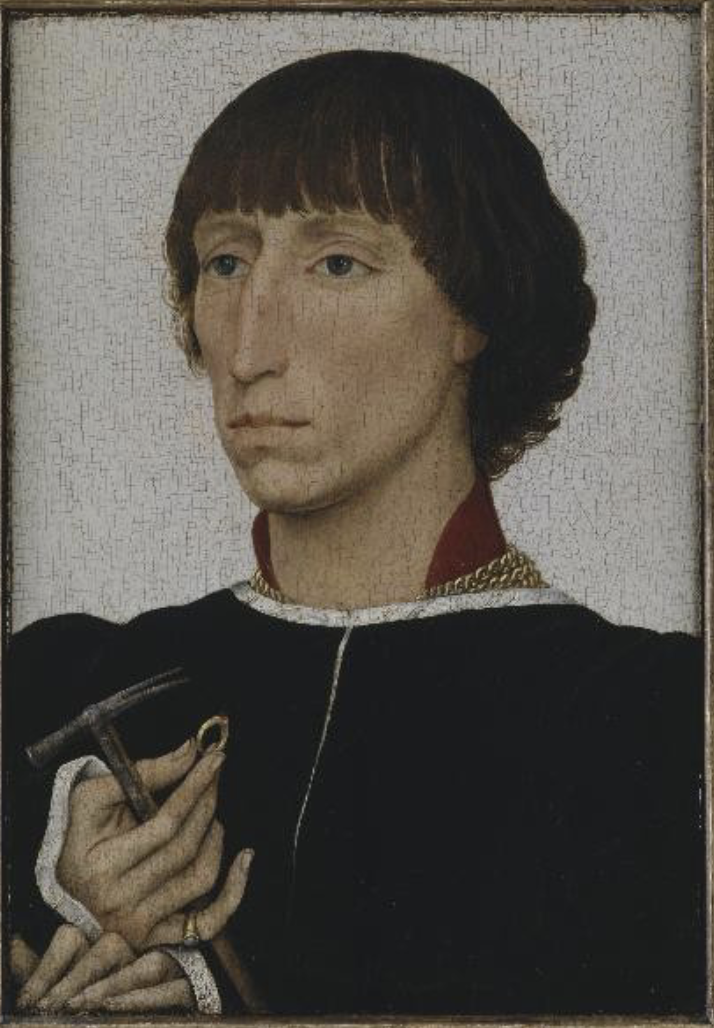
Van der Weyden, Portrait of Francesco d'Este, c. 1455-1460
City of Ferrara and as often happened as illegitimate children, Francesco was sent off to northern Europe to serve apprenticeship at aristocratic courts since he was not destined for royalty but still recognized by father so had distinguished career in aristocratic circles
Debate on whether background was meant to be white or not since rather unusual
He's holding a ring and a Jewelers tool despite already wearing a ring so maybe skill he picked up but as an aristocrat you wouldn't want to be seen working with your hands, but hammer and ring might act as some sort of trophy won in battle and jousting since silver hammer known as a prize but being paired with ring is a little unknown
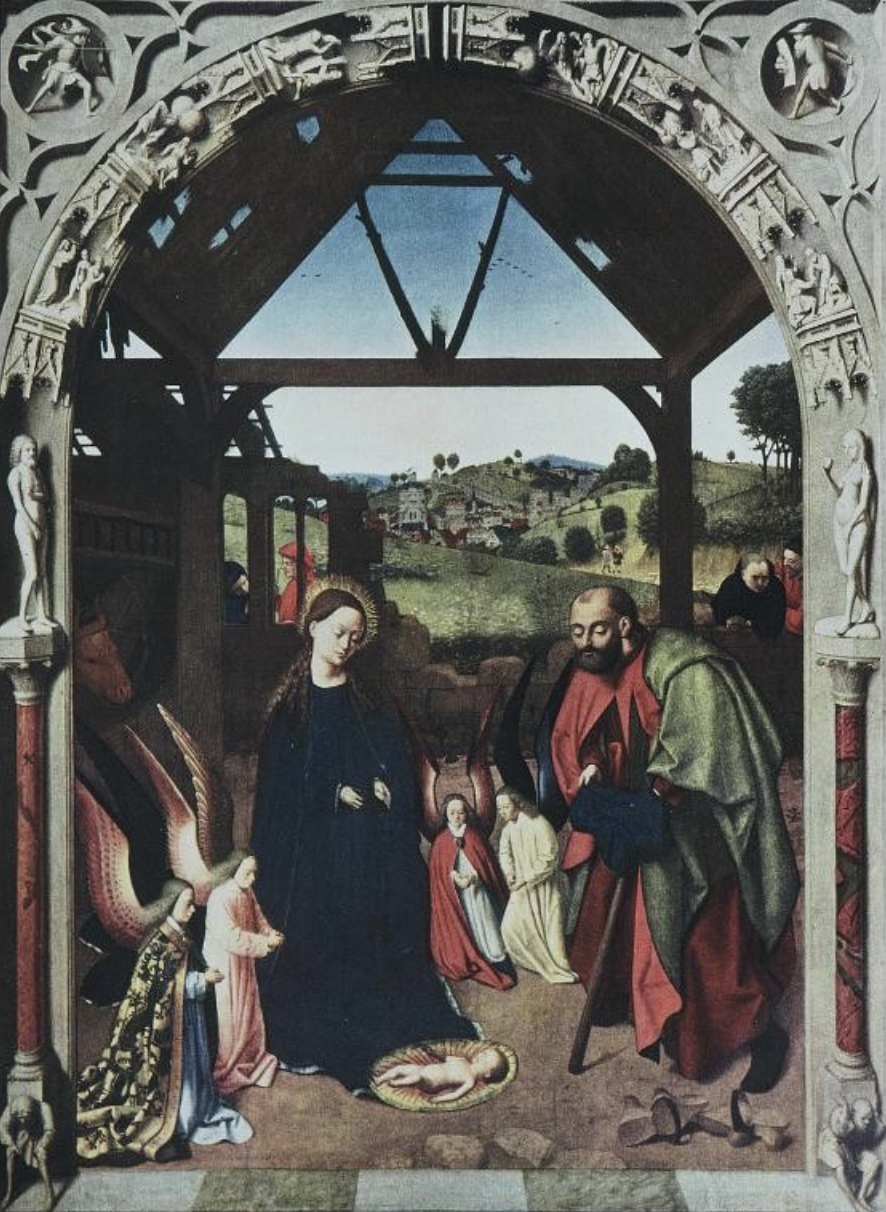
Petrus Christus, Nativity, c. 1450-1455
Not super similar to Van Eyck, but similar framing structure to Van Dery Weyden like in St. John the baptist and other alterpieces, so these artists of second generation have ability to draw ideas from all three painters of first generation so can really take influence especially from Van Eyck and Van der Weyden
Not too different from Campin's nativity with focus on the child by his parents and diminutive but not childlike angels, while Angels are male according to the church not men more teen like since no beard
Christ will redeem their sin which affected humanity after that point, Adam placed on Mary's side and Eve placed on Joseph's side maybe so dont confuse them with Saints introducing these figures
These are similar to Ghent altarpiece with and like similar posing and form of body
Further up scenes all have to do with story of Adam and Eve and their expulsion
If we look at heads in particular, some marks of Christus’ individual style, maybe so he's identifiable but not yet crucial, more so like in Joseph's head we see tendencies to create regular solids, to the point where irregularities are pushed to one side in favor to spherical or ovaloid character, Stereometry, meaning two sources and measurement, idea to create effective 3 dimensional image like the head you need to liken irregular organic form to a regular solid
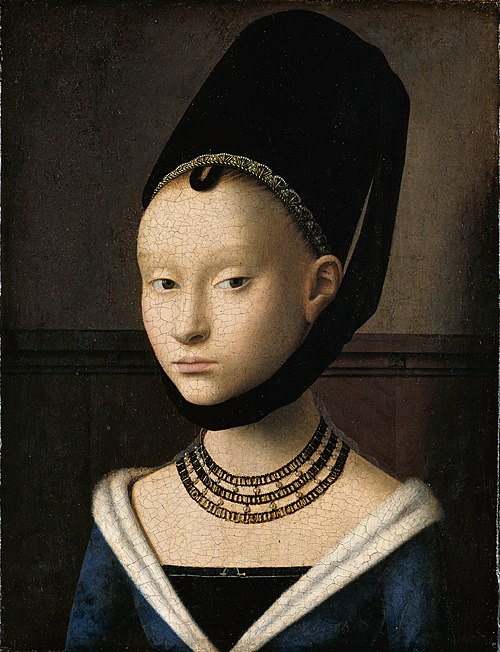
Petrus Christus, Portrait of a Young Woman, c. 1470
Again see this stereometry with this unidentified woman
Extraordinary work where see clearly stereometry, look at head with on one head modeling with light and dark and likening of the head to oval solid, suppress irregular details, maybe this woman's complexion is this actual perfect rendition but there's just no imperfections so more likely that he modeled it
Emphasis on oval shape by extending her forehead which was common at this time
Headgear creating this choker effect which also isolates head from body emphasizing once again stereometric effect
No real hint of bust, maybe prepubescent, but adult garments since kids wore mini versions of what parents wore, but strange propositional view
Long neck and huge head and impossibly narrow shoulders
Flatness of neck and shoulders emphasized by necklace again
Generally dark backgrounds in these early portraits, but almost wainscoting on background with different color rising on wall and then dark wall paint, not super emphasized but still a development on the space in which this takes place
Three quarter view but eyes turn back towards us so glance outwards notable and she's so close to us this time it's almost startling
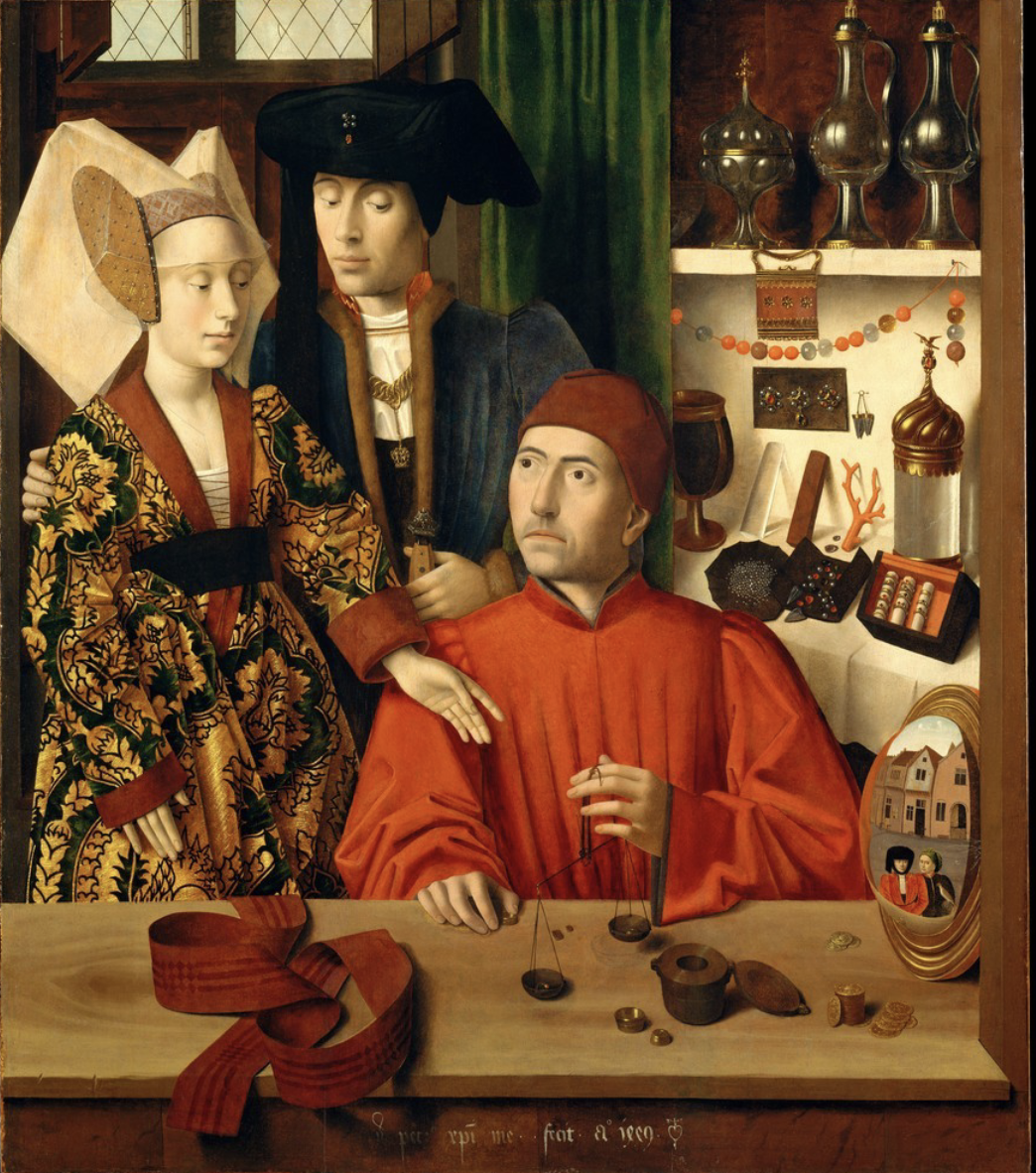
Petrus Christus, St. Eloy in His Studio, 1449
Lots of argument of whether this is sacred or not
At one point halo on this figure and people unsure whether that was original to the painting or not
Very tight but very detailed view
This counter opens out onto street like josephs workshop in Campin's merode altarpiece since selling his work
Detail like in Arnolfini portrait with this mirror that gives us scene of the street, so while we have tight scene inside workshop we still see the street with people approaching show like they're potential customers
One figure holding falcon, hunting bird, since the use of these birds is still symbol of aristocratic status, so in city environment we see with middle class houses, but an aristocratic patron coming up to goldsmiths counter
Detail at edge of mirror we see the red reflecting off garment of the goldsmith
Couple looking eager to marry who might be trying to acquire a ring, they match similar social status as people in mirror with the falcon
In this time laws against who can wear what and like you can only wear this pattern if you're aristocrat so highlighted dress code here
Things in gold and silver shown in his workshop, get the feeling that this is an attempt to provide window into the world of luxury goods, and in another since Christus is a supplier of luxury goods, and identification of highly accomplished painters as intellectuals, artists identify with people like gold workers who make stuff for high society
This red sash on table maybe belonging to goldsmiths robe or womans, moves over the counter and overlaps it seeming to fall into our space
See some stereometric features especially in female figure but not quite as pushed to perfect geometry
Could have been made for goldworkers and this was their patron saint, and maybe idea of what they can do
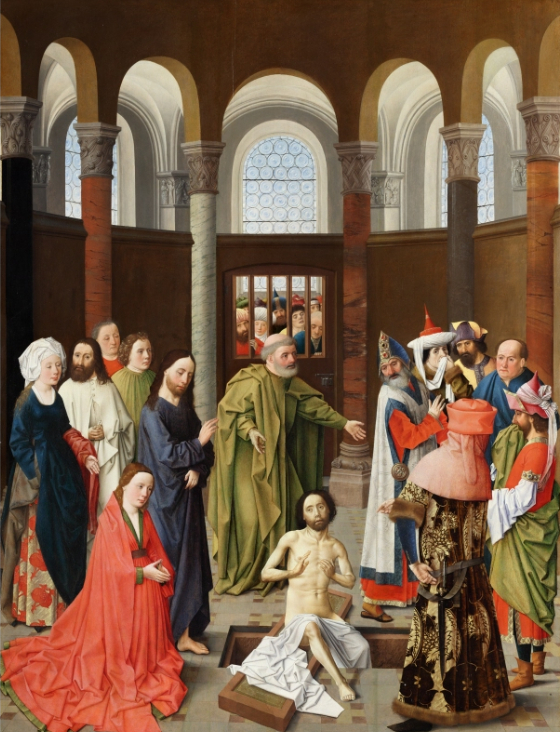
Albert van Ouwater, Raising of Lazarus, c. 1455-1460
Miracle recounted in many of the gospels during Christ's life where he brings a dead man back to life, argument that he was supposed to come back to life after death but also that this will happen to all Christians
Inside p[lace of worship here which is somewhat unusual since usually outside in like earlier mostly Italian works
You did often want to be buried inside church like under ground or inside the walls so another contemporary feature
Chrust making benediction
St. Peter balding and beard which is typical for him
On right group of figures dressed much more elaborately and many forms of headgear not typical of this time so images likely of Jews or others who stay skeptacle at this time
Cadavers dont smell good so one way to show he was dead before is people covering nose since they smell bad
Romanesque church with round arches and colored columns with story telling capitols since associated with before Christianity and intended to be a Shul
Very long and thing and in particular weird rigidity like locked into specific pose where we see frame or like still from almost a film
Feels more awkward than normal, maybe Harlem artists were less focused on working for aristocratic patrons so rougher feel would make some sense since not from these specific patrons
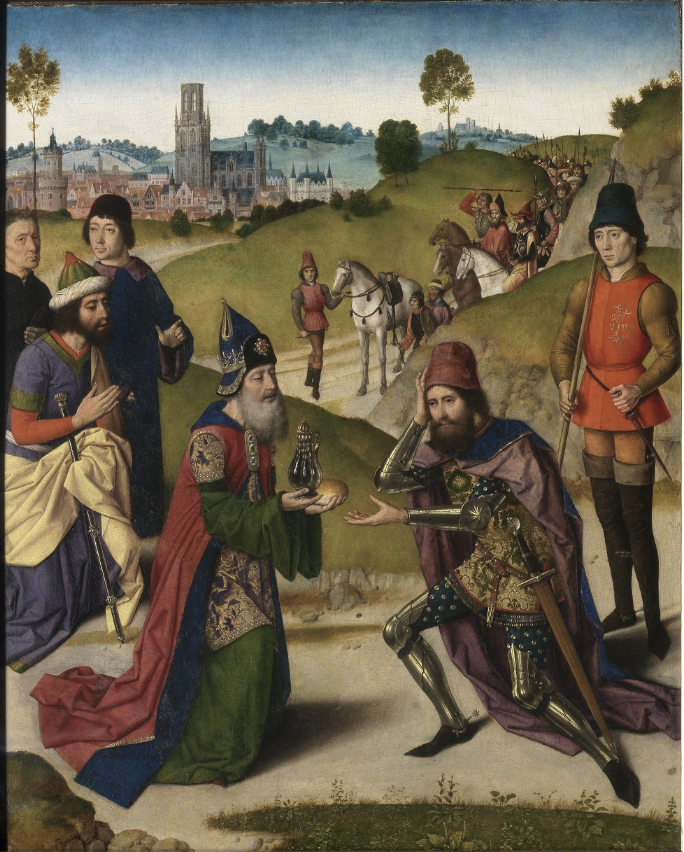
Dieric Bouts, Last Supper Altarpiece, Louvain, St. Peter's,1464-1467, Abraham and Melchizedek
Melchizedek often seen dressed like priest as these materials presented
These faces aren't too different but even longer and case in men are bonier and more carefully observed aging
All faces really seemed to be pulled downwards
While not new to him but way to particular space by having pieces of land at regular intervals which lets us see how far we are
Triangle bits of landscape, coulisse
Maybe some relationship to theatrical performance
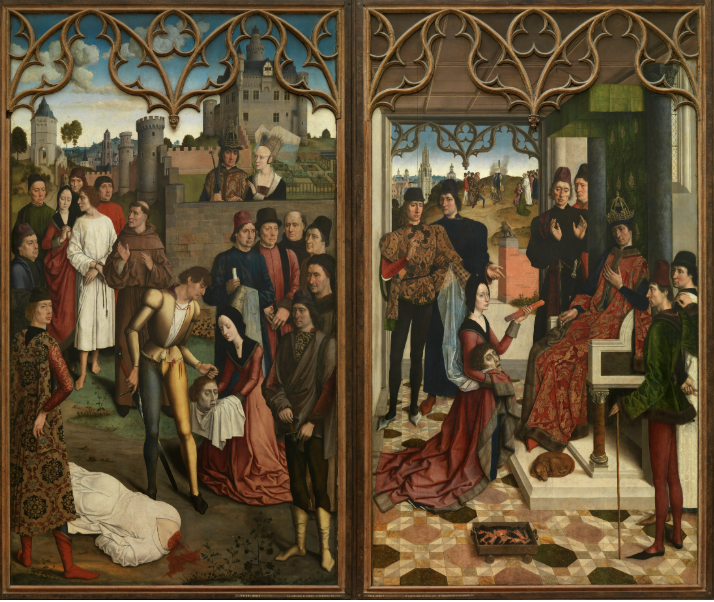
Dieric Bouts, Justice of Otto: The Ordeal by Fire, 1470-1475
Much bigger piece and this time a diptych
Recounts justice of emperor Otto, not a work for sacred space but for hall of justice and brussels, so these artists getting work outside of the church
The emperor received denunciation and that one of his noblemen was a traitor and he ordered beheading which was pretty normal and what an elite would expect as a punishment, beheading was noblest form of capital punishment and if you were normal you would just be hung
Emperors quest of information does not end, continuous narrative since keeps moving after noblemen dead, nobleman's wife insists he wasn't a traitor and wanted testimony to be believed so in theory could suffer burn to demonstrate willing to suffer while telling the truth by offering to be tested by fire so we have here a place to like charcoal and burning things like wood while she holds severed head of dead husband and is not burned so G-d preformed miracle to prove her innocence
Even for hall of justice not church still hint of religion present
Image of justice is not great like going into court and seeing someone executed or in jail for 30 years who was actually innocent so not calm your nerves but at least you see an apology for injustice and integrity to legal system
Bout’s approach again seen with tall slender figures in sometimes awkward but expressive poses
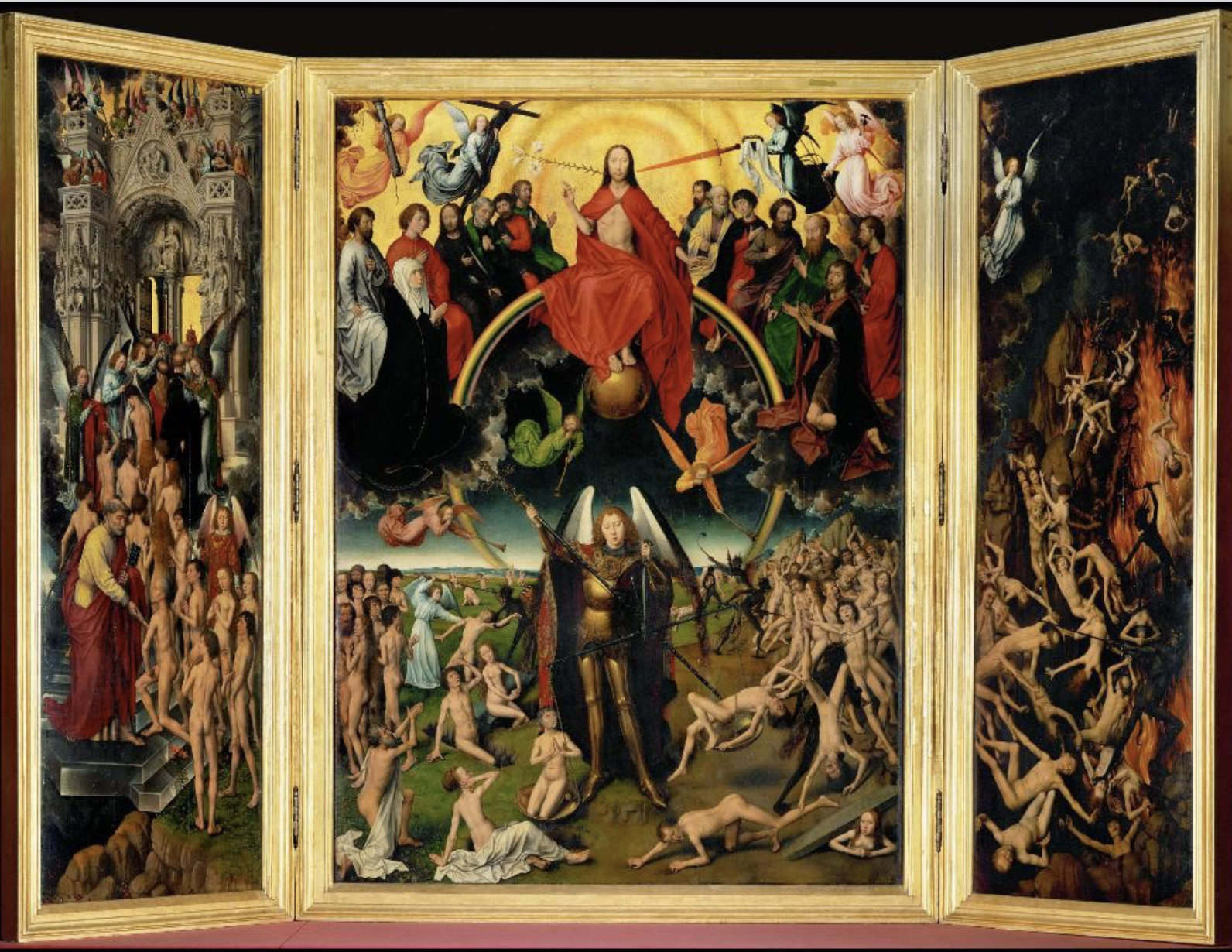
Hans Memlinc, Last Judgment, 1467
Quite an ambitious triptych and looks similar to a Van Der Weydens Beaune altarpiece with similar composition of St. Michael
Carrying off people to Hell even when still on earth, work that helped establish Membling skills, ambitious image showing he can draw from original generation but still make it his own
Dark skinned man being taken towards heaven, at this time Europe thinking again back to people outside of Europe and in Africa, maybe something Memling brought to commission
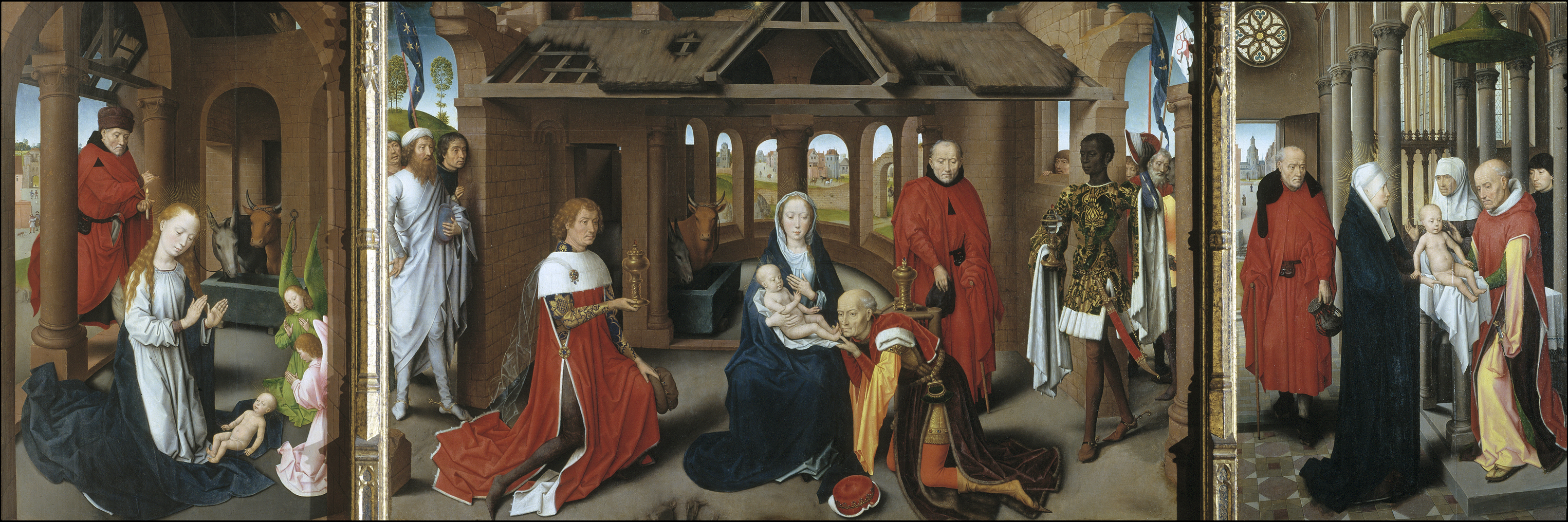
Hans Memling, Adoration of the Magi, c. 1470
Similar to one of Van der Weyden's Columba altarpiece which Memling may have worked on, but one main thing that separates is one of the Magi being displayed as a Black Africa which idea came around in Germany in 1440s, but Memling seemed to bring it to the Northern low countries
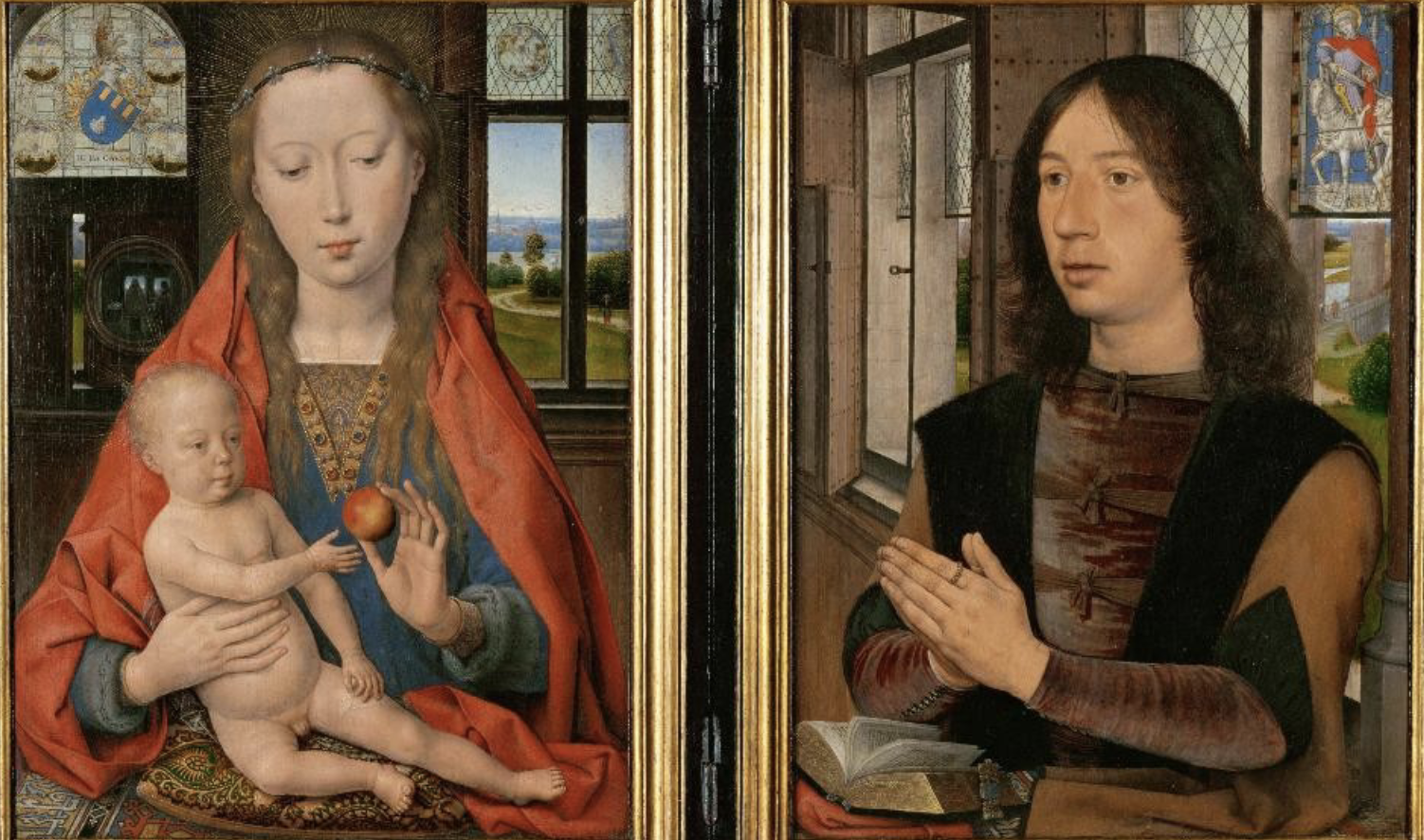
Hans Memling, Diptych of Martin van Nieuwenhove, 1487
Name of the patron represented on right side of Diptych, kind of painting Van Eyck seemed to have invented, image of Mary and Christ child on one side and image of Patron adjoined on separate panel
Mary and Chrsit as well seems very similar to Van der Weyden's image of the madonna
Just behind Mary's shoulder we see another convex mirror like Van Eyck, doesn't show artist but shows back of Mary, her robe, and second figure is Martin van Nieuenhove
Framing of panels separate figure and architecture same throughout so dealing with whether or not in the same place so convex mimics that separation but in same scene
Nieuwenhove’s coat of arms is shown above Mary and to the left on stained glass, and behind him we see his patron saint, St. Martin, cutting his cloth in two to give to poor man which is like Martins most famous painting
One of the first that set portraiture against landscape backgrounds
Martin has kind of velour shown in his garments which shows Memlings talent
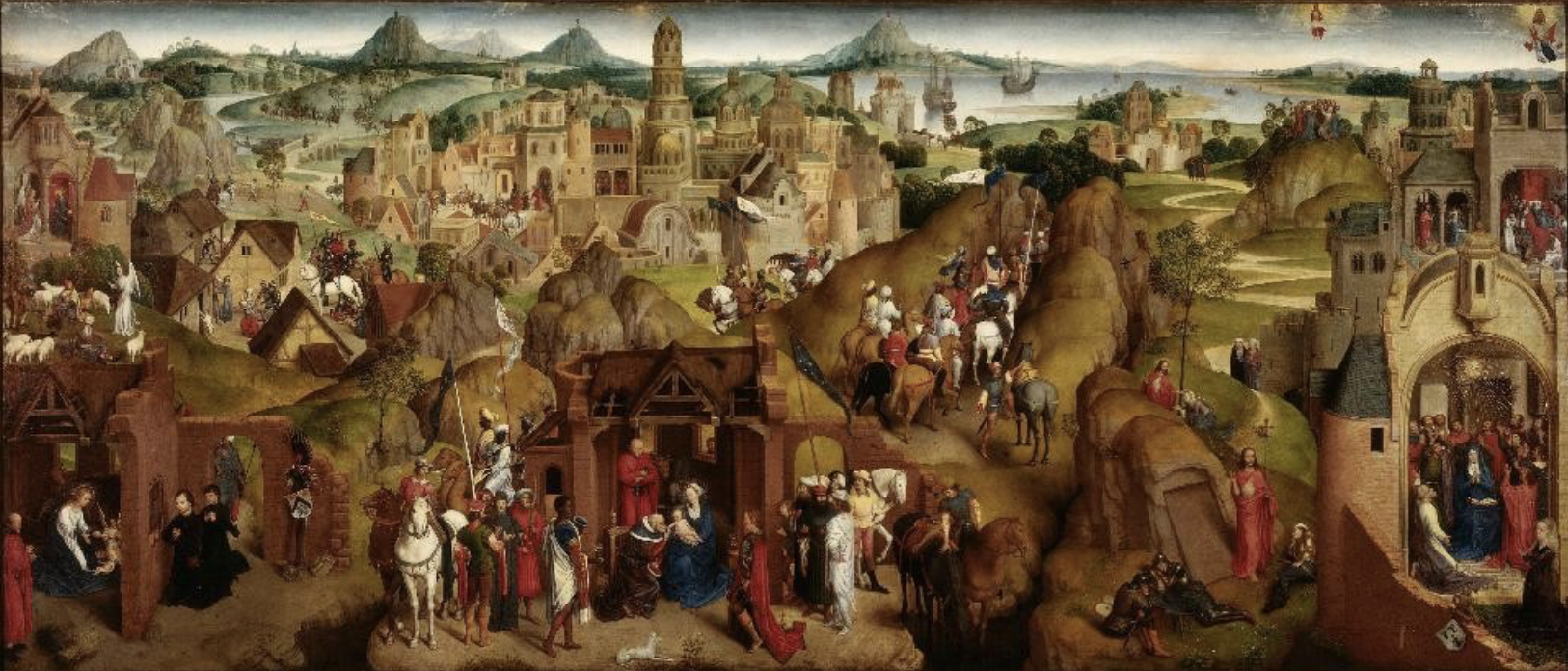
Hans Memling, Seven Joys of Mary, c. 1480
Almost like an advent calendar with an image of many events of the life of Mary, seems like all events happening at same time but somewhat chronological
Mostly focuses on happy events, seven joys
Nativity, adoration of Magi, and just outside ruin walls we see patrons
And all the way right we see death of the virgin which isn't joy but she goes right up to heaven, so early parts of her life but then very end
Use of the triangular ridges again to show movement into space and winding roads, these artists share from each other
We see some sad scenes with like sacrificing and shepherds
Story of magi in multiple different stages
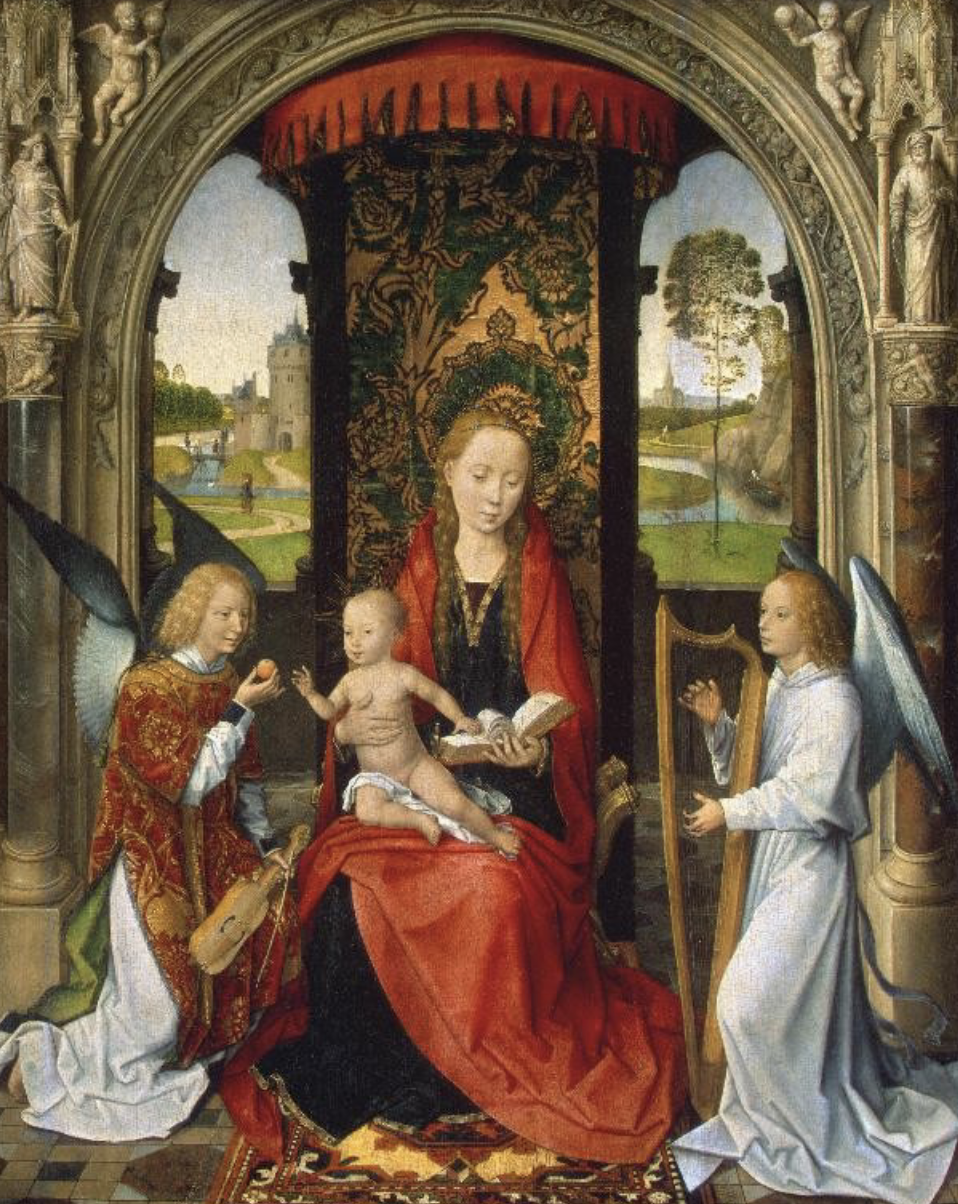
Hans Memling, Madonna and Child with Angels, c. 1485
Towards the end of his career Memling's later works fit into slowly growing familiarity with Italian innovations
Somewhat common depiction we see in multitudes
Nice framework above
Cloth of honor seen again and adolescent music making angels, presence of winged infants up above, Puti, naked infant winged angels which is pretty typically Italian
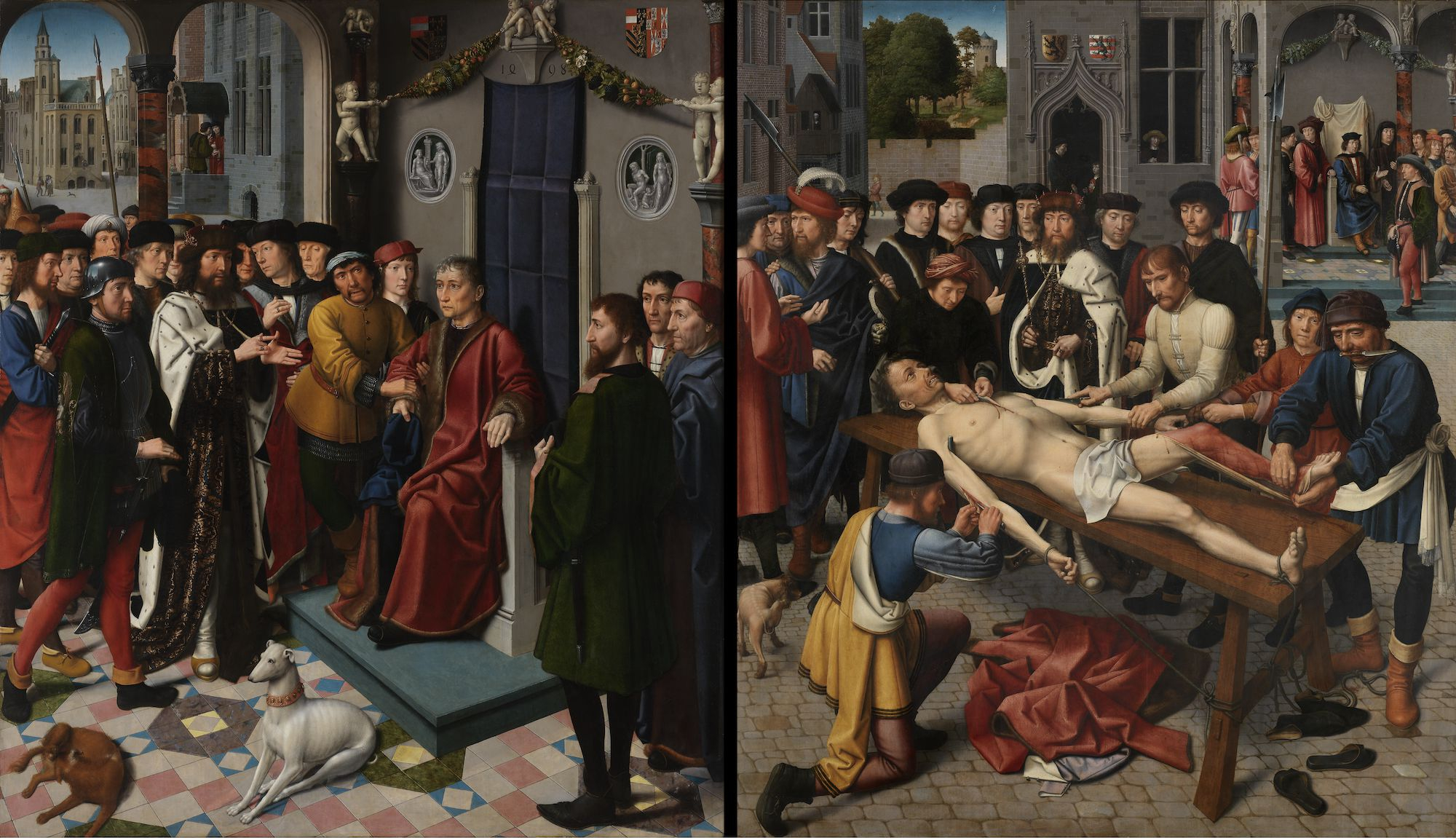
Gerard David, Justice of Cambyses, 1498
Even as Bruges was going downwards he still remained successful
Justice of Cambyses, legend of this Persian ruler, the ruler was kind of like the supreme court at this time and known for being rather fair
Installed in palace of justice so secular work of art not in a religious space, Camyses was ancient ruler before Christianity itself
Presiding over a judge that was bribed, ruler accuses judge and taken from his throne of justice and he’ll be punished in the next scene
Above the justice is two round sculptures of figures who appear to be naked and then two sets of naked infants holding a huge garland, they are not angels, garlands are taken from ancient Roman reliefs, major decorative part in Ancient Roman life and sculpture
Relief sculptures with nudes also suggest David has begun to see Italian Renaissance art that came north to Bruges
Guilty party tortured and skinned alive, pain was real and represented a lot, no one was actually skinned alive with the law in Bruges, other versions of torture but not skinned
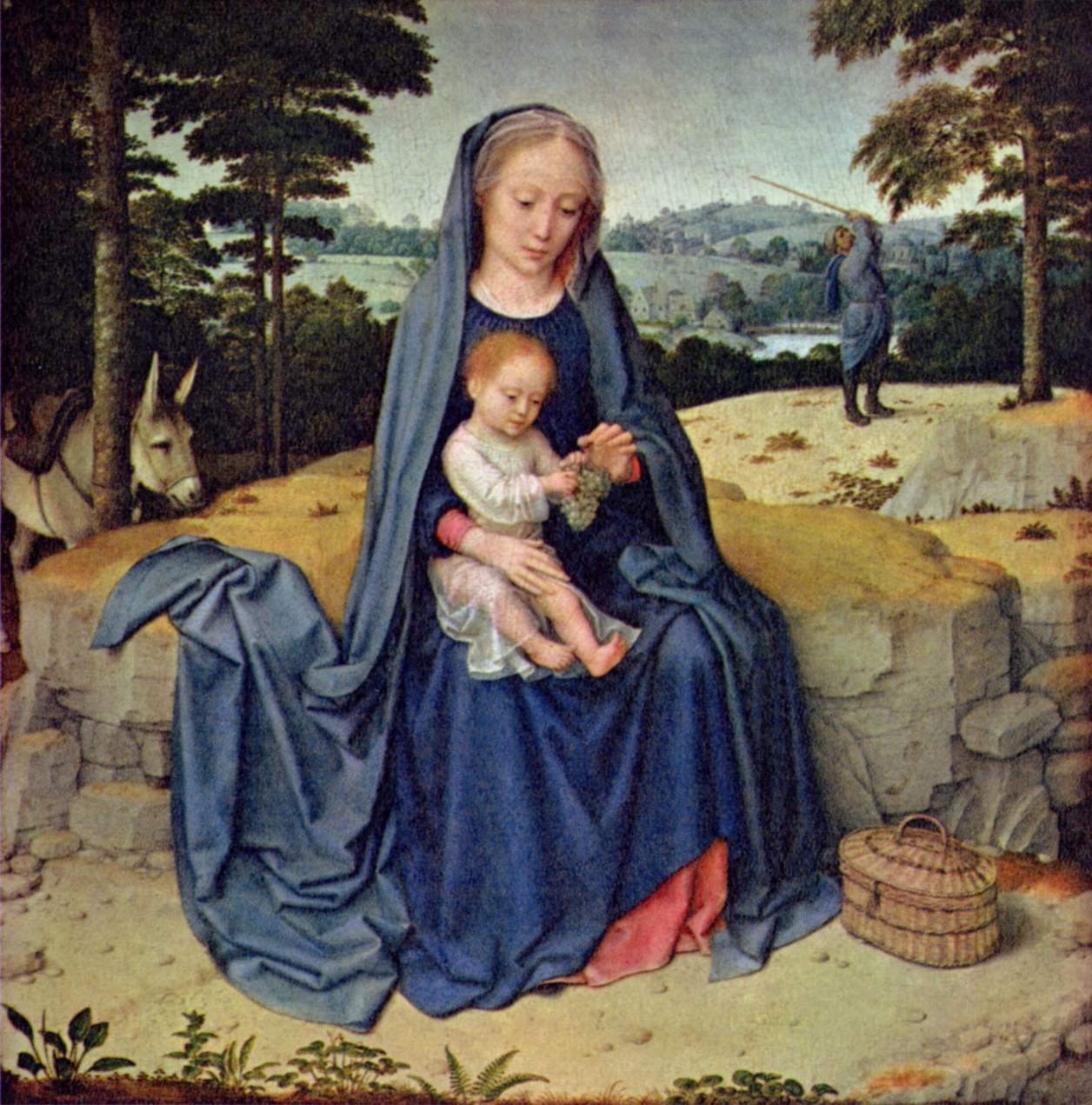
Gerard David, Rest on the Flight into Egypt, c. 1500-1510
Holy family with Joseph in back, going to Egypt fleeing Herods soldiers killing infants, these are refugees but the harassment of fate is not emphasized
Beautifully made basket that might hold provision
Joseph in background trying to knock fruit off tree to provide food
Wilderness is not desert of Sinai peninsula but a beautiful lush landscape in Netherlandish area
Still someone Italianate about this, he might have seen things from Tuscany but also Venice at this time, the way the Madonna is given bulky profile by drapery, modeling of her face is very soft unlike Eyck or Van der Weyden, she is soft and nice looking, child is still more like infant Christ like in Northern not chunky like Italian but his legs are more revealed, Italy was pushing for naked or nearly naked Christ so elements suggest that David was looking towards Venetian art
Looks rather similar to Bellini, Venetian artist, Mary and Christ arent in beautifully decorated rooms but outside which is the Italian idea known as “Madonna of Humility” since in simple surroundings, Mary as Christ's mother is associated with power of nature to generate things like fertility so place figures in fertile lovely landscapes that are flourishing, women seen closer to nature than men because of fertility and most notably menstruation, so large religious idea being alluded to here
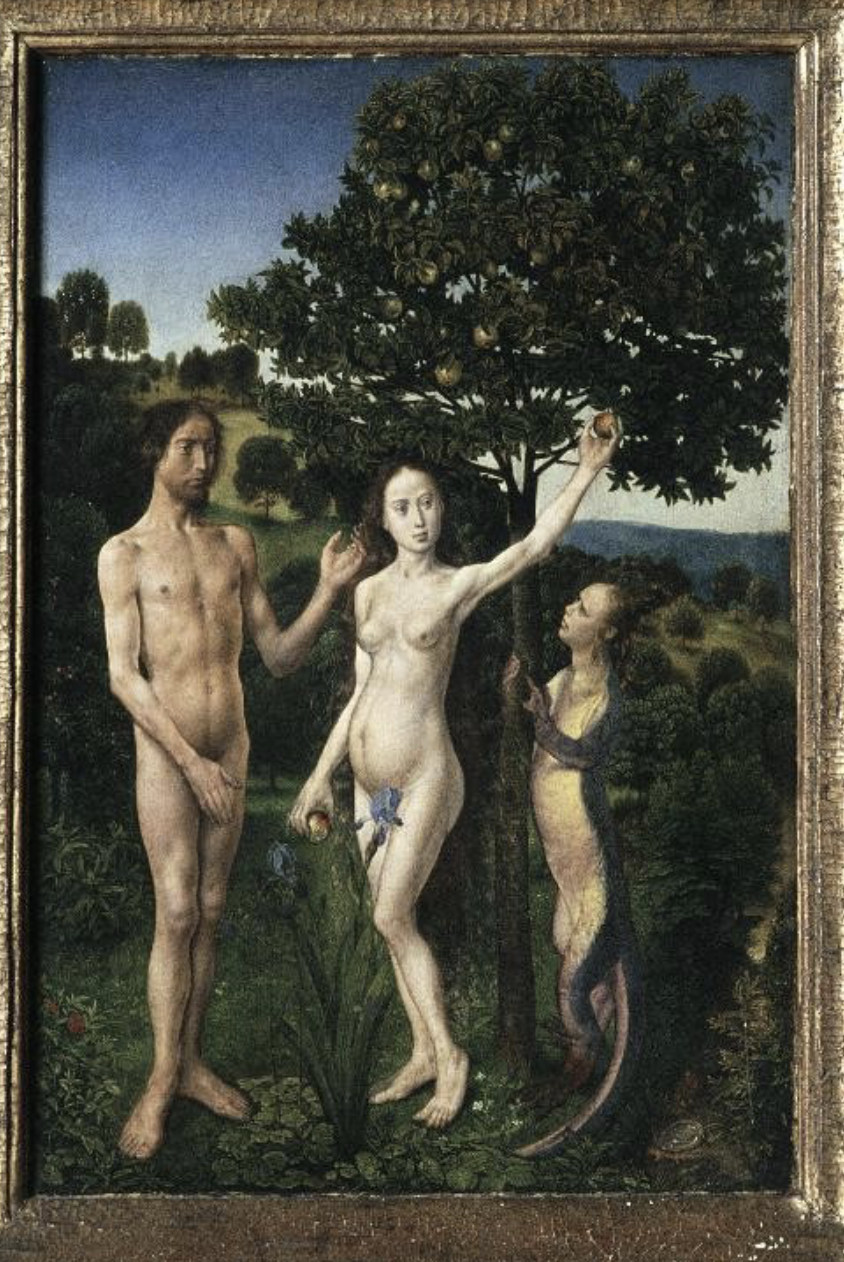
Hugo van der Goes, Fall of Man, c. 1470
More realistic to say Fall of Adam and Eve or Fall of Humanity, moment of temptation from serpent in garden
Adam and Eve in the nude is not at all brand new but nudity in Middle Ages was not typical but it is necessary for Adam and Eve since crucial aspect of innocence than to shame after eating the fruit
Super similar to Van Eyck's Ghent altarpiece which makes sense since he's working in Ghent where that was like the most successful work in that city, too young to be student of Van Eycks but no doubt saw, modest bust but huge belly and swayed back posture with stereometry oval head and Adams darker skin and shape, but now not in a niche but in a garden
Were in a different kind of representation of garden, no longer enclosure but endless vista of lush green landscape, not garden in sense of perfectly planned out near a structure but meadow and trees but no marker of human activity with village or anything which would actually be appropriate to Garden of Eden
Flower in foreground is an Iris, or gladiris which derived from word of sword since leaves of Iris kind of look like a sword, flowers o fIris usually have symbolic elements, here its used to cover Eve's Genitalia, but unclear if that's why Adam is covering might just be like confusion or expression but still no penis shown
Serpent has female head with shape of Eve, interpreting gospel assigning blame to Eve more than Adam
More palpable and front and center than in Ghent altarpiece
Hugo van der Goes, Portinari Altarpiece, 1475-1476
His most famous work that's known as his masterpiece
Very ambitious and would have cost crazy amount of money, of course we see donor, and in this case its an Italian patron who is representative of Medici bank in low countries, brought back to Florence and installed above an alter in a Florentine church, probably the first large scale work from the low countries to be displayed, While not only northern artists with fame in Italy, artist who produced largest and most impressive northern work to go to Italy
Version of the nativity scene in the middle is where Mary seems to worship the child, the child is on the ground and mother and sometimes father and angels, so adoration of the child NOT adoration of the magi, his own family sometimes accompanied by angels prays and honors him
In the background of the left wing we see touches of narratives that are connected to the foreground scene, we see Joseph and Mary in back on their way to Bethlehem, so on the left are going to give birth and then in the middle panel after she's given birth, St. Thomas who introduces patrons and children are not just mini adults but rounded cheeks are quite childlike which shows accurate portraiture
On the right wing we see the wife Margareta who is introduced by St. Margaret who is stepping on a dragon, which is part of her story, we also see Magdalen holding ointment cream and than Magdalena the daughter of patrons who is shown as like teen, not artificial difference in sizing but actually realistic to the scene, little pond that reflects trees and building and group of roughly crude people, we also see magi approaching on this side and also see scout asking for directions by a more humble normal looking person so imagine how magi would have made their way through, but like why would they ask directions if star of Bethlehem guiding, maybe suggesting this is how they actually made their way to the scene, first painting in Florence to show a Black Magus
Center panel: TENSION
We see a couple of vessels with flower but also a sheaf of wheat occupying so much space where center of altar would be, of course all have symbolic meaning, northerners live off wheat and it was essential to the diet of people all across Europe, but wheat also substance of communion wafers and meaning of bethlehem meant to mean house of wheat, another naturalistic detail that any ambitious netherlandish artist is going to use to show skill, flowers to be so central to composition is pretty new, choice of object seems sacramental like the decoration of the ceramic vase being grapes making reference to communion wine in addition to commission wafer hint, the irises we see with sharp points of leaves, redness of lilies like the color of blood which may relate to wine, not just an image of Christ's infancy but also final act of his earthly mission with the eucharist
Obviously symbolic since they just wouldn't have been with them like were they going to be carrying a vase and glass with them all the time
Sheaf of wheat placed parallel to child laid on ground, idea of parallel between the two since the faithful taking communion would take Christ's body through a piece of wheat, so theological equivalence we see, Images of Christ and Mary again becoming more popular in this time
Halos had kind of fallen away in the 15th century, heightened levels of naturalism take over, not fully gone as we see like rays coming off the child
Three very clear non angelic figures, the adoration of the shepherds, kind of mimic three figures in foreground, Hugo is an expert at naturalism but creates angelic figures that are super tiny, angels not same size as Mary, but shepherds look so large like they could almost trample the main figures, but they stop right before reach child so idea of how we see actions unfolding, youngest shepherds hands are in weird position almost like they're confused and soon to turn into prayer hands, various phases or awareness of Christ's holiness
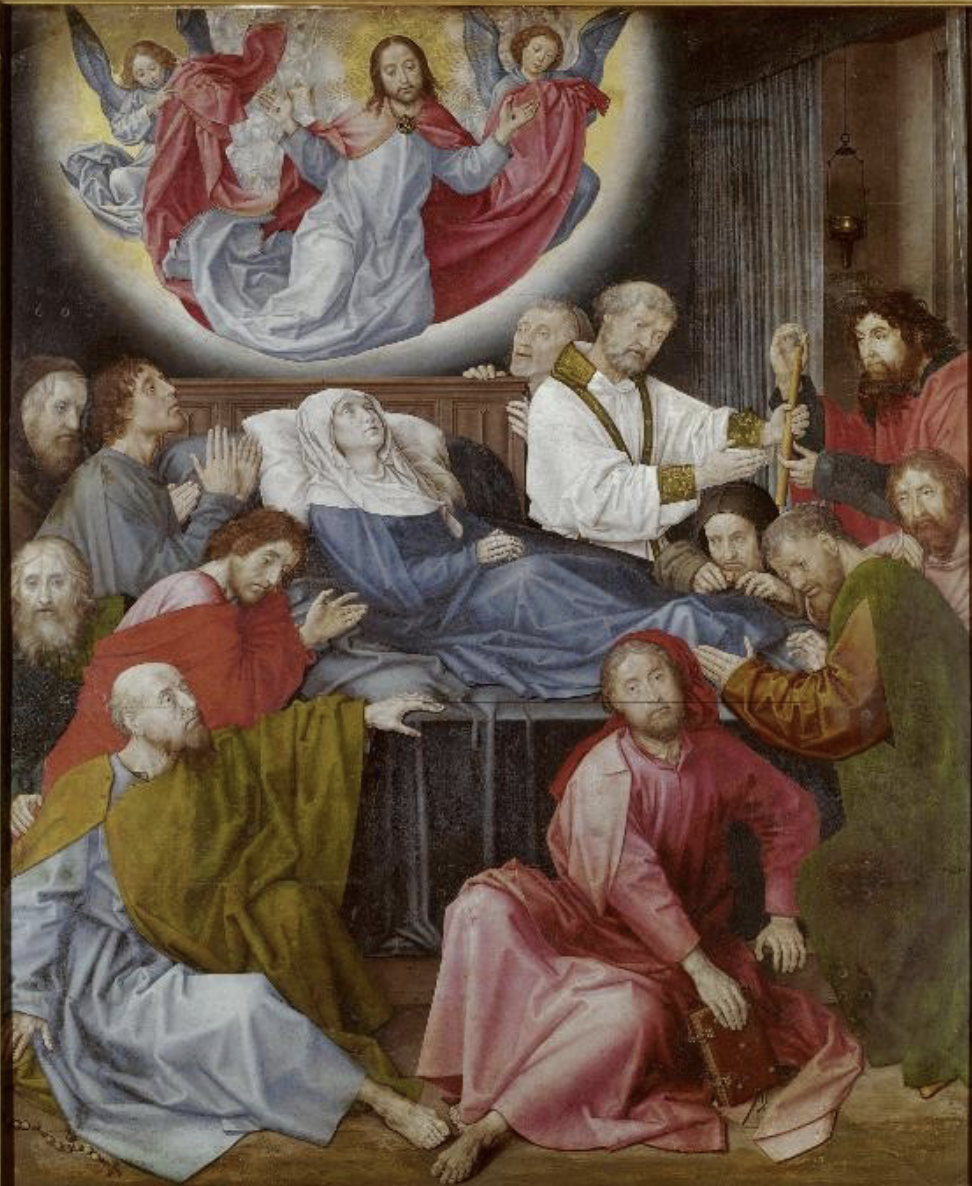
Hugo van der Goes, Dormition of the Virgin, c. 1480
Dormition referring to her death but she will go straight up to heaven and not wait to be judged
Grief stricken idea isn't new or unusual but super emphasized here with some looking like they're just gonna collapse out of grief
Mary is so pale and her hands touch in prayer but she looks almost like a cadaver but suddenly up above is an enormous circular form that was descendant, Her soul will rise up soon to join these angels and intrusion of this heavenly sphere here, Still very understandable room like niches of doors but structural integrity violated by this holy sphere, Hugo does not hesitate to interrupt naturalism to emphasize the story, death down below and salvation up above
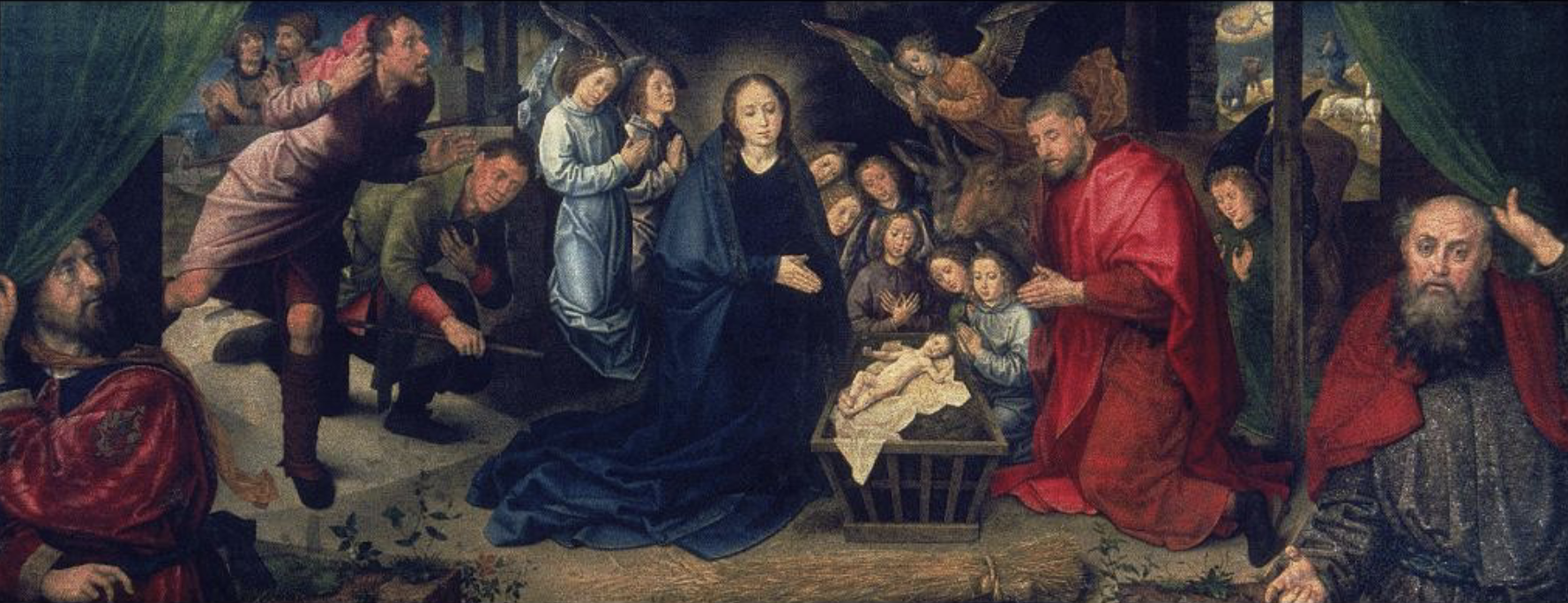
Hugo van der Goes, Nativity, c. 1480
These last years of his life were easy, may have suffered from some type of mental illness and joins religious institution and leaves ordinary society
Similar to his earlier altarpiece
Again tension of people surrounding look like they're gonna enter the scene but still just surrounding
Hebrew prophets who were told to have foretold this vision of this sacred event
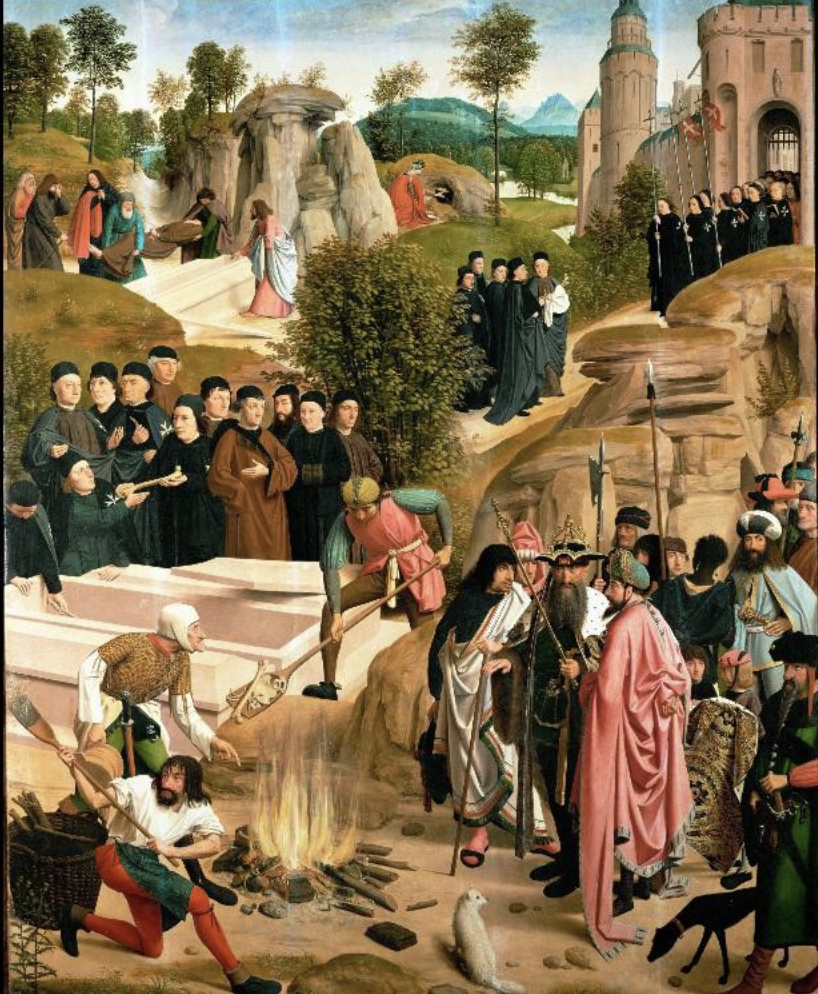
Geertgen tot Sint Jans, Burning of the Bones of St. John the Baptist, after 1484
Burial of the body of St. John on top, down towards foreground is the burning of John's bones in an attempt to desecrate his body
Members of confraternity of what looks like femurs in cloth since this specific confraternity claims to have these pieces of St. John, so story of John but more importantly his relics, since relics super significant at this time
He's just trying to cram so much into this small space so composition is weird, landscape looks tipped up towards us so does not read comfortably with scale of landscape, and somewhat typical of his pieces to not be as smooth or elegant
Figures in foreground dressed in like exotic dress and Black African figure with earring and someone wearing turban
He was closely related to this confraternity and was commissioned but also because he's connected to St. John
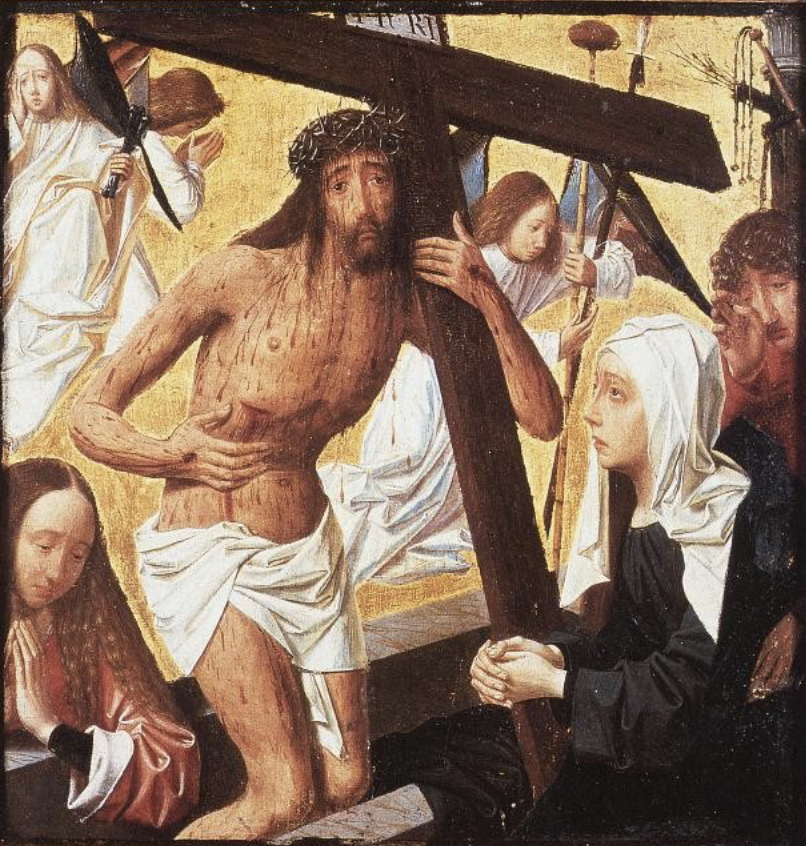
Geertgen tot Sint Jans, Man of Sorrows, c. 1480-1485
Category of imagery that is becoming more important, desire for more overt suffering and pain, Man of sorrows is gaining popularity
Starting in later 1300s religious writers who don't just comment on story of saints but writers who provide tools for an individual to enter deeper prayer to G-d, called mystics since they often say they have experienced visions of seeing Mary or Christ on cross, developed across 1400’s and developing of printing let religious texts not to just for high class
Christ not at particular moment towards last days of his life but image of suffering emphasized to show somewhat relation to viewer
Wearing crown of thorns and holding cross but also standing in his tomb so combination of different moments of his torture and eecution
Figures of humans mourning, Virgin Mary, Mary Magdalen and St. John evangelist wiping tear from his eyes
Not full landscape but artist throwing back to 14th century art with gold leaf background maybe to not distract from central figure
Angels are holding instruments of the passion which also seen in Ghent altarpiece, the pieces of hardware associated with his suffering, sponge filled with vinegar lifted to his mouth, nails and the dagger used to stab his side and then also what was used to beat him

