3.3.2 - investment appraisals
 Studied by 1 person
 Call Kai
 Learn
Learn Practice Test
 Spaced Repetition
 Match
Match Flashcards
 Knowt Play
1/12

There's no tags or description
Looks like no tags are added yet.
Name | Mastery | Learn | Test | Matching | Spaced | Call with Kai |
|---|
No analytics yet
Send a link to your students to track their progress
13 Terms
What is investment appraisal?
Investment appraisal is the process of assessing the financial viability of an investment project using quantitative methods (such as payback period, ARR, and NPV) to judge whether the project is worth undertaking.
What is the planning process in investment appraisal?
The planning process in investment appraisal involves identifying, analysing, and evaluating potential investment projects before a business commits money. It includes:
Setting objectives (what the investment aims to achieve)
Identifying possible investment options
Estimating costs and expected returns
Forecasting cash flows
Applying appraisal methods (payback, ARR, NPV)
Comparing alternatives
Assessing risks and uncertainties
Making a final decision based on financial viability and strategic fit
What is the payback method in investment appraisal?
The payback method measures how long it takes for an investment to recover its initial cost from the net cash inflows it generates. It focuses on speed of return and helps businesses assess how quickly they can get their money back.
How do you calculate the payback period?
List the annual net cash inflows from the investment.
Add the cash inflows cumulatively until the total equals (or exceeds) the initial investment.
Identify the last full year before payback is reached.
Use the formula to calculate the remaining fraction of the year:
\mathrm{Fraction\ of\ year}=\frac{\mathrm{Amount\ still\ to\ recover}}{\mathrm{Cash\ inflow\ in\ the\ next\ year}}
Payback period = Full years + Fraction of year
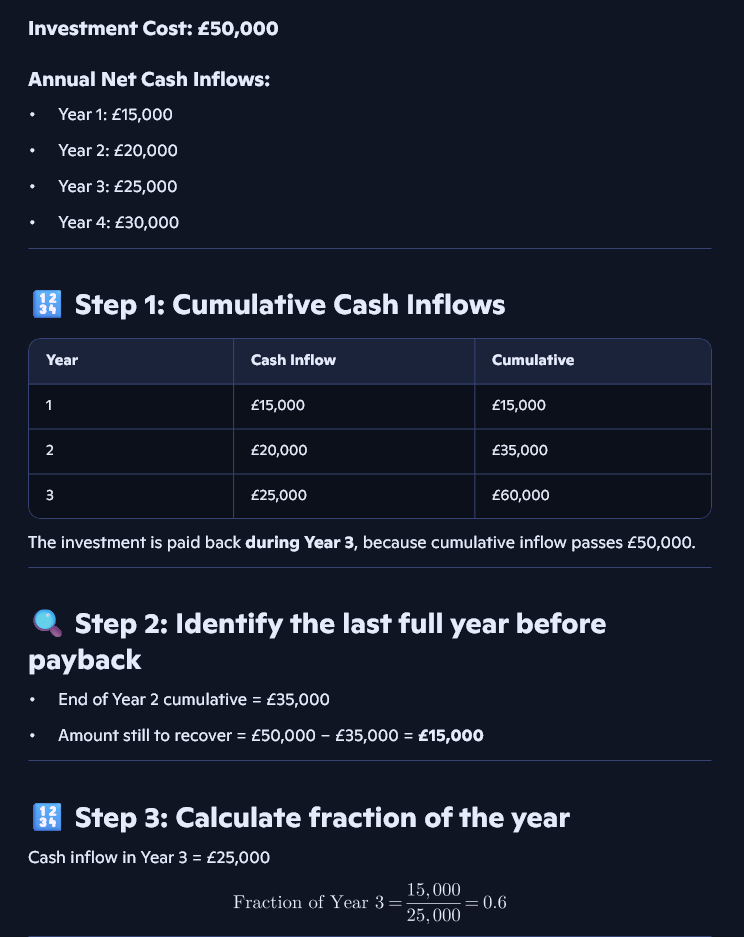
simple payback
cost of inital investment / average yearly net cash flow
what is ARR
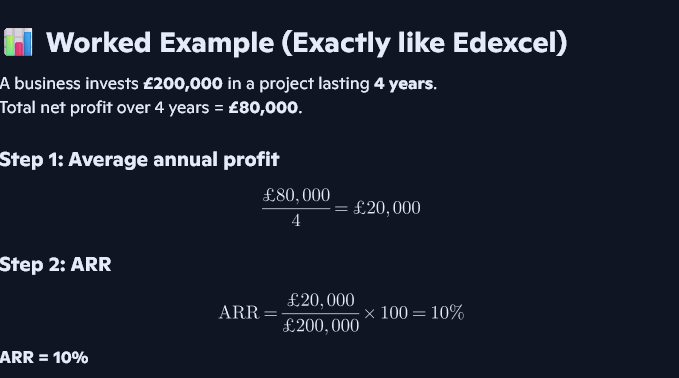
ARR measures the average annual profit a project makes as a percentage of the initial investment.
It’s used in investment appraisal to compare different projects.
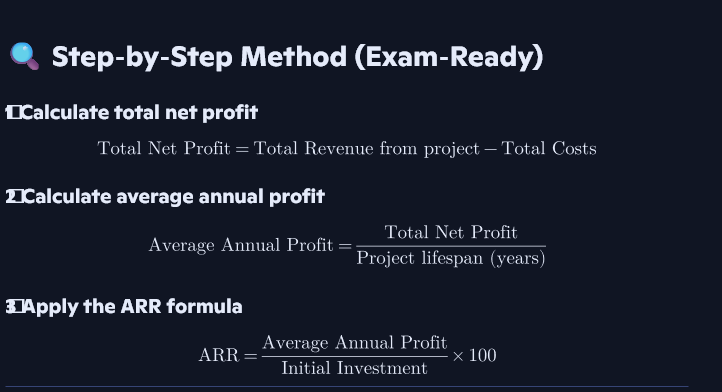
forumla for ARR

ARR method
worked example
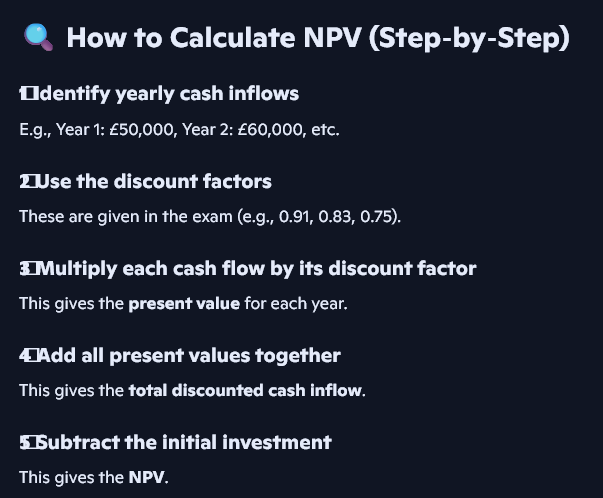
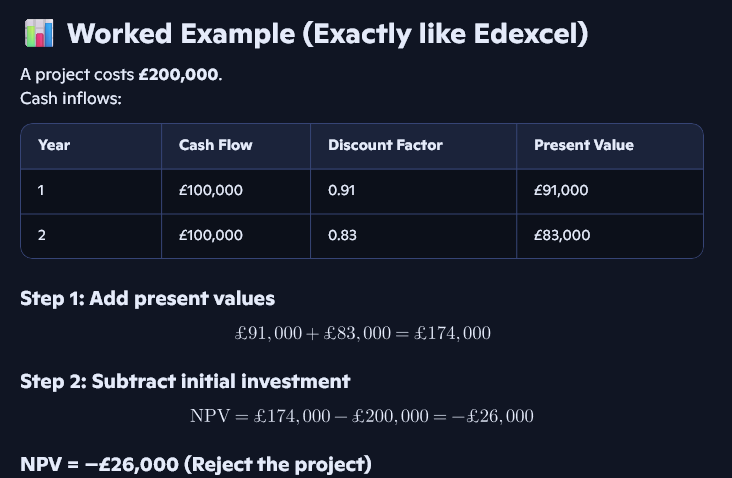
NPV
Net profit value - measures the total return on an investment after disocunting future cashflows
how to calculate
worked example
limitations of investment appraisals
payback limitation - very simple, only looks at the speed of payback and does not look at profitability
ARR limitations - does not take into account the effects of time on the value of money
NPV limitations - very complicated, not used by small businesses, also results depend on the rate of discount used; the higher the rate, the more likely it is that the project will be rejected as unprofitable
 Note
Note  Flashcards (39)