Imperial Image Reign of Augustus: Golden Age, Culture Hero and Legacy
 Call Kai
 Learn
Learn Practice Test
 Spaced Repetition
 Match
Match Flashcards
 Knowt Play
1/14

There's no tags or description
Looks like no tags are added yet.
Name | Mastery | Learn | Test | Matching | Spaced | Call with Kai |
|---|
No analytics yet
Send a link to your students to track their progress
15 Terms
When did Augustus become seriously ill and what significant act did he do at that time?
23 BC - gave Agrippa his signet ring, signifying passing power on
What was the cursus honorum?
Ladder of positions in the senate - 'Sequential order of public offices held by politicians in Ancient Rome'
Why did Augustus 'retain power in his own hands' according to Suetonius?
To maintain the security of the state and his own life, instead of splitting power among many
After Augustus fell seriously ill, what changed and why?
Shift towards making imperial family more prominent in sources, presenting them as continuation of his legacy; Augustus realised his own mortality, started planning for future, made room for other men to hold positions in cursus honorum
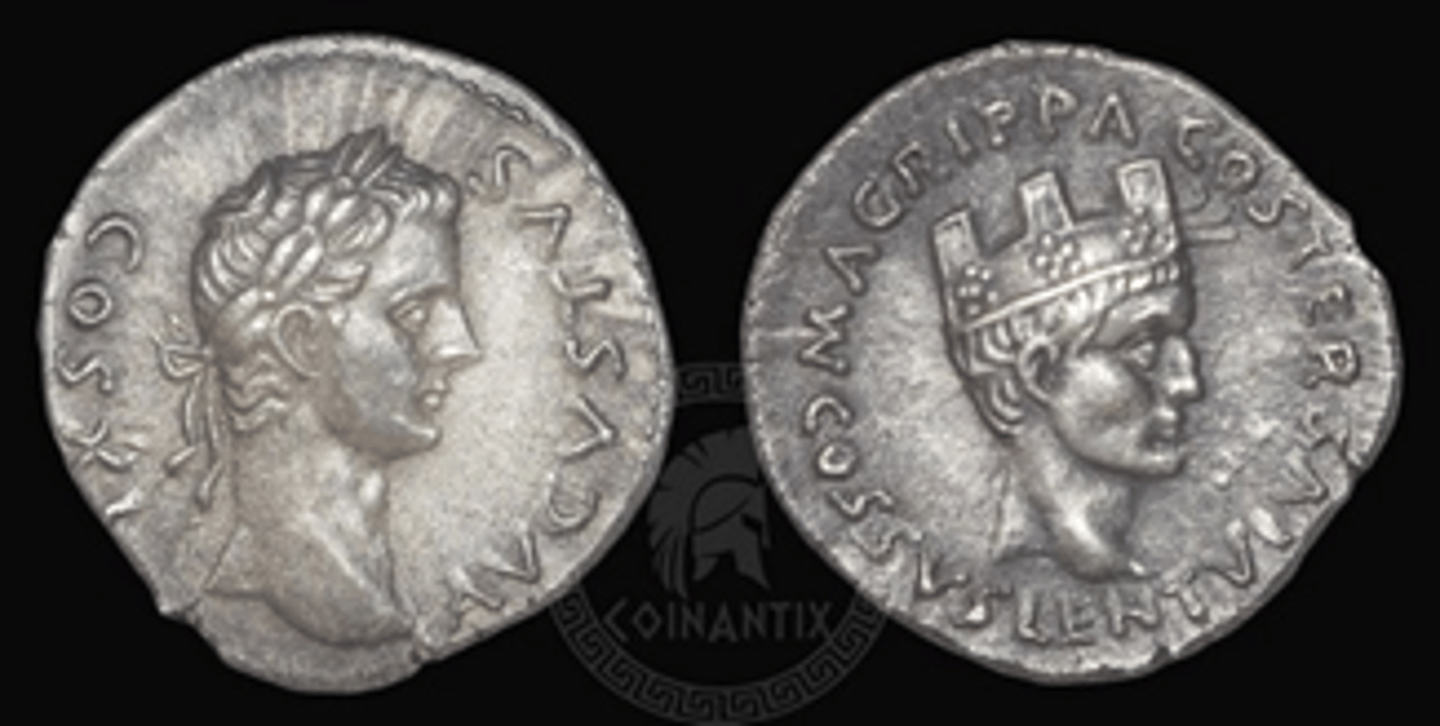
Coin obv. Augustus with oak wreath, COS XI AVGVSTVS, rev. Agrippa with mural + rostral crown - what type of coin and what is its date?
Denarius, 20-10BC
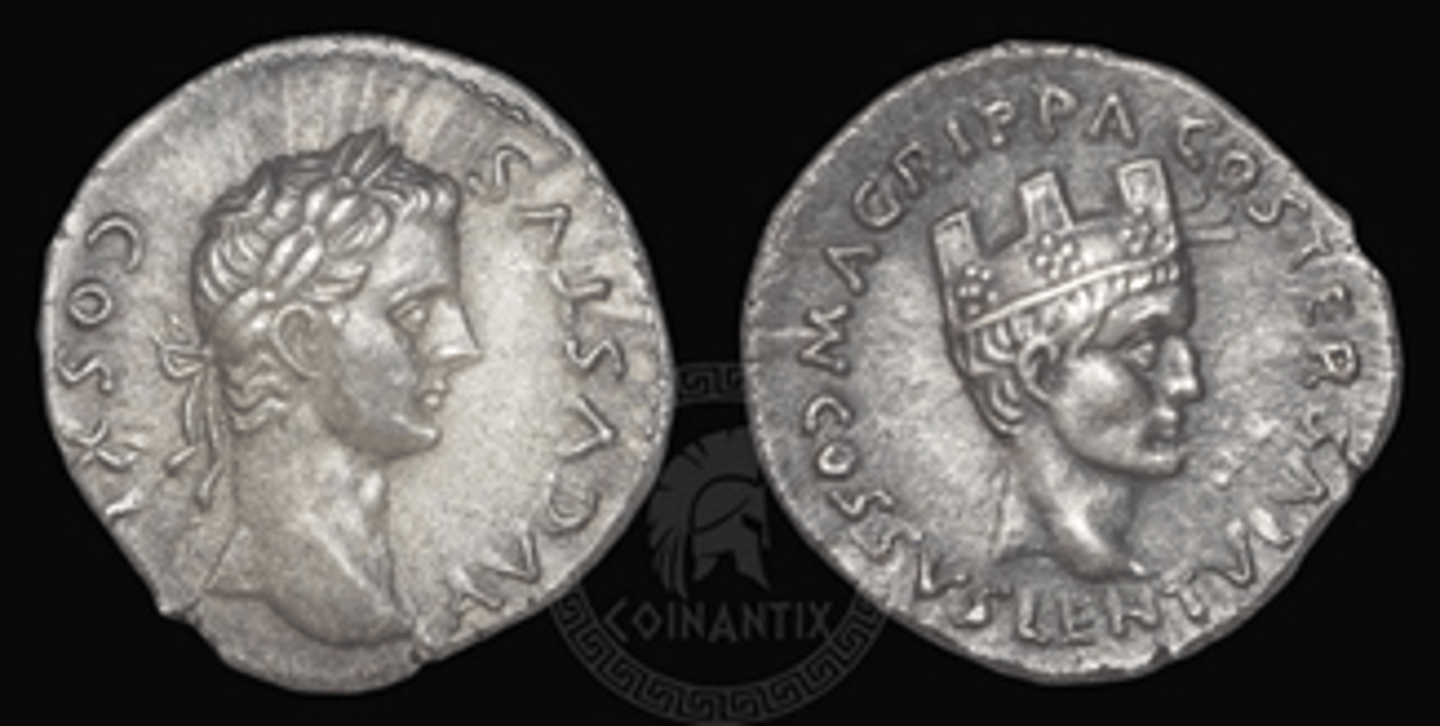
What does the oak wreath symbolise?
Award given to Roman who saved the life of another Roman in battle - symbolises Augustus as saving individuals and entire society (saviour), strong military leader
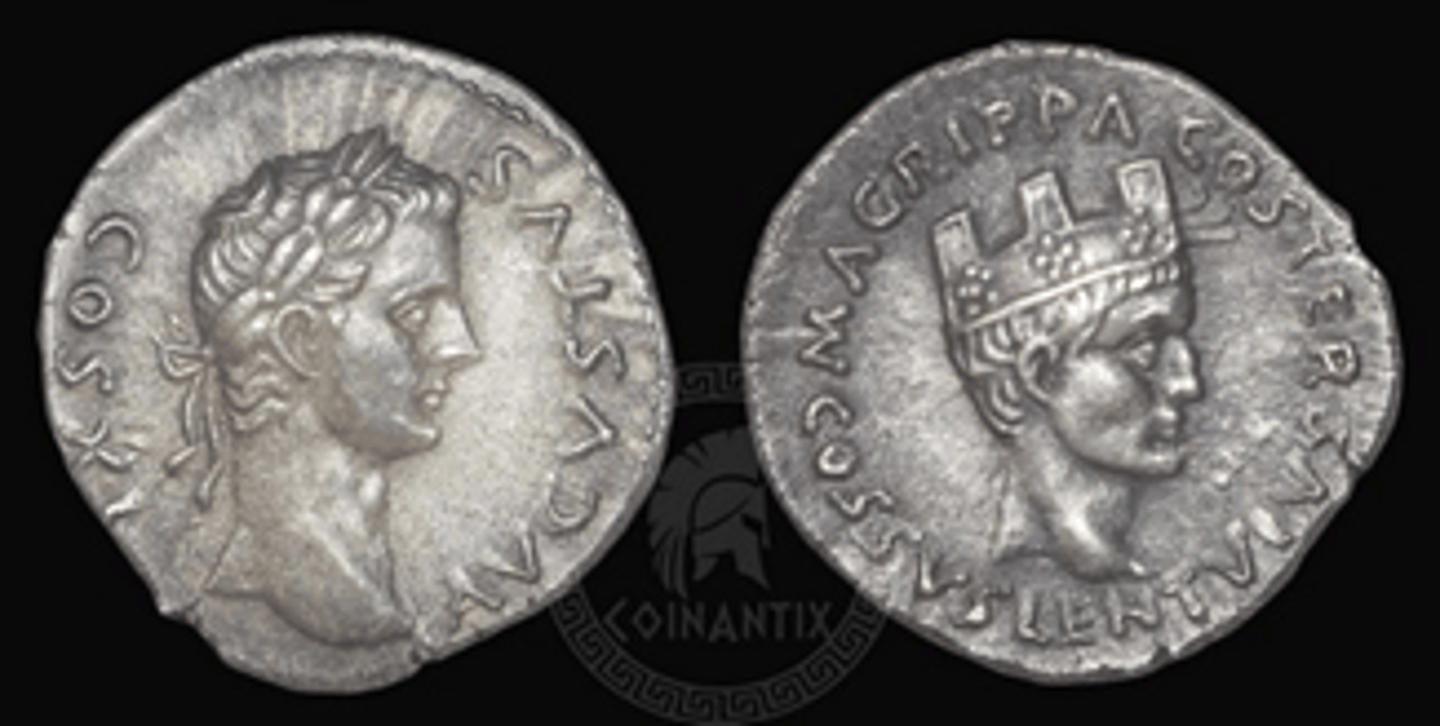
What was a mural and what does it symbolise?
Circle of gold resembling battlement, given to soldier who first climbed wall of a besieged city - great bravery, courage, strength, strategy
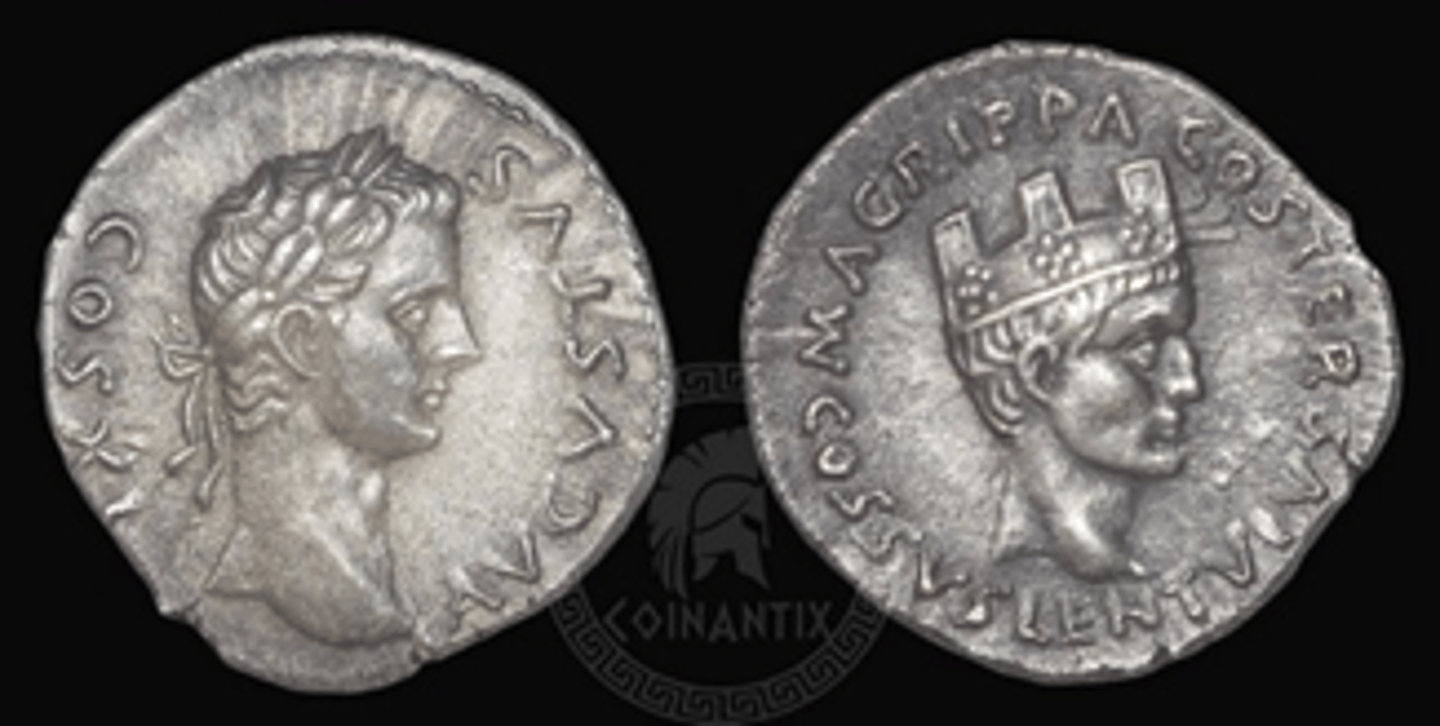
What does the rostral crown symbolise?
Consists of miniaturised foreparts of galleys, awarded by Senate to leaders of naval victories - Agrippa is strategist, imperator, trustworthy leader, victorious - hails back to Actium
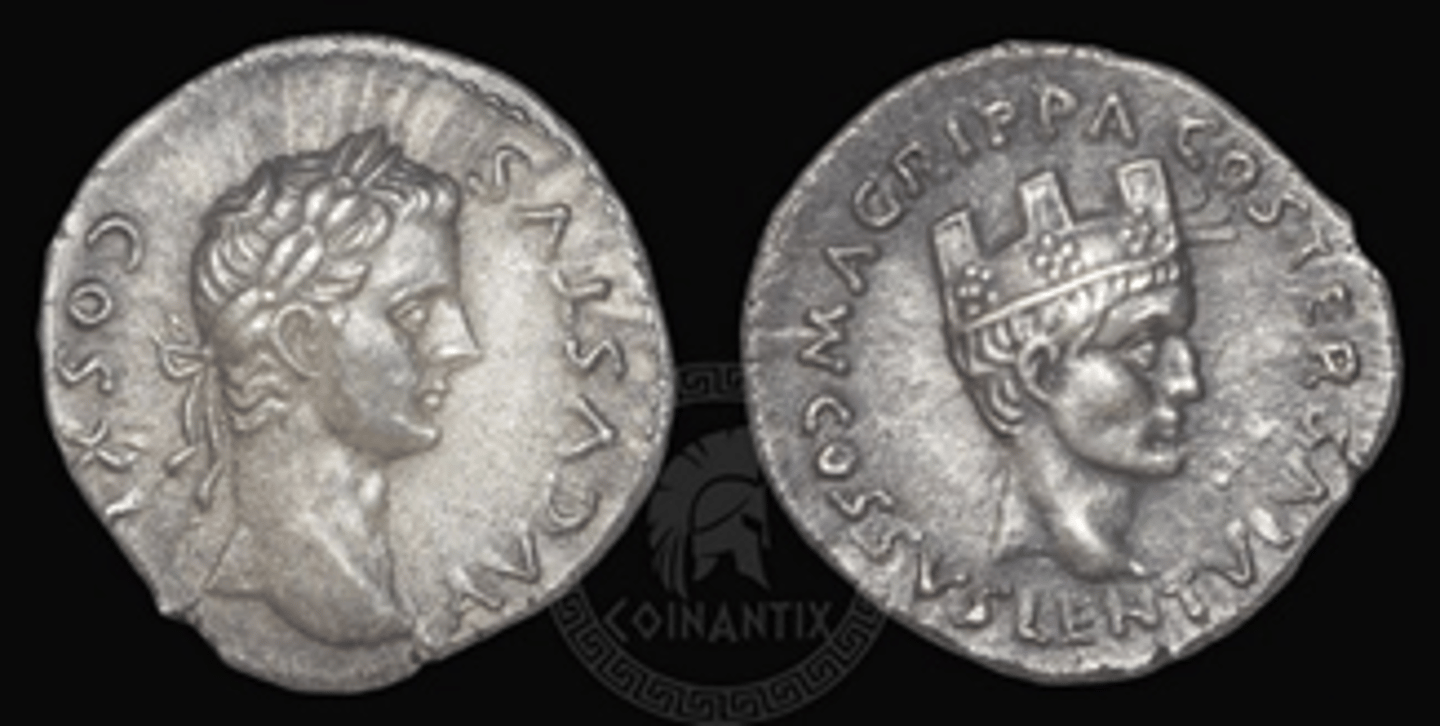
What is the significance of this coin? Obv. Augustus with oak wreath, COS XI AVGVSTVS, rev. Agrippa with mural + rostral crown
Augustus giving credit to other prominent politicians, works together so not dominating power (not dictator); celebrates specific men he wants to make prominent (Agrippa is his ally); shows strength of Augustus' associates, more trustworthy as has a good team
What is the Golden Age?
Time of prosperity, flourishing, abundance of food, wealth and pleasure
How is the Golden Age described in Hesiod's Works and Days?
Under the reign of Saturn, the first race of humans, where they lived in happiness and leisure (no toil, rest from work), a time of higher morality, living in the best days
Why would Augustus want to suggest a new Golden Age was beginning?
Taking Rome back to their roots, championing Rome's legacy, returning to good morality (as Pater Patriae, like Father Saturn in Golden Age - also presents him as divine, more than human); suggests Rome will, and can only, flourish under his leadership; exchanges Hesiod's idea of constant decline to cyclical pattern
How did Augustus validate his claim that he was the Bringer of the Golden Age?
Prophecies from Sibylline books spoke of a new Golden Age, so Augustus claimed he was the one who would bring it, showing he had divine endorsement; suggested it wasn't a political move but divinely ordained; as a member of the college of 15 Priests, he (conveniently) had access to Sibylline books (was it possible he faked it?); Sibylline books prophesied a revival of the ancient Ludi Saeculares
Why was Augustus' claim to bring back the Golden Age a risky one?
If he faked the Sibylline books, he would have been accused of blasphemy; as the other Golden Age ended when Saturn was murdered by Jupiter, Augustus was possibly at risk of assassination of other jealous powers
What different views of the Golden Age did ancient writers have and which one most describes Augustus' presentation of the new Golden Age?
Hesiod describes slothful bliss; Virgil's Georgics suggest it was a good and desirable time brought about by continue hard work (so not free from work); Ovid speaks time of arts, culture, justice and peace (most desirable to contemporary Rome) - Augustus presented the Battle of Actium as the end of civil war and the ushering of the new Golden Age