Biology IB - Neural signalling
 Studied by 0 people
 Call Kai
 Learn
Learn Practice Test
 Spaced Repetition
 Match
Match Flashcards
 Knowt Play
1/108

There's no tags or description
Looks like no tags are added yet.
Name | Mastery | Learn | Test | Matching | Spaced | Call with Kai |
|---|
No analytics yet
Send a link to your students to track their progress
109 Terms
What is a neuron?
A cell that processes and transmits information through electrical and chemical signals in the nervous system (they are the functional and structural unit of the nervous system)
What is a nerve?
A bundle of neurons
What can the nervous system be divided into?
Central nervous system (CNS), made up of the brain and spinal cord, and peripheral nervous system (PNS), made up of all the other nerves
What can the PNS be further divided into?
Autonomic nervous system (automatic and unconscious responses such as breathing and heartbeat) and somatic nervous system (conscious responses)
What can the autonomic nervous system be further divided into?
Sympathetic division (the network of nerves behind the "fight or flight" response) and parasympathetic (the network of nerves responsible for the body's rest and digestion response)
What can the somatic nervous system be further divided into?
Sensory nervous system (processes input information and consists of sensory neurons) and motor nervous system (carries signals to muscles or glands)
What are the parts of a neuron?
- A main, long, fibre known as an axon (insulated by Schwann cells which form the myelin sheath, which serves as insulation and prevents loss of nerve impulses along the axon)
- A cell body (soma) that contains the nucleus and other cellular structures
- Axon terminals that contain many extensions called dendrites
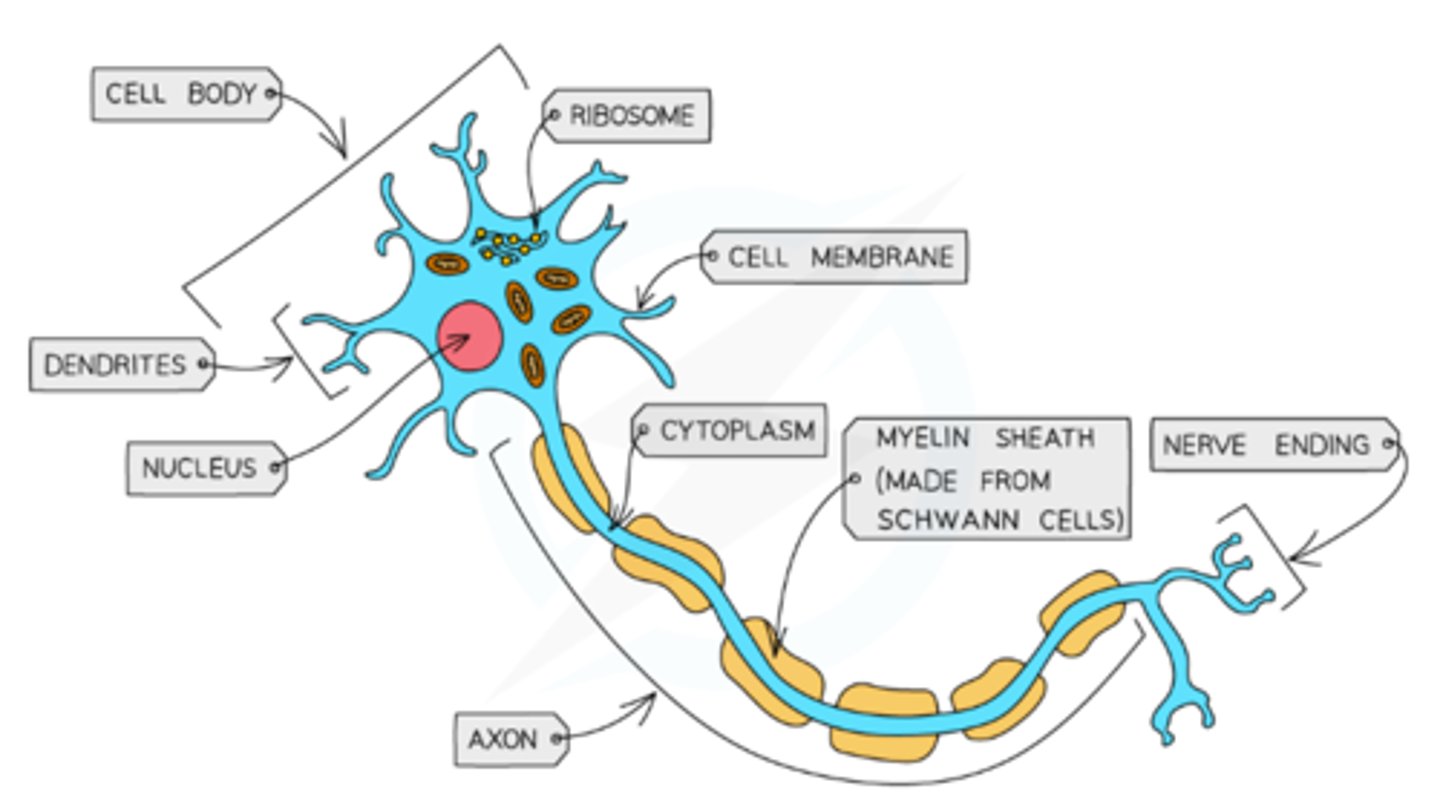
In a neuron, what is the node of Ranvier?
The gaps between Schwann cells
What are the three main types of neuron?
Sensory (carry impulses from receptors to the CNS), relay (are found entirely within the CNS and connect sensory and motor neurons) and motor (carry impulses from the CNS to effectors)
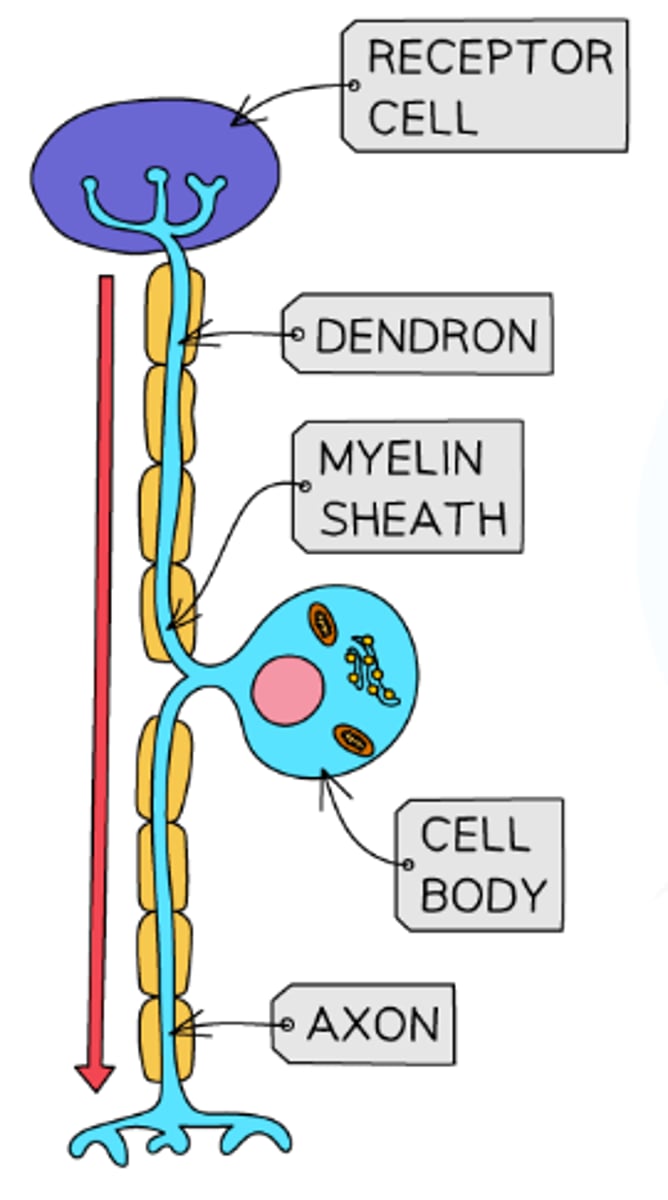
What is the structure of a motor neuron?
- A large cell body at one end that lies within the spinal cord or brain
- A nucleus that is always in its cell body
- Many highly-branched dendrites extending from the cell body, providing a large surface area for the axon terminals of other neurons
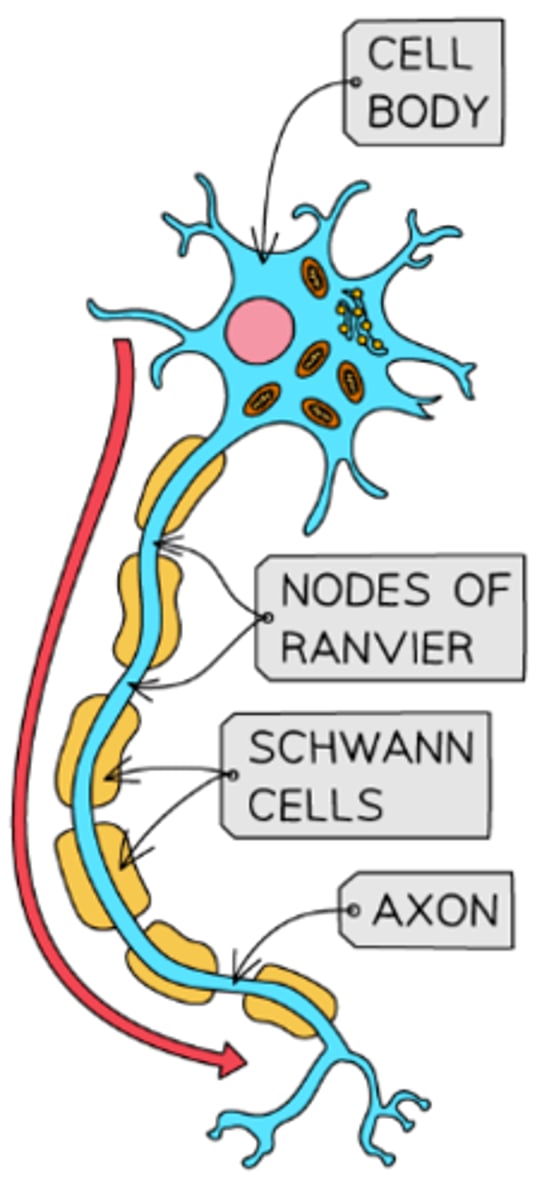
What is the structure of a relay neuron?
Short, but highly branched, axons and dendrites
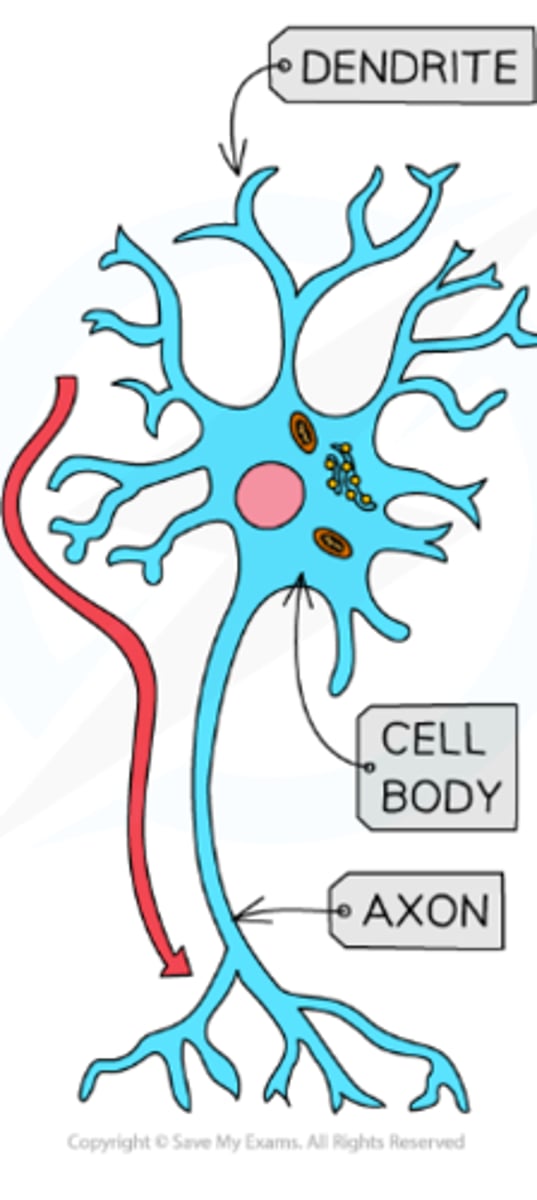
What is the structure of a sensory neuron?
- A cell body that branches off in the middle of the cell
- A single long dendron that carries impulses to the cell body and a single long axon that carries impulses away from the cell body
What is a nerve impulse?
A momentary reversal in the electrical potential difference across the neuron cell surface membrane
What is a membrane potential?
The difference in charge between the inside and the outside of the cell membrane
What is the resting potential?
The difference in charge between the inside and the outside of the cell membrane when the neuron is not sending an impulse (it's usually negative, around -70mV)
Which three things contribute to a negative resting membrane potential?
- The active transport of sodium ions and potassium ions (more Na⁺ out than K⁺ in)
- A difference in rates of diffusion of sodium ions and potassium ions (K⁺ passively diffuse out)
- Negatively charged proteins on the inside of the neuron
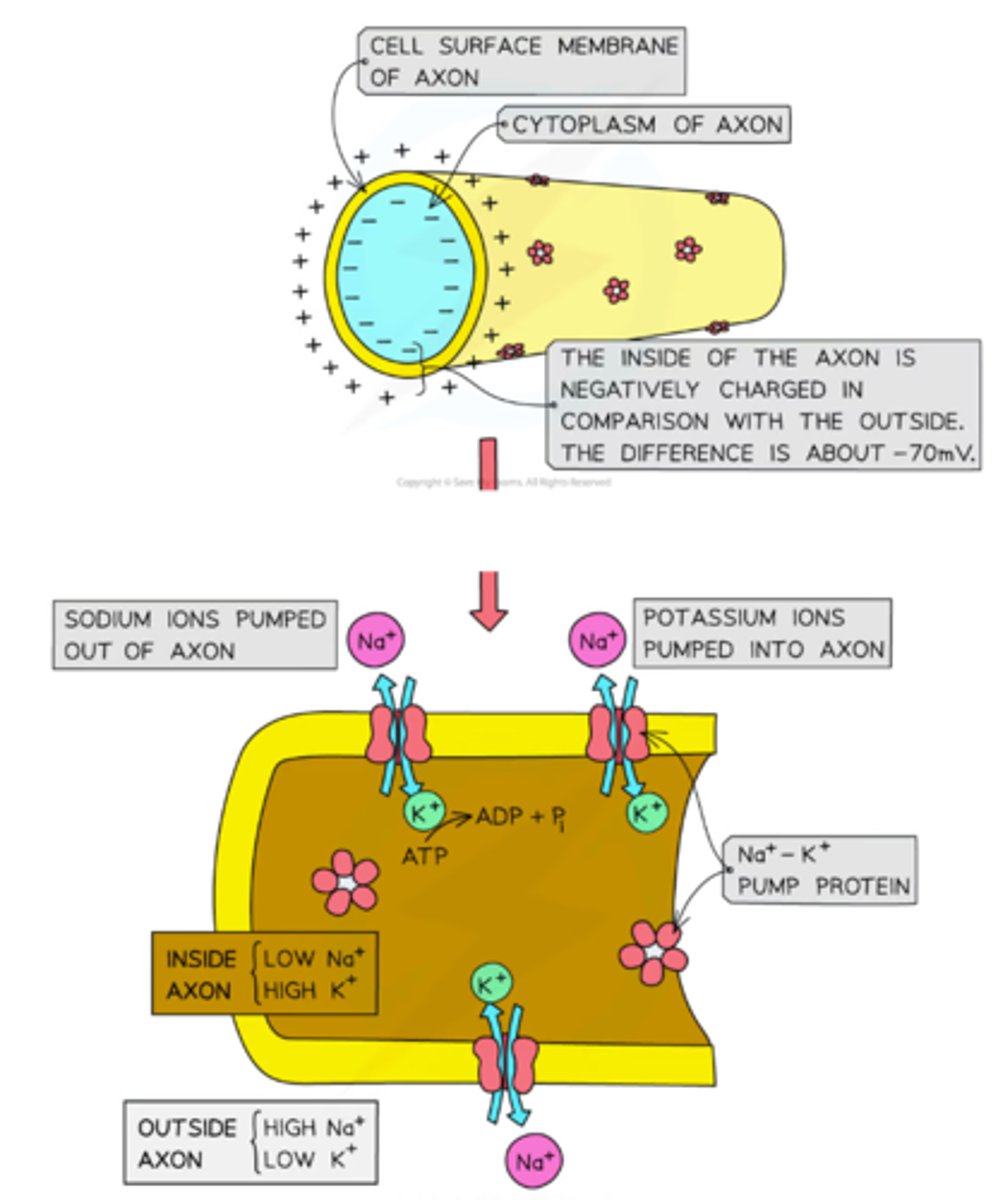
How does the active transport of Na⁺ and K⁺ contribute to a negative resting membrane potential?
Carrier proteins (sodium-potassium pumps) in the cell surface membranes of neurons use ATP to actively transport 3 Na⁺ out of the axon and 2 K⁺ into the axon, creating a concentration gradient across the membrane for both sodium ions and potassium ions
How does the difference in rates of diffusion of sodium ions and potassium ions contribute to a negative resting membrane potential?
1. Because of the concentration gradient generated by the sodium-potassium pumps, both Na⁺ and K⁺ will diffuse back across the membrane across Na⁺ and K⁺ channels that them to move across the membrane by facilitated diffusion.
2. The membrane is much less permeable to Na⁺ than K⁺, so K⁺ inside the neuron diffuse out at a faster rate than Na⁺ can diffuse back in.
3. This results in far more positive ions on the outside of the neuron than on the inside, generating a negative charge inside the neuron in relation to the outside (forming a resting membrane potential of around -70 millivolts (mV))
What is the neuron membrane said to be when the resting potential is reached?
Polarised (for an impulse to be initiated the membrane needs to be depolarised)
What is depolarisation?
The reversal of the electrical potential difference across the membrane (occurs when an action potential is generated)
What do action potentials involve?
The rapid movement of sodium ions and potassium ions across the membrane of the axon due to the opening of specific voltage-gated channels
What is an action potential?
The potential electrical difference produced across the axon membrane when a neuron is stimulated (e.g. when an environmental stimulus is detected by a receptor cell)
What does the speed of a neuron impulse depend on?
The body size of the animal, the axon diameter size and whether or not the axon is myelinated
Does the body size of the animal affect the speed of a neuron impulse?
Not significantly (however, larger animals experience longer delays in nerve impulses as their neurons have to travel further distances)
Do larger diameter axons result in a faster or slower nerve impulse?
Faster (they are directly proportional as larger axons experience less resistance in ion flow which facilitates the faster propagation of the action potential)
Des myelination of neurons increase or decrease the speed of a nerve impulse?
Increase (it acts as insulation allowing for a higher action potential propagation velocity)
What is an example of an organism that contains large, unmyelinated axons?
Giant squids
What is a synapse?
Junctions between neurons and between neurons and effector cells
What is the synaptic gap?
The tiny space between the axon terminal of one neuron and the dendrite of an adjoining neuron
What are the three types of synapses?
1. Synapse between a sensory cell and a sensory neuron
2. Synapse between neurons
3. Synapse between motor neuron and effector (muscle or gland)
In a synapse, can the signal be passed from both direction?
No (only from one, from the presynaptic to the postsynaptic neuron)
What are neurotransmitters?
Chemical messengers that carry information between cells at the synapse
What do neurotransmitters move by?
Diffusion
Do neurotransmitters have more globalised or localised effects?
Localised
What is the process of the release of the neurotransmitters?
1. A nerve impulse arrives at the axon terminal of the presynaptic cell.
2. Depolarisation of the cell membrane causes voltage-gated calcium (Ca²⁺) channels in the axon terminal to open.
3. Ca²⁺ moves into the cell through facilitated diffusion down their concentration gradient.
4. The increase in Ca²⁺ concentration causes vesicles containing neurotransmitters to move towards the end of the presynaptic membrane.
5. Vesicles fuse with the cell membrane and neurotransmitters are released into the synaptic gap via exocytosis
What happens once the neurotransmitters have diffused across the synaptic gap?
They bind to specific receptors on the postsynaptic neuron (usually ligand-gated channels)
What do the binding of neurotransmitters on receptors of the postsynaptic neuron trigger?
The opening of an ion channel within the postsynaptic membrane (this allows ions to move by facilitated diffusion leading to depolarisation)
What is a common neurotransmitter?
Acetylcholine (it's involved in formation of memory and triggering muscle contraction at the neuromuscular junction)
What is acetylcholine made of?
The joining of acetyl CoA and choline
What is the name of synapses that use acetylcholine?
Cholinergic synapses
What happens if the neurotransmitter is not broken down and remains in the synaptic cleft?
The neurotransmitter would continue to bind to the receptor, resulting in multiple action potentials and continuous response (therefore an enzyme breaks down the neurotransmitters)W
What is acetylcholinesterase?
An enzyme in the synaptic cleft that breaks down acetylcholine into acetyl CoA and choline so that it no longer binds to the postsynaptic receptors
How does acetylcholine trigger the opening of voltage-gated Na⁺ channels?
By changing their tertiary structure
What is the complete process of the diffusion of acetylcholine across the synapse?
1. ACh is synthesised in the axon terminals of presynaptic neuron by enzyme (combines choline from diet and acetyl group from aerobic respiration).
2. ACh is loaded onto vesicles and released from the presynaptic neuron via exocytosis.
3. ACh diffuses across the synaptic gap and binds to receptors in the postsynaptic neuron (ligand-gated channels).
4. When ACh binds to its receptors, Na⁺ channels open and Na⁺ moves into the cell by facilitated diffusion.
5. If the threshold potential is reached with the influx of Na⁺, an action potential will be initiated and propagated as an impulse across the postsynaptic neuron.
6. An enzyme in the synaptic gap (acetylcholinesterase) rapidly breaks down ACh into choline and acetyl group.
7. Choline is recycled back to the presynaptic neuron and the acetyl group is excreted as waste
What needs to happen in order for an action potential to be initiated?
The threshold must be reached (minimum membrane potential value at which the neuron will fire an action potential)
What are the stages for the formation of an action potential in a neuron?
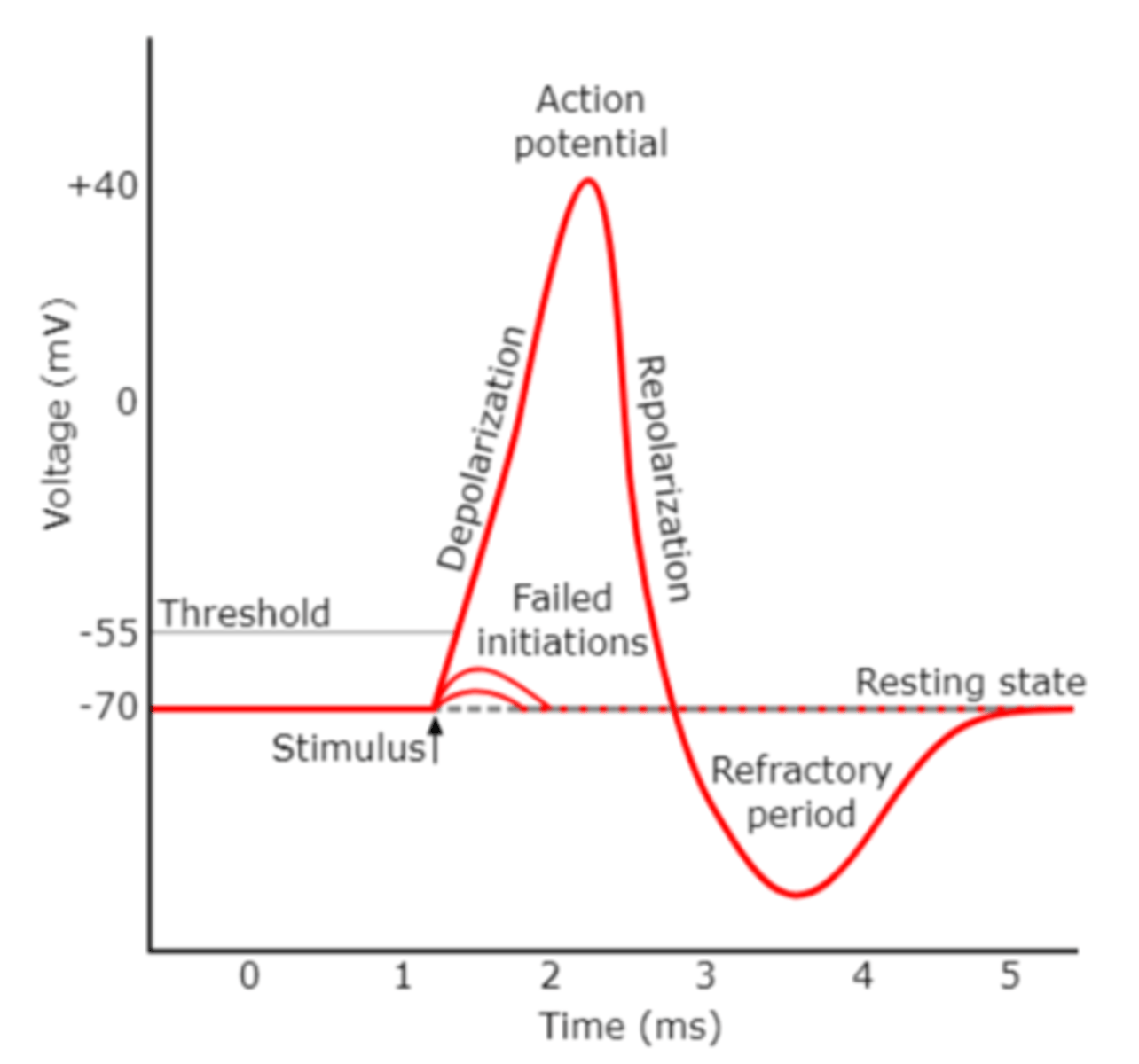
1. Resting potential (when there is no stimuli, about -70mV)
2. Stimulus (any change in environment that triggers an electrical impulse, Na⁺ channels open)
3. Threshold (typically around -55mV)
4. Depolarisation
5. Repolarisation
6. Refractory
What is repolarisation?
The process of the membrane potential becoming more negative relative to the outside of the cell
How does repolarisation happen?
Voltage-gated K⁺ channels open (K⁺ diffuses out causing the inside of the membrane to again become more - charged relative to the outside) and all the voltage gated sodium channels in this section of membrane close
What happens after repolarisation?
The concentration gradients of Na⁺ and K⁺ must be restored by Na-K pumps (causing a slight delay before there can be another action potential)
What is the refractory period?
The brief period of time during which the membrane is incapable of repeating an action potential
What is a local current?
The process by which Na⁺ move within the neuron to generate action potentials in neighbouring regions of the membrane
What are the steps for the propagation of a neural impulse?
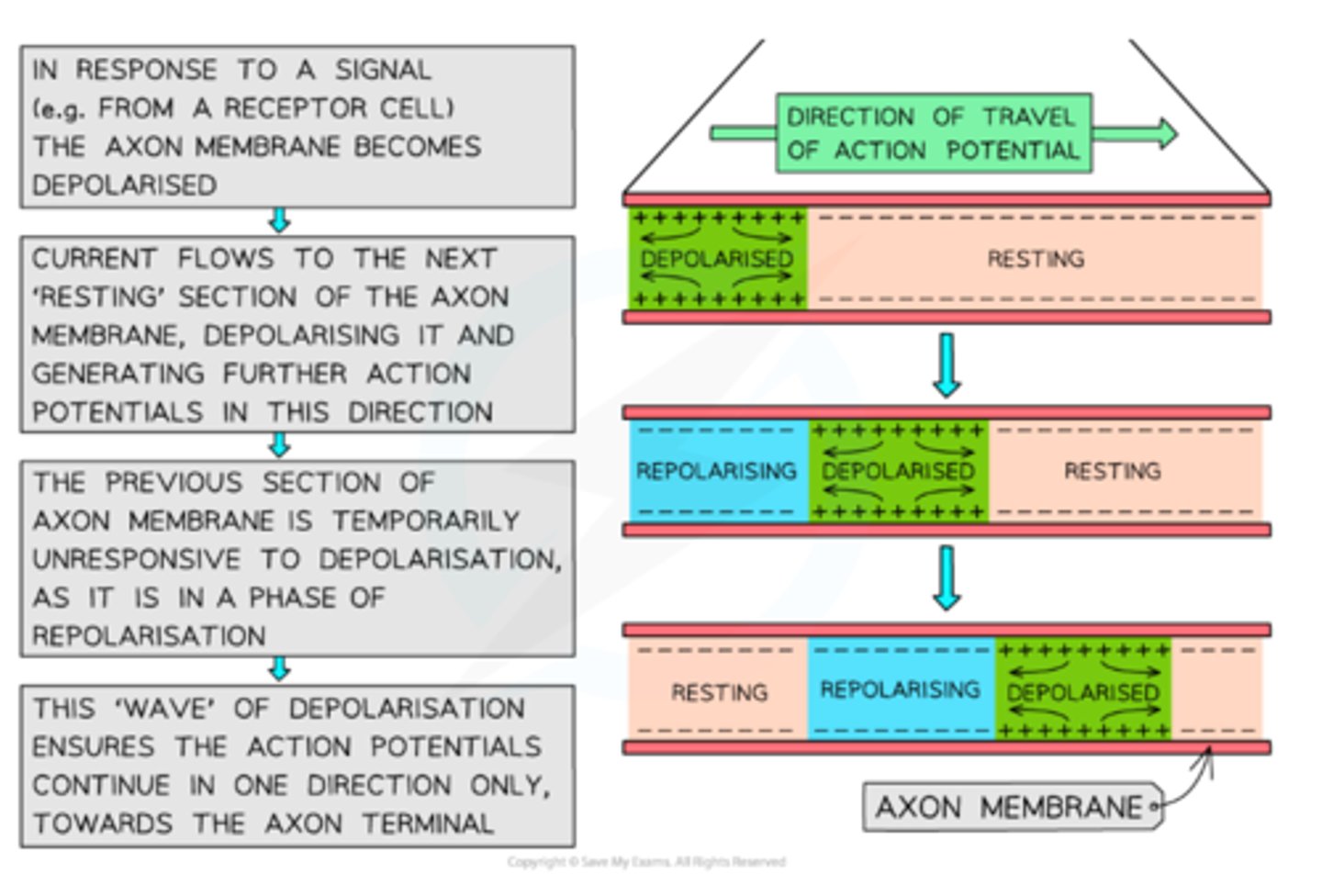
1. Na⁺ enter the membrane through a channel during depolarisation.
2. The Na⁺ that have entered the cell diffuse to both neighbouring sides of the channel from which the ion entered the cell (local current).
3. The Na⁺ that move through the local current bring their + charge to the neighbouring region of the membrane (rising the membrane potential from the resting potential of -70mV).
4. If the charge reaches the threshold potential (-50mV), the voltage-gated Na⁺ open causing an action potential.
5. This is repeated, causing a wave of action potential along the neuron membrane (and the nervous signal is boosted due to saltatory conduction in myelinated neurons)
In which direction is the action potential propagated?
Only forwards (even though Na⁺ diffuses via local current in both directions)
Why is the action potential only propagated forwards?
- Because the region of the membrane that has just had an action potential will not be able to depolarise again for a brief period of time (it is hyperpolarised in the refractory period)
- Due to electrochemical gradient of Na⁺
What is hyperpolarisation?
The short period during which the membrane potential is more negative than resting potential
What is electrotonic spread?
The passive spread of electrical activity through living tissue or cells in the absence of repeated action potentials (e.g. when the electric signal is passing under the myelin and the action potential is not regenerated yet)
What can the refractory period be divided into?
Absolute (between depolarisation and repolarisation) and relative (between below threshold and hyperpolarisation)
Is it possible to provoke an action potential in the absolute refractory period?
No
Is it possible to provoke an action potential in the relative refractory period?
Yes (but more stimulus is needed due to the hyperpolarisation)
What is an oscilloscope?
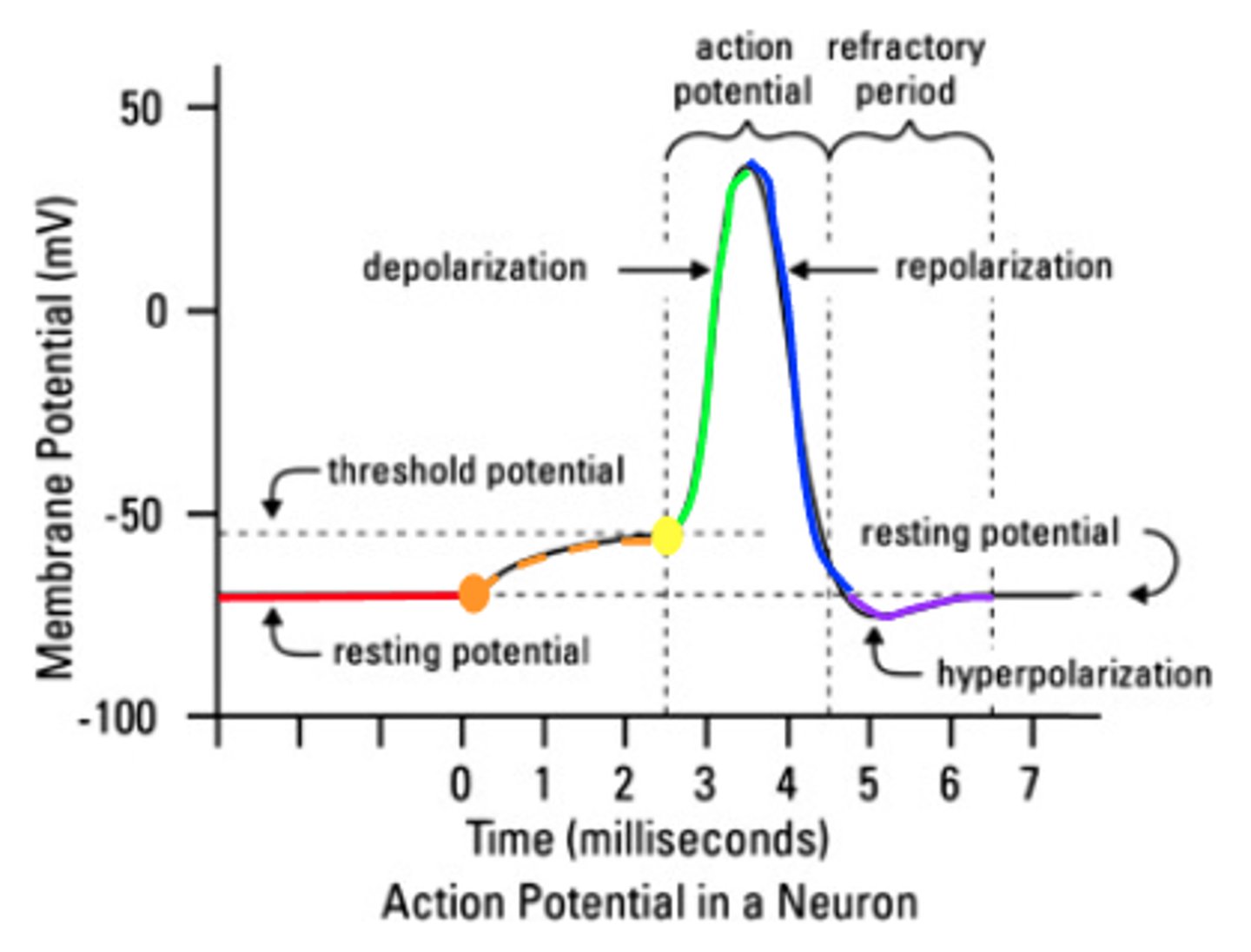
An instrument that graphically displays electrical signals as waveform, creating visualisation of the change of voltage over time (y-axis is voltage measurement and x-axis is time)
How can membrane potentials in neurons be measured?
By placing electrodes on either side of the membrane (the electrodes connect to the oscilloscope which displays the change in charge between the electrodes during resting and action potentials in a section of neuron cell membrane)
What do myelinated axons have?
Schwann cells that wrap around a segment of an axon creating multiple layers of its cell membrane to form the myelin sheath
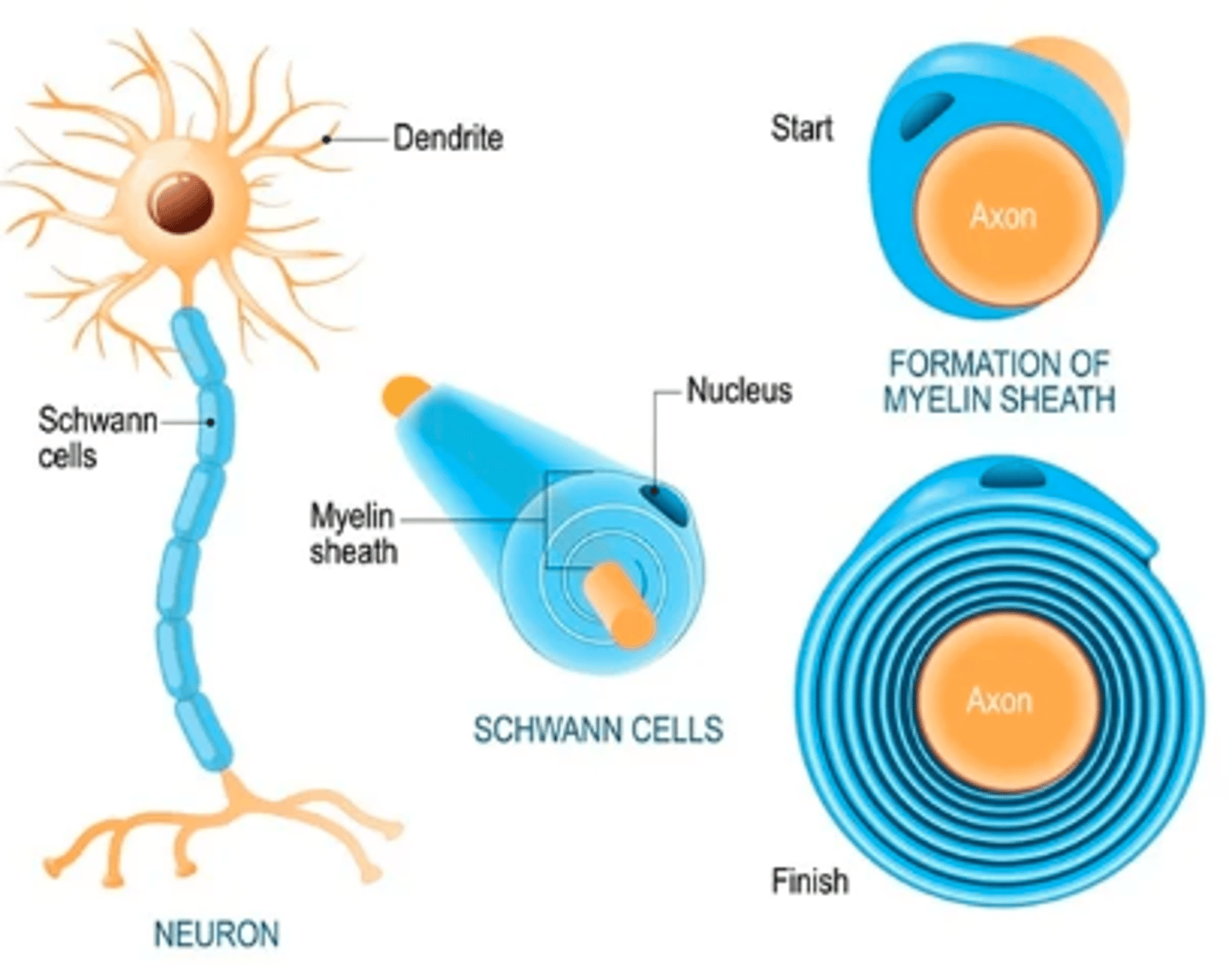
What does the myelination of axons allow?
Saltatory conduction
What is saltatory conduction?
The propagation of action potentials along myelinated axons from one node of Ranvier to the next node, increasing the conduction velocity of action potentials
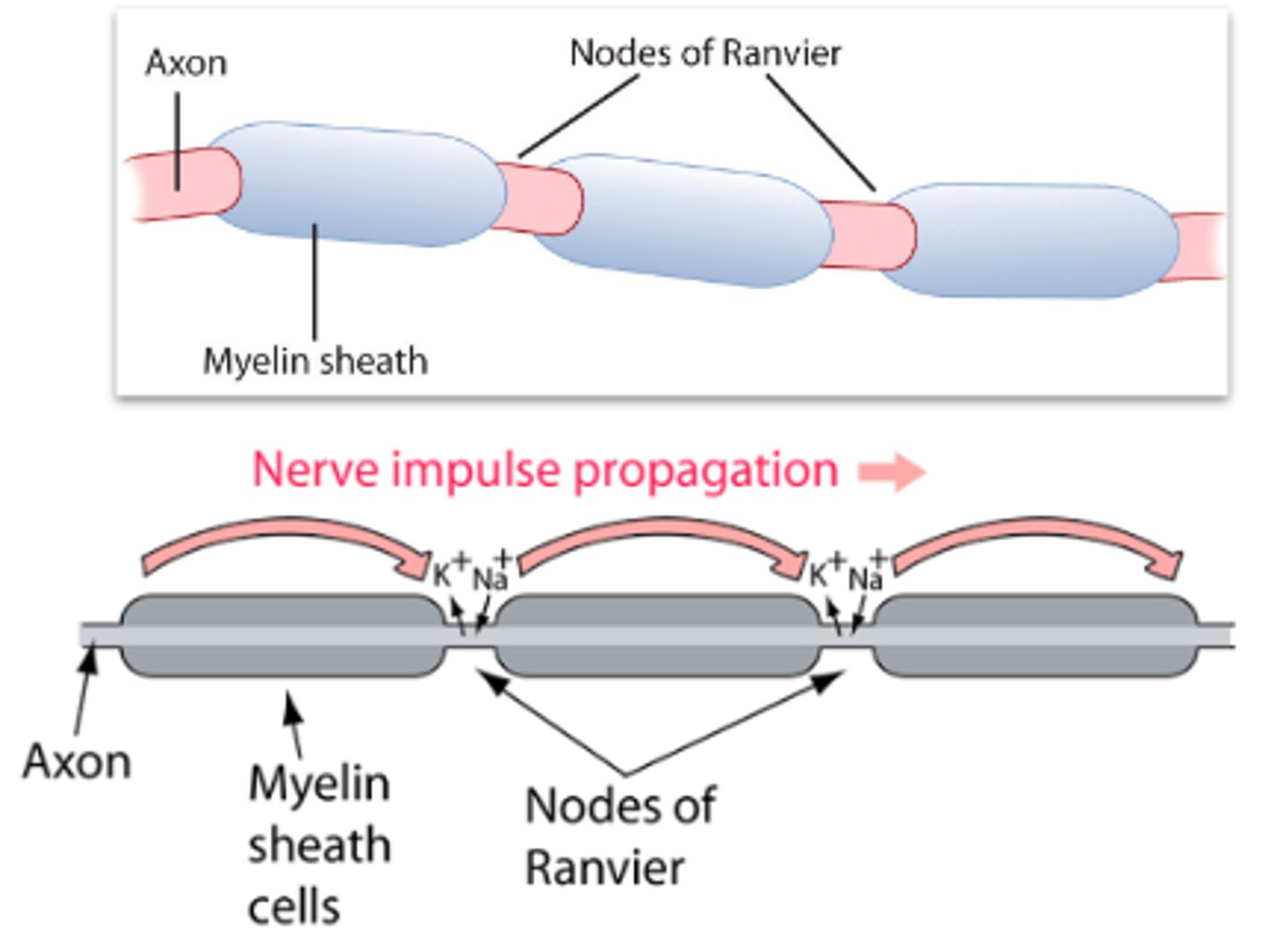
How does saltatory conduction increase the speed of an action potential?
- Myelination provides insulation (preventing loss of signal)
- Na+ and K+ ion channels are clustered at nodes of Ranvier so the action potential is only regenerated at spaced-out points (less delay and energy)
What are the types of myelin sheath cells?
Schwann cells (in PNS) and oligodendrocytes (in CNS)
What are exogenous chemicals?
Substances that enter an organism from an external source (not produced naturally by the body) (e.g. pharmaceutical medicines, cigarette smoke, pollutants in air, pesticides, industrial chemicals...)
Can some exogenous chemicals alter synaptic transmissions?
Yes
What are some possible effects of exogenous chemicals in synapses?
- Stimulate or inhibit the synthesis of a neurotransmitter
- Inhibit the storage of neurotransmitters
- Overstimulate or inhibit the release of neurotransmitters
- Bind to and stimulate or inhibit neurotransmitter receptors
- Block the enzymatic digestion of neurotransmitters
- Block the reuptake of neurotransmitters
What are two examples of exogenous chemicals that affect synaptic transmission?
Neonicotinoids and cocaine
What are neonicotinoids?
Synthetic insecticides that can bind to acetylcholine receptors in the CNS (inhibiting acetylcholine from binding)
What happens if neonicotinoids bind to acetylcholine receptors?
Acetylcholine doesn't bind so depolarisation doesn't occur and the postsynaptic cell will not fire an action potential (so synaptic transmission is prevented)
Is the binding of neonicotinoids reversible?
No, as acetylcholinesterase cannot break down neonicotinoids (causing the paralysis and death of insects)
Are neonicotinoids toxic for humans?
No
How does cocaine alter synaptic transmission?
It binds to the dopamine reuptake transporter (blocking the removal of dopamine from the synapse and causing dopamine to accumulate and continue to activate the postsynaptic cell)
What happens to regular cocaine users?
The brain responds by increasing dopamine receptors to respond to the high levels of dopamine (once levels return to normal, more dopamine receptors results in increased sensitivity and depression)
Are there symptoms of withdrawal when chronic use of cocaine is stopped?
Yes (e.g. paranoia, arrhythmia or stroke)
What are psychoactive drugs?
Addictive substances that act upon the central nervous system and alter brain function
What are the two types of psychoactive drugs?
Stimulants and sedatives
How do psychoactive drugs affect the nervous system?
- Stimulant psychoactive drugs increase postsynaptic transmission. They mimic the stimulation provided by the sympathetic nervous system (e.g. nicotine, cocaine, amphetamine).
- Sedative psychoactive drugs decrease postsynaptic transmission. They mimic inhibition of the parasympathetic nervous system (e.g. benzodiazepines, alcohol, tetrahydrocannabinol)
What are the two types of neurotransmitters (according to the effect that they can have)?
- Excitatory postsynaptic potentials (EPSP): leads to depolarisation and a subsequent propagation of action potential (it's set up by Na⁺ flowing in postsynaptic neuron).
- Inhibitory postsynaptic potentials (IPSP): leads to hyperpolarisation and a subsequent reduction in likelihood of propagation of an action potential (it's set up by negative ions flowing in postsynaptic neuron)
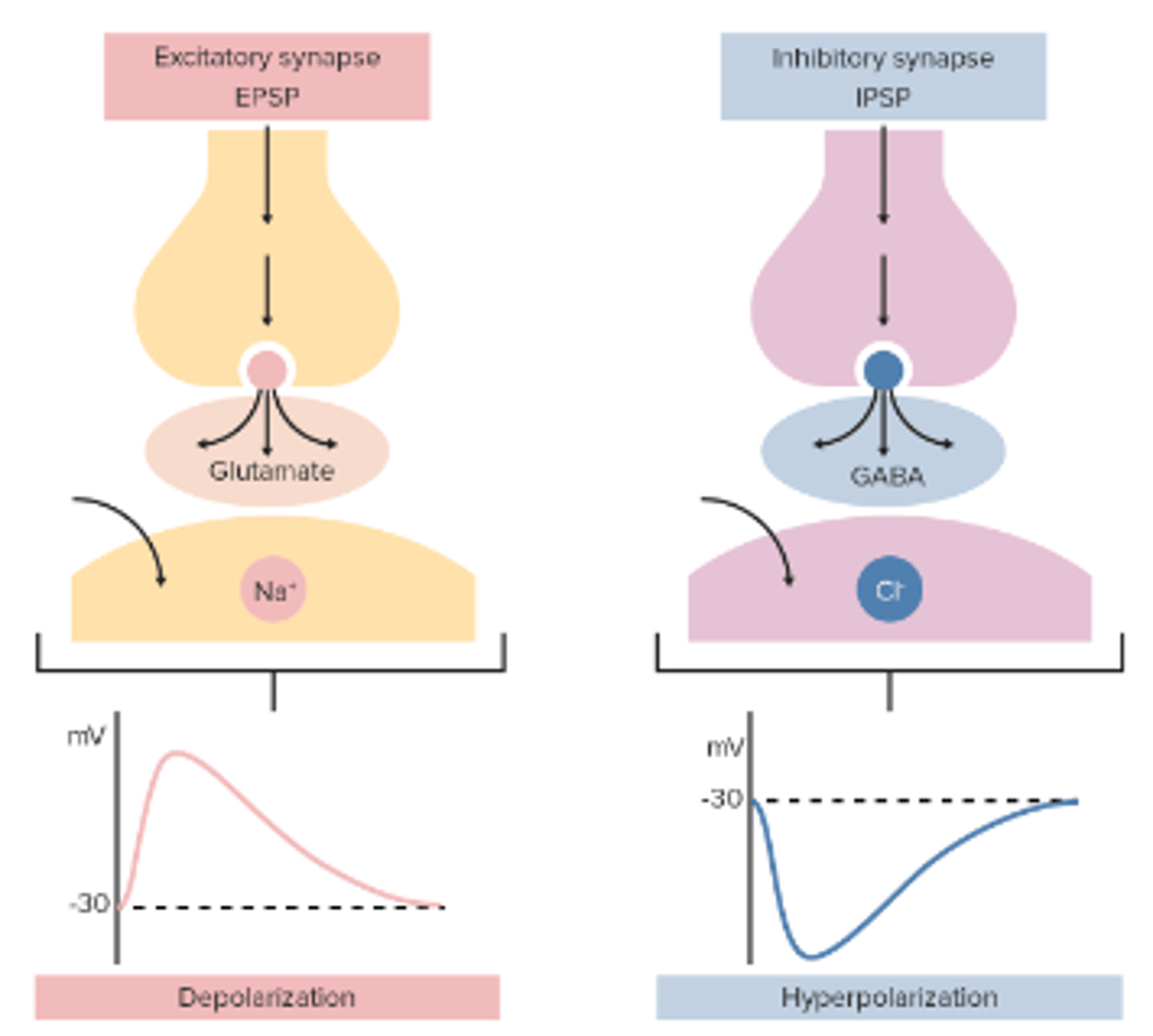
When can hyperpolarisation happen?
- When channels allow positive ions to flow out of the cell (e.g. K⁺ during refractory of an action potential
- When the neurotransmitter binding opens ligand-channels that allow negative ions (e..g Cl⁻) to flow into the cell
What is the most common inhibitory neurotransmitter in the brain?
GABA (Gamma-Aminobutyric Acid)
What is the effect of GABA?
It lessens the ability of a nerve cell to receive, create or send chemical messages to other nerve cells (it is thought to be able to reduce stress, relieve anxiety and improve sleep)
What is one of the receptors of GABA?
A ligand-gated chlorine (Cl⁻) ion channel (when GABA binds, Cl⁻ flow into the cell and hyperpolarise the membrane potential)
Can there be more than one excitatory and inhibitory neurotransmitter acting on the same synapse?
Yes, as multiple presynaptic neurons can form synapses with the same postsynaptic cell (it allows for more control)
What happens if the cell body of a motor neurone is subject to both excitatory and inhibitory synapses at the same time?
- Na⁺ enter the cell body following stimulation by the excitatory synapse
- The stimulation of the inhibitory synapse causes K⁺ to diffuse out of the cell body
- This cancels out the effect of the sodium ions entering
- The threshold potential is not reached so no action potential is generated
What is summation?
The combined effect of all input to the postsynaptic cell (the net change determines if the neuron reaches the threshold potential)
Where does summation occur?
At the axon hillock (the cone-shaped region at the end of the cell body where the axon originates)
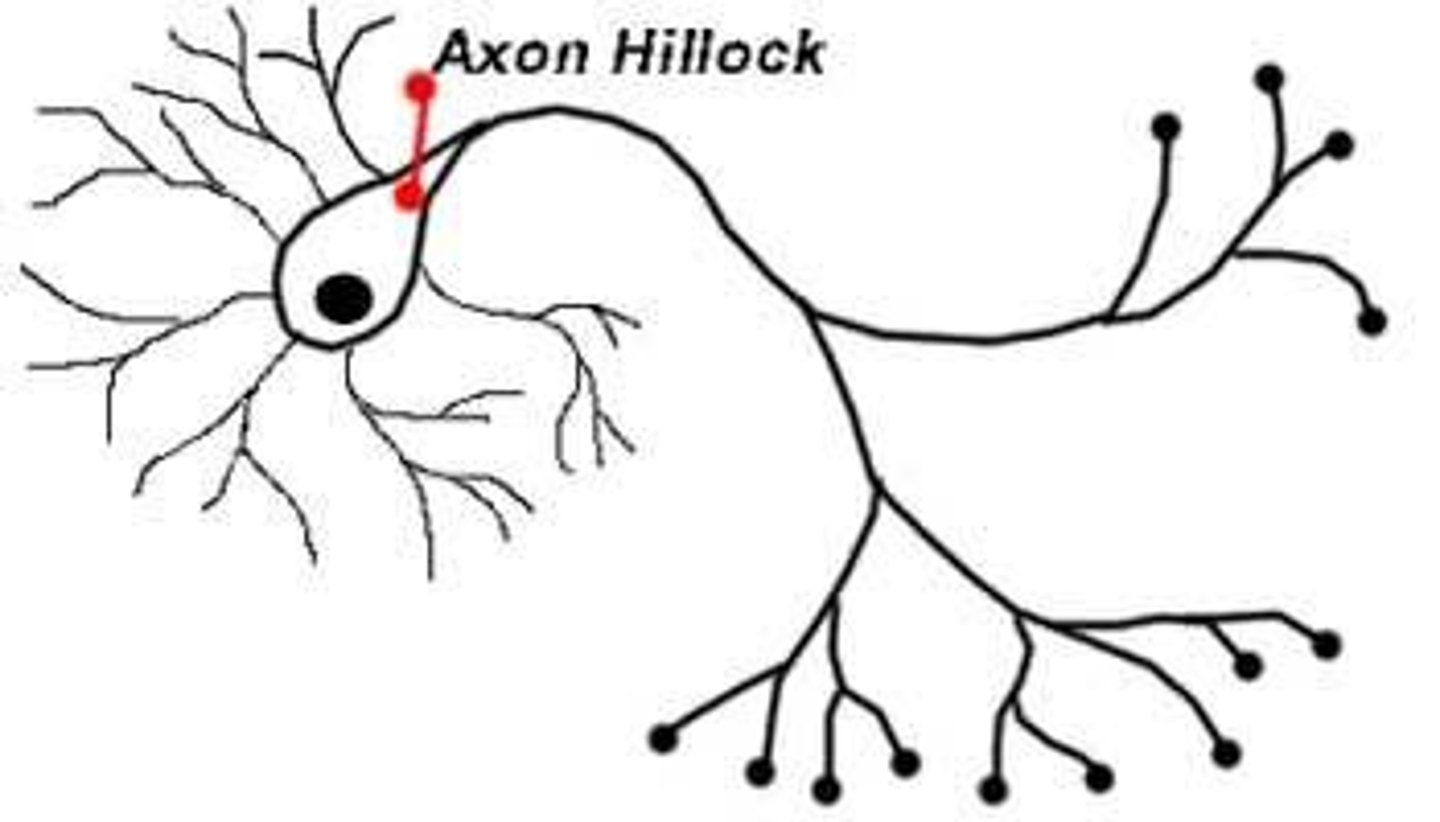
What are the two type of summation?
- Temporal: different signals from the same neuron one after the other (can only be inhibitory or excitatory)
- Spatial: different signals from different neurons reaching the synapse at the same time (can be both inhibitory and excitatory)
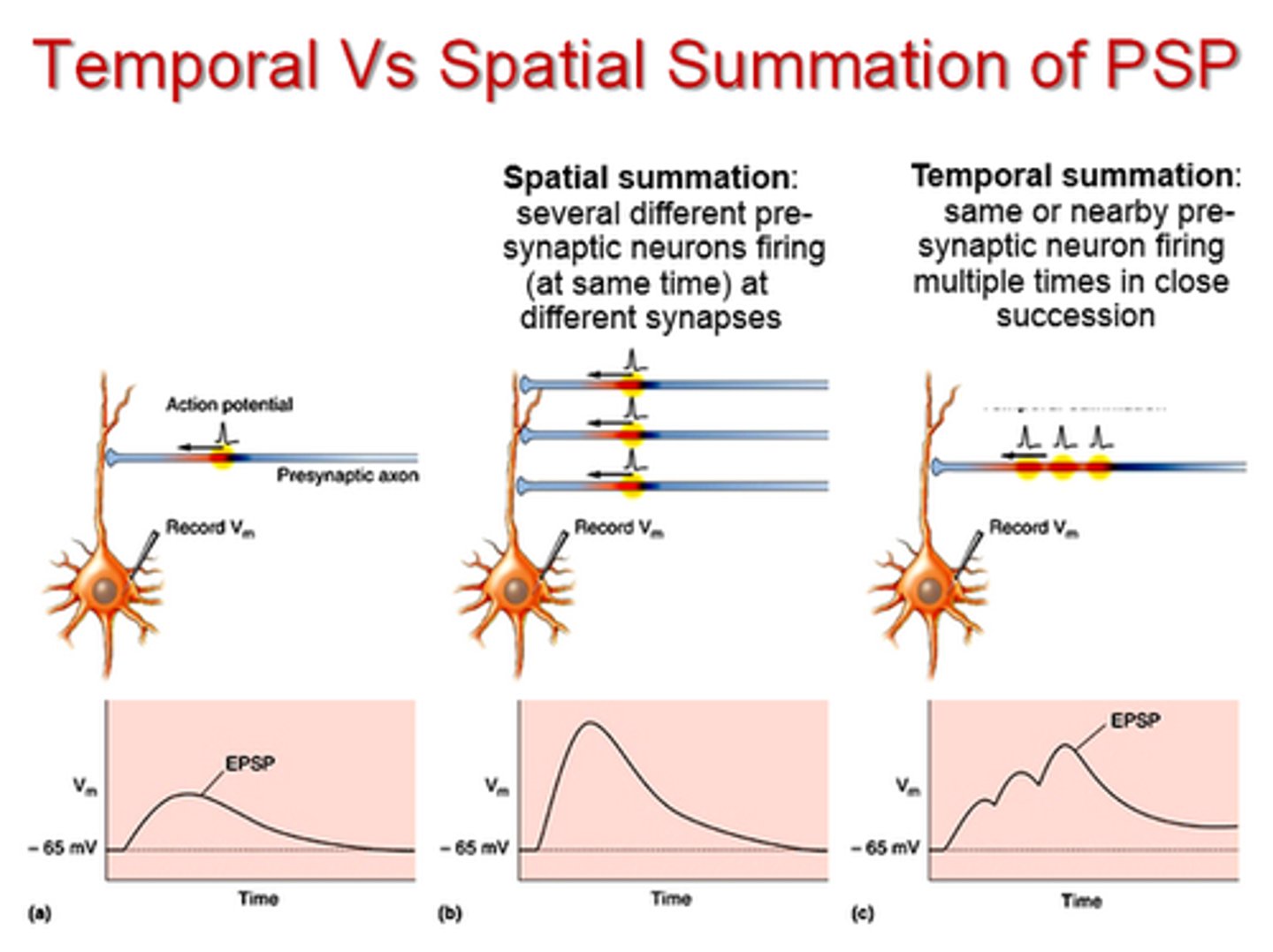
What are the benefits of summation?
- It allows for the effect of a stimulus to be magnified
- A combination of different stimuli can trigger a response
- It avoids the nervous system being overwhelmed by impulses
What is pain stimuli detected by?
Pain receptors (nociceptors)
What are the three types of pain stimuli?
Mechanical, thermal and chemical
What do mechanical nociceptors respond to?
To pressure formed by physical touch
Are thermoreceptors separate for hot and cold?
Yes
What can chemical nociceptors detect?
Chemicals such as capsaicin (substance found in chili peppers) or chemicals released during inflammation)
What do pain stimuli cause?
The opening of gated sodium channels in neurons (influx of Na⁺ causes depolarisation and trigger an action potential)
What are the three types of gated ion channels?
- Voltage-gated channels: open in response to changes in electrical charge
- Ligand-gated channels: open when a specific molecule (ligand) binds to them
- Mechanically gated channels: open in response to physical force or pressure
What is the flow of information during the pain response?
1. The stimulus activates a sensory neuron.
2. The impulse is passed through the sensory neuron to an interneuron in the spinal cord.
3. The interneuron relays the message to the cerebral cortex, allowing the brain to become aware of the pain
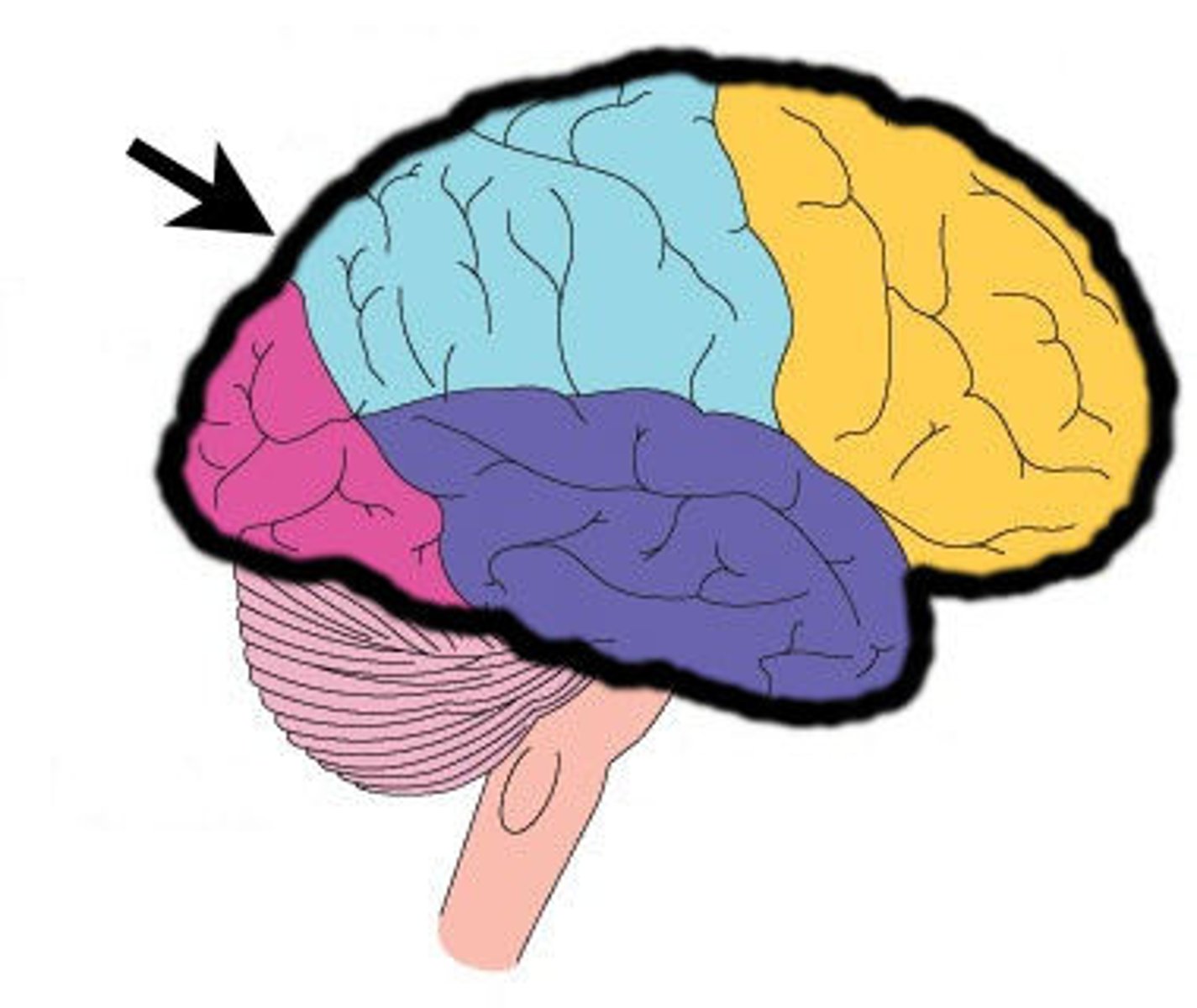
What is the cerebrum?
The largest part of the brain in humans (accounts for about 80% of the total mass of the brain)
 Note
Note  Flashcards (73)